
Judgeschapter 21
25 verses · BSBJudges book hub →
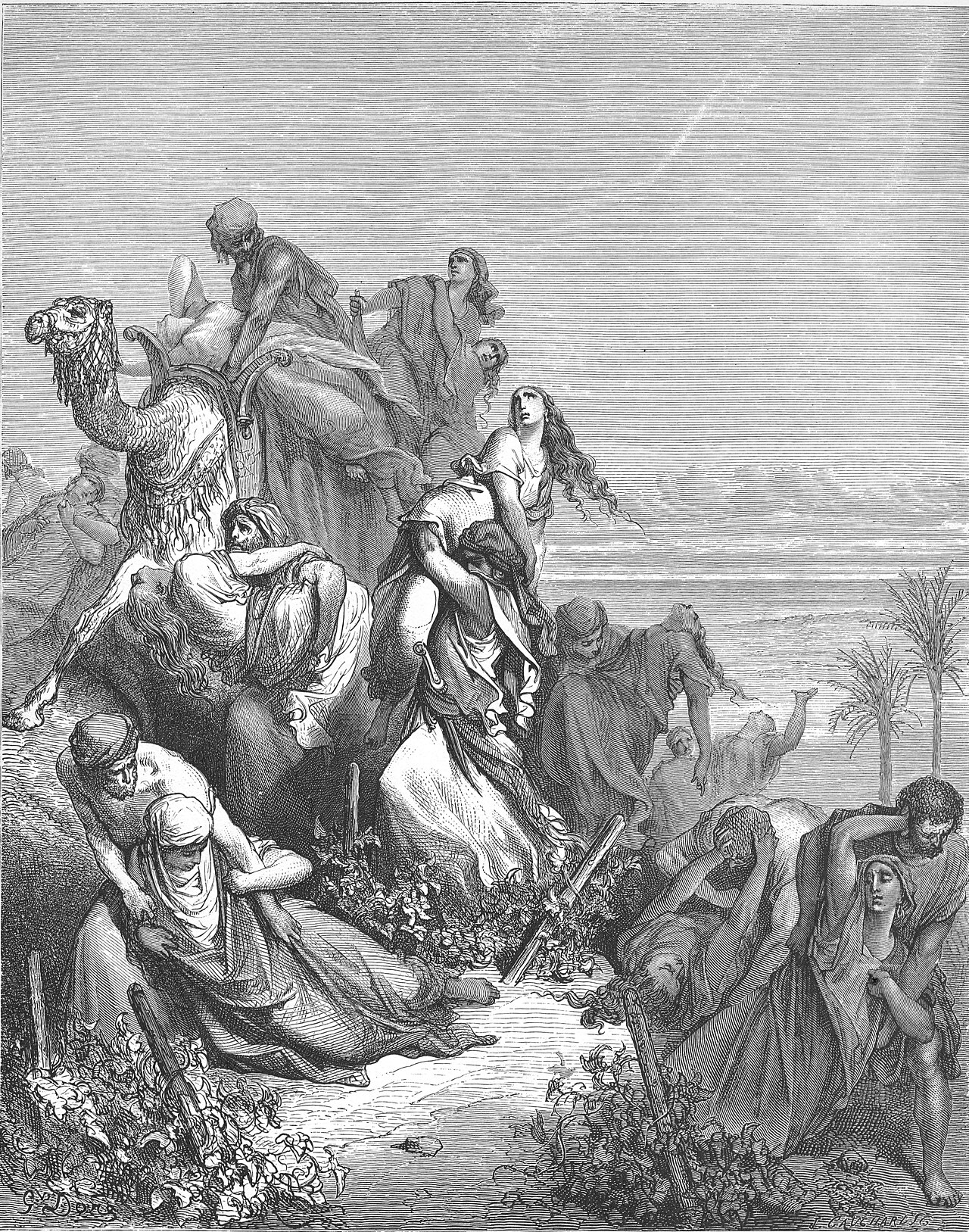
The Benjaminites Take the Virgins of Jabesh-gilead, Gustave Doré, Doré's English Bible (1866), public domain
Key verse
Now the men of Israel had sworn an oath at Mizpah, saying, “Not one of us will give his daughter in marriage to a Benjamite.”
It stands in scene A of the chapter, verses 1 to 7.
The chapter
Chapter summary
Israel weeps at Bethel over its own victory: one tribe is lacking, and they have sworn at Mizpah to give no daughters to Benjamin. Their solutions are as lawless as the crime that started it. Jabesh-gilead, which had not come to the assembly, is put to the sword and four hundred virgins taken for the survivors; when that falls short, the elders coach the Benjamites to lie in wait and catch the daughters of Shiloh as they come out to dance at the yearly feast. Then every man departs to his tribe, and the book closes on its own diagnosis: there was no king in Israel; every man did that which was right in his own eyes.
Context
History · Samuel · Judges overview
Where the chapter sits
Judges 21 falls in Appendix: diagnosis of Israel (chapters 17–21). Micah's household idolatry and the Danite migration; the Levite's concubine and the near-extinction of Benjamin. Not chronological; thematic. ‘Every man did that which was right in his own eyes.’
‘No king in Israel’. The book closes with the refrain that answers its own question.
Before it: The twelve judges, chapters 3–16.
The whole shape of Judges→The world behind this chapter
Judges 21The history
The crisis is entirely of Israel's own making. They swore at Mizpah that no man would give his daughter to a Benjamite, and now six hundred survivors are hiding at the rock of Rimmon with no possibility of a next generation. A tribe without wives is a tribe erased in one lifetime, and they cannot break the oath, because an oath sworn before the LORD was held to be irreversible.
The rest of the history, and what it meant to them
So they find a loophole. They had also sworn that any town which failed to appear at Mizpah would die, and Jabesh-gilead had not come. Wiping out that town and sparing four hundred unmarried women lets them supply brides without technically giving their daughters. Two hundred men are still short. That connection between Jabesh-gilead and Benjamin resurfaces generations later, when the men of Jabesh risk everything to rescue the body of Saul, a Benjamite king.
The remaining solution is the feast at Shiloh. Israel's yearly festivals included dancing by young women in the vineyards outside the sanctuary, a public, joyful, ordinary part of the harvest calendar. The elders arrange for the Benjamite survivors to hide in the vines and seize a wife each as the girls come out. Since the fathers did not give their daughters, the oath is technically intact.
Shiloh is described precisely, north of Bethel, east of the road from Bethel to Shechem, south of Lebonah, the kind of direction-giving that indicates the site mattered and was known. It was the home of the tabernacle through this whole era, and it is where 1 Samuel opens.
What it meant to them
The book ends with its refrain stated in full: in those days there was no king in Israel; every man did what was right in his own eyes. The last chapter is that sentence acted out, men keeping the letter of a rash oath by committing two more atrocities.
For hearers, the closing note was the setup for everything that came next. A people this incapable of governing itself will ask for a king, and the books that follow will ask whether a king is the answer or only a better-dressed version of the same problem.
Sources cited
- Keil and Delitzsch, Biblical Commentary on the Old Testament: Joshua, Judges, Ruth
- Roland de Vaux, Ancient Israel: Its Life and Institutions
A. A rash oath: no daughters for Benjamin
1. (vv. 1-3)
a.The oath is reported here for the first time, though it was sworn back at the muster of 20:1 where all Israel gathered to the Lord in Mizpeh. Israel then asks God why one tribe is lacking, putting the loss as something that came to pass rather than as something the army did in chapter 20. The place they weep in is called the house of God, which is Bethel in the Hebrew, where 20:27 puts the ark and 20:28 puts Phinehas the son of Eleazar standing before it, and that priest's name sets these chapters near the beginning of the period rather than at its end.
Judges 21:1, 1 voiceWhat preachers and commentators have said about this verse, in their own words.
Judges 21:1
“Now the men of Israel had sworn - Of this oath we had not heard before; but it appears they had commenced this war with a determination to destroy the Benjamites utterly, and that if any of them escaped the sword no man should be permitted to give him his daughter to wife. By these means the remnant of the tribe must soon have been annihilated.”
Adam Clarke· Commentary on the Bible (1810-1826)evangelical
Judges 21:2, 1 voice
Judges 21:2
“The people came to the house of God - Literally, the people came בית־אל to Bethel; this is considered as the name of a place by the Chaldee, Syriac, Arabic, and Septuagint. And wept sore - Their revenge was satisfied, and now reflection brings them to contrition for what they had done.”
Adam Clarke· Commentary on the Bible (1810-1826)evangelical
Judges 21:3, 1 voice
Judges 21:3
“The repetition of the name of Israel is very striking in connection with the title of Yahweh as “God of Israel.” It contains a very forcible pleading of the covenant, and memorial of the promises. The very name “Israel” comprehended all the twelve tribes; with one of them blotted out, the remnant would not be Israel.”
2. (vv. 4-5)
a.They build an altar before they offer, which Clarke reads as evidence that the place held no standing altar of its own at that time. Then a second oath surfaces, also unrecorded when it was sworn, laying death on any man who failed to come up to Mizpeh. Two oaths are now on the record inside five verses, and the rest of the chapter is spent working around the first one by means of the second.
Judges 21:4, 1 voice
Judges 21:4
“Built there an altar - This affords some evidence that this was not a regular place of worship, else an altar would have been found in the place; and their act was not according to the law, as may be seen in several places of the Pentateuch. But there was neither king nor law among them, and they did whatever appeared right in their own eyes.”
Adam Clarke· Commentary on the Bible (1810-1826)evangelical
3. (vv. 6-7)
a.They call Benjamin their brother, which is the word Phinehas used at 20:28 while asking whether to go out against him one more time. The grief is over the outcome rather than the sentence, since 20:48 had put the towns of Benjamin to the sword and to the fire and left the six hundred at the rock with nothing to go home to. Verse 7 states the deadlock the remaining eighteen verses answer: they have sworn by the Lord, and their own oath now stands between Benjamin and a next generation.
Judges 21:6, 1 voice
Judges 21:6
“There is one tribe cut off from Israel this day--that is, in danger of becoming extinct; for, as it appears from Jud 21:7, they had massacred all the women and children of Benjamin, and six hundred men alone survived of the whole tribe.”
Jamieson, Fausset & Brown· Commentary Critical and Explanatory on the Whole Bible (1871)reformed
Judges 21:7, 1 voice
Judges 21:7
“How shall we do for wives for them - From this it appears that they had destroyed all the Benjamitish women and children! They had set out with the purpose of exterminating the whole tribe, and therefore they massacred the women, that if any of the men escaped, they might neither find wife nor daughter; and they bound themselves under an oath not to give any of their females to any of the remnant of this tribe, that thus the whole tribe might utterly perish.”
Adam Clarke· Commentary on the Bible (1810-1826)evangelical
B. Jabesh-gilead pays for staying home
1. (vv. 8-9)
a.The way out begins with a roll call rather than with a prayer. The people are numbered, one town is found missing from the assembly, and absence at the muster is the whole charge the text records against it. Jabesh sits east of the Jordan in Gilead, on ground the war against Benjamin never touched.
Judges 21:8, 1 voice
Judges 21:8
“But it appears (Jud 21:11) that, besides acting in fulfilment of their oath, the Israelites had the additional object by this raid of supplying wives to the Benjamite remnant.”
Jamieson, Fausset & Brown· Commentary Critical and Explanatory on the Whole Bible (1871)reformed
2. (vv. 10-12)
a.The order given to the twelve thousand carries the wording of Deuteronomy 13:15, smite the inhabitants of that city with the edge of the sword, which is the law written for an Israelite city that has gone after other gods; the offence named in this chapter is failure to appear at Mizpeh. The sparing of the unmarried women follows the Midian formula of Numbers 31:17-18, kill every woman that hath known man and keep the rest alive, and it is applied here to a town of Israel. Verse 12 brings the four hundred to Shiloh, which is in the land of Canaan, the same phrase Joshua 22:9 uses to mark the west side of the Jordan off against Gilead.
Judges 21:10, 1 voice
Judges 21:10
“And the congregation sent thither twelve thousand men of the valiantest,.... That were in their army; in the Vulgate Latin version it is only 10,000; but the Targum, Septuagint, Syriac, and Arabic versions, and Josephus (c), agree with the Hebrew text.”
Judges 21:12, 1 voice
Judges 21:12
“To Shiloh - Whither, as the usual place of meeting for the national assembly, the Israelites had moved from Bethel (a distance of about 10 miles), during the expedition of the 12,000 to Jabesh-Gilead.”
3. (vv. 13-14)
a.Peace is called to the six hundred at the rock Rimmon, where 20:47 says they had held out four months, and the captive women are handed over. Four hundred does not cover six hundred, and the text says so without softening it, so they sufficed them not. The town raided here returns twice in the story of the first king: Saul the Benjamite rescues Jabesh from Nahash the Ammonite at 1 Samuel 11, and the men of Jabesh take his body down from the wall of Bethshan and bury his bones at 1 Samuel 31:11 to 13.
Judges 21:13, 1 voice
Judges 21:13
“While the poor distressed Benjamites that were hidden in the rock feared their brethren were contriving to ruin them, they were at the same time upon a project to prefer them; and it was this:-- [1.] There was a piece of necessary justice to be done upon the city of Jabesh-Gilead, which belonged to the tribe of Gad, on the other side Jordan.”
Matthew Henry· Commentary on the Whole Bible (1707-1721)puritan
Judges 21:14, 1 voice
Judges 21:14
“Yet so they sufficed them not - There were six hundred men at Rimmon, and all the young women they saved from Jabesh were only four hundred; therefore, there were two hundred still wanting.”
Adam Clarke· Commentary on the Bible (1810-1826)evangelical
4. (v. 15)
a.This is the second time in ten verses that the people repent for Benjamin, and the sentence lays the loss on the Lord, that he had made a breach in the tribes of Israel. The same phrase falls twice more in Scripture, of Uzzah at 2 Samuel 6:8 and of the first attempt to carry the ark at 1 Chronicles 15:13, and in both of those places the breach comes from inside Israel rather than from an enemy.
C. Wives from the dance at Shiloh, and no king in Israel
1. (vv. 16-18)
a.Then the elders of the congregation said: The elders restate the problem and add a reason for solving it, that there must be an inheritance for them that be escaped, since the territory allotted to Benjamin at Joshua 18:11 to 28 would otherwise pass to nobody. Verse 18 gives the oath in its sharpest form, cursed be he that giveth a wife to Benjamin, in the wording of the twelve curses read out from Ebal in Deuteronomy 27. They keep the letter of it and look for another road, and the last seven verses are that road.
Judges 21:17, 1 voice
Judges 21:17
“There must be an inheritance for them that be escaped of Benjamin--As they were the only rightful owners of the territory, provision must be made for transmitting it to their legitimate heirs, and a new act of violence was meditated (Jud 21:19); the opportunity for which was afforded by the approaching festival--a feast generally supposed to be the feast of tabernacles.”
Jamieson, Fausset & Brown· Commentary Critical and Explanatory on the Whole Bible (1871)reformed
Judges 21:18, 1 voice
Judges 21:18
“For the children of Israel have sworn - See Jdg 21:1. Compare Saul’s rash oath 1Sa 14:24, and his breach of the oath made to the Gideonites 2Sa 21:2. For the guilt of a broken oath, see Eze 17:15-20; Exo 20:7.”
2. (vv. 19-21)
a.The feast is fixed by four landmarks, north of Bethel, east of the highway that runs from Bethel to Shechem, and south of Lebonah, which is more direction than a man living in the land would need. Which feast it was is not stated, and Barnes takes it for one of the three pilgrim feasts while Gill argues from the title feast of the Lord that it cannot be a fair or a market. Shiloh kept a yearly gathering that Elkanah is still keeping at 1 Samuel 1:3, and the elders turn the dance of its daughters into an ambush, with Benjamin told to lie in wait in the vineyards.
Judges 21:19, 2 voices
Judges 21:19
“Then they said,.... Some of the elders that sat in council debating this matter, and considering of ways and means to assist their brethren the Benjaminites, and preserve their tribe from being lost: behold, there is a feast of the Lord in Shiloh yearly; where the tabernacle then was, and before which the males of Israel were obliged to appear three times of the year; and this was one of them, as is clear by its being called a feast of the Lord; and therefore cannot design any civil festival or fair kept for trade and commerce.”
Judges 21:19
“The Feast was probably the Passover, or one of the three great Jewish Feasts. In these unsettled times men went up to Shiloh (Seilun) only once a year 1Sa 1:3 instead of thrice; only the males kept the Feasts, and therefore the virgins of Shiloh would naturally be the only maidens present, and the public festival would be a likely occasion for their festive dances. It is, however, possible that some particular feast unique to Shiloh is meant, like the yearly sacrifice of David’s family in Bethlehem 1Sa 20:29.”
Judges 21:21, 1 voice
Judges 21:21
“21, 22. daughters of Shiloh come out to dance in dances--The dance was anciently a part of the religious observance. It was done on festive occasions, as it is still in the East, not in town, but in the open air, in some adjoining field, the women being by themselves.”
Jamieson, Fausset & Brown· Commentary Critical and Explanatory on the Whole Bible (1871)reformed
3. (vv. 22-23)
a.The answer to the fathers is drafted before the raid happens, and its argument turns on a single word of the oath: nobody gave a daughter, so nobody falls under the curse of verse 18. Benjamin takes wives according to their number, goes back to its own inheritance, and rebuilds the cities burned at 20:48. Barnes sets the scene beside the seizing of the Sabine women at a Roman festival as Livy tells it, which is the nearest parallel he finds outside Scripture.
Judges 21:22, 1 voice
Judges 21:22
“In strictness it was not a breach of their vow; they had sworn not to give them their daughters, but they had not sworn to fetch them back if they were forcibly taken, so that if there was any fault the elders must be responsible, not the parents. And Quod fieri non debuit, factum valet -- That which ought not to have been done is yet valid when it is done.”
Matthew Henry· Commentary on the Whole Bible (1707-1721)puritan
Judges 21:23, 1 voice
Judges 21:23
“Compare the very similar account of the rape of the Sabine women by the Romero youths at the festival of the Consualia, as related by Livy.”
4. (vv. 24-25)
a.Every man goes back to his tribe, his family and his inheritance, which is the word the elders used at verse 17 for the thing Benjamin had to be kept alive to hold. Then the closing sentence falls for the fourth time in the book, at 17:6, 18:1, 19:1 and here, and the two that carry the second half stand at the first verse of this closing block and at its last. King in Israel occurs first in all of Scripture at 17:6, in the book that says there was none, and the demand for one is made at 1 Samuel 8:5.
Judges 21:24, 1 voice
Judges 21:24
“Every man to his tribe - Though this must have been four months after the war with Benjamin, Jdg 20:47; yet it appears the armies did not disband till they had got the remnant of Benjamin settled, as is here related.”
Adam Clarke· Commentary on the Bible (1810-1826)evangelical
Judges 21:25, 2 voices
Judges 21:25
After a long time spent in this state of indecision and while I was still busily searching for the cause I have mentioned, there came to my mind the book of Judges, which tells how each man did what was right in his own eyes and gives the reason for this in these words: "In those days there was no king in Israel."
Basil of Caesarea· written before 379· PREFACE ON THE JUDGMENT OF GODpatristic
Judges 21:25
“The repetition of this characteristic phrase (compare Jdg 17:6; Jdg 18:1; Jdg 19:1) is probably intended to impress upon us the idea that these disorders arose from the want of a sufficient authority to suppress them. The preservation of such a story, of which the Israelites must have been ashamed, is a striking evidence of the divine superintendence and direction as regards the Holy Scriptures.”
The text of this chapter
This page carries no textual note on Judges 21. Where this site has examined a place the manuscripts differ, the examination is in the manuscripts room. Every place this site examines →
This page draws on Adam Clarke; Albert Barnes; Basil of Caesarea, PREFACE ON THE JUDGMENT OF GOD; Jamieson, Fausset & Brown; John Gill; Keil and Delitzsch, Biblical Commentary on the Old Testament: Joshua, Judges, Ruth and Matthew Henry.
Keep studying
On this page