
Johnchapter 3
36 verses · John, by tradition · AD 85 to 95 · The Gospels
Just as Moses lifted up the snake in the wilderness, so the Son of Man must be lifted up,
Introduction
John, by tradition, The Gospels, John Overview.
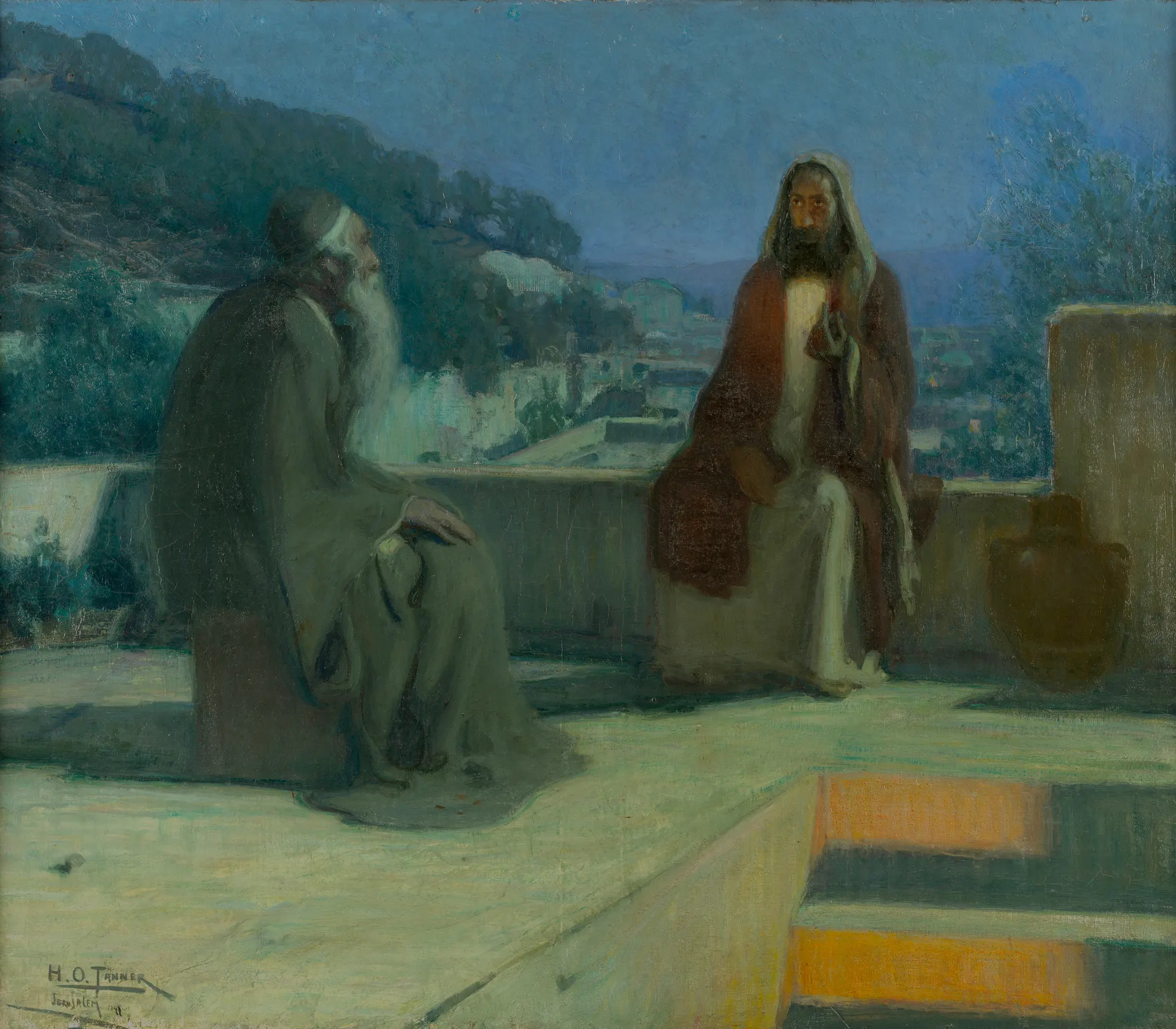
John wrote this chapter for readers who needed to understand how a person enters the kingdom of God. It opens with a respected religious leader and closes with the last testimony of the Baptist, so both a teacher and a prophet stand in it. The conversation turns on pictures drawn from birth, wind and an old wilderness story. Listen for where the dialogue stops and the voice becomes the Gospel writer's own, since the chapter does not mark the join. Read it with the question of what new life means.
Context
- Who
- Readers who wanted to know how a person actually enters the kingdom
- What
- A night conversation between Jesus and Nicodemus on new birth, followed by the Baptist's final witness to Jesus.
- Where
- Jerusalem by night, then the Judean countryside and Aenon near Salim, where John was baptizing.
- When
- The first year of the ministry, about AD 28, soon after the Passover of chapter 2.
- Why
- To teach that entry into the kingdom is a new birth given by God and received by believing in His Son.
Historical context
Nicodemus is introduced with two titles: a Pharisee and a ruler of the Jews, which means a member of the Sanhedrin, the council of seventy-one that governed Jewish religious and civil affairs under Roman oversight. He is also called a teacher of Israel. This is not a curious bystander; he is the establishment.
Show the rest of the historical context, 3 more paragraphs
Coming at night is often read as cowardice, and it may have been. But night was also the preferred time for serious study of the Law, when the day's business was over, and a teacher visiting another teacher after dark was ordinary. John, who cares about light and darkness throughout the book, lets both readings stand.
Being born of water and the Spirit landed on ears trained by ritual immersion. Jews immersed in stepped stone baths for purity, and a Gentile converting to Judaism was immersed as part of entering the people, so being told that a Jewish teacher needed a new birth reversed the whole social order Nicodemus lived in.
The Baptist's picture of himself is a real wedding role. The friend of the bridegroom was the man who arranged the marriage, carried messages between the families, and stood outside the bridal chamber waiting to hear the groom's voice, at which point his job was complete and his joy was full. He then stepped back permanently.
Significance
The bronze serpent Jesus points to was a story every Jewish reader knew: a plague of snakes in the wilderness, a bronze serpent lifted on a pole, and anyone who looked at it lived. It was not a cure; it was a look. That is the frame he puts under the most quoted verse in the Bible.
Show the rest of the significance, 1 more paragraph
Aenon near Salim is described as chosen because there was much water there, a working detail that tells you these were real immersions in real volume. And the Baptist's summary of his own career, that he must decrease, gave readers the measure by which to judge every preacher they would ever follow.
The heads below are this chapter's scenes. The numbered points under each are its verses.
Nicodemus by Night: Ye Must Be Born Anew
John 3:1-2
named Nicodemus, a leader of the Jews: Nicodemus is a Pharisee and a leader of the Jews, which puts him on the ruling council. He comes at night, and the hour carries a man's caution and this Gospel's own use of darkness. His words name Jesus a teacher who has come from God.
John 3:1
“There was a man of the Pharisees,.... The Syriac version adds, "there"; that is, at Jerusalem; and who was among those that believed in the name of Christ, upon seeing the miracles he did at the feast of the passover, in that place.”
He came to Jesus at night: Why he came at night divides readers. Cyril of Alexandria sees a man convinced by the signs yet unwilling to lose his rank among the rulers. Adam Clarke thinks he wanted Jesus alone, away from the daytime crowds.
John 3:2
“Came to Jesus by night - He had matters of the utmost importance, on which he wished to consult Christ; and he chose the night season, perhaps less through the fear of man than through a desire to have Jesus alone, as he found him all the day encompassed with the multitude; so that it was impossible for him to get an opportunity to speak fully on those weighty affairs concerning which he intended to consult him.”
Adam Clarke · Commentary on the Bible (1810-1826)evangelical
2 more voices on this verse
John 3:2
“The grace which is at first but a grain of mustard-seed may grow to be a great tree. He did not come to talk with Christ about politics and state-affairs (though he was a ruler), but about the concerns of his own soul and its salvation, and, without circumlocution, comes immediately to the business; he calls Christ Rabbi, which signifies a great man; see Isa. xix.”
Matthew Henry · Commentary on the Whole Bible (1707-1721)puritan
John 3:2
“More ready is Nicodemus to believe, but overcome by no good fear, and not despising the opinion of men, he refuses boldness, and is divided in opinion into two, and halts in purpose, feeble upon both his knee joints, as it is written, forced by the convictions of his conscience to the duty of believing by reason of the exceedingness of the miracles, but esteeming the loss of rulership over his own nation a thing not to be borne, for he was a ruler of the Jews.”
Cyril of Alexandria · written before 444 · Commentary on the Gospel of John, Book 2patristic
Born again renders anothen, a Greek word carrying two senses at once, a second time and from above. Both hold here: the birth is new, and it comes down from God; without that birth no one sees the kingdom of God. Jesus allows no exception for a ruler's learning.
John 3:3
“Jesus answered - That knowledge will not avail thee unless thou be born again - Otherwise thou canst not see, that is, experience and enjoy, either the inward or the glorious kingdom of God.”
John Wesley · Explanatory Notes upon the New Testament (1755)evangelical
4 more voices on this verse
John 3:3
“Nicodemus was impressed by the miracles wrought and Jesus pointed out the necessity of a miracle being wrought with every man who would see the kingdom. When the man is born of God, is brought from darkness to light, a mighty miracle is wrought.”
Smith Wigglesworth · Ever Increasing Faith, Chapter 2: "Deliverance to the Captives" (1924)British Pentecostal
John 3:3
“Once the likeness painted on a panel has been effaced by stains from outside itself, the one whose likeness it is needs to come once more to enable the portrait to be renewed on the same wood. And, for the sake of his picture, even the mere wood on which it is painted is not thrown away, but the outline is renewed upon it. In the same way, the most holy Son of the Father, being the image of the Father, came to our world to renew humankind once made in his likeness.”
Athanasius of Alexandria · written before 373 · On the Incarnation of the Word 14.1-2patristic
John 3:3
“Verily, verily - An expression of strong affirmation, denoting the certainty and the importance of what he was about to say. Jesus proceeds to state one of the fundamental and indispensable doctrines of his religion. It may seem remarkable that he should introduce this subject in this manner; but it should be remembered that Nicodemus acknowledged that he was a teacher come from God; that he implied by that his readiness and desire to receive instruction; and that it is not wonderful, therefore, that Jesus should commence with one of the fundamental truths of his religion.”
John 3:3
“This answer was wither, [1.] A rebuke of what he saw defective in the address of Nicodemus. It was not enough for him to admire Christ's miracles, and acknowledge his mission, but he must be born again. It is plain that he expected the kingdom of heaven, the kingdom of the Messiah now shortly to appear.”
Matthew Henry · Commentary on the Whole Bible (1707-1721)puritan
Nicodemus takes the word in its first sense alone and asks about a second physical birth. A teacher of Israel had categories for washing, for circumcision and for the proselyte, and none for a man born over again. The figure was new to him.
John 3:4
“Nicodemus saith unto him,.... Understanding him of a natural birth, to be repeated: how can a man be born when he is old? as it seems by this, he himself now was: can he enter the second time into his mothers womb, and be born? the Ethiopic version adds, "again"; and the Arabic version, "and then be born"; this he urges, as absurd, impracticable, and impossible; and which shows him to have been as yet a natural man, who could not receive nor discern spiritual things.”
3 more voices on this verse
John 3:4
“How can a man be born when he is old? - It is probable that Nicodemus was pretty far advanced in age at this time; and from his answer we may plainly perceive that, like the rest of the Jews, and like multitudes of Christians, he rested in the letter, without paying proper attention to the spirit: the shadow, without the thing signified, had hitherto satisfied him. Our Lord knew him to be in this state, and this was the cause of his pointed address to him.”
Adam Clarke · Commentary on the Bible (1810-1826)evangelical
John 3:4
“Faith consisteth not, O Nicodemus, in what thou thinkest. Speech sufficeth not unto thee for righteousness, neither wilt thou achieve piety by mere words. For not every one that saith unto Me, Lord, Lord, shall enter into the kingdom of Heaven, but he that doeth the will of My Father Which is in Heaven. But the will of the Father is, that man be made partaker of the Holy Ghost, that the citizen of earth reborn unto an unaccustomed and new life, be called a citizen of Heaven.”
Cyril of Alexandria · written before 444 · Commentary on the Gospel of John, Book 2patristic
John 3:4
“How, &c.--The figure of the new birth, if it had been meant only of Gentile proselytes to the Jewish religion, would have been intelligible enough to Nicodemus, being quite in keeping with the language of that day; but that Jews themselves should need a new birth was to him incomprehensible.”
Jamieson, Fausset & Brown · Commentary Critical and Explanatory on the Whole Bible (1871)reformed
born of water and the Spirit: has drawn three readings: Christian baptism, natural birth, and the washing promised at Ezekiel 36:25 to 27. Ezekiel promised clean water and a new spirit within, and the rebuke at verse 10 falls on a teacher who should have known it.
John 3:5
“Jesus answered, verily, verily, I say unto thee,.... Explaining somewhat more clearly, what he before said: except a man be born of water and of the Spirit: these are, מלות שנות, "two words", which express the same thing, as Kimchi observes in many places in his commentaries, and signify the grace of the Spirit of God.”
4 more voices on this verse
John 3:5
“Be born of water - By “water,” here, is evidently signified “baptism.” Thus the word is used in Eph 5:26; Tit 3:5. Baptism was practiced by the Jews in receiving a Gentile as a proselyte. It was practiced by John among the Jews; and Jesus here says that it is an ordinance of his religion, and the sign and seal of the renewing influences of his Spirit.”
John 3:5
“Who is the one who is born of the Spirit and is made spirit but he who is renewed in the spirit of his mind? This certainly is he who is regenerated by water and the Holy Spirit, since we receive the hope of eternal life through the laver of regeneration and renewing of the Holy Spirit. And elsewhere the apostle Peter says, "You shall be baptized with the Holy Spirit." For who is the one who is baptized with the Holy Spirit but the one who is born again through water and the Holy Spirit?”
Ambrose of Milan · written before 397 · On the Holy Spirit 3.10.64patristic
John 3:5
“Already had the symbol of water been embodied in an initiatory ordinance, in the baptism of the Jewish expectants of Messiah by the Baptist, not to speak of the baptism of Gentile proselytes before that; and in the Christian Church it was soon to become the great visible door of entrance into "the kingdom of God," the reality being the sole work of the Holy Ghost (Tit 3:5).”
Jamieson, Fausset & Brown · Commentary Critical and Explanatory on the Whole Bible (1871)reformed
John 3:5
“Except a man be born of water and of the Spirit - Except he experience that great inward change by the Spirit, and be baptized (wherever baptism can be had) as the outward sign and means of it.”
John Wesley · Explanatory Notes upon the New Testament (1755)evangelical
Flesh is born of flesh: states a law of kind: a birth produces what it is. Devout parents, a priestly line and a Pharisee's training all produce flesh, and the Spirit alone gives the second birth. Nicodemus had every pedigree Israel could hand a man.
John 3:6
“That which is born of the flesh is flesh - Mere flesh, void of the Spirit, yea, at enmity with it; And that which is born of the Spirit is spirit - Is spiritual, heavenly, divine, like its Author.”
John Wesley · Explanatory Notes upon the New Testament (1755)evangelical
3 more voices on this verse
John 3:6
“By another argument again He persuades him to mount up to a higher understanding, and on hearing of spiritual birth, not to think of the properties of bodies. For as it is altogether necessary, saith He, that the offspring of flesh should be flesh, so also is it that those of the Spirit should be spirit. For in things the mode of whose being is different, in these must surely the mode of generation also be not the same.”
Cyril of Alexandria · written before 444 · Commentary on the Gospel of John, Book 2patristic
John 3:6
“That which is born of the flesh is flesh - This is the answer to the objection made by Nicodemus in Joh 3:4. Can a man enter the second time into his mother’s womb and be born? Our Lord here intimates that, were even this possible, it would not answer the end; for the plant will ever be of the nature of the seed that produces it - like will beget its like.”
Adam Clarke · Commentary on the Bible (1810-1826)evangelical
John 3:6
“That which is born, &c.--A great universal proposition; "That which is begotten carries within itself the nature of that which begat it" [OLSHAUSEN]. flesh--Not the mere material body, but all that comes into the world by birth, the entire man; yet not humanity simply, but in its corrupted, depraved condition, in complete subjection to the law of the fall (Ro 8:1-9).”
Jamieson, Fausset & Brown · Commentary Critical and Explanatory on the Whole Bible (1871)reformed
You must be born again is plural in the Greek, so the command reaches past Nicodemus to every hearer. Jesus speaks to the astonishment on the man's face and repeats the requirement without softening it. The birth is required of every man alive.
John 3:7
“For in Thy spiritual things I am dull, as Thy Only-begotten says, "Marvel not that I said unto thee, ye must be born anew. The Spirit breathes where it will, and thou hearest the voice of it; but dost not know whence it comes or whither it goes. So is every one who is born of water and of the Holy Spirit." Though I hold a belief in my regeneration, I hold it in ignorance; I possess the reality, though I comprehend it not.”
Hilary of Poitiers · written before 367 · On the Trinity 12.56patristic
4 more voices on this verse
John 3:7
“Marvel not that I said unto thee,...., For Nicodemus was quite astonished, at this doctrine of the new birth; it was altogether new to him, and unheard of by him; nor could he understand, nor conceive in what manner it could be: ye must be born again; in "four" of Beza's copies, it is read "we"; but as Christ was not begotten in a carnal way, or descended not from Adam in the ordinary way of generation, he was not carnal and corrupt, nor in the least tainted with sin; and so stood in no need of regeneration; wherefore such…”
John 3:7
Ye must--"Ye, says Jesus, not we" [BENGEL]. After those universal propositions, about what "a man" must be, to "enter the kingdom of God" (Joh 3:5) --this is remarkable, showing that our Lord meant to hold Himself forth as "separate from sinners."
Jamieson, Fausset & Brown · Commentary Critical and Explanatory on the Whole Bible (1871)reformed
John 3:7
“He who is the great Lawgiver, whose will is a law,--he who is the great Mediator of the new covenant, and has full power to settle the terms of our reconciliation to God and happiness in him,--he who is the great Physician of souls, knows their case, and what is necessary to their cure,--he hath said, You must be born again.”
Matthew Henry · Commentary on the Whole Bible (1707-1721)puritan
John 3:7
“Ye must be born again - To be born again, is to be inwardly changed from all sinfulness to all holiness. It is fitly so called, because as great a change then passes on the soul as passes on the body when it is born into the world.”
John Wesley · Explanatory Notes upon the New Testament (1755)evangelical
The wind blows where it wishes: The one Greek word pneuma carries both wind and Spirit, and Jesus works the picture on both. A man standing in the wind hears it and feels it, and its coming and going stay hidden from him. Everyone born of the Spirit is known the same way.
John 3:8
“The wind bloweth - According to its own nature, not thy will, and thou hearest the sound thereof - Thou art sure it doth blow, but canst not explain the particular manner of its acting. So is every one that is born of the Spirit - The fact is plain, the manner of his operations inexplicable.”
John Wesley · Explanatory Notes upon the New Testament (1755)evangelical
2 more voices on this verse
John 3:8
"Where it chooses," says the Scripture, not "where it is ordered." If, then, the Spirit does breathe where it chooses, cannot the Son do what he wills? Why, it is the very same Son of God who in his gospel says that the Spirit has power to breathe where it chooses. Does the Son, therefore, confess the Spirit to be greater, in that it has power to do what is not permitted to himself?
Ambrose of Milan · written before 397 · Exposition of the Christian Faith 2.6.47patristic
John 3:8
“That he works powerfully, and with evident effects: Thou hearest the sound thereof; though its causes are hidden, its effects are manifest. When the soul is brought to mourn for sin, to groan under the burden of corruption, to breathe after Christ, to cry Abba--Father, then we hear the sound of the Spirit, we find he is at work, as Acts ix.”
Matthew Henry · Commentary on the Whole Bible (1707-1721)puritan
John 3:9-10
Nicodemus has not moved past his question of verse 4, and Jesus turns from patience to a rebuke: Israel's teacher does not understand these things. The prophets had promised a new heart and a law written inside a man, at Jeremiah 31:33. His office was to teach that promise.
John 3:9
“How can these things be? - Nicodemus was still unwilling to admit the doctrine unless he understood it; and we have here an instance of a man of rank stumbling at one of the plainest doctrines of religion, and unwilling to admit a truth because he could not understand “how” it could be, when he daily admitted the truth of facts in other things which he could as little comprehend. And we may learn: 1. That people will often admit facts on other subjects, and be greatly perplexed by similar facts in religion.”
2 more voices on this verse
John 3:9
“Long discourse nothing profits him who understandeth not a whit. Wise then is the saying in the book of Proverbs, Well is he that speaketh in the ears of them that will hear. And this the Saviour showed by trial to be true, giving Himself an ensample to us in this too. For the teacher will be wholly free from the charge of not being able to persuade, saying what himself thinks good, though he profit nothing by reason of the dulness of the hearers. Besides we learn by this, that hardness in part is happened to Israel.”
Cyril of Alexandria · written before 444 · Commentary on the Gospel of John, Book 2patristic
John 3:9
“We have in these verses the second part of the conversation between our Lord Jesus Christ and Nicodemus. A lesson about regeneration is closely followed by a lesson about justification! The whole passage ought always to be read with affectionate reverence. It contains words which have brought eternal life to myriads of souls. These verses show us, firstly, what gross spiritual ignorance there may be in the mind of a great and learned man. We see a "master of Israel" unacquainted with the first elements of saving religion.”
John Gill places Nicodemus among the wise men or doctors of Israel, a title the Jewish writings often use. Adam Clarke presses the charge: such a man had proselytes baptized as a sign of new birth and still knew nothing of the thing itself.
John 3:10
“Jesus answered and said unto him,.... Upbraiding him with his continued and invincible ignorance, which was aggravated by his dignified character: art thou a master in Israel? or "of Israel", as all the Oriental versions render it, as it literally may be rendered he was one of the חכמי ישראל, "wise men", or "doctors of Israel" (r), so often mentioned by the Jews.”
2 more voices on this verse
John 3:10
“Art thou a master of Israel, etc. - Hast thou taken upon thee to guide the blind into the way of truth; and yet knowest not that truth thyself? Dost thou command proselytes to be baptized with water, as an emblem of a new birth; and art thou unacquainted with the cause, necessity, nature, and effects of that new birth? How many masters are there still in Israel who are in this respect deplorably ignorant; and, strange to tell, publish their ignorance and folly in the sight of the sun, by writing and speaking against the thing itself!”
Adam Clarke · Commentary on the Bible (1810-1826)evangelical
John 3:10
“Nor is it merely as something that should be experienced under the Gospel that the Old Testament holds it forth--as many distinguished critics allege, denying that there was any such thing as regeneration before Christ.”
Jamieson, Fausset & Brown · Commentary Critical and Explanatory on the Whole Bible (1871)reformed
John 3:11-12
we speak of what we know: takes in more than Jesus: the Father, Son and Spirit, or Jesus with the witnesses this Gospel has named. The words are a court's words. Verse 12 argues from the smaller to the greater: earthly things refused make heavenly things unreachable.
John 3:11
“We speak - Jesus here speaks in the plural number, including himself and those engaged with him in preaching the gospel. Nicodemus had said Joh 3:2, “we know that thou art,” etc., including himself and those with whom he acted. Jesus in reply said, we, who are engaged in spreading the new doctrines about which you have come to inquire, speak what we know. We do not deliver doctrines which we do not practically understand.”
3 more voices on this verse
John 3:11
“Observe, First, That the truths of Christ are of undoubted certainty. We have all the reason in the world to be assured that the sayings of Christ are faithful sayings, and such as we may venture our souls upon; for he is not only a credible witness, who would not go about to deceive us, but a competent witness, who could not himself be deceived: We testify that we have seen.”
Matthew Henry · Commentary on the Whole Bible (1707-1721)puritan
John 3:11
“And ye receive not our witness. As having in Himself the Father and the Spirit Naturally, the Saviour set forth the person of the Witnesses in the plural number, that, as in the law of Moses, by the mouth of two or three witnesses, what is said may be established. For He shows that the Jews in no wise will to be saved, but with unbridled and heedless impetus are they being borne unto the deep pit of perdition.”
Cyril of Alexandria · written before 444 · Commentary on the Gospel of John, Book 2patristic
John 3:11
“The "we" and "our" are here used, though Himself only is intended, in emphatic contrast, probably, with the opening words of Nicodemus, "Rabbi, we know," &c. ye receive not, &c.--referring to the class to which Nicodemus belonged, but from which he was beginning to be separated in spirit.”
Jamieson, Fausset & Brown · Commentary Critical and Explanatory on the Whole Bible (1871)reformed
I have told you about earthly things: Cyril of Alexandria takes the earthly things as the teaching just given, a doctrine within the reach of human understanding. Matthew Henry sees condescension in it, the gospel suited to human capacities as a father speaks to children. Cyril adds that no second witness could come down from heaven.
John 3:12
“A doctrine, saith He, not exceeding the understanding befitting man, ye from your extreme folly received not, and how shall I explain to you things more Divine? For they who in their own matters are most foolish, how shall they be wise in matters above them? And they who are powerless as to the less, how shall they not find the greater intolerable? And if, says He, ye believe not Me being Alone in speaking, but seek many witnesses for every thing, whom shall I bring to you as a witness of the heavenly Mysteries?”
Cyril of Alexandria · written before 444 · Commentary on the Gospel of John, Book 2patristic
1 more voice on this verse
John 3:12
“The things of the gospel are heavenly things, out of the road of the enquiries of human reason, and much more out of the reach of its discoveries. Secondly, To acknowledge with thankfulness the condescension of Christ, that he is pleased to suit the manner of the gospel revelation to our capacities, to speak to us as to children.”
Matthew Henry · Commentary on the Whole Bible (1707-1721)puritan
No one has ascended into heaven: No one has gone up to heaven and come back with a report. The One who descended from heaven is the only witness to heavenly things, and He is speaking. His qualification is where He came from.
John 3:13
Possessing both natures, that is, the human and the divine, [Christ] endured the passion in his humanity, in order that without distinction he who suffered should be called both Lord of glory and Son of man, even as it is written: "Who descended from heaven."
Ambrose of Milan · written before 397 · Exposition of the Christian Faith 2.7.58patristic
3 more voices on this verse
John 3:13
“And no man hath ascended into heavens - No man, therefore, is qualified to speak of heavenly things, Joh 3:12. To speak of those things requires intimate acquaintance with them - demands that we have seen them; and as no one has ascended into heaven and returned, so no one is qualified to speak of them but He who came down from heaven.”
John 3:13
“First, None but Christ was able to reveal to us the will of God for our salvation. Nicodemus addressed Christ as a prophet; but he must know that he is greater than all the Old-Testament prophets, for none of them had ascended into heaven.”
Matthew Henry · Commentary on the Whole Bible (1707-1721)puritan
John 3:13
“For no one - For here you must rely on my single testimony, whereas there you have a cloud of witnesses: Hath gone up to heaven, but he that came down from heaven. Who is in heaven - Therefore he is omnipresent; else he could not be in heaven and on earth at once.”
John Wesley · Explanatory Notes upon the New Testament (1755)evangelical
The Son Lifted Up: God So Loved the World
John 3:14-15
Moses lifted up the snake in the wilderness: Numbers 21:8 and 9 gives the picture: a bronze snake on a pole, and a bitten man looked and lived. Lifted up in this Gospel always means the cross. The snake carried the likeness of the thing killing the people, as Christ was made sin at 2 Corinthians 5:21.
John 3:14
“As Moses lifted up - He shows the reason why he descended from heaven, that he might be lifted up, i.e. crucified, for the salvation of man. kind, and be, by the appointment of God, as certain a remedy for sinful souls as the brazen serpent elevated on a pole, Num 21:9, was for the bodies of the Israelites, which had been bitten by the fiery serpents in the wilderness. It does not appear to me that the brazen serpent was ever intended to be considered as a type of Christ.”
Adam Clarke · Commentary on the Bible (1810-1826)evangelical
3 more voices on this verse
John 3:14
“It was good that the Lord ordained that, by the lifting up of the brazen serpent, the wounds of those who were bitten should be healed; for the brazen serpent is a type of the cross.… In the same way, the world was crucified in its allurements. Therefore not a real but a brazen serpent was hung. This is so because the Lord took on himself the likeness of a sinner in his body but, in actuality, was without sin.”
Ambrose of Milan · written before 397 · On the Holy Spirit 3.8.50patristic
John 3:14
“It was the last miracle that passed through the hand of Moses before his death. Now in this type of Christ we may observe, First, The deadly and destructive nature of sin, which is implied here. The guilt of sin is like the pain of the biting of a fiery serpent; the power of corruption is like the venom diffused thereby.”
Matthew Henry · Commentary on the Whole Bible (1707-1721)puritan
John 3:14
“Yet was the warrant in both cases to expect a cure equally rational and well grounded. As the serpent was God's ordinance for the cure of every bitten Israelite, so is Christ for the salvation of every perishing sinner--the one however a purely arbitrary ordinance, the other divinely adapted to man's complicated maladies.”
Jamieson, Fausset & Brown · Commentary Critical and Explanatory on the Whole Bible (1871)reformed
ConnectionsNumbers 21:9
everyone who believes in Him: Everyone who believes shows what Albert Barnes calls the freeness of the gospel, open to every man who knows he is a sinner. John Wesley sets the bitten man who looked at the snake in the wilderness beside the man who looks to the Son of Man.
John 3:15
“That whosoever - This shows the fulness and freeness of the gospel. All may come and be saved. Believeth in him - Whosoever puts confidence in him as able and willing to save. All who feel that they are sinners, that they have no righteousness of their own, and are willing to look to him as their only Saviour.”
1 more voice on this verse
John 3:15
“That whosoever - He must be lifted up, that hereby he may purchase salvation for all believers: all those who look to him by faith recover spiritual health, even as all that looked at that serpent recovered bodily health.”
John Wesley · Explanatory Notes upon the New Testament (1755)evangelical
For God so loved the world: So loved names the manner of the love and the length God went to in it. The world here is mankind under judgment, and the gift went to all of it. One and only renders monogenes, the Son of His kind alone.
John 3:16
“For God so loved the world,.... The Persic version reads "men": but not every man in the world is here meant, or all the individuals of human nature; for all are not the objects of God's special love, which is here designed, as appears from the instance and evidence of it, the gift of his Son: nor is Christ God's gift to every one; for to whomsoever he gives his Son, he gives all things freely with him; which is not the case of every man.”
4 more voices on this verse
John 3:16
“For God so loved the world - Such a love as that which induced God to give his only begotten son to die for the world could not be described: Jesus Christ does not attempt it. He has put an eternity of meaning in the particle οὑτω, so, and left a subject for everlasting contemplation, wonder, and praise, to angels and to men. The same evangelist uses a similar mode of expression, 1Jn 3:1: Behold, What Manner of love, ποταπην αγαπην, the Father hath bestowed upon us. From the subject before him, let the reader attend to the following particulars.”
Adam Clarke · Commentary on the Bible (1810-1826)evangelical
John 3:16
“There is something I want you to do for me: I have some enemies that deserve to perish, and I want you to go and die in their place, so that they can have eternal life.”
John Piper · God So Loved the World, Part 1 (sermon) (2009)Reformed Baptist
John 3:16
“He desireth to show openly herein, that He is God by Nature, since one must needs deem that He Who came forth from God the Father, is surely God also, not having the honour from without, as we have, but being in truth what He is believed to be. With exceeding skill does He say this, having joined therewith the love of God the Father to us, well and opportunely coming to discourse thereon. For He shames the unbelieving Nicodemus, yea rather, He shows that he is ungodly also.”
Cyril of Alexandria · written before 444 · Commentary on the Gospel of John, Book 2patristic
John 3:16
“Whosoever believeth on him - With that faith which worketh by love, and hold fast the beginning of his confidence steadfast to the end. God so loved the world - That is, all men under heaven; even those that despise his love, and will for that cause finally perish. Otherwise not to believe would be no sin to them.”
John Wesley · Explanatory Notes upon the New Testament (1755)evangelical
ConnectionsGenesis 22:2
John 3:17-18
God did not send His Son into the world: The Son was sent so that the world might be saved through Him. Whoever believes in Him stands uncondemned, and whoever refuses Him has been condemned already, so the judgment is a present thing in force now. The verdict turns on the Son's name.
John 3:17
“To condemn the world - Not to judge, or pronounce sentence on mankind. God might justly have sent him for this. Man deserved condemnation, and it would have been right to have pronounced it; but God was willing that there should be an offer of pardon, and the sentence of condemnation was delayed. But, although Jesus did not come then to condemn mankind, yet the time is coming when he will return to judge the living and the dead, Act 17:31; 2Co 5:10; Mat. 25:31-46.”
1 more voice on this verse
John 3:17
“An act of indemnity is passed and published, through Christ a remedial law made, and the world of mankind dealt with, not according to the rigours of the first covenant, but according to the riches of the second; that the world through him might be saved, for it could never be saved but through him; there is not salvation in any other.”
Matthew Henry · Commentary on the Whole Bible (1707-1721)puritan
has already been condemned: John Wesley reads is not condemned as acquitted and justified before God, and the Son's name as the Son Himself. Matthew Henry pictures a man convicted on his own confession, whose sentence is stayed the moment he believes. Irenaeus calls unbelief a chosen separation from God.
John 3:18
“He that believeth on him is not condemned - Is acquitted, is justified before God. The name of the only-begotten Son of God - The name of a person is often put for the person himself.”
John Wesley · Explanatory Notes upon the New Testament (1755)evangelical
3 more voices on this verse
John 3:18
“And to as many as continue in their love towards God, does He grant communion with Him. But communion with God is life and light, and the enjoyment of all the benefits which He has in store. But on as many as, according to their own choice, depart from God. He inflicts that separation from Himself which they have chosen of their own accord. But separation from God is death, and separation from light is darkness; and separation from God consists in the loss of all the benefits which He has in store.”
Irenaeus · written before 202 · Against Heresies Book V, Chapter XXVIIpatristic
John 3:18
“He that believeth - As stated before on Joh 3:16. Is not condemned - For past sin, that being forgiven on his believing in Christ. But he that believeth not - When the Gospel is preached to him, and the way of salvation made plain.”
Adam Clarke · Commentary on the Bible (1810-1826)evangelical
John 3:18
“Though he has been a sinner, a great sinner, and stands convicted ( habes confilentem reum--by his own confession ), yet, upon his believing, process is stayed, judgment is arrested, and he is not condemned.”
Matthew Henry · Commentary on the Whole Bible (1707-1721)puritan
John 3:19-21
The Light has come into the world: The verdict is the Light, and men loved the darkness over it while their deeds were evil. A man doing evil hates the Light and keeps clear of it for fear of being seen. A man doing the truth walks into it.
John 3:19
“He lets not the condemnation of the unbelievers remain without consideration, but recounts its causes, and shows clearly that, according to the words of the Proverbs, Not unjustly is the net spread for the birds.”
Cyril of Alexandria · written before 444 · Commentary on the Gospel of John, Book 2patristic
for fear that his deeds will be exposed: John Gill reads exposed as more than seen: the Light convicts a man's deeds, rebukes them and calls him to part with them. Coming into the Light, for Gill, means coming to hear Christ preached. Adam Clarke gives vile as the sense of the Greek word.
John 3:20
“For every one that doth evil, hateth the light,.... Every man, the series of whose life and conversation is evil, hates Christ and his Gospel, cause they make manifest his evil deeds, convict him of them, and rebuke him for them: neither cometh to the light; to hear Christ preach, or preached; to attend on the Gospel ministration and means of grace: lest his deeds should be reproved; or discovered, and made manifest, and he be brought to shame, and laid under blame, and advised to part with them, which he cares not to do; see Eph 5:11.”
1 more voice on this verse
John 3:20
“For every one that doeth evil hateth the light - He who doth vile or abominable things: alluding to the subject mentioned in the preceding verse. The word φαυλος, evil or vile, is supposed by some to come from the Hebrew פלס phalas, to roll, and so cover oneself in dust or ashes, which was practised in token of humiliation and grief, not only by the more eastern nations, see Job 42:6, but also by the Greeks and Trojans, as appears from Homer, Iliad xviii. l. 26; xxii. l. 414; xxiv. l. 640; compare Virgil, Aen. x. l.”
Adam Clarke · Commentary on the Bible (1810-1826)evangelical
whoever practices the truth comes into the Light: John Wesley finds Nicodemus in the verse: the man who came by night later came into the light. Cyril of Alexandria says the doer of truth welcomes the Spirit's light to examine whether he has kept God's law. Wesley reads in God as in His light, power and love.
John 3:21
“But he that doeth truth (that is, the lover and doer of the works of the Truth) cometh to the light, that his deeds may be made manifest that they are wrought in God. For he doth not reject the illumination in the Spirit, by It specially led to be able to understand in all calm collectedness, whether he hath transgressed the Divine commandment, and whether he hath wrought all things according to the Law of God.”
Cyril of Alexandria · written before 444 · Commentary on the Gospel of John, Book 2patristic
2 more voices on this verse
John 3:21
“Are that doeth truth - He who does right, or he that obeys the truth. Truth here is opposed to error and to evil. The sinner acts from falsehood and error. The good man acts according to truth. The sinner believes a lie - that God will not punish, or that there is no God, or that there is no eternity and no hell. The Christian believes all these, and acts as if they were true. This is the difference between a Christian and a sinner. Cometh to the light - Loves the truth, and seeks it more and more.”
John 3:21
“He that practiceth the truth (that is, true religion) cometh to the light - So even Nicodemus, afterward did. Are wrought in God - That is, in the light, power, and love of God.”
John Wesley · Explanatory Notes upon the New Testament (1755)evangelical
He Must Increase, but I Must Decrease
John 3:22-24
into the Judean countryside: Jesus and His disciples move out of Jerusalem into the Judean countryside and baptize there. At 4:2 John adds that Jesus Himself baptized no one and that His disciples did it. Both ministries ran at once, before John was thrown into prison.
John 3:22
“Jesus went - From the capital city, Jerusalem, into the land of Judea - That is, into the country. There he baptized - Not himself; but his disciples by his order, chap. iv, 2.”
John Wesley · Explanatory Notes upon the New Testament (1755)evangelical
3 more voices on this verse
John 3:22
“Came - into the land of Judea - Jerusalem itself, where Christ held the preceding discourse with Nicodemus, was in Judea; but the evangelist means that our Lord quitted the city and its suburbs, and went into the country parts. The same distinction between Jerusalem and Judea is made, Act 1:8; Act 10:39; and in 1 Maccabees 3:34; and in 2 Maccabees 1:1, 10. See Bp. Pearce.”
Adam Clarke · Commentary on the Bible (1810-1826)evangelical
John 3:22
“After the conversation with Nicodemus had now reached its conclusion, the Divine Evangelist again prepares something else most profitable. For enlightened by the Divine Spirit to the exposition of things most needful, he knew that it would exceedingly profit his readers to know clearly, how great the excellence, and by how great measures, the baptism of Christ surpasses that of John.”
Cyril of Alexandria · written before 444 · Commentary on the Gospel of John, Book 2patristic
John 3:22
“Let it not be said that all Christ's followers are unlearned and ignorant men. The principles of the Pharisees, and the peculiarities of their sect, were directly contrary to the spirit of Christianity; yet there were some in whom even those high thoughts were cast down and brought into obedience to Christ. The grace of Christ is able to subdue the greatest opposition.”
Matthew Henry · Commentary on the Whole Bible (1707-1721)puritan
baptizing at Aenon near Salim: Aenon means a fountain, fit where the water was plentiful. Barnes reports that Eusebius placed Aenon, where John was baptizing, eight Roman miles south of Scythopolis, and he calls both sites uncertain. Jerome says Salem or Salim matters little, for the Jews rarely wrote vowels inside words.
John 3:23
“And John also was baptizing in Aenon,.... The Syriac and Persic versions call it "Ain", or "In you", the fountain of the dove; and the Arabic version reads it, the fountain of "Nun": and whether it was a town, or river, it seems to have its name from a fountain near it, or that itself was one, where was an abundance of water, as the text shows.”
1 more voice on this verse
John 3:23
“In Enon - The word “Enon,” or “Aenon,” means “a fountain,” and was doubtless given to this place because of the fountains there. On the situation of the place nothing certain has been determined. Eusebius places it eight Roman miles south of Scythopolis or Bethshan, and 53 miles northeast of Jerusalem. Near to Salim - It would seem from this that Salim was better known then than Enon, but nothing can be determined now respecting its site. These places are believed to have been on the west side of the Jordan.”
John had not yet been thrown into prison.): Before John was thrown into prison, Jesus and John were baptizing at the same time. Eusebius records the account that John wrote the deeds done before the Baptist's imprisonment, which the other three Gospels left out.
John 3:24
“For John was not yet cast into prison. As he afterwards was by Herod, for the sake of Herodias, because he reproved Herod for taking her to be his wife, when she was wife to his brother Philip; see Mat 14:3; and this circumstance shows, that these things were done before that journey of Christ into Galilee, mentioned in Mat 4:12.”
2 more voices on this verse
John 3:24
“For John was not yet cast into prison - See Luk 3:20. The mention of this shows that John was not imprisoned until some time after our Lord entered on his ministry. The design of John was to call men to repentance, and to prepare them for the Messiah, and this he continued to do after our Saviour commenced his work. It shows that a minister of religion should be industrious to the day of his death. John still toiled in his work not the “less” because the Messiah had come.”
John 3:24
“For it is evident that the three Evangelists recorded only the deeds done by the Savior for one year after the imprisonment of John the Baptist and indicated this in the beginning of their account.… They say, therefore, that the apostle John, being asked to do it for this reason, gave in his Gospel an account of the period that had been omitted by the earlier Evangelists and of the deeds done by the Savior during that period; that is, of those that were done before the imprisonment of the Baptist.”
Eusebius of Caesarea · written before 339 · Ecclesiastical History 3.24.8-12patristic
John 3:25-26
a dispute arose between John’s disciples: A dispute over ceremonial washing sets the scene. John's disciples bring him a report about the man he had testified to beyond the Jordan, now baptizing crowds of his own. Everyone is going to Him is the sting, and they hand John his own word back as a grievance.
John 3:25
“A question - Rather a controversy a dispute. John’s disciples - Those who had been baptized by him, and who attached great efficacy and importance to the teaching of their master. Compare the notes at Act 19:1-5. And the Jews - Many manuscripts, some of the fathers, and the ancient Syriac version read this in the singular number “with A Jew,” one who, it is commonly supposed, had been baptized by the disciples of Jesus. About purifying - What the precise subject of this dispute was we do not know.”
2 more voices on this verse
John 3:25
“The Jews being powerless to commend the purifications of the law, and not able to advocate the cleansing through the ashes of an heifer, plan something against John's disciples, whereby they thought to cause them no slight vexation, albeit easily worsted in their own matters.”
Cyril of Alexandria · written before 444 · Commentary on the Gospel of John, Book 2patristic
John 3:25
“The Jews - Those men of Judea, who now went to be baptized by Jesus; and John's disciples, who were mostly of Galilee: about purifying - That is, baptism.”
John Wesley · Explanatory Notes upon the New Testament (1755)evangelical
Albert Barnes reads envy in the report. John Gill notes that the Persic version has one disciple come, the man who could not answer the Jew in the dispute about purifying. Jamieson, Fausset and Brown call John's reply one of the noblest and most affecting utterances ever spoken.
John 3:26
“Came unto John - Came to him with their complaint; envious and jealous at the success of Jesus, and evidently irritated from the discussion, as if their master was about to lose his popularity. Rabbi - Master. See the notes at Mat 23:7. Acknowledging him as their master and teacher. That was with thee - Who was baptized by thee. Thou barest witness - See Joh 1:29-35. All men come to him - This was the source of their difficulty.”
1 more voice on this verse
John 3:26
“Rabbi, &c.--"Master, this man tells us that He to whom thou barest such generous witness beyond Jordan is requiting thy generosity by drawing all the people away to Himself. At this rate, thou shalt soon have no disciples at all." The reply to this is one of the noblest and most affecting utterances that ever came from the lips of man.”
Jamieson, Fausset & Brown · Commentary Critical and Explanatory on the Whole Bible (1871)reformed
John 3:27-28
John takes the complaint back to its source: every office a man holds is handed down from heaven. His own place and the greater place of Jesus come from the same hand. He points his disciples to what they had already heard him say at 1:20 and 1:23.
John 3:27
“A man can receive nothing, except it be given him from heaven. He says that there is nothing good in man, but must needs be wholly the gift of God, For it befits the creation to hear, What hast thou that thou didst not receive?”
Cyril of Alexandria · written before 444 · Commentary on the Gospel of John, Book 2patristic
1 more voice on this verse
John 3:27
“A man can receive nothing - Neither he nor I. Neither could he do this, unless God had sent him: nor can I receive the title of Christ, or any honour comparable to that which he hath received from heaven.”
John Wesley · Explanatory Notes upon the New Testament (1755)evangelical
John makes his disciples his witnesses, recalling 1:20. Cyril of Alexandria hears a rebuke for forgetting and a call to remember the Scriptures, which foretell both the Christ and His forerunner. Albert Barnes draws the plain inference: a man sent ahead ranks below the One he announces.
John 3:28
“He brings his disciples to the recollection of the words which they have already often heard, partly reproving them rightly, as steeped in forgetfulness of things profitable, and slumbering in respect to this so most dread doctrine, partly persuading them to remember the Divine Scripture, as having been nourished in zeal for the knowledge of these things; Whom it preaches as the Christ to come, whom again as the Baptist the forerunner.”
Cyril of Alexandria · written before 444 · Commentary on the Gospel of John, Book 2patristic
1 more voice on this verse
John 3:28
“Bear me witness - You remember that at first I told you I was not the Messiah. As he had been “witness” to Jesus - as he came for no other end but to point him out to the Jews, they ought not to suppose that he was his superior.”
John 3:29-30
The bride belongs to the bridegroom: The friend of the bridegroom has one part: he stands, he listens, and he is glad when the bridegroom's voice comes. The bride belongs to the bridegroom, and the friend envies nothing, so John's joy is complete at the very point his disciples call a loss.
John 3:29
“That is, he alone is the husband of the Church, he is the expectation of the nations, offering to him the bond of nuptial grace, the prophets have loosed their sandals in his presence. He is the bridegroom, I am the friend of the bridegroom: I rejoice because he has come, because I hear the bridal voice, because no longer do we endure the harsh punishments of sins, the severe torments of the Law, but rather the forgiveness of sins, the voice of joy, the sound of gladness, we have heard the exultation of the festive nuptials.”
Ambrose of Milan · written before 397 · On the Blessings of the Patriarchs 4.22patristic
2 more voices on this verse
John 3:29
“He that hath the bride ... - This is an illustration drawn from marriage. The bride belongs to her husband. So the church, the bride of the Messiah, belongs to him. It is to be expected, therefore, and desireD, that the people should flock to him. But the friend of the bridegroom - He whose office it is to attend him on the marriage occasion. This was commonly the nearest friend, and was a high honor. Rejoiceth greatly - Esteems himself highly honored by the proof of friendship. The bridegroom’s voice - His commands, requests, or conversation.”
John 3:29
“But all men now come to Jesus. Hence it is plain he is the bridegroom. The friend who heareth him - Talk with the bride; rejoiceth greatly - So far from envying or resenting it.”
John Wesley · Explanatory Notes upon the New Testament (1755)evangelical
He must increase: Adam Clarke reads both halves: He must increase, since His success is only a beginning. John's baptism and teaching must decrease and cease now that the Christ has come.
John 3:30
“He must increase - His present success is but the beginning of a most glorious and universal spread of righteousness, peace, truth, and good will among men. I must decrease - My baptism and teaching, as pointing out the coming Messiah, must cease; because the Messiah is now come, and has entered publicly on the work of his glorious ministry.”
Adam Clarke · Commentary on the Bible (1810-1826)evangelical
2 more voices on this verse
John 3:30
“He must increase, but I must decrease - So they who are now, like John, burning and shining lights, must (if not suddenly eclipsed) like him gradually decrease, while others are increasing about them; as they in their turns grew up, amidst the decays of the former generation.”
John Wesley · Explanatory Notes upon the New Testament (1755)evangelical
John 3:30
“He convicts his disciples of being yet troubled about trifles, and of taking unseasonable offence at what they by no means ought, and of not yet knowing accurately, Who and whence Emmanuel is. For not thus far, saith he, shall His Deeds be marvelled at, nor because more are baptized by Him, shall He for this alone surpass my honour, but He shall attain to so great a measure of honour, as befitteth God.”
Cyril of Alexandria · written before 444 · Commentary on the Gospel of John, Book 2patristic
He That Cometh From Above Is Above All
John 3:31-33
The One who comes from above is above all: Greek manuscripts carry no quotation marks, so these verses stand either as the Baptist still speaking or as the evangelist's close to the scene. Either way they carry verse 30 forward. An earthly teacher speaks from the earth, and the One from heaven speaks what He has seen and heard.
John 3:31
“He that cometh from above - The Messiah, represented as coming down from heaven. See Joh 3:13; Joh 6:33; Joh 8:23. It has been doubted whether the remainder of this chapter contains the words of “John the Baptist” or of “the evangelist.” The former is the more probable opinion, but it is difficult to decide it, and it is of very little consequence.”
3 more voices on this verse
John 3:31
“He that cometh from above,.... Meaning Christ; not that he brought his human nature with him from heaven, or that that is of a celestial nature; but he came from heaven in his divine person, not by change of place, he being God immense and infinite, but by assumption of human nature; which he took upon him, in order to do in it his Father's will, and the work of our salvation.”
John 3:31
“It is not improbable, that what is added, to the end of the chapter, are the words of the evangelist, not the Baptist. He that is of the earth - A mere man; of earthly original, has a spirit and speech answerable to it.”
John Wesley · Explanatory Notes upon the New Testament (1755)evangelical
John 3:31
“And who does not perceive it? The words of prophets and apostles are undeniable and most precious truth; but in the words of Christ we hear a voice as from the excellent Glory, the Eternal Word making Himself heard in our own flesh.”
Jamieson, Fausset & Brown · Commentary Critical and Explanatory on the Whole Bible (1871)reformed
yet no one accepts His testimony: Charles Spurgeon sets no one accepts His testimony beside verse 26, where everyone is going to Him, and takes the disciples' count as outward appearance. Adam Clarke, following Kypke, reads it as no one taking up the testimony of John. Cyril says seen and heard gives full proof.
John 3:32
“But since the other part of the verse runs thus, And what He hath seen and heard, that He testifieth, come we will discuss a few things on this too. We are so constituted and habituated, as to receive the full proof of everything, by means of two especial senses particularly, I mean sight and hearing. For having been both ear-witnesses and eye-witnesses of anything, we come to speak positively thereof.”
Cyril of Alexandria · written before 444 · Commentary on the Gospel of John, Book 2patristic
1 more voice on this verse
John 3:32
“And no man receiveth his testimony - Or, And this his testimony no man taketh up. That is, the testimony which John had borne to the Jews, that Jesus was the promised Messiah. No man taketh up. - No person is found to tread in my steps, and to publish to the Jews that this is the Christ, the Savior of the world. See this sense of the original fully proved and vindicated by Kypke in loc.”
Adam Clarke · Commentary on the Bible (1810-1826)evangelical
has certified that God is truthful: Certified renders the Greek for setting a seal, and John Wesley notes the Jewish custom of a witness sealing the testimony he gave. The One God sent speaks the words of God, Wesley notes, so accepting His testimony confirms God as truthful.
John 3:33
“He that hath received his testimony - Hath received and fully believed his doctrine. Hath yielded his heart to its influence. Hath set to his seal - To “seal” an instrument is to make it sure; to acknowledge it as ours; to pledge our varacity that it is true and binding, as when a man seals a bond, a deed, or a will. Believing a doctrine, therefore, in the heart, is expressed by “sealing it,” or by believing it we express our firm conviction that it is true, and that God who has spoken it is true.”
3 more voices on this verse
John 3:33
“Hath set to his seal - It was customary among the Jews for the witness to set his seal to the testimony he had given. That God is true - Whose words the Messiah speaks.”
John Wesley · Explanatory Notes upon the New Testament (1755)evangelical
John 3:33
“There was no other possible way of showing the impiety of those who do not believe except by making known the glorious achievement of the believers. Evil is a lot easier to see when it is contrasted with good. When you know there is something better out there, it only puts what is worse in starker contrast. If anyone then, John says, has assented to the words of the one who comes from above, he has sealed and confirmed by his understanding that truth is ever near and dear to the divine nature.”
Cyril of Alexandria · written before 444 · Commentary on the Gospel of John, Book 2patristic
John 3:33
IN opening this discourse I would call your attention to the different statistics given by John's disciples and by John himself. In the 26th verse, the disciples say, "All men come to Him"—that is their judgment of how the ministry of Jesus was succeeding. John, in the 32nd verse, said, "And no man receives His testimony." If we view them as both correct, then the disciples looked at outward appearances and in their view the cause of Jesus seemed to be prospering to an overwhelming degree—"All men come to Him."
John 3:34-36
speaks the words of God: The One God sent speaks the words of God, and the Spirit is given Him without limit. The prophets had a measure and the Son has none. The Father's love has placed all things in His hands, so whoever believes has eternal life now.
John 3:34
“For God giveth not the Spirit by measure - He is the most perfect of all teachers, as having received the Holy Spirit as none before him ever did. Without measure - not for a particular time, people, purpose, etc., but for the whole compass of time, and in reference to all eternity.”
Adam Clarke · Commentary on the Bible (1810-1826)evangelical
1 more voice on this verse
John 3:34
“The Father then knoweth that His own Son is in Him the Same by Nature (for this I suppose the words, are One, signify, and nothing else), and acknowledgeth Him as Son not creature; Son I mean of His own Essence, and not honoured with the bare name of Sonship.”
Cyril of Alexandria · written before 444 · Commentary on the Gospel of John, Book 2patristic
has placed all things in His hands: Athanasius answers those who took this gift to mean the Son once lacked what He was given. As the Father's own Word and Wisdom, He has always had what the Father has.
John 3:35
“Loveth the Son - Loves him eminently, above all the prophets and all the other messengers of God. Hath given all things into his hand - See the notes at Mat 28:18.”
1 more voice on this verse
John 3:35
“This passage does not demonstrate that the Son, at one time, did not have these prerogatives [that were given him by the Father]. For he who is the only Word and Wisdom of the Father in essence has eternally what the Father has. For doesn't Christ elsewhere say, "All that the Father has are mine," and whatever things are mine are the Father's? For if the things of the Father are the Son's and the Father always has them, it is plain that what the Son has, being the Father's, were always in the Son.”
Athanasius of Alexandria · written before 373 · Discourses Against the Arians 3.27.35patristic
Rejects renders a Greek word Adam Clarke traces to a root meaning to persuade. The man who will not be persuaded neither believes nor obeys. John Wesley stresses the tense: the believer has it already.
John 3:36
“Hath everlasting life - He has already the seed of this life in his soul, having been made a partaker of the grace and spirit of him in whom he has believed. See on Joh 3:8 (note). He that believeth not - Or, obeyeth not - απειθων: from α, negative, and πειθω, to persuade, or πειθομαι, to obey - the want of the obedience of faith. The person who will not be persuaded, in consequence, does not believe; and, not having believed, he cannot obey.”
Adam Clarke · Commentary on the Bible (1810-1826)evangelical
3 more voices on this verse
John 3:36
“He that believeth on the Son hath everlasting life - He hath it already. And love is the essence of heaven. He that obeyeth not - a consequence of not believing.”
John Wesley · Explanatory Notes upon the New Testament (1755)evangelical
John 3:36
“And not merely in works, but also in faith, has God preserved the will of man free and under his own control, saying, "According to thy faith be it unto thee;" thus showing that there is a faith specially belonging to man, since he has an opinion specially his own. And again, "All things are possible to him that believeth;" and, "Go thy way; and as thou hast believed, so be it done unto thee." Now all such expressions demonstrate that man is in his own power with respect to faith.”
Irenaeus · written before 202 · Against Heresies Book IV, Chapter XXXVIIpatristic
John 3:36
“Note.--How flatly does this contradict the teaching of many in our day, that there neither was, nor is, anything in God against sinners which needed to be removed by Christ, but only in men against God!”
Jamieson, Fausset & Brown · Commentary Critical and Explanatory on the Whole Bible (1871)reformed
Keep studying
Studies26
- Born of the Spirit
- Entering the Kingdom
- Eternal Life
- Grumbling, the Opposite of Thanks
- Hard Questions in the Old Testament
- Irony in Scripture: More Than the Speaker Knows
Show the next 6 titles
Words12
Sources for this chapter
The summary
Jamieson, Fausset & Brown, Commentary Critical and Explanatory; John Calvin, Commentaries; John Wesley, Explanatory Notes Upon the New Testament and Matthew Henry, Complete Commentary.
The context
C. H. Spurgeon, The Mysteries of the Brazen Serpent and Matthew Henry, Commentary on the Whole Bible.
The exposition
Adam Clarke, Commentary on the Bible; Albert Barnes; Athanasius of Alexandria, Discourses Against the Arians 3.27.35; Brooke Foss Westcott, The Gospel according to St. John; Charles Spurgeon, The Metropolitan Tabernacle Pulpit, Sermon No. 2158: “Christ's Testimony Received” (lightly modernized text, CCEL edition); Cyril of Alexandria, Commentary on the Gospel of John, Book 2; Eusebius of Caesarea, ECCLESIASTICAL HISTORY 3.24.8-12; Irenaeus, Against Heresies Book V, Chapter XXVII; J. C. Ryle, Expository Thoughts on the Gospels, John; Jamieson, Fausset & Brown, Commentary Critical and Explanatory on the Whole Bible; Jerome, Catena Aurea by Aquinas; John Calvin, Commentary on the Gospel according to John; John Gill; John Lightfoot, Horae Hebraicae et Talmudicae on John; John Wesley, Explanatory Notes upon the New Testament; Matthew Henry, Commentary on the Whole Bible and Thomas Aquinas, Commentary on John.