
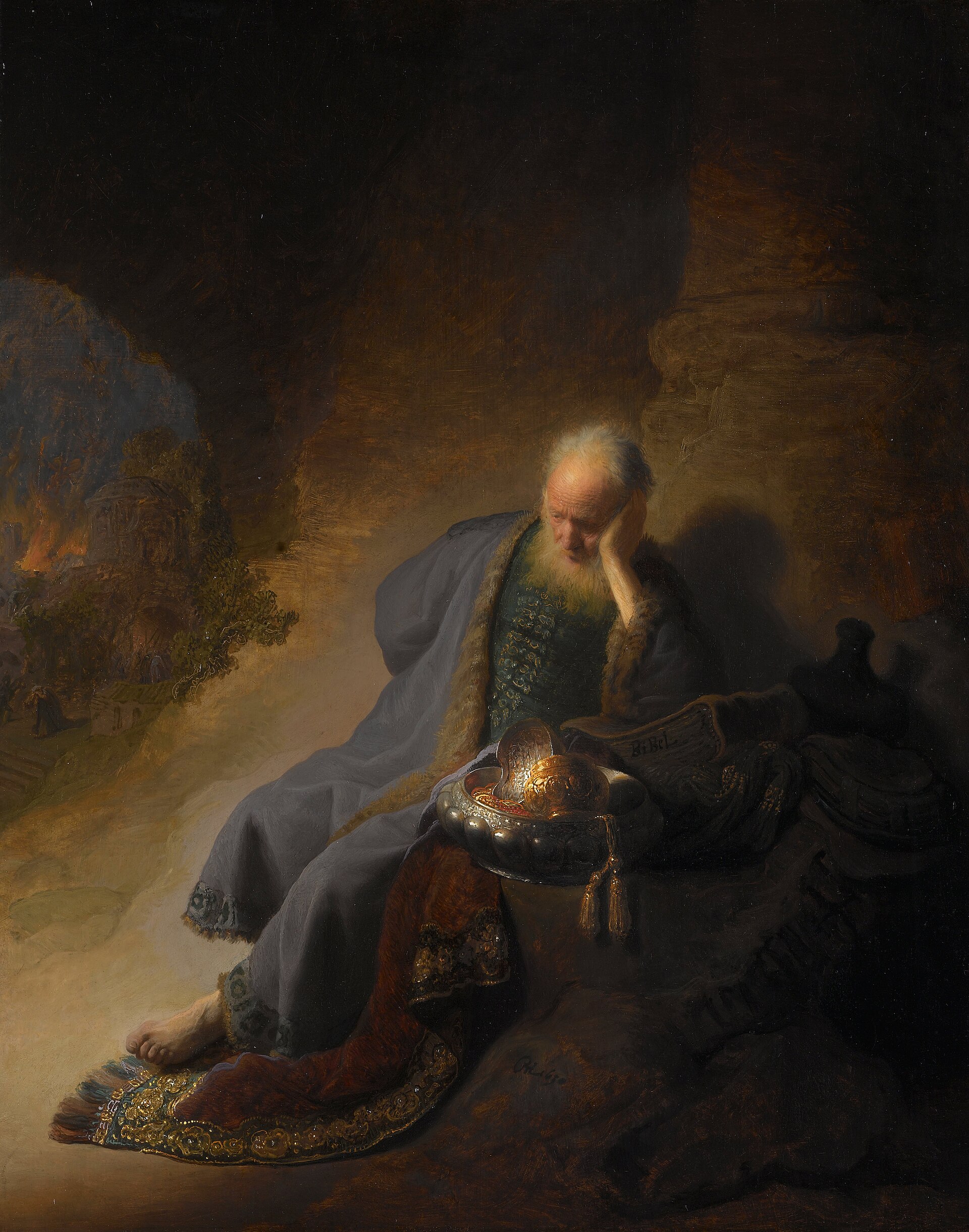
Jeremiahchapter 4
31 verses · Jeremiah, written by Baruch · 7th to 6th century BC · The Prophets
I looked at the earth, and it was formless and void; I looked to the heavens, and they had no light.
Introduction
Jeremiah, written by Baruch, The Prophets, Jeremiah Overview.
Jeremiah spoke these words to the towns of Judah while an army was still over the horizon. His hearers lived in villages that would have to empty at the sound of a horn, with families running for the walled cities. The chapter moves from a last appeal into a warning, and from the warning into the prophet's own anguish. Listen for the farming language at the start and for the change of voice when the prophet cries out in pain. Listen for four lines near the end that begin the same way. Read it as a people being told what is coming before it comes.
Context
- Who
- Townspeople who would have to decide, when the horn sounded, whether to run for a walled city
- What
- A call to repent, followed by the alarm of an invading army and a vision of the land laid waste.
- Where
- The hills and walled towns of Judah between the northern border and Jerusalem, where the watchmen kept their posts.
- When
- The chapter carries no date; it belongs to the early sermons, usually placed in the reign of Josiah, with the invasion still ahead.
- Why
- To warn Judah that the walled towns it trusted would not hold, and to press a change of heart while time remained.
Historical context
Judah's early-warning system was simple and it worked. Lookouts on high points watched the northern approaches; a ram's-horn blast and a raised signal, a pole, a banner, or fire and smoke at night, passed the alarm from ridge to ridge. Villagers then abandoned their houses and ran for the nearest fortified town, driving animals ahead of them.
Show the rest of the historical context, 3 more paragraphs
An invading army in that age moved like weather. Chariots and cavalry ranged ahead, the countryside was stripped of standing grain and fruit trees for fuel and fodder, and the villages that could not be defended were burned to keep the defenders from using them.
The chapter uses two farming pictures against the hearers. Break up your fallow ground means take a mattock to soil that has gone hard and thorny and turn it before you sow, or you waste the seed. The other picture is a woman applying eye paint and fine clothes to meet men who have come to kill her, a city dressing up for a siege.
The vision at the centre reverses the creation account step by step: the land goes back to being formless and empty, the light goes out of the sky, the hills shake, the birds are gone, the farmland is desert. That is deliberate.
Significance
For the first hearers this was not poetry about the end of the world. It was a briefing about the road from the north, and it told them the walls they were counting on would not hold.
Show the rest of the significance, 1 more paragraph
The demand underneath it is the hardest line in the chapter: circumcise your hearts. The nation's covenant mark was in their flesh already. They were being told the mark had never reached the place that mattered.
This chapter in Jewish lifeWhat this chapter is in Jewish life and reading.
What is done
The first two verses of this chapter are read in the synagogue in one rite. The site's table in src/lib/hebraic/readings.ts records the Sephardi Haftarah of Masei (Numbers 33:1 to 36:13) as Jeremiah 2:4 to 2:28 and 4:1 to 4:2. The Ashkenazi rite closes the same reading with Jeremiah 3:4 instead.
How it is read
Rashi is the one commentator on this chapter whose English the corpus carries, quoted here from The Judaica Press complete Tanach with Rashi, translated by A. J. Rosenberg, which Sefaria reports as CC-BY.
Rashi reads the call to plough the fallow ground as a lesson from the farmer, who ploughs in summer to kill the roots before the winter sowing. "You, too, improve your deeds before the evil befalls you" (Rashi on Jeremiah 4:3:1). The circumcision of the heart he calls "like plowing before the sowing" (Rashi on Jeremiah 4:4:1). The lion come up from the thicket is Nebuchadnezzar (Rashi on Jeremiah 4:7:1).
Rashi reads the eighth and ninth verses as turning to the death of Josiah. His generation did not repent properly. Rashi reports how they hid their idols from the king's reform by carving half an image on each leaf of a door so that it vanished when the door was open (Rashi on Jeremiah 4:9:1). On the voice from Dan he reports the Targum of Jonathan, which ties the disaster to the calf at Dan (Rashi on Jeremiah 4:15:1).
The corpus carries two further notes on this chapter without an English text, each marked linked because Sefaria holds no English version of the ref. They stand cited and unquoted at Radak on Jeremiah 4:22:1 and 4:23:1.
What the rabbis say
The corpus carries 40 rabbinic locators on the verses of this chapter, 8 in the Talmud and 32 in the Midrash. It carries the text of none, so each is cited by ref here and never quoted or paraphrased. The verse numbers are the Hebrew ones the corpus prints.
On verse 1 it holds Ein Yaakov (Glick Edition), Sanhedrin 11:46, Midrash Lekach Tov, Exodus 3:20:1 and Midrash Mishlei 6:6. On verse 2 it holds Bamidbar Rabbah 22:1, Bamidbar Rabbah 9:40 and Midrash Lekach Tov, Numbers 5:27:2. On verse 3 it holds Aggadat Bereshit 17:1, Ein Yaakov, Pesakhim 10:3 and Pesachim 107b:6. On verse 7 it holds Aggadat Bereshit 56:1, Berakhot 56b:12 and Eikhah Rabbah 1:1. On verse 8 it holds Jerusalem Talmud Yoma 8:7:10. On verse 9 it holds Eikhah Rabbah 1:51.
On verse 13 it holds Aggadat Bereshit 67:3, Pesikta Rabbati 12:1 and Sifrei Devarim 319:1. On verse 14 it holds Bamidbar Rabbah 11:7, Ein Yaakov (Glick Edition), Rosh Hashanah 1:17 and Ein Yaakov, Rosh Hashanah 1:21. On verse 16 it holds Introductions to Amoraic Literature, Part II (Notes and Interpretations for Chapters of the Talmud), Baba Batra, Chapter I 114. On verse 18 it holds Eikhah Rabbah, Petichta 16 and Pesikta Rabbati 31:1. On verse 19 it holds Bamidbar Rabbah 9:7, Berakhot 10b:3 and Ein Yaakov (Glick Edition), Berakhot 1:52.
On verse 20 it holds Midrash Sekhel Tov, Bereshit 42:1:1 and Tanna DeBei Eliyahu Rabbah 30:1. On verse 22 it holds Bereshit Rabbah 50:8 and Eikhah Rabbah, Petichta 14. On verse 23 it holds Bereshit Rabbah 2:1 and Bereshit Rabbah 2:4. On verse 24 it holds Eikhah Rabbah 1:23 and Yalkut Shimoni on Nach 1026:9. On verse 27 it holds Midrash Tehillim 50:1. On verse 29 it holds Eikhah Rabbah 2:1. On verse 30 it holds Bava Batra 16b:8 and Chagigah 15b:1.
On verse 31 it holds Aggadat Bereshit 82:1 and Bava Batra 16b:14.
Sources: Rashi, Rashi on Jeremiah 4:1:1 to 4:24:1, The Judaica Press complete Tanach with Rashi, translated by A. J. Rosenberg, reported CC-BY; Radak, Radak on Jeremiah 4:22:1 and 4:23:1, cited by ref because the corpus carries no English text; The Sefaria corpus, scripts/data/sources/sefaria/jeremiah/4.json, the 40 Talmud and Midrash locators on the verses of this chapter; The site's own files, src/lib/hebraic/readings.ts, probed for Jeremiah 4: a Haftarah use, and no festival reading for the book.
The heads below are this chapter's scenes. The numbered points under each are its verses.
Break Up Your Fallow Ground; Circumcise Your Hearts
Jeremiah 4:1-4
The return has conditions, idols removed and an oath sworn “in truth, in justice, and in righteousness”. The command “Break up your unplowed ground” turns farming into repentance. The call to “remove the foreskins of your hearts” names what the outward sign of Abraham's covenant was meant to picture.
Jeremiah 4:1
“Return - The repentance of Israel described in Jer 3:21-25 was a hope, and not a reality. The return, literally, would be their restoration to their land; spiritually, their abandoning their sins. Jer 4:1-2 should be translated as follows: If thou wouldst return, O Israel, saith Yahweh. Unto Me thou shalt return: And if thou wouldst remove thy abominations from before Me, And not wander to and fro, But wouldst swear truly, uprightly; and justly By the living Yahweh; Then shall the pagan bless themselves ... - In him - In Yahweh.”
Jerome reads the oath As surely as the LORD lives as a confession of the living God, against the idols by which Israel had sworn. Israel's return would reach the nations. Wesley adds that peoples who once gloried in idols would glory in God alone.
Jeremiah 4:2
“The nations - This shall be a means to work upon the Heathen nations, to come into the same way of worship. They shall think themselves happy to be incorporated with thee, that it may be with them according to that promise, Gen. xii, 3. Glory - Whereas before they gloried in their idols, they shall glory in God alone.”
John Wesley · Explanatory Notes upon the Old Testament (1765)evangelical
Unplowed ground left alone grows thorns, and seed sown among the thorns is choked. Barnes reads the command as a call to break up the hard heart before new obedience is sown. The words go to each of the men of Judah.
Jeremiah 4:3
The departure from virtue gives place for the entrance of the unclean spirit. There is, moreover, the apostolic injunction, that the grace given us should not be unprofitable. Those things that he wrote particularly to his disciple, he enforces on us through him, saying, "Do not neglect the gift that is in you. For he who tills his land shall be satisfied with bread. But the paths of the slothful are strewn with thorns." The Spirit warns ahead of time not to fall into them, saying, "Break up your fallow ground. Do not sow among thorns."
Athanasius of Alexandria · written before 373 · Festal Letters 3:3patristic
1 more voice on this verse
Jeremiah 4:3
“To the men - To each man “of Judah.” They are summoned individually to repentance. Break up - literally, Fallow for you a fallow ground, i. e., do not sow the seeds of repentance in unfit soil, but just as the farmer prepares the ground, by clearing it of weeds, and exposing it to the sun and air, before entrusting to it the seed, so must you regard repentance as a serious matter, requiring forethought, and anxious labor. To sow in unfallowed ground was practically to sow on land full of thorns.”
remove the foreskins of your hearts: Circumcision was the sign cut in the flesh, and the LORD calls the men of Judah to remove the foreskins of the heart. Symmachus, as Jerome reports, rendered it be purified to the LORD and remove the malice from your hearts. The alternative is wrath that burns like fire.
Jeremiah 4:4
“What we translate as "be circumcised to the Lord and remove the foreskin of your hearts," Symmacus renders as "be purified to the Lord and remove the malice from your hearts," understanding circumcision as purification and the foreskin as vice.”
Jerome · written before 420 · Six Books on Jeremiah 1:70.1-4patristic
1 more voice on this verse
Jeremiah 4:4
“Circumcise yourselves to the Lord,.... Or, "be ye circumcised", as the Septuagint and Vulgate Latin versions render it.”
Jeremiah 4:5-9
Announce in Judah, proclaim in Jerusalem: The alarm sounds, and the enemy in a figure: “A lion has gone up from his thicket, and a destroyer of nations has set out”. Panic reaches every office that should steady the people, as “the king and officials will lose their courage”, and priests and prophets tremble.
Jeremiah 4:5
“Rather, Make proclamation “in Judah, and in Jerusalem” bid them hear, “and say, Blow the trumpet” throughout “the land:” cry aloud “and say etc.” The prophecy begins with a loud alarm of war. The verse sets forth well, in its numerous commands, the excitement and confusion of such a time.”
4 more voices on this verse
Jeremiah 4:5
"Declare it in Judah, and let it be heard in Jerusalem; say, declare, signal with a trumpet upon the earth, and cry aloud." These things, he says, which are announced, say in Judah, to those from the tribe of Judah of Christ; "for it is evident that our Savior arose out of Judah." "Signal with a trumpet upon the earth."
Origen of Alexandria · written before 253 · Homilies on Jeremiah 5patristic
Jeremiah 4:5
“Those that are able men, and fit for service, must go into the defenced cities, to garrison them; those that are weak, and would lessen their provisions, but not increase their strength, must retire, and not stay. An express arrived with intelligence of the approach of the king of Babylon and his army. It is an evil that God will bring from the north (as he had said, ch. i.”
Matthew Henry · Commentary on the Whole Bible (1707-1721)puritan
Jeremiah 4:5
“Blow ye the trumpet - Give full information to all parts of the land, that the people may assemble together and defend themselves against their invaders.”
Adam Clarke · Commentary on the Bible (1810-1826)evangelical
Jeremiah 4:5
“The trumpet - The Lord being now about to bring enemies upon them, speaks in martial language, warning them of the nature of their approaching judgment.”
John Wesley · Explanatory Notes upon the Old Testament (1765)evangelical
Raise a signal flag toward Zion: The signal flag raised toward Zion points the country people to the walled city for refuge. The disaster comes from the north, the direction the invader of the next verse sets out from. Origen read the flight to Zion as entry into the church.
Jeremiah 4:6
"Take up your baggage and flee to Zion"; as many of you as are outside Zion, "take up your baggage and flee to Zion; hasten, do not stand still," you who are in progress hasten to the Watchtower, "for I bring evils from the north and great destruction"—of the evils brought "from the north," from the north of the adversary, as has often been said; and whoever is found not to have hastened, nor to have entered "into the walled cities," not having come to be in "the churches of God," but standing outside, he himself, being seized by the…
Origen of Alexandria · written before 253 · Homilies on Jeremiah 5patristic
A lion has gone up from his thicket: The destroyer leaves his lair like a lion, and Barnes notes that set out is a military term for breaking camp before a march. The ruin of the cities, left uninhabited, came after the murder of Gedaliah. Jerome saw the devil behind the lion.
Jeremiah 4:7
This is the true Nebuchadnezzar, as we have said before, about whom Peter also said, "Our adversary, the devil, prowls about like a roaring lion." He ascended from the depths to which he had been relegated and for fear that he is sent back, the plunderer or destroyer of the nations entreats and arises. He is whom it was said that "he will dominate all his enemies" and those who boast in the face of the Lord: "I have gone around the earth and trampled it."
Jerome · written before 420 · Six Books on Jeremiah 1:72.1-3patristic
put on sackcloth, mourn and wail: Sackcloth is the mourner's dress. The call to wear it answers the alarm of verses 5 and 6, and the fierce anger of the LORD still stands against the nation. Gill reports that the Septuagint, Syriac and Arabic versions put the anger in the second person, against the hearers.
Jeremiah 4:8
“For this gird you with sackcloth, lament and howl,.... That is, because of this destruction threatened, which was so near at hand, and so sure and certain: for the fierce anger of the Lord is not turned back from us. The Septuagint, Syriac, and Arabic versions, render it "from you" and some render it "from it" (u); from his purpose and design to destroy the Jews.”
The prophets astounded in that day are the ones who had promised Jerusalem peace. The Targum, quoted by Clarke on the next verse, names them false prophets deceiving the people. Their word fails on the day it is tested.
Jeremiah 4:9
“The heart of the king shall perish - Shall lose all courage.”
Adam Clarke · Commentary on the Bible (1810-1826)evangelical
1 more voice on this verse
Jeremiah 4:9
“The prophets too, the false prophets, who had cried peace to them, shall be put into the greatest amazement imaginable, seeing their own guilty blood ready to be shed by that sword which they had often told the people there was no danger of. Note, God's judgments come with the greatest terror upon those that have been most secure.”
Matthew Henry · Commentary on the Whole Bible (1707-1721)puritan
A Hot Wind from the Bare Heights of the Wilderness
Jeremiah 4:10-12
how completely You have deceived this people: Jeremiah cries that the LORD has deceived the people “by saying, ‘You will have peace,’ while a sword is at our throats”. The promise of peace was the word of prophets speaking in the LORD's name without warrant. 1 Kings 22 shows the LORD letting lying prophets speak.
The searing wind from the desert heights is the samum, as Barnes identifies it, a dry east wind that withers the land and stops work. Farmers winnow and sift grain in a gentle breeze. This wind pictures the invading Babylonian army.
Jeremiah 4:11
“At that time - See Jer 4:7. Though the revelation of the certainty of Judah’s ruin wrings from Jeremiah a cry of despair, yet it is but for a moment; he immediately returns to the delivery of God’s message. A dry wind - literally, A clear wind. The Samum is probably meant, a dry parching east wind blowing from the Arabian desert, before which vegetation withers, and human life becomes intolerable. Not to fan ... - The Syrian farmers make great use of the wind for separating the chaff from the grain: but when the Samum blows labor becomes impossible.”
1 more voice on this verse
Jeremiah 4:11
“Image of the invading Babylonian army (Ho 13:15). Babylon in its turn shall be visited by a similar "destroying wind" (Jer 51:1). of . . . high places--that is, that sweeps over the high places. daughter--that is, the children of my people. not to fan--a very different wind from those ordinary winds employed for fanning the grain in the open air.”
Jamieson, Fausset & Brown · Commentary Critical and Explanatory on the Whole Bible (1871)reformed
a wind too strong for that: The Syriac, as Gill reports, reads a wind stronger than any breeze fit to winnow grain. The wind comes from the LORD, and with it come judgments against Judah. Babylon meets a destroying wind of its own at Jeremiah 51:1.
Jeremiah 4:12
“Even a full wind from those places shall come unto me,.... That is, a strong one, very vehement; or, "a wind which is fuller than these", as the Syriac version renders it; which is stronger than those winds which are fit for fanning and winnowing the chaff from the wheat.”
Jeremiah 4:13-18
his chariots like the whirlwind: The invader is pictured by speed alone, clouds, whirlwind and horses “swifter than eagles”. The call “Wash the evil from your heart” answers verse 4. The besiegers “surround her like men guarding a field”, and the Hebrew verb for guarding is the one used of shepherds keeping a flock.
Jeremiah 4:13
“His troops move on in large masses like dark threatening clouds Joe 2:2. Woe unto us! for we are spoiled - Jeremiah’s own cry of grief.”
Wash the evil from your heart: The wicked thoughts Jerusalem harbors are plans for rescue, such as an alliance with Egypt, in the reading of Jamieson, Fausset and Brown. Only a heart washed of evil can be saved. Spurgeon preached the verse as a sermon on bad lodgers, wicked thoughts given a home in the heart.
Jeremiah 4:14
“ONE notices, in reading such a chapter as this fourth of Jeremiah, that the change which God required in the Jewish people was a very deep and thorough one. It was not only the washing of their hands, nor the cleansing of their outward lives, but the washing of their hearts from wickedness—and the Lord did not only require of them that they should cease from wicked actions, but even from vain thoughts.”
1 more voice on this verse
Jeremiah 4:14
Only one means of deliverance is left to the Jews--a thorough repentance. vain thoughts--namely, projects for deliverance, such as enlisting the Egyptians on their side. GESENIUS translates, "How long wilt thou harbor vain thoughts?"
Jamieson, Fausset & Brown · Commentary Critical and Explanatory on the Whole Bible (1871)reformed
a voice resounds from Dan: Dan was the northern border town of the land, and the hills of Ephraim marked the northern edge of Judah itself. The army moves faster than the news. Barnes notes that the Hebrew word aven, disaster, also means wickedness, and verse 14 used it for the wicked thoughts.
Jeremiah 4:15
“Dan - The border-town of Palestine on the north Deu 34:1. Mount Ephraim - The northern boundary of Judaea itself. The invading army presses on so rapidly, that scarcely have the news arrived of its appearance at Dan, before fresh messengers announce that it has traversed the whole length of Galilee, and is now defiling through the mountains of Samaria. Affliction - The same word, aven, occurs in Jer 4:14, and apparently there is a play upon its double meaning: for from a root signifying worthlessness, it is used both for wickedness and for misery.”
1 more voice on this verse
Jeremiah 4:15
“It was well if their sufferings put them in mind of their sins, the murders committed upon them of the murders committed by them; for God was now making inquisition for the innocent blood shed in Jerusalem, which the Lord would not pardon, 2 Kings xxiv. Note, As sin will find out the sinner, so sorrow will, sooner or later, find out the secure.”
Matthew Henry · Commentary on the Whole Bible (1707-1721)puritan
Warn the nations now!: The nations are summoned as witnesses of the LORD's judgment on his own people, as Jamieson, Fausset and Brown read it. The besieging army is literally watchers, the word for men who keep guard around a city. Their raised voices are the war shout.
Jeremiah 4:16
“The neighboring foreign "nations" are summoned to witness Jehovah's judgments on His rebel people (Jer 6:18, 19). watchers--that is, besiegers (compare 2Sa 11:16); observed or watched, that is, besieged. their voice--the war shout.”
Jamieson, Fausset & Brown · Commentary Critical and Explanatory on the Whole Bible (1871)reformed
like men guarding a field: Barnes compares the tents of the army around Jerusalem to the booths men built to guard a field of crops. They surround the city and keep her people in. The cause is named in one word, rebellion against the LORD.
Jeremiah 4:17
“Jeremiah compares the tents of the besiegers on guard round Jerusalem to the booths erected by shepherds or farmers for the protection of their flocks or produce.”
Judah's own ways and deeds brought the siege, and the punishment grew out of them. The bitterness pierces to the heart. Gill allows that the cry in the next verse may be the people's own, their heart reached, though he prefers to hear the prophet.
Jeremiah 4:18
“Thy wickedness - This siege is thy wickedness, i. e., in its results; or better, this is thy wretchedness, this army and thy approaching ruin is thy misery. Because - “For.” To feel that one’s misery is the result of one’s own doings adds bitterness to the anguish, and makes it reach, penetrate to the heart.”
1 more voice on this verse
Jeremiah 4:18
“Note, Sin is the procuring cause of all our troubles. Those that go on in sin while they are endeavouring to ward off mischiefs with one hand are at the same time pulling them upon their own heads with the other. God was angry with them for their sin.”
Matthew Henry · Commentary on the Whole Bible (1707-1721)puritan
My Anguish, My Anguish! The Earth Waste and Void Again
Jeremiah 4:19-22
My anguish, my anguish!: The prophet's body answers the horn before he can compose a sentence: “My anguish, my anguish! I writhe in pain!”, where the Hebrew names his bowels. The indictment of verse 22 stands inside that weeping: “They are skilled in doing evil, but they know not how to do good”.
Jeremiah 4:19
“The prophet suddenly assumes the language of the Jewish state personified, lamenting its affliction (Jer 10:19, 20; Isa 15:5; compare Lu 19:41). at my very heart--Hebrew, "at the walls of my heart"; the muscles round the heart. There is a climax, the "bowels," the pericardium, the "heart" itself. maketh . . . noise--moaneth [HENDERSON]. alarm--the battle shout.”
Jamieson, Fausset & Brown · Commentary Critical and Explanatory on the Whole Bible (1871)reformed
1 more voice on this verse
Jeremiah 4:19
“My bowels, my bowels,.... These are either the words of the people, unto whose heart the calamity reached, as in the preceding verse; or rather of the prophet, who either, from a sympathizing heart, expresses himself in this manner; or puts on an appearance of mourning and distress, in order to awaken his people to a sense of their condition. The repetition of the word is after the manner of persons in pain and uneasiness, as, "my head, my head", 2Ki 4:19, I am pained at my very heart; as a woman in labour.”
Disaster after disaster is proclaimed: Gill renders the Hebrew breach upon breach, one report of disaster arriving before the last is done. The tents fell first, as Matthew Henry notes. The Rechabites of chapter 35 lived in tents and fled into Jerusalem when the land was laid waste.
Jeremiah 4:20
THE sorrow of the weeping prophet was exceeding heavy when he uttered these words of bitter lamentation. A great and present burden from the Lord is weighing so heavily upon our hearts this morning, that we cannot spare so much as a moment for sympathy with the griefs of past ages. God has visited our land, and his strokes have been exceeding hard. We are constrained to take up a wailing, and cry aloud, “Suddenly are my tents spoiled, and my curtains in a moment.”
2 more voices on this verse
Jeremiah 4:20
“Though the cities held out for some time, the country was laid waste at the very first. The shepherds and all that lived in tents were plundered immediately; they and their effects fell into the enemies' hands; therefore we find the Rechabites, who dwelt in tents, upon the first coming of the army of the Chaldees into the land retiring to Jerusalem, Jer. xxxv.”
Matthew Henry · Commentary on the Whole Bible (1707-1721)puritan
Jeremiah 4:20
“Destruction upon destruction is cried;.... Or, "breach upon breach" (g); as soon as one affliction is over, another comes on; and upon the news of one calamity, tidings are brought of another, as in Job's case: it signifies, that distress and troubles would come thick and fast, and that there would be no end of them, until there was an utter destruction, as this phrase signifies, and the following words show. Kimchi interprets it of the destruction of the ten tribes which came first, and of the destruction of Judah that came now.”
How long must I see the signal flag: The signal flag and the horn were the two alarms of war, the one seen and the other heard. The prophet asks how long he must live with them. Jerome read the Latin as those fleeing, either from the king of Babylon or from the service of God.
Jeremiah 4:21
“The standard - See Jer 4:6. The alarm caused by the invasion is graphically described. The people are dispersed over the land following their usual pursuits, when tidings come of the enemy’s approach. The only chance of escape is a hasty flight. Flags stream from the hills to mark the safest route, while the blasts of the trumpet quicken the steps of the wavering.”
Jamieson, Fausset and Brown hear the LORD answering the prophet's lament, and the misery lasts as long as the sin lasts. The people have skill for evil and none for good. Paul's counsel at Romans 16:19 turns the line around.
Jeremiah 4:22
Jehovah's reply; they cannot be otherwise than miserable, since they persevere in sin. The repetition of clauses gives greater force to the sentiment. wise . . . evil . . . to do good . . . no knowledge--reversing the rule (Ro 16:19) "wise unto . . . good, simple concerning evil."
Jamieson, Fausset & Brown · Commentary Critical and Explanatory on the Whole Bible (1871)reformed
Jeremiah 4:23-26
it was formless and void: The vision borrows the Hebrew of the creation account, “formless and void”, the phrase Genesis uses for the earth before the first day. The heavens have no light, the mountains quake, no man is left, the birds have fled and the fruitful land is a desert.
Jeremiah 4:23
“In four verses each beginning with “I beheld,” the prophet sees in vision the desolate condition of Judaea during the Babylonian captivity. Jer 4:23 Without form, and void - Desolate and void (see Gen 1:2 note). The land has returned to a state of chaos (marginal reference note). And the heavens - And upward to the heavens. The imagery is that of the last day of judgment. To Jeremiah’s vision all was as though the day of the Lord had come, and earth returned to the state in which it was before the first creative word (see 2Pe 3:10).”
1 more voice on this verse
Jeremiah 4:23
“It is Tohu and Bohu, the words there used, as far as the land of Judea goes. It is confusion and emptiness, stripped of all its beauty, void of all its wealth, and, compared with what it was, every thing out of place and out of shape.”
Matthew Henry · Commentary on the Whole Bible (1707-1721)puritan
I looked at the mountains: The mountains are quaking, the hills swaying at the presence of the LORD, as Gill reads the verse with Psalm 68:8. Gill reports that Kimchi's father gave the word for swaying a sense of lightness. The hills rock as if weightless.
Jeremiah 4:24
“I beheld the mountains, and, lo, they trembled,.... At the presence of God, at the tokens of his displeasure, and at his awful vengeance in the destruction of the Jews, as they are sometimes said to do, Psa 68:8, and all the hills moved lightly; so Kimchi's father says the word used has the signification of lightness; though Jarchi, from Menachem, explains it, they were plucked up, and thrown out of their place; and some render it, were pulled down and destroyed, so the Targum.”
no man was left: The land is emptied of every man, then of every bird. Clarke reads the birds as having fled a land laid so waste that they found nothing to eat, and sets the verse beside Zephaniah 1:3.
Jeremiah 4:25
“The birds of the heavens were fled - The land was so desolated that even the fowls of heaven could not find meat, and therefore fled away to another region. How powerfully energetic is this description! See Zep 1:3.”
Adam Clarke · Commentary on the Bible (1810-1826)evangelical
the fruitful land was a desert: The fruitful land is Carmel in Hebrew, and the desert is the wilderness, as Jamieson, Fausset and Brown note. The garden land has become the great desert. Its cities fall before the fierce anger of the LORD.
Jeremiah 4:26
“The cities also and their gates and walls are broken down and levelled with the ground. Those that look no further than second causes impute it to the policy and fury of the invaders; but the prophet, who looks to the first cause, says that it is at the presence of the Lord, at his face (that is, the anger of his countenance), even by his fierce anger, that this was done.”
Matthew Henry · Commentary on the Whole Bible (1707-1721)puritan
Jeremiah 4:27-28
but I will not finish its destruction: Full desolation is announced and limited in the same breath: “but I will not finish its destruction”. The book returns to that limit at 5:10 and 5:18. The earth mourns under a fixed sentence, “I have spoken, I have planned, and I will not relent or turn back”.
Jeremiah 4:27
“Desolate - a waste. One of the most striking points of prophecy is, that however severe. may be the judgment pronounced against Judah, there is always the reservation, that the ruin shall not be complete Jer 3:14.”
the earth will mourn: Barnes follows the Septuagint's order of the last line, which pairs spoken with relent and planned with turn back. Four verbs close the sentence of judgment. The decree is fixed.
Jeremiah 4:29-31
climb among the rocks: The chapter closes on the Daughter of Zion as a woman in labor with “her first child”. The scarlet, the gold jewelry and the painted eyes of verse 30 show Jerusalem dressed for lovers who turn on her. Her beauty and ornament cannot buy back a covenant she has broken.
Jeremiah 4:29
“The whole city ... - Rather, Every city is fleeing. All the inhabitants of the tokens flee to Jerusalem for protection, or seek refuge in the woods and rocks. The horsemen and bowmen - The cavalry Jer 4:13 and bowmen formed the chief strength of the Assyrian armies. They shall go - They have gone.”
O devastated one: Enlarging the eyes with paint meant working antimony around the eye to make it look larger, as Clarke describes it. He reads the scarlet, the gold jewelry and the paint as Judah's appeals to the nations for help. Jerome gives the Hebrew for devastated one as Sadud.
Jeremiah 4:30
“Though thou rentest thy face with painting - This probably refers to the custom of introducing stibium a preparation of antimony, between the eye and the lids, in order to produce a fine lustre, which occasions a distension of the eye-lid in the time of the operation. In order to heighten the effect from this some may have introduced a more than ordinary quantity, so as nearly to rend the eye-lid itself. Though thou make use of every means of address, of cunning, and of solicitation, to get assistance from the neighboring states, it will be all in vain.”
Adam Clarke · Commentary on the Bible (1810-1826)evangelical
1 more voice on this verse
Jeremiah 4:30
“He uses the term "distendest" in derision of their effort to make their eyes look large [MAURER]; or else, "rentest," that is, dost lacerate by puncturing the eyelid in order to make the antimony adhere [ROSENMULLER].”
Jamieson, Fausset & Brown · Commentary Critical and Explanatory on the Whole Bible (1871)reformed
a cry like a woman in labor: The Daughter of Zion is Jerusalem pictured as a woman. The painted lover of verse 30 becomes a mother in her first labor, gasping and stretching out her hands. Gill had described the prophet's own pain at verse 19 in the same way, as labor pain.
Jeremiah 4:31
“For a cry have I heard as of one writhing in vain: Anguish as of one that bringeth forth her first-born: The cry of the daughter of Zion. She gasps for breath: she stretches out her palms: Woe is me! for my soul faints before the murderers.”
2 more voices on this verse
Jeremiah 4:31
“In travail - When the scripture would express any exquisite sorrow, it doth it by a woman in travail. First child - Which is usually the most painful.”
John Wesley · Explanatory Notes upon the Old Testament (1765)evangelical
Jeremiah 4:31
“Bringeth forth her first child - In such a case the fear, danger, and pain were naturally the greatest. Spreadeth her hands - The gesture indicated by nature to signify distress, and implore help. We have met with this figure in other parts, and among the classic writers it is frequent.”
Adam Clarke · Commentary on the Bible (1810-1826)evangelical
Keep studying
Sources for this chapter
The summary
Jamieson, Fausset & Brown, Commentary Critical and Explanatory; John Calvin, Commentaries; John Wesley, Notes on the Old Testament and Matthew Henry, Complete Commentary.
The exposition
Adam Clarke, Commentary on the Bible; Albert Barnes; Carl Friedrich Keil, The Prophecies of Jeremiah; Charles Spurgeon, The Metropolitan Tabernacle Pulpit, Sermon No. 1573: “Bad Lodgers and How To Treat Them” (lightly modernized text, CCEL edition); Jamieson, Fausset & Brown, Commentary Critical and Explanatory on the Whole Bible; Jerome; John Calvin, Commentary on Jeremiah and Lamentations; John Gill; John Wesley, Explanatory Notes upon the Old Testament; Matthew Henry, Commentary on the Whole Bible and Origen of Alexandria, HOMILIES ON JEREMIAH 5.