
Jeremiah 4:21
in Jeremiah 4How long must I see the signal flag and hear the sound of the horn?
BSB
The same verse in ASV and KJV ▾
ASV
How long shall I see the standard, and hear the sound of the trumpet?
KJV
How long shall I see the standard, and hear the sound of the trumpet?
⋯
This verse in Jeremiah 4
Commentary
7 notes on this verse(Verse 21.) How long will I see those fleeing (Vulgate: the one fleeing), hear the sound of the horn? Whether those fleeing from the king of Babylon, or those fleeing from me and departing from my service.
This site's exposition
My bowels, my bowels!
on Jeremiah 4:19-22
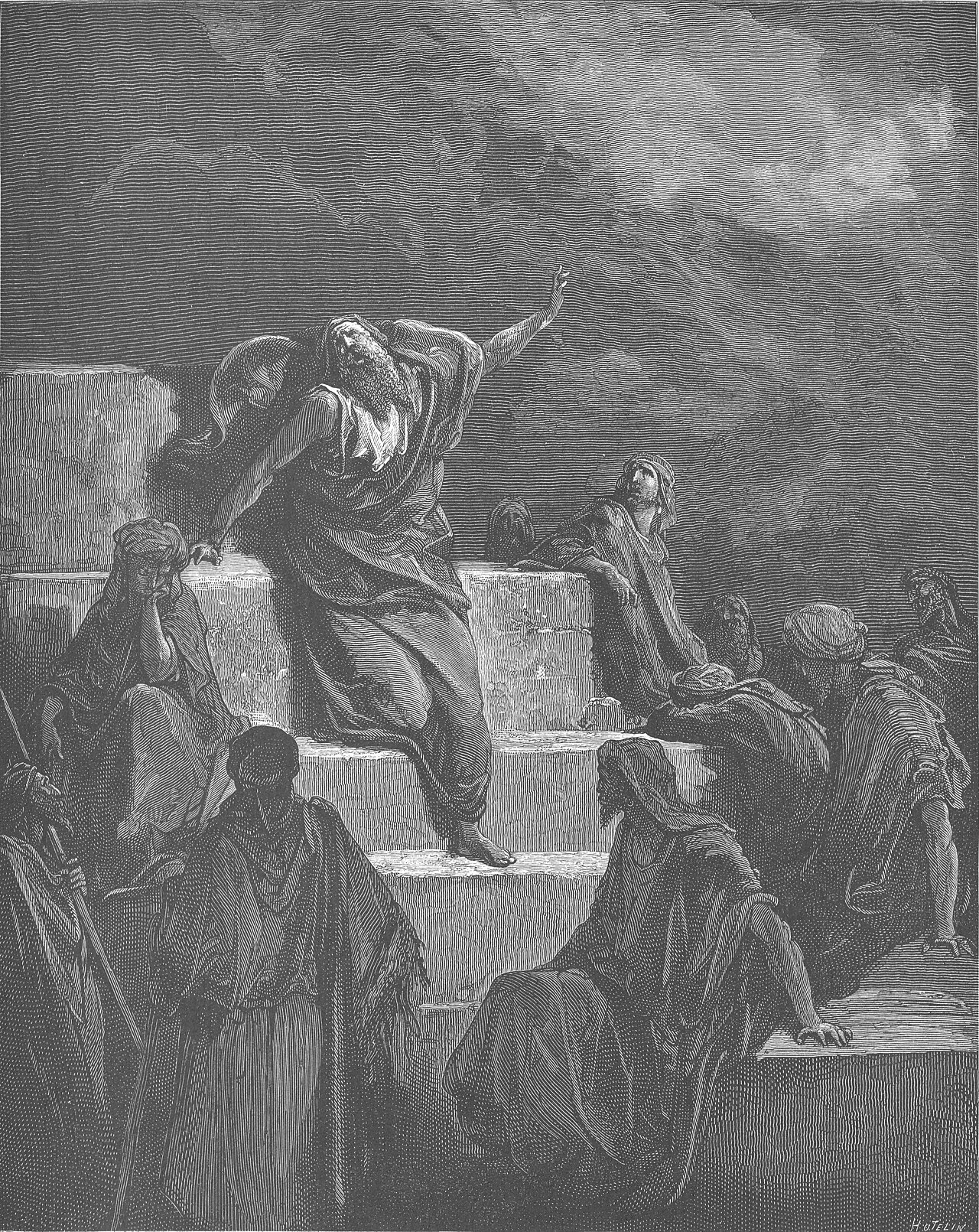
The prophet's own body answers the trumpet before he can compose a sentence about it, bowels, heart, and a noise he cannot still, the same licensed grief that runs through the confessions of chapters 11 to 20 breaking out here at the first sound of the enemy rather than waiting for the city's fall. The indictment that follows, my people is foolish, they have not known me, wise to do evil, but to do good they have no knowledge, is Jeremiah's own diagnosis inside his own weeping, sin and sorrow held together rather than one replacing the other.
The record, by era
The Puritans and the Awakening4 voices
Good men are none of those that delight in war, for they know not how to fish in troubled waters; they are for peace ( Ps. cxx. 7 ), and will heartily say Amen to that prayer, "Give peace in out time, O Lord!" O thou sword of the Lord! when wilt thou be quiet? (3.) The desolations made by it in the land were general and universal: The whole land is spoiled, or plundered (
quarantine:debris (2026-07-29) — unbalanced-parens
How long shall I see the standard,....
"Thou must utterly abandon all sin, and not retain any of the relics of idolatry: Put away thy abominations out of my sight, " that is, out of all places (for every place is under the eye of God), especially out of the temple, the house which he had in a particular manner his eye upon, to see that it was kept clean.
It becomes us to tremble at the thought of the misery that sinners are running themselves into, though we have good hopes, through grace, that we ourselves are delivered from the wrath to come. (2.) To awaken them to a holy fear, and so to a care to prevent so great a judgment by a true and timely repentance.
The Nineteenth Century1 voice
A commentator
Albert Barnes1798–1870
Notes, Explanatory and Practical, on the Old and New Testaments (1832-1869)
proposed
The standard - See Jer 4:6. The alarm caused by the invasion is graphically described. The people are dispersed over the land following their usual pursuits, when tidings come of the enemy’s approach. The only chance of escape is a hasty flight. Flags stream from the hills to mark the safest route, while the blasts of the trumpet quicken the steps of the wavering.
The words behind it
7 Hebrew wordsEvery Hebrew word of this verse in the order it stands, with what it means and the door to its own study. The last column counts the times a word stands in the whole Bible: the rarer the word, the more the places it appears belong together.
| Hebrew | Sound | Meaning | Word study | In the Bible |
|---|---|---|---|---|
| עַד־ | ʾad- | until | H5704 → | 1261 times |
| מָתַ֖י | matai | when? | H4970 → | 43 times |
| אֶרְאֶה־ | ʾereh- | will I see | H7200 → | 1300 times |
| נֵּ֑ס | nes | a standard | H5251 → | 21 times |
| אֶשְׁמְעָ֖ה | ʾeshmeah | will I hear | H8085 → | 1159 times |
| ק֥וֹל | kol | [the] sound of | H6963 → | 506 times |
| שׁוֹפָֽר׃ ס | shofar | a trumpet | H7782 → | 72 times |
עַד־until
ʾad-H5704 →1261 times
מָתַ֖יwhen?
mataiH4970 →43 times
אֶרְאֶה־will I see
ʾereh-H7200 →1300 times
נֵּ֑סa standard
nesH5251 →21 times
אֶשְׁמְעָ֖הwill I hear
ʾeshmeahH8085 →1159 times
ק֥וֹל[the] sound of
kolH6963 →506 times
שׁוֹפָֽר׃ סa trumpet
shofarH7782 →72 times
A shaded row is a word that stands 400 times or fewer in the Bible.
The walk
8 stopsEach card is a verse this one points to, and under it the verses that one points to in turn. Where several paths arrive at the same place, that place is listed first: the text keeps returning to it.
Through
Jeremiah 6:1“Run for cover, O sons of Benjamin; flee from Jerusalem! Sound the ram’s horn in Tekoa; send up a signal over Beth-haccherem, for disaster looms from the north, even great destruction.
it leads to
- Nehemiah 3:14
The Dung Gate was repaired by Malchijah son of Rechab, ruler of the district of Beth-haccherem. He rebuilt it and installed its doors, bolts, and bars.
- Judges 1:21
The Benjamites, however, failed to drive out the Jebusites living in Jerusalem. So to this day the Jebusites live there among the Benjamites.
- Jeremiah 4:5–6
Announce in Judah, proclaim in Jerusalem, and say: “Blow the ram’s horn throughout the land. Cry aloud and say, ‘Assemble yourselves and let us flee to the fortified cities.’
- Nehemiah 3:14
Through
2 Chronicles 35:25Then Jeremiah lamented over Josiah, and to this day all the choirs of men and women sing laments over Josiah. They established them as a statute for Israel, and indeed they are written in…
it leads to
- Lamentations 4:20
The LORD’s anointed, the breath of our life, was captured in their pits. We had said of him, “Under his shadow we will live among the nations.”
- Jeremiah 22:10
Do not weep for the dead king; do not mourn his loss. Weep bitterly for the one who is exiled, for he will never return to see his native land.
- Matthew 9:23
When Jesus entered the house of the synagogue leader, He saw the flute players and the noisy crowd.
- Jeremiah 9:17–21
This is what the LORD of Hosts says: “Take note, and summon the wailing women; send for the most skillful among them.
- Job 3:8
May it be cursed by those who curse the day—those prepared to rouse Leviathan.
- Lamentations 4:20
Where this verse is studied
On this page
Studies1
About Jeremiah
This page draws on Albert Barnes, Notes on the Old Testament; Albert Barnes, Notes, Explanatory and Practical, on the Old and New Testaments (1832-1869); Carl Friedrich Keil, The Prophecies of Jeremiah; Jerome, Commentary on Jeremiah; John Gill, Exposition of the Old Testament (1748-1763) and Matthew Henry, Commentary on the Whole Bible.