
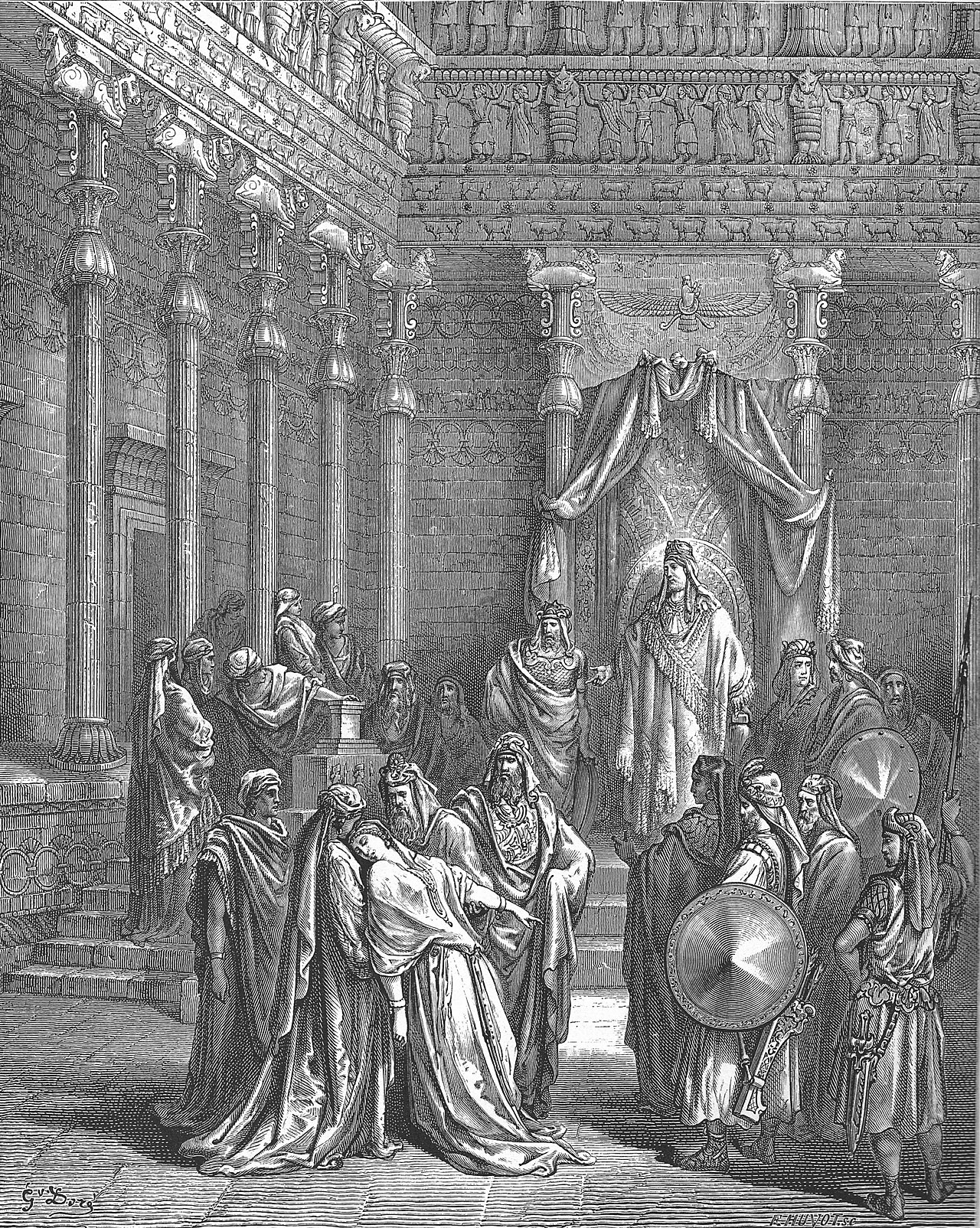
Estherchapter 9
32 verses · unknown · 5th century BC · History
to establish among them an annual celebration on the fourteenth and fifteenth days of the month of Adar
Introduction
unknown, History, Esther Overview.
This chapter was written for Jews who would keep its feast every year for the rest of their history. It brings the book to the day an enemy chose by lot, and then it becomes the founding record of a festival. The first half tells what happened on that day, and the second half tells how it was to be remembered. Listen for the phrase the text repeats about the plunder. Notice why the feast falls on two different days, and where its name comes from. The chapter closes with letters, because the feast was meant to reach every province.
Context
- Who
- Jews who would keep this day every year for the rest of their history
- What
- The Jews defend themselves on the thirteenth of Adar, and Mordecai and Esther write to establish the Feast of Purim for every generation.
- Where
- Susa and the provinces of the Persian empire.
- When
- The thirteenth to fifteenth days of Adar, the twelfth month, about 473 BC.
- Why
- To record the deliverance and to fix the feast by which it would be remembered.
Historical context
The fighting described is defensive and limited. The Jews strike at those who came to attack them, and the provincial officials, reading the king's second letter and Mordecai's rise, back them rather than the mob. In the empire's cities the whole thing is done in one day; in Susa itself the king grants a second day, which is why the capital finished on the fourteenth while everyone else finished on the thirteenth.
Show the rest of the historical context, 3 more paragraphs
That one-day difference is why the festival is kept on two dates. Jews in unwalled towns observe the fourteenth of Adar; those in cities walled from ancient times observe the fifteenth, still called Shushan Purim. The rule is spelled out in the Mishnah's tractate on the reading of Esther, and it is still followed, Jerusalem keeps the later day.
Three times the text stops to say that the Jews did not touch the spoil, though the decree allowed it. Hearers who knew their history heard the correction at once: Saul son of Kish had been sent against Amalek and kept the plunder, and lost his kingdom over it. Mordecai's people, facing the descendant of Agag, take nothing.
The name of the festival is a jab. Purim comes from the pur, the lot Haman threw to pick a lucky date for a massacre. The day he chose became the annual party of the people he meant to kill. Its practices are laid down here in plain terms: feasting, sending portions of food to one another, and gifts to the poor.
Significance
This chapter is the reason the book exists. It is the founding document of a holiday, written so that a community scattered across an empire would have one shared day, one shared story, and a fixed obligation to feed the poor while they celebrated.
Show the rest of the significance, 1 more paragraph
The lesson it hands its first hearers is not that Jews always win. It is that this deliverance happened, on a date an enemy picked, and must not be forgotten, so the reading of the scroll became the ceremony, and Haman's lot became the name.
This chapter in Jewish lifeWhat this chapter is in Jewish life and reading.
What is done
This is the chapter the feast comes from, and Rashi's notes on it read as the law of the day. The date turns on where a person lives. Those who do not live in walled cities keep the fourteenth, and those who live in walled cities keep the fifteenth, like Shushan. The walls must stand from the days of Joshua son of Nun, and Rashi says this is how the Rabbis expounded it (Rashi on Esther 9:19:1). The edition's note names Maseches Megillah 2b and records why Shushan keeps the later day. It had no wall in Joshua's time, and it was given its standing because the miracle was done there.
The reading itself is grounded here. On the words about these days being remembered, Rashi's note is "With the reading of the Scroll [of Esther]" (Rashi on Esther 9:28:1). The edition's note names Talmud Yerushalmi Megillah 1:5. Mordechai wrote this scroll as it now stands, which Rashi takes from the twentieth verse (Rashi on Esther 9:20:1). The site's own table in src/lib/hebraic/readings.ts gives the practice that follows. The scroll is read twice, in the evening and again the next morning, from a handwritten roll, and the names of Haman's ten sons are read in one breath. The table cites Mishnah Megillah 2 and Babylonian Talmud Megillah 18a.
How it is read
Rashi carries all the English the corpus holds on this chapter, quoted here from The Metsudah Five Megillot, Lakewood, N.J., 2001, which Sefaria reports as CC-BY. The edition prints its own numbered notes inside his words, and a note is named here as the edition's. His longest note is on the ten sons of Haman, and he takes it from another book. He cites Seder Olam, where these ten are the men who wrote the accusation against Judah and Jerusalem at the start of Achashveirosh's reign, the letter recorded in Ezra 4:6. Their aim was to stop the rebuilding of the Temple, begun by the returning exiles in the days of Koresh (Rashi on Esther 9:10:1). A Christian reader meets here a tradition that joins the book of Esther to the story of Ezra.
The rest of the notes on the fighting are short. The executive staff were the men appointed over the king's affairs (Rashi on Esther 9:3:1). The ten were hanged after they had already been slain (Rashi on Esther 9:13:1). The king's decree was proclaimed as a statute (Rashi on Esther 9:14:1). Haman's plot was devised to terrify them and destroy them (Rashi on Esther 9:24:1). Esther's coming in the twenty-fifth verse is her coming to the king to plead (Rashi on Esther 9:25:1).
Three notes explain why the book was written and for whom. The days were fixed, and so the scroll was written for later generations to know (Rashi on Esther 9:26:1). Those who joined themselves to the Jews in the twenty-seventh verse are "Proselytes who are destined to convert to Judaism" (Rashi on Esther 9:27:1). The edition's note gives the reason they share the feast: Haman's decree reached the people they would one day join. The power of the second letter Rashi reads as the power of the miracle, of Achashveirosh, of Haman, of Mordechai and of Esther (Rashi on Esther 9:29:1). The edition's note names Maseches Megillah 19a.
The corpus carries twelve further notes on this chapter without an English text, each marked linked because Sefaria holds no English version of the ref. Seven stand cited and unquoted at Ibn Ezra on Esther 9:1:1, 9:2:1, 9:4:1, 9:6:1, 9:12:1, 9:16:1 and 9:23:1. Five stand at Malbim on Esther 9:5:1, 9:11:1, 9:21:1, 9:22:1 and 9:30:1.
What the rabbis say
The corpus carries forty rabbinic locators on this chapter and the text of none, so each is cited and linked here rather than quoted. Twenty-seven are Midrash and thirteen are Talmud, the most Talmud of any chapter in the book. On the first verse it holds Ein Yaakov (Glick Edition), Megillah 1:14 and Esther Rabbah 10:10. Esther Rabbah 10:11 stands on the second. On the third it holds Esther Rabbah 10:12 and Pirkei DeRabbi Eliezer 50:12, and on the fourth Bamidbar Rabbah 3:1 with Bereshit Rabbah 39:11. On the sixth it holds Tractate Soferim 13:6, and on the seventh Ein Yaakov (Glick Edition), Megillah 1:41 with Jerusalem Talmud Megillah 3:7:3.
The sons of Haman draw the next run, two of its locators from works on the enlarged and the small letters. On the ninth verse the corpus holds two passages of Otzar Midrashim from the Midrashim of Rabbi Akiba, The Enlarged Letters 9 and The Small Letters and their Purposes 9. On the tenth it holds Ein Yaakov, Megillah 1:10 and Jerusalem Talmud Megillah 1:1:10. On the eleventh it holds Midrash Lekach Tov, Exodus 6:12:1 and Otzar Midrashim, Baraita of The 32 Midot of Aggadah 1:9. On the twelfth it holds Bereshit Rabbah 92:7 and Megillah 16b:13, and on the thirteenth Bereshit Rabbati, Parashat Vayigash 5. On the fifteenth it holds Pirkei DeRabbi Eliezer 50:1, and on the seventeenth Midrash Tanchuma, Vayechi 8:4.
The founding of the feast carries the rest, and much of it is Talmud on the scroll. On the eighteenth verse the corpus holds Jerusalem Talmud Megillah 1:4:3 and Yalkut Shimoni on Torah 81:2. On the nineteenth it holds Jerusalem Talmud Megillah 1:1:4 and 2:3:3. On the twentieth it holds Megillah 2b:7 and Tanna DeBei Eliyahu Zuta, Additions to Seder Eliyahu Zuta, Pirkei Derech Eretz 2. On the twenty-first it holds Jerusalem Talmud Megillah 1:5:6 and Megillah 2a:10. Ein Yaakov (Glick Edition), Pesakhim 6:6 stands on the twenty-second, and Otzar Midrashim, Midrashim on Missing and Extra Letters 1:28 on the twenty-third. Pesikta Rabbati 13:1 stands on the twenty-fourth, Bamidbar Rabbah 10:2 on the twenty-fifth and Jerusalem Talmud Megillah 2:4:2 on the twenty-sixth. On the twenty-seventh it holds Ein Yaakov (Glick Edition), Makkot 3:5, and on the twenty-eighth Eikhah Rabbah 3:23. Jerusalem Talmud Megillah 1:5:2 stands on the twenty-ninth, Esther Rabbah 6:2 on the thirtieth, Megillah 2a:8 on the thirty-first and Ein Yaakov, Yoma 3:7 on the thirty-second. What each of them teaches is a saying of the rabbis, and is reported as theirs wherever this site quotes one.
Sources: Rashi, Rashi on Esther 9:3:1 to 9:29:1, The Metsudah Five Megillot, Lakewood, N.J., 2001, reported CC-BY; Ibn Ezra, Ibn Ezra on Esther 9:1:1, 9:2:1, 9:4:1, 9:6:1, 9:12:1, 9:16:1 and 9:23:1, cited by ref because the corpus carries no English text; Malbim, Malbim on Esther 9:5:1, 9:11:1, 9:21:1, 9:22:1 and 9:30:1, cited by ref because the corpus carries no English text; The Sefaria corpus, scripts/data/sources/sefaria/esther/9.json, the 40 Talmud and Midrash locators of this chapter; The site's own files, src/lib/hebraic/readings.ts, the FESTIVAL_READINGS entry for esther at Purim citing Mishnah Megillah 2, Babylonian Talmud Megillah 18a and the Rema's gloss to Shulchan Aruch, Orach Chayim 690:17, and no portion or Haftarah for this book.
The heads below are this chapter's scenes. The numbered points under each are its verses.
The day turned about: the Jews rule over those who hated them
Esther 9:1-4
On the thirteenth day: The day the lot chose eleven months earlier arrives. The enemies of the Jews "had hoped to overpower them, but their plan was overturned". The satraps, governors and administrators now help the people they were ordered to destroy, "because the fear of Mordecai had fallen upon them".
Esther 9:1
“Now in the twelfth month - What a number of providences, and none of them apparently of an extraordinary nature, concurred to preserve a people so signally, and to all human appearance so inevitably, doomed to destruction! None are ever too low for God to lift up, or too high for God to cast down. Must not these heathens have observed that the uncontrollable hand of an Almighty Being had worked in behalf of the Jews? And must not this have had a powerful tendency to discredit the idolatry of the country?”
Adam Clarke · Commentary on the Bible (1810-1826)evangelical
1 more voice on this verseWhat preachers and commentators have said about this verse, in their own words.
Esther 9:1
“YOU are probably aware that some persons have denied the Inspiration of the Book of Esther because the name of God does not occur in it. They might, with equal justice, deny the Inspiration of a great number of chapters in the Bible, and of a far greater number of verses. Although the name of God does not occur in the Book of Esther, the Lord Himself is there most conspicuously in every incident which it relates.”
In each of the provinces of King Xerxes: The Jews gathered in their own cities and struck those who sought to harm them. Adam Clarke judged that every man they killed had first risen to destroy them. Their enemies were those who acted on Haman's decree.
And all the officials of the provinces: Albert Barnes identifies the officials' help as the Persian garrison, the standing army at each governor's disposal. The enemies of the Jews, in his reading, came mostly from the idolatrous subject peoples. John Gill adds that the officials feared for their posts.
Esther 9:3
“And all the rulers of the provinces, and the lieutenants, and the deputies, and officers of the king, blessed the Jews,.... Countenanced them and encouraged them, and gave them all assistance in their power; extolled them, as the word signifies, lifted them up, and spoke well of them, or praised them, as the Targum: because the fear of Mordecai was upon them; he being now chief minister, they might fear, if they took part with the enemies of the Jews against them, they might be turned out of their places.”
2 more voices on this verse
Esther 9:3
“All the rulers ... helped the Jews - i. e. the Persians, who formed the standing army which kept the Empire in subjection, and were at the disposal of the various governors of provinces, took the Jews’ side. The enemies of the Jews (e. g. Est 9:16) were almost entirely to be found among the idolatrous people of the subject nations, for whose lives neither the Persians generally, nor their monarchs, cared greatly.”
Esther 9:3
“They all saw it their interest to help Mordecai's friends because he was not only great in the king's house, and caressed by the courtiers (as many are who have no intrinsic worth to support their reputation), but his fame for wisdom and virtue went out thence throughout all the provinces: in all places he was extolled as a great man.”
Matthew Henry · Commentary on the Whole Bible (1707-1721)puritan
For Mordecai exercised great power in the palace: This verse explains the officials' fear in verse 3. Mordecai's rank at court was matched by a reputation that reached every province, and Matthew Henry credits it to his wisdom and virtue. John Gill reads the last clause as office heaped on office, with wealth and power growing together.
Esther 9:4
“For Mordecai was great in the king's house,.... Not only over Esther's affairs, but was one of the king's counsellors, and was the chief minister of state: and his fame went out throughout all the provinces; what a favourite he was of the king, as well as a relation of the queen, and how wise and just his administrations were: for this man Mordecai waxed greater and greater, was more and more in the king's favour, and had offices of honour and trust heaped upon him, and increased both in wealth and power.”
Esther 9:5-10
The Jews put all their enemies: Then comes the clause the chapter repeats three times: "they did not lay a hand on the plunder". At 1 Samuel 15:19 Saul lost the kingdom when he rushed upon the plunder of Amalek. Under Mordecai, of Kish's house, the Jews finish that war and leave the plunder untouched.
Esther 9:5
“Thus the Jews smote all their enemies with the stroke of the sword, and slaughter, and destruction,.... Some with swords, and others with clubs, and staves; as the Targum; and such like slaughtering weapons of destruction: and did what they would unto those that hated them; being then entirely at their will, and under their power.”
1 more voice on this verse
Esther 9:5
“Thus the Jews smote all their enemies--The effect of the two antagonistic decrees was, in the meantime, to raise a fierce and bloody war between the Jews and their enemies throughout the Persian empire; but through the dread of Esther and Mordecai, the provincial governors universally favored their cause, so that their enemies fell in great numbers.”
Jamieson, Fausset & Brown · Commentary Critical and Explanatory on the Whole Bible (1871)reformed
In the citadel of Susa: The citadel of Susa here means the whole upper town, which Barnes measures at more than a hundred acres, with many residences besides the palace. Adam Clarke found the number startling. Five hundred men in the king's own city still rose against people the king was known to favor.
Esther 9:6
“And in Shushan - It is strange that in this city, where the king’s mind must have been so well known, there should be found five hundred persons to rise up in hostility against those whom they knew the king befriended!”
Adam Clarke · Commentary on the Bible (1810-1826)evangelical
including Parshandatha, Dalphon, Aspatha: Barnes traces most names of Haman's ten sons to Old Persian roots. Clarke found that Persian names passing into Hebrew were so altered that some can scarcely be known. The enemy of the Jews had given his sons Persian names.
Esther 9:7
“Most of these names are Persian, and readily traceable to Old Persian roots. Est 9:10 On the spoil laid they not their hand - As they might have done (see the margin reference).”
Poratha, Adalia, Aridatha: Henry reported a Chaldee tradition: when the Jews killed these ten, Zeresh escaped with seventy more of Haman's children. Gill noted that the Targum gives the distance between the ten sons hanged on the gallows. Both come from Jewish tradition.
Parmashta, Arisai, Aridai: The list closes at ten, the sons Haman recounted at 5:11. Barnes cites Herodotus: after prowess in arms, the greatest proof of manly excellence in Persia was to father many sons. Haman's ten sons now lay among the enemies killed in the citadel of Susa.
They killed these ten sons: The decree of 8:11 allowed the Jews to plunder, and they left the plunder where it lay. Henry reads the restraint as mercy: they killed only men found in arms and left the goods to the women and children they spared. Wesley reads it as proof they acted from necessity.
Esther 9:10
“The ten sons of Haman - Their names are given above. And it is remarked here, and in Est 9:16, where the account is given of the number slain in the provinces, that the Jews laid no hands on the spoil. They stood for their lives, and gave full proof that they sought their own personal safety, and not the property of their enemies, though the decree in their favor gave them authority to take the property of all those who were their adversaries, Est 8:11.”
Adam Clarke · Commentary on the Bible (1810-1826)evangelical
1 more voice on this verse
Esther 9:10
“The Chaldee paraphrase says that, when these ten were slain, Zeresh, with seventy more of his children, escaped, and afterwards begged their bread from door to door.”
Matthew Henry · Commentary on the Whole Bible (1707-1721)puritan
A second day granted in Shushan, and ten sons hanged
Esther 9:11-14
On that day the number: The count reaches the king, and his offer to Esther brings a request: that "the bodies of Haman’s ten sons be hanged on the gallows". The commentators generally read a queen securing her people in a capital still hostile to them. The text records the request without praise or blame.
Esther 9:11
“On that day the number of those that were slain in Shushan the palace was brought before the king. Either by order of the king, that he might know how many enemies the Jews had in the city, and how many of subjects had been slain; or officiously by others, with an intention to irritate the king against the Jews.”
who said to Queen Esther: John Gill allows that the count may have reached the king from men hoping to turn him against the Jews. The king instead reckons the provinces from Susa's five hundred and asks what the rest have done. The offer that opened the banquets is made once more.
Esther replied, “If it pleases the king: The edict gave the Jews one day, and Esther asks that Susa have a second. John Wesley supposed the worst enemies had hidden through the thirteenth, meaning to return home once the Jews' commission expired. Adam Clarke supposed that Mordecai had told her many had escaped.
Esther 9:13
“Let Haman’s ten sons be hanged - They had been slain the preceding day, and now she requests that they may be exposed on posts or gibbets, as a terror to those who sought the destruction of the Jews.”
Adam Clarke · Commentary on the Bible (1810-1826)evangelical
So the king commanded that this be done: A second edict was issued for Susa alone, and the king granted it at once. John Gill thought the ten sons were hanged on the gallows that had held their father. The provinces kept to the single day, Matthew Henry notes.
Esther 9:14
“And the king commanded it so to be done: and the decree was given at Shushan,.... That the Jews might have leave to seek out and slay the rest of their enemies in Shushan, on the fourteenth day, in like manner as they had on the thirteenth: and they hanged Haman's ten sons; on the same gallows very probably their father was hanged; the Targum gives us the distance between each person hanged thereon.”
Esther 9:15-19
On the fourteenth day: Susa's second day takes three hundred more, and the provinces kill "75,000 who hated them". Twice more comes the refusal: "they did not lay a hand on the plunder". The two campaigns set two dates for the feast, the villages resting on the fourteenth and walled Susa on the fifteenth.
Esther 9:15
“For the Jews that were in Shushan gathered themselves together on the fourteenth day also of the month Adar,.... As they had on the thirteenth: and slew three hundred men at Shushan; the Targum adds, of the family of Amalek: but there is no reason to confine it to them; it respects all such as were the enemies of the Jews, and rose up against them; so that the whole number slain in Shushan were eight hundred persons, besides the sons of Human: but on the prey they laid not their hand; See Gill on Est 9:7.”
1 more voice on this verse
Esther 9:15
“Shushan - Here probably the lower town, which lay east of the upper one, and was of about the same size (compare the Est 9:6 note).”
The rest of the Jews: The Septuagint puts the dead in the provinces at fifteen thousand. Barnes thought that figure sits better beside the eight hundred killed in Susa. Henry reported the Jewish tradition that the enemies killed were Amalekites, the old enemy of Exodus 17.
Esther 9:16
“If all these were Amalekites (as the Jews say), surely now it was that the remembrance of Amalek was utterly put out, Exod. xvii. However, that which justifies them in the execution of so many is that they did it in their own just and necessary defence; they stood for their lives, authorized to do so by the law of self-preservation, as well as by the king's decree.”
Matthew Henry · Commentary on the Whole Bible (1707-1721)puritan
1 more voice on this verse
Esther 9:16
“Seventy and five thousand - The Septuagint gives the number as 15,000; and this amount seems more in proportion to the 800 slain in Susa.”
This was done on the thirteenth day: The provinces fought on the thirteenth and feasted on the fourteenth. Henry notes that each group kept its feast on the very day after its work was done, while the deliverance was fresh. The feasting and joy began before any letter had ordered it.
The Jews in Susa, however, had assembled: Susa's calendar runs a day behind, and the cause is Esther's request in verse 13 for a second day of fighting. John Gill notes that the decree was renewed for the fourteenth in Susa as it had stood for the thirteenth. The capital rested on the fifteenth.
Esther 9:18
“But the Jews that were at Shushan assembled together on the thirteenth day thereof, and on the fourteenth day thereof,.... Of the month Adar; that is, they gathered together to defend themselves, and destroy their enemies, on both these days, having the decree renewed for the fourteenth as they had for the thirteenth: and on the fifteenth day of the same they rested, and made it a day of feasting and gladness; as the Jews in the provinces did on the fourteenth.”
2 more voices on this verse
Esther 9:18
“The Jews - assembled - on the thirteenth - and on the fourteenth - These two days they were employed in slaying their enemies; and they rested on the fifteenth.”
Adam Clarke · Commentary on the Bible (1810-1826)evangelical
Esther 9:18
“Both of them celebrated their festival the very day after they had finished their work and gained their point. When we have received signal mercies from God we ought to be quick and speedy in making our thankful returns to him, while the mercy is fresh and the impressions of it are most sensible.”
Matthew Henry · Commentary on the Whole Bible (1707-1721)puritan
This is why the rural Jews: Barnes reads the rural Jews as those of the country towns, set apart from the Jews of Susa. Their feast on the fourteenth added the sending of gifts. Clarke reads the gifts as the wealthy providing for the poor, so that joy would be as general as sorrow had been.
Esther 9:19
“The Jews of the villages ... - Rather, “the Jews of the country districts, that dwelt in the country towns,” as distinguished from those who dwelt in the metropolis.”
Purim named for the lot Haman cast, kept in every generation
Esther 9:20-23
Mordecai recorded these events: Mordecai's letters go to all the provinces to keep the fourteenth and fifteenth of Adar every year. The feast builds charity into its joy, "sending gifts to one another and to the poor," as at Nehemiah 8:10-12. So "the Jews agreed to continue the custom they had started."
Esther 9:20
“Mordecai wrote these things - It has been supposed that thus far that part of the book of Esther, which was written by Mordecai extends: what follows to the end, was probably added either by Ezra, or the men of the Great Synagogue; though what is said here may refer only to the letters sent by Mordecai to the Jews of the provinces.”
Adam Clarke · Commentary on the Bible (1810-1826)evangelical
2 more voices on this verse
Esther 9:20
“But, because there is so little of the language of Canaan in this book, many think it was not written by Mordecai, but was an extract out of the journals of the kings of Persia, giving an account of the matter of fact, which the Jews themselves knew how to comment upon.”
Matthew Henry · Commentary on the Whole Bible (1707-1721)puritan
Esther 9:20
“Mordecai wrote these things--Commentators are not agreed what is particularly meant by "these things"; whether the letters following, or an account of these marvellous events to be preserved in the families of the Jewish people, and transmitted from one generation to another.”
Jamieson, Fausset & Brown · Commentary Critical and Explanatory on the Whole Bible (1871)reformed
to establish among them an annual celebration: Mordecai sets both days for every Jew, every year. Matthew Henry observes that the feast keeps the days of rest after the fighting. He sets the Sabbath beside it, kept on the day God rested from His work.
Esther 9:21
“Let us not be niggardly in our returns of praise to him who bestows his favours so liberally upon us. Observe, They did not keep the day when they fought, but the days when they rested, and on the fifteenth those in Shushan, and both those days they kept. The sabbath was appointed not on the day that God finished his work, but on the day that he rested from it.”
Matthew Henry · Commentary on the Whole Bible (1707-1721)puritan
as the days on which the Jews: The custom of verse 19 was gifts to one another, and Mordecai's letter adds the poor. Henry pairs thanksgiving with almsgiving. The letter also remembers the month of Adar, when their sorrow turned to joy.
Esther 9:22
“Those that have received mercy must, in token of their gratitude, show mercy; and there never wants occasion, for the poor we have always with us. Thanksgiving and almsgiving should go together, that, when we are rejoicing and blessing God, the heart of the poor may rejoice with us and their loins may bless us. (2.) What was added to this, which was much better.”
Matthew Henry · Commentary on the Whole Bible (1707-1721)puritan
So the Jews agreed to continue the custom: Albert Barnes reads Mordecai's first letter as a recommendation, and this verse as the people's acceptance of it. A second letter, with Esther's authority behind it, made the feast binding at verse 29. Adam Clarke traced its keeping without a break through the dispersion.
Esther 9:23
“The Jews undertook to do as they had begun - They had already kept the fifteenth day, and some of them in the country the fourteenth also, as a day of rejoicing: Mordecai wrote to them to bind themselves and their successors, and all their proselytes, to celebrate this as an annual feast throughout all their generations; and this they undertook to do. And it has been observed among them, in all places of their dispersion, from that day to the present time, without any interruption.”
Adam Clarke · Commentary on the Bible (1810-1826)evangelical
Esther 9:24-28
had cast the Pur: The feast takes its name from the plot's tool: Haman "had cast the Pur (that is, the lot) to crush and destroy them". The custom binds the Jews, their descendants "and all who join them," so the charter admits converts. Purim is still kept, with this book read aloud.
But when it came before the king: The recap folds the story into one sentence, from the plot reaching the king to Haman and his sons hanged. Gill's text makes Esther the one who came before the king, and the Berean reads the plot as coming before him. Rabanus cites the pit that catches its own digger.
Therefore these days are called Purim: The name comes first, and then the two grounds for keeping the feast: the letter's instructions and what the people had seen and experienced. Adam Clarke takes the letter as Mordecai's letter of verse 20. Matthew Henry classes Purim as a feast set by human appointment.
Esther 9:26
“They called these days Purim - That is from pari, the lot; because, as we have seen, Haman cast lots to find what month, and what day of the month, would be the most favorable for the accomplishment of his bloody designs against the Jews. See on Est 3:7 (note). And of that which they had seen - The first letter to which this second refers, must be that sent by Mordecai himself. See Est 9:20.”
Adam Clarke · Commentary on the Bible (1810-1826)evangelical
1 more voice on this verse
Esther 9:26
“But this was remedied by authority, which fixed the fourteenth and fifteenth of Adar. It became a season of sunny memories to the universal body of the Jews; and, by the letters of Mordecai, dispersed through all parts of the Persian empire, it was established as an annual feast, the celebration of which is kept up still.”
Jamieson, Fausset & Brown · Commentary Critical and Explanatory on the Whole Bible (1871)reformed
the Jews bound themselves to establish: The obligation is one the Jews took on themselves, and it binds their descendants and every convert who joins them. John Wesley calls it the act of the whole people. Matthew Henry reads the converts' share in the feast as their pledge of union with the Jewish nation.
Esther 9:27
“The observance of this feast was to be both universal and perpetual; the proselytes must observe it, in token of their sincere affection to the Jewish nation and their having united interests with them. A concurrence in joys and praises is one branch of the communion of saints.”
Matthew Henry · Commentary on the Whole Bible (1707-1721)puritan
These days should be remembered and celebrated: The verse names four circles of keeping: generation, family, province and city. Family puts the feast inside the home. Rabanus Maurus carried the charge into the church, reading the days of the lot as a pledge of the rest to come.
Esther's letter confirming the fasting and the crying
Esther 9:29-32
So Queen Esther daughter of Abihail: Esther writes "with full authority to confirm this second letter concerning Purim," the orphan of 2:7 now giving law to the Jews of an empire. Mordecai's letters carry "words of peace and truth". The confirmation also fixes "the times of fasting and lamentation," so the feast keeps its fast.
Esther 9:29
“This second letter of Purim - Mordecai’s first letter Est 9:20 was to some extent tentative, a recommendation. The Jews generally having accepted the recommendation Est 9:23, Est 9:27, he and Esther now wrote a second letter which was mandatory.”
And Mordecai sent letters with words: Matthew Henry reads words of peace and truth as the tone of the letter. Esther and Mordecai wrote with authority and still wrote gently, as the council at Jerusalem did in Acts 15:29. The letters reached all 127 provinces.
in order to confirm these days of Purim: Adam Clarke notes that no high priest's approval is recorded, only the authority of Mordecai and Esther. The king had no part in a Jewish feast. Albert Barnes reads the fasting and lamentation as observances the provincial Jews had added, which the second letter now sanctioned.
Esther 9:31
“The matters of the fastings and their cry - The Jews of the provinces had added to the form of commemoration proposed by Mordecai certain observances with respect to fasting and wailing, and Mordecai’s second letter sanctioned these.”
So Esther’s decree confirmed these regulations: The record where Esther's decree was written is read three ways. Barnes takes it as the royal chronicles, the sense the word has at 6:1 and 10:2. Gill allows this book or a lost book, the view of Aben Ezra, and the Targum reads it as the roll of Esther.
Esther 9:32
“The decree of Esther confirmed these matters - It was received by the Jews universally with all respect, and they bound themselves to abide by it. The Vulgate gives a strange turn to this verse: Et omnia quae libri hujus, qui vocatur Esther, historia continentur; “And all things which are contained in the history of this book, which is called Esther.” The Targum says, And by the word of Esther all these things relative to Purim were confirmed; and the roll was transcribed in this book.”
Adam Clarke · Commentary on the Bible (1810-1826)evangelical
Keep studying
Sources for this chapter
The summary
Jamieson, Fausset & Brown, Commentary Critical and Explanatory; John Wesley, Notes on the Old Testament and Matthew Henry, Complete Commentary.
The context
Matthew Henry, Commentary on the Whole Bible and W. F. Adeney, Ezra, Nehemiah and Esther (Expositor's Bible).
The exposition
Adam Clarke, Commentary on the Bible; Albert Barnes, Notes, Explanatory and Practical, on the Old and New Testaments (1832-1869); Alfred Edersheim, Bible History: Old Testament; Jamieson Fausset and Brown, Commentary Critical and Explanatory on the Whole Bible; John Gill; John Wesley, Explanatory Notes upon the Old Testament; Keil, The Books of Ezra, Nehemiah, and Esther; Matthew Henry, Commentary on the Whole Bible; Rabanus Maurus and W. F. Adeney, Ezra, Nehemiah and Esther (Expositor's Bible).