
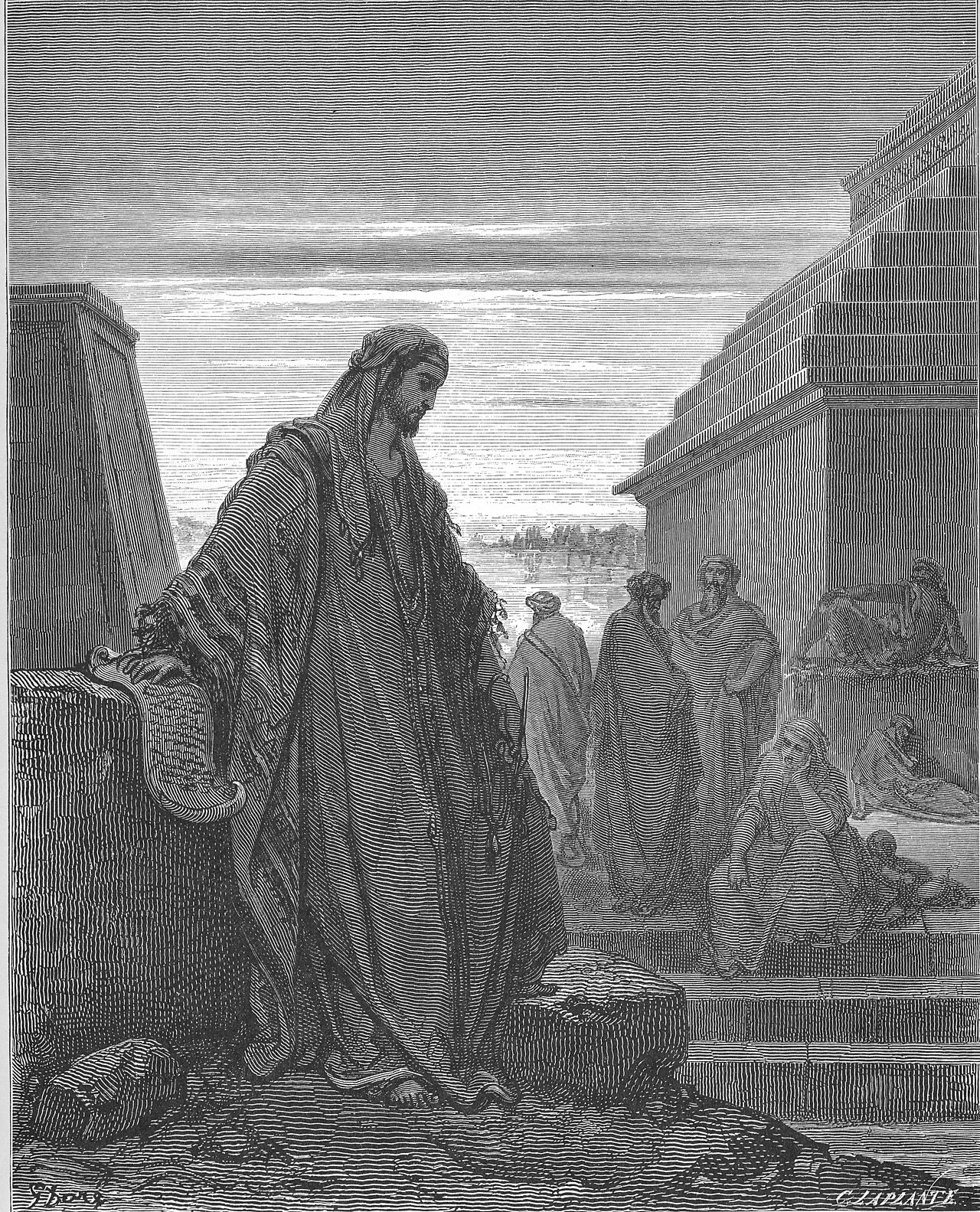
Danielchapter 4
37 verses · Daniel, by tradition · 6th century BC · The Prophets
the king exclaimed, “Is this not Babylon the Great, which I myself have built by the might of my power as a royal residence and for the glory of my majesty?”
Introduction
Daniel, by tradition, The Prophets, Daniel Overview.
This chapter is set out as a public letter from the king of Babylon to every nation of his empire. It was kept for exiles who watched the most powerful man alive behave as if he were a god. It is the only chapter in the Old Testament told in the first person by a foreign emperor, and the voice changes partway through. Listen for who is speaking at each point, and for the one sentence the chapter repeats. Read it as the testimony of a man who learned who rules, told by the man himself.
Context
- Who
- Exiles watching the most powerful man alive act as if he were a god
- What
- A royal proclamation in which Nebuchadnezzar tells of his dream of the great tree, his fall into madness and his restoration.
- Where
- The palace of Babylon, its roof over the city, and the open field where the king lived among the animals.
- When
- Late in the reign of Nebuchadnezzar, before his death in 562 BC; the chapter gives no year.
- Why
- To show that the Most High rules over the kingdoms of men and gives them to whom He wishes, and that He humbles the proud.
Historical context
The chapter is written as a public proclamation from the king himself, addressed to all peoples and languages, the standard opening of a Babylonian or Persian royal decree. It is the only chapter of its kind in the Old Testament: a pagan emperor's own testimony.
Show the rest of the historical context, 3 more paragraphs
His boast is documented. Nebuchadnezzar's building inscriptions, recovered by the thousand from stamped bricks and clay cylinders, say almost word for word what he says on the roof: that he built Babylon, that he made it magnificent. The city he describes had double walls, a processional way, and a bridge over the Euphrates, all of it dug up and standing in museums. The terraced gardens that later Greek writers counted among the wonders of the world are a different case: no Babylonian text mentions them, nothing has been excavated, and some historians now place them at Nineveh instead.
The madness described here, living outdoors, eating grass, hair and nails growing wild, matches a rare condition in which a person believes himself to be an animal. Babylonian records go quiet about the king's activity for a stretch in his later years, though the records are patchy and nothing survives that names the illness.
One nearby find is worth knowing about honestly: among the Dead Sea Scrolls is a short text called the Prayer of Nabonidus, in which a later Babylonian king is struck with a disease for seven years, is helped by a Jewish exile, and is told to honor God. Scholars argue about how the two accounts are related. Nobody has settled it.
Significance
To an exile, Nebuchadnezzar was the last word on earth. He had taken their city and their king. This chapter shows him losing his mind for seven years, then getting it back the moment he looks up.
Show the rest of the significance, 1 more paragraph
The line the whole chapter turns on is that heaven rules, that the Most High gives kingdoms to whomever He will, and gives them to the lowliest of men. That is not a comfort about the future. It was a claim about who was actually in charge of Babylon while Babylon was in charge of them.
This chapter in Jewish lifeWhat this chapter is in Jewish life and reading.
What is done
The king's letter about his madness has no reading in the synagogue. Probed for this lane, the site's own table in src/lib/hebraic/readings.ts printed parashot total 0 and haftarah uses total 0 for Daniel, and no festival reading. The site's book dossier records that Daniel stands among the Writings in the Hebrew Bible rather than among the Prophets, so no weekly portion is drawn from it and no Haftarah either.
The corpus numbers this chapter by the Hebrew text, which begins it three verses later than an English Bible does. Its first verse is the fourth in English, and every verse number below stands three lower than the English count. The chapter is met in the Talmud at Chullin 59a:5, Chullin 140a:1 and Chullin 21a:2, and at Sanhedrin 110b:10, which the corpus carries under the sixth, ninth, sixteenth and twentieth verses.
How it is read
Rashi is quoted from The Judaica Press complete Tanach with Rashi, translated by A. J. Rosenberg, which Sefaria reports as CC-BY, and Ibn Ezra from the Sefaria Community Translation, which Sefaria reports as CC0, each at fifty words or fewer.
Ibn Ezra reads the chapter's form as a matter of honour. The king tells the whole event in his own voice, "And it was written this way for the honor of Daniel, in that the king wrote this [account] in this manner [as a royal proclamation] to all the provinces of his kingdom." He calls it a great glory for Israel (Ibn Ezra on Daniel 4:3:1). Two more of his notes are grammar: the Aramaic "I said" is a participle with its pronoun, which he calls correct usage, and the tree is a tree rooted in the earth (Ibn Ezra on Daniel 4:4:1 and 4:7:1). At the seventeenth verse he reports Rabbi Yeshua's reading of the tree's "visibility" from the root for seeing (Ibn Ezra on Daniel 4:17:1).
Rashi's notes give the dream's terms their sense. The seven periods are "seven years" (Rashi on Daniel 4:13:1). The watchers' edict is called a question "since they take counsel from the Holy One, blessed be He, before they issue the decree" (Rashi on Daniel 4:14:1). When Daniel is bewildered, Rashi reads it as silence: "He was silent" (Rashi on Daniel 4:16:1). The roots left in the ground mean the kingdom will stay with the king. "Your kingdom will ultimately be restored to you" (Rashi on Daniel 4:23:1).
The corpus carries twenty-four commentary entries on this chapter, the cap its fetch sets, and they stop at the twenty-fourth verse, so what the commentators say on the verses after it is not reported here. The corpus carries two further notes on this chapter without an English text, each marked linked because Sefaria holds no English version of the ref. They stand cited and unquoted: Metzudat David on Daniel 4:19:1 and Daniel 4:20:1.
What the rabbis say
The corpus carries thirty-eight rabbinic locators on this chapter. Eight of them stand in the Talmud and its minor tractates and the rest in the Midrash. The corpus carries the text of none, so each is cited by ref here and never quoted.
On the first verse it holds Midrash Tanchuma Buber, Vaera 22:2. On the second verse it holds Midrash Tanchuma Buber, Vayetzei 6:2 and Yoma 20b:10. On the sixth verse it holds Chullin 59a:5 and Ein Yaakov (Glick Edition), Chullin 3:7. On the span Daniel 4:7 to 14 it holds Midrash Tanchuma Buber, Miketz 4:1. On the eighth verse it holds Pirkei DeRabbi Eliezer 33:15. On the ninth verse it holds Chullin 140a:1.
On the span Daniel 4:10 to 20 it holds Midrash Tehillim 1:11. On the tenth verse it holds Midrash Tehillim 121:1. On the eleventh verse it holds Avot DeRabbi Natan 36:1. On the span Daniel 4:11 to 12 it holds Ein Yaakov (Glick Edition), Sanhedrin 11:131. On the thirteenth verse it holds Otzar Midrashim, Midrash on the Ten Kings 1:10 and Vayikra Rabbah 13:5. On the fourteenth verse it holds Avot DeRabbi Natan, Recension B 44:15 and Ein Yaakov (Glick Edition), Sanhedrin 4:17.
On the sixteenth verse it holds Chullin 21a:2 and Ein Yaakov (Glick Edition), Shevuot 4:5. On the seventeenth verse it holds Mekhilta DeRabbi Shimon Ben Yochai 15:7 and Mekhilta DeRabbi Yishmael, Tractate Shirah 6:14. On the eighteenth verse it holds Midrash Tehillim 104:6. On the twentieth verse it holds Sanhedrin 110b:10. On the twenty-second verse it holds Midrash Aggadah, Leviticus 6:2:3 and Midrash Mishlei 2:2. On the twenty-fourth verse it holds Bamidbar Rabbah 10:4.
On the span Daniel 4:24 to 26 it holds Bamidbar Rabbah 9:31. On the twenty-fifth verse it holds Mekhilta DeRabbi Yishmael, Tractate Shirah 6:8 and Midrash Tanchuma, Beshalach 16:6. On the twenty-sixth verse it holds Bamidbar Rabbah 9:24. On the twenty-seventh verse it holds Midrash Tanchuma, Mishpatim 4:4 and Midrash Tanchuma, Vaera 17:2. On the twenty-eighth verse it holds Midrash Tehillim 14:2. On the twenty-ninth verse it holds Midrash Tanchuma Buber, Tazria 10:4.
On the thirtieth verse it holds Jerusalem Talmud Nazir 1:1:7. On the thirty-first verse it holds Midrash Tehillim 32:1. On the thirty-second verse it holds Devarim Rabbah 1:5. On the thirty-third verse it holds Ein Yaakov, Shabbat 23:2. On the span Daniel 4:34 to 5:1 it holds Bereshit Rabbah 85:2.
Sefaria also files two links for this chapter to Learning to Read Midrash, a modern study rather than a rabbinic source. They are named among the sources and left out of the count above. What each locator teaches is a saying of the rabbis, and it is reported as theirs wherever this site quotes one. The quotations wait on a fetch that carries the text.
Sources: Rashi, Rashi on Daniel 4:1:1 to Daniel 4:24:1, The Judaica Press complete Tanach with Rashi, translated by A. J. Rosenberg, reported CC-BY; Ibn Ezra, Ibn Ezra on Daniel 4:3:1 to Daniel 4:18:1, Sefaria Community Translation, reported CC0; Metzudat David, Metzudat David on Daniel 4:19:1 and Daniel 4:20:1, cited by ref because the corpus carries no English text; Learning to Read Midrash, Learning to Read Midrash, Chapter 14; The Meaning of a Chronological Problem; Connecting Yosef and Yehuda 167 | Learning to Read Midrash, Chapter 14; The Meaning of a Chronological Problem; Connecting Yosef and Yehuda 156, linked by Sefaria under Midrash, cited by ref; The Sefaria corpus, scripts/data/sources/sefaria/daniel/4.json, the 38 Talmud and Midrash locators of this chapter; The site's own files, src/lib/hebraic/readings.ts, probed for this book and printing daniel parashot total 0 and haftarah uses total 0, and src/components/book/dossier-content/daniel.ts on the place of Daniel among the Writings.
The heads below are this chapter's scenes. The numbered points under each are its verses.
A king's testimony and the dream that frightened him
Daniel 4:1-3
May your prosperity be multiplied: The chapter opens as Nebuchadnezzar's decree turned to declare what “the Most High God has performed”. The older commentators note this is the one chapter of Scripture written in a gentile emperor's first person. Verse 3 sets the doxology first, so the reader knows where the king's humbling ends.
Daniel 4:1
“Nebuchadnezzar the king, unto all people ... - The Syriac here has, “Nebuchadnezzar the king wrote to all people, etc.” Many manuscripts in the Chaldee have שׁלח shâlach, “sent,” and some have כתב kethab, “wrote;” but neither of these readings are probably genuine, nor are they necessary. The passage is rather a part of the edict of the king than a narrative of the author of the book, and in such an edict the comparatively abrupt style of the present reading would be what would be adopted.”
signs and wonders: Albert Barnes notes that the Aramaic behind "I am pleased" means that it seemed fair or fitting to the king. Jamieson, Fausset and Brown explain the plural signs. They are the dream, its interpretation and its fulfillment.
Daniel 4:2
“I thought it good--"It was seemly before me" (Ps 107:2-8). signs--tokens significant of God's omnipotent agency. The plural is used, as it comprises the marvellous dream, the marvellous interpretation of it, and its marvellous issue.”
Jamieson, Fausset & Brown · Commentary Critical and Explanatory on the Whole Bible (1871)reformed
His kingdom is an eternal kingdom: Matthew Henry sets this confession against chapter 2, where the king saw his own kingdom hastening to its end. God's kingdom has no end. John Wesley notes that the king was now old and had reigned above forty years.
Daniel 4:3
Nothing is excluded from the dominion of God, for Scripture says of him, "All things serve you." God, then, rules over all things, and in his forbearance he endures even murderers and robbers and fornicators, having determined a fixed time for requiting each, that they who, granted a long reprieve, remain impenitent may suffer the greater condemnation. There are kings … who reign on earth, yet not without power from on high. This, of old, Nebuchadnezzar knew from experience when he said, "his kingdom is an everlasting kingdom."
Cyril of Jerusalem · written before 386 · Catechetical Lecture 8:5patristic
1 more voice on this verse
Daniel 4:3
“How great are his signs - Nothing less than a real change of heart could cause such a confession as this! Nebuchadnezzar was now old, had reigned above forty years, and seen as much of the world as most men ever did.”
John Wesley · Explanatory Notes upon the Old Testament (1765)evangelical
Daniel 4:4-6
at ease in my house: The narrative opens with the king “at ease in my house and flourishing in my palace,” settled again in the same security. A second dream frightens him, and he decrees “all the wise men of Babylon be brought before me,” the court that failed in chapter two.
Daniel 4:4
“I - was at rest - I had returned to my palace in Babylon after having subdued Syria, Phoenicia, Judea, Egypt, and Arabia. It was probably these great conquests that puffed him up with pride, and brought that chastisement upon him which he afterwards describes. See the dream of the emblematical tree explained.”
Adam Clarke · Commentary on the Bible (1810-1826)evangelical
and it frightened me: Verse 4 had just found the king at ease and flourishing. Matthew Henry contrasts his soft and well-guarded bed with the thoughts that troubled him on it. Albert Barnes traces the fear to a sense that the dream disclosed something of great importance.
all the wise men of Babylon: Jamieson, Fausset and Brown ask why Daniel came in last. They answer that providence kept him to the last, so that every human means would be proved vain before God acted through his servant. Albert Barnes traces the word decree to a root meaning taste.
Daniel 4:6
“Therefore made I a decree - The word here rendered decree (טעם ṭe‛êm) means, commonly, “taste, flavor,” as of wine; then “judgment, discernment, reason;” and then a judgment of a king, a mandate, edict. Compare Dan 3:10. The primary notion seems to be that of a delicate “taste” enabling one to determine the qualities of wines, viands, etc.; and then a delicate and nice discrimination in regard to the qualities of actions.”
1 more voice on this verse
Daniel 4:6
“It may seem strange that Daniel was not first summoned. But it was ordered by God's providence that he should be reserved to the last, in order that all mere human means should be proved vain, before God manifested His power through His servant; thus the haughty king was stripped of all fleshly confidences.”
Jamieson, Fausset & Brown · Commentary Critical and Explanatory on the Whole Bible (1871)reformed
Daniel 4:7-9
they could not interpret it: The magicians, enchanters, astrologers, and diviners hear the dream and “could not interpret it,” the court failing a second time. Daniel comes last, and the king credits his gift to “the spirit of the holy gods”. His words “no mystery baffles you” rest on what Daniel had already done.
Daniel 4:7
“Providence ordered it so that they should be first puzzled with it, that Daniel's interpreting it afterwards might redound to the glory of the God of Daniel. Now was fulfilled what Isaiah foretold ( ch. xlvii. 12, 13 ), that when the ruin of Babylon was drawing on her enchantments and sorceries, her astrologers and star-gazers, should not be able to do her any service.”
Matthew Henry · Commentary on the Whole Bible (1707-1721)puritan
1 more voice on this verse
Daniel 4:7
“Then he described what happened in his second vision, as none of the magicians, soothsayers, and Chaldeans were able to declare the matter to the king, until Daniel was called who also described to Nebuchadnezzar his first vision, so that in all things God might glorify his own slaves the prophets beyond the other barbarians and foreign nations, who pretend to be flattered in their human wisdom, having practiced earthly learning.”
Hippolytus of Rome · written before 235 · Commentary on Daniel 3.2.2-6patristic
after the name of my god: Matthew Henry notes the king's pride in the name he had given Daniel, taken from Bel, which he counted a good omen. Jerome records that the Septuagint translators omitted this whole passage. The king still speaks as a worshipper of Bel.
chief of the magicians: Albert Barnes suggests that Daniel still held the office given him in 2:48. Cyril of Jerusalem judged the king half right. Daniel truly had the spirit, and Matthew Henry notes that the king still speaks in the language of his idolatry.
Daniel 4:9
“He looked upon him as one that had such an insight, such a foresight, as none of his magicians had: I know that no secret troubles thee. Note, The spirit of prophecy quite outdoes the spirit of divination, even the enemies themselves being judges; for so it was adjudged here, upon a fair trial of skill.”
Matthew Henry · Commentary on the Whole Bible (1707-1721)puritan
The great tree and the watcher who says, hew it down
Daniel 4:10-12
a tree in the midst: The tree “grew large and strong; its top reached the sky, and it was visible to the ends of the earth”. The older commentators read it against the common ancient figure of a king as a great tree sheltering his people. Before the watcher speaks the picture is wholly good.
Daniel 4:10
“I saw - a tree - This vision Nebuchadnezzar says made him afraid. What a mercy it is that God has hidden futurity from us! Were he to show every man the lot that is before him, the misery of the human race would be complete. Great men and princes are often represented, in the language of the prophets, under the similitude of trees; see Eze 17:5, Eze 17:6; Eze 31:3, etc.; Jer 22:15; Psa 1:3; Psa 37:35.”
Adam Clarke · Commentary on the Bible (1810-1826)evangelical
ConnectionsJudges 9:8
its top reached the sky: Albert Barnes reads the tree as standing in full glory before the king, and Hippolytus of Rome identifies it with his kingdom. John Gill sees in its growth the enlargement of his dominions. Daniel confirms this in verse 22.
Daniel 4:11
“For the tree "grew great and strong, which reached unto the height of heaven and its trunk to the limits of all the earth," [Daniel 4:11] Scripture indicates it to be the kingdom of Nebuchadnezzar, as also Daniel distinctly stated, because the king was exalted and became glorious and ruled over all the earth and mastered the farthest nations. Its branches were dignitaries and commanders and governors and all who were appointed by him were as branches which are put forward from a tree.”
Hippolytus of Rome · written before 235 · Commentary on Daniel 3.8.3-10patristic
food for all: Jamieson, Fausset and Brown read the tree as God's purpose for empire, to give its peoples food and shelter. World powers turn that trust to their own use. Matthew Henry notes that protection is what draws a people's allegiance.
Daniel 4:12
“By "foliage" he refers to the visible splendor in apparel, throne, palace, warriors bearing shields and javelins, and foot soldiers, and by "fruit" to the tribute offered from all quarters.”
Theodoret of Cyrus · written before 458 · Commentary on Daniel 4:12patristic
1 more voice on this verse
Daniel 4:12
“If the bramble be promoted over the trees, he invites them to come and trust in his shadow, such as it is, Judg. ix. It is protection that draws allegiance. The kings of the earth are to their subjects but as the shadow of a great tree; but Christ is to his subjects as the shadow of a great rock, Isa. xxxii.”
Matthew Henry · Commentary on the Whole Bible (1707-1721)puritan
Daniel 4:13-15
A “watcher, a holy one” comes down from heaven with a sentence: “Cut down the tree and chop off its branches”. The older commentators note that “watcher” is this book's term for an order of angels, one that later Jewish writings expand beyond what Daniel states.
Daniel 4:13
“I saw in the visions of my head upon my bed,.... The king goes on to relate what other things presented themselves to his imagination in his dream, concerning this tree which signified himself: and, behold, a watcher: which Saadiah interprets of Bath Kol; but Aben Ezra, Jarchi, Jacchiades, and Ben Melech of an angel; so called because incorporeal, ever watches, and never sleeps, and is always attentive to, and observant of, the commands of God so the angels in the fragment of Enoch are called "egregori", watchers; and the same word is here used in the Alexandrian copy.”
Albert Barnes takes the command as addressed to no one in particular, a forceful way of saying that it would be done. Adam Clarke reads the fleeing beasts and birds as the courtiers. They abandoned the king when his madness appeared.
Daniel 4:14
“And so when the angel came down from heaven and said, "Cut down the tree and strip its branches and shake off its leaves and scatter its fruit. Let the beasts be loosed from under it and the birds from its branches" [Daniel 4:14], this indicates the occurrence of a plot by the satraps against the king and by those who are in power under them.”
Hippolytus of Rome · written before 235 · Commentary on Daniel 3.9.1-10patristic
leave the stump with its roots: Jamieson, Fausset and Brown explain the band as a hoop that kept a felled stump from splitting in the heat, in hope of new growth. Matthew Henry cites Job 14 on the hope of a tree cut down. The kingdom was held in reserve.
Daniel 4:15
“Nevertheless, leave the stump of his roots in the earth - As of a tree that is not wholly dead, but which may send up suckers and shoots again. See the note at Isa 11:1. In Theodotion this is, τὴν φυήν τῶν ῥιξῶν tēn phuēn tōn rizōn - the nature, germ.”
1 more voice on this verse
Daniel 4:15
“After he was banished by them, he fled to the desert and his kingdom and the authority and majesty which he had formerly were taken, because he boasted and said, "Who is the god, who shall take you from my hands?" [Daniel 3:15] Later stooping piteously to the earth, and wailing in the mountains, he lived with the beasts, fearing his satraps, lest he be killed by them.”
Hippolytus of Rome · written before 235 · Commentary on Daniel 3.9.2-5patristic
Daniel 4:16-18
given the mind of a beast: The sentence takes from the king the mind of a man and gives him “the mind of a beast till seven times pass him by”. Its purpose, “that the Most High rules over the kingdom of mankind,” returns at verse 25 and from heaven at verse 32.
Daniel 4:16
“Let his heart be changed - Let him conceive himself to be a beast, and act as such, herding among the beasts of the field. Let seven times pass over him - Let him continue in this state for seven years. I knew a man who was thus changed in his heart - in his imagination. He believed himself to be a bear, and would imitate the ursal growl, etc.; and the case did not appear to be hypochondriacal. Whether he ever came to sound mind, I know not.”
Adam Clarke · Commentary on the Bible (1810-1826)evangelical
the decree of the watchers: The verse calls the sentence “the decree of the watchers,” which is also “the verdict declared by the holy ones”. Verse 24 names the same sentence as the Most High's own decree, so the watchers declare what He has decided.
Daniel 4:17
“This matter is by the decree of the watchers - See the notes at Dan 4:13. They are described here not only as watching over the affairs of men, but as entrusted wth the execution of high and important designs of God. The representation is, that one of these heavenly beings was seen by Nebuchadnezzar in his visions, and that this one stated to him that he had come to execute what had been determined on by his associates, or in counsel with others.”
2 more voices on this verse
Daniel 4:17
“It is by the decree of the watchers; not that the great God needs the counsel or concurrence of the angels in any thing he determines or does, but, as he uses their ministration in executing his counsels, so he is sometimes represented, after the manner of men, as if he consulted them. So it denotes the solemnity of this sentence.”
Matthew Henry · Commentary on the Whole Bible (1707-1721)puritan
Daniel 4:17
“Not only as members of God's council (Da 7:10; Zec 1:10) do they subscribe to His "decree," but that decree is in answer to their prayers, wherein they demand that every mortal who tries to obscure the glory of God shall be humbled [CALVIN]. Angels are grieved when God's prerogative is in the least infringed.”
Jamieson, Fausset & Brown · Commentary Critical and Explanatory on the Whole Bible (1871)reformed
But you are able: Albert Barnes notes that the king tells the whole dream without attempting an interpretation of his own. His wise men have failed again, as in verse 7. The king's confidence rests on the spirit he saw in Daniel, as he said in verse 9.
Daniel 4:18
“This dream I king Nebuchadnezzar have seen - This is the dream which I saw. He had detailed it at length as it appeared to him, without pretending to be able to explain it. Forasmuch as all the wise men of my kingdom ... - Dan 4:7. But thou art able ... - See the notes at Dan 4:9.”
1 more voice on this verse
Daniel 4:18
“26 And whereas they commanded to leave the stump of the tree roots; thy kingdom shall be sure unto thee, after that thou shalt have known that the heavens do rule. 27 Wherefore, O king, let my counsel be acceptable unto thee, and break off thy sins by righteousness, and thine iniquities by showing mercy to the poor; if it may be a lengthening of thy tranquillity.”
Matthew Henry · Commentary on the Whole Bible (1707-1721)puritan
Daniel's answer: break off your sins by righteousness
Daniel 4:19-22
perplexed, and his thoughts alarmed him: Daniel is “perplexed, and his thoughts alarmed him,” and the king has to urge him to speak. His words wish the sentence on the king's enemies, “may the dream apply to those who hate you,” which shows his goodwill. Then he names the king, “you, O king, are that tree!”
Daniel 4:19
“Belteshazzar--The use of the Hebrew as well as the Chaldee name, so far from being an objection, as some have made it, is an undesigned mark of genuineness.”
Jamieson, Fausset & Brown · Commentary Critical and Explanatory on the Whole Bible (1871)reformed
The tree you saw: Albert Barnes notes that Daniel first repeats the tree's glory and leaves the felling for later, which shows that he had understood the dream. Jerome saw tact here. Daniel names the king's greatness before he names any fault.
providing food for all: John Gill reads verses 20 and 21 together as the flourishing state of the king and his kingdom. Daniel repeats the picture of verse 12 almost word for word. Jamieson, Fausset and Brown saw in the food and shelter God's purpose for empire, to serve its peoples.
are that tree!: Albert Barnes sets "you, O king, are that tree" beside 2:38, where the king was the head of gold. Matthew Henry notes the king would have welcomed this word as he welcomed that one, except for the sentence that follows. Jamieson, Fausset and Brown see pity and plain judgment here.
Daniel 4:22
“It is thou, O king, that art grown, and become strong,.... Here begins the interpretation of the dream: the tree was an emblem of King Nebuchadnezzar, of his greatness, and growing power and strength: for thy greatness is grown, and reacheth unto heaven; he overtopped all the kings of the earth, exceeding them in honour and power, and aspired to deity itself; See Gill on Dan 4:11. and thy dominion to the end of the earth; as far as Hercules's pillars, as Strabo (q) says he came.”
1 more voice on this verse
Daniel 4:22
“And willing enough would the king be to hear this (as, before, to hear, Thou art the head of gold ), but for that which follows. He shows the king his present prosperous state in the glass of his own dream; " Thy greatness has grown and reaches as near to heaven as human greatness can do, and thy dominion is to the end of the earth, " ch. ii.”
Matthew Henry · Commentary on the Whole Bible (1707-1721)puritan
Daniel 4:23-24
Daniel repeats the watcher's sentence before he applies it, “Cut down the tree and destroy it, but leave the stump,” keeping to the vision's words. His next words mark what follows as a sentence already passed in heaven and only now announced on earth.
the Most High has issued: Jamieson, Fausset and Brown note that what verse 17 called the decree of the watchers is named “the decree that the Most High has issued”. Daniel still calls the king “my lord the king” as he gives it.
Daniel 4:25-26
driven away from mankind: Verse 25 states plainly what the felling of the tree pictured: the king “driven away from mankind” to “feed on grass like an ox”. This lasts until he acknowledges “that the Most High rules over the kingdom of mankind,” the second of the refrain's three times in the chapter.
Daniel 4:25
“Next Scripture says, "And he shall lie outside in the grass and in the dew of heaven and seven seasons shall pass over him until you know that God the Most High rules over the kingdom of men." [Daniel 4:25] And so some count seven seasons as seven years. But some take seven seasons to refer to three months for each year, for one year has four seasons, winter, spring, summer, and autumn, as seven seasons then are given to the king.”
Hippolytus of Rome · written before 235 · Commentary on Daniel 3.10.1-2patristic
acknowledge that Heaven rules: Adam Clarke holds that no new king was set over the kingdom, and names Evil-merodach his son as regent during the madness. Hippolytus of Rome calls the sentence an education for the king. Heaven here stands for the Most High who rules, as in verse 25.
Daniel 4:26
“Thy kingdom shall he sure unto thee - No new king was set up; Evil-merodach his son was regent during his father’s insanity.”
Adam Clarke · Commentary on the Bible (1810-1826)evangelical
Break away from your sins: Daniel's counsel is the one pastoral appeal in the scene. It offers repentance as the door left open before the sentence falls. His closing words, “Perhaps there will be an extension of your prosperity,” hold out hope after a judgment already pronounced, pressing the king to choose.
Daniel 4:27
“Wherefore, O king, let my counsel be acceptable unto thee - Daniel was permitted to see not only the fact that this calamity impended over the king, but the cause of it, and as that cause was his proud and sinful heart, he supposed that the judgment might be averted if the king would reform his life. If the “cause” were removed, he inferred, not unreasonably, that there was a hope that the calamity might be avoided.”
Twelve months later, driven out to graze with the beasts
Daniel 4:28-30
All this happened to King Nebuchadnezzar: “All this happened to King Nebuchadnezzar,” though only after twelve months. Walking on the palace roof, the king claims the city as his work, “Is this not Babylon the Great, which I myself have built”. Barnes notes the timing, with the judgment falling in the same breath as the boast.
Daniel 4:28
“And so similarly it happened also to Nebuchadnezzar. For indeed after he began the eighteenth year, he set up the image, just as has been said in the book before this, and its dimensions were also made known. After the year with twelve months was fulfilled, his kingdom was taken away from him so that the dream which was seen by him was fulfilled and he who had captured others, himself became a fugitive, and he who punished the Hebrews in a strange land, even he was deservedly punished in a desolate land.”
Hippolytus of Rome · written before 235 · Commentary on Daniel 3.5.1patristic
1 more voice on this verse
Daniel 4:28
“King Nebuchadnezzar - With how admirable propriety is the person changed here! These six verses speaking in the third person. But in the thirty fourth, Nebuchadnezzar having recovered his reason, speaks in the first person again.”
John Wesley · Explanatory Notes upon the Old Testament (1765)evangelical
walking on the roof: Albert Barnes and Jamieson, Fausset and Brown both read the king as walking on the flat roof of the palace. Jamieson, Fausset and Brown compare him to Ahab. He was alarmed at first, then returned to his pride when the judgment was delayed.
Daniel 4:29
“At the first announcement of the coming judgment he was alarmed, as Ahab (1Ki 21:27), but did not thoroughly repent; so when judgment was not executed at once, he thought it would never come, and so returned to his former pride (Ec 8:11). in the palace--rather, upon the (flat) palace roof, whence he could contemplate the splendor of Babylon.”
Jamieson, Fausset & Brown · Commentary Critical and Explanatory on the Whole Bible (1871)reformed
Babylon the Great: Jamieson, Fausset and Brown stress the king's emphatic words for himself, by which he puts himself in the place of God. Adam Clarke credits him with the walls, the hanging gardens, the temple of Bel and the royal palace of Babylon. The boast claims them as built by his power.
Daniel 4:30
“Is not this great Babylon - Here his heart was inflated with pride; he attributed every thing to himself, and acknowledged God in nothing. The walls, hanging gardens, temple of Bel, and the royal palace, all built by Nebuchadnezzar, made it the greatest city in the world.”
Adam Clarke · Commentary on the Bible (1810-1826)evangelical
1 more voice on this verse
Daniel 4:30
“Scarcely a figure in stone, or tablet, has been dug out of the rubbish heaps of Babylon, whereas Nineveh abounds in them; fulfilling Jer 51:37, "Babylon shall become heaps." The "I" is emphatic, by which he puts himself in the place of God; so the "my . . . my." He impiously opposes his might to God's, as though God's threat, uttered a year before, could never come to pass.”
Jamieson, Fausset & Brown · Commentary Critical and Explanatory on the Whole Bible (1871)reformed
Daniel 4:31-33
still in the king’s mouth: “While the words were still in the king’s mouth,” a heavenly voice declares “that the kingdom has departed from you,” answering his boast. “At that moment the sentence against Nebuchadnezzar was fulfilled”. His hair grew “like the feathers of an eagle and his nails like the claws of a bird”.
feed on grass like an ox: John Gill and Albert Barnes both note that the voice from heaven repeats Daniel's words from verse 25. The sentence is now confirmed from above. Adam Clarke describes the madness as driving the king from society to live like a wild beast in the woods.
Daniel 4:32
“They shall make thee, etc. - Thou shalt be made to eat grass as oxen. The madness that fell upon him induced him to forsake society, and to run to the woods and deserts, where he lived like a wild beast, his hairs growing long and thick, so as to be a substitute for clothing; and his nails strong and hooked, that he might the better climb trees and grub up the ground, in order to get roots and earth-nuts. It was the mercy of God that thus clothed and accoutred him.”
Adam Clarke · Commentary on the Bible (1810-1826)evangelical
his hair grew like the feathers: The verse describes a madman living as a wild beast: he “ate grass like an ox”. Jamieson, Fausset and Brown allow that his nobles may have joined in driving him “away from mankind”. The verse opens “At that moment,” so the sentence came upon him at once.
Daniel 4:33
“The same hour was the thing fulfilled - On the word hour, see the note at Dan 4:19. The use of the word here would seem to confirm the suggestion there made that it means a brief period of time. The idea is clearly that it was done instantly. The event came suddenly upon him, without any interval, as he was speaking. Till his hairs were grown like eagles’ feathers - By long neglect and inattention.”
Reason returns and heaven's King is praised
Daniel 4:34-35
looked up to heaven: When Nebuchadnezzar “looked up to heaven,” his “sanity was restored,” and he praised the Most High at once, so recognition and worship arrive together. His confession, “All the peoples of the earth are counted as nothing” and “There is no one who can restrain His hand,” states God's rule.
Daniel 4:34
“His flatterers often complimented him with, O king! live for ever. But he is now convinced that no king lives for ever, but the God of Israel only, who is still the same. That his kingdom is like himself, everlasting, and his dominion from generation to generation; there is no succession, no revolution, in his kingdom.”
Matthew Henry · Commentary on the Whole Bible (1707-1721)puritan
2 more voices on this verse
Daniel 4:34
“NO one has ever numbered Nebuchadnezzar with the Prophets, or believed his language to be inspired. We have before us simply a statement made by an uninspired man, after passing through the most extraordinary experience. He had been among the greatest and proudest of men—he suddenly fell into the condition of a grass-eating ox, by losing his reason. And upon being restored, he acknowledged publicly the hand of the Most High.”
Daniel 4:34
“Nebuchadnezzar's looking up towards heaven was the first symptom of his "understanding" having "returned." Before, like the beasts, his eyes had been downward to the earth. Now, like Jonah's (Jon 2:1, 2, 4) out of the fish's belly, they are lifted up to heaven in prayer.”
Jamieson, Fausset & Brown · Commentary Critical and Explanatory on the Whole Bible (1871)reformed
counted as nothing: Albert Barnes finds the same thought in Isaiah 40. Jerome judged the king's language still that of a worldling, since God wills only what is good. John Wesley lists the ways creatures are nothing before God, in help, in harm and in duration.
Daniel 4:35
“And all the inhabitants of the earth are reputed as nothing - Are regarded as nothing in comparison with him. Compare Isa 40:15, note 17, note. Precisely the same sentiment occurs in Isaiah which is expressed here: “All nations before him are as nothing; and they are accounted unto him less than nothing and vanity.” And he doeth according to his will in the army of heaven - In the host of heaven - בחיל bechēyol - Greek, “in the power of heaven,” ἐν τῇ, δυνάμει en tē, dunamei.”
Daniel 4:36-37
my sanity was restored: With his sanity came back his honor, splendor and throne, and his nobles sought him out, closing the circle from verse 33. The chapter ends on the doxology it began preparing. Its last line names the lesson: “He is able to humble those who walk in pride”.
those who walk in pride: Whether the praise of Nebuchadnezzar shows true conversion is debated. Adam Clarke thought it probable that he died in the faith of Israel's God, and John Wesley held that this praise came from his heart. Matthew Henry, speaking of the king earlier in the chapter, feared he was no convert.
Keep studying
Studies6
People and groups1
Sources for this chapter
The summary
Jamieson, Fausset & Brown, Commentary Critical and Explanatory; John Calvin, Commentaries; John Wesley, Notes on the Old Testament and Matthew Henry, Complete Commentary.
The exposition
Adam Clarke, Commentary on the Bible; Albert Barnes; Carl Friedrich Keil, Biblical Commentary on the Book of Daniel; Cyril of Jerusalem, Catechetical Lecture 16:31; Hippolytus of Rome; Jamieson, Fausset & Brown, Commentary Critical and Explanatory on the Whole Bible; Jerome, St. Jerome, Commentary on Daniel, CHAPTER FOUR; John Gill; John Wesley, Explanatory Notes upon the Old Testament and Matthew Henry, Commentary on the Whole Bible.