
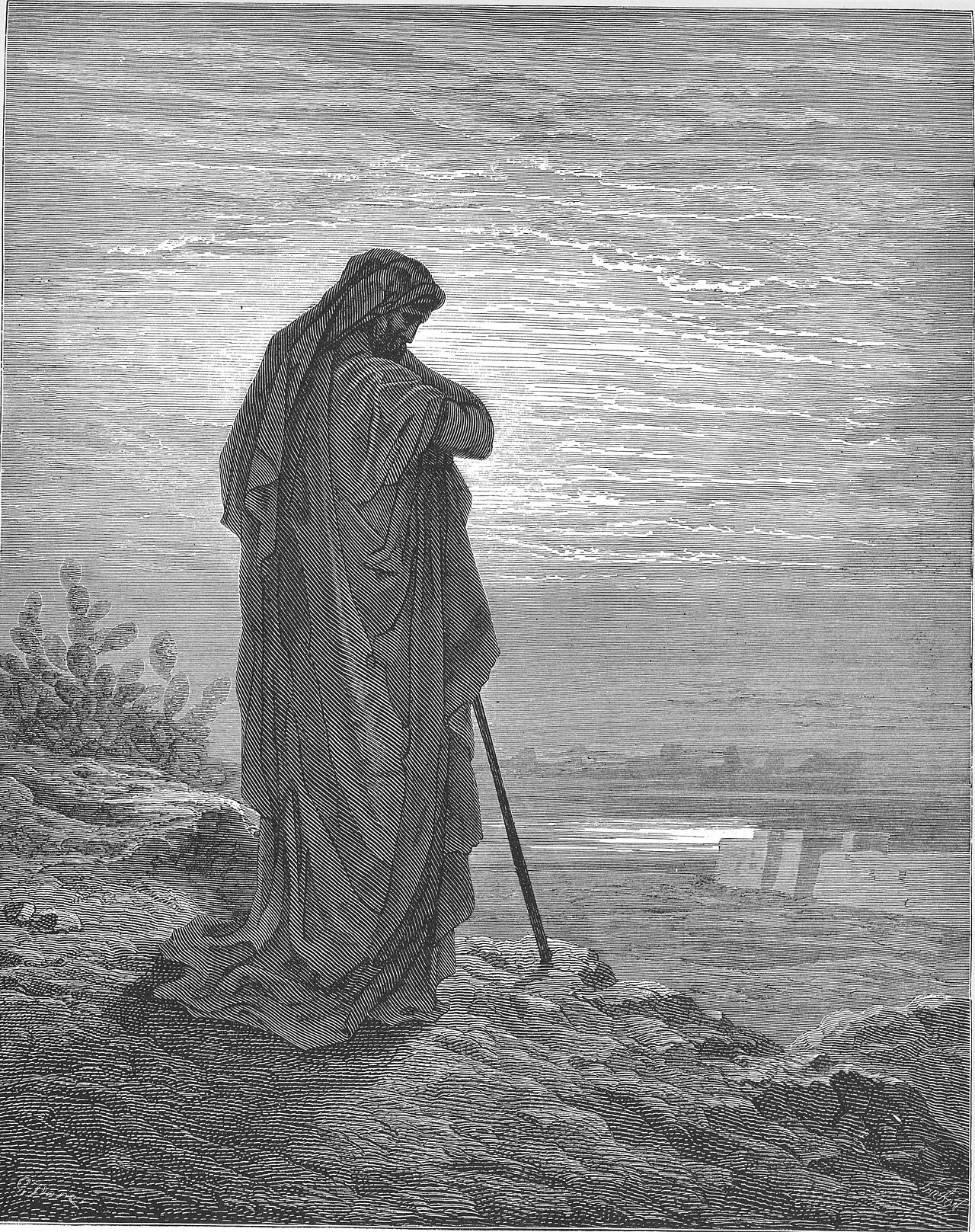
Amoschapter 5
27 verses · Amos · about 760 BC · The Twelve
Hear this word, O house of Israel, this lamentation I take up against you:
Introduction
Amos, The Twelve, Amos Overview.
This chapter is the third of the messages Amos gave to Israel, and it opens as a funeral song. Israel was at the height of its wealth, so the song was sung over a nation that looked alive and well. Courts sat in the town gate, and the rich used them to take grain and land from the poor. The chapter sets two kinds of seeking side by side and names the day the people were waiting for. Listen for the calls to seek and live. Notice what God says He wants in place of feasts and songs.
Context
- Who
- Israelites who could not imagine themselves as the corpse
- What
- A lament over Israel, calls to seek the LORD and live, a warning about the day of the LORD, and a rejection of worship without justice.
- Where
- The northern kingdom, its city gates, and the shrines at Bethel, Gilgal and Beersheba.
- When
- About 760 BC, in the reign of Jeroboam II of Israel; the book gives no exact year.
- Why
- To offer Israel life on God's terms while there was still time, and to show that worship cannot cover injustice.
Historical context
The chapter opens in the rhythm of a funeral dirge, a limping metre Israelites associated with professional mourners at a graveside. Singing it over a prosperous kingdom was as shocking as reading someone their own obituary at their birthday party.
Show the rest of the historical context, 3 more paragraphs
The gate was the courthouse. Excavated Israelite city gates at Dan, Beersheba, and Gezer have chambers with stone benches built into them, and this is where elders heard cases, witnesses testified, and contracts were sealed, the shaded, public bottleneck every citizen passed through. When Amos says they hate the one who reproves in the gate and take a bribe and push aside the needy, he is naming a specific place with a specific address.
The astronomy in the middle is not decoration. Pleiades and Orion were watched across the ancient world and were the property of star cults everywhere; Amos hands them to the God who made them and who turns deep darkness into morning and calls for the waters of the sea.
The two names at the end, Sikkuth and Kiyyun, are Assyrian astral deities associated with the planet Saturn. Their appearance in Israel's worship shows how far imported religion had come, and it shows up centuries later in Stephen's speech, quoted from this chapter.
Significance
Seek the LORD and live is the chapter's offer, and it is set directly against seek Bethel and Gilgal. There was still an open door, and it did not run through the shrines.
Show the rest of the significance, 1 more paragraph
I hate, I despise your feast days would have been almost blasphemous to a festival crowd. God says he will not accept the offerings and will not listen to the songs, and then names what he wants instead: let justice roll down like waters, and righteousness like an ever-flowing stream. In a land of seasonal wadis that run dry every summer, an ever-flowing stream was the rare, valuable, year-round kind.
This chapter in Jewish lifeWhat this chapter is in Jewish life and reading.
What is done
No part of this chapter is read in the synagogue. Probed for this lane, the site's table in src/lib/hebraic/readings.ts printed parashot 0 and no Haftarah use for Amos 5, and no festival reading for the book. The same probe printed 54 weekly portions and 6 festival readings in the table as a whole. Amos is heard in the synagogue twice in the year, and neither reading reaches this chapter. The table records Amos 2:6 to 3:8 as the Haftarah of Vayeshev and Amos 9:7 to 9:15 as the Ashkenazi Haftarah of Kedoshim.
The chapter is met in the study of Exodus. Under the seventeenth verse, where the Lord passes through the midst of the people, the corpus carries Mekhilta DeRabbi Yishmael, Tractate Pischa 11:18 and Mekhilta DeRabbi Shimon Ben Yochai 12:12 and 12:23. Pischa, the Passover, names that tractate of the Mekhilta, and the Passover law of Exodus 12 stands in the portion Bo, which the table records as Exodus 10:1 to 13:16. Under the sixth verse the corpus carries Shemot Rabbah 12:3.
How it is read
Rashi is the one commentator on this chapter whose English the corpus carries, quoted here from The Judaica Press complete Tanach with Rashi, translated by A. J. Rosenberg, which Sefaria reports as CC-BY. The translation is modern, so every quotation from it is fifty words or fewer.
The lament of the second verse Rashi reads as the end of the northern kingdom. When the ten tribes went into exile under Hoshea son of Elah, "a king will never again rise from the ten tribes" (Rashi on Amos 5:2:1). The call to seek the Lord and live he reads as a practice of the Temple. "Perform the pilgrimage to pay your vows in Jerusalem" (Rashi on Amos 5:4:1).
His note on the fifth verse is the longest in the chapter and turns on one verb. The verse says to seek neither Bethel nor Gilgal, and for Beersheba it says only do not cross over. Rashi reads from it that no idol stood at Beersheba, which lay on the road. So long as a man of the ten tribes on that road "did not yet pass Beersheba, he could still turn to the Temple, to Jerusalem" (Rashi on Amos 5:5:1). Past Beersheba the road led to the calf at Bethel or the calf at Dan. He proves it from Amos 8:14 and from the decrees of this verse, which fall on Gilgal and Bethel and not on Beersheba.
The court in the gate is the setting of the middle of the chapter, and Rashi says so outright, "you hated those who reprove you in the gates of the courts" (Rashi on Amos 5:10:1). The prudent man who keeps silent in an evil time keeps silent before God's judgment, "he shall not criticize the Divine standard of justice" (Rashi on Amos 5:13:1). The remnant of Joseph is the whole people. "All Israel are called by his name because he sustained them" (Rashi on Amos 5:15:1).
At the festivals and offerings Rashi names the Temple's music. The noise of songs is the song "that the Levites sing on the platform, since you are robbers and perverters of justice" (Rashi on Amos 5:23:1). The justice rolling down like water he reads, after Targum Jonathan, as a promise with a condition. "And you shall do this, and I will accept you. The justice that you have hidden and concealed shall be revealed and stream among you like water" (Rashi on Amos 5:24:1).
The last three verses are cited by Stephen in Acts 7:42 and 7:43, and the corpus holds no English note of Rashi on them. The store prints the two passages with different words. In the Berean Standard Bible, Amos names "Sakkuth your king and Kaiwan your star god" and exile "beyond Damascus". Stephen's citation names "the tabernacle of Molech and the star of your god Rephan" and exile "beyond Babylon". The corpus carries Chagigah 6b:4 and 10b:9 on the twenty-fifth verse and Seder Olam Rabbah 22:1 on the twenty-seventh, without their text.
The corpus carries four further notes on this chapter without an English text, each marked linked because Sefaria holds no English version of the ref. They stand cited and unquoted at Ibn Ezra on Amos 5:1:1, 5:17:1, 5:19:1 and 5:20:1.
What the rabbis say
The corpus carries forty rabbinic locators on this chapter, seven it files under Talmud and thirty-three under Midrash, and the text of none, so each is cited by ref here rather than quoted. On the first verse it holds Eikhah Rabbah, Petichta 2, Otzar Midrashim, Baraita of The 32 Midot of Aggadah 1:14 and Pesikta DeRav Kahana 15:4. On the second verse it holds Berakhot 4b:21, Ein Yaakov (Glick Edition), Berakhot 1:12 and Ein Yaakov, Berakhot 1:18. On the third verse it holds Sifrei Devarim 47:9 and Yalkut Shimoni on Torah 872:2.
On the fourth verse it holds Bamidbar Rabbah 10:1, Ein Yaakov (Glick Edition), Makkot 3:7 and Ein Yaakov, Makkot 3:10. On the fifth verse it holds Bereshit Rabbah 39:15. On the sixth verse it holds Shemot Rabbah 12:3. On the seventh verse it holds Yalkut Shimoni on Torah 83:1.
On the eighth verse it holds Aggadat Bereshit 8:2, Aggadat Bereshit 8:3 and Berakhot 58b:12. On the ninth verse it holds Ein Yaakov (Glick Edition), Shabbat 8:1, Ein Yaakov, Shabbat 8:1 and Jerusalem Talmud Sotah 9:13:5. On the tenth verse it holds Bereshit Rabbah 31:3, Mekhilta DeRabbi Yishmael, Tractate Bachodesh 6:9 and Midrash Lekach Tov, Exodus 2:14:1. On the twelfth verse it holds Sifrei Devarim 48:9.
On the fifteenth verse it holds Bereshit Rabbah 71:2, Bereshit Rabbati, Parashat Vayechi 44 and Chagigah 4b:10. On the sixteenth verse it holds Pesikta Rabbati 21:1. On the seventeenth verse it holds Mekhilta DeRabbi Shimon Ben Yochai 12:12, Mekhilta DeRabbi Shimon Ben Yochai 12:23 and Mekhilta DeRabbi Yishmael, Tractate Pischa 11:18. On the eighteenth verse it holds Berakhot 13a:3, Ein Yaakov (Glick Edition), Sanhedrin 11:53 and Midrash Tehillim 121:1.
On the nineteenth verse it holds Bereshit Rabbati, Parashat Vayishlach 5 and Bereshit Rabbati, Parashat Vayishlach 53. On the twenty-second verse it holds Yalkut Shimoni on Torah 719:25. On the twenty-fifth verse it holds Chagigah 10b:9 and Chagigah 6b:4. On the twenty-seventh verse it holds Seder Olam Rabbah 22:1. What each of them teaches is a saying of the rabbis, and it is reported as theirs wherever this site quotes one. The quotations wait on a fetch that carries the text.
Sources: Rashi, Rashi on Amos 5:2:1 to 5:24:1, The Judaica Press complete Tanach with Rashi, translated by A. J. Rosenberg, reported CC-BY; Ibn Ezra, Ibn Ezra on Amos 5:1:1, 5:17:1, 5:19:1 and 5:20:1, cited by ref because the corpus carries no English text; The Sefaria corpus, scripts/data/sources/sefaria/amos/5.json, the 40 Talmud and Midrash locators of this chapter; The site's own files, src/lib/hebraic/readings.ts, probed for this chapter and printing parashot 0 and no Haftarah use, with festivalReadingForBook(amos) null.
The heads below are this chapter's scenes. The numbered points under each are its verses.
A lamentation: the virgin of Israel is fallen
Amos 5:1-3
this lamentation I take up: Amos sings "Fallen is Virgin Israel, never to rise again" as a funeral dirge over a nation still alive. Virgin is a title the prophets give a whole people. Verse 3 gives the dirge its numbers, a city that marches out "a thousand strong will only see a hundred return."
Amos 5:1
“In order to impress Israel the more, Amos begins this his third appeal by a “dirge” over its destruction, mourning over those who were full of joy, and thought themselves safe and enviable. As if a living man, in the midst of his pride and luxury and buoyant recklessness of heart, could see his own funeral procession, and hear, as it were, over himself the “earth to earth, ashes to ashes, dust to dust.” It would give solemn thoughts, even though he should impatiently put them from him.”
The dirge speaks of the fall as already done. Jamieson, Fausset and Brown, following Calvin, read virgin as the beauty, wealth and power a state prides itself on. Adam Clarke reads it of the ten tribes, lost among the nations.
Amos 5:2
“The virgin of Israel - The kingdom of Israel, or the ten tribes, which were carried into captivity; and are now totally lost in the nations of the earth.”
Adam Clarke · Commentary on the Bible (1810-1826)evangelical
1 more voice on this verse
Amos 5:2
“La 2:13; may be interpreted, Thou who wast once the "virgin daughter of Zion." Rather, "virgin" as applied to a state implies its beauty, and the delights on which it prides itself, its luxuries, power, and wealth [CALVIN]. no more rise--in the existing order of things: in the Messianic dispensation it is to rise again, according to many prophecies.”
Jamieson, Fausset & Brown · Commentary Critical and Explanatory on the Whole Bible (1871)reformed
will only see a hundred return: Albert Barnes reads marches out as going out to fight, so each city keeps only a tenth of the men it sends. The loss falls alike on the large city and the small one, nine parts in ten destroyed. The dirge of verse 2 is given its numbers here.
Amos 5:3
“The city that went out by a thousand - (that is, probably that sent out a thousand fighting men, as the word “went out” is often used for, “went out” to fight,) “shall have” literally, “shall retain, an hundred.” She was to be decimated. Only, the tenth alone was to be reserved alive; the nine-tenths were to be destroyed. And this, alike in larger places and in the small. The city “that went forth an hundred shall retain ten.” Smaller places escape for their obscurity, the larger from their strength and situation. One common doom was to befall all.”
Seek me and live; do not seek Bethel
Amos 5:4-6
One door stands open, "Seek Me and live," set beside its opposite: "Do not seek Bethel or go to Gilgal." In Hebrew "Gilgal will surely go into exile" plays on the town's own name. The God who could be sought will otherwise "sweep like fire through the house of Joseph."
ConnectionsAmos 5:14
Do not seek Bethel or go to Gilgal: Matthew Henry notes that Bethel held one of the golden calves. Albert Barnes reads the verse as setting two kinds of seeking against each other: to seek God at Bethel was to lose Him. Barnes adds that Jeroboam I claimed that going up to Jerusalem was too much for Israel.
Amos 5:5
“But (and) seek not Bethel - Israel pretended to seek God in Bethel. Amos sets the two seeking, as incompatible. The god, worshiped at Bethel, was not the One God. To seek God there was to lose Him. “Seek not God,” he would say, “and a phantom, which will lead from God.” And pass not to Beersheba - Jeroboam I pretended that it was too much for Israel to go up to Jerusalem.”
1 more voice on this verse
Amos 5:5
“They had sought to Bethel, where one of the golden calves was; they had frequented Gilgal, a place which they chose to set up idols in, because it had been made famous in the days of Joshua by God's wonderful appearances to and for his people.”
Matthew Henry · Commentary on the Whole Bible (1707-1721)puritan
He will sweep like fire through the house of Joseph: Jamieson, Fausset and Brown recall that God is a consuming fire (Deuteronomy 4:24). The house of Joseph is the northern kingdom, as Adam Clarke notes. Jamieson, Fausset and Brown read the absence of anyone to put the fire out as the Bethel idols unable to turn the judgment away.
Amos 5:6
“Seek the Lord, and ye shall live - Repeated from Amo 5:4. In the house of Joseph - The Israelites of the ten tribes, of whom Ephraim and Manasseh, sons of Joseph, were the chief.”
Adam Clarke · Commentary on the Bible (1810-1826)evangelical
1 more voice on this verse
Amos 5:6
“God is "a consuming fire" (De 4:24; La 2:3). the house of Joseph--the kingdom of Israel, of which the tribe of Ephraim, Joseph's son, was the chief tribe (compare Eze 37:16). none to quench it in Beth-el--that is, none in Beth-el to quench it; none of the Beth-el idols on which Israel so depended, able to remove the divine judgments.”
Jamieson, Fausset & Brown · Commentary Critical and Explanatory on the Whole Bible (1871)reformed
Amos 5:7-9
those who turn justice into wormwood: Verse 7 names the crime the chapter answers, the courts made bitter. The second of the book's three hymns breaks in, setting the Maker of the stars against the corrupt judges. Its close, "He flashes destruction on the strong," shows a God able to overturn any human balance of power.
Amos 5:7
“Corruptio optimi est pessima -- The best, when corrupted, becomes the worst. "You leave off righteousness in the earth, as if those that do wrong were accountable to the God of heaven only, and not to the princes and judges of the earth. " Thus it was as before the flood, when the earth was filled with violence.”
Matthew Henry · Commentary on the Whole Bible (1707-1721)puritan
ConnectionsAmos 5:10
He who made the Pleiades and Orion: Jamieson, Fausset and Brown note that these were stars a shepherd like Amos knew well. Adam Clarke reads the waters of the sea as drawn up into clouds and poured out as rain. John Gill records a reading that joins the verse to verse 7 and applies it to Christ.
Amos 5:8
“That maketh the seven stars and Orion - Or, Hyades and Arcturus, Kimah and Kesil. See my notes on Job 9:9; Job 38:32, where the subject of this verse is largely considered. Turneth the shadow of death into the morning - Who makes day and night, light and darkness. Calleth for the waters of the sea - Raising them up by evaporation, and collecting them into clouds. And poureth them out - Causing them to drop down in showers upon the face of the earth. Who has done this? Jehovah is his name.”
Adam Clarke · Commentary on the Bible (1810-1826)evangelical
2 more voices on this verse
Amos 5:8
“Seek him that maketh the seven stars,.... Which some connect with the preceding words, without a supplement, "they leave righteousness on the ground, who maketh the seven stars"; understanding it of Christ, the Lord our righteousness, who is made unto us righteousness, whom the Jews rejected and despised, though the Maker of the heavens and the constellations in them. Some continue, and supply the words thus, and remember not him "that maketh the seven stars", as Kimchi; or forget him, as Japhet in Aben Ezra.”
Amos 5:8
“He names the stars well known to shepherds (to which class Amos belonged), Orion as the precursor of the tempests which are here threatened, and the Pleiades as ushering in spring. shadow of death--Hebraism for the densest darkness. calleth for the waters of the sea--both to send deluges in judgment, and the ordinary rain in mercy (1Ki 18:44).”
Jamieson, Fausset & Brown · Commentary Critical and Explanatory on the Whole Bible (1871)reformed
He flashes destruction on the strong: The verb is read in more than one way. John Gill follows the older rendering, God strengthening the spoiled against the strong, and cites the Targum. Albert Barnes reads it as God making devastation smile on the strong, and Jamieson, Fausset and Brown, after Maurer, read destruction coming upon them.
Amos 5:9
“That strengtheneth the spoiled against the strong,.... Such as have been taken by an enemy, who have been stripped of their armour, and spoiled of all their goods and substance, and have no friends nor allies, nor anything to help themselves with; the Lord can supply them with strength, furnish them with weapons, and send them helpers, so that they shall rise up against their conquerors and spoilers, and in their turn subdue them. The Targum is, "that strengthens the weak against the strong;'' or causes the weak to prevail over the strong.”
2 more voices on this verse
Amos 5:9
“That strengtheneth the spoiled - (Literally, “spoil” English margin) probably That “maketh devastation to smile on the strong.” . The “smile,” in anger, attests both the extremity of anger, and the consciousness of the ease, wherewith the offence can be punished. They were strong in their own strength; strong, as they deemed, in their “fortress” ; “strong with an evil strength, like one phrensied against his physician.” But their strength would be weakness. “Desolation” when God willed, would “smile at” all which they accounted “might,” and would “come against the fortress,” which, as they deemed, “cut off” all approach.”
Amos 5:9
“The Hebrew is elsewhere used, to make, to shine, to make glad: and as English Version here (Ps 39:13), "recover strength." the spoiled shall come--"devastation," or "destruction shall come upon" [MAURER].”
Jamieson, Fausset & Brown · Commentary Critical and Explanatory on the Whole Bible (1871)reformed
They hate the man who reproves in the gate
Amos 5:10-13
who reproves in the gate: The gate was the court, and "those who hate the one who reproves in the gate" are the officials meant to protect the poor. The "stone houses you have built" and the "lush vineyards you have planted" go unused, the covenant curse of Deuteronomy 28:30 and 39.
Amos 5:10
“They hate him that rebukes in the gate, in the gate of the Lord's house, or in their courts of justice, or in the places of concourse, where Wisdom is lifting up her voice, Prov. i. Reprovers in the gate are reprovers by office; these they hated, counting them their enemies because they told them the truth, as Ahab hated Micaiah.”
Matthew Henry · Commentary on the Whole Bible (1707-1721)puritan
a tax of grain: Albert Barnes notes that the phrasing marks a habit of trampling on the poor, and that the word for the grain means a present. Jamieson, Fausset and Brown record the reading of Rabbi Salomon, wheat lent in scarcity and taken back at heavy interest.
Amos 5:11
“Or wheat advanced in time of scarcity, and exacted again at a burdensome interest [RABBI SALOMON]. built houses . . . but not dwell in them . . . vineyards, . . . but not drink wine of them--according to the original prophecy of Moses (De 28:30, 38, 39).”
Jamieson, Fausset & Brown · Commentary Critical and Explanatory on the Whole Bible (1871)reformed
1 more voice on this verse
Amos 5:11
“Forasmuch therefore - (Since they rejected reproof, he pronounces the sentence of God upon them,) “as your treading is upon the poor.” This expresses more habitual trampling on the poor, than if he had said, “ye tread upon the poor.” They were ever trampling on those who were already of low and depressed condition. “And ye take from him burdens of wheat, presents of wheat.” The word always signifies presents, voluntary , or involuntary , what was carried, offered to anyone.”
For I know that your transgressions are many: Albert Barnes notes that the Hebrew reads I have known, since Israel thought God did not know because He had not punished. He reads the second phrase as mighty sins, as strong as the deeds the people were proud of. Bribes turn the gate against the righteous and the poor.
the prudent keep silent in such times: Albert Barnes notes that the evil time may be the season when the wicked prevail or the season of the punishment itself. In the first case the wise among the oppressed poor keep silent, because complaint would find no justice.
Amos 5:13
“Therefore the prudent shall keep silence in that time - The “time” may be either the time of the obduracy of the wicked, or that of the common punishment. For a time may be called “evil,” whether evil is done, or is suffered in it, as Jacob says, “Few and evil have the days of the years of my life been” Gen 47:9. Of the first, he would perhaps say, that the oppressed poor would, if wise, be silent, not complaining or accusing, for, injustice having the mastery, complaint would only bring on them fresh sufferings.”
Seek good and not evil, that you may live
Amos 5:14-15
Seek good, not evil: The promise that "the LORD, the God of Hosts, will be with you, as you have claimed" takes Israel at its own word. The closing "Perhaps the LORD, the God of Hosts, will be gracious to the remnant of Joseph" keeps mercy possible and never presumed.
Amos 5:14
“Let us hurry to him in whom is that highest good, since he is goodness itself. He is the patience of Israel calling you to repentance, so you will not come to judgment but may receive the remission of sins. "Repent," he says. He is the one of whom the prophet Amos cries, "Seek you good." He is the highest good, for he needs nothing and abounds in all things. Well may he abound, for in him dwells bodily the fullness of divinity.”
Ambrose of Milan · written before 397 · LETTER 79patristic
establish justice in the gate: Jamieson, Fausset and Brown set the verse beside Isaiah 1:16-17 and Romans 12:9, and compare the perhaps of mercy with Moses at Exodus 32:30. Cyril of Alexandria reads the remnant of Joseph as Ephraim, the ten tribes, called by the name of their father Joseph.
Amos 5:15
“And again it signifies Ephraim, that is, the ten tribes. For as I have already said before, since Ephraim came from Joseph, for this reason he is also signified by his father's name.”
Cyril of Alexandria · written before 444 · Commentary on Amospatristic
Woe to those who long for the day of the LORD
Amos 5:16-17
wailing in all the public squares: Verse 16 opens with a threefold title, "the LORD, the God of Hosts, the Lord." "There will be wailing in all the vineyards," the fields planted for wine in verse 11 filled with funeral cries. The words "I will pass through your midst" echo the Passover night of Exodus 12:12.
Amos 5:16
“They shall call the husbandman to mourning - Because the crops have failed, and the ground has been tilled in vain. Such as are skillful of lamentation - See the note on Jer 9:17.”
Adam Clarke · Commentary on the Bible (1810-1826)evangelical
There will be wailing in all the vineyards: John Gill notes that the vintage was a season of shouting, and here the vines are destroyed and the shout becomes a wail (Jeremiah 48:32). He reads I will pass through your midst as the Lord going through to destroy, as He passed through Egypt when the firstborn died.
Amos 5:17
“And in all vineyards shall be wailing,.... The vines being destroyed, and no grapes to be gathered, and put into the press; when there used to be great shoutings, and large expressions of joy, at the gathering in of the vintage, and pressing the grapes; but now there shall be a different tone; see Jer 48:32; for I will pass through thee, saith the Lord; through their cities, towns, and country, fields and vineyards, and destroy all in his way, as he passed through Egypt when he destroyed their firstborn.”
Amos 5:18-20
who long for the Day: Israel expected the Day of the LORD as vindication against her enemies, and Amos calls it "darkness and not light" for Israel itself. This is the earliest use of the Day of the LORD as a fixed phrase in Scripture, and Joel and Zephaniah carry its darkness forward.
Amos 5:18
“Wo unto you that desire the day of the Lord - The prophet had often denounced the coming of God’s day, that is, of a time of judgment; and the unbelievers had said, “Let his day come, that we may see it.” Now the prophet tells them that that day would be to them darkness - calamity, and not light - not prosperity.”
Adam Clarke · Commentary on the Bible (1810-1826)evangelical
1 more voice on this verse
Amos 5:18
“Or, rather, it is spoken to those who speak jestingly of that day of the Lord which the prophet spoke so seriously of; they desired it, that is, they challenged it; they said, Let him do his worst; let him make speed, and hasten his work, Isa. v. 19 . Where is the promise of his coming?”
Matthew Henry · Commentary on the Whole Bible (1707-1721)puritan
like a man who flees from a lion: Jamieson, Fausset and Brown suggest that Israel longed for the day as a way out of its present troubles. Albert Barnes sees terror on every side, abroad and at home, and notes that the Syrian bear was held to be fiercer than the lion.
Amos 5:19
“As if a man, did flee from a lion - The Day of the Lord is a day of terror on every side. Before and behind, without and within, abroad under the roof of heaven, or under the shelter of his own, everywhere is terror and death. The Syrian bear is said to have been more fierce and savage than the lion. For its fierceness and voracity Dan 7:5, God made it, in Daniel’s vision, a symbol of the empire of the Medes. From both lion and bear there might be escape by flight.”
1 more voice on this verse
Amos 5:19
“As if a man did flee . . . a lion, and a bear met him--Trying to escape one calamity, he falls into another. This perhaps implies that in Am 5:18 their ironical desire for the day of the Lord was as if it would be an escape from existing calamities. The coming of the day of the Lord would be good news to us, if true: for we have served God (that is, the golden calves).”
Jamieson, Fausset & Brown · Commentary Critical and Explanatory on the Whole Bible (1871)reformed
even gloom with no brightness in it?: The question repeats verse 18 and asks the hearers to answer it themselves. Albert Barnes reads it as an appeal to conscience. However people dull it with argument, they know in their hearts that there is a Judge, that guilt is punished and that they are guilty.
Amos 5:20
“Shall not the Day of the Lord be darkness? - He had described that Day as a day of inevitable destruction, such its man’s own conscience and guilty fears anticipate, and then appeals to their own consciences, “is it not so, as I have said?” People’s consciences are truer than their intellect. However, they may employ the subtlety of their intellect to dull their conscience, they feel, in their heart of hearts, that there is a Judge, that guilt is punished, that they are guilty.”
I hate your feasts: let justice roll down like waters
Amos 5:21-24
The Lord refuses the festival calendar in His own voice, "I hate, I despise your feasts." Burnt offerings, grain offerings and peace offerings are named and turned away. Verse 24 is the standard all of it failed: "let justice roll on like a river, and righteousness like an ever-flowing stream."
Amos 5:21
“I hate, I despise your feasts - Israel clave to its heart’s sin, the worship of the true God, under the idol-form of the calf; else, it would fain be conscientious and scrupulous. It had its “feasts” of solemn “joy” and the “restraint” of its “solemn assemblies” , which all were constrained to keep, abstaining from all servile work. They offered “whole burnt offerings,” the token of self-sacrifice, in which the sacrificer retained nothing to himself, but gave the whole freely to God. They offered also “peace offerings,” as tokens of the willing thankfulness of souls at peace with God.”
1 more voice on this verse
Amos 5:21
“I do not acknowledge them: unlike those in Judah, yours are of human, not divine institution. I will not smell--that is, I will take no delight in the sacrifices offered (Ge 8:21; Le 26:31). in your solemn assemblies--literally, "days of restraint." Isa 1:10-15 is parallel.”
Jamieson, Fausset & Brown · Commentary Critical and Explanatory on the Whole Bible (1871)reformed
I will not accept them: Three kinds of offering are named and refused: the burnt offering, the grain offering and the peace offering of fattened cattle. Albert Barnes calls the whole burnt offering the token of self-sacrifice, in which the worshipper kept nothing back. Jamieson, Fausset and Brown give Isaiah 1:10-15 as the parallel.
Amos 5:22
“The peace-offerings of your fat beasts - מריאיכם merieychem probably means buffaloes; and so Bochart.”
Adam Clarke · Commentary on the Bible (1810-1826)evangelical
Take away from Me the noise of your songs!: Albert Barnes notes that the Hebrew reads from upon Me, the songs a weight God will no longer carry, as at Isaiah 1:14. Jerome calls the songs of the Levites tumult because there is no beautiful praise in the mouth of a sinner. Jamieson, Fausset and Brown compare Isaiah 1:15.
Amos 5:23
“Take thou away from Me - Literally, “from upon Me,” that is, from being a burden to Me, a weight on Me. So God says by Isaiah, “your new moons and your appointed feasts My soul hateth; they are a burden upon Me; I am weary to bear them” Isa 1:14. Their “songs” and hymns were but a confused, tumultuous, “noise,” since they had not the harmony of love.”
1 more voice on this verse
Amos 5:23
So Isa 1:14, "They are a trouble unto Me (literally, 'a burden upon Me'): I am weary to bear them." the noise of thy songs--The hymns and instrumental music on sacred occasions are to Me nothing but a disagreeable noise. I will not hear--Isaiah substitutes "prayers" (Isa 1:15) for the "songs" and "melody" here; but, like Amos, closes with "I will not hear."
Jamieson, Fausset & Brown · Commentary Critical and Explanatory on the Whole Bible (1871)reformed
let justice roll on like a river: Adam Clarke reads the verse as a command: let justice fall like rain and righteousness run like the Jordan, carrying every abomination away. Jerome reads it of the judgment of God revealed like water running downhill, uncovering all it passes and sweeping everything along.
Amos 5:24
“Let judgment run down - Let the execution of justice be everywhere like the showers that fall upon the land to render it fertile; and let righteousness in heart and life be like a mighty river, or the Jordan, that shall wind its course through the whole nation, and carry every abomination into the Dead Sea. Let justice and righteousness prevail everywhere, and sweep their contraries out of the land.”
Adam Clarke · Commentary on the Bible (1810-1826)evangelical
1 more voice on this verse
Amos 5:24
“The sin of Israel in Amos' time is the very sin of their forefathers, mocking God with worship, while at the same time worshipping idols (compare Eze 20:39). It was clandestine in Moses' time, else he would have put it down; he was aware generally of their unfaithfulness, though not knowing the particulars (De 31:21, 27).”
Jamieson, Fausset & Brown · Commentary Critical and Explanatory on the Whole Bible (1871)reformed
Amos 5:25-27
sacrifices and offerings forty years: The question "Did you bring Me sacrifices and offerings forty years in the wilderness" expects the answer no. Stephen quotes the passage at Acts 7:42-43, and the Greek text he follows names Babylon where the Hebrew names Damascus. The chapter that opened as a dirge closes on exile "beyond Damascus."
Amos 5:25
“Have ye offered unto me sacrifices and offerings,.... No; they were not offered to God, but to devils, to the golden calf, and to the host of heaven: so their fathers did in the wilderness forty years; where sacrifices were omitted during that time, a round number for a broken one, it being about thirty eight years; and these their children were imitators of them, and offered sacrifice to idols too, and therefore deserved punishment as they: even ye, O house of Israel? the ten tribes, who are here particularly charged and threatened; See Gill on Act 7:42.”
2 more voices on this verse
Amos 5:25
“Have ye offered - (better, “Did ye offer”) unto Me sacrifices and offerings? Israel justified himself to himself by his half-service. This had been his way from the first. “Their heart was not whole with God, neither abode they in His covenant” Psa 78:37. He thought to be accepted by God, because he did a certain homage to Him. He acknowledged God in his own way. God sets before him another instance of this half-service and what it issued in; the service of that generation which He brought out of Egypt, and which left their bones in the wilderness.”
Amos 5:25
“Stephen quotes this passage ( Acts vii. 42 ), to show the Jews that they ought not to think it strange that ceremonial law was repealed when from the beginning it was comparatively made light of. What little reason they had to expect that their sacrifices should be acceptable to God, when they and their fathers had been all along addicted to the worship of other gods.”
Matthew Henry · Commentary on the Whole Bible (1707-1721)puritan
Cross references
Amos 5:25
- Quoted inActs 7:42“But God turned away from them and gave them over to the worship of the host of heaven, as it is written in the book of the prophets: ‘Did you bring Me sacrifices and offerings forty years in the wilderness, O house of Israel?”
'O ye house of Israel, have ye offered...', Stephen ('as it is written in the book of the prophets')
the idols you made for yourselves: John Wesley reads the verse of the wilderness, the people carrying a shrine for the image of Moloch. Adam Clarke applies it to Israel in the days of Amos, so given to idols that they carried portable shrines with them everywhere. The Berean text names the gods Sakkuth and Kaiwan.
Amos 5:26
“But ye have borne - The preceding verse spoke of their fathers; the present verse speaks of the Israelites then existing, who were so grievously addicted to idolatry, that they not only worshipped at stated public places the idols set up by public authority, but they carried their gods about with them everywhere. The tabernacle of your Moloch - Probably a small portable shrine, with an image of their god in it, such as Moloch; and the star or representative of their god Chiun.”
Adam Clarke · Commentary on the Bible (1810-1826)evangelical
1 more voice on this verse
Amos 5:26
“Ye have born - Ye carried along with you in the wilderness; the shrine, or canopy in which the image was placed. Moloch - The great idol of the Ammonites.”
John Wesley · Explanatory Notes upon the Old Testament (1765)evangelical
Albert Barnes recalls that Syria had been the enemy God used to chasten Israel (2 Kings 13:7), and Damascus had been given into Israel's hands. Matthew Henry reads this exile as heavier than the one Damascus suffered, since the sins of a professing people are greater.
Amos 5:27
“Therefore - (And) this being so, such having been their way from the beginning until now, will I cause you to go into captivity beyond Damascus Syria was the most powerful enemy by whom God had heretofore chastened them 2Ki 13:7. From Syria He had recently, for the time, delivered them, and had given Damascus into their hands 2Ki 14:25, 2Ki 14:28. That day of grace had been wasted, and they were still rebellious. Now God would bring against them a mightier enemy. Damascus, the scene of their triumph, should be their pathway to captivity.”
1 more voice on this verse
Amos 5:27
“Or the captivity of Israel under Shalmaneser was far beyond that of Damascus under Tiglath-pileser, and much more grievous and destructive, which was foretold ch. i. For, as the sins of God's professing people are greater than the sins of others, so it may be expected that their punishments will be proportionable.”
Matthew Henry · Commentary on the Whole Bible (1707-1721)puritan
Keep studying
Studies8
People and groups1
Words12
Sources for this chapter
The summary
Jamieson, Fausset & Brown, Commentary Critical and Explanatory; John Calvin, Commentaries; John Wesley, Notes on the Old Testament and Matthew Henry, Complete Commentary.
The exposition
Adam Clarke, Commentary on the Bible; Albert Barnes; Carl Friedrich Keil, The Twelve Minor Prophets; Cyril of Alexandria, Commentary on Amos; Edward Bouverie Pusey, The Minor Prophets: A Commentary; Jamieson, Fausset & Brown, Commentary Critical and Explanatory on the Whole Bible; Jerome, Commentary on Amos; John Gill; John Wesley, Explanatory Notes upon the Old Testament and Matthew Henry, Commentary on the Whole Bible.