
Amos 5:1
in Amos 5Hear this word, O house of Israel, this lamentation I take up against you:
BSB
The same verse in ASV and KJV ▾
ASV
Hear ye this word which I take up for a lamentation over you, O house of Israel.
KJV
Hear ye this word which I take up against you, even a lamentation, O house of Israel.
⋯
This verse in Amos 5
Commentary
5 notes on this verseA commentator
Albert Barnes1798–1870
Notes, Explanatory and Practical, on the Old and New Testaments (1832-1869)
In order to impress Israel the more, Amos begins this his third appeal by a “dirge” over its destruction, mourning over those who were full of joy, and thought themselves safe and enviable. As if a living man, in the midst of his pride and luxury and buoyant recklessness of heart, could see his own funeral procession, and hear, as it were, over himself the “earth to earth, ashes to ashes, dust to dust.” It would give solemn thoughts, even though he should impatiently put them from him.
This site's exposition
a lamentation, O house of Israel
on Amos 5:1-3
Amos takes up a lamentation over a nation not yet dead, the funeral dirge sung before the funeral, the virgin of Israel fallen and none to raise her up. The bench reads virgin as a title of unbroken standing now shattered rather than any comment on conduct, the same title the prophets give Zion and Babylon alike when a people's confidence is stripped away. The arithmetic of verse 3, a thousand marching out and a hundred returning, ten out of a hundred, is read as the ordinary shrinkage of an army broken in the field, one defeat cutting the nation down by nine parts in ten.
The record, by era
The Church Fathers1 voice
(Chapter 5, Verses 1-2) Hear this word, which I bring against you as a lamentation. The house of Israel has fallen, and it shall not rise again. The virgin of Israel is cast down upon her own land; there is no one to raise her up. LXX: Hear this word, which I will take up against you as a lamentation. The house of Israel has fallen, it shall not rise again.
The Puritans and the Awakening1 voice
Hear ye the word which I take up against you,.... And which was not his own word, but the word of the Lord; and which he took up, by his direction as a heavy burden as some prophecies are called, and this was; and which, though against them, a reproof for their sins, and denunciation of punishment for them, yet was to be heard; for every word of God is pure, and to be hearkened to, whether for us or against us; since the whole is profitable, either for doctrine and instruction in righteousness, or for reproof and correction.
The Nineteenth Century1 voice
Hear ye this word - Attend to this doleful song which I make for the house of Israel.
The words behind it
11 Hebrew wordsEvery Hebrew word of this verse in the order it stands, with what it means and the door to its own study. The last column counts the times a word stands in the whole Bible: the rarer the word, the more the places it appears belong together.
| Hebrew | Sound | Meaning | Word study | In the Bible |
|---|---|---|---|---|
| שִׁמְע֞וּ | shimu | hear | H8085 → | 1159 times |
| אֶת־ | ʾet- | <obj.> | H853 → | 10935 times |
| הַדָּבָ֣ר | hadavar | the word | H1697 → | 1440 times |
| הַזֶּ֗ה | hazeh | <the> this | H2088 → | 1180 times |
| אֲשֶׁ֨ר | ʾasher | which | H834 → | 5497 times |
| אָנֹכִ֜י | ʾanokhi | I | H595 → | 359 times |
| נֹשֵׂ֧א | nose' | [am] lifting up | H5375 → | 656 times |
| עֲלֵיכֶ֛ם | ʾaleikhem | on you | H5921 → | 5755 times |
| קִינָ֖ה | kinah | a lamentation | H7015 → | |
| בֵּ֥ית | beit | O house of | H1004 → | 2046 times |
| יִשְׂרָאֵֽל׃ | yisrael | Israel | H3478 → | 2507 times |
שִׁמְע֞וּhear
shimuH8085 →1159 times
אֶת־<obj.>
ʾet-H853 →10935 times
הַדָּבָ֣רthe word
hadavarH1697 →1440 times
הַזֶּ֗ה<the> this
hazehH2088 →1180 times
אֲשֶׁ֨רwhich
ʾasherH834 →5497 times
אָנֹכִ֜יI
ʾanokhiH595 →359 times
נֹשֵׂ֧א[am] lifting up
nose'H5375 →656 times
עֲלֵיכֶ֛םon you
ʾaleikhemH5921 →5755 times
קִינָ֖הa lamentation
kinahH7015 →
בֵּ֥יתO house of
beitH1004 →2046 times
יִשְׂרָאֵֽל׃Israel
yisraelH3478 →2507 times
A shaded row is a word that stands 400 times or fewer in the Bible.
The walk
8 stopsEach card is a verse this one points to, and under it the verses that one points to in turn. Where several paths arrive at the same place, that place is listed first: the text keeps returning to it.
Through
Jeremiah 9:20Now, O women, hear the word of the LORD. Open your ears to the word of His mouth. Teach your daughters to wail, and one another to lament.
it leads to
- Luke 23:27–30
A great number of people followed Him, including women who kept mourning and wailing for Him.
- Isaiah 32:9–13
Stand up, you complacent women; listen to me. Give ear to my word, you overconfident daughters.
- Job 22:22
Receive instruction from His mouth, and lay up His words in your heart.
- Luke 23:27–30
Through
Jeremiah 9:17This is what the LORD of Hosts says: “Take note, and summon the wailing women; send for the most skillful among them.
it leads to
- Amos 5:16–17
Therefore this is what the LORD, the God of Hosts, the Lord, says: “There will be wailing in all the public squares and cries of ‘Alas! Alas!’ in all the streets. The farmer will…
- Ecclesiastes 12:5
when men fear the heights and dangers of the road, when the almond tree blossoms, the grasshopper loses its spring, and the caper berry shrivels—for then man goes to his eternal home and mourners…
- Amos 5:16–17
Through
Jeremiah 9:10I will take up a weeping and wailing for the mountains, a dirge over the wilderness pasture, for they have been scorched so no one passes through, and the lowing of cattle is not…
it leads to
- Jeremiah 12:4
How long will the land mourn and the grass of every field be withered? Because of the evil of its residents, the animals and birds have been swept away, for the people have said,…
- Hosea 4:3
Therefore the land mourns, and all who dwell in it will waste away with the beasts of the field and the birds of the air; even the fish of the sea disappear.
- Jeremiah 12:4
Through
Jeremiah 7:29Cut off your hair and throw it away. Raise up a lamentation on the barren heights, for the LORD has rejected and forsaken the generation of His wrath.’
it leads to
- Job 1:20
Then Job stood up, tore his robe, and shaved his head. He fell to the ground and worshiped,
- Job 1:20
Where this verse is studied
About Amos
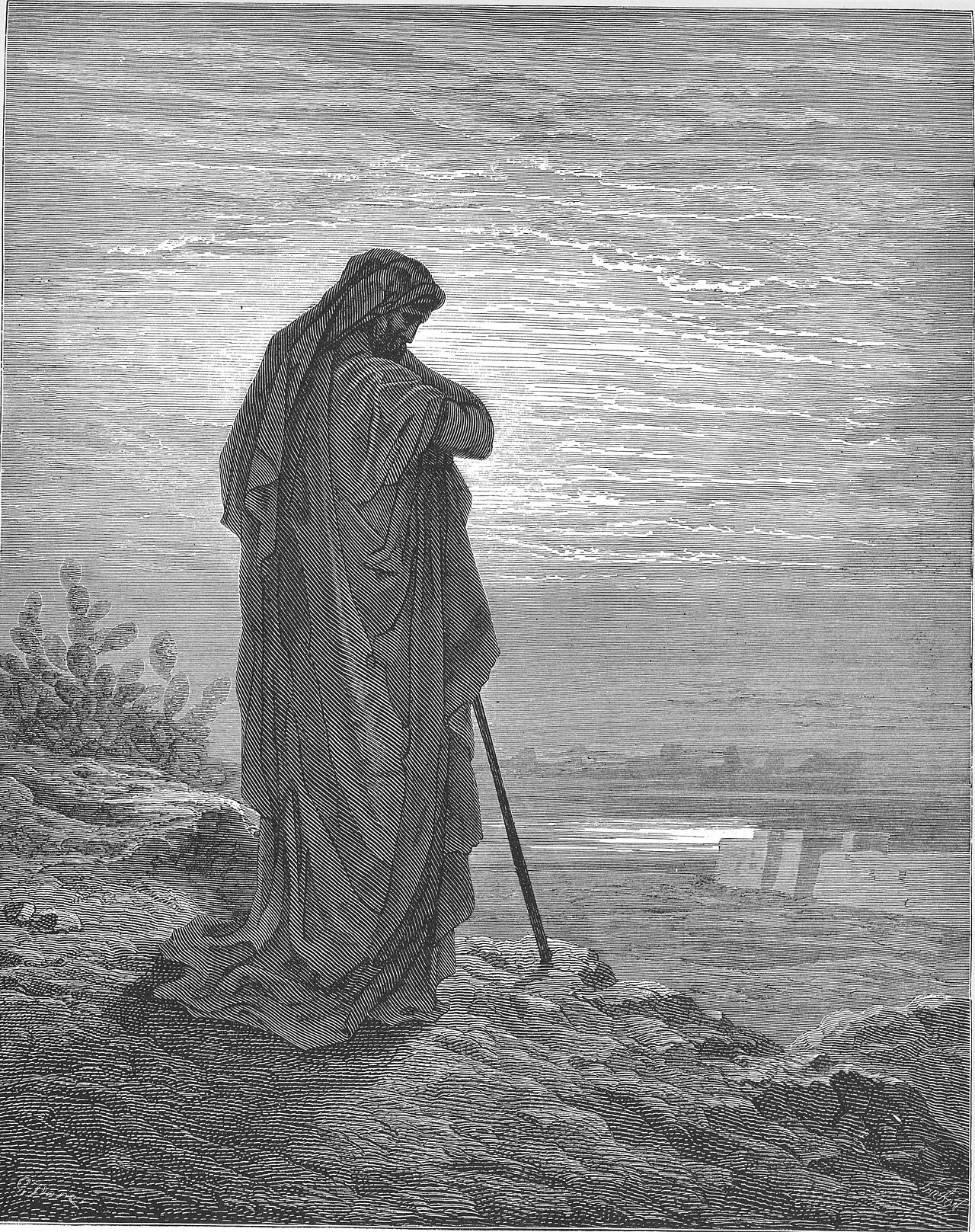
This page draws on Adam Clarke, Commentary on the Bible; Albert Barnes, Notes, Explanatory and Practical, on the Old and New Testaments (1832-1869); Carl Friedrich Keil, The Twelve Minor Prophets; Jerome, Commentary on Amos; John Gill, Exposition of the Old Testament and John Gill, Exposition of the Old Testament (1748-1763).