
2 Chronicleschapter 34
33 verses · Ezra, by tradition · 450 to 400 BC · History
Josiah was eight years old when he became king, and he reigned in Jerusalem thirty-one years.
Introduction
Ezra, by tradition, History, 2 Chronicles Overview.
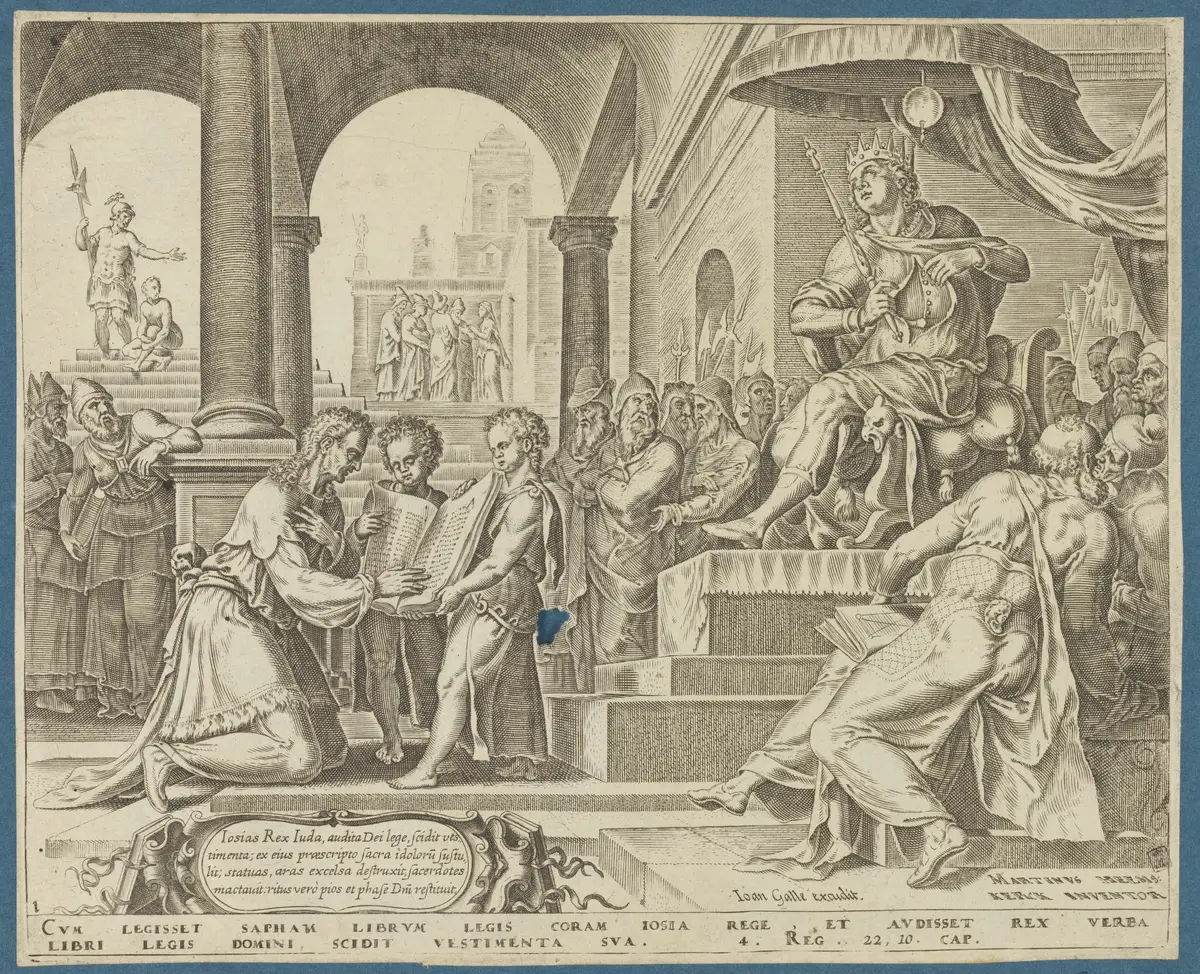
This chapter was written for a generation that had to learn again the law their nation was founded on. It follows a king who came to the throne as a boy and began to seek God while still young. The book dates each stage of his reform by the year of his reign. Midway through, an ordinary task in the temple turns up something the king had never heard. Listen for how he responds to what is read to him. Then listen to the prophetess, who speaks judgment and mercy in the same answer.
Context
- Who
- A generation that had grown up without the text their nation was founded on
- What
- Josiah's purge of idolatry, the repair of the temple, the finding of the Book of the Law, Huldah's prophecy, and the renewal of the covenant.
- Where
- Jerusalem and the temple, with the purge reaching north into Manasseh, Ephraim, Simeon and Naphtali.
- When
- About 640 to 622 BC, from the start of Josiah's reign to its eighteenth year.
- Why
- To show that God's word can be lost and found, and that hearing it calls for humility and a covenant to obey it.
Historical context
The chapter is Josiah's, and around him stand Hilkiah the priest, Shaphan the scribe, three officials sent to the temple, and Huldah the prophetess.
Show the rest of the historical context, 4 more paragraphs
The time runs from about 640 BC to 622 BC. The eighteenth year is the fixed point, the year of the repair and the discovery, and the earlier stages are dated by the chapter itself.
The place is Jerusalem and the temple, with the purge reaching well beyond Judah into four named northern territories that had been Israel's and were then resettled under Assyria.
The occasion for the discovery is ordinary. Money collected for repairs was being counted out, and the book came to light in the course of that work.
A first hearer knew how far the country had drifted. Two long reigns, Manasseh's and Amon's, stood between this king and the last reform, and the chapter's own account has a scroll of the law of Moses come as news to the king of Judah. A hearer also knew that burning the bones of priests on their own altars was the strongest defilement the law allowed. A king's men going to a prophetess for a ruling on a text was an act of authentication rather than of curiosity.
Significance
For Judah this chapter said that the word could be lost and found, and that finding it was not the same as having obeyed it. Josiah tears his clothes at what he hears rather than at what he has done.
Show the rest of the significance, 2 more paragraphs
It also told them that judgment and mercy can be spoken in one oracle. Huldah says the evil on the place will come and that this king will be gathered to his grave in peace.
The covenant of verses 29 to 32 gave them their own part in it. The book was read in the people's hearing and the king made the covenant standing in his place before binding the nation to it.
This chapter in Jewish lifeWhat this chapter is in Jewish life and reading.
What is done
Chronicles stands among the Writings in the Hebrew canon, and the annual cycle of Torah portions and their Haftarot draws on other books. A Jewish reader meets this chapter in study rather than in a reading appointed for a Sabbath or a feast, and the site's own reading data records the same for every chapter.
The chapter turns on a scroll being read aloud to a king, and Rashi explains the office that made that ordinary. Every king kept a scribe to write down what happened in the kingdom, and a recorder sat beside the scribe to call each event to mind (Rashi on II Chronicles 34:8:1). Reading a document before the king was the scribe's own duty, which is why the high priest handed the scroll to him (Rashi on II Chronicles 34:15:1). Rashi identifies the scroll itself as the Book of Deuteronomy (Rashi on II Chronicles 34:14:1).
How it is read
The king's youth is read as the surprising thing about him. Rashi says the wonder is that he began to seek God while he was still a youth, and that no one would be surprised had he been thirty (Rashi on II Chronicles 34:3:1). The tearing of the garments is read as a personal application. Rashi has the king hearing the curse of Deuteronomy on a king the people set over themselves, and taking it as spoken about himself (Rashi on II Chronicles 34:19:1).
The choice of Huldah rather than Jeremiah is answered from the Talmud. Rashi reports the explanation of the Sages that a woman is more merciful than a man (Rashi on II Chronicles 34:22:1, citing Megillah 14b). He also reads the order of her answer as deliberate. She breaks off the word about the place and its people, finishes it, and then turns to the longer word about the king who sent to her (Rashi on II Chronicles 34:23:1).
The promise of a peaceful grave is the chapter's hardest line, and Rashi does not soften the death. He takes the peace to mean that the king's eyes would not see the evil coming on the place, which is the destruction of the house (Rashi on II Chronicles 34:28:1). The pouring of wrath he explains from the fire that wrath is compared to (Rashi on II Chronicles 34:21:1).
Metzudat David comments at 34:5:1, 34:24:1, 34:26:1 and 34:27:1, and Radak at 34:7:1. The corpus holds no English text for either, so both stand cited and unquoted. This chapter carries more of Rashi than any other in the range except the last, nineteen comments in all.
What the rabbis say
The corpus carries six locators on this chapter, the fewest of any chapter here that carries one at all, and it holds the locator alone for each. Pirkei DeRabbi Eliezer carries it at 17:14 and 34:5. Tractate Soferim carries it at 7:3 and the Jerusalem Talmud at Megillah 4:1:2. The other two are Otzar Midrashim, Midrashim on Missing and Extra Letters 1:28, and Introductions to Amoraic Literature, Part II, Pesachim, Chapter I 7.
Sources: Rashi, Rashi on II Chronicles, the Judaica Press complete Tanach with Rashi, translated by A. J. Rosenberg (Sefaria, CC-BY); Metzudat David, Metzudat David on II Chronicles 34, cited by ref from the Sefaria corpus, which holds no English version of it; Radak, Radak on II Chronicles 34, cited by ref from the Sefaria corpus, which holds no English version of it; The Sefaria corpus on disk, scripts/data/sources/sefaria/2-chronicles/34.json, fetched 2026-09-19; The reading data of this site, src/lib/hebraic/readings.ts, probed in this lane: 2-chronicles parashot 0, haftarah uses 0, hasSynagogueReading true for 0 of 36 chapters.
The heads below are this chapter's scenes. The numbered points under each are its verses.
A young king purges Judah and Israel of its idols
2 Chronicles 34:1-2
Josiah was eight years old when he became king: Chronicles opens Josiah as Kings does: “Josiah was eight years old when he became king,” and he reigned thirty-one years. The refrain that “he did not turn aside to the right or to the left” is the book's verdict on a reign across two chapters.
2 Chronicles 34:1
“Compare the parallel history of 2 Kings 22 notes; 23:1-30 notes; the writer here being more full on the celebration of the Passover. The only approach to a discrepancy between the two narratives is with respect to the time of the religions reformation, which the writer of Chronicles distinctly places before, the author of Kings after, the repair of the temple. The best explanation seems to be, that the author of Kings has departed from the chronological order, to which he makes no profession of adhering.”
he did not turn aside to the right or to the left: The phrase comes from Deuteronomy 17:20, where the king is told to turn neither to the right nor to the left. Adam Clarke reads it as a steady reform, pressed far enough and kept within due bounds. Matthew Henry notes that there are errors on both sides of the road.
2 Chronicles 34:2
“He declined neither to the right hand, nor to the left - He never swerved from God and truth; he never omitted what he knew to be his duty to God and his kingdom; he carried on his reformation with a steady hand; timidity did not prevent him from going far enough; and zeal did not lead him beyond due bounds. He walked in the golden mean, and his moderation was known unto all men. He went neither to the right nor to the left, he looked inward, looked forward, and looked upward.”
Adam Clarke · Commentary on the Bible (1810-1826)evangelical
2 Chronicles 34:3-4
while he was still young: Chronicles alone dates the turn. In the eighth year, “while he was still young, Josiah began to seek the God of his father David,” sixteen years by John Wesley's reckoning. Kings tells the reform from the finding of the book in the eighteenth year and does not record this stage.
2 Chronicles 34:3
“He began to purge Judah - Jeremiah’s first prophecies Jer. 2–3 appear to have been coincident with Josiah’s earlier efforts to uproot idolatry, and must have greatly strengthened his hands.”
2 more voices on this verse
2 Chronicles 34:3
“This destruction of idolatry is here said to be in his twelfth year, but it was said ( 2 Kings xxiii. 23 ) to be in his eighteenth year. Something was probably done towards it in his twelfth year; then he began to purge out idolatry, but that good work met with opposition, so that it was not thoroughly done till they had found the book of the law six years afterwards.”
Matthew Henry · Commentary on the Whole Bible (1707-1721)puritan
2 Chronicles 34:3
“Young - ln the sixteenth year of his age; when he was entering into the age of temptation, and had the administration of his kingdom wholly in his own power, and none to restrain him; even then he begins to be religious in good earnest.”
John Wesley · Explanatory Notes upon the Old Testament (1765)evangelical
scattered them over the graves of those who had sacrificed to them: Jamieson, Fausset and Brown, following Bertheau, read the scattering of dust as treating the graves as guilty with the idolaters buried in them. Moses did the like with the golden calf in Exodus 32:20, and 2 Kings 23:6 records the same act at the Kidron.
2 Chronicles 34:4
“The altars of Baalim - How often have these been broken down, and how soon set up again! We see that the religion of a land is as the religion of its king.”
Adam Clarke · Commentary on the Bible (1810-1826)evangelical
1 more voice on this verse
2 Chronicles 34:4
“The images - Margin, sun-images. See Lev 26:30 note.”
2 Chronicles 34:5-7
he burned the bones of the priests on their altars: Josiah “burned the bones of the priests on their altars,” the worst defilement an altar could suffer under the law. John Gill ties the act to the man of God at Bethel, who named this deed more than three hundred and fifty years before Josiah.
2 Chronicles 34:5
“And he burnt the bones of the priests upon their altars,.... On which they sacrificed, in detestation of their idolatry, and to deter from it; and this he did according to the prophecy of him, above three hundred and fifty years before: and cleansed Judah and Jerusalem; from idolatry, and all the monuments of it.”
1 more voice on this verse
2 Chronicles 34:5
“He burnt the bones of the priests - כומריא kumeraiya, the kemarim, says the Targum. See this word explained, 2Ki 23:5 (note).”
Adam Clarke · Commentary on the Bible (1810-1826)evangelical
2 Chronicles 34:6
as far as Naphtali: Naphtali lay at the far northern edge of the old kingdom of Israel, John Wesley notes. Albert Barnes explains how Josiah could reach it: Assyrian power was failing. Jamieson, Fausset and Brown add that the Israelites left in the north looked to the kings of Judah as their protectors.
2 Chronicles 34:6
“Naphtali - Which was in the utmost borders of the kingdom of Israel. For it must be remembered, that the ten tribes were now gone into captivity; and those who were come in their stead were weak and few, and not able to withstand the power of Josiah.”
John Wesley · Explanatory Notes upon the Old Testament (1765)evangelical
1 more voice on this verse
2 Chronicles 34:6
“Therefore, it is necessary to observe that, after the destruction of Samaria by Shalmaneser, the remnant that continued on the mountains of Israel maintained a close intercourse with Judah, and looked to the sovereigns of that kingdom as their natural protectors.”
Jamieson, Fausset & Brown · Commentary Critical and Explanatory on the Whole Bible (1871)reformed
Money put into the hands of workmen who dealt faithfully
2 Chronicles 34:8-9
in the eighteenth year of his reign: Kings begins its account of the reform in the eighteenth year, so the two books meet here after Chronicles has told six years. Three officials are sent to repair the temple. Albert Barnes takes the houses needing repair as temple chambers or outbuildings left to decay under Manasseh and Amon.
the Levites at the doors had collected: The collection had been taken at the temple doors by the Levites who kept the gates. Adam Clarke defends the reading behind the last phrase, the people of Jerusalem, from many manuscripts and the ancient versions. The standard Hebrew text has a verb for returning in its place.
2 Chronicles 34:9
“And they returned to Jerusalem - Instead of וישבו vaiyashubu, “they returned,” we should read יושבי yoshebey, “the inhabitants;” a reading which is supported by many MSS., printed editions, and all the versions, as well as by necessity and common sense. See the note on 2Ch 19:8, where a similar mistake is rectified.”
Adam Clarke · Commentary on the Bible (1810-1826)evangelical
2 Chronicles 34:10-13
the supervisors of those doing the work: Chronicles gives the repair a staff list that Kings does not carry. Levites of Merari and Kohath oversee the work, and other Levites serve as musicians and as “secretaries, officers, and gatekeepers”. Albert Barnes notes that this is the first place the scribe names an office within the Levites.
the kings of Judah had allowed to deteriorate: Albert Barnes explains the buildings as the side chambers built against the temple on three sides, 1 Kings 6:5, or outbuildings of the courts. He names the kings who let them decay as Manasseh and Amon. John Gill takes them as the rooms that belonged to the priests and Levites.
2 Chronicles 34:11
“The “houses” intended are either the “chambers” which surrounded the temple on three sides 1Ki 6:5, or out-buildings attached to the courts. The “kings of Judah” intended are, no doubt, Manasseh and Amon.”
all skilled with musical instruments: The men did the work faithfully, the same trust 2 Kings 22:7 records when no account was asked of the workers. Adam Clarke suggests the Levite musicians played to encourage the laborers as they worked. The overseers come from Merari and Kohath, two of the three Levitical clans.
2 Chronicles 34:12
“All that could skill of instruments of music - Did the musicians play on their several instruments to encourage and enliven the workmen? Is not this a probable case from their mention here? If this were really the case, instrumental music was never better applied in any thing that refers to the worship of God.”
Adam Clarke · Commentary on the Bible (1810-1826)evangelical
Some of the Levites were secretaries, officers, and gatekeepers: David had assigned Levites as officers and judges and as gatekeepers in 1 Chronicles 23:4 and 5, and the offices return here under Josiah. Earlier scribes, like Solomon's in 1 Kings 4:3, were single royal officials, and Albert Barnes notes that here they form a division of the Levites.
2 Chronicles 34:13
“Of the Levites there were scribes - Hereto the word “scribe” has never been used to designate a class (compare 1Ki 4:3). But here an order of scribes, forming a distinct division of the Levitical body, has been instituted.”
The book of the law found, and Josiah rends his clothes
2 Chronicles 34:14-15
Hilkiah the priest found the Book of the Law: The book comes to light, and Chronicles names it “the Book of the Law of the LORD written by Moses”. The text does not say which scroll this was. The commentators generally take it as the Pentateuch or a copy kept by the ark and neglected under Manasseh and Amon.
2 Chronicles 34:14
“And when they brought out the money that was brought into the house of the Lord,.... The Levites, who brought it out of the country into the temple, and from thence brought it to the high priest, who delivering it to the king's ministers, and they to the overseers, the repairs were begun: and then Hilkiah the high priest found a book of the law of the Lord given by Moses house of the Lord,....”
1 more voice on this verse
2 Chronicles 34:14
“Found a book of the law - See on 2Ki 22:8 (note).”
Adam Clarke · Commentary on the Bible (1810-1826)evangelical
Charles Spurgeon preached on this verse as the finding of a treasure, and took the scroll to be the five books of Moses. Deuteronomy 31:26 had ordered the Book of the Law placed beside the ark as a witness, so the temple was where a copy belonged.
2 Chronicles 34:15
“HILKIAH had found THE BOOK and it was a more important find than if he had discovered a mine of diamonds, or perpetual motion, or a new world! Oh, that Book, that wonderful Book! Was there ever anything like it under Heaven? Well may it be a power when we come to think of what it is—the Book of the Law of the living God! How reverently did he lift it from its hiding place, remove its dust and commence to read its title and contents!”
Charles Spurgeon · written before 1892 · The Metropolitan Tabernacle Pulpit, Sermon No. 3303: “A Very Early Bible Society” (lightly modernized text, CCEL edition)Particular Baptist
2 Chronicles 34:16-18
Shaphan brought the book to the king: Shaphan reports the money and the repairs first, and only then adds, “Hilkiah the priest has given me a book”. He reads it before the king inside his own report. The order shows how ordinary the find seemed to the men who handled it, set against the king's response.
Shaphan read the book to the king, and the king heard the words of the Law. Deuteronomy 17:18 and 19 charged the king to keep a copy of the law and read it all his days. Charles Spurgeon preached on the passage under the title A Very Early Bible Society.
2 Chronicles 34:18
“HILKIAH had found THE BOOK and it was a more important find than if he had discovered a mine of diamonds, or perpetual motion, or a new world! Oh, that Book, that wonderful Book! Was there ever anything like it under Heaven? Well may it be a power when we come to think of what it is—the Book of the Law of the living God! How reverently did he lift it from its hiding place, remove its dust and commence to read its title and contents!”
Charles Spurgeon · written before 1892 · The Metropolitan Tabernacle Pulpit, Sermon No. 3303: “A Very Early Bible Society” (lightly modernized text, CCEL edition)Particular Baptist
2 Chronicles 34:19-21
he tore his clothes: He sends men to inquire of the LORD “for me and for those remaining in Israel and Judah,” the northern remnant under one king's care. The wrath he fears is named as already poured out, because “our fathers have not kept the word of the LORD”.
2 Chronicles 34:19
“Rent his clothes - Were the things contained in scripture new to us, as they were here to Josiah, surely they would make deeper impressions upon us than they commonly do. But they are not the less weighty, and therefore should not be the less regarded, because they are well known.”
John Wesley · Explanatory Notes upon the Old Testament (1765)evangelical
for those remaining in Israel and Judah: Where 2 Kings 22:13 has the king inquire, Chronicles names those remaining in Israel and Judah. Albert Barnes reads both records as showing that Josiah counted the northern tribes under his care. Matthew Henry draws from it the ruin that sin brings on nations.
2 Chronicles 34:21
“For them, that are left in Israel and in Judah - Compare the words in Kings 2Ki 22:13. in both records the intention is to show that the king regarded the ten tribes as being under his care, no less than the two.”
Huldah's answer: because thy heart was tender
Huldah the prophetess, the wife: The five men go to a woman, “Huldah the prophetess,” named with her husband Shallum and her home in Jerusalem, “in the Second District”. The chapter gives her more personal detail than most of the men around her. The Kings account of the same scene also carries her oracle.
2 Chronicles 34:22
“Huldah the prophetess - See on 2Ki 22:14 (note).”
Adam Clarke · Commentary on the Bible (1810-1826)evangelical
1 more voice on this verse
2 Chronicles 34:22
“It is written in the book of Days: "Hezekiah fell because his heart was lifted up." Certainly, no one but the ungodly will deny that Hezekiah was a just man. You may say, "He sinned in certain things, and, therefore, he ceased to be just." But Scripture does not say this. For he did not lose the title of just because he committed small sins, but he possessed the title of just because he performed many good deeds.”
Jerome · written before 420 · Against the Pelagians 2.22patristic
2 Chronicles 34:23-28
“This is what the LORD, the God of Israel, says” opens both halves of her word. The judgment for generations of forsaking the LORD stands. Josiah's tender heart, his humbling, his torn clothes and his tears win a mercy inside it: “you will be gathered to your grave in peace”.
according to all the curses written in the book: The curses are those of the covenant, set out in Leviticus 26 and Deuteronomy 28. The book read aloud to the king now becomes the measure of the sentence. Matthew Henry notes that the decree had gone out against a people who persisted in their sin without repentance.
2 Chronicles 34:25
The charge is that they forsook the LORD and burned incense to other gods, the sins of Manasseh. Kings names Manasseh as the cause of the wrath that remained, 2 Kings 23:26. Matthew Henry draws from Josiah's example the call to humble oneself and seek the LORD.
because your heart was tender: Adam Clarke notes that the Targum renders it before the Word of the LORD, distinguishing the personal Word from the words spoken. Charles Spurgeon preached this verse under the title Self-Humbling, observing that Josiah wept for sins his people had committed while he was innocent of them.
2 Chronicles 34:27
“Because thine heart was tender - “Because thy heart was melted, and thou hast humbled thyself in the sight of the Word of the Lord, מימרא דיי meymera daya, when thou didst hear his words, ית פתגמוי yath pithgamoi, against this place,” etc. Here the Targum most evidently distinguishes between מימרא meymera, the Personal Word, and פתגם pithgam, a word spoken or expressed.”
Adam Clarke · Commentary on the Bible (1810-1826)evangelical
1 more voice on this verse
2 Chronicles 34:27
“And good people are here taught to be so far from fearing death as to welcome it rather when it takes them away from the evil to come. See how the property of it is altered by making it the matter of a promise: Thou shalt be gathered to thy grave in peace, housed in that ark, as Noah, when a deluge is coming.”
Matthew Henry · Commentary on the Whole Bible (1707-1721)puritan
you will be gathered to your grave in peace: Josiah later died of wounds from Megiddo, 35:23 and 24. The promise of peace is measured by its last clause: he would not see the calamity. Matthew Henry reads the promise as a good man taken away before the evil comes, as Isaiah 57:1 says of the righteous.
2 Chronicles 34:28
“Gathered to thy grave in peace - See particularly the note on 2Ki 22:20 (note).”
Adam Clarke · Commentary on the Bible (1810-1826)evangelical
The covenant read aloud and made to stand
2 Chronicles 34:29-31
summoned all the elders of Judah and Jerusalem: Where Kings has prophets, Chronicles names “the priests and the Levites,” a change Albert Barnes calls typical of this book's credit to the Levites. The king himself reads the covenant “in their hearing”. He then stands by the pillar and makes the covenant before he binds the nation to it.
2 Chronicles 34:29
“Then the king sent and gathered,.... From hence, to the end of 2Ch 34:32, the same account is given of the reading of the law to the people, and of the covenant the king and they made to serve the Lord, as in 2Ki 23:1.”
The whole people, small and great, heard the book read, as Deuteronomy 31:10 to 13 required the law to be read before all Israel. Matthew Henry notes that the terms of the covenant were read so that the people could enter it knowing what they bound themselves to.
2 Chronicles 34:30
“The writer has characteristically substituted “Levites” for the “prophets” of 2Ki 23:2. No doubt Josiah was accompanied by priests, prophets, and Levites, but the writer of Kings thought it enough to mention the two former, and merged the Levites in the mass of the people. The writer of Chronicles, on the other hand, thinks the presence of Levites too important to he omitted, and as the prophets could be but few in number, passes them over.”
the king stood by the pillar: Joash was crowned standing by his pillar in 23:13, so the place was the king's own station in the temple court. The covenant binds all his heart and all his soul, the words of Deuteronomy 6:5. Matthew Henry notes that the king then urged the people to give their consent.
2 Chronicles 34:31
“Made a covenant - See on 2Ki 23:3 (note). And see the notes on that and the preceding chapter, 2 Chronicles 33 (note), for the circumstances detailed here.”
Adam Clarke · Commentary on the Bible (1810-1826)evangelical
2 Chronicles 34:32-33
take a stand in agreement to it: Josiah has everyone in Jerusalem and Benjamin “take a stand in agreement to it,” which Adam Clarke takes as the people rising to their feet. The purge that began in the northern cities closes the chapter. Albert Barnes and John Gill hold the closing formula true of public religion.
2 Chronicles 34:32
“To stand to it - He caused them to engage by an oath or covenant, that they would observe the laws of God, as his predecessors had formerly done, and which indeed they were before obliged to do.”
John Wesley · Explanatory Notes upon the Old Testament (1765)evangelical
1 more voice on this verse
2 Chronicles 34:32
“To stand to it - It is likely that he caused them all to arise when he read the terms of the covenant, and thus testify their approbation of the covenant itself, and their resolution to observe it faithfully and perseveringly.”
Adam Clarke · Commentary on the Bible (1810-1826)evangelical
Throughout his reign they did not turn aside: Albert Barnes reads the verse as outward conformity: open idolatry ceased. John Gill points to the prophecies of Jeremiah and Zephaniah, spoken in these same years, which expose the corruption that remained. Jeremiah 3:6 to 10, dated to Josiah's days, says Judah returned to the LORD without her whole heart.
2 Chronicles 34:33
“And Josiah took away all the abominations out of all the countries that pertained to the children of Israel,.... All their idols, as related in 2Ki 23:4, &c. and made all that were present in Israel to serve, even to serve the Lord their God; by his edicts, and by his example: and all his days they departed not from following the Lord God of their fathers; not publicly and universally; otherwise there were great declensions and corruptions among them, as the prophecies of Jeremiah and Zephaniah show.”
1 more voice on this verse
2 Chronicles 34:33
“All his days they departed not - This must be understood in the letter rather than in the spirit. There was no open idolatry in the reign of Josiah, but the reformation was seeming rather than real, superficial rather than searching and complete (compare the marginal reference).”
How this psalm is built
The form: A reform narrative ordered by the king's own biography, carrying a discovery, a prophetic oracle in two halves, and a covenant made in public, as John Wesley, with Matthew Henry classes it.
The patterns in this chapter
| Device | What it does | Where to see it |
|---|---|---|
| The eighth year, the twelfth year, the eighteenth year | Chronicles dates the reign in three stages where the parallel account begins at the third. Verse 3 has the seeking begin in the eighth year and the purge in the twelfth, and verse 8 has the repair in the eighteenth. The site's exposition note on 34:3 to 4 records that Kings tells the whole reform from the finding of the book and leaves the earlier stages out. The difference between the two accounts is one of arrangement.John Wesley, Explanatory Notes upon the Old Testament, cited by the site's exposition note on 2 Chronicles 34:3 to 4. | 2 Chronicles 34:3, 2 Chronicles 34:8 |
| The purge that crossed a border | Verses 6 and 7 carry the reform into the cities of Manasseh, Ephraim, Simeon and Naphtali, territory that had been the northern kingdom and sat resettled under Assyria. The site's exposition note on 34:5 to 7 records Josiah treating it as his own to cleanse. The same reach appears earlier in the book as an invitation sent north before Hezekiah's Passover, and here it is the king's own axe.John Gill, Exposition of the Old Testament, cited by the site's exposition note on 2 Chronicles 34:5 to 7. | 2 Chronicles 34:6, 2 Chronicles 34:7, 2 Chronicles 34:9, 2 Chronicles 34:33 |
| Found while counting the money | The book surfaces as a byproduct of an audit rather than as the object of a search, and Shaphan reports the money and the repairs before he mentions it. The site's exposition note on 34:16 to 18 records what the order says, that the discovery seemed ordinary to the men who made it, set against how the king receives it one verse later. Verse 14 names the scroll plainly as a book of the law of the LORD given by Moses.John Gill, Exposition of the Old Testament, cited by the site's exposition note on 2 Chronicles 34:14 to 15. | 2 Chronicles 34:14, 2 Chronicles 34:15, 2 Chronicles 34:18, 2 Chronicles 34:19 |
| Thus saith the LORD, twice | Huldah's oracle at verses 23 to 28 opens each of its two halves with the messenger formula, first the doom against the place and then the personal word to the king. The site's exposition note on those verses records that the two halves stand together rather than against each other. The nation's judgment for generations of forsaking stands, and Josiah's own humbling earns a personal mercy inside that same judgment.Charles Spurgeon, The Metropolitan Tabernacle Pulpit, sermon 748, Self-Humbling, cited by the site's exposition note on 2 Chronicles 34:23 to 28. | 2 Chronicles 34:23, 2 Chronicles 34:26, 2 Chronicles 34:28 |
The historical value
15 more paragraphs on the patterns
One of the dossier's five finds belongs to this chapter's own century. The Ketef Hinnom silver amulets from Jerusalem, dated to the late seventh century BC, are two rolled silver strips inscribed with the priestly blessing of Numbers 6. The dossier calls them the oldest biblical text ever found, and states their bearing plainly. They come from Josiah's own century and show the words of the Torah being worn and used in Jerusalem in the period 34:14 to 21 describes.
The dossier's timeline anchors the discovery at 622 BC, the eighteenth year of the reign. The scroll's identity is a separate matter, and the site's exposition note on 34:14 to 15 states the position honestly. The text names it a book of the law of the LORD given by Moses and says no more. The commentators generally take it as the Pentateuch, or a copy kept by the ark and neglected through the two reigns before.
The repair itself is documented more closely here than in the parallel account. The site's exposition note on 34:10 to 13 records Albert Barnes observing that this is the first place scribe names an office inside the Levitical body rather than a general term for a writer.
The debated concept
The first question is where the two accounts of this reform differ, and the answer is arrangement. Kings orders the whole reform around the finding of the book in the eighteenth year. Chronicles dates a seeking in the eighth year and a purge in the twelfth, and reaches the eighteenth with six years already told. The site's exposition note on 34:3 to 4 states that both accounts stand and that the difference is a matter of order, with Kings ordered by the discovery and Chronicles by the king's own biography.
The second is why the king's men go to Huldah. Jeremiah's ministry had begun by this year, and the site's exposition note on verse 22 records that Chronicles gives no reason for the choice and that the text simply records it. The chapter gives her more personal detail than it gives most of the men around her, naming her husband, her lineage, her office as keeper of the wardrobe and her address in Jerusalem.
The third belongs to the oracle itself and the dossier carries it as one of its seven questions, why Josiah dies in battle after Huldah promised him peace. The dossier's own answer reads the promise in its own terms. Josiah is told he will be gathered to his grave in peace, and that his eyes will not see the evil brought on the place. He dies before Jerusalem falls and is buried in his fathers' sepulchres. The full argument, with the Chronicler's own explanation of the battle at 35:22, belongs to the next chapter and to the dossier's own section.
The divine connection
The chapter states its own theology through what the king does rather than through a sentence about him. Josiah tears his clothes at verse 19. The site's exposition note on 34:19 to 21 records John Wesley reading the act as the mark of a heart still soft toward words entirely new to his own generation. The same passage moves straight to an order to inquire of the LORD.
Huldah's answer holds two things together that a reader is tempted to separate. The judgment on the place stands, and a personal mercy is given to one man inside it, on the stated ground of a tender heart, a humbling and tears. The site's exposition note on 34:23 to 28 records Charles Spurgeon preaching that pairing as a man's own repentance heard inside a sentence already determined for others.
The covenant of verses 29 to 32 is where the chapter turns public. The site's exposition note on 34:29 to 31 records that Josiah reads the book in the people's own ears rather than having it read to him alone. He then stands in his place and makes the covenant himself before binding the nation to it.
How the rest of Scripture reads this chapter
The parallel is 2 Kings 22:1 to 23:3, which carries the same discovery, the same errand to Huldah and the same covenant, and begins in the eighteenth year. The site's exposition note on 34:16 to 18 sends a reader to the Kings exposition for the fuller account of what Josiah heard. The note on verse 22 records that Huldah's oracle is preserved there.
The act of verse 5 has a prophecy standing behind it. The site's exposition note on 34:5 to 7 records John Gill tying the burning of the priests' bones on their own altars to the word of the man of God at Bethel. That word stands at 1 Kings 13:2, given more than three hundred and fifty years before Josiah was born.
The chapter's one substitution against the parallel is the site's own observation. Where Kings has priests and prophets with the king at the public reading, Chronicles names priests and Levites. The site's exposition note on 34:29 to 31 records Albert Barnes calling that characteristic of this book's habit of crediting the Levites wherever it can.
Keep studying
Studies4
Sources for this chapter
The summary
Jamieson, Fausset & Brown, Commentary Critical and Explanatory; John Wesley, Notes on the Old Testament and Matthew Henry, Complete Commentary.
The form and classifications
John Wesley, with Matthew Henry, Explanatory Notes upon the Old Testament and Commentary on the Whole Bible, cited together by the site's exposition note on 2 Chronicles 34:3 to 4 and the site's 2 Chronicles guide, the APEX table of `Book2ChroniclesGuide.tsx`, the Josiah panel at 34:1 to 35:27.
The exposition
Adam Clarke, Commentary on the Bible; Albert Barnes; Charles Spurgeon; Jamieson Fausset and Brown, Commentary Critical and Explanatory on the Whole Bible; Jamieson, Fausset & Brown, Commentary Critical and Explanatory on the Whole Bible; John Gill; John Wesley, Explanatory Notes upon the Old Testament; Matthew Henry, Commentary on the Whole Bible and W. H. Bennett, The Books of Chronicles (Expositor's Bible).