
1 Samuelchapter 6
21 verses · Samuel, Nathan and Gad, by tradition · 10th century BC · History
And see, if it goeth up by the way of his own coast to Beth–shemesh, then he hath done us this great evil: but if not, then we shall know that it is not his hand that smote us; it was a chance that happened to us.
Introduction
Samuel, Nathan and Gad, by tradition, History, 1 Samuel Overview.
This chapter brings the ark back to Israelite ground, and most of it takes place in a Philistine council. It was kept for Israelites who knew the border road and knew that only priests could handle the ark. The Philistine priests design a test to learn whether their suffering came by chance. The account pays close attention to animals, gold and grain. Listen for the priests' own memory of Egypt, and for how the test is built to rule out coincidence. Then notice how Israel's joy at the ark's return turns to fear, and the question the chapter ends on.
Context
- Who
- Israelites who knew the border road and knew that a priest alone could handle the ark
- What
- The Philistines send the ark back on a cart with a guilt offering of gold, and the men of Beth-shemesh are struck for looking into it.
- Where
- A Philistine council, the road east out of Philistine territory and the fields of Beth-shemesh, a priests' town on the border.
- When
- About 1084 BC, seven months after the capture, at the wheat harvest.
- Why
- To show that the LORD's hand, and no chance, lay behind the plague, and that His holiness binds Israel as well as the nations.
Historical context
The chapter belongs to the Philistine priests and diviners, who design the test, and to the reapers of Beth-shemesh, who are working in their fields when the cart arrives.
Show the rest of the historical context, 5 more paragraphs
The occasion is the seven months of plague named in verse 1. The priests prescribe a guilt offering of five golden tumours and five golden mice, one of each for every lord. Votive models of an affliction were a known practice among the nations of the ancient world, and the number matches the five cities.
The test itself is built to rule out coincidence. A new cart, never used, is drawn by two milk cows that have never worn a yoke, and their calves are shut up at home. Every natural instinct in such an animal is to turn back, so a straight road held to Beth-shemesh could not be explained by the cows.
Beth-shemesh was a town given to the priests in Joshua 21 and the first Israelite settlement on the road out of Philistine territory. That is why Levites are on hand at verse 15 to lift the ark down, and why the Philistine drivers who loaded it were not struck for handling it. Numbers 4 and Numbers 7 bound Israel to carry the ark on Kohathite shoulders, and that law bound Israel rather than the nations.
A first hearer knew what the men of Beth-shemesh did wrong at verse 19 and a reader today needs it said. They looked into the ark, which the law reserved to the priests alone.
The number of the dead in that verse is a genuine textual question. Some Hebrew manuscripts give seventy alone, without the fifty thousand, and Josephus reports seventy at Antiquities of the Jews 6.1.4. Albert Barnes reads the larger figure as a marginal note that entered the text. Jamieson, Fausset and Brown keep the received Hebrew and read the toll as seventy out of a wider gathering. The dossier for this book carries both readings with their holders and takes neither.
Significance
The Philistines built a test that could only come back one way, and it came back that way. A first hearer heard the enemy's own experiment return the verdict Israel had failed to draw at Aphek.
Show the rest of the significance, 1 more paragraph
The question the men of Beth-shemesh ask at verse 20 is the question the whole ark narrative has been building toward. Who is able to stand before this holy LORD God.
This chapter in Jewish lifeWhat this chapter is in Jewish life and reading.
How it is read
Rashi is the only commentator the corpus carries with text on this chapter, in the Metsudah Tanach series, Lakewood, N.J., under CC-BY. On the question the Philistines put he gives the sense as asking in what manner to send the ark away, so that the wrath would be removed (Rashi on I Samuel 6:2:1). On the guilt offering he says it stands "As an indication that you confess that you have betrayed Him" (Rashi on I Samuel 6:3:1). On the healing promised he reads the verse as a test, since the hand would turn away once the offering was sent (Rashi on I Samuel 6:3:2). On the five rulers he counts them from the list in Joshua, the Azites, the Ashdodites, the Ashkelonites, the Gittites and the Ekronites (Rashi on I Samuel 6:4:1). On the cows he glosses the word as nursing, and on the coffer beside the ark he gives the word in Old French (Rashi on I Samuel 6:7:1 and 6:8:1). On the calves shut up at home he derives the verb from the word for imprisonment (Rashi on I Samuel 6:10:1). The cows taking the straight road is where the chapter's best known tradition sits. Rashi calls the form of the verb "a grammatical hermaphrodite", masculine in one part and feminine in another (Rashi on I Samuel 6:12:1). He takes the mixture to teach that the young also sang, and he gives the song from Maseches Avodah Zorah (same ref). On the men of Beth-shemesh he says they went out to see how the ark came alone, and behaved with levity rather than awe (Rashi on I Samuel 6:13:1). On the stroke that followed he gives the Targum's reading, seventy men of the elders and fifty thousand of the community (Rashi on I Samuel 6:19:1). He gives the reading of the Rabbis too, that the seventy were each equal to fifty thousand, or the fifty thousand each equal to the seventy of the Sanhedrin (same ref, citing Maseches Sotah 35b). The number itself is one of the seven contested points this site carries with their holders, in src/components/book/dossier-content/1-samuel.ts, and this card states no verdict on it. On the open villages he gives the plain sense, a village without a wall (Rashi on I Samuel 6:18:1). Radak, Malbim and Metzudat David comment at thirteen verses, and the corpus holds no English version of any of them, so they stand as citations. They are Radak on I Samuel 6:4:1, 6:6:1 and 6:14:1, Malbim on I Samuel 6:1:1, and Metzudat David on I Samuel 6:2:1, 6:5:1, 6:9:1, 6:11:1, 6:15:1, 6:16:1, 6:17:1, 6:20:1 and 6:21:1.
What the rabbis say
The corpus records forty rabbinic locators on this chapter, twenty-eight of them Midrash and twelve Talmud, each a locator without text. The opening verse, on the time the ark stood in Philistine country, draws seven locators. They are Bereshit Rabbah 54:4, Midrash Aggadah, Genesis 21:28:4, Midrash Shmuel 12:1, Otzar Midrashim, Midrash Shelosha v'Arba'ah 3:14, Pesikta DeRav Kahana 11:9, Seder Olam Rabbah 13:1 and Seder Olam Rabbah 13:2. The guilt offering draws Sifrei Bamidbar 46:2, and verse 6 draws Midrash Sekhel Tov, Shemot 10:2:3 and Midrash Shmuel 12:2. The nursing cows draw Midrash Sekhel Tov, Bereshit 33:13:3. The coffer of gold set beside the ark draws another seven. Those are Bamidbar Rabbah 4:20, Bava Batra 14a:14, Ein Yaakov (Glick Edition), Yoma 5:3, Ein Yaakov, Bava Batra 1:29, Ein Yaakov, Yoma 5:4, Horayot 12a:1 and Jerusalem Talmud Shekalim 6:1:6. The test set on the road draws Midrash Lekach Tov, Exodus 17:5:3, the yoking of the cows draws Avodah Zarah 24b:12, and the cart itself draws Jerusalem Talmud Yevamot 4:12:3. The straight road, and the song the cows are said to have sung, draw the largest cluster of the chapter. They are Avodah Zarah 24b:14, Ein Yaakov (Glick Edition), Avodah Zarah 2:1, Ein Yaakov, Avodah Zarah 2:2 and Midrash Lekach Tov, Genesis 21:30:2. The rest of that cluster is Midrash Shmuel 12:3, Midrash Tanchuma, Vayakhel 7:14 and Otzar Midrashim, Perek Shirah ('Chapter of Song'), Introduction 2. Verse 14 draws Avodah Zarah 24b:6, Avodah Zarah 24b:11, Jerusalem Talmud Avodah Zarah 2:1:4 and Jerusalem Talmud Megillah 1:11:3. The stroke at Beth-shemesh draws Bamidbar Rabbah 5:9, Eikhah Rabbah 2:4, Ein Yaakov (Glick Edition), Sotah 7:13, Ein Yaakov, Sotah 7:15, Jerusalem Talmud Megillah 1:1:6 and Jerusalem Talmud Sanhedrin 2:4:5. The question the men asked, who is able to stand before this holy LORD, draws Yalkut Shimoni on Torah 71:1 and Yalkut Shimoni on Torah 940:7. The rabbis teach in these places, and this site reports them as their teaching rather than as a rule of the text.
Sources: Rashi, Rashi on I Samuel 6:2:1, 6:3:1, 6:3:2, 6:4:1, 6:7:1, 6:8:1, 6:10:1, 6:12:1, 6:13:1, 6:18:1 and 6:19:1, the Metsudah Tanach series, Lakewood, N.J., CC-BY; Radak, Radak on I Samuel 6:4:1, 6:6:1 and 6:14:1, cited only, no English version in the corpus; Metzudat David, Metzudat David on I Samuel 6:2:1, 6:5:1, 6:9:1, 6:11:1, 6:15:1, 6:16:1, 6:17:1, 6:20:1 and 6:21:1, cited only; Malbim, Malbim on I Samuel 6:1:1, cited only; MannaFest, the 1 Samuel dossier, src/components/book/dossier-content/1-samuel.ts, for the contested point on the number at Beth-shemesh, 2026.
The heads below are this chapter's scenes. The numbered points under each are its verses.
A new cart, two milch kine, and golden tumors
1 Samuel 6:1-3
The ark spends seven months among the Philistines before they summon “the priests and diviners” to ask what to do with it. Their answer echoes Israel's own law: send it back with “a guilt offering”, and they will learn “why His hand has not been lifted from you”. The priests never name the Lord, yet they fear him.
1 Samuel 6:1
“And the ark of the Lord was in the country of the Philistines seven months. Or "in the field" (c) of the Philistines; hence Procopius Gazaeus observes, that none of the cities daring to receive the ark, they left it without under the open air, so thinking they should be delivered from their calamity.”
The Philistines summon their own priests and diviners. Albert Barnes noted that the word for priests here is the one used for the priests of the LORD, while the word for diviners always marks pagan divining. Their question already asks how to send the ark back to its place.
1 Samuel 6:2
“The diviners - קסמים kosemim, from קסם kasam, to presage or prognosticate. See Deu 18:10. In what their pretended art consisted, we know not.”
Adam Clarke · Commentary on the Bible (1810-1826)evangelical
1 more voice on this verse
1 Samuel 6:2
“They were supposed to be best acquainted both with the rules of wisdom and with the rites of worship and atonement. And the Israelites being their neighbours, and famed above all people for the institutions of their religion, they had no doubt the curiosity to acquaint themselves with their laws and usages; and therefore it was proper to ask them, What shall we do to the ark of Jehovah?”
Matthew Henry · Commentary on the Whole Bible (1707-1721)puritan
The priests call for a guilt offering, an offering that pays for a trespass against the God of Israel. Adam Clarke read the promise this way: if the plague lifts once the offering is sent, the Philistines will know why it stayed so long. The cure would prove the cause.
1 Samuel 6:3
“Send it not empty - See the marginal references. The pagan idea of appeasing the gods with gifts, and the scriptural idea of expressing penitence, allegiance, or love to God, by gifts and offerings to His glory and to the comfort of our fellow worshippers, coincide in the practical result.”
1 more voice on this verse
1 Samuel 6:3
“But those who by wilful sin have imprisoned the truth in unrighteousness, as the Philistines did the ark ( Rom. i. 18 ), may conclude that there is no making their peace with him whom they have thus injured but by a sin-offering; and we know but one that can take away sin.”
Matthew Henry · Commentary on the Whole Bible (1707-1721)puritan
1 Samuel 6:4-6
The priests prescribe “Five gold tumors and five gold rats”, one for each ruler, images of the two plagues in a votive practice common among ancient nations. They ask “Why harden your hearts as the Egyptians and Pharaoh hardened theirs”, a question that shows the exodus story had reached Philistine ears. Wesley reads the gold as an offering meant to gain favor from the God who sent the plague.
1 Samuel 6:4
“Five golden emerods, and five golden mice - One for each satrapy. The emerods had afflicted their bodies; the mice had marred their land. Both, they considered, as sent by God; and, making an image of each, and sending them as a trespass-offering, they acknowledged this. See at the end.”
Adam Clarke · Commentary on the Bible (1810-1826)evangelical
2 more voices on this verse
1 Samuel 6:4
“Emerods - Figures representing the disease. These they offered not in contempt of God, for they fought to gain his favour hereby; but in testimony of their humiliation, that by leaving this monument of their own shame and misery, they might obtain pity from God.”
John Wesley · Explanatory Notes upon the Old Testament (1765)evangelical
1 Samuel 6:4
“Five golden emerods--Votive or thank offerings were commonly made by the heathen in prayer for, or gratitude after, deliverance from lingering or dangerous disorders, in the form of metallic (generally silver) models or images of the diseased parts of the body.”
Jamieson, Fausset & Brown · Commentary Critical and Explanatory on the Whole Bible (1871)reformed
The gold images confess in metal what the plague had done. Adam Clarke counted three things under God's hand in this verse: the people, the land ravaged by rats, and their gods, with Dagon already broken. John Wesley read give glory as owning God's power, his justice and his goodness.
1 Samuel 6:5
“He will lighten his hand from off you - The whole land was afflicted; the ground was marred by the mice; the common people and the lords afflicted by the haemorrhoids, and their gods broken in pieces.”
Adam Clarke · Commentary on the Bible (1810-1826)evangelical
2 more voices on this verse
1 Samuel 6:5
“Give glory - The glory of his power in conquering you, who seemed to have conquered him; of his justice in punishing you, and of his goodness if he relieve you.”
John Wesley · Explanatory Notes upon the Old Testament (1765)evangelical
1 Samuel 6:5
“Note, Sinners lengthen out their own miseries by obstinately refusing to part with their sins. Egypt's plagues would have been fewer than ten if Pharaoh's heart had not been hardened not to let the people go. But at length it is determined that the ark must be sent back; there is no remedy, they are undone if they detain it.”
Matthew Henry · Commentary on the Whole Bible (1707-1721)puritan
The priests cite the exodus as a warning. Matthew Henry observed that Pharaoh's hardened heart had drawn out Egypt's plagues to ten. John Wesley read the question as aimed at those in Philistia who still opposed sending the ark home.
1 Samuel 6:6
“It seems they were well acquainted with the Mosaic history, and could cite precedents out of it. This good use we should make of the remaining records of God's judgments upon obstinate sinners, we should by them be warned not to harden our hearts as they did. It is much cheaper to learn by other people's experience than by our own.”
Matthew Henry · Commentary on the Whole Bible (1707-1721)puritan
1 Samuel 6:7-9
The priests' test is “one new cart with two milk cows that have never been yoked”. Cows fresh from calving would by instinct turn back for their young, so a straight road to Beth-shemesh would show “it is the LORD who has brought on us this great disaster”. Numbers 4 and 7 had assigned the ark to Kohathite shoulders, and David will later copy this cart before learning that law.
1 Samuel 6:7
“A new cart ... kine on which there hath come no yoke - This was so ordered in reverence to the ark, and was a right and true feeling. See Mar 11:2; Mat 27:60. For the supposed special virtue of new things, see Jdg 16:7, Jdg 16:11.”
Jamieson, Fausset and Brown noted that the law forbade carrying the ark this way, and they held that the Philistines' ignorance excused them. John Gill observed that the Philistines who handled it went unpunished, while Uzzah, an Israelite, was punished for touching it at 2 Samuel 6:6. The gold rode beside it in a chest.
1 Samuel 6:8
“The jewels of gold - The word קלי keley, which our translators so often render jewels, signifies vessels, implements, ornaments, etc. A jewel of gold has an odd sound to those who always attach the idea of a precious stone to the term.”
Adam Clarke · Commentary on the Bible (1810-1826)evangelical
The priests leave room for chance. Adam Clarke explained the word chance as a disaster arising from ordinary causes, such as bad air or poor food. John Wesley observed that cows taking the road to Beth-shemesh against their instinct, away from their calves, would show the hand of the LORD.
1 Samuel 6:9
“Beth-shemesh--that is, "house of the sun," now Ain Shems [ROBINSON], a city of priests in Judah, in the southeast border of Dan, lying in a beautiful and extensive valley.”
Jamieson, Fausset & Brown · Commentary Critical and Explanatory on the Whole Bible (1871)reformed
2 more voices on this verse
1 Samuel 6:9
“His own coast - Or Border, that is, the way that leadeth to his coast, or border, namely, the country to which it belongs. Then he, &c. - Which they might well conclude, if such heifers should against their common use, and natural instinct, go into a strange path, and regularly and constantly proceed in it, without any man's conduct.”
John Wesley · Explanatory Notes upon the Old Testament (1765)evangelical
1 Samuel 6:9
“Bethshemesh was the first Israelite town they would come to, being on the border of Judah. (See the marginal reference.)”
The cows go straight to Beth-shemesh, lowing
1 Samuel 6:10-12
The men do as instructed, hitching two milk cows to the cart and penning up their calves. Gill notes that Philistines lift the ark here and are not struck as Uzzah later was, because the law's prohibition bound Israel. The cows head “straight up the road toward Beth-shemesh”, “lowing as they went”, and the five rulers who follow read that obedience as their answer.
1 Samuel 6:10
“You are aware, then, that when the ark of the testimony was seized by the enemies of Ashdod, and a terrible and incurable malady had broken out among them, they resolved to place it on a cart to which they yoked cows that had recently calved, for the purpose of ascertaining by trial whether or not they had been plagued by God's power on account of the ark, and if God wished it to be taken back to the place from which it had been carried away.”
Justin Martyr · written before 165 · Dialogue with Trypho, Chapter CXXXIIpatristic
1 more voice on this verse
1 Samuel 6:10
“Thus the ark that was carried into the land of the Philistines, a trophy of their victory, carried back with it trophies of its own, and lasting monuments of the disgrace of the Philistines. Note, God will be no loser in his glory, at last, by the successes of the church's enemies against his ark, but will get himself honour from those that seek to do dishonour to him.”
Matthew Henry · Commentary on the Whole Bible (1707-1721)puritan
The ark had entered the land of the Philistines as a trophy, and it leaves on the cart with trophies of its own. Matthew Henry read the gold rats and the tumor images as lasting monuments of the Philistines' disgrace. The captor pays tribute to the captive.
1 Samuel 6:11
“And they laid the ark of the Lord upon the cart,.... Perhaps the same men that made the cart; however they were the Philistines, yet were not punished for touching it, as Uzzah was, though an Israelite, 2Sa 6:6. and the coffer with the mice of gold, and the images of their emerods; which coffer was placed in a purse or bag hung at the side of the ark, with the golden mice and emerods in it.”
The cows low for their penned calves and still keep the road away from them. Albert Barnes saw the lowing as proof that nature pulled one way while God drove them the other. John Wesley said the rulers followed to prevent any trick.
1 Samuel 6:12
“Lowing as they went - Calling for their calves. To the right hand or to the left - Some think they were placed where two roads met; one going to Ekron, the other to Beth-shemesh. It is possible that they were put in such circumstances as these for the greater certainty of the affair: to have turned from their own homes, from their calves and known pasture, and to have taken the road to a strange country, must argue supernatural influence.”
Adam Clarke · Commentary on the Bible (1810-1826)evangelical
2 more voices on this verse
1 Samuel 6:12
“Loving - Testifying at once both their natural and vehement inclination to their calves, and the supernatural power which over-ruled them to a contrary course. The lords went - To prevent all imposture, and to get assurance of the truth of the event. All which circumstances tended to the greater illustration of God's glory.”
John Wesley · Explanatory Notes upon the Old Testament (1765)evangelical
1 Samuel 6:12
“They went on lowing for their young ones, by which it appeared that they had not forgotten them, but that nature was sensible of the grievance of going from them; the power of the God of nature therefore appeared so much the greater, in overruling one of the strongest instincts of nature.”
Matthew Henry · Commentary on the Whole Bible (1707-1721)puritan
1 Samuel 6:13-14
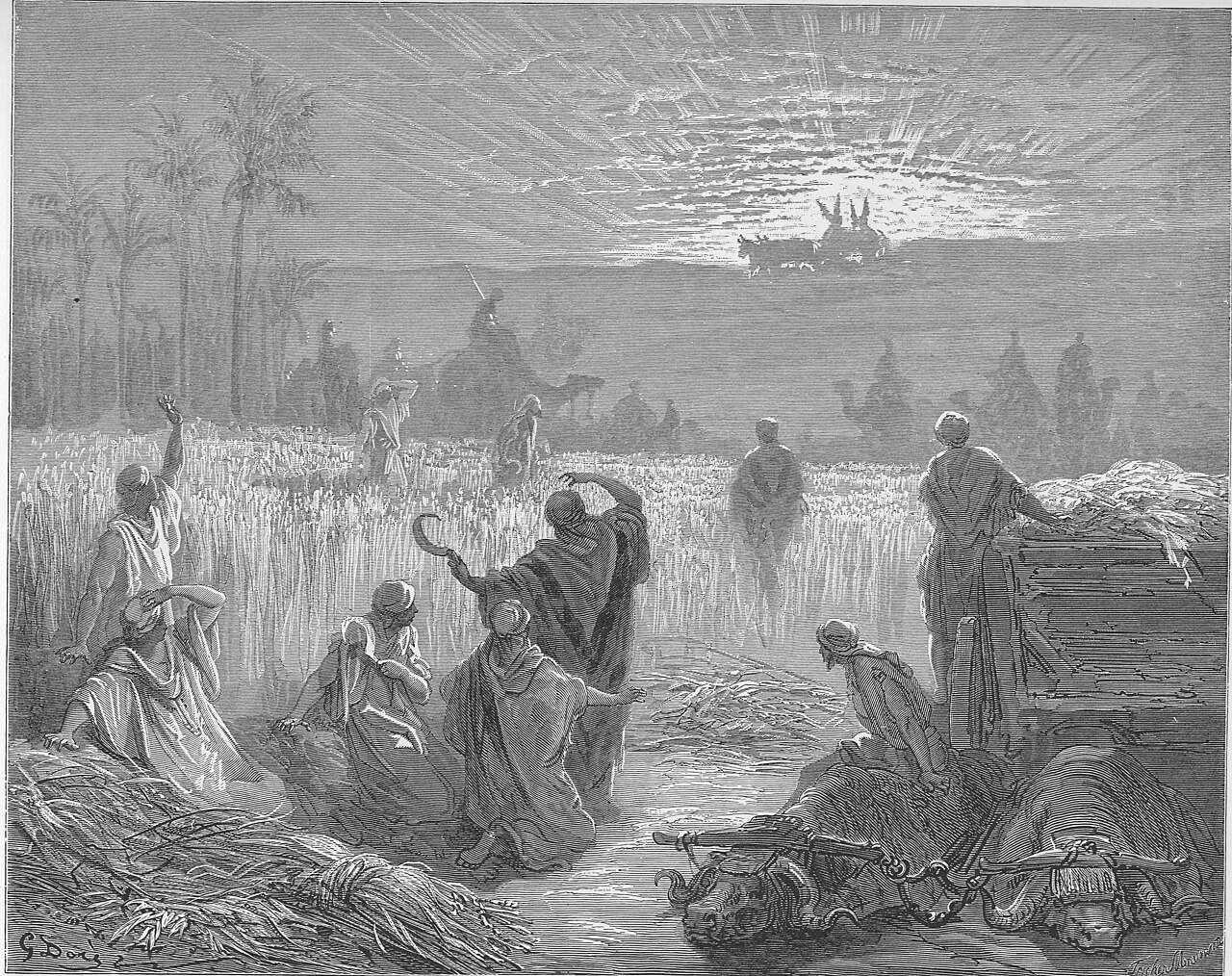
The people of Beth-shemesh are “harvesting wheat in the valley” when the ark comes into view, and they are “overjoyed at the sight”. The cart stops at a large rock in Joshua's field, and they burn the cart and offer the cows, a departure from the law's ordinary altar that Henry reads as fitting while Shiloh lay empty. Nothing in their welcome yet hints at the judgment of verse 19.
1 Samuel 6:13
“Some observe that the returning ark found the men of Beth-shemesh, not idling or sporting in the streets of the city, but busy, reaping their corn in their fields, and well employed. Thus the tidings of the birth of Christ were brought to the shepherds when they were keeping their flock by night.”
Matthew Henry · Commentary on the Whole Bible (1707-1721)puritan
The cart stops at a large rock, and Albert Barnes held that the people took the stop as a sign to sacrifice there. Adam Clarke noted that cart and cows, once used for the ark, could never return to common work, so the wood became fuel for the offering. Joshua appears nowhere else.
1 Samuel 6:14
“They clave the wood of the cart - Both the cart and the cattle having been thus employed, could no longer be devoted to any secular services; therefore the cattle were sacrificed, and the cart was broken up for fuel to consume the sacrifice.”
Adam Clarke · Commentary on the Bible (1810-1826)evangelical
1 Samuel 6:15-16
Levites took down the ark: Levites lift the ark and the chest of gold from the cart, since Beth-shemesh is a Levitical city and its own men can do lawfully what the Philistines could not. The five rulers watch the sacrifices and return to Ekron “that same day”, about twelve miles behind them. They came to see whether the plague was the hand of Israel's God, and they leave having seen it.
1 Samuel 6:15
“The word “Levites” here probably means priests Exo 4:14, sons of Levi, since Bethshemesh was one of the cities of the priests Jos 21:13-16. The burnt offering of the kine was not in any sense the offering of the men of Bethshemesh, but rather of the Philistine lords to whom the cart and the kine belonged. But the Bethshemites themselves, in token of their gratitude for such a signal mercy, now offered both burnt offerings and sacrifices, probably peace offerings, and doubtless feasted together with great joy and gladness (see 1Ki 8:62-66; Ezr 6:16-17).”
1 more voice on this verse
1 Samuel 6:15
“And, the case being extraordinary, the law for offering at the altar in the court of the tabernacle was dispensed with, and the more easily because Shiloh was now dismantled; God himself had forsaken it, and the ark, which was its chief glory, they had with them here.”
Matthew Henry · Commentary on the Whole Bible (1707-1721)puritan
The five rulers stay to watch until the ark is received and the sacrifices are offered. John Gill noted that Ekron lay about twelve miles from Beth-shemesh, close enough for a return the same day. Their test had been answered.
1 Samuel 6:16
“And when the five lords of the Philistines had seen it,.... Observed all that was done, how the kine performed their journey, drew the cart in which the ark was straight to Bethshemesh, stopped in a field near it, where it was received joyfully by the people, and sacrifices offered on account of it: they returned to Ekron the same day; as they might very well, since it was but twelve miles from Bethshemesh.”
1 Samuel 6:17-18
The gold tumors are counted by city, “Ashdod, Gaza, Ashkelon, Gath, and Ekron”, with Goliath's city among them. The gold rats are counted by every fortified city and outlying village the plague reached, a scale of damage the tumors alone did not show. The narrator adds that the large rock still “stands to this day in the field of Joshua of Beth-shemesh”, an eyewitness marker.
1 Samuel 6:17
“And these are the golden emerods, which the Philistines returned for a trespass offering unto the Lord,.... Along with the ark: for Ashdod one, for Gaza one, for Ashkelon, one, for Gath one, for Ekron one; which were the five principalities of the Philistines that belonged to the five lords before mentioned; and each of these were at the expense of a golden emerod, and sent it along with the ark to make atonement for the offence they had been guilty of in taking and detaining it.”
The gold tumors stood for the five ruling cities, and Adam Clarke read the gold rats as coming from every town, fortified or open, for the rats had ravaged the whole land. Matthew Henry held that the large rock stood as a memorial fathers showed their children. It marked the ark's return.
1 Samuel 6:18
“Abel - This is mentioned as the utmost border of the Philistines territory, to which the plague of mice extended. And this place is here called Abel, by anticipation from the great mourning mentioned in the following verse. It is desirable, to see the ark in its habitation, in all the circumstances of solemnity.”
John Wesley · Explanatory Notes upon the Old Testament (1765)evangelical
1 more voice on this verse
1 Samuel 6:18
“Their proposal to offer a trespass-offering for their offence was conformable enough to divine revelation at that time; but to send such things as these for trespass-offerings was very foreign, and showed them grossly ignorant of the methods of reconciliation appointed by the law of Moses; for there it appears all along that it is blood, and not gold, that makes atonement for the soul.”
Matthew Henry · Commentary on the Whole Bible (1707-1721)puritan
Who is able to stand before this holy God?
The number of the dead is a textual question: some Hebrew manuscripts and Josephus give seventy alone, and Barnes reads the fifty thousand of the received text as a marginal note. Jamieson, Fausset and Brown keep the received text and cite Josephus's count of seventy out of fourteen hundred. The ground of judgment is plain, for the men “looked inside the ark of the LORD”, and the town mourned.
1 Samuel 6:19
“God, instead of decimating, according to an ancient usage, slew only a twentieth part; that is, according to JOSEPHUS, seventy out of fourteen hundred (see Nu 4:18-22).”
Jamieson, Fausset & Brown · Commentary Critical and Explanatory on the Whole Bible (1871)reformed
1 more voice on this verse
1 Samuel 6:19
“Be not deceived, God is not mocked. Those that will not fear his goodness, and reverently use the tokens of his grace, shall be made to feel his justice, and sink under the tokens of his displeasure. Those that pry into what is forbidden, and come too near to holy fire, will find it is at their peril.”
Matthew Henry · Commentary on the Whole Bible (1707-1721)puritan
1 Samuel 6:20-21
The men of Beth-shemesh ask “Who can stand in the presence of the LORD, this holy God”, and then send the ark away without examining their own trespass. They summon the people of Kiriath-jearim, where the ark rests for years on the road from Shiloh's fall to David. Clarke reads their question as blame laid on the ark's severity, the same instinct that first sent it away from Ashdod.
1 Samuel 6:20
“Who is able to stand - Why this exclamation? They knew that God had forbidden any to touch his ark but the priests and Levites; but they endeavored to throw that blame on God, as a Being hard to be pleased, which belonged solely to themselves.”
Adam Clarke · Commentary on the Bible (1810-1826)evangelical
1 more voice on this verse
1 Samuel 6:20
“This they infer from that tremendous judgment, "Who is able to stand before the God of the ark?" To stand before God to worship him (blessed be his name) is not impossible; we are through Christ invited, encouraged, and enabled to do it, but to stand before God to contend with him we are not able.”
Matthew Henry · Commentary on the Whole Bible (1707-1721)puritan
Beth-shemesh passes the ark to Kiriath-jearim. Adam Clarke held it probable that the Philistines had destroyed Shiloh after Israel's defeat, for the ark never went back there. Matthew Henry saw the ark passed from town to town with no public care, a sign that Israel had no king.
1 Samuel 6:21
“Kirjath-jearim - See Jos 9:17 note. It has been thought that there was a high place at Kirjath-jearim (the hill, 1Sa 7:1), the remnant of its old pagan sanctity when it was called Kirjath-Baal, “the city of Baal” (see Jos 18:14; 2Sa 6:2); and that for this reason it was selected as a proper place to send the ark to.”
1 more voice on this verse
1 Samuel 6:21
“It lay in the way from Beth-shemesh to Shiloh, so that when they sent to them to fetch it, we may suppose, they intended that the elders of Shiloh should fetch it thence, but God intended otherwise. Thus was it sent from town to town, and no care taken of it by the public, a sign that there was no king in Israel.”
Matthew Henry · Commentary on the Whole Bible (1707-1721)puritan
How this psalm is built
The form: Narrative, the return panel of the ark account, built around a controlled test devised by the enemy, as Samuel classes it.
The patterns in this chapter
| Device | What it does | Where to see it |
|---|---|---|
| The offering counted by city and by field | Verse 17 names the five golden tumours one by one, for Ashdod, Gaza, Ashkelon, Gath and Ekron. Verse 18 then counts the golden mice by every fenced city and every country village belonging to the five lords. The first list measures the political reach of the plague and the second measures how far it went into the fields.Adam Clarke, Commentary on the Bible, 1832, on 1 Samuel 6:17 to 18. | 1 Samuel 6:17, 1 Samuel 6:18 |
| The test set so it could only pass one way | Verses 7 to 9 set two conditions against each other. A new cart never used and two milk cows that have never worn a yoke are one side. Their calves shut up at home are the other. Every natural instinct in such an animal is to turn back, so the priests tell the lords that a straight road to Beth-shemesh will settle it and a turning will mean chance.Albert Barnes, Notes on the Old Testament, 1834, on 1 Samuel 6:7 to 9. | 1 Samuel 6:7, 1 Samuel 6:8, 1 Samuel 6:9, 1 Samuel 6:12 |
| The joy and the mourning, in the same field | The reapers of Beth-shemesh lift their eyes at verse 13 and rejoice to see the ark. At verse 19 the same town mourns, because the LORD had struck the men who looked into it. The chapter closes the field it opened, and the two verses use the same place and the same people.Matthew Henry, Commentary on the Whole Bible, 1710, on 1 Samuel 6:19. | 1 Samuel 6:13, 1 Samuel 6:19 |
| The question the account has been building toward | The men of Beth-shemesh ask at verse 20 who is able to stand before this holy LORD God. It is the only direct question asked of God in the ark account, and it is asked by Israelites after a judgment rather than by Philistines under a plague. Their next act is to send the ark on to Kiriath-jearim.Adam Clarke, Commentary on the Bible, 1832, on 1 Samuel 6:20. | 1 Samuel 6:20, 1 Samuel 6:21 |
What the chapter is built on
12 more paragraphs on the patterns
The law behind the judgment at verse 19 is in Numbers 4:15 and 4:20, which forbid the Kohathites to touch the holy things or to look on them, on pain of death. The men of Beth-shemesh looked into the ark, and the chapter treats the law as known rather than quoting it.
The Philistine priests' reference to Egypt at verse 6 is drawn from the exodus account itself. Their choice of a new cart with untried animals follows the ordinary logic of an omen test in that world.
The New Testament's use
This chapter is not quoted in the New Testament. Its argument returns in Scripture at 2 Samuel 6. There David moves the ark on a new cart in the same way the Philistines did, and Uzzah dies for steadying it. David gives his own explanation at 1 Chronicles 15:13, that the LORD broke out because they did not seek Him after the due order.
That passage is the closest thing Scripture gives to a commentary on this chapter, and it reads the cart as the error.
The reading the chapter has drawn argument over
The number of the dead at verse 19 is a genuine textual question, and this book's dossier carries it with its holders.
One reading gives seventy men alone and treats the fifty thousand as a copyist's intrusion. It rests on a number of Hebrew manuscripts that lack the larger figure entirely, and on Josephus, who reports seventy at Antiquities of the Jews 6.1.4. Albert Barnes takes this view and reads the larger figure as a marginal note that entered the text.
The other reading keeps the received Hebrew as it stands and takes the seventy as struck out of a wider gathering. Jamieson, Fausset and Brown hold it, and cite Josephus's own count of seventy out of fourteen hundred.
The Hebrew gives two numbers side by side without a conjunction joining them naturally, and Beth-shemesh was a small farming town. The estate prints both readings with their holders and takes neither. What the verse does not leave open is the ground of the judgment, which it states plainly.
The thing the chapter states before its time
The enemy built a test designed to rule out coincidence, and the test returned the answer the enemy feared. Two cows fresh from calving held a strange road while their calves cried behind them, and five lords followed the cart to the border to watch. The chapter records an experiment run by people with every reason to want it to fail.
Keep studying
Sources for this chapter
The summary
Jamieson, Fausset & Brown, Commentary Critical and Explanatory; John Wesley, Notes on the Old Testament and Matthew Henry, Complete Commentary.
The form and classifications
Albert Barnes, Notes on the Old Testament, 1834, on 1 Samuel 6:19; John Wesley, Explanatory Notes upon the Old Testament, 1765, on 1 Samuel 6:4 to 5 and This site's published structure for 1 Samuel, src/components/book/dossier-content/1-samuel.ts, the chiasm entry for the ark account, which places the Philistines sending the ark home with a guilt offering at 6:1 to 12 and Beth-shemesh struck at 6:13 to 20.
The exposition
Adam Clarke, Commentary on the Bible; Albert Barnes; Jamieson Fausset and Brown, Commentary Critical and Explanatory on the Whole Bible; Jamieson, Fausset & Brown, Commentary Critical and Explanatory on the Whole Bible; John Gill; John Wesley, Explanatory Notes upon the Old Testament and Matthew Henry, Commentary on the Whole Bible.