
1 Kingschapter 3
28 verses · Jeremiah, by tradition · 6th century BC · History
Only the people sacrificed in high places, because there was no house built unto the name of the Lord, until those days.
Introduction
Jeremiah, by tradition, History, 1 Kings Overview.
The historian writes this for exiles who wanted to know what kind of king their fathers once had. This chapter opens the reign proper, before any building work begins. Its first hearers knew that a king was the last court of appeal for anyone the local courts could not help. Listen for the one request the young king makes and the three he passes over. Then watch the gift tested in a case with no witness on either side. Two short notes at the start, a marriage and a place of worship, will matter to the rest of the book.
Context
- Who
- Israelites who worshipped at local high places because no house had yet been built for the Name
- What
- An account of Solomon's dream at Gibeon, his request for an understanding heart, and the case of the two mothers that proves the gift.
- Where
- Gibeon, the great high place north west of Jerusalem, and the king's court in Jerusalem.
- When
- The opening of Solomon's reign, about 970 BC, before the temple was begun in his fourth year.
- Why
- To show that the wisdom of Israel's king was a gift from the LORD given for judging His people.
Historical context
The chapter is Solomon's, and he is a young king newly secure, with a treaty marriage behind him and no house for the LORD yet standing.
Show the rest of the historical context, 4 more paragraphs
The time is the opening of the reign, about 970 BC. The places are Jerusalem, where the ark rested in the tent David pitched, and Gibeon, a town north west of the city that the chapter calls the great high place.
The occasion is a sacrifice of a thousand burnt offerings at Gibeon and the night that followed it, and then a case brought before the king in open court.
A first hearer knew what made Gibeon the great high place. The tent Moses made still stood there, which 2 Chronicles 1:3 to 1:6 states, so an offering at Gibeon was worship at Israel's own sanctuary and not private excess.
A marriage to the daughter of a foreign king was an ordinary instrument of treaty in that world, and the reader is told about it before any act of wisdom is reported. A night spent at a sanctuary in hope of a dream was a known practice across the region. A king was the last court of appeal, and two women of no standing with no witness to call had nowhere else to go, which is why the case reached him at all.
Significance
For the first hearers the chapter answered what kind of king they had. He asked for a hearing heart to judge rather than for long life, wealth or the death of his enemies, and the chapter names the three he passed over.
Show the rest of the significance, 2 more paragraphs
The case that follows shows the gift working where no evidence could reach, in a dispute the law's own standard of two witnesses could not settle.
The chapter also leaves them with two facts that the rest of the book takes up, a foreign marriage and the high places still standing.
This chapter in Jewish lifeWhat this chapter is in Jewish life and reading.
What is done
This chapter is heard once a year, and both rites read it. It stands in the reading from the Prophets that follows the Torah portion of Pharaoh's dreams and Joseph's rise, the portion called Miketz. The reading begins where Solomon wakes from the dream at Gibeon and runs on into the next chapter. A congregation hears a king dreaming and a young man given wisdom to rule Egypt in the morning, and then hears a young king ask for wisdom and use it the same day. That the pairing sets one dream that made a ruler beside another is the writer's reading of src/lib/hebraic/readings.ts. It is marked as the writer's reading until a source for the pairing is filed.
How it is read
Rashi is quoted here from the Metsudah Tanach series of Lakewood, New Jersey, which Sefaria reports as CC-BY. He reads the marriage to Pharaoh's daughter against the chapter's own order, and dates it from a death. While Shimei his teacher lived, Solomon did not make the match, and Rashi draws a rule from the joining of the two events. A person should always live near his teacher (Rashi on I Kings 3:1:1). The four years before the building were the years Solomon kept his father's decrees, and Rashi holds that the marriage came once the building began. He cites Seder Olam for it, and states the principle the classical reading works by: the passages are not written in the order they happened (Rashi on I Kings 3:3:1).
The high places are read as lawful for their moment. Any man who wished built an altar on his roof or in his yard for the sake of Heaven, and Rashi marks the window this was allowed in. It ran from the destruction of the tabernacle at Shiloh to the building of the house (Rashi on I Kings 3:2:1). The great high place at Gibeon he identifies with the bronze altar Moses made in the wilderness. It stood at Shiloh, went to Nob when Shiloh fell, and came to Gibeon when Nob fell (Rashi on I Kings 3:4:1).
Solomon's own words are measured closely. Calling himself a small lad, Rashi takes as a statement of age, and he reckons the years out of Samuel and Chronicles to reach twelve (Rashi on I Kings 3:7:1). The translation notes Abarbanel and others against him, who read the word as a word about standing rather than years and put Solomon nearer twenty. The weight Solomon feels in the request is judicial. Rashi reads it as the weight of a court that may err. He sets an error over Israel higher than the same error over a stranger, because the law holds the judge to account for it (Rashi on I Kings 3:9:1). The answer divides on the same line. Wealth and honour God gives without condition, since the Torah set none on them. Length of days and a throne for the sons are held to a condition already written in the law, and Rashi says that condition will not be altered (Rashi on I Kings 3:14:1).
The waking is read as a test the king could check. Rashi says Solomon knew the dream was true because he heard a bird chirping and understood it, and a dog barking and understood it (Rashi on I Kings 3:15:1). The judgment of the two women closes the chapter, and the corpus carries it mostly without English. Fourteen notes stand cited and unquoted. Radak stands at Radak on I Kings 3:11:1, 3:12:1, 3:13:1, 3:16:1, 3:19:1, 3:22:1, 3:23:1 and 3:26:1. Metzudat David stands at 3:8:1, 3:17:1, 3:18:1, 3:20:1 and 3:25:1, and Malbim at Malbim on I Kings 3:10:1. The one note Rashi carries there is on the mother's certainty. She had scrutinized the child with her whole attention, so she could not mistake him (Rashi on I Kings 3:21:1).
What the rabbis say
The corpus carries forty rabbinic locators on this chapter and the text of none, so each is cited and linked here rather than quoted. The marriage to Pharaoh's daughter draws four on the first verse. The corpus holds Ein Yaakov, Yevamot 8:3, Kohelet Rabbah 9:1:1, Niddah 70b:6 and Seder Olam Rabbah 15:2. On the third verse, the love of the LORD and the high places together, it holds Midrash Mishlei 1:1.
Gibeon carries its own run on the fourth verse. The corpus holds Makkot 10a:23, Ein Yaakov (Glick Edition), Sotah 9:7, Mekhilta DeRabbi Yishmael, Tractate Bachodesh 11:4 and Midrash Tanchuma, Terumah 11:7. The dream itself draws four more on the fifth. It holds Bereshit Rabbah 44:8, Avot DeRabbi Natan, Recension B 43:26, Midrash Tanchuma, Chukat 6:1 and Midrash Tanchuma, Vayikra 7:1.
The request and the answer draw the heaviest weight. On the ninth verse the corpus holds Kohelet Rabbah 1:16:1, Midrash Lekach Tov, Deuteronomy 3:24:1 and Numbers 11:13:1, with Midrash Tanchuma Buber, Shoftim 1:1. On the twelfth it holds Bamidbar Rabbah 20:22, Midrash Aggadah, Leviticus 25:1:2 and Midrash Lekach Tov, Leviticus 25:1:3. On the thirteenth, the wealth and honour, it holds Sifrei Devarim 162:5, Yalkut Shimoni on Torah 915:2, Midrash Tanchuma, Bechukotai 1:1 and the Buber recension at the same place. On the fourteenth it holds Midrash Tehillim 51:1.
The waking draws four on the fifteenth verse. The corpus holds Kohelet Rabbah 1:1:1, Eikhah Rabbah 2:22, Midrash Tehillim 50:2 and Shir HaShirim Rabbah 1:1:9. The two women draw four on the sixteenth. It holds Kohelet Rabbah 10:16:1, Midrash Tehillim 72:1, Ruth Rabbah 2:2 and Shir HaShirim Rabbah 1:1:10. On the twenty-third it holds Devarim Rabbah 5:6 and Jerusalem Talmud Sanhedrin 3:8:6, and on the twenty-sixth Midrash Tehillim 17:15. The verdict draws Bereshit Rabbah 85:12 on the twenty-seventh, with Ein Yaakov, Makkot 3:9 and the Glick Edition at Makkot 3:6. All Israel hearing of the judgment draws Bamidbar Rabbah 23:13 on the thirtieth. What each of them teaches is a saying of the rabbis, and this site reports it as theirs. The quotations wait on a fetch that carries the text.
Sources: Rashi, Rashi on I Kings 3:1:1 to 3:21:1, the Metsudah Tanach series, Lakewood, N.J, reported CC-BY; Radak, Radak on I Kings 3:11:1 to 3:26:1, cited by ref because Sefaria holds no English version; Metzudat David, Metzudat David on I Kings 3:8:1 to 3:25:1, cited by ref because Sefaria holds no English version; Malbim, Malbim on I Kings 3:10:1, cited by ref because Sefaria holds no English version; Abarbanel, noted against Rashi at Rashi on I Kings 3:7:1 by the Metsudah translation; Seder Olam, cited by Rashi at Rashi on I Kings 3:3:1; The Sefaria corpus on disk, scripts/data/sources/sefaria/1-kings/3.json, fetched 2026-09-19, the forty Midrash and Talmud locators cited above, 2026; MannaFest, src/lib/hebraic/readings.ts, the Haftarah use and its rite, printed in this lane, 2026.
The heads below are this chapter's scenes. The numbered points under each are its verses.
High places and a Pharaoh's daughter: a mixed beginning
1 Kings 3:1-3
made affinity with Pharaoh: Solomon's marriage to Pharaoh's daughter opens the reign before the narrator names a single act of wisdom, and the alliance anticipates the multiplied wives Deuteronomy 17:17 forbade the king, though the text withholds any comment here. The same restraint governs the next verse: the people, and Solomon himself, sacrifice at high places only because no house had yet been built to the name of the Lord. That formula, a king weighed partly by whether the high places stood or fell, becomes the book's standing measure for every reign that follows.
1 Kings 3:1
“And Solomon made affinity with Pharaoh king of Egypt,.... Pharaoh was a common name of the kings of Egypt, of whom no mention is made in Scripture from the times of Moses until this time; which may seem strange, when it is considered that that kingdom was a potent one, and near the land of Canaan; but it was governed by a race of kings in this period of time, of whom, as Diodorus Siculus (i) says, there is nothing worthy of relation.”
3 more voices on this verseWhat preachers and commentators have said about this verse, in their own words.
1 Kings 3:1
“Solomon made affinity with Pharaoh--This was a royal title, equivalent to "sultan," and the personal name of this monarch is said to have been Vaphres. The formation, on equal terms, of this matrimonial alliance with the royal family of Egypt, shows the high consideration to which the Hebrew kingdom had now arisen.”
Jamieson, Fausset & Brown · Commentary Critical and Explanatory on the Whole Bible (1871)reformed
1 Kings 3:1
“What Pharaoh is meant is uncertain. It must have been a predecessor of Shishak (or Sheshonk), who invaded Judaea more than 40 years later 1Ki 14:25; and probabilities are in favor, not of Psusennes II, the last king of Manetho’s 21st dynasty, but of Psinaces, the predecessor of Psusennes. This, the Tanite dynasty, had become very weak, especially toward its close, from where we may conceive how gladly it would ally itself with the powerful house of David. The Jews were not forbidden to marry foreign wives, if they became proselytes.”
1 Kings 3:1
“Pharaoh - As being a powerful neighbour, whose daughter doubtless was first instructed in, and proselyted to the Jewish religion. It seems, this was designed by God to be a type of Christ, calling his church to himself, and to the true religion, not only out of the Jews, but even out of the Gentile world.”
John Wesley · Explanatory Notes upon the Old Testament (1765)evangelical
Albert Barnes finds the law against high places only by implication, in the command of Leviticus 17:3 to 5 to sacrifice at the door of the tabernacle. Adam Clarke lists Gibeon, Gilgal, Shiloh and Hebron as places where judges, prophets and kings had offered. Matthew Henry says God bore with their weakness.
1 Kings 3:2
“Only the people sacrificed in high places,.... On the tops of their houses, on hills and mountains, and particularly at the high place in Gibeon, where the tabernacle was: because there was no house built unto the name of the Lord until those days; to which they were obliged to repair as afterwards, and there offer their sacrifices, as the Lord had commanded, Deu 12:5.”
2 more voices on this verse
1 Kings 3:2
“The people sacrificed in high places - Could there be any sin in this, or was it unlawful till after the temple was built? for prophets, judges, the kings which preceded Solomon, and Solomon himself, sacrificed on high places, such as Gibeon, Gilgal, Shiloh, Hebron, Kirjath-jearim, etc. But after the temple was erected, it was sinful to offer sacrifices in any other place; yet here it is introduced as being morally wrong, and it is introduced, 1Ki 3:3, as being an exceptionable trait in the character of Solomon.”
Adam Clarke · Commentary on the Bible (1810-1826)evangelical
1 Kings 3:2
“High places - Which were groves, or other convenient places upon hills, in which the patriarchs used to offer up their sacrifices to God; and from them this custom was derived both to the Gentiles and the Jews: and in them the Gentiles sacrificed to idols, the Hebrew to the true God.”
John Wesley · Explanatory Notes upon the Old Testament (1765)evangelical
Solomon loved the Lord: Matthew Henry calls Solomon's love for the LORD his brightest praise, the mark of every saint, even the poorest. John Wesley explains the statutes of his father David as God's own commands, pressed on Solomon with David's authority. John Gill reads the exception as high places besides Gibeon.
1 Kings 3:3
“And Solomon loved the Lord,.... The worship of the Lord, as the Targum: and which he showed by walking in the statutes of David his father; in which his father walked, which were the statutes of the Lord, or which he exhorted him to walk in, and were the same, 1Ki 2:3; only he sacrificed and burnt incense in high places; besides that at Gibeon, which it seems David did not.”
1 more voice on this verse
1 Kings 3:3
“Statutes - According to the statutes or commands of God, which are here called the statutes of David; not only because they were diligently practiced by David, but also because the observation of them was so earnestly pressed upon Solomon, and fortified with David's authority and command.”
John Wesley · Explanatory Notes upon the Old Testament (1765)evangelical
1 Kings 3:4-5
went to Gibeon to sacrifice: Gibeon is called the great high place, and 2 Chronicles 1:3-6 explains why: the tabernacle Moses made in the wilderness still stood there, so a thousand burnt offerings there was worship at Israel's own sanctuary tent rather than private excess. The Lord meets Solomon at night in a dream and opens with no conditions attached, ask what I shall give thee, an offer as wide as a king could receive. The scene does not repeat with this openness again in the book, and what Solomon does with it sets the reign's course.
1 Kings 3:4
“The royal progress was of public importance. It was a season of national devotion. The king was accompanied by his principal nobility (2Ch 1:2); and, as the occasion was most probably one of the great annual festivals which lasted seven days, the rank of the offerer and the succession of daily oblations may help in part to account for the immense magnitude of the sacrifices.”
Jamieson, Fausset & Brown · Commentary Critical and Explanatory on the Whole Bible (1871)reformed
1 more voice on this verse
1 Kings 3:4
“Our God is a consuming fire. Bishop Patrick quotes it as a tradition of the Jews that the smoke of the sacrifices ascended directly in a straight pillar, and was not scattered, otherwise it would have choked those that attended, when so many sacrifices were offered as were here. Here is something concerning which it may be doubted whether it was good or no.”
Matthew Henry · Commentary on the Whole Bible (1707-1721)puritan
Ask what I shall give thee: an understanding heart
the Lord appeared to Solomon in a dream: Albert Barnes sets Solomon’s dream at Gibeon beside the dreams God gave in Genesis. Adam Clarke places it on the night after the thousand burnt offerings, and Matthew Henry reads God’s offer to give as a sign He accepted them. The grant was real, say Jamieson, Fausset and Brown.
1 Kings 3:5
“The Lord appeared to Solomon in a dream - This was the night after he had offered the sacrifices, (see 2Ch 1:7), and probably after he had earnestly prayed for wisdom; see Wis. 7:7: Wherefore I prayed, and understanding was given me: I called upon God, and the spirit of wisdom came to me.”
Adam Clarke · Commentary on the Bible (1810-1826)evangelical
2 more voices on this verse
1 Kings 3:5
“He saw the glory of God shine about him, and heard a voice saying, Ask what I shall give thee. Not that God was indebted to him for his sacrifices, but thus he would testify his acceptance of them, and signify to him what great mercy he had in store for him, if he were not wanting to himself. Thus he would try his inclinations and put an honour upon the prayer of faith.”
Matthew Henry · Commentary on the Whole Bible (1707-1721)puritan
1 Kings 3:5
“In sleep his thoughts ran upon the subject of his prayer, and he dreamed that God appeared to him and gave him the option of every thing in the world--that he asked wisdom, and that God granted his request (1Ki 3:9-12). His dream was but an imaginary repetition of his former desire, but God's grant of it was real.”
Jamieson, Fausset & Brown · Commentary Critical and Explanatory on the Whole Bible (1871)reformed
1 Kings 3:6-7
according as he walked before thee: Solomon's prayer opens by naming covenant kindness already shown to David, the great mercy that gave David a son to sit on his throne, grounding his own request in a promise older than his reign. He then calls himself a little child who does not know how to go out or come in, an idiom for a leader's whole public conduct rather than a claim to literal boyhood, since Solomon already reigns in the city of David with a court to govern. The humility is rhetorical and real at once, a king who has everything still naming himself unequal to the office.
1 Kings 3:6
“Truth - In the true worship of God, in the profession, belief, practice and defense of the true religion. So truth here contains all duties to God, as righteousness doth his duties to men, and uprightness the right manner of performing both sorts of duties. With thee - That is, in thy judgment, to whom he often appealed as the witness of his integrity.”
John Wesley · Explanatory Notes upon the Old Testament (1765)evangelical
John Wesley and Jamieson, Fausset and Brown put Solomon at about twenty, a man new to governing a kingdom. Albert Barnes reads little child as hyperbole. Matthew Henry holds that a king who knows his own lack is ready to be taught by God.
1 Kings 3:7
“See 1Ki 2:2 note, and on the hyperbole contained in the phrase “little child,” compare Gen 43:8; Exo 33:11. How to go out or come in - This expression is proverbial for the active conduct of affairs. (See the marginal reference.)”
2 more voices on this verse
1 Kings 3:7
“Child - So he was in years: not above twenty years old; and withal (which he principally intends) he was raw and unexperienced, as a child, in state affairs.”
John Wesley · Explanatory Notes upon the Old Testament (1765)evangelical
1 Kings 3:7
“I am but a little child--not in age, for he had reached manhood (1Ki 2:9) and must have been at least twenty years old; but he was raw and inexperienced in matters of government.”
Jamieson, Fausset & Brown · Commentary Critical and Explanatory on the Whole Bible (1871)reformed
1 Kings 3:8-9
thy people which thou hast chosen: Solomon calls Israel a great people that cannot be numbered nor counted, echoing the promise made to Abraham of a seed too many to count, and grounds his request in the size of the task rather than his own ambition. What he asks is an understanding heart to judge, literally a hearing heart in the Hebrew, fit to discern between good and bad. That phrase, discern between good and bad, reaches forward to the very case the chapter closes with, two claims that sound alike until a hearing heart tells them apart.
1 Kings 3:8
“Compare the marginal references. Solomon regards the promises as fulfilled in the existing greatness and glory of the Jewish nation.”
Albert Barnes notes that hearing and deciding cases was a chief duty of an Eastern king, and Israel's rulers were called judges for that reason. Adam Clarke calls the request the science of government. Bonaventure joins it to the counsel of James to ask God for wisdom.
1 Kings 3:9
“An understanding heart - Whereby I may both clearly discern, and faithfully perform all the parts of my duty: for both these are spoken of in scripture, as the effects of a good understanding; and he that lives in the neglect of his duties, or the practice of wickedness, is called a fool, and one void of understanding.”
John Wesley · Explanatory Notes upon the Old Testament (1765)evangelical
1 more voice on this verse
1 Kings 3:9
One of the chief functions of the Oriental monarch is always to hear and decide causes. Hence, supreme magistrates were naturally called “judges.” (See the introduction to the Book of Judges.) In the minds of the Jews the “judge” and the “prince” were always closely associated, the direct cognisance of causes being constantly taken by their chief civil governors. (See Exo 2:14; Exo 18:16, Exo 18:22; 1Sa 8:20; 2Sa 15:2-6.) Good and bad - i. e. “right and wrong,” “justice and injustice.”
1 Kings 3:10-12
the speech pleased the Lord: The speech pleases the Lord because of what Solomon did not ask: not long life, not riches, not the life of his enemies, three requests any king in the ancient world might have reached for first. Because the request excluded self-interest, God grants what was asked and adds what a lesser prayer would have sought on its own. Verse 12's superlative, none like thee before thee, neither after thee, describes wisdom given, not yet the character that will keep it, and the book's later chapters test how long the gift outlasts the reign.
1 Kings 3:10
“Although Solomon’s choice was made “in a dream” 1Ki 3:5, we must regard it as springing from his will in some degree, and therefore as indicative of his moral character.”
1 more voice on this verse
1 Kings 3:10
“Those are accepted of God who prefer spiritual blessings to temporal, and are more solicitous to be found in the way of their duty than in the way to preferment. But that was not all; it was a prevailing prayer, and prevailed for more than he asked.”
Matthew Henry · Commentary on the Whole Bible (1707-1721)puritan
Albert Barnes names the enemies Solomon might have asked to be rid of, Hadad the Edomite and Rezon, who trouble his reign in chapter 11. The king had just cleared his own court of rivals in chapter 2. Here he asks for justice.
1 Kings 3:11
“Thine enemies - e. g. Hadad the Edomite 1Ki 11:14-22 and Rezon the son of Eliadah 1Ki 11:23-25, whom Solomon might well have wished to remove.”
Albert Barnes calls the wise and discerning heart practical wisdom, the kind that knows what is in man, and he notes that Christ names one greater than Solomon. Adam Clarke asks whether the gift hung on the condition to walk in God’s ways in verse 14. Hippolytus called Solomon the peacemaker, a name of Christ.
1 Kings 3:12
“I have given thee a wise and an understanding heart - I have given thee a capacious mind, one capable of knowing much: make a proper use of thy powers, under the direction of my Spirit, and thou shalt excel in wisdom all that have gone before thee; neither after thee shall any arise like unto thee. But, query, Was not all this conditional? If he should walk in his ways, and keep his statutes and commandments, 1Ki 3:14. Was it not to depend upon his proper use of initiatory inspirations? Did he ever receive all this wisdom?”
Adam Clarke · Commentary on the Bible (1810-1826)evangelical
1 more voice on this verse
1 Kings 3:12
“Proverbs are words of exhortation that serve the whole path of life. They serve as guides and signs for those who are seeking their way to God by reviving them when they become tired by the length of the road. These, moreover, are the proverbs of "Solomon," that is to say, the "peacemaker," who, in truth, is Christ the Savior.”
Hippolytus of Rome · written before 235 · FRAGMENT ON PROVERBSpatristic
1 Kings 3:13-15
given thee that which thou hast not asked: Riches and honour are added though Solomon never asked for them, a shape the commentators set beside Matthew 6:33, seek first the kingdom and all these things shall be added, a likeness they draw between the two prayers rather than a claim the text itself makes. The promise of long life carries one condition, if thou wilt walk in my ways, and the book's later chapters show exactly how that condition plays out. Solomon wakes to find it was a dream, then goes to Jerusalem, stands before the ark, and offers burnt and peace offerings before feasting the whole court, moving in one scene from the high place at Gibeon to the ark already resting in the city of David.
1 Kings 3:13
“All thy days - Whereby he signifies that these gifts of God were not transient, as they were in Saul, but such as should abide with him whilst he lived.”
John Wesley · Explanatory Notes upon the Old Testament (1765)evangelical
Long days depend on walking in God’s ways as David did. Albert Barnes notes that Solomon failed to keep His statutes and commandments, as 11:1 to 8 records, and died at no more than fifty-nine or sixty. Matthew Henry teaches that riches and long life are left to God, while wisdom is asked for with urgency.
1 Kings 3:14
“I will lengthen thy days - The promise here was only conditional. As the condition was not observed 1Ki 11:1-8, the right to the promise was forfeited, and it was not fulfilled. Solomon can scarcely have been more than fifty-nine or sixty at his death.”
stood before the ark of the covenant: Albert Barnes notes that two holy places divided Israel's worship, the tabernacle at Gibeon and the ark on Zion, and Solomon honours both. The peace offerings supplied the feast. John Wesley reads the burnt offerings as pointing to the blood of Christ.
1 Kings 3:15
“Solomon determined to inaugurate his reign by a grand religious ceremonial at each of the two holy places which at this time divided between them the reverence of the Jews. Having completed the religious service at Gibeon, where was the tabernacle of the congregation, he proceeded to Jerusalem, and sacrificed before the ark of the covenant, which was in Mount Zion 2Sa 6:12. A great feast naturally followed on a large sacrifice of peace-offerings.”
2 more voices on this verse
1 Kings 3:15
“The ark - Which was there in the city of David, 2 Sam. vi, 17, before which he presented himself in a way of holy adoration. Burnt offerings - Chiefly for the expiation of his and his peoples sin, through the blood of Christ, manifestly signified in these sacrifices.”
John Wesley · Explanatory Notes upon the Old Testament (1765)evangelical
1 Kings 3:15
“The wisdom, however, that was asked and obtained was not so much of the heart as of the head--it was wisdom not for himself personally, but for his office, such as would qualify him for the administration of justice, the government of a kingdom, and for the attainment of general scientific knowledge. HIS JUDGMENT BETWEEN TWO HARLOTS.”
Jamieson, Fausset & Brown · Commentary Critical and Explanatory on the Whole Bible (1871)reformed
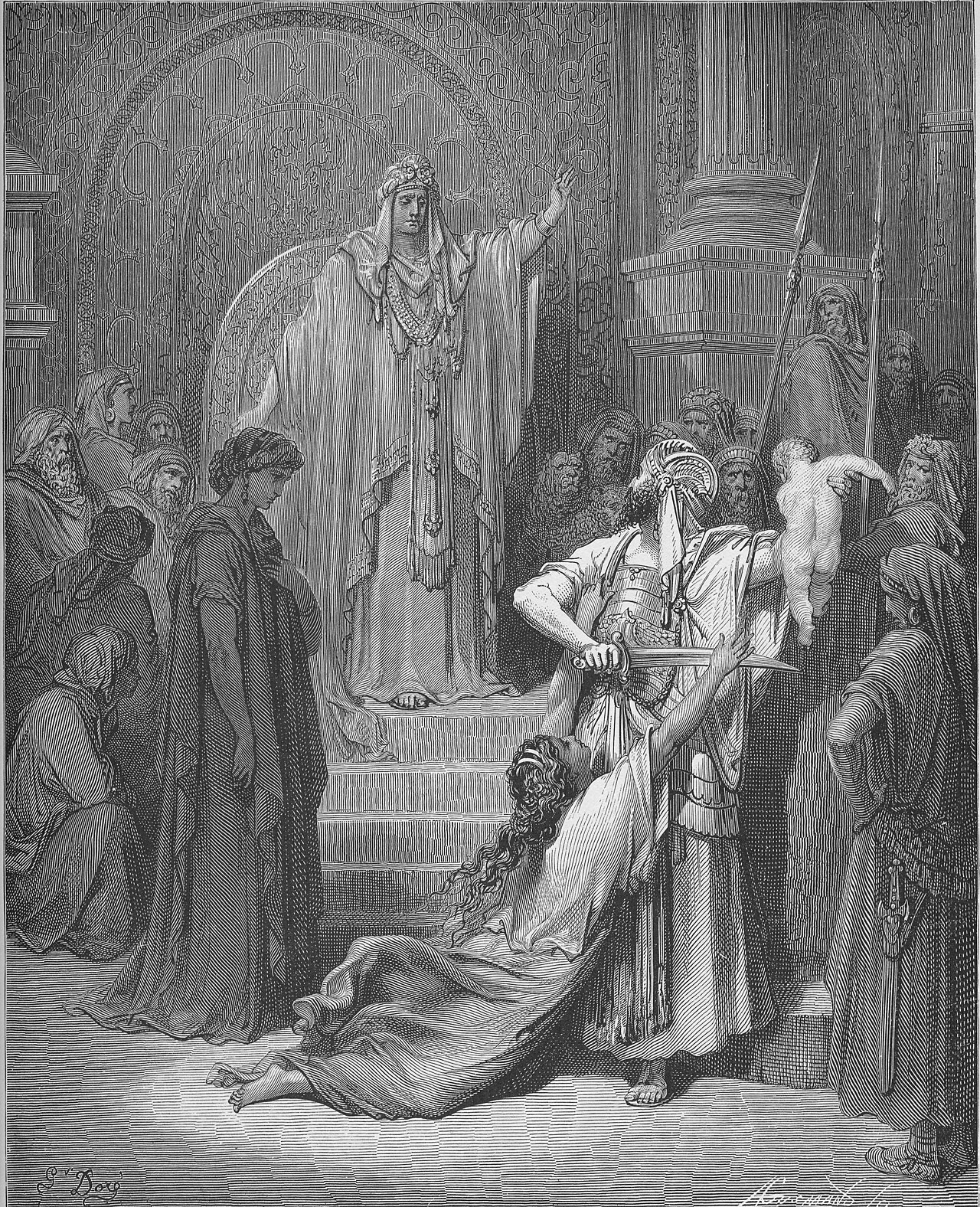
Divide the living child: the wisdom of God in him
1 Kings 3:16-18
two women, that were harlots: Two harlots bring an ordinary dispute to the king's own court, unusual only in who is asking: no elder, no priest, no outside witness, just two women whose case turns entirely on their own word. Both keep insisting no stranger was with us in the house, so the normal evidentiary path, a second witness under the Law's own standard, is closed to the king before he begins. The case is built to require exactly the gift Solomon asked for at Gibeon.
1 Kings 3:16
“The interpretation of Solomon's judgment on the quarrel of two harlot women (1 Kings 3) is clear as far as the simple history is concerned: that a boy of twelve years judged with an affection beyond his age for the depths of human nature. Hence, he was both admired and feared by all Israel, because he would not miss what was so skillfully concealed.”
3 more voices on this verse
1 Kings 3:16
“Then came there two women - harlots - The word זנות zonoth, which we here, and in some other places, improperly translate harlots, is by the Chaldee (the best judge in this case) rendered פונדקין pundekayan, tavern-keepers. (See on Jos 2:1 (note)). If these had been harlots, it is not likely they would have dared to appear before Solomon; and if they had been common women, it is not likely they would have had children; nor is it likely that such persons would have been permitted under the reign of David.”
Adam Clarke · Commentary on the Bible (1810-1826)evangelical
1 Kings 3:16
“Harlots - Or, victuallers: for the Hebrew words signifies both. Yet that they are unmarried persons, seems probable, both because there is no mention of any husbands, whose office it was, if there were any such, to contest for their wives; and because they lived a solitary life in one house.”
John Wesley · Explanatory Notes upon the Old Testament (1765)evangelical
1 Kings 3:16
“Then came there two women--Eastern monarchs, who generally administer justice in person, at least in all cases of difficulty, often appeal to the principles of human nature when they are at a loss otherwise to find a clue to the truth or see clearly their way through a mass of conflicting testimony.”
Jamieson, Fausset & Brown · Commentary Critical and Explanatory on the Whole Bible (1871)reformed
John Gill casts the first woman as the plaintiff and the other woman, who stood before the king beside her, as the defendant. Gill has the other woman alone present at the birth.
1 Kings 3:17
“And the one woman said,.... Who was the plaintiff: O my lord, I and this woman dwell in one house; pointing to the defendant, who stood by her: and I was delivered of a child with her in the house; she being present at the delivery, and she only, as it should seem.”
The two boys were born three days apart. John Gill notes that two sons so close in age would be hard to tell apart, and the house held no other witness who could tell them apart for the king.
1 Kings 3:18
“And it came to pass, the third day after I was delivered,.... Of a child, as before expressed: that this woman was delivered also; of another child; and being both of the same sex, both sons, as afterwards appears; and being so nearly of an age, it was difficult to distinguish them; and we were together; there was no stranger with us in the house, save we two in the house; so that in this trial no evidences could be produced on either side.”
1 Kings 3:19-21
this woman’s child died in the night: One child dies in the night, and the woman telling the story states plainly that she overlaid it, an accidental smothering the text records without softening. She then claims the living child was switched for the dead one while she slept, and the other woman's whole case rests on a mother's morning recognition, when I had considered it, behold, it was not my son. Nothing in the account settles the matter by evidence outside the two women's testimony, which is exactly the impasse the king must resolve.
1 Kings 3:19
“And this woman's child died in the night,.... Whether the same night following the day it was born is not certain; because she overlaid it; or laid upon it, being heavy through sleep, and not knowing what she did, turned herself upon it, and smothered it; because it had no previous illness, or any marks of any disease it could be thought to die of, and perhaps there might be some of its being overlaid.”
The first woman says the switch came in the middle of the night while she was asleep, so she saw none of it. Her claim rests on what she discovered in the morning. John Gill calls each woman’s claim a bare assertion without proof.
The first woman got up to nurse her son and found a dead child at her bosom. Matthew Henry calls the age of a newborn the valley of the shadow of death and marvels that so few babies die in nursing. One such death began this case.
1 Kings 3:21
“What anxiety is caused by little children, how uncertain their lives are, and to how many dangers they are continually exposed. The age of infancy is the valley of the shadow of death; and the lamp of life, when first lighted, is easily blown out. It is a wonder of mercy that so few perish in the perils of nursing.”
Matthew Henry · Commentary on the Whole Bible (1707-1721)puritan
1 Kings 3:22-23
Thus they spake before the king: The two accounts contradict each other word for word, the living is my son traded back and forth until the narrator simply notes that they spake before the king rather than telling the reader who is right. Solomon restates both claims for the record at verse 23, refusing to rule from instinct or from rank, laying the contradiction out in full before he acts. The king functions here as the last court of appeal precisely because no other evidence exists.
John Gill hears the king summing up as a judge, showing the whole court that the two claims settle nothing and another method is needed. Matthew Henry names that method. The child could show no preference, so Solomon would test which woman loved the child.
1 Kings 3:23
“Then said the king,.... As judge, summing up what had been said on both sides, which were only bare assertions without proof; the one affirming what the other denied, and the other denying what the other affirmed: the one saith, this is my son that liveth, and thy son is the dead; and the other saith nay; but thy son is the dead, and my son is the living; this he repeated to show to all present that no determination could be made by what had been said on each side, and that some other method must be taken.”
1 more voice on this verse
1 Kings 3:23
“To find out the true mother, he could not try which the child loved best, and must therefore try which loved the child best; both pretended to a motherly affection, but their sincerity will be tried when the child is in danger. (1.) She that knew the child was not her own, but in contending for it stood upon a point of honour, was well content to have it divided.”
Matthew Henry · Commentary on the Whole Bible (1707-1721)puritan
1 Kings 3:24-25
Bring me a sword: turns the case from testimony to test, a plan that never intends the child's death but is built to expose the truth by what each woman does next. Divide the living child in two offers both women the same legal outcome, an equal half, so that only motive and love can break the tie that evidence could not. The command is theater with a purpose, staged before a court that will judge the king by what happens next.
1 Kings 3:24
What about Solomon, who in his first judgment manifested the gift of wisdom, which he had received of God, only by making use of falsehood? For in order to get at the truth which was hidden by the woman's lie, even he used the help of a lie most cunningly invented, saying: "Bring me a sword and divide the living child into two parts, and give the one half to the one and the other half to the other."
John Cassian · written before 435 · CONFERENCE 17.25patristic
Augustine of Hippo read the king’s order as a test of charity, for Solomon means peaceable and a peaceable king cuts no living child in two. In another sermon he made the true mother a figure of the church keeping Christ whole. Adam Clarke says the ruling was defensible only as a threat.
1 Kings 3:25
“Divide the living child in two - This was apparently a very strange decision, and such as nothing could vindicate had it been carried into execution; but Solomon saw that the only way to find out the real mother was by the affection and tenderness which she would necessarily show to her offspring. He plainly saw that the real mother would rather relinquish her claim to her child than see it hewn in pieces before her eyes, while it was probable the pretender would see this with indifference.”
Adam Clarke · Commentary on the Bible (1810-1826)evangelical
1 Kings 3:26-27
her bowels yearned upon her son: names the true mother by what her body does before her mouth can argue further, compassion breaking through where testimony had reached deadlock. The other woman's answer, let it be neither mine nor thine, but divide it, exposes itself as willing to destroy what it cannot keep, and the king reads the difference correctly. Give her the living child closes the case: the boy is handed not to the louder claim but to the love that would rather lose him than kill him.
1 Kings 3:26
"Let me see it hers, rather than not see it at all." By this tenderness towards the child it appeared that she was not the careless mother that had overlaid the dead child, but was the true mother of the living one, that could not endure to see its death, having compassion on the son of her womb. "The case is plain," says Solomon; "what need of witnesses?
Matthew Henry · Commentary on the Whole Bible (1707-1721)puritan
The ruling turns the true mother's plea back on her, for she had asked the king to give the baby to the other woman. John Gill weighs the proof the king saw, her compassion and eagerness to save the child against the other woman's indifference and cruelty. She is his mother.
1 Kings 3:27
“Then the king answered and said, give her the living child, and in no wise slay it,.... That is, to her who desired it might not be slain, but rather be given to her who had no right to it: she is the mother thereof; which might be strongly concluded from her compassion for it, her eagerness and earnestness to have its life spared, and from the indifference of the other, yea, from her cruelty and barbarity in moving to have it divided.”
all Israel heard of the judgment: All Israel hears of the judgment, and the report that spreads is not of a clever trick but that the wisdom of God was in him, to do judgment, the exact gift asked for at Gibeon now shown in open court. Verse 9's request, an understanding heart to judge, discern between good and bad, is answered in a case that let no other evidence decide. The chapter that opened with a private dream closes with a public verdict, and the whole nation stands as witness.
1 Kings 3:28
“They feared the king - This decision proved that they could not impose upon him; and they were afraid to do those things which might bring them before his judgment-seat. They saw that the wisdom of God was in him - They perceived that he was taught of God, judged impartially, and could not be deceived. What was done to the other woman we are not told; justice certainly required that she should be punished for her lies and fraud.”
Adam Clarke · Commentary on the Bible (1810-1826)evangelical
How this psalm is built
The form: Narrative, a night offer and a daytime case that tests the answer to it, as Henry classes it.
The patterns in this chapter
| Device | What it does | Where to see it |
|---|---|---|
| A heart that hears, asked for and then shown | The request at verse 9 asks for a heart able to tell good from evil so the king can judge, and the report at verse 28 says all Israel saw the wisdom of God in him to do justice. The two verses use the same language of judging, counted in the Berean text in the store, and the case of verses 16 to 27 stands between them. Matthew Henry reads the case as the answer to the prayer rather than as a separate story.Matthew Henry, Commentary on the Whole Bible, 1710, on 1 Kings 3:28. | 1 Kings 3:9, 1 Kings 3:11, 1 Kings 3:12, 1 Kings 3:28 |
| What he did not ask for, listed | Verse 11 names three requests Solomon passed over, long life, wealth and the death of his enemies, and verse 13 gives him two of the three unasked. The list is the reason the prayer pleased God, stated by God in the text itself. John Gill reads the three as the ordinary wishes of a king in that world, so the list measures the prayer against what a king was expected to want.John Gill, Exposition of the Old Testament, 1748 to 1763, on 1 Kings 3:11. | 1 Kings 3:11, 1 Kings 3:12, 1 Kings 3:13, 1 Kings 3:14 |
| The living one and the dead one, traded back and forth | At verse 22 each woman states the same claim with the terms reversed, and the narrator declines to say who is right. The pairing leaves the court with two identical statements and no third witness, since both women agree at verse 18 that no one else was in the house. Albert Barnes notes that the case reached the king because no lower court could settle it on evidence.Albert Barnes, Notes, Explanatory and Practical, on the Old and New Testaments, 1832 to 1869, on 1 Kings 3:16. | 1 Kings 3:17, 1 Kings 3:18, 1 Kings 3:22, 1 Kings 3:23 |
| Bring me a sword | The order at verse 24 turns the hearing from testimony into a test, and the division offered at verse 25 gives both women the same legal outcome. Only the answer each gives separates them. John Cassian treats the order as a deliberate falsehood used to reach a hidden truth, and names it as such rather than defending it. Adam Clarke reads it as a plan that never intended the child's death.Adam Clarke, Commentary on the Bible, 1832, on 1 Kings 3:24. | 1 Kings 3:24, 1 Kings 3:25, 1 Kings 3:26 |
| The high places, named and excused | Verses 2 and 3 name the high places twice and give the same reason both times, that no house had yet been built for the Name. The formula becomes the book's standing measure, and from chapter 15 onward a reign is graded partly by whether the high places stood. John Wesley reads the excuse as good only while the house was unbuilt.John Wesley, Explanatory Notes upon the Old Testament, 1765, on 1 Kings 3:2. | 1 Kings 3:2, 1 Kings 3:3, 1 Kings 3:4 |
Where the chapter stands in the book
8 more paragraphs on the patterns
Chapter 3 opens the second era of the book's arc, which the book page titles An Understanding Heart and runs from 3:1 to 4:34. The wisdom given here is the thing the next seven chapters spend, on the treaty with Hiram, on the building of the house and on the prayer at its dedication.
The historical value
Gibeon is called the great high place at verse 4, and 2 Chronicles 1:3 to 6 supplies the reason, that the tent Moses made still stood there. A thousand burnt offerings at that site was therefore worship at Israel's own sanctuary tent. The marriage at verse 1 is a treaty marriage of the ordinary kind in that world, and the text records it as the first act of the reign.
The debated concept
How far the marriage to Pharaoh's daughter is to be blamed was already a question in the early church. Ishodad of Merv reports that some wondered why Solomon was not blamed for marrying outside Israel, and answers that the prohibition of Deuteronomy 7:3 was given against the drawing away of the heart, so the case turns on the effect rather than on the act alone. Matthew Henry reads the marriage against the law of the king at Deuteronomy 17:17 and treats the chapter's silence as deliberate. The text passes no verdict here and states the outcome in chapter 11.
The sword is the second question. John Cassian holds in Conference 17.25 that Solomon reached the truth by a falsehood and says so plainly, using the case in a discussion of when a lie may be told. Adam Clarke holds that no falsehood was involved, because the order was a test and the child was never in danger. Both readings are old and neither is settled by the text, which reports the order and the result without comment.
The New Testament and the later church
The commentators set the answer at verse 13 beside the promise of Matthew 6:33, that what is sought second is added to what is sought first, and they present the likeness as a comparison of two prayers rather than as a claim the chapter makes. James 1:5 invites a reader who lacks wisdom to ask for it, and Bonaventure uses Solomon's request in exactly that way. Christ's own words at Matthew 12:42 point to this reign, where a queen came from the ends of the earth to hear the wisdom given here.
Keep studying
Words12
Subjects1
Sources for this chapter
The summary
Jamieson, Fausset & Brown, Commentary Critical and Explanatory; John Wesley, Notes on the Old Testament and Matthew Henry, Complete Commentary.
The form and classifications
Augustine of Hippo, Sermon 10.2; Ephrem the Syrian, On the First Book of Kings, on 3:12; Isaac of Nineveh, Discourse 3; Jerome, Letter 74 and Matthew Henry, Commentary on the Whole Bible, 1710, on 1 Kings 3:5.
The exposition
Adam Clarke, Commentary on the Bible; Albert Barnes, Notes, Explanatory and Practical, on the Old and New Testaments (1832-1869); Alfred Edersheim, Bible History: Old Testament; Augustine of Hippo; Bonaventure, Collations on the Hexaemeron, Collation 2; F. W. Farrar, The First Book of Kings (Expositor's Bible); Hippolytus of Rome, FRAGMENT ON PROVERBS; Jamieson, Fausset & Brown, Commentary Critical and Explanatory on the Whole Bible; John Gill; John Wesley, Explanatory Notes upon the Old Testament; Keil, The Books of the Kings and Matthew Henry, Commentary on the Whole Bible.