
1 Kings 3:26
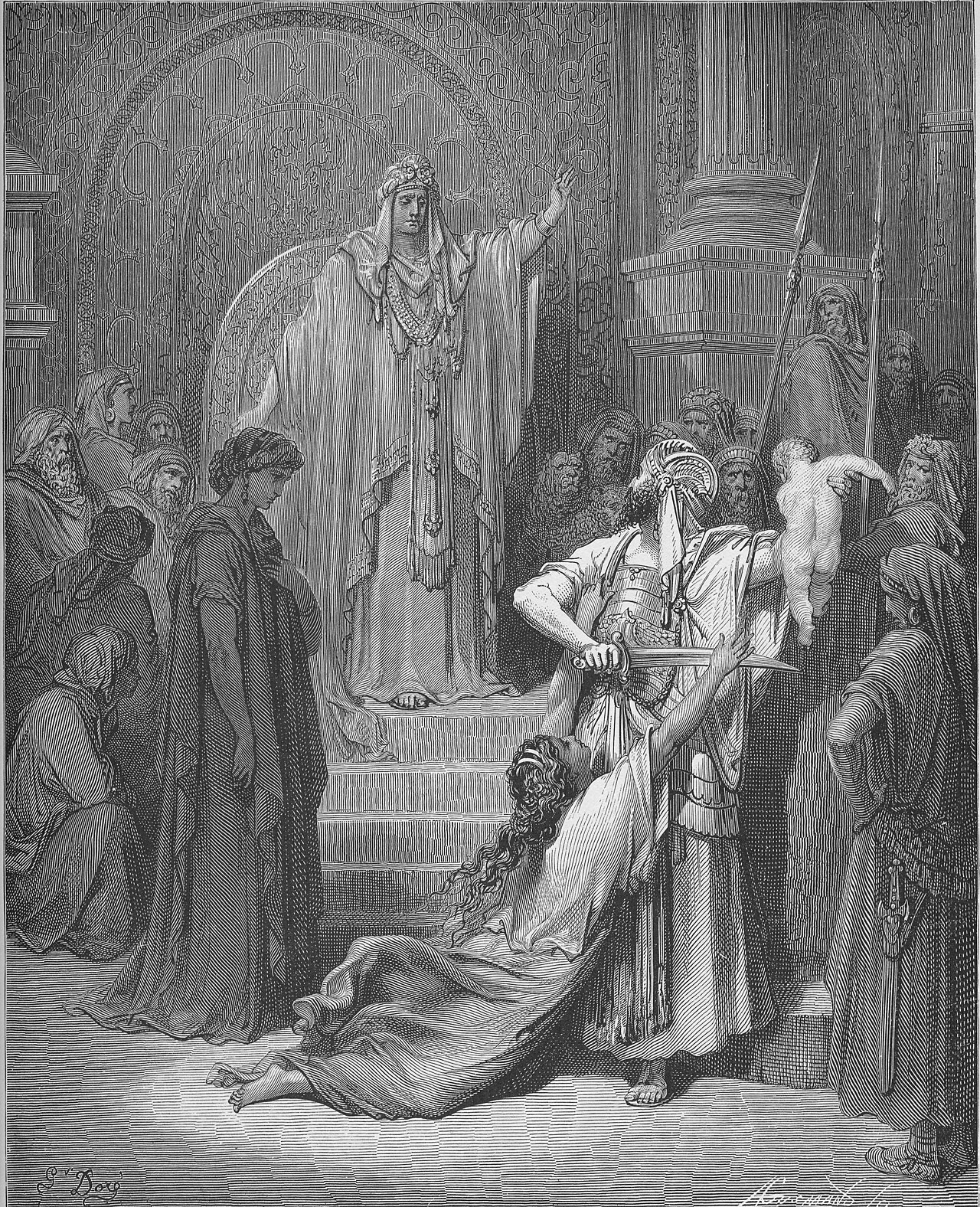
in 1 Kings 3Then the woman whose son was alive spoke to the king because she yearned with compassion for her son. “Please, my lord,” she said, “give her the living baby. Do not kill him!” But the other woman said, “He will be neither mine nor yours. Cut him in two!”
BSB
The same verse in ASV and KJV ▾
ASV
Then spake the woman whose the living child was unto the king, for her heart yearned over her son, and she said, Oh, my lord, give her the living child, and in no wise slay it. But the other said, It shall be neither mine nor thine; divide it.
KJV
Then spake the woman whose the living child was unto the king, for her bowels yearned upon her son, and she said, O my lord, give her the living child, and in no wise slay it. But the other said, Let it be neither mine nor thine, but divide it.
⋯
This verse in 1 Kings 3
Commentary
12 notes on this verseThe interpretation of Solomon's judgment on the quarrel of two harlot women (1 Kings 3) is clear as far as the simple history is concerned: that a boy of twelve years judged with an affection beyond his age for the depths of human nature. Hence, he was both admired and feared by all Israel, because he would not miss what was so skillfully concealed.
This site's exposition
her bowels yearned upon her son
on 1 Kings 3:26-27
Her bowels yearned upon her son names the true mother by what her body does before her mouth can argue further, compassion breaking through where testimony had reached deadlock. The other woman's answer, let it be neither mine nor thine, but divide it, exposes itself as willing to destroy what it cannot keep, and the king reads the difference correctly. Give her the living child closes the case: the boy is handed not to the louder claim but to the love that would rather lose him than kill him.
The record, by era
The Church Fathers5 voices
What about Solomon, who in his first judgment manifested the gift of wisdom, which he had received of God, only by making use of falsehood? For in order to get at the truth which was hidden by the woman's lie, even he used the help of a lie most cunningly invented, saying: "Bring me a sword and divide the living child into two parts, and give the one half to the one and the other half to the other."
But there is no greater proof of charity in Christ's church than when the very honor that seems so important among people is despised, in order to prevent the limbs of the infant being cut in two and Christian infirmity being torn to shreds by the break of unity. The apostle says that he had shown himself like a mother to the little ones among whom he had done the good work of the gospel, not he but the grace of God in him. That harlot could call nothing her own except her sins, whereas the gift of fertility she had from God. And the Lord says beautifully about a harlot, "She to whom much is forgiven loves much." So the apostle Paul says, "I became a little one among you, like a wet-nurse fondling her children." But when it comes to the danger of the little one being cut in two, when Insincerity claims for herself a spurious dignity of motherhood and is prepared to break up unity, the mother despises her proper dignity provided she may see her son whole and preserve him alive; she is afraid that if she insists too obstinately on the dignity due to her motherhood, she may give Insincerity a chance to divide the feeble limbs with the sword of schism. So indeed let mother Charity say, "Give her the boy." "Whether in pretense or in truth, let Christ be preached." In Moses Charity exclaims, "Lord, either pardon them or blot me out of your book." But in the Pharisees Insincerity speaks: "If we let him go, the Romans will come and take away our nation and place." It was not the reality of justice that they wished to have but its name, and they desired to hold on dishonestly to the honor owed to just men and women. […]
The two women indicate to us the church and the synagogue. The latter, after it tried to suppress the sacrament of human redemption and persecuted and killed the Redeemer through false accusations, claims, nevertheless, that its child should still be alive, that is, that the …
As for the royal judgment between the two of them, it simply admonishes us to fight for the truth and to drive hypocrisy away from the spiritual gift of the church like a spurious mother from another woman's living son and not to let her control the grace granted to others when she could not take care of her own. But let us do this, defending and fighting for the truth without running the risk of division. That decision of the judge, when he ordered the baby to be cut in two, is not meant as a breach of unity but as a test of charity. The name Solomon means peaceable. So a peaceable king does not tear limbs apart that contain the spirit of life in unity and concord. But his threat discovers the true mother, and his judgment sets aside the spurious one. So then, if it comes to this sort of crisis and trial, to prevent the unity of Christian grace from being torn apart, we are taught to say, "Give her the child, only let him live." The true mother, you see, is not concerned about the honor of motherhood but about the well-being of her son. Wherever he may be, his mother's true love will make him more her possession than that of the false claimant.
Such a Shechem is the church; for Solomon chose her whose hidden love he had discerned. Such a Shechem is Mary, whose soul God's sword pierces and divides. Such a Shechem is a "coming up," even as it appears in the meaning of the word. As to what the "coming up" is, hear Solomon speaking in reference to the church, "Who is she that comes up clothed in white, leaning on her brother?" She is radiant, a word expressed in Greek as aktinodes, because she is resplendent in faith and in works. To her children it is said, "Let your works shine before my Father, who is in heaven."
5 more voices on this verse
The Church Fathers2 voices
The lesson to be read at Vespers, dearly beloved, concerns the two harlots who came for the decision of Solomon; one of them, who was not only dissolute but also cruel and wicked, shouted to the king that he should command the infant to be cut in two. Now, if you willingly listen, we would like to mention to the ears of your charity what the holy Fathers have explained about the matter. The woman who cried out that the boy should be kept whole represented a type of the Catholic church; the other cruel and impious woman who shouted that the boy should be divided signified the Arian heresy. The Catholic church like a most devoted mother exclaims to all heretics: Do not make Christ less than the Father; do not divide his unity; do not divide the one God in various degrees and fashion, as it were, idols of the pagans in your hearts. Keep him with you entirely; if you want to have peace, do not divide his unity. Indeed, if you have the whole, everything remains yours. So great is the omnipotence of God that all possess him entire, and each one possesses all of him. However, the impious, cruel heresy exclaims, "No, but divide him." What does this mean, divide him, except that the Son is not equal to the Father? If a person takes equality from the Son, he denies that the Father is good and omnipotent. If God the Father could beget a Son like himself but would not, he is not good; if he would but could not, he is not almighty. Be assured, brothers, that none of the Arians can answer this statement; but whenever they are limited by the truest reason, like a slippery snake they take refuge in some sort of clever and involved inquiries.
Is not that noble judgment of Solomon full of wisdom and justice? Let us see whether it is so. "Two women," it says, "stood before King Solomon, and the one said to him, 'Hear me, my lord, I and this woman dwell in one house, and before the third day we gave birth and bore a son apiece and were together; there was no witness in the house, nor any other woman with us, only we two alone. And her son died this night, because she laid on him, and she arose at midnight, and took my son from my breast and laid him in her bosom, and her dead child she laid at my breast. And I arose in the morning to nurse my child and found him dead. And I examined him at dawn, and behold, it was not my son.' And the other woman said, 'No, but the living is my son, and the dead is your son.' " This was their dispute, in which either tried to claim the living child for herself and denied that the dead one was hers. Then the king commanded a sword to be brought and the infant to be cut in half, and either piece to be given to one, one half to the one, and one half to the other. Then the woman whose the child really was, moved by her feelings, cried out, "Do not divide the child, my lord; rather, let it be given to her and live, and do not kill it." But the other answered: "Let it be neither mine nor hers; divide it." Then the king ordered that the infant should be given to the woman who had said "do not kill it," for, as it says, "her compassion earned over her son."It is not wrong to suppose that the mind of God was in him; for what is hidden from God? What can be more hidden than the witness that lies deep within; into which the mind of the wise king as though to judge a mother's feelings and elicited as it were the voice of a mother's heart? […]
The Puritans and the Awakening3 voices
"Let me see it hers, rather than not see it at all." By this tenderness towards the child it appeared that she was not the careless mother that had overlaid the dead child, but was the true mother of the living one, that could not endure to see its death, having compassion on the son of her womb. "The case is plain," says Solomon; "what need of witnesses?
quarantine:debris (2026-07-29) — odd-straight-quotes
3 And Solomon loved the L ORD , walking in the statutes of David his father: only he sacrificed and burnt incense in high places. 4 And the king went to Gibeon to sacrifice there; for that was the great high place: a thousand burnt offerings did Solomon offer upon that altar. We are here told concerning Solomon, I.
quarantine:scripture (2026-07-29) — scripture-overlap:88%@v3-5
Then spake the woman, whose the living child was, unto the king,....
The words behind it
32 Hebrew wordsEvery Hebrew word of this verse in the order it stands, with what it means and the door to its own study. The last column counts the times a word stands in the whole Bible: the rarer the word, the more the places it appears belong together.
| Hebrew | Sound | Meaning | Word study | In the Bible |
|---|---|---|---|---|
| וַתֹּ֣אמֶר | vatomer | and she said | H559 → | 5305 times |
| הָאִשָּׁה֩ | haishah | the woman | H802 → | 781 times |
| אֲשֶׁר־ | ʾasher- | whom | H834 → | 5497 times |
| בְּנָ֨הּ | benah | [was] son her | H1121 → | 4930 times |
| הַחַ֜י | hachai | the living one | H2416 → | 498 times |
| אֶל־ | ʾel- | to | H413 → | 5510 times |
| הַמֶּ֗לֶךְ | hamelekh | the king | H4428 → | 2525 times |
| כִּֽי־ | ki- | for | H3588 → | 4482 times |
| נִכְמְר֣וּ | nikhmeru | they had grown warm | H3648 → | |
| רַחֲמֶיהָ֮ | rachameiha | compassion<s> her | H7356 → | |
| עַל־ | ʾal- | on | H5921 → | 5755 times |
| בְּנָהּ֒ | benah | son her | H1121 → | 4930 times |
| וַתֹּ֣אמֶר׀ | vatomer | and she said | H559 → | 5305 times |
| בִּ֣י | bi | pardon me | H994 → | |
| אֲדֹנִ֗י | ʾadoni | O lord my | H113 → | 333 times |
| תְּנוּ־ | tenu- | give | H5414 → | 2011 times |
| לָהּ֙ | lah | to her | ||
| אֶת־ | ʾet- | <obj.> | H853 → | 10935 times |
| הַיָּל֣וּד | haiyalud | the child | H3205 → | 496 times |
| הַחַ֔י | hachai | <the> living | H2416 → | 498 times |
| וְהָמֵ֖ת | vehamet | and certainly <to kill> | H4191 → | 839 times |
| אַל־ | ʾal- | may not | H408 → | 724 times |
| תְּמִיתֻ֑הוּ | temituhu | you kill him | H4191 → | 839 times |
| וְזֹ֣את | vezot | and this [one] | H2063 → | 603 times |
| אֹמֶ֗רֶת | ʾomeret | [was] saying | H559 → | 5305 times |
| גַּם־ | gam- | neither | H1571 → | 769 times |
| לִ֥י | li | to me | ||
| גַם־ | gam- | nor | H1571 → | 769 times |
| לָ֛ךְ | lakh | to you | ||
| לֹ֥א | lo' | not | H3808 → | 5168 times |
| יִהְיֶ֖ה | yihyeh | he will belong | H1961 → | 3559 times |
| גְּזֹֽרוּ׃ | gezoru | cut | H1504 → |
וַתֹּ֣אמֶרand she said
vatomerH559 →5305 times
הָאִשָּׁה֩the woman
haishahH802 →781 times
אֲשֶׁר־whom
ʾasher-H834 →5497 times
בְּנָ֨הּ[was] son her
benahH1121 →4930 times
הַחַ֜יthe living one
hachaiH2416 →498 times
אֶל־to
ʾel-H413 →5510 times
הַמֶּ֗לֶךְthe king
hamelekhH4428 →2525 times
כִּֽי־for
ki-H3588 →4482 times
נִכְמְר֣וּthey had grown warm
nikhmeruH3648 →
רַחֲמֶיהָ֮compassion<s> her
rachameihaH7356 →
עַל־on
ʾal-H5921 →5755 times
בְּנָהּ֒son her
benahH1121 →4930 times
וַתֹּ֣אמֶר׀and she said
vatomerH559 →5305 times
בִּ֣יpardon me
biH994 →
אֲדֹנִ֗יO lord my
ʾadoniH113 →333 times
תְּנוּ־give
tenu-H5414 →2011 times
לָהּ֙to her
lah
אֶת־<obj.>
ʾet-H853 →10935 times
הַיָּל֣וּדthe child
haiyaludH3205 →496 times
הַחַ֔י<the> living
hachaiH2416 →498 times
וְהָמֵ֖תand certainly <to kill>
vehametH4191 →839 times
אַל־may not
ʾal-H408 →724 times
תְּמִיתֻ֑הוּyou kill him
temituhuH4191 →839 times
וְזֹ֣אתand this [one]
vezotH2063 →603 times
אֹמֶ֗רֶת[was] saying
ʾomeretH559 →5305 times
גַּם־neither
gam-H1571 →769 times
לִ֥יto me
li
גַם־nor
gam-H1571 →769 times
לָ֛ךְto you
lakh
לֹ֥אnot
lo'H3808 →5168 times
יִהְיֶ֖הhe will belong
yihyehH1961 →3559 times
גְּזֹֽרוּ׃cut
gezoruH1504 →
A shaded row is a word that stands 400 times or fewer in the Bible.
The walk
8 stopsEach card is a verse this one points to, and under it the verses that one points to in turn. Where several paths arrive at the same place, that place is listed first: the text keeps returning to it.
Through
Isaiah 49:15“Can a woman forget her nursing child, or lack compassion for the son of her womb? Even if she could forget, I will not forget you!
it leads to
- Jeremiah 31:20
Is not Ephraim a precious son to Me, a delightful child? Though I often speak against him, I still remember him. Therefore My heart yearns for him; I have great compassion for him,” declares…
Reached by 3 separate paths from here.
- Isaiah 44:21
Remember these things, O Jacob, for you are My servant, O Israel. I have made you, and you are My servant; O Israel, I will never forget you.
- Psalms 103:13
As a father has compassion on his children, so the LORD has compassion on those who fear Him.
- Matthew 7:11
So if you who are evil know how to give good gifts to your children, how much more will your Father in heaven give good things to those who ask Him!
- Jeremiah 31:20
Through
1 John 3:17If anyone with earthly possessions sees his brother in need, but withholds his compassion from him, how can the love of God abide in him?
it leads to
- Hebrews 13:16
And do not neglect to do good and to share with others, for with such sacrifices God is pleased.
- Isaiah 58:7–10
Isn’t it to share your bread with the hungry, to bring the poor and homeless into your home, to clothe the naked when you see him, and not to turn away from your own…
- Deuteronomy 15:7–11
If there is a poor man among your brothers within any of the gates in the land that the LORD your God is giving you, then you are not to harden your heart or…
- 1 John 4:20
If anyone says, “I love God,” but hates his brother, he is a liar. For anyone who does not love his brother, whom he has seen, cannot love God, whom he has not seen.
- Hebrews 13:16
Where this verse is studied
On this page
About 1 Kings
This page draws on 12 works. Open the list of works
This page draws on Ambrose of Milan, Interrogation of Job and David 4.4.16; Ambrose of Milan, On the Duties of the Clergy 2.8.44-47; Augustine of Hippo, SERMON 10.8; Augustine of Hippo, SERMON 10.4; Augustine of Hippo, SERMON 123.1; Ephrem the Syrian, ON THE FIRST BOOK OF KINGS 3:16; Jerome, Letter 74; John Cassian, CONFERENCE 17.25; John Gill, Exposition of the Old Testament (1748-1763); John Wesley, Explanatory Notes upon the Old Testament; Keil, The Books of the Kings and Matthew Henry, Commentary on the Whole Bible.