
1 Kings 3:16
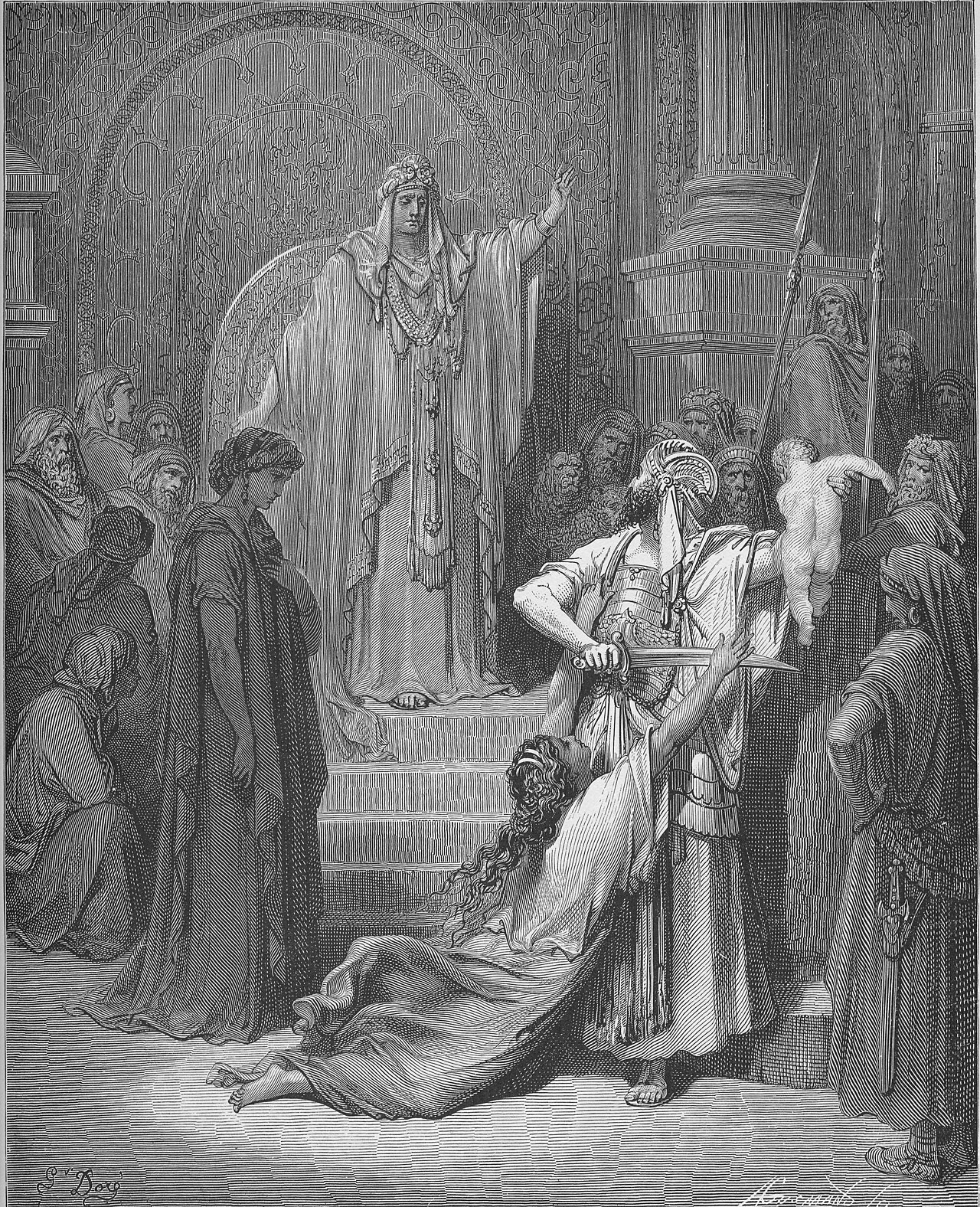
in 1 Kings 3At that time two prostitutes came to the king and stood before him.
BSB
The same verse in ASV and KJV ▾
ASV
Then there came two women that were harlots, unto the king, and stood before him.
KJV
Then came there two women, that were harlots, unto the king, and stood before him.
⋯
This verse in 1 Kings 3
Commentary
13 notes on this verseThe interpretation of Solomon's judgment on the quarrel of two harlot women (1 Kings 3) is clear as far as the simple history is concerned: that a boy of twelve years judged with an affection beyond his age for the depths of human nature. Hence, he was both admired and feared by all Israel, because he would not miss what was so skillfully concealed.
This site's exposition
two prostitutes came to the king
on 1 Kings 3:16-18
Two prostitutes bring their dispute to the king, and the case turns on their word. The account in verse 18 is plain: “We were alone, with no one in the house but the two of us”. The second witness the Law requires is closed to the king before he begins.
The record, by era
The Church Fathers5 voices
The first idea that occurs to me on consideration is that the two women are the synagogue and the church. For the synagogue is convicted of having killed Christ her son, born of the Jews according to the flesh, in her sleep; that is, by following the light of this present life and not perceiving the revelation of trust in the sayings of the Lord. That is why it is written, "Rise, sleeper, and arise from the dead, and Christ will enlighten you." That they were two and that they were alone, living in one house, may be taken to mean, without being far-fetched, that besides the circumcision and the uncircumcision there is no other kind of religion to be found in this world. So under the person of one woman you can include the race of circumcised men bound by the worship and the law of one God, while under the person of the other woman you can comprehend all the uncircumcised Gentiles given over to the worship of idols.But they were both harlots. Well, the apostles say that Jews and Greeks are all under sin. Every soul that forsakes eternal truth for base earthly pleasures is whoring away from the Lord. Now about the church that comes from the whoredom of the Gentiles, it is clear that it did not kill Christ.… Pay attention to the Gospel and listen to what the Lord says: "Whoever does the will of my Father, this is my mother and brother and sister." So when did this one sleep, not indeed to smother her child in sleep but at least so that the dead one could be substituted and the living one taken away from her? […]
Now let the other one claim that the gospel is hers, as being owed to her and produced through her. For that is what they were saying to the Gentiles in this dispute, those of the Jews who, while clinging to the letter of the law, dared to call themselves Christians. They were saying that the gospel had come as something owed to them for their justice. But it was not theirs, because they did not know how to grasp its spirit. So they even had the audacity to contend that they were to be called Christians, boasting in someone else's name like that woman claiming a son she had not borne; and this though by excluding a spiritual understanding from the works of the law they had as it were drained the soul out of the body of their works, and while smothering the live spirit of prophecy had remained attached to their material keeping of the law, which lacked all life, that is to say, spiritual understanding. They wanted to foist all this on the Gentiles too, and take from them, like the living child, the name of Christian. In refuting them, the apostle went so far as to say that the more they claim Christian grace as their due and boast that it is theirs as though by right of the works of the law, the less it really belongs to them. "For to one who works," he says, "his wages are not reckoned as a grace or favor but as his due. But to one who does not work but believes in him who justifies the wicked, it is faith that is reckoned as justice." And therefore he does not count among their number those of the Jews who had believed rightly and were holding fast to a living spiritual grace. He says this remnant of the Jewish people were saved, when the majority of them had gone to perdition. "So therefore at the present time also," he says, "a remnant has been saved, chosen by grace. […]
Again, I see these two women in one house as representing two kinds of people in one church: one of them dominated by insincerity, the other ruled by charity. So we may regard these two kinds of people simply like two women, called love and insincerity. Insincerity, of course, deceitfully imitates love. That is why the apostle warns us against her when he says, "Let love be without insincerity." Although the two live in one house as long as that gospel net is in the sea, enclosing good and bad fish together until it is brought ashore, yet each is doing her own thing. They were both harlots, though, because everyone is converted to the grace of God from worldly desires, and nobody can properly boast about any prior justice and its merits. A harlot's committing fornication is her own doing; her having a son is God's. All human beings, after all, are fashioned by the one creator God. Nor it is surprising that God works well even in the sins of men and women. After all, even the crime of Judas the traitor was used by our Lord to achieve the salvation of the human race. But the difference is that when God brings something good out of anyone's sin, it is not usually something that the sinner wants. It is not only that when he sins he does not sin with the same intention as God's providence turning his sin to a just end—Judas, you see, did not betray Christ with the same intention as Christ had in allowing himself to be betrayed; it is also that when he realizes his sin has produced a better result that he never wanted to happen, it gives him more pain than pleasure. Suppose, for example, someone wants to give his enemy poison while he is sick, but he makes a mistake about the kind of medicine and gives him something beneficial instead, so that the sick person gets better through the kindness of God, who decided to turn his enemy's villainy to his advantage. […]
The two women indicate to us the church and the synagogue. The latter, after it tried to suppress the sacrament of human redemption and persecuted and killed the Redeemer through false accusations, claims, nevertheless, that its child should still be alive, that is, that the …
Is not that noble judgment of Solomon full of wisdom and justice? Let us see whether it is so. "Two women," it says, "stood before King Solomon, and the one said to him, 'Hear me, my lord, I and this woman dwell in one house, and before the third day we gave birth and bore a son apiece and were together; there was no witness in the house, nor any other woman with us, only we two alone. And her son died this night, because she laid on him, and she arose at midnight, and took my son from my breast and laid him in her bosom, and her dead child she laid at my breast. And I arose in the morning to nurse my child and found him dead. And I examined him at dawn, and behold, it was not my son.' And the other woman said, 'No, but the living is my son, and the dead is your son.' " This was their dispute, in which either tried to claim the living child for herself and denied that the dead one was hers. Then the king commanded a sword to be brought and the infant to be cut in half, and either piece to be given to one, one half to the one, and one half to the other. Then the woman whose the child really was, moved by her feelings, cried out, "Do not divide the child, my lord; rather, let it be given to her and live, and do not kill it." But the other answered: "Let it be neither mine nor hers; divide it." Then the king ordered that the infant should be given to the woman who had said "do not kill it," for, as it says, "her compassion earned over her son."It is not wrong to suppose that the mind of God was in him; for what is hidden from God? What can be more hidden than the witness that lies deep within; into which the mind of the wise king as though to judge a mother's feelings and elicited as it were the voice of a mother's heart? […]
6 more voices on this verse
The Church Fathers1 voice
Such a Shechem is the church; for Solomon chose her whose hidden love he had discerned. Such a Shechem is Mary, whose soul God's sword pierces and divides. Such a Shechem is a "coming up," even as it appears in the meaning of the word. As to what the "coming up" is, hear Solomon speaking in reference to the church, "Who is she that comes up clothed in white, leaning on her brother?" She is radiant, a word expressed in Greek as aktinodes, because she is resplendent in faith and in works. To her children it is said, "Let your works shine before my Father, who is in heaven."
The Puritans and the Awakening3 voices
Harlots - Or, victuallers: for the Hebrew words signifies both. Yet that they are unmarried persons, seems probable, both because there is no mention of any husbands, whose office it was, if there were any such, to contest for their wives; and because they lived a solitary life in one house.
3 And Solomon loved the L ORD , walking in the statutes of David his father: only he sacrificed and burnt incense in high places. 4 And the king went to Gibeon to sacrifice there; for that was the great high place: a thousand burnt offerings did Solomon offer upon that altar. We are here told concerning Solomon, I.
quarantine:scripture (2026-07-29) — scripture-overlap:88%@v3-5
Then came there two women that were harlots unto the king,....
The Nineteenth Century2 voices
Then came there two women - harlots - The word זנות zonoth, which we here, and in some other places, improperly translate harlots, is by the Chaldee (the best judge in this case) rendered פונדקין pundekayan, tavern-keepers. (See on Jos 2:1 (note)). If these had been harlots, it is not likely they would have dared to appear before Solomon; and if they had been common women, it is not likely they would have had children; nor is it likely that such persons would have been permitted under the reign of David.
A commentator
Jamieson, Fausset & Brown1802–1910
Commentary Critical and Explanatory on the Whole Bible (1871)
Then came there two women--Eastern monarchs, who generally administer justice in person, at least in all cases of difficulty, often appeal to the principles of human nature when they are at a loss otherwise to find a clue to the truth or see clearly their way through a mass of conflicting testimony.
How the passage was read
What the Jewish commentators add
On the verses either side of this one
Shlomo woke up and behold it was a dream. And behold he understood that his dream was true. He heard a bird chirping and understood its language, a dog barking and he understood its language.
This section is reception history: how the passage was read and kept in the Jewish tradition. Where a reading parts from an essential of the Christian faith, the section says so at that point.
Texts and citation data: Sefaria; each excerpt follows its version’s licence. 5 further sources are cited on this chapter that carry no English text this site may quote or only restate the verse.
The words behind it
9 Hebrew wordsEvery Hebrew word of this verse in the order it stands, with what it means and the door to its own study. The last column counts the times a word stands in the whole Bible: the rarer the word, the more the places it appears belong together.
| Hebrew | Sound | Meaning | Word study | In the Bible |
|---|---|---|---|---|
| אָ֣ז | ʾaz | then | H227 → | 141 times |
| תָּבֹ֗אנָה | tavonah | they came | H935 → | 2568 times |
| שְׁתַּ֛יִם | shetayim | two | H8147 → | 768 times |
| נָשִׁ֥ים | nashim | women | H802 → | 781 times |
| זֹנ֖וֹת | zonot | prostitutes | H2181 → | |
| אֶל־ | ʾel- | to | H413 → | 5510 times |
| הַמֶּ֑לֶךְ | hamelekh | the king | H4428 → | 2525 times |
| וַֽתַּעֲמֹ֖דְנָה | vataamodenah | and they stood | H5975 → | 521 times |
| לְפָנָֽיו׃ | lefanav | <to> before him | H6440 → | 2123 times |
אָ֣זthen
ʾazH227 →141 times
תָּבֹ֗אנָהthey came
tavonahH935 →2568 times
שְׁתַּ֛יִםtwo
shetayimH8147 →768 times
נָשִׁ֥יםwomen
nashimH802 →781 times
זֹנ֖וֹתprostitutes
zonotH2181 →
אֶל־to
ʾel-H413 →5510 times
הַמֶּ֑לֶךְthe king
hamelekhH4428 →2525 times
וַֽתַּעֲמֹ֖דְנָהand they stood
vataamodenahH5975 →521 times
לְפָנָֽיו׃<to> before him
lefanavH6440 →2123 times
A shaded row is a word that stands 400 times or fewer in the Bible.
The walk
8 stopsEach card is a verse this one points to, and under it the verses that one points to in turn. Where several paths arrive at the same place, that place is listed first: the text keeps returning to it.
Through
Joshua 2:1Then Joshua son of Nun secretly sent two spies from Shittim, saying, “Go, inspect the land, especially Jericho.” So they went and entered the house of a prostitute named Rahab and stayed there.
it leads to
- Hebrews 11:31
By faith the prostitute Rahab, because she welcomed the spies in peace, did not perish with those who were disobedient.
- James 2:25
In the same way, was not even Rahab the prostitute justified by her actions when she welcomed the spies and sent them off on another route?
- Hebrews 11:31
Through
Judges 11:1Now Jephthah the Gileadite was a mighty man of valor; he was the son of a prostitute, and Gilead was his father.
it leads to
- Hebrews 11:32
And what more shall I say? Time will not allow me to tell of Gideon, Barak, Samson, Jephthah, David, Samuel, and the prophets,
- Judges 6:12
And the angel of the LORD appeared to Gideon and said, “The LORD is with you, O mighty man of valor.”
- 2 Kings 5:1
Now Naaman, the commander of the army of the king of Aram, was a great man in his master’s sight and highly regarded, for through him the LORD had given victory to Aram. And…
- Hebrews 11:32
Through
Deuteronomy 23:17No daughter or son of Israel is to be a shrine prostitute.
it leads to
- 2 Kings 23:7
He also tore down the quarters of the male shrine prostitutes that were in the house of the LORD, where the women had woven tapestries for Asherah.
- Leviticus 19:29
You must not defile your daughter by making her a prostitute, or the land will be prostituted and filled with depravity.
- 1 Kings 14:24
There were even male shrine prostitutes in the land. They imitated all the abominations of the nations the LORD had driven out before the Israelites.
- 2 Kings 23:7
Where this verse is studied
On this page
About 1 Kings
This page draws on 13 works. Open the list of works
This page draws on Adam Clarke, Commentary on the Bible; Ambrose of Milan, On the Duties of the Clergy 2.8.44-47; Ambrose of Milan, Interrogation of Job and David 4.4.16; Augustine of Hippo, SERMON 10.2; Augustine of Hippo, SERMON 10.3; Augustine of Hippo, SERMON 10.5; Ephrem the Syrian, ON THE FIRST BOOK OF KINGS 3:16; F. W. Farrar, The First Book of Kings (Expositor's Bible); Jamieson, Fausset & Brown, Commentary Critical and Explanatory on the Whole Bible; Jerome, Letter 74; John Gill, Exposition of the Old Testament (1748-1763); John Wesley, Explanatory Notes upon the Old Testament and Matthew Henry, Commentary on the Whole Bible.