
Luke 15:20
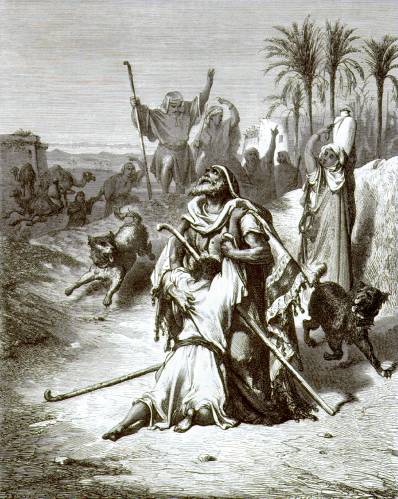
in Luke 15So he got up and went to his father. But while he was still in the distance, his father saw him and was filled with compassion. He ran to his son, embraced him, and kissed him.
BSB
The same verse in ASV and KJV ▾
ASV
And he arose, and came to his father. But while he was yet afar off, his father saw him, and was moved with compassion, and ran, and fell on his neck, and kissed him.
KJV
And he arose, and came to his father. But when he was yet a great way off, his father saw him, and had compassion, and ran, and fell on his neck, and kissed him.
⋯
This verse in Luke 15
Commentary
43 notes on this verseChrist chooses those who stand. Rise and run to the church. Here is the Father, the Son and the Holy Spirit. He who hears you pondering in the secret places of the mind runs to you. When you are still far away, he sees you and runs to you. He sees in your heart. He runs, perhaps someone may hinder, and he embraces you. His foreknowledge is in the running, his mercy in the embrace and the disposition of fatherly love.
This site's exposition
was filled with compassion
on Luke 15:20-24
His father saw him while he was still in the distance and was filled with compassion, splanchnizomai, the verb Luke keeps for the deepest mercy. He ran to his son, which no dignified householder did, and the confession stops short of the hired-servant clause as the father calls for the best robe, a ring, sandals, and the fattened calf. The father states the verdict as resurrection: this son of mine was dead and is alive again.
The record, by era
The Church Fathers5 voices
Then he shall get up, come to his father, and confess to him, "I have sinned against heaven and before you. I am no longer worthy to be called your son. Treat me like one of your hired servants."When he confesses like that, he will be considered worthy of more than that for which he prayed. His father neither takes him in like a hired servant nor treats him like a stranger. Oh no, he kisses him as a son. He accepts him as a dead man come back to life again.
He runs then to meet thee, because He hears thee within meditating the secrets of thy heart, and when thou wert yet afar off, He runs lest any one should stop Him. He embraces also, (for in the running there is fore-knowledge, in the embrace mercy,) and as if by a certain impulse of paternal affection, falls upon thy neck, that he may raise up him that is cast down, and bring back again to heaven him that was loaded with sins and bent down to the earth. I had rather then be a son than a sheep. For the sheep is found by the shepherd, the son is honoured by the father.
(ubi sup.) For before that he perceived God afar off, when he was yet piously seeking him, his father saw him. For the ungodly and proud, God is well said not to see, as not having them before his eyes. For men are not commonly said to be before the eyes of any one except those who are beloved. (ubi sup.) Or running he fell upon his neck; because the Father abandoned not His Only-Begotten Son, in whom He has ever been running after our distant wanderings. For God was in Christ reconciling the world unto himself. (2 Cor. 5:19.) But to fall upon his neck is to lower to his embrace His own Arm, which is the Lord Jesus Christ. But to be comforted by the word of God's grace unto the hope of pardon of our sins, this is to return after a long journey to obtain from a father the kiss of love.
(ubi sup.) Now this prodigal son, the Holy Spirit has engraved upon our hearts, that we may be instructed how we ought to deplore the sins of our soul.
Jacob led out his sheep And brought them to his father's home; A symbol for those with discernment, A parable for those with perception Is to be found in this homecoming: Let us too return to our Father's house, My brothers, and do not become …
36 more voices on this verse
The Church Fathers10 voices
In the case of the prodigal son, it is the patience of his father that welcomes, clothes, feeds and finds an excuse for him in the face of the impatience of his angry brother. The one who perished is rescued, because he embraced repentance. Repentance is not wasted because it meets up with patience!
Leaving those that have not strayed, the good Shepherd seeks you. If you will surrender yourself, he will not hold back. In his kindness, he will lift you up on his shoulders, rejoicing that he has found his sheep that was lost. The Father stands and awaits your return from your wandering. Only turn to him, and while you are still afar off, he will run and embrace your neck. With loving embraces, he will enfold you, now cleansed by your repentance.… He says, "Truly I say to you that there is joy in heaven before God over one sinner who repents." If any one of those who seem to stand will bring a charge that you have been quickly received, the good Father himself will answer for you. He will say, "It is fitting that we should celebrate and be glad, for this my daughter was dead and is come to life again. She was lost and is found."
What is the object of the parable? Let us examine the occasion that led to it so we will learn the truth. The blessed Luke had said a little before of Christ the Savior of us all.… The Pharisees and scribes made this outcry at his gentleness and love to people. They wickedly and impiously blamed him for receiving and teaching people whose lives were impure. Christ very necessarily set before them the present parable. He clearly shows them that the God of all requires even him who is thoroughly steadfast, firm, holy, and has attained to the highest praise for sobriety of conduct to be earnest in following his will. When any are called to repentance, even if they have a bad reputation, he must rejoice rather and not give way to an unloving irritation because of them.
It is the opinion of some that the two sons signify the holy angels and us earth dwellers. The elder one, who lived soberly, represents the company of the holy angels, while the younger and prodigal son is the human race. Some among us give it a different explanation, arguing that the older and well-behaved son signifies Israel after the flesh. The other son, who chose to live in the lust of pleasures and moved far away from his father, depicts the company of the Gentiles.
(Hom. 14. in Ep. Rom.) Who after that he said, I will go to my father, (which brought all good things,) tarried not, but took the whole journey; for it follows, And he arose, and came to his father. Let us do likewise, and not be wearied with the length of the way, for if we are willing, the return will become swift and easy, provided that we desert sin, which led us out from our father's house. But the father pitieth those who return. For it is added, And when he was yet afar off.
(Hom. 10. in Ep. Rom. Greg. ubi sup.) Now the father perceiving his penitence did not wait to receive the words of his confession, but anticipates his supplication, and had compassion on him, as it is added, and was moved with pity.
(Hom. de Patre et duob. Fil.) For what else means it that he ran, but that we through the hindrance of our sins cannot by our own virtue reach to God. But because God is able to come to the weak, he fell on his neck. The mouth is kissed, as that from which has proceeded the confession of the penitent, springing from the heart, which the father gladly received.
His meditating confession so won his father to him, that he went out to meet him, and kissed his neck; for it follows, and ran, and fell on his neck, and kissed him. This signifies the yoke of reason imposed on the mouth of man by Evangelical tradition, which annulled the observance of the law.
"He fell on his neck and kissed him." This is how the father judges and corrects his wayward son and gives him not beatings but kisses. The power of love overlooked the transgressions. The father redeemed the sins of his son by his kiss, and …
The father runs out from far away. "When we were still sinners, Christ died for us." The Father runs out. He runs out in his Son, when through him he descends from heaven and comes down on earth. "With me," the Son says, "is he …
The Medieval Church7 voices
Third, with respect to the humility of satisfaction, he adds: And rising up he came to his father. By this rising is understood the abandonment of sin and a certain distancing from it, which is the beginning of satisfaction. For "to make satisfaction is to …
And rising up, he came to his father. To come to the father is to be established in the Church through faith, where legitimate and fruitful confession of sins already may exist.
Yet while he was still far off. And before he could understand God, but nevertheless while he already piously sought Him.
His father saw him. For the impious and proud are fittingly said to not be seen, as if not held before the eyes. For someone held before the eyes is usually said to be one who is loved.
And he was moved with mercy, and running, fell on his neck. For the father did not desert the only-begotten Son, in whom he ran and descended even to our distant wandering. Because God was in Christ, reconciling the world to Himself (II Cor. V). …
And he kissed him. To be consoled by the word of God's grace unto the hope of the forgiveness of sins, that is, after long journeys remaining, to merit the kiss of charity from the father.
We must not only desire what is pleasing to God, but also carry it out in actual deed. You have now seen the warm repentance; behold also the father's compassion. He does not wait for the son to reach him, but himself hastens to meet …
The Puritans and the Awakening4 voices
And he arose,.... This shows that his resolution to arise was not of nature, but of grace, by its being put into execution; for it was made and executed, not in his own strength, but in another's.
They are sometimes ranked with harlots ( Matt. xxi. 32 ); here and elsewhere with sinners, such as were openly vicious, that traded with harlots, known rakes. Some think that the sinners here meant were heathen, and that Christ was now on the other side Jordan, or in Galilee of the Gentiles.
16 . [3.] Here were feet of mercy, and those feet quick-paced: He ran. This denotes how swift God is to show mercy. The prodigal son came slowly, under a burden of shame and fear; but the tender father ran to meet him with his encouragements. [4.] Here were arms of mercy, and those arms stretched out to embrace him: He fell on his neck.
And he arose and came to his father - The moment he had resolved, he began to execute his resolution. While he was yet a great way off, his father saw him - Returning, starved, naked.
The Nineteenth Century15 voices
And kissed him - Or, kissed him again and again; the proper import of καταεφιλησεν αυτον. The father thus showed his great tenderness towards him, and his great affection for him.
THIS SENTENCE EXPRESSES the true turning point in the prodigal’s life story. Many other matters led up to it, and before he came to it there was much in him that was very hopeful; but this was the point itself, and had he never reached it he would have remained a prodigal, but would never have been the prodigal restored, and his life would have been a warning rather than an instruction to us.
A commentator
Jamieson, Fausset & Brown1802–1910
Commentary Critical and Explanatory on the Whole Bible (1871)
"Our Father who art in heaven," is this Thy portraiture? It is even so (Jer 31:20). And because it is so, I wonder not that such incomparable teaching hath made the world new.
A commentator
J.C. Ryle1816–1900
Expository Thoughts on the Gospels: Luke (lightly modernized text, Grace Gems edition) (1858)
proposed
The parable before us is commonly known as the parable of "the prodigal son." It may be truly called a mighty spiritual picture. Unlike some of our Lord's parables, it does not convey to us one great lesson only, but many. Every part of it is particularly rich in instruction. We see, firstly, in this parable — a man following the natural bent of his own heart. Our Lord shows us a "younger son" making haste to go far away from a kind father's house, and "wasting his substance in riotous living."
A commentator
Charles Spurgeon1834–1892
The Metropolitan Tabernacle Pulpit, Sermon No. 2520: “A Program Never Carried Out” (lightly modernized text, CCEL edition) · Written before 1892.
proposed
I THOUGHT I would hardly preach a set discourse from this familiar text, but just give you some odds and ends of thought upon these words.
A commentator
J.C. Ryle1816–1900
Expository Thoughts on the Gospels: Luke (lightly modernized text, Grace Gems edition) (1858)
proposed
The parable before us is commonly known as the parable of "the prodigal son." It may be truly called a mighty spiritual picture. Unlike some of our Lord's parables, it does not convey to us one great lesson only, but many. Every part of it is particularly rich in instruction. We see, firstly, in this parable — a man following the natural bent of his own heart. Our Lord shows us a "younger son" making haste to go far away from a kind father's house, and "wasting his substance in riotous living." We have in these words, a faithful portrait of the mind with which we are all born. This is our likeness. We are all naturally proud and self-willed. We have no pleasure in fellowship with God. We long to depart, and go afar away from Him. We spend our time, and strength, and faculties, and affections — on things that cannot profit. The covetous man does it in one way; the slave of lusts and passions in another way; and the lover of pleasure in another way. In one point alone are all agreed. Like sheep, we all naturally "go astray, and turn every one to his own way." (Isaiah 53:6.) In the younger son's initial conduct, we see the natural heart of every man. He who knows nothing of these things, has yet much to learn. He is spiritually blind. The eyes of his understanding need to be opened. The worst ignorance in the world, is not to know ourselves. Happy is he who has been delivered from the kingdom of darkness — and been made acquainted with himself! Of too many it may be said, "They know not, neither will they understand. They walk on in darkness." (Psalm 82:5.) We see, secondly, in this parable — man finding out by bitter experience, that the ways of sin are hard.
ALL PERSONS ENGAGED IN EDUCATION will tell you that they find it far more difficult to make the mind unlearn its errors than to make it receive truth. If we could suppose a man totally ignorant of anything, we should have a fairer chance of instructing him quickly and effectually than we should have had if his mind had been previously stored with falsehood. I have no doubt you, each of you, find it harder to unlearn than to learn. To get rid of old prejudices and preconceived notions is a very hard struggle indeed.
ALL PERSONS ENGAGED IN EDUCATION will tell you that they find it far more difficult to make the mind unlearn its errors than to make it receive truth. If we could suppose a man totally ignorant of anything, we should have a fairer chance of instructing him quickly and effectually than we should have had if his mind had been previously stored with falsehood. I have no doubt you, each of you, find it harder to unlearn than to learn. To get rid of old prejudices and preconceived notions is a very hard struggle indeed. It has been well said, that those few words, “I am mistaken,” are the hardest in all the English language to pronounce, and certainly it takes very much force to compel us to pronounce them: and after having done so, it is even then difficult to wipe away the slime which an old serpentine error has left upon the heart. Better for us not to have known at all than to have known the wrong thing. Now, I am sure that this truth is never more true than when it applies to God. If I had been let alone to form my notion of God, entirely from Holy Scripture, I feel, that with the assistance of his Holy Spirit it would have been far more easy for me to understand what he is, and how he governs the world, than to learn even the truths of his own Word, after the mind had become perverted by the opinions of others. Why, brethren, who is it that gives a fair representation of God? The Arminian slanders God by accusing him (not in his own intention, but really so) of unfaithfulness; for he teaches that God may promise what he never performs; that he may give eternal life, and promise that those who have it shall never perish, and yet they may perish after all. He speaks of God as if he were a mutable being, for he talks of his loving men one day, and hating them the next; of his writing their names in the Book of Life one hour, and then erasing their names in the next.
THERE he is! He is as wretched as misery itself—as filthy as his brute associates who could satisfy themselves with husks—while he could not. His clothes hang about him in rags and what he is on the outside, that he is within. He is disgraced in the eyes of the good and the virtuous remember him with indignation. He has some desires to go back to his father's house but these desires are not sufficient to alter his condition. Mere desires have not scraped the filth from him, nor have they so much as patched his rags.
THERE he is! He is as wretched as misery itself—as filthy as his brute associates who could satisfy themselves with husks—while he could not. His clothes hang about him in rags and what he is on the outside, that he is within. He is disgraced in the eyes of the good and the virtuous remember him with indignation. He has some desires to go back to his father's house but these desires are not sufficient to alter his condition. Mere desires have not scraped the filth from him, nor have they so much as patched his rags. Whatever he may or may not desire, he is still filthy, still disgraced, still an alien from his father's house—and he knows it—for, by God's Grace, he has come to himself. He would have been angry if we had said as much as this before, but now we cannot describe him in words too black. With many tears and sighs he assures us that he is even worse than he appears to be and that no man can know all the depth of the vileness of his conduct—he has spent his living with harlots—he has despised a generous parent's love and broken loose from his wise control. He has done evil with both his hands to the utmost of his strength and opportunity. There he stands, notwithstanding this confession, just what I have described him to be—for even though he has said within himself, "I have sinned"—yet that confession has not removed his griefs. He acknowledges that he is not worthy to be called a son—and it is true he is not. But his unworthiness is not removed by his consciousness of it nor by his confession of it. He has no claims to a father's love. If that father shuts the door in his face, he acts with justice. If he shall refuse so much as to speak a single word, except words of rebuke, no one can blame the father, for the son has so sadly erred. To this the son utters no denial. He confesses that if he is cast away forever, he well deserves it.
THIS SENTENCE EXPRESSES the true turning point in the prodigal’s life story. Many other matters led up to it, and before he came to it there was much in him that was very hopeful; but this was the point itself, and had he never reached it he would have remained a prodigal, but would never have been the prodigal restored, and his life would have been a warning rather than an instruction to us. ‘He arose, and came to his father.’ Speaking, as I do, in extreme weakness, I have no words to spare; and while my voice holds out I shall speak straight to the point, and I pray the Lord to make every syllable practical and powerful by his Holy Spirit. I. We shall begin by noticing that HERE WAS ACTION‘He arose, and came to his father.’ He had already been in a state of thoughtfulness; he had come to himself, but now he was to go further, and come to his father. He had considered the past, and weighed it up, and seen the hollowness of all the world’s pleasures; he had seen his condition in reference to his father, and his prospects if he remained in the far-off country; he had thought upon what he ought to do, and what would be the probable result of such a course; but now he passed beyond the dreaminess of thought into matter-of-fact acting and doing. How long will it be, dear hearers, before you will do the same? We are glad to have you thoughtful; we hope that a great point is gained when you are led to consider your ways, to ponder your condition, and to look earnestly into the future, for thoughtlessness is the ruin of many a traveler to eternity, and by its means the unwary fall into the deep pit of carnal security and perish therein. But some of you have been among the ‘thoughtful’ quite long enough; it is time you passed into a more practical stage.
IN the Revised Version, if you will kindly look at the margin, you will find that the text there reads, "and kissed him much." This is a very good translation of the Greek which might bear the meaning, "Kissed him earnestly," or, "Kissed him eagerly," or, "Kissed him often." I prefer to have it in very plain language and, therefore, adopt the marginal reading of the Revised Version, "Kissed him much," as the text of my sermon, the subject of which will be the overflowing love of God toward the returning sinner. The first word, "and," links us on to all that had gone before. The parable is a very familiar one, yet it is so full of sacred meaning that it always has some fresh lesson for us. Let us, then, consider the preliminaries to this kissing. On the son's side, there was something, and on the father's side, much more. Before the prodigal son received these kisses of love, he had said in the far country, "I will arise and go to my father." He had, however, done more than that, otherwise his father's kiss would never have been upon his cheek. The resolve had become a deed—"He arose, and came to his father." A bushel full of resolutions is of small value—a single grain of practice is worth the whole. The determination to return home is good, but it is when the wandering boy begins the business of really carrying out the good resolve that he draws near the blessing. If any of you here present have long been saying, "I will repent. I will turn to God," leave off resolving and come to practicing! And may God, in His mercy, lead you both to repent and to believe in Christ! Before the kisses of love were given, this young man was on his way to his father, but he would not have reached him unless his father had come the major part of the way. When you give God an inch, He will give you a mile.
IN the Revised Version, if you will kindly look at the margin, you will find that the text there reads, "and kissed him much." This is a very good translation of the Greek which might bear the meaning, "Kissed him earnestly," or, "Kissed him eagerly," or, "Kissed him often." I prefer to have it in very plain language and, therefore, adopt the marginal reading of the Revised Version, "Kissed him much," as the text of my sermon, the subject of which will be the overflowing love of God toward the returning sinner.
A commentator
Charles Spurgeon1834–1892
The Metropolitan Tabernacle Pulpit, Sermon No. 2520: “A Program Never Carried Out” (lightly modernized text, CCEL edition) · Written before 1892.
proposed
I THOUGHT I would hardly preach a set discourse from this familiar text, but just give you some odds and ends of thought upon these words. You know that there are many people who are in such a low state of mind—and who have such a humble opinion of themselves that if I bring them a loaf of bread, they will be afraid to eat it—so I have only brought a few crumbs, this time, and my hope is that they will say with the Syrophenician woman, "Truth, Lord: yet the little dogs eat of the crumbs which fall from their masters' table." May any such persons who are here feel able to pick up a stray thought which shall be spiritual food to them, even manna sent from Heaven and, perhaps, when they have eaten one morsel of it, they may then dare to eat more, and yet more, until their souls are satisfied and they learn to rejoice in the God of their salvation! I am going to take a roving commission and ramble about somewhat more than usual—and I shall do so because I know there are many here who are, themselves, rambling. Perhaps if I ramble, I may come across them. If I keep along the city road, some of the hedge birds that are out of the way may get missed, but if I go over hedge and ditch and say something unusual here and something startling there—it may be that they will wonder how I went just where they happened to be as much as I marvel how they have managed to go where they are! My one thought at this time is not concerning my subject, but my objective.
A commentator
Albert Barnes1798–1870
Notes, Explanatory and Practical, on the Old and New Testaments (1832-1869)
proposed
He arose, and came - Was coming. But here is no indication of “haste.” He did not “run,” but came driven by his wants, and, as we may suppose, filled with shame, and even with some doubts whether his father would receive him. A great way off - This is a beautiful description - the image of his father’s happening to see him clad in rags, poor, and emaciated, and yet he recognized “his son,” and all the feelings of a father prompted him to go and embrace him. Had compassion - Pitied him. Saw his condition - his poverty and his wretched appearance - and was moved with compassion and love. And ran - This is opposed to the manner in which the son came. The beauty of the picture is greatly heightened by these circumstances. The son came slowly - the father “ran.” The love and joy of the old man were so great that he hastened to meet him and welcome him to his home. Fell on his neck - Threw his arms around his neck and embraced him. And kissed him - This was a sign at once of affection and reconciliation. This must at once have dissipated every doubt of the son about the willingness of his father to forgive and receive him. A kiss is a sign of affection, 1Sa 10:1; Gen 29:13. This is evidently designed to denote the “readiness of God” to pity and pardon returning sinners. In this verse of inimitable beauty is contained the point of the parable, which was uttered by the Saviour to vindicate “his own conduct” in receiving sinners kindly. Who could “blame” this father for thus receiving his repenting son? Not even a Pharisee could blame him; and our Saviour thus showed them, so that “they” could not resist it, that “God” received returning sinners, and that it was right for “him” also to receive them and treat them with attention.
The words behind it
29 Greek wordsEvery Greek word of this verse in the order it stands, with what it means and the door to its own study. The last column counts the times a word stands in the whole Bible: the rarer the word, the more the places it appears belong together.
| Greek | Sound | Meaning | Word study | In the Bible |
|---|---|---|---|---|
| καὶ | kai | And | G2532 → | 9120 times |
| ἀναστὰς | anastas | having risen up | G450 → | 107 times |
| ἦλθεν | elthen | he went | G2064 → | 628 times |
| πρὸς | pros | to | G4314 → | 700 times |
| τὸν | ton | the | G3588 → | 19766 times |
| πατέρα | patera | father | G3962 → | 410 times |
| ἑαυτοῦ.¶ | he'autou | of himself | G1438 → | 322 times |
| Ἔτι | eti | Still | G2089 → | 140 times |
| δὲ | de | now | G1161 → | 2765 times |
| αὐτοῦ | autou | he | G846 → | 5565 times |
| μακρὰν | makran | far | G3112 → | |
| ἀπέχοντος | apechontos | being distant | G568 → | 19 times |
| εἶδεν | eiden | he saw | G1492 → | 374 times |
| αὐτὸν | auton | him | G846 → | 5565 times |
| ὁ | ho | the | G3588 → | 19766 times |
| πατὴρ | pater | father | G3962 → | 410 times |
| αὐτοῦ | autou | of him | G846 → | 5565 times |
| καὶ | kai | and | G2532 → | 9120 times |
| ἐσπλαγχνίσθη, | esplagchnisthe | was moved with compassion, | G4697 → | 12 times |
| καὶ | kai | and | G2532 → | 9120 times |
| δραμὼν | dramon | having run | G5143 → | |
| ἐπέπεσεν | epepesen | he fell | G1968 → | |
| ἐπὶ | epi | upon | G1909 → | 883 times |
| τὸν | ton | the | G3588 → | 19766 times |
| τράχηλον | trachelon | neck | G5137 → | |
| αὐτοῦ | autou | of him | G846 → | 5565 times |
| καὶ | kai | and | G2532 → | 9120 times |
| κατεφίλησεν | katephilesen | he kissed | G2705 → | 6 times |
| αὐτόν. | auton | him. | G846 → | 5565 times |
καὶAnd
kaiG2532 →9120 times
ἀναστὰςhaving risen up
anastasG450 →107 times
ἦλθενhe went
elthenG2064 →628 times
πρὸςto
prosG4314 →700 times
τὸνthe
tonG3588 →19766 times
πατέραfather
pateraG3962 →410 times
ἑαυτοῦ.¶of himself
he'autouG1438 →322 times
ἜτιStill
etiG2089 →140 times
δὲnow
deG1161 →2765 times
αὐτοῦhe
autouG846 →5565 times
μακρὰνfar
makranG3112 →
ἀπέχοντοςbeing distant
apechontosG568 →19 times
εἶδενhe saw
eidenG1492 →374 times
αὐτὸνhim
autonG846 →5565 times
ὁthe
hoG3588 →19766 times
πατὴρfather
paterG3962 →410 times
αὐτοῦof him
autouG846 →5565 times
καὶand
kaiG2532 →9120 times
ἐσπλαγχνίσθη,was moved with compassion,
esplagchnistheG4697 →12 times
καὶand
kaiG2532 →9120 times
δραμὼνhaving run
dramonG5143 →
ἐπέπεσενhe fell
epepesenG1968 →
ἐπὶupon
epiG1909 →883 times
τὸνthe
tonG3588 →19766 times
τράχηλονneck
trachelonG5137 →
αὐτοῦof him
autouG846 →5565 times
καὶand
kaiG2532 →9120 times
κατεφίλησενhe kissed
katephilesenG2705 →6 times
αὐτόν.him.
autonG846 →5565 times
A shaded row is a word that stands 400 times or fewer in the Bible.
The walk
8 stopsEach card is a verse this one points to, and under it the verses that one points to in turn. Where several paths arrive at the same place, that place is listed first: the text keeps returning to it.
Through
Ephesians 2:13But now in Christ Jesus you who once were far away have been brought near through the blood of Christ.
it leads to
- Acts 2:39
This promise belongs to you and your children and to all who are far off—to all whom the Lord our God will call to Himself.”
- Colossians 1:20–22
and through Him to reconcile to Himself all things, whether things on earth or things in heaven, by making peace through the blood of His cross.
- Colossians 1:13–14
He has rescued us from the dominion of darkness and brought us into the kingdom of His beloved Son,
- Acts 2:39
Through
Psalms 86:15But You, O Lord, are a compassionate and gracious God, slow to anger, abounding in loving devotion and faithfulness.
it leads to
- Psalms 103:8
The LORD is compassionate and gracious, slow to anger, abounding in loving devotion.
Reached by 2 separate paths from here.
- Ephesians 2:4–7
But because of His great love for us, God, who is rich in mercy,
- Psalms 130:7
O Israel, put your hope in the LORD, for with the LORD is loving devotion, and with Him is redemption in abundance.
- Ephesians 1:7
In Him we have redemption through His blood, the forgiveness of our trespasses, according to the riches of His grace
- Psalms 103:8
Through
Psalms 86:5For You, O Lord, are kind and forgiving, rich in loving devotion to all who call on You.
it leads to
- Psalms 145:8–9
The LORD is gracious and compassionate, slow to anger and abounding in loving devotion.
- Psalms 145:8–9
Where this verse is studied
By subject
Forgiveness35 verses
On this page
Studies5
On this verse
About Luke
This page draws on 28 works. Open the list of works
This page draws on Adam Clarke, Commentary on the Bible; Albert Barnes, Notes, Explanatory and Practical, on the Old and New Testaments (1832-1869); Alexander Maclaren, Expositions of Holy Scripture, Luke; Ambrose of Milan, Exposition of the Gospel of Luke; Ambrose of Milan, Catena Aurea by Aquinas; Athanasius of Alexandria, FESTAL LETTER 7; Augustine of Hippo, Catena Aurea by Aquinas; Basil of Caesarea, LETTER 46; Bede, On the Gospel of Luke; Bonaventure, Commentary on Luke, Chapter 15; Charles Spurgeon, The Metropolitan Tabernacle Pulpit, Sermon No. 1189: “The Turning Point” (lightly modernized text, CCEL edition); Charles Spurgeon, The Metropolitan Tabernacle Pulpit, Sermon No. 2520: “A Program Never Carried Out” (lightly modernized text, CCEL edition); Charles Spurgeon, The New Park Street Pulpit, Sermon No. 176: “The Prodigal's Return” (lightly modernized text, CCEL edition); Charles Spurgeon, The Metropolitan Tabernacle Pulpit, Sermon No. 588: “The Prodigal'S Reception” (lightly modernized text, CCEL edition); Charles Spurgeon, The Metropolitan Tabernacle Pulpit, Sermon No. 2236: “Prodigal Love for the Prodigal Son” (lightly modernized text, CCEL edition); Cyril of Alexandria, COMMENTARY ON LUKE, HOMILY 107; Ephrem the Syrian, HYMNS ON PARADISE 14.7; Gregory of Nyssa, Catena Aurea by Aquinas; J.C. Ryle, Expository Thoughts on the Gospels: Luke (lightly modernized text, Grace Gems edition); Jamieson, Fausset & Brown, Commentary Critical and Explanatory on the Whole Bible; John Chrysostom, Catena Aurea by Aquinas; John Gill, Exposition of the New Testament (1746-1748); John Wesley, Explanatory Notes upon the New Testament; Matthew Henry, Commentary on the Whole Bible; Peter Chrysologus, SERMON 3; Peter Chrysologus, SERMON 5; Tertullian, ON PATIENCE 12 and Theophylact of Ohrid, Commentary on Luke.