
Psalm 146:8, Matthew 6:22 to 23 and John 9:3 · Story · Illness and Pain
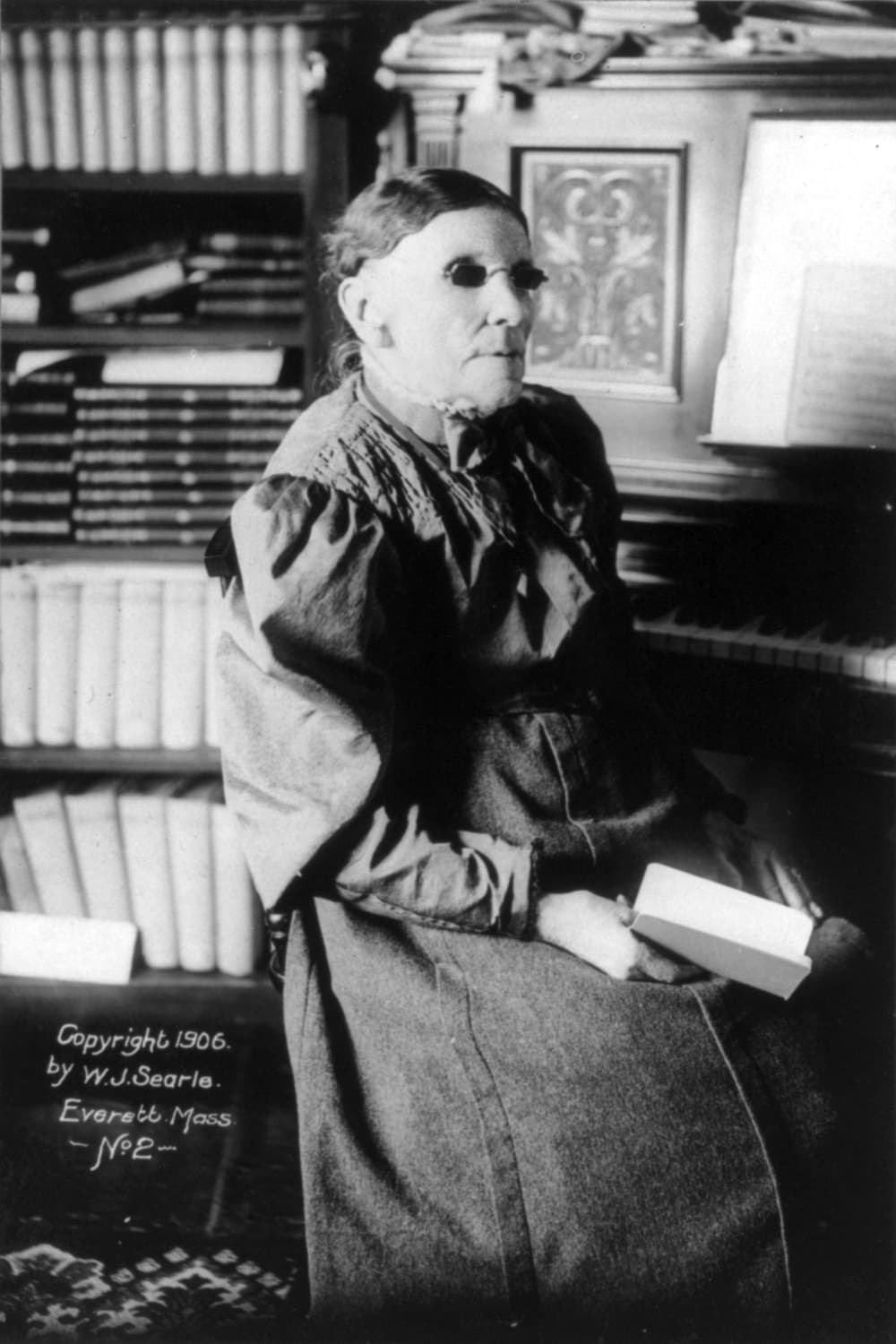
Fanny Crosby, Blind from Infancy
Fanny Crosby was a blind poet, teacher and hymn writer of New York.
An old woman in Edinburgh once thanked Ira Sankey for writing "Safe in the Arms of Jesus", and he answered that Fanny Crosby had written it.
the LORD opens the eyes of the blind, the LORD lifts those who are weighed down, the LORD loves the righteous.
- When
- 1820 to 1915 AD
Summary
Fanny Crosby was blind from her first weeks of life and never regained her sight. She married a blind musician, wrote hymn texts for the gospel composers of her day, and in old age counted her blindness as God's appointment for that work and refused to wish it undone. Her life shows a disability carried without bitterness, in her own words.
- She was born in Putnam County, New York, on 24 March 1820, and she died on 12 February 1915 after her last years in Bridgeport, Connecticut.
- Her two books blame the treatment of an eye inflammation at six weeks old, given by a physician in the telling of 1903 and by a stranger in the telling of 1906.
- S. Trevena Jackson reported in 1915 that her hymns and poems numbered more than eight thousand.
Her Own Account of the Blindness
Her books give her own reasons for counting her blindness a gift.
Fanny Crosby, Blind from Infancy tells the life of Frances Jane Crosby in her own words and in the words of S. Trevena Jackson, who retold it in the year of her death. It belongs to the trial of illness and pain because an illness of her eyes in infancy left her blind, as both her books tell it, and she bore the blindness for life.
The question it answers is how she herself understood the loss, and what her life shows of a disability carried in faith. It gives her own account in her own words, the dates of her life, the course of her schooling, marriage and work, the two tellings of the cause, and the reported count of her hymns.
In her Life-Story of 1903 she wrote that she would refuse a cure: "if perfect earthly sight were offered me to-morrow, I would not accept it". She gave her first reason in the same chapter: "although it may have been a blunder on the physician's part, it was no mistake of God's". She believed she could not have written her hymns if the sights of the world had distracted her.
Three years later, in Memories of Eighty Years, she wrote of the man who treated her that she had "not for a moment, in more than eighty-five years, felt a spark of resentment against him". She believed that "the good Lord, in His Infinite Mercy, by this means consecrated me to the work that I am still permitted to do."
The eye is the lamp of the body. If your eyes are good, your whole body will be full of light. But if your eyes are bad, your whole body will be full of darkness. If then the light within you is darkness, how great is that darkness!Fanny Crosby named this saying of Jesus as a passage she often thought of when she wrote of the man who blinded her.
Fanny Crosby's Life in Dates
Her schooling, her marriage and her work with the composers fall between 1835 and 1868.
She was blind before she was two months old and wrote hymns into her nineties.
To scale: 12 of 12 stops dated; a ring is approximate; a mark that would lie on another stands in a lane under the axis.
- Birth in Southeast, Putnam County, New York24 March 1820 ADFixed by her Life-Story, chapter 1, and Jackson
- The inflammation of the eyes and its treatment1820 AD, at six weeks oldFixed by the Life-Story, chapter 1, and her Memories, chapter 1
- Two New York surgeons find no hope for her eyes1825 ADFixed by the Life-Story, chapter 2, headed 1825
- Her first poem1828 AD, at eight years oldFixed by the Life-Story, chapter 3, from her age
- She leaves home for the New York Institution for the Blind3 March 1835 ADFixed by the Life-Story, chapter 4
- Her poem recited before CongressJanuary 1844 ADFixed by the Life-Story, chapter 14
- Her marriage to Alexander Van Alstyne1858 ADFixed by the Life-Story, chapter 16
- William B. Bradbury dies after four years of their work together1868 ADFixed by the Life-Story, chapter 22
- She moves from Brooklyn to BridgeportAbout 1900 ADFixed by the Life-Story, chapter 28, which says three years before 1903
- Fanny Crosby's Life-Story published1903 ADFixed by its title page
- Memories of Eighty Years published1906 ADFixed by its title page
- Her death12 February 1915 ADFixed by Jackson, chapter 15
A timeline of twelve dated events, each row naming the book that fixes its date.
Her marriage to Alexander Van Alstyne, William B. Bradbury dies after four years of their work together, She moves from Brooklyn to Bridgeport, Fanny Crosby's Life-Story published, Memories of Eighty Years published, Her death
From Putnam County to Bridgeport
Her own two books give the course of her childhood, schooling, marriage and work.
A blind child in the country1820 to 1835
Her father, John Crosby, died when she was very young. When she was about five she was taken down the Hudson to New York, where the surgeons Dr. Mott and Dr. Delafield examined her eyes and told her mother that there was no hope for them. Her first poem, made at the age of eight, ran in full:
"Oh, what a happy child I am, / Although I cannot see! / I am resolved that in this world / Contented I will be."
"How many blessings I enjoy / That other people don't! / So weep or sigh because I'm blind, / I cannot, nor I won't!"
Pupil and teacher at the Institution1835 to 1858
She left home on 3 March 1835 for the New York Institution for the Blind, looking, as she put it, for "the mental, instead of the physical, light". In January 1844 a party from the Institution went to Washington for the cause of the blind, and she gave a poetical address to the Senate and House in joint session. She later taught at the Institution, and she reminded its superintendent that she "was a teacher there, and had rights".
Her marriage1858
Alexander Van Alstyne, a blind boy whose mother put him in her charge, entered the Institution in 1844, studied at Union College in Schenectady and came back to teach there in 1855. They married in 1858. He was an accomplished musician and set several of her hymns to music, and at his wish she kept writing under the name Fanny Crosby.
The hymnsBradbury, Doane and Knapp
She was introduced to the composer William B. Bradbury, who told her he had long wanted her to write for him, and she wrote for him for about four years, almost until his death in 1868. She then wrote many hymns for W. H. Doane. Once, with forty minutes to catch a train to Cincinnati, Doane hummed her a melody, and in fifteen minutes she gave him the words that begin:
"Safe in the arms of Jesus, / Safe on his gentle breast, / There by his love o'ershadowed, / Sweetly my soul shall rest."
Sometimes the tune came first. Mrs. Joseph F. Knapp composed a melody and asked her for words, and from it came "Blessed Assurance". In old age she moved from Brooklyn to Bridgeport, Connecticut, for her health, to live with a widowed sister.
Two Tellings of the Cause
Each account is given in the words of its own book.
In the Life-Story her eyes were "put under the care of a physician", and she wrote: "What he did to them, or what happened in spite of him, I do not know". She had heard that he never ceased to regret it.
In the Memories the family physician was away from home, "a stranger was called", and he recommended hot poultices, which destroyed her sight.
The Life-Story's second chapter adds that the surgeons who examined her eyes judged that malpractice had spoiled them. Both books say the man who treated her left the neighbourhood and was never heard of again, and they differ on whether he was a physician or a stranger called in the physician's place.
How Many Hymns She Wrote
The count of her hymns rests on her publishers' records and on estimates, and her many pen names make it hard to fix.
S. Trevena Jackson, in Fanny Crosby's Story of Ninety-Four Years (1915), reported that by her ninety-third year the publishers Biglow and Main had paid her for 5,900 hymns. He gave Hubert P. Main's estimate of 2,700 more written for other publishers and friends.
She often composed six or seven hymns in a day, more than Bradbury could set to music, and others chose which to print. She also signed hundreds of hymns with more than a hundred other names, among them "Ella Dale", "Grace I. Francis" and "Lizzie Edwards".
Blindness and Her Calling
She read her blindness as an appointment of God for her work.
Jesus answered, “Neither this man nor his parents sinned, but this happened so that the works of God would be displayed in him.Jesus refuses the disciples' search for a sin behind a blindness from birth, and Fanny Crosby's reading of her own blindness follows the same line.
She held that the merciful God had put His hand over her eyes and spared her the sight of much cruelty and misfortune she could not have relieved. At eighty-three she wrote that hearing, taste, smell and touch were still felt in their fullest degree, and that the four senses she had were enough for her to know life.
Her Last Evening
S. Trevena Jackson's book of 1915 records the night of her death.
On the last evening of her life she dictated a letter of comfort to a family whose daughter had died. She closed it with lines of her own about loved ones met again "some sweet day, bye and bye". She died early the next morning, and her funeral was said to be the largest ever held in Bridgeport.
Then the eyes of the blind will be opened and the ears of the deaf unstopped.Isaiah's promise of the age to come answers a life lived without sight, and her last letter looked ahead to that age.
Sources
Scripture is the Berean Standard Bible.
- Fanny Crosby, Fanny Crosby's Life-Story, by Herself (New York: Every Where Publishing Company, 1903), chapters 1 to 4, 14, 16, 22 to 24 and 28.
- Fanny Crosby, Memories of Eighty Years (Boston: James H. Earle and Company, 1906), chapter 1.
- S. Trevena Jackson, Fanny Crosby's Story of Ninety-Four Years (New York: Fleming H. Revell Company, 1915), the opening chapter, "My Living Hymns" and chapter 15.
Keep Studying
Read it2