
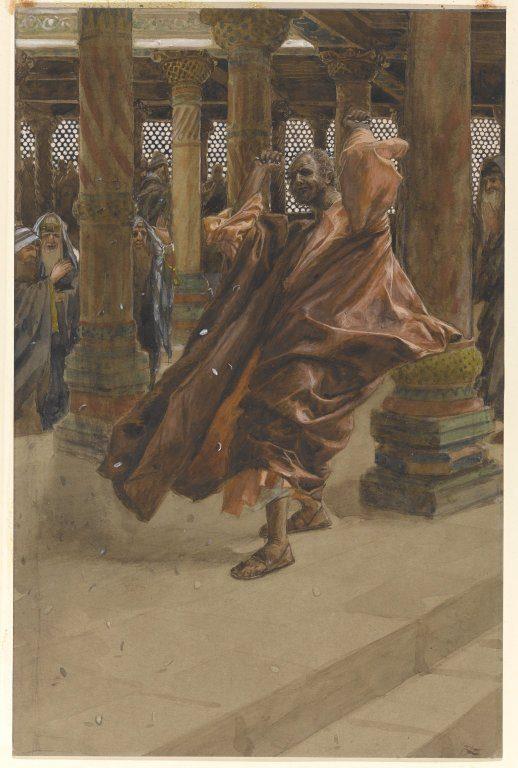
James Tissot, Judas Returns the Money, 1886 to 1894. Public domain.
Matthew 27:3 to 10 and Acts 1:18 to 19 · Debate · Featured Study
The Death of Judas and the Potter's Field
Matthew 27 and Acts 1 tell the death of Judas in two different ways.
Thirty pieces of silver bought one field, and the city gave it the name Field of Blood.
That is why it has been called the Field of Blood to this day.
That is why it has been called the Field of Blood to this day.
- The question
- How do Matthew 27 and Acts 1 fit together on the death of Judas and the buying of the Field of Blood?
- The texts
- Matthew 27:5, Acts 1:18, Matthew 27:7, Acts 1:19, Zechariah 11:13
Summary
Matthew follows the money from the temple to a burial ground for foreigners. Luke, in Peter's speech, follows the man to the place where he died. Readers have joined the two accounts in more than one way.
- The Gospel and Acts name different buyers for the field.
- Matthew reads the purchase by Zechariah 11.
- Papias, Barnes and Hammond each read the death differently.
Two Accounts of One Field
Matthew gives his remorse and death, and Acts gives a fall in a field.
When Judas, who had betrayed Him, saw that Jesus was condemned, he was filled with remorse and returned the thirty pieces of silver to the chief priests and elders. “I have sinned by betraying innocent blood,” he said. “What is that to us?” they replied. “You bear the responsibility.” So Judas threw the silver into the temple and left. Then he went away and hanged himself.Matthew's account of how Judas died.
(Now with the reward for his wickedness Judas bought a field; there he fell headlong and burst open in the middle, and all his intestines spilled out.Luke's account, set inside Peter's speech.
The Readings on the Same Questions
The readers divide on how Judas died, who bought the field, and why it was named for blood.
Each question has an answer from Matthew, one from Acts, and the readers who join them.
| Question | Matthew 27 | Acts 1 | Who joins them |
|---|---|---|---|
| How did Judas die? | By hanging, after he threw down the silver | By a fall in the field, his body torn open | Barnes and Bede; Papias and Oecumenius; Hammond, as Henry reports him |
| Who bought the field? | The chief priests, with his silver | Judas himself | Barnes, Clarke and Wesley |
| Why the Field of Blood? | It was bought with the price of blood | His death there was known through the city | Gill and Barnes |
Three Readings of His Death
Each reading takes both accounts as true and differs on the order of events.
He hanged himself and then fellAlbert Barnes, Notes, Explanatory and Practical, on the Old and New Testaments, on Acts 1:18; Bede, Commentary on Acts (735)
Barnes noted that the word for headlong means bent forward, head foremost. He held that Judas first hanged himself, and when the cord broke he fell forward and burst open.
Bede also kept both: the noose strangled the throat that had spoken the betrayal, and he burst open in the middle.
He was cut down alive and died laterPapias of Hierapolis, as the Greek catena on Acts gives him; Oecumenius, Commentary on Acts
The fragment kept under the name of Papias says that Judas was cut down before he choked and lived on. Oecumenius gave the same account and pointed to the fall in Acts as its proof.
He was choked by griefDr. Hammond, as Matthew Henry reports him, Commentary on the Whole Bible (1710), on Matthew 27:5
Matthew Henry reports that Hammond read the words he hanged himself as he was choked with grief. Henry adds that Whitby held the usual rendering to be right.
Who Bought the Field
The two accounts name two different buyers, and the commentators make them one purchase.
The chief priests picked up the pieces of silver and said, “It is unlawful to put this into the treasury, since it is blood money.” After conferring together, they used the money to buy the potter’s field as a burial place for foreigners.This is the purchase Matthew credits to the chief priests.
Albert Barnes wrote that a man is often said to do a thing when he furnishes the means for it. Adam Clarke judged that Judas probably did not buy the field himself, and that his money was applied to it.
John Wesley read the verse in Acts as a field bought with the reward of his sin, and allowed that Judas may have planned the purchase.
Akeldama, the Field of Blood
Akeldama is the name the people of Jerusalem gave the field.
This became known to all who lived in Jerusalem, so they called that field in their own language Akeldama, that is, Field of Blood.)Luke explains the name for readers who did not know the language.
Albert Barnes placed the field just outside the walls, on the south of Mount Zion. Jerome spelled the name Acheldemach.
OpenBible.info gives its identification of Akeldama a score of 456 out of 1,000, a proposed identification.
Thirty Pieces and the Potter
Matthew reads the purchase by the thirty pieces of silver thrown to the potter in Zechariah 11.
And the LORD said to me, “Throw it to the potter”—this magnificent price at which they valued me. So I took the thirty pieces of silver and threw them to the potter in the house of the LORD.Matthew's quotation draws its price and its potter from here.
Then what was spoken through Jeremiah the prophet was fulfilled: “They took the thirty pieces of silver, the price set on Him by the people of Israel, and they gave them for the potter’s field, as the Lord had commanded me.”Here Matthew names the prophet.
Augustine read the field as the whole world and the foreigners buried there as Christians, given rest by the price of Christ's blood.
Another Takes His Place
Peter told of the field to show why the Twelve needed a twelfth again.
“For it is written in the book of Psalms: ‘May his place be deserted; let there be no one to dwell in it,’ and, ‘May another take his position.’Peter reads two psalms over the field and the vacant office.
Sources
Scripture is the Berean Standard Bible.
- Albert Barnes, Notes, Explanatory and Practical, on the Old and New Testaments (1832 to 1869), on Matthew 27:7 and 27:8 and on Acts 1:18 and 1:19.
- Papias of Hierapolis, in the Greek catena on Acts 1:18 to 19; Oecumenius, Commentary on Acts (550), on Acts 1:18; Bede, Commentary on Acts (735), on Acts 1:18; Jerome, Commentary on Matthew (420), on Matthew 27:7 to 8; Augustine, in the Catena Aurea on Matthew 27:7.
- Adam Clarke, Commentary on the Bible (1832), on Acts 1:18; John Wesley, Explanatory Notes upon the New Testament (1755), on Acts 1:18; Matthew Henry, Commentary on the Whole Bible (1710), on Matthew 27:5; John Gill, Exposition of the New Testament (1746 to 1748), on Matthew 27:8.
- OpenBible.info, Bible-Geocoding-Data, ancient.jsonl, entries Akeldama (score 456) and Valley of Hinnom (score 1000)
Keep Studying
People and groups3
Go further8