
1 Samuel 3:18
in 1 Samuel 3So Samuel told him everything and did not hide a thing from him. “He is the LORD,” replied Eli. “Let Him do what is good in His eyes.”
BSB
The same verse in ASV and KJV ▾
ASV
And Samuel told him every whit, and hid nothing from him. And he said, It is Jehovah: let him do what seemeth him good.
KJV
And Samuel told him every whit, and hid nothing from him. And he said, It is the Lord: let him do what seemeth him good.
⋯
This verse in 1 Samuel 3
Commentary
10 notes on this verseSamuel told him every whit - Our word whit, or wid, comes from the Anglo-Saxon, which signifies person, thing, etc.; every whit is every thing. The Hebrew את כל הדברים et col haddebarim, “all these words.” It is the Lord - He is Sovereign, and will do what he pleases; he is righteous, and will do nothing but what is just. Let him do what seemeth him good - There is much of a godly submission, as well as a deep sense of his own unworthiness, found in these words.
This site's exposition
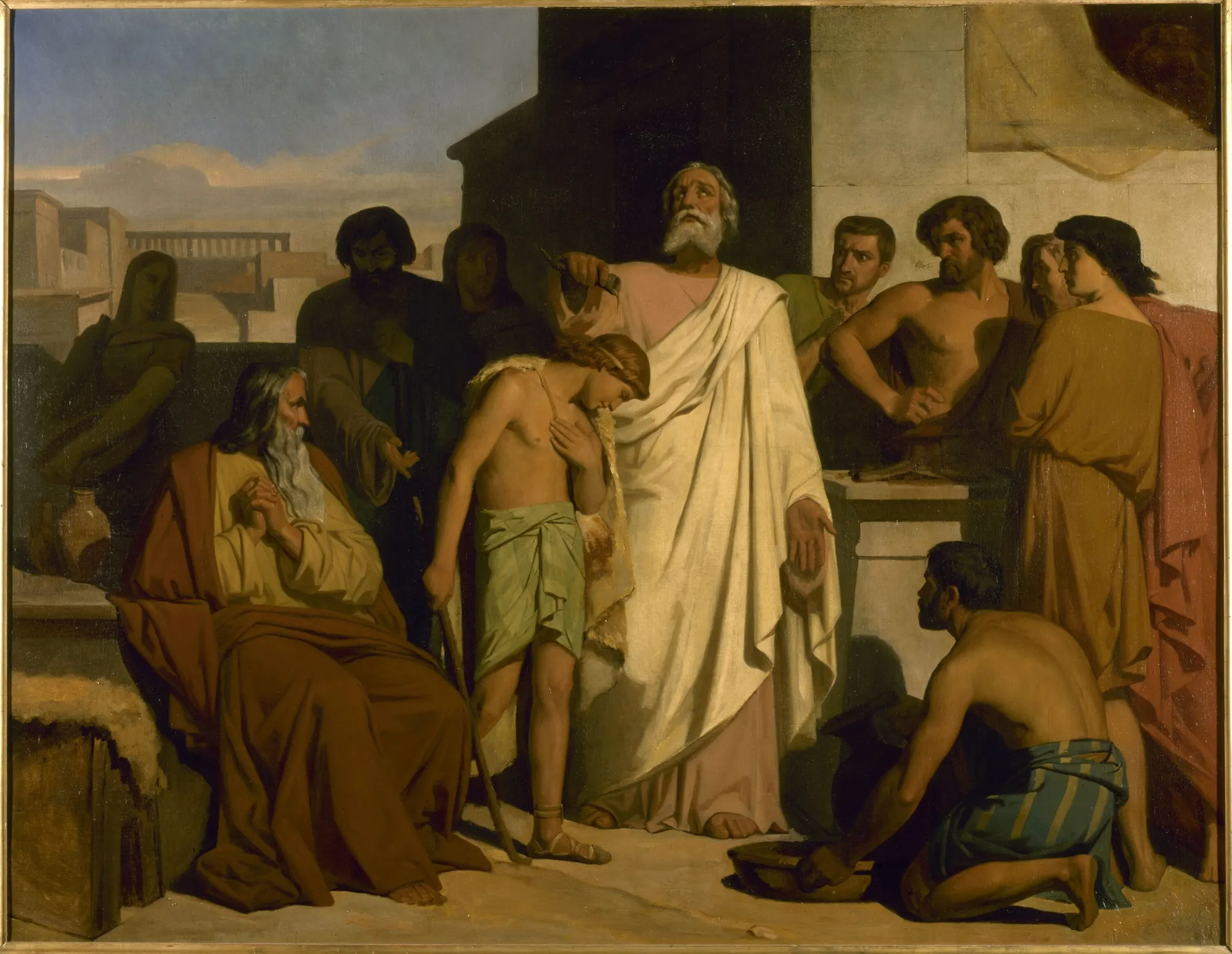
He was afraid to tell Eli the vision
on 1 Samuel 3:15-18
Samuel opens the doors of the house of the LORD, afraid to tell Eli what he has heard. Eli draws it out with an oath, and Samuel “told him everything and did not hide a thing from him”. Eli answers “He is the LORD” and “Let Him do what is good in His eyes”, a resignation the older writers read as genuine though his discipline came too late.
This site's exposition
So Samuel told him everything
Eli hears the whole message and says, He is the LORD, as Aaron held his peace at Leviticus 10:3 when his sons died. Albert Barnes sets the answer beside that verse, and Adam Clarke hears godly submission in it. Like Aaron, Eli would lose two sons in one day.
The record, by era
The Medieval Church2 voices
A commentator
Gregory the DialogistCommentary on 1 Kings, Book 3, Chapter 1 · Written before 604.
proposed
And he indeed responded, saying: (Verse 18) "It is the Lord; let him do what is good in his eyes." 26. By these words, indeed, what else is more clearly recognized than the faithlessness of the Jewish people? For he who calls the almighty God Lord still considers himself to be serving Him. When therefore his rejection is made known to the Jewish people by the doctors of the holy Church, he says: He is the Lord; let Him do what is good in His eyes.
A commentator
Gregory the DialogistCommentary on 1 Kings, Book 2, Chapter 4 · Written before 604.
proposed
25. He who considers this response of Eli more simply than he ought thinks that he responded as rightly as he did humbly. For as it is heard outwardly, what could he have responded more humbly, he who heard his own reprobation and offered to God who was threatening—indeed, promulgating the sentence of his reprobation—whatever He wished to do concerning him? But certainly if this humility of response is examined more carefully, it is not true humility. For that is recognized to be true humility which accompanies the good of obedience in carrying out the commands of a superior. He would therefore truly have been humble if he had offered himself for the amendment of the fault for which he was being rebuked. But perhaps he would have been even more truly humble if, when rebuked, he had not responded at all, but had applied to his wicked sons the correction he had neglected—if even then he had persisted with pastoral zeal and had punished the crimes of the flagitious priests with fitting vengeance. Therefore, when he says, "He is the Lord; let Him do what is good in His eyes," he is recognized to have uttered a word of his own choosing rather than a response of humility, because indeed he preferred to incur the causes of God's threats rather than condemn his sons for the iniquities they had committed. Oh, how many are still imitators of Eli, who, though they daily perceive from sacred Scripture that Almighty God threatens them, nevertheless tremble at displeasing men and do not fear to incur the threats of divine indignation, and while they dread the enmities of men as though they were implacable, they presume upon God's mercy even while sinning! 26. But disordered confidence can have a place of vengeance before almighty God, yet cannot obtain pardon. […]
The Puritans and the Awakening3 voices
In a few words, (1.) He lays down this satisfying truth, " It is the Lord; it is he that pronounces the judgment, from whose bar there lies no appeal and against whose sentence there lies no exception. It is he that will execute the judgment, whose power cannot be resisted, his justice arraigned, nor his sovereignty contested.
quarantine:debris (2026-07-29) — odd-straight-quotes
It is the Lord - This severe sentence is from the sovereign Lord of the world, who hath an absolute right to dispose of me and all his creatures; who is in a special manner the ruler of the people of Israel, to whom it properly belongs to punish all mine offenses; whose chastisement I therefore accept.
And Samuel told him every whit, and hid nothing from him,....
2 more voices on this verse
The Nineteenth Century2 voices
A commentator
Jamieson, Fausset & Brown1802–1910
Commentary Critical and Explanatory on the Whole Bible (1871)
proposed
he ran unto Eli, and said, Here am I; for thou calledst me--It is evident that his sleeping chamber was close to that of the aged high priest and that he was accustomed to be called during the night.
quarantine:debris (2026-07-29) — starts-lowercase
A commentator
Albert Barnes1798–1870
Notes, Explanatory and Practical, on the Old and New Testaments (1832-1869)
proposed
It is the Lord ... - Compare the devout submission of Aaron Lev 10:3, and of Hezekiah 2Ki 20:19. And, for the highest conceivable submission to the will of God, compare Luk 22:42.
The words behind it
15 Hebrew wordsEvery Hebrew word of this verse in the order it stands, with what it means and the door to its own study. The last column counts the times a word stands in the whole Bible: the rarer the word, the more the places it appears belong together.
| Hebrew | Sound | Meaning | Word study | In the Bible |
|---|---|---|---|---|
| וַיַּגֶּד־ | vaiyaged- | and he told | H5046 → | 370 times |
| ל֤וֹ | lo | to <the> him | ||
| שְׁמוּאֵל֙ | shemuel | Samuel | H8050 → | 141 times |
| אֶת־ | ʾet- | <obj.> | H853 → | 10935 times |
| כָּל־ | kol- | all | H3605 → | 5413 times |
| הַדְּבָרִ֔ים | hadevarim | the words | H1697 → | 1440 times |
| וְלֹ֥א | velo' | and not | H3808 → | 5168 times |
| כִחֵ֖ד | khiched | he hid [them] | H3582 → | 32 times |
| מִמֶּ֑נּוּ | mimenu | from him | H4480 → | 1188 times |
| וַיֹּאמַ֕ר | vaiyomar | and he said | H559 → | 5305 times |
| יְהוָ֣ה | yahweh | [is] Yahweh | H3068 → | 6520 times |
| ה֔וּא | hu' | he | H1931 → | 1879 times |
| הַטּ֥וֹב | hatov | the good | H2896 → | 538 times |
| בְּעֵינָ֖יו | beeinav | in eyes his | H5869 → | 887 times |
| יַעֲשֶֽׂה׃ פ | yaaseh | let him do | H6213 → | 2628 times |
וַיַּגֶּד־and he told
vaiyaged-H5046 →370 times
ל֤וֹto <the> him
lo
שְׁמוּאֵל֙Samuel
shemuelH8050 →141 times
אֶת־<obj.>
ʾet-H853 →10935 times
כָּל־all
kol-H3605 →5413 times
הַדְּבָרִ֔יםthe words
hadevarimH1697 →1440 times
וְלֹ֥אand not
velo'H3808 →5168 times
כִחֵ֖דhe hid [them]
khichedH3582 →32 times
מִמֶּ֑נּוּfrom him
mimenuH4480 →1188 times
וַיֹּאמַ֕רand he said
vaiyomarH559 →5305 times
יְהוָ֣ה[is] Yahweh
yahwehH3068 →6520 times
ה֔וּאhe
hu'H1931 →1879 times
הַטּ֥וֹבthe good
hatovH2896 →538 times
בְּעֵינָ֖יוin eyes his
beeinavH5869 →887 times
יַעֲשֶֽׂה׃ פlet him do
yaasehH6213 →2628 times
A shaded row is a word that stands 400 times or fewer in the Bible.
The walk
8 stopsEach card is a verse this one points to, and under it the verses that one points to in turn. Where several paths arrive at the same place, that place is listed first: the text keeps returning to it.
Through
1 Peter 5:6Humble yourselves, therefore, under God’s mighty hand, so that in due time He may exalt you.
it leads to
- James 4:10
Humble yourselves before the Lord, and He will exalt you.
- Luke 14:11
For everyone who exalts himself will be humbled, and the one who humbles himself will be exalted.”
- Proverbs 29:23
A man’s pride will bring him low, but a humble spirit will obtain honor.
- Matthew 23:12
For whoever exalts himself will be humbled, and whoever humbles himself will be exalted.
- Luke 18:14
I tell you, this man, rather than the Pharisee, went home justified. For everyone who exalts himself will be humbled, but the one who humbles himself will be exalted.”
- James 4:10
Through
Job 2:10“You speak as a foolish woman speaks,” he told her. “Should we accept from God only good and not adversity?” In all this, Job did not sin in what he said.
it leads to
- James 1:12
Blessed is the man who perseveres under trial, because when he has stood the test, he will receive the crown of life that God has promised to those who love Him.
- Lamentations 3:38–41
Do not both adversity and good come from the mouth of the Most High?
- James 1:12
Through
Job 1:21saying: “Naked I came from my mother’s womb, and naked I will return. The LORD gave, and the LORD has taken away. Blessed be the name of the LORD.”
it leads to
- Ecclesiastes 5:15
As a man came from his mother’s womb, so he will depart again, naked as he arrived. He takes nothing for his labor to carry in his hands.
- Ecclesiastes 5:15
Where this verse is studied
On this page
About 1 Samuel
Who and where
2 names in this verse with a page on the site.
- PersonJudges to monarchySamuelAsked of God by Hannah and lent to the LORD at Shiloh; the last judge and first of the prophets after Moses, who anointed both Sau…
- PersonJudges eraEliHigh priest of Israel at Shiloh who mistook Hannah's silent prayer for drunkenness and raised the boy Samuel; his corrupt sons def…
This page draws on 9 works. Open the list of works
This page draws on Adam Clarke, Commentary on the Bible; Albert Barnes, Notes, Explanatory and Practical, on the Old and New Testaments (1832-1869); Gregory the Dialogist, Commentary on 1 Kings, Book 3, Chapter 1; Gregory the Dialogist, Commentary on 1 Kings, Book 2, Chapter 4; Jamieson, Fausset & Brown, Commentary Critical and Explanatory on the Whole Bible; John Gill, Exposition of the Old Testament; John Gill, Exposition of the Old Testament (1748-1763); John Wesley, Explanatory Notes upon the Old Testament and Matthew Henry, Commentary on the Whole Bible.