
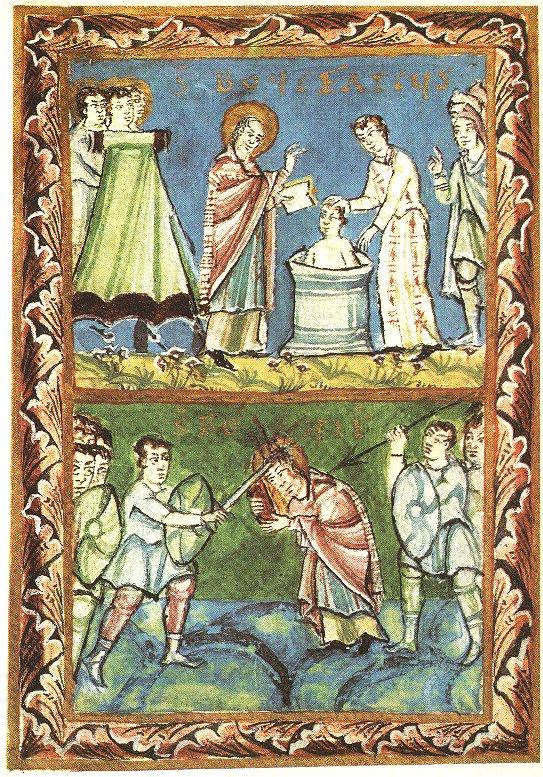
Saint Boniface Baptizing and His Martyrdom, Sacramentary of Fulda, 11th century. Public domain.
Wessex to Frisia, to 754 or 755 · Person · Featured Study
Boniface
This English monk organized the church in Hesse, Thuringia and Bavaria for the bishops of Rome.
When the raiders came to his tents in Frisia, the old archbishop told his men to stop fighting.
Do not be afraid of those who kill the body but cannot kill the soul. Instead, fear the One who can destroy both soul and body in hell.
Do not be afraid of those who kill the body but cannot kill the soul. Instead, fear the One who can destroy both soul and body in hell.
- The name means
- Boniface was the Latin name of the man born Wynfrith
- Born
- between 675 and 680, by Edward Kylie (proposed)
- Died
- 5 June, in 754 or 755, in Frisia (probable)
- Places
- Wessex, Nursling, Rome, Hesse, Thuringia, Fulda, Frisia
Summary
Wynfrith entered a monastery as a child in the south-west of England and was a teacher at Nursling. He gave up the chance of an abbot's chair to go overseas. The bishop of Rome gave him his commission in 719, and he held to Rome for the rest of his life.
- He wrote home for books all his life, and his letters to English abbesses survive.
- Willibald, who wrote the Life, says the oak fell at Gaesmere as if by a blast from above.
- The book raised against the sword comes from a later Life, on an old woman's oath.
The Texts at His Death
George W. Robinson traces the words Willibald gives him to Peter, Paul and Matthew.
The question of this life is why a man who spent decades among councils and princes went back in old age to preach to the people who had refused him. His letters and one early Life give an answer. Willibald sets out his last words, and Robinson's notes trace them to Scripture.
Do not repay evil with evil or insult with insult, but with blessing, because to this you were called so that you may inherit a blessing.Robinson traces to this verse the words Boniface used when he forbade his men to fight.
For I am already being poured out like a drink offering, and the time of my departure is at hand.Robinson traces to this verse the words on the time of departure, which Boniface had also used to Lul.
The Life in Order
Willibald gives few years, and the letters and the editors supply most of them.
Willibald counts forty years of his pilgrimage from the first departure to his death.
- 675 to 680He was born in the south-west of EnglandKylie (1911), Introduction
- 716He went to Frisia and came back with little doneKylie, Introduction; Willibald 4
- Late 718He came to Rome as a pilgrimKylie, Introduction; Willibald 5
- 722Gregory II consecrated him bishop at RomeKylie, Introduction; Willibald 6
- After 722He felled the oak at GaesmereWillibald 6
- 732He was made archbishopKylie, Introduction; Willibald 6
- 735He asked Eadburga for Peter's letters in goldKylie, the letter of 735
- 739He divided Bavaria into four bishopricsWillibald 7; Robinson
- 742 to 747He led the councils of the Frankish churchKylie, Introduction
- 12 March 744Fulda was foundedRobinson's Introduction, citing Eigil
- 753 or 754He sailed for FrisiaWillibald 8; Robinson
- 5 June 754 or 755He was killed at the camp on the river BoornWillibald 8; Kylie, Introduction
Each step of the life stands with its witness.
735, 739, 742 to 747, 12 March 744, 753 or 754, 5 June 754 or 755
From Nursling to the Boorn
Willibald's Life carries the story, and the letters show the friends behind it.
Willibald says that at four or five he set his heart on the monastic life. He was schooled at Exeter and moved to Nursling, near Winchester, under Abbot Winbert, and he became a teacher in demand at neighbouring houses.
When he crossed to Frisia, King Radbod was at war with Charles Martel and had put down the churches. He spoke with Radbod at Utrecht, saw no opening and went home. Nursling asked him to succeed Winbert. His friend Bishop Daniel of Winchester persuaded the monks to let him go, and he took the road to Rome with Daniel's letter.
Gregory II tested him on the faith, and he asked to answer in writing because he lacked skill in the Pope's own speech. At his consecration he swore an oath in the form that Italian bishops took. He carried back canons, letters and the protection of Charles Martel.
In Hesse he found people who sacrificed to trees and springs while calling themselves Christians. With the counsel of those he trusted, he set an axe to a great oak at Gaesmere while a crowd of pagans cursed him. Willibald says that when it was only a little cut, a blast from above threw it down in four parts, and that those who had cursed now believed. He built an oratory of Saint Peter from its timber.
He asked England for help, and people came. Lioba, a kinswoman of his, ruled a convent at Bischofsheim, and Kylie says that no missionary before Boniface had called women to his aid. He founded Fulda and asked to be buried there.
In old age he told Lul, his successor, to finish the churches in Thuringia and the basilica at Fulda. He told him to put a linen cloth for his body in the chest of his books. He sailed down the Rhine with a small company and preached through Frisia.
He pitched his tents on the Boorn and sent the new converts home until a day set for their confirmation. On that morning an armed crowd came instead, and his attendants took up arms. He stepped from the tent with the relics and forbade them. The raiders killed him and his companions.
They broke open the chests for gold and found books. Willibald says they fought one another over the wine and threw the volumes across the meadow and into the marsh, and that the books were found long after and returned. His body was carried up the Rhine to Fulda, as he had asked.
The Letters and the Life
His own correspondence survives beside a Life written within a few years of his death.
Robinson names the two chief sources as his letters, with the replies kept among them, and the Life by Willibald. Willibald, a priest of English birth, wrote at the request of Lul and of Bishop Megingoz. Robinson respects his industry and honesty and faults his inflated style.
Kylie's English of 1911 takes the letters to and from his English friends. Many ask for prayer or for books. Abbess Eangyth and her daughter Bugga confide their griefs to him, and he uses his Saxon name, Wynfrith, to an old friend.
In Their Own Words
Two sayings from Willibald's account of his death and three from his own letters.
Boniface (675 to 754)
words reported in Willibald, The Life of Saint Boniface, chapter 8, chapter 8, to his attendants
Stop fighting
“Stop fighting, lads! Give up the battle!”
English Benedictine
About this saying1 paragraph
He said this to his attendants on the morning of the raid in Frisia, in 754 or 755, by Willibald's account.
Boniface
words reported in Willibald, The Life of Saint Boniface, chapter 8, chapter 8, to the priests and deacons
To those about to die
“Men and brethren, be of stout heart, and fear not them who kill the body, since they are not able to slay the soul, which continues without end”
English Benedictine
About this saying1 paragraph
He said this to the priests and deacons beside him as the raiders came on, in 754 or 755, by the same account.
Boniface
letter to Eadburga, in The English Correspondence of Saint Boniface, the letter to Eadburga, 735
Peter in gold
“I long, above all else, to have with me, the words of him who guided me into this path.”
English Benedictine
About this saying1 paragraph
He wrote this in 735, in a letter that asks for a costly copy of Scripture.
Boniface
letter to Cuthbert, in The English Correspondence of Saint Boniface, the letter to Cuthbert, page 180
The great ship
“Therefore, the Church, which like a great ship, sails over the sea of the world, and is buffeted by the many waves of temptation in this life, must not be abandoned, but steered.”
English Benedictine
About this saying1 paragraph
He wrote this to Archbishop Cuthbert of Canterbury when he sent him the decrees of the synod of 747.
Boniface
letter to Cuthbert, in The English Correspondence of Saint Boniface, the letter to Cuthbert, page 188
Zealous shepherds
“Let us not be dumb dogs nor silent watchmen, nor hirelings who flee before the wolf, but zealous shepherds, watching over the flock of Christ”
English Benedictine
About this saying1 paragraph
In the same letter of 747 he called on Cuthbert and himself to preach to high and low, in season and out of season.
The People Around Him
Bishops, princes and English friends each had a part in his work.
Two popes commissioned him, and his friends in England sent the books.
| Person | Tie to Boniface | The witness |
|---|---|---|
| Winbert | This abbot of Nursling taught him, and his death left a chair open. | Willibald 2 and 5 |
| Daniel of Winchester | This bishop sent him to Rome and advised him on the pagans. | Willibald 5; Kylie, Letter V |
| Gregory II | This pope commissioned him and consecrated him. | Willibald 5 and 6 |
| Gregory III | This pope sent him the honours of an archbishop. | Willibald 6; Robinson |
| Charles Martel | This Frankish ruler wrote him a letter of protection. | Willibald 6; Kylie, Introduction |
| Radbod | This king of the Frisians drove the servants of God from his land. | Willibald 4 |
| Eadburga | This abbess of Thanet sent him books and vestments. | Kylie, letters to Eadburga |
| Lioba | She was his kinswoman, and Kylie counts her among the English women at his side. | Kylie, Introduction |
| Cuthbert | This archbishop of Canterbury was his correspondent in England. | Kylie, Introduction and letter |
| Lul | This disciple was named to finish his work and succeeded him. | Willibald 8; Robinson |
Eadburga, Lioba, Cuthbert, Lul
The Places of His Life
His road ran from Wessex to Rome and across the Rhine, and it ended in the Frisian marshes.
Editors can place most of these today, and the place of the oak remains unsure.
| Place | What the witnesses say | The witness |
|---|---|---|
| Nursling | This monastery lay between Winchester and Southampton. | Robinson's note on Willibald 2 |
| Utrecht | He spoke with King Radbod there. | Willibald 4 |
| Rome | He made three visits to the tomb of the Apostles. | Willibald 5, 6 and 7 |
| Amoneburg | He stopped there on the river Ohm, about seven miles east of Marburg. | Willibald 6; Robinson |
| Gaesmere | The editor says the location is uncertain, and several places in Hesse are named Geismar. | Robinson's note on Willibald 6 |
| Fulda | He asked that his body be brought to this abbey, and it was. | Robinson's Introduction; Willibald 8 |
| The Boorn | He camped on this river in the Dutch province of Friesland, and he died there. | Willibald 8; Robinson |
| Mainz | His body rested there on its way to Fulda. | Willibald 8 |
The Boorn, Mainz
What He Was Told to Say
Bishop Daniel gave him a plan for talking with pagans, and he wanted Scripture seen as well as heard.
Daniel advised him to leave the genealogy of their false gods unchallenged. He told him to grant the births of the gods and then ask whether the universe had a beginning, and who created it.
Boniface asked Eadburga for gold letters so that the Scriptures might be "honoured and reverenced when the preacher holds them before the eyes of the heathen". The felled oak and the golden page show a teacher who wanted the people to see what he was saying.
How the Key Verse Was Taught
Jerome, John Wesley and Adam Clarke read the words on those who kill the body.
Jerome (died 420)
Catena Aurea by Aquinas
Jerome traced the word for hell in this verse to the valley of Baal near Jerusalem.
“This word is not found in the Old Scriptures, but it is first used by the Saviour. Let us enquire then into its origin. We read in more than one place that the idol Baal was near Jerusalem, at the foot of Mount Moriah, by which the brook Siloc flows. This valley and a small level plain was watered and woody, a delightful spot, and a grove in it was consecrated to the idol.”
on Matthew 10:28Patristic
John Wesley (1703 to 1791)
Explanatory Notes upon the New Testament, on Matthew 10:28
John Wesley found it striking that those who love God are still told to fear Him.
“It is remarkable, that our Lord commands those who love God, still to fear him, even on this account, under this notion.”
Evangelical
Adam Clarke (1762 to 1832)
Commentary on the Bible, on Matthew 10:28
Adam Clarke heard the verse speaking of the martyrs to come.
“Those who slay with acts of cruelty, alluding probably to the cruelties which persecutors should exercise on his followers in their martyrdom.”
Methodist
What the Witnesses Leave Open
Readers differ on the year he died, the book at his death, the oak, his birthplace and his debt to the Franks.
The year of his deathWillibald; the Fulda tradition and Tangl; Robinson; Kylie
Willibald gives 755. Robinson reports that the Fulda tradition and Tangl give 754, and he says a passage of Willibald weighs "somewhat heavily" against Tangl. Kylie writes 754.
Did he raise a book against the sword?Willibald; the Life attributed to Radbod; Edward Kylie
Willibald says only that the pagans fell on them with swords. A later Life, which bears the name of Bishop Radbod of Utrecht, reports a very old woman who swore that he covered his head with a copy of the gospels.
A book at Fulda, cut almost through, is traditionally identified with it, Robinson notes. Kylie tells the story as fact, and the Sacramentary of Fulda paints it.
The oak at GaesmereWillibald; George W. Robinson
Willibald calls it the Oak of Jupiter and says "a divine blast from above" brought it down. Robinson writes that Jupiter renders the Teutonic Thor and that the location is uncertain.
Robinson's note says the lower notch was cut to the centre of the tree. A reader may weigh that notch against the blast from above.
Was he born at Crediton?Edward Kylie; George W. Robinson, citing Wilhelm Levison
Kylie mentions the tradition that he was born at Crediton, which he places in Somersetshire. Robinson places it in Devonshire and, citing Levison, says the statement cannot be traced further back than John de Grandisson, bishop of Exeter from 1327 to 1369.
How far did Frankish power carry the mission?Edward Kylie; Willibald
Kylie says Charles Martel was "ready enough" to grasp at missions as "a weapon against Frisian independence" and used the church to serve his own ends. He also records Boniface's own word to Daniel of Winchester that the ruler's help was of great value.
Willibald sets the oak in Hesse soon after the letter of protection, and he ascribes the fall to God alone.
Books to Read Next
The Life of Saint Boniface
Willibald, translated by George W. Robinson · 1916
Robinson's translation, the first in English, has notes that weigh the dates and the places.
Read Willibald free at the Internet ArchiveThe English Correspondence of Saint Boniface
Edward Kylie, translator · 1911
These letters to and from his friends in England hold his requests for books and his counsel to Cuthbert.
Read Kylie free at the Internet ArchiveWhat Boniface Left
Robinson notes that manuscripts traditionally tied to him are still kept in the Landesbibliothek at Fulda, near the grave he asked for.
Sources
Scripture is the Berean Standard Bible.
- The Holy Bible, Berean Standard Bible (read 2026)
- Willibald, The Life of Saint Boniface, translated with notes by George W. Robinson, Harvard Translations (1916)
- Edward Kylie, The English Correspondence of Saint Boniface, Chatto and Windus (1911), the Introduction and the letters.
- Jerome, on Matthew 10:28, in the Catena Aurea of Thomas Aquinas, Oxford edition (1842)
- John Wesley, Explanatory Notes upon the New Testament (1755), on Matthew 10:28.
- Adam Clarke, Commentary on the Bible (1832), on Matthew 10:28.
Keep Studying
Read it4
People and groups8
Show the next 2 titles
Places2
Go further1
Church history3