
Ezekiel 37:13
in Ezekiel 37Then you, My people, will know that I am the LORD, when I open your graves and bring you up from them.
BSB
The same verse in ASV and KJV ▾
ASV
And ye shall know that I am Jehovah, when I have opened your graves, and caused you to come up out of your graves, O my people.
KJV
And ye shall know that I am the Lord, when I have opened your graves, O my people, and brought you up out of your graves,
⋯
This verse in Ezekiel 37
Commentary
14 notes on this verseThat they were so divided among themselves, too much of the old enmity between Judah and Ephraim remaining even in their captivity. But, as to this, by a sign of two sticks made one in the hand of the prophet is foreshown the happy coalition that should be, at their return, between the two nations of Israel and Judah,
This site's exposition
these bones are the whole house of Israel
on Ezekiel 37:11-14
The vision interprets itself, “these bones are the whole house of Israel”, the exiles who say, “Our bones are dried up, and our hope has perished”. The promise answers with opened graves, a return to the land, and “I will put My Spirit in you”, regathering and then life. The fathers and many since heard the general resurrection here, and Jerome records the passage read at funerals; that hearing stands beside the text's promise to named Israel.
This site's exposition
when I open your graves
The knowledge of the LORD comes through the act of rescue. In verse 11 the exiles said their hope was lost, and the opened graves answer that complaint in their own words. The title My people repeats the covenant claim that the exile seemed to cancel.
The record, by era
The Church Fathers5 voices
If there is some excellent glory in the eye, it is particularly in this: that either it is the leader of the body or it is not abandoned by the functions of the other members. I think this is what is taught to us through that vision of the prophet Ezekiel.
A commentator
Origen of AlexandriaCOMMENTARY ON THE GOSPEL OF JOHN 10:233 · Written before 253.
proposed
The mystery of the resurrection is great and difficult for many of us to understand. It is mentioned also in many other passages of the Scriptures and is proclaimed no less through these words in Ezekiel.
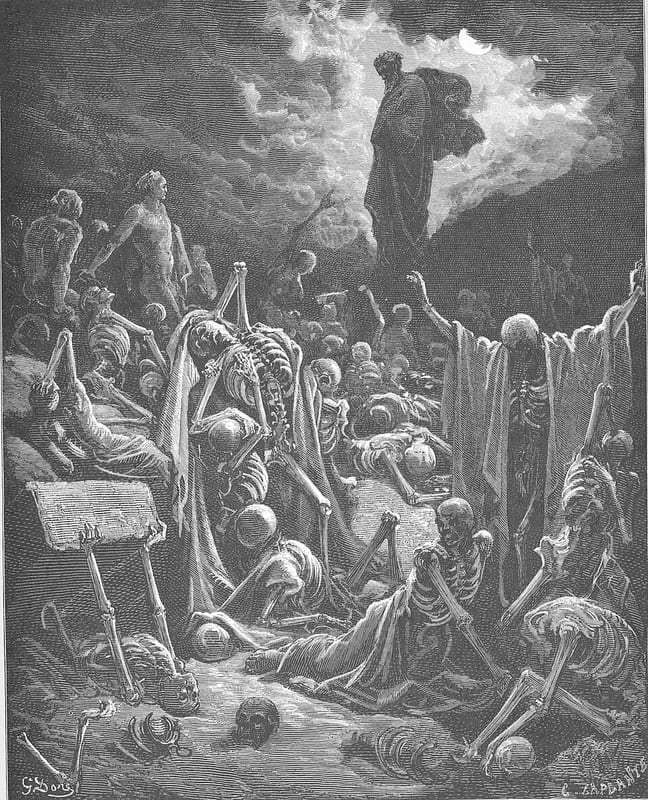
For instance, Ezekiel leaps in the spirit of prophecy over all the intervening time, with its vast duration; he stands, by his powers of foresight, in the actual moment of the Resurrection, and, as if he had really gazed on what is still to come, brings it in his description before our eyes. He saw a mighty plain, unfolded to an endless distance before him, and vast heaps of bones upon it flung at random, some this way, some that; and then under an impulse from God these bones began to move and group themselves with their fellows that they once owned, and adhere to the familiar sockets, and then clothe themselves with muscle, flesh, and skin (which was the process called "decorating" in the poetry of the Psalms); a Spirit in fact was giving life and movement to everything that lay there.
The vision is a famous one and is celebrated by being read in all the churches of Christ.
The hope of resurrection is the root of every kind of good work, for the expectation of reward braces the soul to productive toil. And whereas every worker is ready to sustain his toil if he can look forward to being repaid for his labors, where toil has no recompense the soul is soon discouraged and the body flags with it. A soldier who expects his share of the spoils is ready for war. But no one is prepared to die serving a king so undiscerning that he does not provide rewards for labors. In the same way, any soul that believes in resurrection takes care for itself, as is right, but any soul that disbelieves the resurrection abandons itself to destruction. A person who believes that the body survives to rise again is careful of this garment and does not soil it by fornicating. But a person who does not believe in the resurrection gives himself up to fornication, abusing his own body as if it were nothing to him. A mighty message and teaching of the holy Catholic church is belief about the resurrection of the dead; mighty and most indispensable. While many deny it, the truth claims credence for it. Greeks deny it, Samaritans disbelieve, while heretics tear away the half. Truth never appears but in one shape, while contradiction assumes a hundred.
6 more voices on this verse
The Church Fathers1 voice
(Chapter 37, verses 1 onwards) The hand of the Lord was upon me, and He brought me out in the Spirit of the Lord and set me down in the middle of a valley; it was full of bones. And He led me around among them, and behold, there were very many on the surface of the valley, and behold, they were very dry. And He said to me, 'Son of man, can these bones live?' And I answered, 'O Lord God, you know.'
The Puritans and the Awakening2 voices
Tell them," (1.) "That they shall be brought out of the land of their enemies, where they are as it were buried alive: I will open your graves. " Those shall be restored, not only whose bones are scattered at the grave's mouth ( Ps. cxli.
quarantine:debris (2026-07-29) — unbalanced-parens+odd-straight-quotes
And ye shall know that I am the Lord,.... See Gill on Eze 37:6, when I have opened your graves, O my people, and brought you up out of your graves; which is doing that for them which none but the omnipotent God could do; and they seeing his hand and power, his grace and mercy in it, will know, own, and acknowledge him.
The Nineteenth Century3 voices
I HAVE read to you the vision of the resurrection of the dry bones. Keep it in your minds, that you may understand the text. The figure is a very apt, instructive and impressive one. It is not, however, a mere figure—it is a parable based upon a remarkable representation of the resurrection of the dead. Although the children of Israel, at that time, knew little enough concerning the resurrection, yet the Lord, the Holy Spirit, knew all about it and He used it as a striking picture of the salvation of Israel from that national death which had come upon them. We may, with equal accuracy, see in it, a vivid representation of the work of Grace upon the hearts of all those who are quickened into spiritual life by the power of Divine Grace. Men, by nature, are dead in sin till they hear the voice of God and feel the quickening breath of the Spirit—and are made to live according to that Word of God—"He that believes in Me, though he were dead, yet shall he live: and whoever lives and believes in Me shall never die." Such a metaphor as this before us, drops with teaching as a honeycomb with honey, and it will be our own fault if we are not taught by it! The salvation of men by the Grace and power of God is as great a wonder as the general resurrection. The putting of spiritual life into a natural man is a marvel of marvels and should excite as much wonder as the raising of Lazarus, or of Jairus' daughter, or of the young man at the gates of Nain. Even the rising up of the dead at the last trumpet is not a greater prodigy than the bringing of dead hearts unto the life of God! I shall not, however, detain you by fuller observations upon spiritual resurrection, for I have work to do of another kind upon which we will spend the bulk of our time and the whole of our energies.
I HAVE read to you the vision of the resurrection of the dry bones. Keep it in your minds, that you may understand the text. The figure is a very apt, instructive and impressive one. It is not, however, a mere figure—it is a parable based upon a remarkable representation of the resurrection of the dead.
When I have opened your graves - When I shall have done for you what was beyond your hope, and deemed impossible, then shall ye know that I am Jehovah.
How the passage was read
What the Jewish commentators add
On the verses either side of this one
Therefore, prophesy that I am destined to resurrect you a second time.
This section is reception history: how the passage was read and kept in the Jewish tradition. Where a reading parts from an essential of the Christian faith, the section says so at that point.
Texts and citation data: Sefaria; each excerpt follows its version’s licence. 5 further sources are cited on this chapter that carry no English text this site may quote or only restate the verse.
The words behind it
11 Hebrew wordsEvery Hebrew word of this verse in the order it stands, with what it means and the door to its own study. The last column counts the times a word stands in the whole Bible: the rarer the word, the more the places it appears belong together.
| Hebrew | Sound | Meaning | Word study | In the Bible |
|---|---|---|---|---|
| וִֽידַעְתֶּ֖ם | vida'tem | and you will know | H3045 → | 945 times |
| כִּֽי־ | ki- | that | H3588 → | 4482 times |
| אֲנִ֣י | ʾani | I | H589 → | 874 times |
| יְהוָ֑ה | yahweh | [am] Yahweh | H3068 → | 6520 times |
| בְּפִתְחִ֣י | befitchi | when open I | H6605 → | 144 times |
| אֶת־ | ʾet- | <obj.> | H853 → | 10935 times |
| קִבְרֽוֹתֵיכֶ֗ם | kivroteikhem | graves your | H6913 → | 67 times |
| וּבְהַעֲלוֹתִ֥י | uvehaaloti | and when bring up I | H5927 → | 890 times |
| אֶתְכֶ֛ם | ʾetkhem | <obj.> you | H853 → | 10935 times |
| מִקִּבְרוֹתֵיכֶ֖ם | mikivroteikhem | from graves your | H6913 → | 67 times |
| עַמִּֽי׃ | ʾami | O people my | H5971 → | 1873 times |
וִֽידַעְתֶּ֖םand you will know
vida'temH3045 →945 times
כִּֽי־that
ki-H3588 →4482 times
אֲנִ֣יI
ʾaniH589 →874 times
יְהוָ֑ה[am] Yahweh
yahwehH3068 →6520 times
בְּפִתְחִ֣יwhen open I
befitchiH6605 →144 times
אֶת־<obj.>
ʾet-H853 →10935 times
קִבְרֽוֹתֵיכֶ֗םgraves your
kivroteikhemH6913 →67 times
וּבְהַעֲלוֹתִ֥יand when bring up I
uvehaalotiH5927 →890 times
אֶתְכֶ֛ם<obj.> you
ʾetkhemH853 →10935 times
מִקִּבְרוֹתֵיכֶ֖םfrom graves your
mikivroteikhemH6913 →67 times
עַמִּֽי׃O people my
ʾamiH5971 →1873 times
A shaded row is a word that stands 400 times or fewer in the Bible.
The walk
8 stopsEach card is a verse this one points to, and under it the verses that one points to in turn. Where several paths arrive at the same place, that place is listed first: the text keeps returning to it.
Through
Ezekiel 37:6I will attach tendons to you and make flesh grow upon you and cover you with skin. I will put breath within you so that you will come to life. Then you will know…
it leads to
- Joel 2:27
Then you will know that I am present in Israel and that I am the LORD your God, and there is no other. My people will never again be put to shame.
- Isaiah 49:23
Kings will be your foster fathers, and their queens your nursing mothers. They will bow to you facedown and lick the dust at your feet. Then you will know that I am the LORD;…
- Joel 3:17
Then you will know that I am the LORD your God, who dwells in Zion, My holy mountain. Jerusalem will be holy, never again to be overrun by foreigners.
- Ezekiel 37:14
I will put My Spirit in you and you will live, and I will settle you in your own land. Then you will know that I, the LORD, have spoken, and I will do…
- Ezekiel 38:23
I will magnify and sanctify Myself, and will reveal Myself in the sight of many nations. Then they will know that I am the LORD.
- Joel 2:27
Through
Ezekiel 16:62So I will establish My covenant with you, and you will know that I am the LORD,
it leads to
- Jeremiah 24:7
I will give them a heart to know Me, that I am the LORD. They will be My people, and I will be their God, for they will return to Me with all their…
- Ezekiel 6:7
The slain will fall among you, and you will know that I am the LORD.
- Ezekiel 20:43–44
There you will remember your ways and all the deeds with which you have defiled yourselves, and you will loathe yourselves for all the evils you have done.
- Jeremiah 24:7
Where this verse is studied
On this page
Studies4
About Ezekiel
This page draws on 12 works. Open the list of works
This page draws on Adam Clarke, Commentary on the Bible; Charles Spurgeon, The Metropolitan Tabernacle Pulpit, Sermon No. 1676: “Despair Denounced and Grace Glorified” (lightly modernized text, CCEL edition); Cyril of Jerusalem, Catechetical Lecture 18:1; Gregory of Nyssa, ON THE SOUL AND THE RESURRECTION; Jerome, COMMENTARY ON EZEKIEL 11:37.1-14; Jerome, Commentary on Ezekiel; John Gill, Exposition of the Old Testament; John Gill, Exposition of the Old Testament (1748-1763); Matthew Henry, Commentary on the Whole Bible; Origen of Alexandria, HOMILIES ON LEVITICUS 7:2.9; Origen of Alexandria, COMMENTARY ON THE GOSPEL OF JOHN 10:233 and Patrick Fairbairn, An Exposition of Ezekiel.