
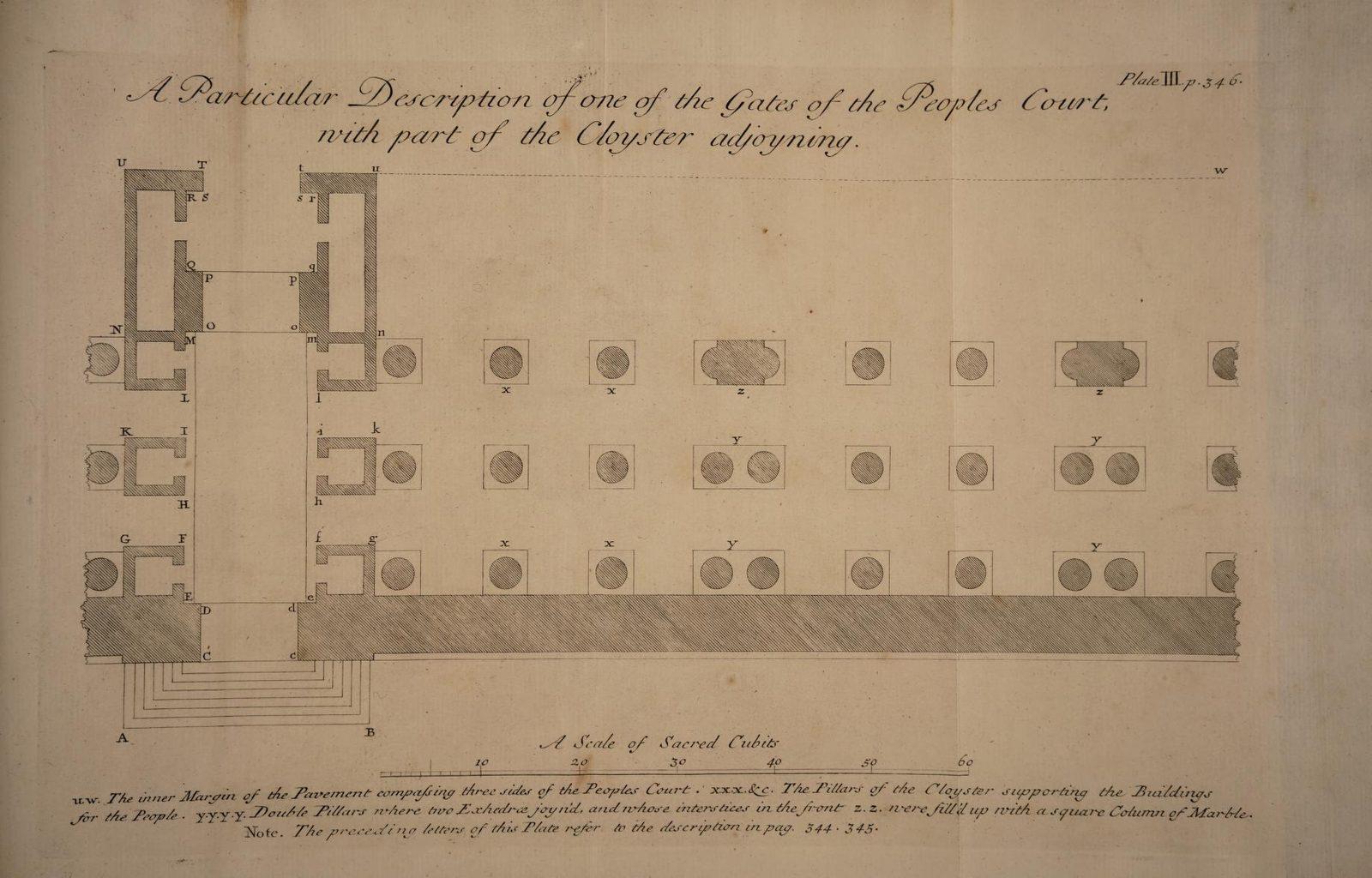
Isaac Newton, one of the Gates of the Peoples Court, 1728. Public domain.
Ezekiel 44 to 48 · Subject · Featured Study
The Prince of Ezekiel 44 to 48
Ezekiel 44 to 48 gives laws for a ruler called the prince, at the gate, on the land and at the feasts.
This land will be his possession in Israel. And My princes will no longer oppress My people, but will give the rest of the land to the house of Israel according to their tribes.
- Book
- Ezekiel
- Hold in memory
- Ezekiel 44:3
The Berean text names the prince fifteen times in Ezekiel 44 to 48, and not once in the four chapters of measuring before them.
Summary
The commentators do not agree on who the prince is.
- Barnes' Notes report that the rabbis took this prince to be the Messiah.
- Ellicott reports the same of the rabbis.
- Barnes' Notes say the prince had land of his own to prevent exactions from his people.
The Prince at the East Gate
The prince's place in the temple begins at the gate the LORD has entered.
And the LORD said to me, “This gate is to remain shut. It shall not be opened, and no man shall enter through it, because the LORD, the God of Israel, has entered through it. Therefore it will remain shut. Only the prince himself may sit inside the gateway to eat in the presence of the LORD. He must enter by way of the portico of the gateway and go out the same way.”Barnes' Notes say that under the old law such sacred meals belonged to the priests alone, and not even the king might share them.
The Prince's Land
Ezekiel 45 and 48 measure a holy district in cubits and give the prince the land on its east and west sides.
The sanctuary stands in the priests' portion, and the city lies to the south of it.
5,000 cubits
- The prince's land, westIt runs west from the holy district to the western borderEzekiel 48:21
- The prince's land, eastIt runs east from the holy district toward the eastern borderEzekiel 45:7
- The Levites' portionA strip the size of the priests' portion, for their townsEzekiel 48:13
- The priests' portion25,000 cubits by 10,000, for the descendants of ZadokEzekiel 48:11
- The sanctuary500 cubits square, with 50 cubits of open land around itEzekiel 45:2
- The city4,500 cubits on each side, with 250 cubits of pasturelandEzekiel 48:16
- The city's farmlandThe two ends of the city's strip, worked by men of all the tribesEzekiel 48:18
The drawing places the Levites' portion north of the priests' portion and the city's to the south; Ezekiel 48:13 says only that the two portions border each other. The drawing cuts off the prince's land, which the text runs on to the borders.
The plan is drawn to scale from Ezekiel 48:8 to 22, with Judah to the north and Benjamin to the south.
What the Prince Does
Chapters 45 and 46 give the prince seven duties, from the offerings of the feasts to the land he leaves his sons.
The duties run from the people's gifts to the prince's own land.
| The duty | The words of the text |
|---|---|
| He receives the people's contribution | “All the people of the land must participate in this contribution for the prince in Israel.” |
| He provides the offerings of the feasts | “the burnt offerings, grain offerings, and drink offerings for the feasts, New Moons, and Sabbaths” |
| He worships at the inner gate | “stand by the gatepost, while the priests sacrifice his burnt offerings and peace offerings” |
| He goes in and out with the people | “When the people enter, the prince shall go in with them, and when they leave, he shall leave.” |
| He brings freewill offerings | “the gate facing east must be opened for him” |
| He keeps his land for his sons | “His inheritance belongs only to his sons; it shall be theirs.” |
| He takes no one's inheritance | “so that none of My people will be displaced from his property” |
Jamieson, Fausset and Brown draw a lesson for the people from the freewill offerings.
“Not only is he to perform official acts of worship on holy days and feasts, but in ‘voluntary’ offerings daily he is to show his individual zeal, surpassing all his people in liberality, and so setting them a princely example.”
Jamieson, Fausset & Brown · Commentary Critical and Explanatory on the Whole Bible · on Ezekiel 46:12 to 15Reformed
Who the Prince Is
Ezekiel's words leave room for more than one reading of the prince.
Four readings of the prince stand among the commentators, from the Messiah himself to a civil ruler.
| Reading | Held by | Work |
|---|---|---|
| The Messiah, the David of chapters 34 and 37 | Keil and Delitzsch; Ellicott; Jerome | Ellicott's Commentary |
| A ruler who stands for the Messiah | Barnes' Notes; Jamieson, Fausset and Brown | Barnes' Notes on the Bible |
| The civil head of the restored nation | Hävernick; Adam Clarke | The Pulpit Commentary |
| A line of rulers after the pattern of David | The Pulpit Commentary | The Pulpit Commentary |
A Prince Among Them
Before the temple vision, Ezekiel had twice named the coming son of David a prince.
I, the LORD, will be their God, and My servant David will be a prince among them. I, the LORD, have spoken.They will live in the land that I gave to My servant Jacob, where your fathers lived. They will live there forever with their children and grandchildren, and My servant David will be their prince forever.Adam Clarke gives the Hebrew word as nasi and defines it as one who held the authority of chief magistrate.
The Offering at Passover
One verse of the Passover law stands at the center of the debate over who the prince is.
On that day the prince shall provide a bull as a sin offering for himself and for all the people of the land.Hävernick counted this offering, with the prince's sons and his place at the gatepost, as proof that the prince is a civil ruler and not the Messiah.
Henry on the People's Offering
Matthew Henry read the people's contribution of Ezekiel 45:16 as an offering to Christ.
Matthew Henry (1662 to 1714)
His note records a reading of the verse and makes it his own.
“Some read it to the prince, and understand it of Christ, who is indeed the prince in Israel, to whom we must offer our oblations, and into whose hands we must put them, to be presented to the Father.”
Matthew Henry · Commentary on the Whole Bible · on Ezekiel 45:16Puritan
The Readings Weighed
Three questions about the prince divide the commentators.
Is the prince the Messiah?Ellicott; Jerome; Jamieson, Fausset and Brown; the Pulpit Commentary
Ellicott holds that the prince must be the same person as the David of chapters 34 and 37, and for that reason reads the worship of chapter 46 as a symbol. Jerome held that the prince alone eats bread before the LORD because his divine nature stands apart from every creature.
Jamieson, Fausset and Brown answer that a prince who leaves land to his sons is no Messiah. The Pulpit Commentary replies to Hävernick that none of his verses forbids the Messiah reading, and gives the prince his highest fulfilment in the Messiah and a lower one in any righteous ruler of Israel.
One prince or a line of princes?Keil and Delitzsch; the Cambridge Bible; Ellicott
Keil and Delitzsch read the plural princes of Ezekiel 45:8 as Ezekiel thinking of the kings of the past, and not as many princes to come. The Cambridge Bible finds a succession of princes assumed in Ezekiel 43:7 and Ezekiel 45:8.
Ellicott answers that Ezekiel describes the future in the terms of the past, so that royal power appears as a line of rulers, though there is to be one king forever.
Does the prince hold a priestly office?the Pulpit Commentary; Ellicott; the Cambridge Bible
The Pulpit Commentary, on Ezekiel 45:17, sees the kingly and priestly offices joined in the prince as a type of their union in Christ.
Ellicott answers that the prince is given no priestly function and does not enter the inner court. The Cambridge Bible allows that he may have stood in the inner gateway to watch the priests at the altar.
Books to Read Next
Two older commentaries read the prince's laws verse by verse.
Ellicott's Commentary for English Readers
Charles John Ellicott, editor · public domain
Ellicott's notes on chapters 44 to 46 argue that the prince is the Messiah.
Read it free at BibleHubCommentary Critical and Explanatory on the Whole Bible
Robert Jamieson, A. R. Fausset and David Brown · 1871
The three authors weigh whether the prince can be the Messiah.
Read it free at BibleHubEnough, O Princes of Israel
Barnes' Notes read the law of the prince's land against the oppressions of Judah's kings.
For this is what the Lord GOD says: ‘Enough, O princes of Israel! Cease your violence and oppression, and do what is just and right. Stop dispossessing My people, declares the Lord GOD.’Sources
Scripture is the Berean Standard Bible.
- The commentators' notes on Ezekiel 44 to 48.
- Barnes' Notes on the Bible, on Ezekiel 44 to 46, as BibleHub prints it; public domain.
- Jamieson, Fausset and Brown, Commentary Critical and Explanatory on the Whole Bible (1871), on Ezekiel 44:3, 46:12 to 15 and 46:16 to 18.
- Adam Clarke, Commentary on the Bible, on Ezekiel 45:7.
- Matthew Henry, Commentary on the Whole Bible (1710), on Ezekiel 45:16.
- Carl Friedrich Keil and Franz Delitzsch, Biblical Commentary on the Old Testament (1857 to 1878), on Ezekiel 44 to 46; public domain.
- The Cambridge Bible for Schools and Colleges, on Ezekiel 34, 37 and 46; public domain.
- The Pulpit Commentary, on Ezekiel 34, 44 and 45; public domain.
- Ellicott's Commentary for English Readers (public domain), on the prince in chapters 44 to 46 of Ezekiel.
- Jerome, Commentary on Ezekiel, on Ezekiel 44:3.
Keep Studying
Read it5