
Nehemiahchapter 13
31 verses · Nehemiah · 5th century BC · History
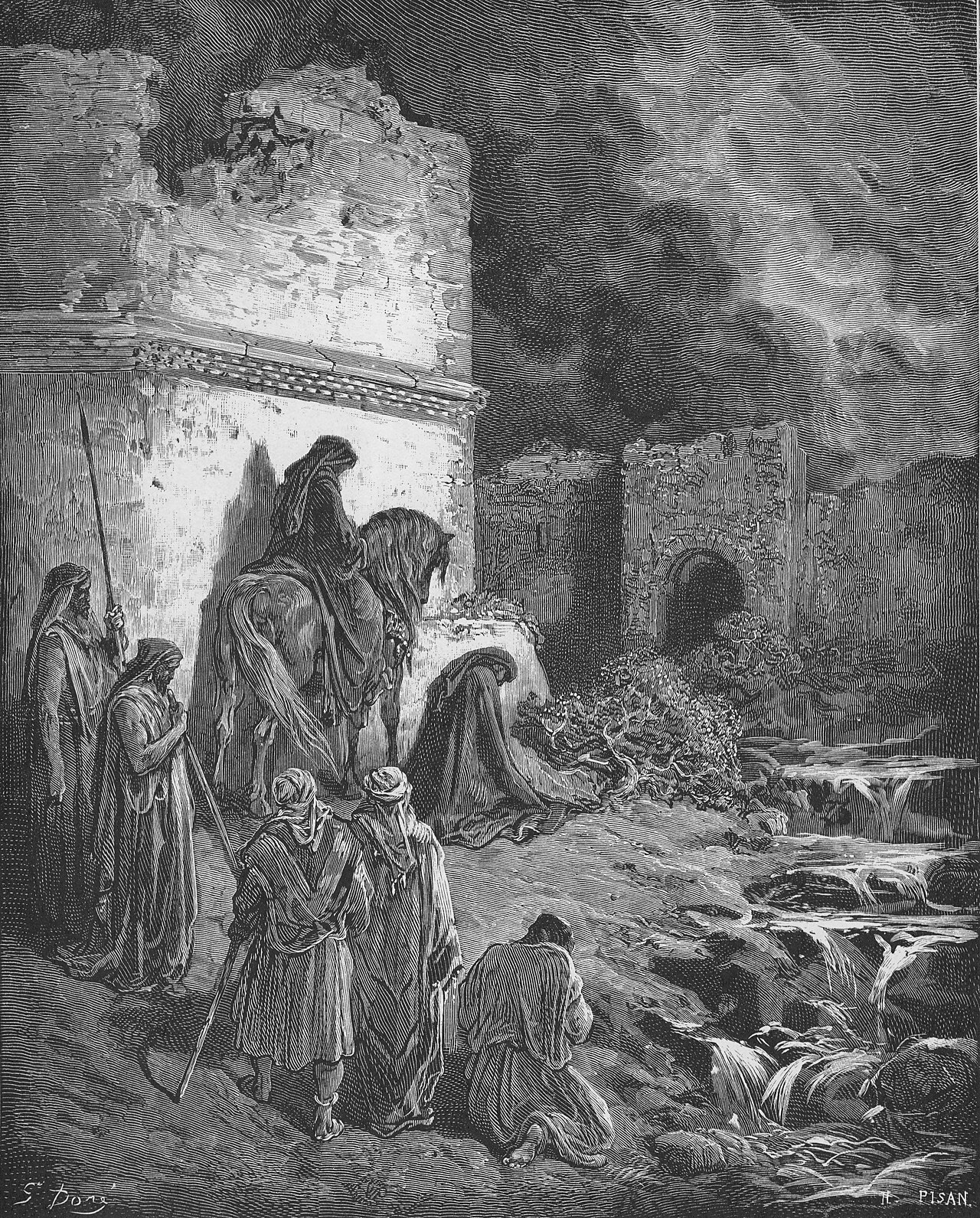
In those days I saw people in Judah treading winepresses on the Sabbath and bringing in grain and loading it on donkeys, along with wine, grapes, and figs. All kinds of goods were being brought into Jerusalem on the Sabbath day. So I warned them against selling food on that day.
Introduction
Nehemiah, History, Nehemiah Overview.
Nehemiah wrote this last chapter about his return to Jerusalem after a time back at the Persian court. His hearers had just read of a covenant sealed with great ceremony, and now they see what became of it. The chapter is a list of failures and of the governor's firm response to each. Listen for the short prayer he repeats, asking God to remember him, and for how many of the covenant's promises have come undone. The book ends with a reformer still at work. It leaves the reader waiting for a change the law alone could not bring.
Context
- Who
- Readers who had just watched a community sign a document, seeing what happened to it
- What
- The reforms of Nehemiah's second term: Tobiah removed from the temple, the Levites' support restored, the Sabbath enforced, and mixed marriages confronted.
- Where
- Jerusalem, its temple storerooms, its gates and markets, and the towns of Judah.
- When
- After the thirty-second year of Artaxerxes I, 433 BC, when Nehemiah returned to the king and later came back to Jerusalem.
- Why
- To show how quickly the covenant was broken and how Nehemiah restored it, and to commend his work to God's remembrance.
Historical context
Nehemiah had gone back to Susa to report, a Persian governor served at the king's pleasure and returned when summoned. When he came back, everything on the signed list had slipped, and the chapter goes through the failures in order.
Show the rest of the historical context, 3 more paragraphs
Tobiah, the old opponent, had been given a large chamber inside the temple courts by a priest related to him by marriage, a storeroom meant for grain, incense and vessels turned into a guest apartment. Nehemiah threw the furniture out into the street. The Levites had not been paid their portions, so they had left the temple and gone back to their fields; he brought them back and reappointed treasurers.
Then the Sabbath. He found winepresses working, loads being brought in on donkeys, and Tyrian fish merchants selling in Jerusalem on the day. Tyre's dried-fish trade down the coast was long-established business. He ordered the gates shut from dusk before the Sabbath until it was over, and when traders camped outside the wall he threatened to lay hands on them.
Last, the mixed marriages had come back, and he found children who could not speak the language of Judah. He records his own conduct plainly: he contended with them, cursed them, struck some, and pulled out their hair.
Significance
This is a deliberately unsatisfying ending, and it is the honest one. Everything gained in the book had to be fought for a second time within about a decade.
Show the rest of the significance, 1 more paragraph
Four times in the chapter Nehemiah stops the narrative to pray, "Remember me, O my God, for good." That is how the historical books of the Old Testament close: a reformer with a broken covenant on his hands, asking God to remember his work, and a people still waiting for a change of heart that laws and walls could not give them.
This chapter in Jewish lifeWhat this chapter is in Jewish life and reading.
What is done
This chapter has no place in the synagogue year. The site's own table in src/lib/hebraic/readings.ts printed parashot total 0 and haftarah uses total 0 for Nehemiah, and no festival reading.
It carries a scene of the Sabbath, the closing of the city gates as the Sabbath came in. Rashi reads the verse this way. "When the shadows of the Sabbath eve fell on the gates, I ordered the doors of the city to be closed and not re-opened until after the Sabbath so that the traffickers would not enter the city to sell their merchandise and cause Israel to profane the Sabbath." (Rashi on Nehemiah 13:19:1). The traders who lodged outside the wall once and twice hoped the people would open the gates and buy on the Sabbath (Rashi on Nehemiah 13:20:1). Under the fifteenth verse, where Rashi glosses the stacks as sheaves of grain (Rashi on Nehemiah 13:15:1), the corpus carries Shabbat 123b:13 and Jerusalem Talmud Shabbat 17:1:3, with Jerusalem Talmud Taanit 4:5:19.
The Levites' portions stand in the same chapter. Rashi reads Nehemiah's gathering of them as returning the priests and Levites to their watches, with all Israel bringing their gifts there (Rashi on Nehemiah 13:11:1).
How it is read
Rashi is the one commentator on this chapter whose English the corpus carries, quoted here from The Judaica Press complete Tanach with Rashi, translated by A. J. Rosenberg, which Sefaria reports as CC-BY. The mixed multitude separated from Israel in the third verse he reads through the mixed multitude that went up from Egypt in Exodus 12:38 (Rashi on Nehemiah 13:3:1). The chamber given to Tobiah was prepared by Eliashib, and Nehemiah was away because he had returned to the king in Babylon (Rashi on Nehemiah 13:5:1 and 13:6:1). On his return he commanded the chambers to be purified (Rashi on Nehemiah 13:9:1).
The treasurers were chosen because they were trusted to distribute the gifts among the Levites (Rashi on Nehemiah 13:13:1). The men of Tyre in the city were merchants who brought fish to sell (Rashi on Nehemiah 13:16:1), and Nehemiah warned the traffickers who lodged by the wall (Rashi on Nehemiah 13:21:1).
The marriages that close the book Rashi reads in plain terms. The men had married heathen wives (Rashi on Nehemiah 13:23:1), and the fruit of it was a loss of the language. "Many of their children spoke the Ashdodite language like their mothers." (Rashi on Nehemiah 13:24:1).
The corpus carries nine further notes on this chapter without an English text, each marked linked because Sefaria holds no English version of the ref. They stand cited and unquoted at Metzudat David on Nehemiah 13:1:1, 13:2:1, 13:7:1, 13:8:1, 13:12:1, 13:14:1, 13:17:1 and 13:18:1 and Ibn Ezra on Nehemiah 13:22:1.
What the rabbis say
The corpus carries twenty-eight rabbinic locators on this chapter and the text of none, so each is cited and linked here rather than quoted. On the first verse it holds Yalkut Shimoni on Torah 785:25. On the second it holds Bereshit Rabbah 41:3, Eikhah Rabbah 1:38 and Yalkut Shimoni on Torah 70:1. On the sixth it holds Pirkei DeRabbi Eliezer 49:8 and Seder Olam Rabbah 30:1.
On the ninth verse the corpus holds Bereshit Rabbah 98:2. On the fifteenth it holds Eikhah Rabbah 2:4, Esther Rabbah 1:10, Introductions to Tanaitic Literature, Introductions to Tractates of the Mishnah, Shabbat 12, Jerusalem Talmud Shabbat 17:1:3, Jerusalem Talmud Taanit 4:5:19, Midrash Sekhel Tov, Bereshit 44:13:2, Otzar Midrashim, Baraita of Rabbi Pinchas Ben Yair 1:33 and Shabbat 123b:13. On the seventeenth it holds Pirkei DeRabbi Eliezer 18:8. On the eighteenth it holds Midrash Tannaim on Deuteronomy 5:15:8.
On the twenty-second verse the corpus holds Avot DeRabbi Natan 41:15. On the twenty-third it holds Yalkut Shimoni on Torah 933:21. On the twenty-fifth it holds Ein Yaakov, Moed Katan 3:3, Moed Katan 16a:10 and Tractate Kallah Rabbati 6:4. On the twenty-sixth it holds Avot DeRabbi Natan, Recension B 43:21, Jerusalem Talmud Sanhedrin 2:6:4 and Shir HaShirim Rabbah 1:1:10.
On the twenty-eighth verse the corpus holds Pesikta DeRav Kahana 14:6 and Sifra, Acharei Mot, Chapter 13 3. On the thirty-first it holds Sanhedrin 93b:16. What each of them teaches is a saying of the rabbis, and is reported as theirs wherever this site quotes one. The quotations wait on a fetch that carries the text.
Sources: Rashi, Rashi on Nehemiah 13:3:1 to 13:24:1, The Judaica Press complete Tanach with Rashi, translated by A. J. Rosenberg, reported CC-BY; Metzudat David, Metzudat David on Nehemiah 13:1:1, 13:2:1, 13:7:1, 13:8:1, 13:12:1, 13:14:1, 13:17:1 and 13:18:1, cited by ref because the corpus carries no English text; Ibn Ezra, Ibn Ezra on Nehemiah 13:22:1, cited by ref because the corpus carries no English text; The Sefaria corpus, scripts/data/sources/sefaria/nehemiah/13.json, the 28 Talmud and Midrash locators of this chapter; The site's own files, src/lib/hebraic/readings.ts, printing no portion, no Haftarah and no festival reading for this book.
The heads below are this chapter's scenes. The numbered points under each are its verses.
Tobiah's furniture thrown out of the temple chamber
Nehemiah 13:1-3
no Ammonite or Moabite should ever enter the assembly of God: The public reading turns up the law "that no Ammonite or Moabite should ever enter the assembly of God," the ban of Deuteronomy 23. The people "excluded from Israel all of foreign descent," a reading Keil dates after Nehemiah's return.
Nehemiah 13:1
“That day - Not presently after the dedication of the wall and city, but upon a certain day, when Nehemiah was returned from the Persian court to Jerusalem, from which he had been absent for some considerable time, in which some errors and abuses had crept in.”
John Wesley · Explanatory Notes upon the Old Testament (1765)evangelical
1 more voice on this verseWhat preachers and commentators have said about this verse, in their own words.
Nehemiah 13:1
“Eliashib the priest . . . was allied unto Tobiah--This person was the high priest (Ne 13:28; also Ne 3:1), who, by virtue of his dignified office, had the superintendence and control of the apartments attached to the temple.”
Jamieson, Fausset & Brown · Commentary Critical and Explanatory on the Whole Bible (1871)reformed
had hired Balaam to call down a curse: The reason comes from Deuteronomy 23:4-5, which recalls Balaam hired to curse Israel (Numbers 22 to 24). Each curse came out as a blessing. Henry reads the law as a bar on Ammonites and Moabites settling among Israel or joining with them.
Nehemiah 13:2
“Because they met not the children of Israel with bread,.... The same reason is given, and what follows in this verse is observed in Deu 23:4; See Gill on Deu 23:4, Deu 23:5.”
they excluded from Israel all of foreign descent: Barnes compares the separation Ezra made about twenty years before (Ezra 10), when foreign wives were sent back with their children. Henry allows that the reading took place on a later anniversary of the dedication. The chapter's last reform returns to the same issue at verse 23.
Nehemiah 13:3
“A separation like that made by Ezra, some 20 years previously Ezra 10:15-44, seems to be intended. The pagan wives were divorced and sent back, with their offspring, to their own countries.”
Nehemiah 13:4-5
a relative of Tobiah: "Eliashib the priest, a relative of Tobiah," was in charge of the storerooms (13:4). He prepares "a large room" for the Ammonite who mocked the wall in chapter 4. Jamieson, Fausset and Brown identify him with the high priest of chapter 3, noting that his grandson is named at 13:28.
Nehemiah 13:4
“Eliashib the priest - Perhaps this was a different person from Eliashib the high priest; but there is no indubitable evidence that he was not the same. If he was high priest, he was very unfaithful to the high charge which he had received; and a reproach to the priesthood.”
Adam Clarke · Commentary on the Bible (1810-1826)evangelical
had prepared for Tobiah a large room: The room had stored the offerings, incense and temple articles, and the tithes that fed the Levites, singers and gatekeepers. Emptying it for Tobiah left those gifts without a store. Clarke judges that if this Eliashib was the high priest, he betrayed his charge and shamed the priesthood.
Nehemiah 13:5
“And he had prepared for him a great chamber,.... In the temple, by throwing together several chambers, as Piscator observes: where aforetime they laid the meat offerings, the frankincense, and the vessels, and the tithes of the corn, the new wine, and the oil, which was commanded to be given to the Levites, and to the singers, and the porters, and the offerings of the priests; see Neh 10:37.”
1 more voice on this verse
Nehemiah 13:5
The offerings of the priests - i e “the portion of the offerings assigned for their sustenance to the priests.”
Nehemiah 13:6-7
I was not in Jerusalem: m, because I had returned to Artaxerxes king of Babylon in the thirty-second year of his reign" (13:6). The gap gave Eliashib room to act. Clarke reckons the absence at about a year after a twelve-year governorship.
Nehemiah 13:6
“Was not I at Jerusalem - Nehemiah came to Jerusalem in the twentieth year of Artaxerxes, and remained there till the thirty-second year, twelve years: then returned to Babylon, and staid one year; got leave to revisit his brethren; and found matters as stated in this chapter.”
Adam Clarke · Commentary on the Bible (1810-1826)evangelical
2 more voices on this verse
Nehemiah 13:6
“If he had been there, the high priest durst not have done such a thing. The envious one, who sows tares in God's field, knows how to take an opportunity to do it when the servants sleep or are absent, Matt. xiii. The golden calf was made when Moses was in the mount.”
Matthew Henry · Commentary on the Whole Bible (1707-1721)puritan
Nehemiah 13:6
“How long [Nehemiah] remained there is not expressly said, but "after certain days," which is a Scripture phraseology for a year or a number of years, he obtained leave to resume the government of Jerusalem; to his deep mortification and regret, he found matters in the neglected and disorderly state here described.”
Jamieson, Fausset & Brown · Commentary Critical and Explanatory on the Whole Bible (1871)reformed
the evil that Eliashib had done: How long Nehemiah stayed away is open: Clarke puts it at one year, and Jamieson, Fausset and Brown a year or several. Bede names the evil plainly. An enemy of the people of God was lodging in the courts of God's house.
Nehemiah 13:8-9
Tobiah’s household goods: Nehemiah "was greatly displeased," and his response is physical: he "threw all of Tobiah’s household goods out of the room." He orders the rooms purified and restores "the articles of the house of God" (13:9). What one priest gave to an enemy, Nehemiah takes back for God.
Nehemiah 13:8
“I cast forth all the household stuff of Tobiah - He acted as Jesus Christ did when he found the courts of the Lord’s house profaned: He overthrew the tables of the moneychangers, and the seats of those who sold doves.”
Adam Clarke · Commentary on the Bible (1810-1826)evangelical
I ordered that the rooms be purified: Gill notes the plural rooms, which suggests Tobiah's chamber had been made from several. He thinks the cleansing used the water of purification of Numbers 19:9, the rite for uncleanness contracted from a heathen's dwelling. Then the articles and offerings went back in.
Nehemiah 13:9
“Then I commanded, and they cleansed the chambers,.... By which it appears there were more than one, or that several were thrown into one; which was done not only by washing them, but as this was a ceremonial uncleanness, contracted by the habitation of an Heathen in them, their purification might be by the water of separation, Num 19:9 and thither brought I again the vessels of the house of God, with the meat offering and the frankincense; replaced them where they were before.”
The Levites had fled to their fields: remember me, O my God
Nehemiah 13:10-11
the portions for the Levites: The Levites had gone unpaid: "all the Levites and singers responsible for performing the service had gone back to their own fields" (13:10). Nehemiah's question, "Why has the house of God been neglected?" echoes the covenant's last line, "we will not neglect the house of our God" (10:39).
Nehemiah 13:10
“The portions of the Levites had not been given - Hence we find they were obliged to abandon the sacred service, and betake themselves to cultivate the land for their support. This was the fault of the rulers, who permitted all these abuses.”
Adam Clarke · Commentary on the Bible (1810-1826)evangelical
Clarke hears the covenant of 10:39 in the question, where the people had sworn never to neglect the house of their God. Nehemiah turned their own promise into the rebuke. Gill takes the officials as the priests set over the storerooms at 12:44.
Nehemiah 13:11
“Then I contended with the rulers;.... The ecclesiastical rulers, the priests that were appointed over those chambers, Neh 12:44, he expostulated with them warmly, and chode them severely for their conduct: and said, why is the house of God forsaken? no care being taken of the maintenance of the ministers of it, contrary to the promise made Neh 10:37, and l gathered them together; the Levites and singers that were dispersed in the countries round about: and set them in their place; in the temple, and in the course of their ministry there.”
1 more voice on this verse
Nehemiah 13:11
“Why is the house of God forsaken? - They had all solemnly promised, Neh 10:39, that they would never forsake the house of their God; but, alas, how soon is this forgotten! Nehemiah used their own words here by way of reproof.”
Adam Clarke · Commentary on the Bible (1810-1826)evangelical
Nehemiah 13:12-14
a tenth of the grain: Once the portions are restored, "all Judah brought a tenth of the grain, new wine, and oil into the storerooms" (13:12). Nehemiah appoints treasurers, "Shelemiah the priest, Zadok the scribe, and Pedaiah of the Levites," to distribute to their fellow Levites.
Nehemiah 13:12
“Then brought all Judah the tithe of corn, and the new wine, and the oil, into the treasuries. When they saw a reformation made, and things were going in their proper channel, and a right use would be made of their tithes, these given to proper persons, who were now reinstated in their office.”
1 more voice on this verse
Nehemiah 13:12
“His zeal provoked theirs; and, when they saw the Levites at their work, they could not for shame withhold their wages any longer, but honestly and cheerfully brought them in. The better church-work is done the better will church-dues be paid.”
Matthew Henry · Commentary on the Whole Bible (1707-1721)puritan
because they were considered trustworthy: Wesley reads trustworthy as the verdict of those who knew these men, sought with care after the former keeper of the storerooms had failed. The board joins a priest, a scribe and a Levite. Their task was to share the supplies among their fellow Levites.
Nehemiah 13:13
“Faithful - By the consent of those who knew them. Such he now sought out the more diligently, because he had experience of the perfidiousness of the former trustees.”
John Wesley · Explanatory Notes upon the Old Testament (1765)evangelical
my deeds of loving devotion: Clarke reads the prayer as a plea for mercy: under strict judgment even good deeds would be wiped out. This is the first of the chapter's four calls on God to remember, at verses 14, 22, 29 and 31. Nehemiah asks God not to blot out his deeds.
Nehemiah 13:14
“Wipe not out my good deeds - If thou wert strict to mark what is done amiss, even my good deeds must be wiped out; but, Lord, remember me in thy mercy, and let my upright conduct be acceptable to thee!”
Adam Clarke · Commentary on the Bible (1810-1826)evangelical
Winepresses on the sabbath, and the gates shut at dusk
Nehemiah 13:15-16
treading winepresses on the Sabbath: Nehemiah's next target is Sabbath trade: "people in Judah treading winepresses on the Sabbath." In the city, "men of Tyre who lived there were importing fish and all kinds of merchandise," selling on the Sabbath inside the walls. The trade stands in Jerusalem itself, the city of God's house.
Nehemiah 13:15
The desecration of the Sabbath is first brought into prominence among the sins of the Jewish people by Jeremiah Jer 17:21-27. It could not but have gained ground during the captivity, when foreign masters would not have allowed the cessation of labor for one day in seven. On the return from the captivity, the sabbatical rest appears to have been one of the institutions most difficult to re-establish. In the day - Some render, “concerning the day.”
men of Tyre who lived there: Barnes notes the old friendship between Tyre and the returned Jews, who traded with Tyre and Sidon for cedar for the temple (Ezra 3:7). A colony of Tyrians living in Jerusalem was new. Their Sabbath trade drew the people of Judah into the market.
Nehemiah 13:16
“Friendly relations subsisted between the Phoenicians and the Jews, after the captivity Ezr 3:7. It was, however, a new fact, and one pregnant with evil consequences, that the Tyrians should have established a permanent colony at Jerusalem. Its influence on the other inhabitants weakened the hold of the Law upon men’s consciences, and caused it to be transgressed continually more and more openly.”
Nehemiah 13:17-18
I rebuked the nobles of Judah: Nehemiah confronts the nobles, asking "What is this evil you are doing" in profaning the Sabbath. "Did not your forefathers do the same things, so that our God brought all this disaster on us and on this city?" Sabbath breaking now is "rekindling His wrath against Israel."
Nehemiah 13:17
“Then I contended with the nobles,.... The rulers of the city, the civil magistrates, sharply reproved them for their neglect of duty: and said unto them, what evil thing is this that ye do, and profane the sabbath day? by suffering servile works to be done in it, and things sold on it.”
1 more voice on this verse
Nehemiah 13:17
“Nobles - Their chief men and rulers; whom he charges with this sin, because though others did it, it was by their countenance or connivance: probably too by their example.”
John Wesley · Explanatory Notes upon the Old Testament (1765)evangelical
Did not your forefathers do the same things: Barnes traces the charge to Jeremiah 17:21-27, where the prophet warned that burdens carried through the gates on the Sabbath would bring fire on Jerusalem. The fathers did it, and the city burned. Gill reads the charge as the same sin repeated.
Nehemiah 13:18
“Did not your fathers thus,.... Profane the sabbath in like manner: and did not our God bring all this evil upon us, and upon our city? suffered them to be carried captive into a strange land, and their city destroyed for their sins, and for this of sabbath breaking among the rest, see Jer 17:21, yet ye bring more wrath upon Israel by profaning the sabbath; additional judgments to those that had been already upon them for the same evil with others.”
Nehemiah 13:19-20
I ordered that the gates be shut: Then comes enforcement: he posts his own servants "so that no load could enter on the Sabbath day" (13:19). Turned away, the merchants "camped outside Jerusalem" once or twice rather than lose the trade.
Nehemiah 13:19
“The gates were closed at the sunset of the day before the Sabbath; since the Sabbath was regarded as commencing on the previous evening.”
camped outside Jerusalem: Gill takes these merchants as chiefly the Tyrians of verse 16, shut out and camping in hope that buyers would come out to them. Barnes sees their impatience for the gates to open. It happened once or twice before Nehemiah's warning ended it.
Nehemiah 13:20
“For the merchants and sellers of all kind of ware,.... The Tyrians particularly, Neh 13:16 lodged without Jerusalem once or twice; one sabbath day or two, not being able to get into the city, such strict watch and care being taken to keep the gates shut; this they did, hoping the Jews would come out to them and buy their goods, though they were not admitted to bring them within the city.”
Nehemiah 13:21-22
Nehemiah warns the merchants, "Why are you camping in front of the wall? If you do it again, I will lay hands on you," and "From that time on, they did not return on the Sabbath." He charges the Levites to guard the gates "to keep the Sabbath day holy."
Nehemiah 13:21
“The lodging of the merchants with their merchandise just outside Jerusalem during the Sabbath, marked their impatience for the moment when they might bring their wares in. This was thought by Nehemiah to be unseemly, and to have an irreligious tendency.”
instructed the Levites to purify themselves: Wesley explains the cleansing: guarding a gate was common work, yet here it served the holy day and was done on it. The watch passed from his servants to the Levites. Clarke notes that the prayer ends on mercy, which answers the charge that Nehemiah trusted his own merit.
Nehemiah 13:22
“Spare me according to the greatness of thy mercy - By some Nehemiah has been thought to deal with God too much on the principle of merit. That he wished God to remember him for good, is sufficiently evident; and who does not wish the same? But that he expected heaven because of his good deeds, does not appear. Indeed, the concluding clause of this verse proves the contrary, and shows that he expected nothing from God but through the greatness of his mercy.”
Adam Clarke · Commentary on the Bible (1810-1826)evangelical
2 more voices on this verse
Nehemiah 13:22
“Cleanse - Because the work they now were set upon, though common in its nature, yet was holy in design of it, and had respect unto the sabbath: and, because the day in which they were to do this was the sabbath-day, for the observation whereof they were obliged to purify themselves.”
John Wesley · Explanatory Notes upon the Old Testament (1765)evangelical
Nehemiah 13:22
“Note, The best saints, even when they do the best actions, stand in need of sparing mercy; for there is not a just man that doeth good and sinneth not. (2.) The plea: According to the greatness (or multitude) of thy mercies. Note, God's mercy is what we must depend upon, and not any merit of our own, when we appear before God.”
Matthew Henry · Commentary on the Whole Bible (1707-1721)puritan
Children who could not speak the Jews' language, and a priest chased away
Nehemiah 13:23-24
married women from Ashdod: The last reform returns to the crisis Ezra had fought once: "Jews who had married women from Ashdod, Ammon, and Moab." Gill notes that Ashdod was not one of the seven nations under the old conquest ban, yet the marriages still cost the children their language.
Nehemiah 13:23
“Judah has dealt treacherously, and broken covenant with God, the covenant made in Ezra's time with reference to this very thing; he has profaned the holiness of the Lord by marrying the daughter (that is, the worshipper) of a strange god.”
Matthew Henry · Commentary on the Whole Bible (1707-1721)puritan
spoke the language of Ashdod: Clarke explains the half as children of one father by Jewish and by foreign mothers, each child learning the mother's tongue. Ashdod was a Philistine city. Clarke adds that children of one family could not understand each other.
Nehemiah 13:24
“Half in the speech of Ashdod - There were children in the same family by Jewish and Philistine mothers. As the Jewish mother would always speak to her children in Hebrew or Chaldee, so they learnt to speak these languages; and as the Ashdod mother would always speak to her children in the Ashdod language, so they learnt that tongue. Thus there were, in the same family, children who could not understand each other; half, or one part, speaking one language, and the other part another.”
Adam Clarke · Commentary on the Bible (1810-1826)evangelical
Nehemiah 13:25-27
pulled out their hair: Nehemiah's response is the sharpest in the book: "I beat some of these men and pulled out their hair." At Ezra 9:3 Ezra had pulled out his own hair in grief over the same sin. Nehemiah argues from history, "Did not King Solomon of Israel sin in matters like this?"
Nehemiah 13:25
“I contended with them - Proved the fact against these iniquitous fathers, in a legal assembly. And cursed them - Denounced the judgments of God and the sentence of the law upon them. Smote certain of them - Had them punished by whipping. And plucked off their hair - Had them shaven, as a mark of the greatest ignominy. And made them swear by God, saying, Ye shall not give - Caused them to bind themselves by an oath, that they would make no intermarriages with those who were not of the seed of Israel.”
Adam Clarke · Commentary on the Bible (1810-1826)evangelical
1 more voice on this verse
Nehemiah 13:25
“Cursed - Caused them to be excommunicated and cast out of the society of God's people. This and the following punishments were justly inflicted upon them, because this transgression was contrary both to a plain law of God, and to their own late solemn covenants.”
John Wesley · Explanatory Notes upon the Old Testament (1765)evangelical
Did not King Solomon of Israel sin: Solomon is the weightiest example: no king was like him, God loved him, and still foreign wives drew him into sin (1 Kings 11:1-8). Henry adds the cost, the loss of ten of the twelve tribes. The argument runs from the greatest to the least.
Nehemiah 13:26
“He was beloved of God, but his marrying strange wives threw him out of God's favour, and went near to extinguish the holy fire of grace in his soul: he was king over all Israel; but his doing this occasioned the loss of ten of his twelve tribes.”
Matthew Henry · Commentary on the Whole Bible (1707-1721)puritan
acting unfaithfully against our God: Gill reads the question as Nehemiah refusing to let this evil go on by his silence. Ezra 10:2 uses the same word for marrying foreign women. A governor who heard of it and did nothing would share in it.
Nehemiah 13:27
“Shall we then hearken unto you to do all this great evil,.... To suffer it to be done, and connive at it, and not punish for it: to transgress against our God; his law, his mind, and will: in marrying strange wives? forbidden by him, Deu 7:1.”
Nehemiah 13:28-29
a son-in-law to Sanballat: The corruption reaches the high priest's family: "one of the sons of Jehoiada son of Eliashib the high priest had become a son-in-law to Sanballat." Nehemiah "drove him away." Clarke identifies him with Manasseh, whom Josephus says became priest of a rival temple Sanballat built on Mount Gerizim.
Nehemiah 13:28
“Josephus says that this expelled priest was Manasseh, and that when Nehemiah drove him away he went to his father-in-law Sanballat, who built him a temple upon Mount Gerazim, like that at Jerusalem, and promised him he should be high priest in it, and that then was laid the foundation of the Samaritans' pretensions, which continued warm to our Saviour's time.”
Matthew Henry · Commentary on the Whole Bible (1707-1721)puritan
1 more voice on this verse
Nehemiah 13:28
“One of the sons of Joiada - This was Manasseh, brother of Jaddua, son of Joiada, and grandson of Eliashib the high priest. I chased him from me - Struck him off the list of the priests, and deemed him utterly unworthy of all connection and intercourse with truly religious people.”
Adam Clarke · Commentary on the Bible (1810-1826)evangelical
defiled the priesthood and the covenant: Henry gives two readings of the prayer: a plea that God bring these priests to repentance, or a request that God count sin against them. Clarke takes it as a declaration of judgment. The covenant of the priesthood recalls God's covenant with Levi in Malachi 2:4-8.
Nehemiah 13:29
“Remember them, O my God,.... The priests, and punish them: because they have defiled the priesthood; by marrying strange wives, and rendering themselves unfit to officiate in it: and the covenant of the priesthood, and of the Levites; made with Levi, Aaron, and Phinehas, see Num 24:11, of the corruption of which, complaint is made, Mal 2:4.”
2 more voices on this verse
Nehemiah 13:29
“Because they have defiled the priesthood - God, therefore, will remember their iniquities against them, and punish them for their transgressions. These words of Nehemiah are to be understood declaratively.”
Adam Clarke · Commentary on the Bible (1810-1826)evangelical
Nehemiah 13:29
"Lord, convince and convert them; put them in mind of what they should be and do, that they may come to themselves." Or, "Remember them to reckon with them for their sin; remember it against them." If we take it so, this prayer is a prophecy that God would remember it against them.
Matthew Henry · Commentary on the Whole Bible (1707-1721)puritan
Nehemiah 13:30-31
I purified the priests and Levites from everything foreign: Nehemiah restores the wood offering at its appointed times and the firstfruits. The book's last words are its final refrain, "Remember me, O my God, with favor," the prayer of 13:14 and 13:22. Gill notes that with this prayer the historical narrative of the Hebrew canon ends.
Nehemiah 13:30
“Thus cleansed I them from all strangers,.... Both people and priests from strange wives, obliging them to put them away, or flee their country: and appointing the wards of the priests and the Levites, everyone in his business: to do the work of their office in their courses and turns.”
1 more voice on this verse
Nehemiah 13:30
“It was no loss to them to part with one that was the scandal of their cloth; the work would be done better without him. When Judas had gone out Christ said, Now is the Son of Man glorified, John xiii. Here are Nehemiah's prayers on this occasion.”
Matthew Henry · Commentary on the Whole Bible (1707-1721)puritan
contributions of wood at the appointed times: Clarke calls the wood offering a necessary rule, without which the temple service would have stopped, and the people had pledged it at 10:34. The firstfruits were pledged there too (10:35). The book ends on a prayer for favor.
Nehemiah 13:31
“For the wood-offering - This was a most necessary regulation: without it the temple service could not have gone forward; and therefore Nehemiah mentions this as one of the most important services he had rendered to his nation. See Neh 10:34. Remember me, O my God, for good - This has precisely the same meaning with, O my God, have mercy upon me! and thus alone it should be understood. Of Nehemiah the Jews speak as one of the greatest men of their nation.”
Adam Clarke · Commentary on the Bible (1810-1826)evangelical
Keep studying
Sources for this chapter
The summary
Jamieson, Fausset & Brown, Commentary Critical and Explanatory; John Wesley, Notes on the Old Testament and Matthew Henry, Complete Commentary.
The exposition
Adam Clarke, Commentary on the Bible; Albert Barnes, Notes, Explanatory and Practical, on the Old and New Testaments (1832-1869); Bede, Commentary on Ezra and Nehemiah; Jamieson Fausset and Brown, Commentary Critical and Explanatory on the Whole Bible; Jamieson, Fausset & Brown, Commentary Critical and Explanatory on the Whole Bible; John Gill; John Wesley, Explanatory Notes upon the Old Testament; Keil, The Books of Ezra, Nehemiah, and Esther; Matthew Henry, Commentary on the Whole Bible and W. F. Adeney, Ezra, Nehemiah and Esther (Expositor's Bible).