
Nahumchapter 1
15 verses · Nahum · 663 to 612 BC · The Twelve
This is the burden against Nineveh, the book of the vision of Nahum the Elkoshite:
Introduction
Nahum, The Twelve, Nahum Overview.
Nahum of Elkosh spoke this to Judah while Assyria still ruled the Near East from Nineveh. His hearers had paid tribute to that city all their lives and had watched it destroy the northern kingdom of Israel. The chapter is a portrait of God before it is a verdict on a city, and it opens as a partial alphabet poem. Listen for two things said of the LORD that seem to pull apart and are held together. Listen also for the moment the speech turns from the enemy to Judah. The prophet's name means comfort, and the chapter shows why his news was comfort to the oppressed.
Context
- Who
- A people who had paid tribute to Nineveh their whole lives and had watched it destroy their neighbors
- What
- A prophetic oracle that opens with a hymn on the character of the LORD and then announces the end of Nineveh and the release of Judah.
- Where
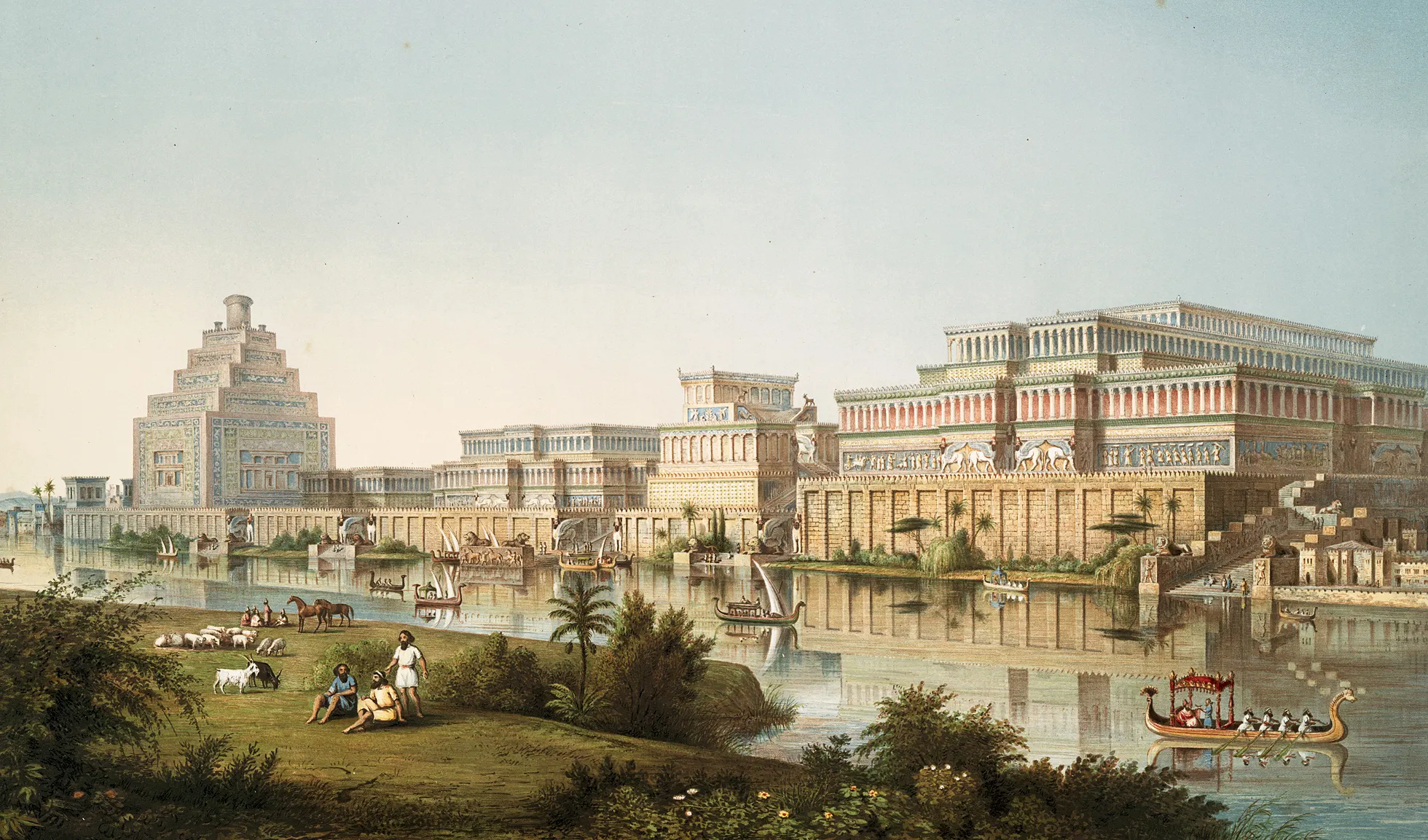
- Spoken in Judah about Nineveh, the Assyrian capital on the Tigris River, more than five hundred miles to the northeast.
- When
- Between the fall of Thebes in 663 BC, which the book treats as past, and the fall of Nineveh in 612 BC, which it treats as still to come; the exact year is unstated.
- Why
- To assure Judah that the God who is patient also judges, so that the empire which had oppressed them would answer for it.
Historical context
Assyria had run the Near East for the better part of three centuries by the time Nahum spoke. It had wiped the northern kingdom of Israel off the map in 722 BC and deported its population, and Sennacherib's army had stripped Judah's fortified towns in 701 BC. Judah survived as a tribute-paying vassal.
Show the rest of the historical context, 4 more paragraphs
The opening of the book is a partial alphabet poem, the lines begin with successive letters of the Hebrew alphabet through part of the chapter. Grief and praise were both written that way; the form gave enormous weight to short lines.
The theology comes first and it is uncomfortable on purpose: the LORD is jealous and takes vengeance, slow to anger and great in power, and will not at all acquit the wicked. Then, in the same breath, He is a stronghold in the day of trouble and knows those who trust Him. Nahum will not separate those two.
The imagery is drawn from the land itself. Bashan, Carmel, and Lebanon were the three most fertile regions people knew, and the poem has all three withering.
The chapter closes with a direct address to Judah: keep your feasts, perform your vows, for the wicked shall no more pass through you, he is utterly cut off. The tribute was going to stop.
Significance
For Judeans, this said the Assyrian machine was not permanent and not beyond accounting. Nineveh had done what it did to real towns with real names, and there was a court that had noticed.
Show the rest of the significance, 1 more paragraph
But the chapter refuses to make it merely political. The same God who is a stronghold to those who trust Him is the one dismantling an empire. Comfort and terror in this book come from the same source.
This chapter in Jewish lifeWhat this chapter is in Jewish life and reading.
What is done
No part of this chapter is read in the synagogue year. Probed for this lane, the site's own table in src/lib/hebraic/readings.ts printed parashot total 0 and haftarah uses total 0 for Nahum, with no festival reading. The same probe printed 54 weekly portions and 6 festival readings in the table as a whole. A congregation does not hear this chapter on a Sabbath or a feast.
The chapter is met in the study of the Torah portions instead, and the corpus shows the joins. Under the first verse it carries Bereshit Rabbah 16:4, on Genesis. Under the tenth it carries Bereshit Rabbah 56:5, Midrash Sekhel Tov, Bereshit 22:18:5 and Yalkut Shimoni on Torah 101:1 and 101:2. Under the eleventh it carries four locators on Deuteronomy, among them Midrash Tannaim on Deuteronomy 17:8:5.
How it is read
Rashi is the one commentator on this chapter whose English the corpus carries, quoted here from The Judaica Press complete Tanach with Rashi, translated by A. J. Rosenberg, which Sefaria reports as CC-BY. He reads the opening word as a burden laid on the city. "The burden of the cup of the curse [which was] to be given Nineveh to drink" (Rashi on Nahum 1:1:1).
He reads the book as the second prophecy against Nineveh, after Jonah's. "Elkosh is the name of his [Nahum’s] city" (Rashi on Nahum 1:1:2). In the same note he gives the Aramaic paraphrase of Jonathan. Jonah prophesied against the city, "and they repented of their sins" (Rashi on Nahum 1:1:2). When they went on sinning, Nahum prophesied against them again.
Rashi dates the prophecy to the time of Manasseh and reads it against the descendants of Sennacherib, citing Seder Olam for the date (Rashi on Nahum 1:2:1). On the threefold vengeance of the second verse he reports a saying of the rabbis. "Rabbi Simon says: These three expressions of vengeance correspond to the three exiles to which Sennacherib exiled Israel, as we find in Seder Olam (ch. 23)" (Rashi on Nahum 1:2:2).
On the third verse he joins patience to justice. "The reason He did not hasten His revenge is that He is slow to anger, but, in any case, He will not acquit" (Rashi on Nahum 1:3:1). The tempest and the storm he reads as messengers of judgment, and he sets the verse beside the east wind at the sea of Egypt, the Flood and Tyre (Rashi on Nahum 1:3:2).
At the rebuke of the sea Rashi records two readings himself. The verse is "To be understood [both] according to its apparent meaning, and as a figure describing the nations, who are compared to water" (Rashi on Nahum 1:4:1). The drying of the rivers he reads as a prophecy that God would crown Nebuchadnezzar in the days of Jehoiakim and give Assyria to the sword (Rashi on Nahum 1:4:2).
The seventh verse carries his longest teaching on the chapter. "Even when he inflicts retribution upon His enemies, His mercies do not cease to do good to those who fear Him" (Rashi on Nahum 1:7:1). He sets it against the way of a man, who cannot do two things at once, and he cites the Mechilta on Exodus 15:3 for it. On the tenth verse he reads the thorns as a sudden fall, "and they will not descend from their honor gradually" (Rashi on Nahum 1:10:1). He adds a second reading of the Hebrew there, as removal (Rashi on Nahum 1:10:2).
The chapter closes on the yoke. "The Shechinah says this to the prophet, who is of Israel: I will break off the yoke of Assyria from you and from My people" (Rashi on Nahum 1:13:1). In the next verse the king of Assyria is the one addressed (Rashi on Nahum 1:14:1).
One further note on this chapter is in the corpus without an English text. Ibn Ezra on Nahum 1:9:1 is marked linked because Sefaria holds no English version of the ref, and it stands cited and unquoted.
What the rabbis say
The corpus carries forty rabbinic locators on this chapter and the text of none, so each is cited here rather than quoted. On the second verse, the jealous and avenging God, it holds Avodah Zarah 4a:5, Bereshit Rabbah 49:8 and 55:3 and Kohelet Rabbah 8:4:1. It also holds Learning to Read Midrash, Appendix; Hebrew Sources 6:4. On the third verse, slow to anger, it holds Aggadat Bereshit 50:3, Bamidbar Rabbah 14:3, Chullin 91a:18 and Eikhah Rabbah 1:1. Devarim Rabbah 3:17 stands under the third and fourth verses together.
On the fourth verse, the rebuke of the sea, the corpus holds Aggadat Bereshit 8:2, Bamidbar Rabbah 12:4, Chagigah 12a:15 and Ein Yaakov (Glick Edition), Khagigah 2:7. On the sixth it holds Avodah Zarah 4a:18, Shemot Rabbah 29:9 and a passage of Otzar Midrashim on the Book of Gehinnom, at 3. On the seventh, the Lord is good, it holds Aggadat Bereshit 4:3, Bamidbar Rabbah 5:3, Midrash Lekach Tov, Numbers 4:22:1 and Midrash Tanchuma Buber, Bamidbar 32:1.
On the ninth verse, the full end, it holds Berakhot 59a:8 and Ein Yaakov, Berakhot 9:24. It also holds Otzar Midrashim on the revival of the dead, at 5, and Sifrei Aggadah on Esther, Midrash Panim Acherim, Version II 3:6. On the eleventh it holds Midrash Aggadah, Deuteronomy 17:8:3 and 3:23:6, Midrash Lekach Tov, Deuteronomy 17:8:1 and Midrash Tannaim on Deuteronomy 17:8:5. On the twelfth it holds Gittin 7a:20 and 7b:1 with the two editions of Ein Yaakov on Gittin 1:5. On the fourteenth it holds Midrash Shmuel 1:3.
The corpus also sets Midrash Tanchuma Buber, Nasso 34:1 under an anchor it prints as Nahum 1:33. That number lies past the last verse any note in the file reaches, and the locator is listed here as the corpus gives it. What each of these locators teaches is a saying of the rabbis, and it is reported as theirs wherever this site quotes one. The quotations wait on a fetch that carries the text.
Sources: Rashi, Rashi on Nahum 1:1:1 to 1:14:1, The Judaica Press complete Tanach with Rashi, translated by A. J. Rosenberg, reported CC-BY; Ibn Ezra, Ibn Ezra on Nahum 1:9:1, cited by ref because the corpus carries no English text; The Sefaria corpus, scripts/data/sources/sefaria/nahum/1.json, the 40 Talmud and Midrash locators of this chapter; The site's own files, src/lib/hebraic/readings.ts, probed for this book and printing parashot total 0, haftarah uses total 0 and festivalReadingForBook null.
The heads below are this chapter's scenes. The numbered points under each are its verses.
A jealous God, slow to anger, whose way is in the whirlwind
This is the burden against Nineveh: Burden is the prophets' own word for a doom oracle, a weight of judgment laid on the nation named. Nahum's home, Elkosh, is not fixed with certainty. The older commentators name three proposed sites: a village in Galilee, a site in Assyria, or a place in Judah lost to memory.
Nahum 1:1
“The burden - Jerome: “The word משׂא mas's'â', ‘burden’ is never placed in the title, except when the vision is heavy and full of burden and toil.” Of Nineveh - The prophecy of Nahum again is very stern and awful. Nineveh, after having “repented at the preaching of Jonah,” again fell back into the sins whereof it had repented, and added this, that, being employed by God to chasten Israel, it set itself, not to inflict the measure of God’s displeasure, but to uproot the chosen people, in whom was promised the birth of Christ .”
Nahum 1:2-3
a jealous and avenging God: Verse 2 calls the LORD "a jealous and avenging God," and verse 3 adds that He "is slow to anger," wrath and patience both true. The Hebrew of these verses keeps the remains of an alphabetic acrostic, from aleph to about kaph, before the pattern breaks off.
Nahum 1:2
“God is jealous - For his own glory. And - revengeth - His justice; by the destruction of his enemies. And is furious - So powerful in the manifestations of his judgments, that nothing can stand before him. He reserveth wrath - Though they seem to prosper for a time, and God appears to have passed by their crimes without notice, yet he reserveth - treasureth up - wrath for them, which shall burst forth in due time.”
Adam Clarke · Commentary on the Bible (1810-1826)evangelical
slow to anger: Nahum takes up the words Jonah once used of God's mercy toward Nineveh and shows their other side. The waiting came from strength. Albert Barnes reads the line as a warning that the patience had run its course, and the whirlwind and storm show the power behind it.
Nahum 1:3
“The Lord is slow to anger - Nahum takes up the words of Jonah Jon 4:2 as he spoke of God’s attributes toward Nineveh, but only to show the opposite side of them. Jonah declares how God is “slow to anger,” giving men time of repentance, and if they do repent, “repenting Him also of the evil;” Nahum, that the long-suffering of God is not “slackness,” that “He is long-suffering to usward, not willing that any should perish, but that all should come to repentance.” And strong in power - Divine long-suffering gees along with Divine power.”
1 more voice on this verse
Nahum 1:3
“His long-suffering is not from want of power to punish (Ex 34:6, 7). not at all acquit--literally, "will not acquitting acquit," or treat as innocent. Lord hath his way in the whirlwind--From this to Na 1:5, inclusive, is a description of His power exhibited in the phenomena of nature, especially when He is wroth.”
Jamieson, Fausset & Brown · Commentary Critical and Explanatory on the Whole Bible (1871)reformed
Nahum 1:4-6
He rebukes the sea: The sea dried up and the rivers run dry recall the Red Sea and the Jordan. Bashan, Carmel and Lebanon were the richest pasture, orchard and forest. Verse 6 asks "Who can endure His burning anger" and leaves it for verse 7 to name the Lord's people as the exception.
Nahum 1:4
“He rebuketh the sea - The Red Sea and the rivers: probably an allusion to the passage of the Red Sea and Jordan. The description of the coming of Jehovah, from the third to the sixth verse, is dreadfully majestic. He is represented as controlling universal nature. The sea and the rivers are dried up, the mountains tremble, the hills melt, and the earth is burnt at his presence. Bashan, Carmel, and Lebanon are withered and languish: streams of fire are poured out, and the rocks are cast down to make him a passage.”
Adam Clarke · Commentary on the Bible (1810-1826)evangelical
1 more voice on this verse
Nahum 1:4
“As Bashan was famed for its pastures, Carmel for its corn fields and vineyards, so Lebanon for its forests (Isa 33:9). There is nothing in the world so blooming that God cannot change it when He is wroth.”
Jamieson, Fausset & Brown · Commentary Critical and Explanatory on the Whole Bible (1871)reformed
mountains quake: The quaking mountains and melting hills recall Sinai, which shook when the LORD came down on it, as John Gill notes. The same words echo the prophet Amos. The whole created order trembles at the presence Nineveh has defied.
Nahum 1:5
“The mountains quaked at Him, and the hills melted - As of their own accord. The words are a renewal of those of Amos Amo 9:13. Inanimate nature is pictured as endowed with the terror, which guilt feels at the presence of God.”
Who can withstand His indignation?: Two questions stand at the centre of the poem, and the answer to both is no one. They appeal to conscience. Jamieson, Fausset and Brown compare the wrath poured out like fire to the burning flow of a volcano that splits even rock.
Nahum 1:6
“Who can stand before His indignation? - This question appeals to our own consciences, that we cannot . It anticipates the self-conviction at every day of God’s visitation, the forerunners of the lust.”
1 more voice on this verse
Nahum 1:6
“Who can stand before his indignation?....”
A stronghold in trouble, and an utter end for his enemies
Nahum 1:7-8
The LORD is good: Verse 7 calls the LORD "a stronghold in the day of distress," and verse 8 turns the same power into "an overwhelming flood" against Nineveh. The flood anticipates the ancient accounts behind chapter 2. The promise that "He cares for those who trust in Him" is the line Judah holds.
Nahum 1:7
“The Lord is good: a stronghold in the day of trouble - “Good and doing good,” and full of sweetness; alike good and mighty; good in giving Himself and imparting His goodness to His own; yea “none is good, save God” Luk 18:19; Himself the stronghold wherein His own amy take refuge; both in the troubles of this life, in which “He will not suffer us to be tempted above that we are able” 1Co 10:13, and in that Day, which shall hem them in on every side, and leave no place of escape except Himself.”
1 more voice on this verse
Nahum 1:7
“HAVE you read this chapter through? It is a very terrible one—it is like the rushing of a mighty river when it is nearing a waterfall. It boils, seethes and flows with overwhelming force, bearing everything before it, yet, right in the middle of the surging flood, there stands out, like a green island, this most cheering, comforting and delightful text! Listen a minute to the Prophet's words of terror.”
Charles Spurgeon · written before 1892 · The Metropolitan Tabernacle Pulpit, Sermon No. 2555: “The Stronghold” (lightly modernized text, CCEL edition)Particular Baptist
overwhelming flood: The Hebrew says only the end of her place, and the Berean text supplies the name Nineveh the first hearers understood. Adam Clarke records the ancient report that a flooded river broke down part of the city wall. Darkness then pursues the enemies wherever they run.
Nahum 1:8
“But with an overrunning flood - Bishop Newcome thinks this may refer to the manner in which Nineveh was taken. The Euphrates overflowed its banks, deluged a part of the city, and overturned twenty stadia of the wall; in consequence of which the desponding king burnt himself, and his palace, with his treasures. - Diodor. Sic., Edit. Wessel., p. 140, lib. ii., s. 27. Darkness shall pursue - Calamity. All kinds of calamity shall pursue them till they are destroyed.”
Adam Clarke · Commentary on the Bible (1810-1826)evangelical
Nahum 1:9-11
Whatever you plot against the LORD: Verse 9 tells Nineveh's plotters that whatever they plan "He will bring to an end". Verse 10 pictures them "entangled as with thorns". The verse names no one as the "plotter of evil against the LORD," and John Gill, following the Targum, reads him as Sennacherib.
Nahum 1:9
“Parallel to Isa 37:23-29; compare Ps 1:1. he will make an utter end--The utter overthrow of Sennacherib's host, soon about to take place, is an earnest of the "utter end" of Nineveh itself. affliction shall not rise up the second time--Judah's "affliction" caused by the invasion shall never rise again.”
Jamieson, Fausset & Brown · Commentary Critical and Explanatory on the Whole Bible (1871)reformed
1 more voice on this verse
Nahum 1:9
“The prophet had in few words summed up the close of Nineveh; he now upbraids them with the sin, which should bring it upon them, and foretells the destruction of Sennacherib. Nineveh had, before this, been the instrument of chastising Israel and Judah. Now, the capture of Samaria, which had cast off God, deceived and emboldened it.”
entangled as with thorns: Three pictures follow one another, a tangle of thorns, a drunkard overcome by his drink and stubble ready for the fire. Albert Barnes reads the thorns as a mass that looks strong and wounds anyone who touches it. Dry stubble burns fastest of all.
Nahum 1:10
“The Hebrew is "soaked," or "drunken as with their own wine." Their drunken revelries are perhaps alluded to, during which the foe (according to DIODORUS SICULUS [2]) broke into their city, and Sardanapalus burned his palace; though the main and ultimate destruction of Nineveh referred to by Nahum was long subsequent to that under Sardanapalus.”
Jamieson, Fausset & Brown · Commentary Critical and Explanatory on the Whole Bible (1871)reformed
a plotter of evil: The plotter who came out of Nineveh is left unnamed. John Gill, following the Targum, reads him as Sennacherib or his officer the Rabshakeh, who mocked the LORD before the walls of Jerusalem. A counselor of wickedness is in Hebrew a counselor of Belial, a worthless man.
Nahum 1:11
“There is one come out of thee - that is, Nineveh, “that imagineth” deviseth, , “evil, Lord, Sennacherib, against the the rod of God’s anger” Isa 10:5-7, yet who “meant not so,” as God meant. “And this was his counsel,” as is every counsel of Satan, “that they could not resist him, and so should withdraw themselves from the land of God, “into a land like their own” Isa 36:16-17, but whose joy and sweetness, its vines and its fig-trees, should not be from God, but from the Assyrian, i. e., from Satan.”
1 more voice on this verse
Nahum 1:11
“There is one come out of thee,.... That is, out of Nineveh, as the Targum explains it; meaning Sennacherib, who had his royal seat and palace there; or Rabshakeh that was sent from hence by him with a railing and blaspheming letter to the king of Judah, and the inhabitants of Jerusalem.”
On the mountains, the feet of him who brings good news
Nahum 1:12-13
Nineveh's allies and numbers count for nothing, for "they will be cut down and pass away". The oracle turns to Judah, "I will afflict you no longer," and the LORD will "break their yoke from your neck". John Wesley reads the yoke as the tribute Judah had paid Assyria.
Nahum 1:12
“Though they be - many - Sennacherib invaded Judea with an army of nearly two hundred thousand men. Thus shall they be cut down - The angel of the Lord (a suffocating wind) slew of them in one night one hundred and eighty-five thousand 2Ki 19:35.”
Adam Clarke · Commentary on the Bible (1810-1826)evangelical
1 more voice on this verse
Nahum 1:12
“In the height of their pride and power, they shall be clean cut off. The same Hebrew stands for "likewise" and "yet thus." So many as they are, so many shall they perish. when he shall pass through--or, "and he shall pass away," namely, "the wicked counsellor" (Na 1:11), Sennacherib. The change of number to the singular distinguishes him from his host.”
Jamieson, Fausset & Brown · Commentary Critical and Explanatory on the Whole Bible (1871)reformed
break their yoke: The yoke was the tribute Judah paid to Assyria, which Hezekiah had sent to Sennacherib at 2 Kings 18:14. The word now matters. It tells God's people they will not wait for a distant day.
Nahum 1:13
“For now will I break his yoke from off thee - God, lest His own should despair, does not put them off altogether to a distant day, but saith, now. Historically, the beginning of the fall is the earnest of the end. By the destruction of Sennacherib, God declared His displeasure against Assyria; the rest was matter of time only.”
The LORD has issued a command: The LORD's command against Nineveh reaches her royal line, with "no descendants to carry on your name," and her gods. "I will prepare your grave, for you are contemptible" denies the city even an honorable end. Nineveh's site was lost to memory for centuries until nineteenth century excavation uncovered it.
Nahum 1:14
“No more of thy name be sown - No more of you shall be carried away into captivity. I will make thy grave; for thou art vile - I think this is an address to the Assyrians, and especially to Sennacherib. The text is no obscure intimation of the fact. The house of his gods is to be his grave: and we know that while he was worshipping in the house of his god Nisroch, his two sons, Adrammelech and Sharezer, smote him there that he died, 2Ki 19:37.”
Adam Clarke · Commentary on the Bible (1810-1826)evangelical
one who brings good news: The messenger, "the feet of one who brings good news," shares its wording with Isaiah 52:7. For Judah the good news is Nineveh's fall, the feasts safe to keep because "the wicked will never again march through you". The chapter closes on comfort before the siege poetry of chapter 2.
Nahum 1:15
“Behold upon the mountains, the feet of him that bringeth good tidings, that publisheth peace - From mountain-top to mountain-top by beacon-fires they spread the glad tidings.”
2 more voices on this verse
Nahum 1:15
“These words are also quoted by the apostle, both from Isaiah and Nahum, and applied to the great redemption wrought out for us by our Lord Jesus, and the publishing of it to the world by the everlasting gospel, Rom. x. Christ's ministers are those messengers of good tidings, that preach peace by Jesus Christ. How beautiful are the feet of those messengers!”
Matthew Henry · Commentary on the Whole Bible (1707-1721)puritan
Nahum 1:15
“A type of the far more glorious spiritual deliverance of God's people from Satan by Messiah, heralded by ministers of the Gospel (Ro 10:15). perform thy vows--which thou didst promise if God would deliver thee from the Assyrian. the wicked--literally, "Belial"; the same as the "counsellor of Belial" (Na 1:11, Margin); namely, Sennacherib.”
Jamieson, Fausset & Brown · Commentary Critical and Explanatory on the Whole Bible (1871)reformed
How this psalm is built
The form: A prophetic oracle against Nineveh whose opening hymn, verses 2 to 8, runs as a partial alphabet poem in the Hebrew, as holds classes it.
The patterns in this chapter
| Device | What it does | Where to see it |
|---|---|---|
| The alphabet in the opening hymn | Counted in the Hebrew, the lines of verses 2 to 8 begin with the letters of the alphabet in order from aleph toward kaph. Aleph opens verse 2, gimel verse 4, he verse 5 and tet verse 7, while vav opens the second half of verse 5 and chet the second half of verse 6. The run is imperfect, since the dalet line of verse 4 opens with aleph, beth and zayin stand second in their lines and kaph stands third in verse 8.the Hebrew text the site holds, the verse_words rows for Nahum 1:2 to 8, counted 2026-09-24. | Nahum 1:2, Nahum 1:4, Nahum 1:5, Nahum 1:6, Nahum 1:7 |
How this chapter is built
1 more paragraph on the patterns
The chapter has three parts. Verses 2 to 8 are a hymn on the character of the LORD, set in the Hebrew as a partial alphabet poem. Verses 9 to 14 turn from the hymn to direct speech, addressed by turns to Nineveh and to Judah. Verse 15 closes the chapter with the messenger on the mountains and the call to keep the feasts. Printed Hebrew Bibles count that verse as 2:1, so the verse numbers of chapter 2 run one higher in Hebrew than in English Bibles.
Key words
The words this chapter repeats, each one a lemma of the store’s tagged Hebrew however the chapter inflects it, with the verses it stands in. The grammar words are struck out, and the eight terms the psalm says the word of God by stand in the figure above the patterns rather than here. Every row opens that word’s own page.
| Word | Said | No.Strong’s | Meaning | Where it stands |
|---|---|---|---|---|
| נָקַם | nâqam | H5358 | to avenge | 2 |
| אָמַל | ʼâmal | H535 | to weaken | 4 |
| כָּלָה | kâlâh | H3617 | consumption | 8, 9 |
| בְּלִיַּעַל | bᵉlîyaʻal | H1100 | Belial | 11, 15 |
| נָקָה | nâqâh | H5352 | to clear | 3 |
| צָרָה | tsârâh | H6869 | dearth | 7, 9 |
Show the next 12 words
| Word | Said | No.Strong’s | Meaning | Where it stands |
|---|---|---|---|---|
| עָנָה | ʻânâh | H6031 | be occupied | 12 |
| חָשַׁב | châshab | H2803 | to devise | 9, 11 |
| חֵמָה | chêmâh | H2534 | rage | 2, 6 |
| עוֹד | ʻôwd | H5750 | still | 12, 14, 15 |
| עָבַר | ʻâbar | H5674 | to pass | 8, 12, 15 |
| יְהֹוָה | Yᵉhôvâh | H3068 | LORD | 2, 3, 7, 9, 11, 12 and 1 more |
| אַף | ʼaph | H639 | face | 3, 6 |
| אֹיֵב | ʼôyêb | H341 | enemy | 2, 8 |
| כָּרַת | kârath | H3772 | to cut | 14, 15 |
| הַר | har | H2022 | mountain | 5, 15 |
| קוּם | qûwm | H6965 | (Leb)-kamai | 6, 9 |
| עָשָׂה | ʻâsâh | H6213 | to make | 8, 9 |
Keep studying
Studies7
Words12
Subjects1
Sources for this chapter
The summary
Jamieson, Fausset & Brown, Commentary Critical and Explanatory; John Calvin, Commentaries; John Wesley, Notes on the Old Testament and Matthew Henry, Complete Commentary.
The form and classifications
the Hebrew text the site holds, the verse_words rows for Nahum 1:2 to 8, counted 2026-09-24.
The exposition
Adam Clarke, Commentary on the Bible; Albert Barnes, Notes on the Old Testament; Carl Friedrich Keil, The Twelve Minor Prophets; Edward Bouverie Pusey, The Minor Prophets: A Commentary; Jamieson, Fausset & Brown, Commentary Critical and Explanatory on the Whole Bible; John Gill, Exposition of the Old Testament; John Wesley, Explanatory Notes upon the Old Testament and Matthew Henry, Commentary on the Whole Bible.