
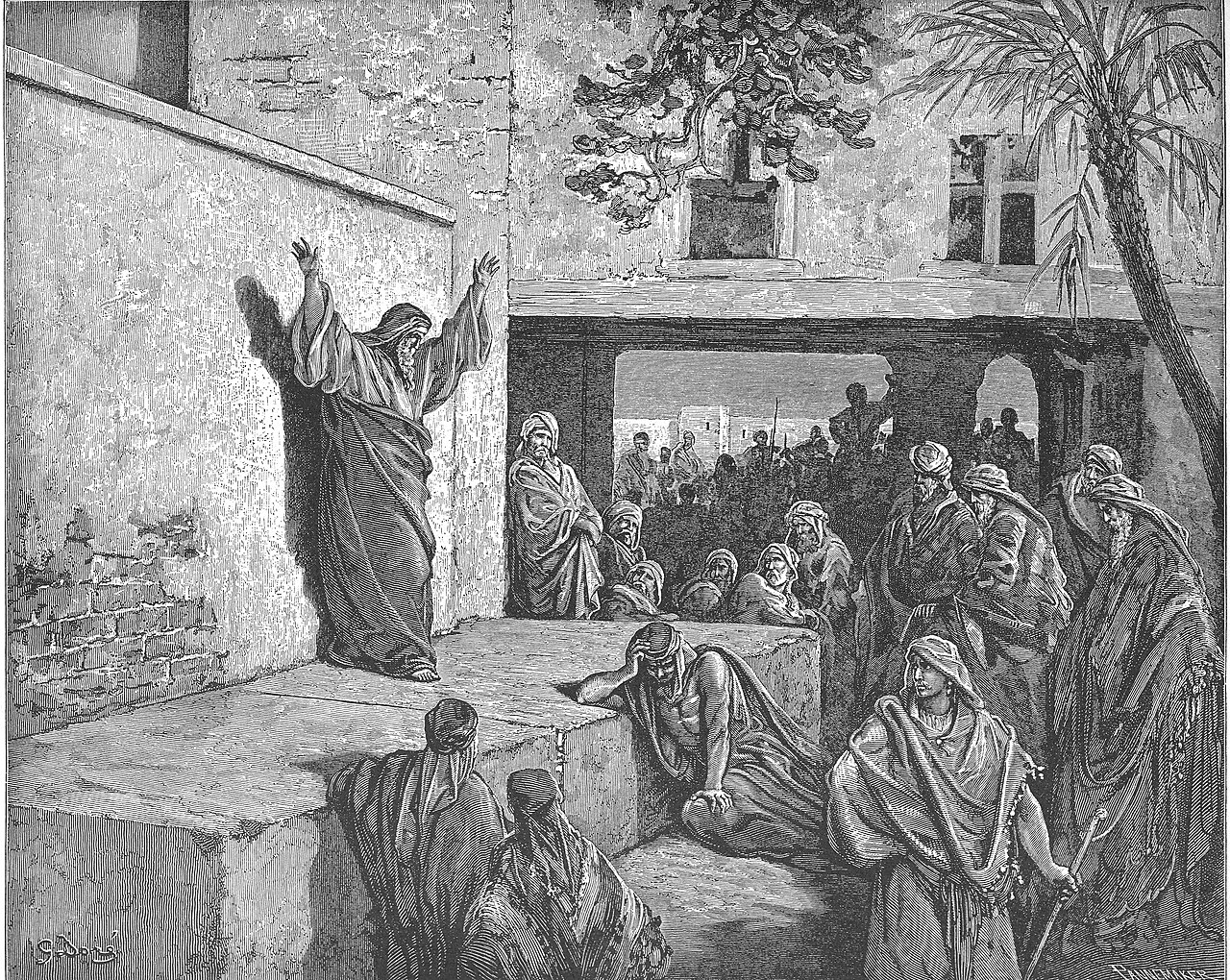
Micahchapter 7
20 verses · Micah · 750 to 686 BC · The Twelve
Who is a God like You, who pardons iniquity and passes over the transgression of the remnant of His inheritance—who does not retain His anger forever, because He delights in loving devotion?
Introduction
Micah, The Twelve, Micah Overview.
The last chapter of Micah begins as a lament and ends as a hymn. The prophet speaks first as a man walking through a society where no one can be trusted, and then as the voice of Zion waiting for God. His hearers lived among neighbours and relatives who were cheating and betraying one another. Listen for the change from the prophet's grief to Zion's confession and then to her confidence. Listen for the question in the closing lines, which echoes the prophet's own name. Read it as the book's last word, spoken in the language of prayer.
Context
- Who
- The few faithful left in a society coming apart
- What
- A lament over a society without faith, followed by Zion's confession and hope, a prayer for the flock and a closing hymn to the God who pardons.
- Where
- Judah and Jerusalem, with the enemy who mocked Zion, the lands of Assyria and Egypt, and the pastures of Bashan and Gilead east of the Jordan.
- When
- Micah's ministry, about 750 to 686 BC; the closing hymn looks ahead to the rebuilding of Zion's walls after the judgment.
- Why
- To show how a faithful person waits for God in a corrupt age, and to end the book on God's pardon and His faithfulness to His promises to Abraham and Jacob.
Historical context
The opening picture is a specific disappointment. After the summer fruit has been gathered and the grapes gleaned, a hungry man walking the rows finds nothing, not one cluster, not one first-ripe fig, which was the prized early fruit everyone waited for. Micah says that is what looking for a godly man in the land feels like.
Show the rest of the historical context, 3 more paragraphs
The hunting language that follows is literal equipment. They hunt one another with a net, and both hands are skilled at evil, the official asks, the judge takes the bribe, the great man states what he wants, and together they weave it. The best of them is like a briar, and the most upright like a thorn hedge, which is what you get when you reach into that tangle.
The breakdown of the household was the last thing to go in that society. A son treating his father with contempt, a daughter rising against her mother, a daughter-in-law against her mother-in-law, and a man's enemies being the men of his own house, in a culture built on the extended family, this is society at the floor. Jesus later quoted these lines about what following him would cost.
The watchman at the end is standing on a wall. The day of your watchmen, the day of your visitation, is coming, and then the promise of a day for building your walls, the boundary extended, and people coming from Assyria and Egypt and from sea to sea.
Significance
The instruction to the faithful few is to wait for the God of my salvation; my God will hear me, and to speak to their enemies: rejoice not over me; when I fall I shall rise; when I sit in darkness the LORD will be a light to me.
Show the rest of the significance, 1 more paragraph
The book ends on its author's own name. Micah means who is like the LORD, and the last lines ask exactly that: who is a God like you, pardoning iniquity and passing over transgression, who does not retain his anger forever because he delights in steadfast love? The sins are trodden underfoot and cast into the depths of the sea, a picture the New Testament never improves on, only repeats.
This chapter in Jewish lifeWhat this chapter is in Jewish life and reading.
What is done
The site's table in src/lib/hebraic/readings.ts records no weekly portion and no Haftarah from this chapter. The probe printed no Haftarah use for chapter 7 and no festival reading for the book. The same table records one use of it on the Day of Atonement. Its entry for Jonah says that Jonah is read whole at the afternoon service. The reading is "followed by the closing verses of Micah on God pardoning iniquity." The entry cites Babylonian Talmud Megillah 31a for the reading of that service. The table names the closing verses and gives no verse numbers for them.
The corpus carries four locators on the eighteenth and nineteenth verses, the verses on pardon and on sins cast into the depths of the sea. They are Aggadat Bereshit 32:1 and Devarim Rabbah 8:1 on the eighteenth, and Midrash Tehillim 36:3 and 38:1 on the nineteenth.
How it is read
Rashi is the one commentator on this chapter whose English the corpus carries, quoted here from The Judaica Press complete Tanach with Rashi, translated by A. J. Rosenberg, which Sefaria reports as CC-BY.
He hears the prophet's own grief in the opening: "Woe is to me that I was appointed a prophet at this time, when there are no righteous people in the generation." (Rashi on Micah 7:1:1). The best of them is like a brier because it is hard to get free of his hand, as hard as freeing briers tangled in wool (Rashi on Micah 7:4:1).
At the fifth verse Rashi sets two readings side by side. The friend not to be trusted is first read by its plain meaning. Then he gives the reading of the Sages, citing Chagigah 16a, which takes the friend as God. "Do not sin and say that the Holy One, blessed be He, is our Friend, and He will forgive us." (Rashi on Micah 7:5:1). The corpus carries the same passage at Chagigah 16a:15 and 16a:17.
The enemy told not to rejoice is "Babylon and the wicked city of Rome." (Rashi on Micah 7:8:1). The day to build the walls is read as the enemy's taunt that the day will never come. The prophet answers that "that day is guarded and preserved, and has not become nullified." (Rashi on Micah 7:11:1 and 7:12:1). The flock that dwells alone is to dwell "in security." (Rashi on Micah 7:14:1).
At the last verse Rashi reports Jonathan's paraphrase. The truth is given to Jacob as sworn at Bethel, and the kindness to Abraham as sworn between the parts. The prayer adds "You shall remember for us the binding of Isaac" (Rashi on Micah 7:20:1). His own reading asks God to keep the word given to Jacob in Genesis 28:15.
The New Testament cites the sixth verse, the household set against itself, at Matthew 10:35 to 10:36. The corpus holds Ibn Ezra on that verse and no English text of his note. It carries Bereshit Rabbah 53:15, Bereshit Rabbah 54:1 and Jerusalem Talmud Sotah 9:16:1 on it.
The corpus carries 7 further notes on this chapter without an English text, each marked linked because Sefaria holds no English version of the ref. They stand cited and unquoted at Ibn Ezra on Micah 7:6:1, 7:9:1, 7:10:1, 7:15:1, 7:16:1, 7:18:1 and 7:19:1.
What the rabbis say
The corpus carries 40 rabbinic locators on the verses of this chapter, 6 in the Talmud and 34 in the Midrash. It carries the text of none, so each is cited by ref here and never quoted or paraphrased. The verse numbers are the Hebrew ones the corpus prints.
On verse 1 it holds Ein Yaakov (Glick Edition), Sotah 9:11, Ein Yaakov, Sotah 9:10 and Jerusalem Talmud Sotah 9:10:1. On verse 2 it holds Devarim Rabbah 11:10, Midrash Tehillim 12:1 and Yalkut Shimoni on Torah 940:27. On verse 3 it holds Jerusalem Talmud Taanit 2:1:12. On verse 4 it holds Ein Yaakov (Glick Edition), Taanit 1:44, Ein Yaakov, Eiruvin 10:7 and Eruvin 101a:10. On verse 5 it holds Chagigah 16a:15, Chagigah 16a:17 and Ein Yaakov (Glick Edition), Khagigah 2:32.
On verse 6 it holds Bereshit Rabbah 53:15, Bereshit Rabbah 54:1 and Jerusalem Talmud Sotah 9:16:1. On verse 7 it holds Yalkut Shimoni on Torah 852:4 and Yalkut Shimoni on Torah 91:8. On verse 8 it holds Aggadat Bereshit 11:1, Bamidbar Rabbah 2:10 and Bereshit Rabbati, Parashat Bereshit 66. On verse 9 it holds Aggadat Bereshit 8:1 and Midrash Lekach Tov, Genesis 40:6:2. On verse 10 it holds Mekhilta DeRabbi Shimon Ben Yochai 14:28 and Mekhilta DeRabbi Yishmael, Tractate Vayehi Beshalach 7:13.
On verse 11 it holds Otzar Midrashim, Keri & K'tiv, Midrash Ketiv V'lo Keri 8. On verse 13 it holds Midrash Tehillim 50:1. On verse 14 it holds Aggadat Bereshit 11:2 and Aggadat Bereshit 41:4. On verse 15 it holds Bereshit Rabbati, Parashat Lech Lecha 35 and Mekhilta DeRabbi Shimon Ben Yochai 15:11. On verse 16 it holds Bereshit Rabbah 99:8 and Midrash Lekach Tov on Esther 3:5:1.
On verse 17 it holds Midrash Sekhel Tov, Shemot 15:16:1. On verse 18 it holds Aggadat Bereshit 32:1 and Devarim Rabbah 8:1. On verse 19 it holds Midrash Tehillim 36:3 and Midrash Tehillim 38:1. On verse 20 it holds Aggadat Bereshit 55:2 and Bereshit Rabbah 40:1.
What each of them teaches is a saying of the rabbis, and is reported as theirs wherever this site quotes one. The quotations wait on a fetch that carries the text.
Sources: Rashi, Rashi on Micah 7:1:1 to 7:20:1, The Judaica Press complete Tanach with Rashi, translated by A. J. Rosenberg, reported CC-BY; Ibn Ezra, Ibn Ezra on Micah 7:6:1, 7:9:1, 7:10:1, 7:15:1, 7:16:1, 7:18:1 and 7:19:1, cited by ref because the corpus carries no English text; The Sefaria corpus, scripts/data/sources/sefaria/micah/7.json, the 40 Talmud and Midrash locators on the verses of this chapter; The site's own files, src/lib/hebraic/readings.ts, probed for Micah 7 with parashotForChapter, haftarahUsesForChapter and festivalReadingForBook; The Berean Standard Bible, Matthew 10:35 to 10:36, read from the store for the citation, not quoted.
The heads below are this chapter's scenes. The numbered points under each are its verses.
No cluster left; trust no friend, not even your own house
Micah 7:1-2
For I am like one gathering summer fruit: The prophet pictures himself in a stripped vineyard, where "there is no cluster to eat, no early fig that I crave". Verse 2 states the fact behind the figure: "The godly man has perished from the earth". The loss of trust among neighbors is the wound the chapter answers.
Micah 7:1
“Woe - o is me! for I am, as when they have gathered the summer fruits , as the grape-gleanings of the vintage “The vineyard of the Lord of hosts,” Isaiah said at the same time, “is the house of Israel, and the men of Judah His pleasant plants” Isa 5:7. Isaiah said, brought forth wild grapes; Micah, that there are but gleanings, few and poor.”
2 more voices on this verseWhat preachers and commentators have said about this verse, in their own words.
Micah 7:1
“THE nation of Israel had fallen into so sad and backsliding a condition—it was not like a vine covered with fruit, but like a vineyard after the whole vintage has been gathered—there was not to be found a single cluster. Not one righteous man could be found, not one to be trusted or found faithful to God. The whole state had become like a field that has been closely reaped, in which nothing remains but the stubble—like a vineyard that has been completely stripped, in which there remains no vestige of fruit.”
Micah 7:1
“I am as when, &c.--It is the same with me as with one seeking fruits after the harvest, grapes after the vintage. "There is not a cluster" to be found: no "first-ripe fruit" (or "early fig"; see on Isa 28:4) which "my soul desireth" [MAURER].”
Jamieson, Fausset & Brown · Commentary Critical and Explanatory on the Whole Bible (1871)reformed
The godly man has perished: The prophet looks for one faithful person the way a man looks for fruit after the harvest, and he finds none. The word for godly means both devout toward God and kind toward others. Everyone left is hunting his neighbour.
Micah 7:2
“The good man is perished out of the earth - A similar sentiment may be found, Psa 12:1; Isa 57:1. As the early fig of excellent flavor cannot be found in the advanced season of summer, or a choice cluster of grapes after vintage, so neither can the good and upright man be discovered by searching in Israel. This comparison, says Bp. Newcome, is beautifully implied. They hunt every man his brother with a net - This appears to be an allusion to the ancient mode of duel between the retiarius and secutor.”
Adam Clarke · Commentary on the Bible (1810-1826)evangelical
1 more voice on this verse
Micah 7:2
“The Hebrew expresses "one merciful and good in relation to man," rather than to God. is perished out of the earth-- (Ps 12:1).”
Jamieson, Fausset & Brown · Commentary Critical and Explanatory on the Whole Bible (1871)reformed
Micah 7:3-4
Both hands are skilled at evil: Verse 3 details corruption: "the prince and the judge demand a bribe", and when "the powerful utters his evil desire, they all conspire together". The Hebrew verb behind conspire means to weave, so each braids his part into one cord. Verse 4 calls even the best "like a brier".
Micah 7:3
“That they may do evil with both hands earnestly - (Literally, upon evil both hands to do well,) that is, “both their hands are upon evil to do it well,” or “earnestly” , as our translation gives the meaning; only the Hebrew expresses more, that evil is their good, and their good or excellence is in evil. Bad men gain a dreadful skill and wisdom in evil, as Satan has; and cleverness in evil is their delight.”
2 more voices on this verse
Micah 7:3
“That they may do evil with both hands earnestly,.... Or "well" (t), strenuously, diligently, to the utmost of their power, labouring at it with all their might and main; as wicked men generally are more industrious, and exert themselves more to do evil than good men do to do good; and even weary themselves to commit iniquity: or, "instead of doing good", as Marinus in Aben Ezra, take a great deal of pains to do evil; work with both hands at it, instead of doing good.”
Micah 7:3
“The "threefold cord is not quickly broken" (Ec 4:12); here the "prince," the "judge," and the "great man" are the three in guilty complicity. "They wrap it up," namely, they conspire to carry out the great man's desire at the sacrifice of justice.”
Jamieson, Fausset & Brown · Commentary Critical and Explanatory on the Whole Bible (1871)reformed
sharper than a hedge of thorns: Even the best of them is like a brier, and anyone who comes near is torn. The watchmen are the prophets who warned the city. The day they warned of has come as the day of its punishment.
Micah 7:4
“The best of them is as a brier - They are useless in themselves, and cannot be touched without wounding him that comes in contact with them. He alludes to the thick thorn hedges, still frequent in Palestine. The day of thy watchmen - The day of vengeance, which the prophets have foreseen and proclaimed, is at hand. Now shall be their perplexity; no more wrapping up, all shall be unfolded.”
Adam Clarke · Commentary on the Bible (1810-1826)evangelical
1 more voice on this verse
Micah 7:4
“Or, "the day of thy false prophets being punished"; they are specially threatened as being not only blind themselves, but leading others blindfold [CALVIN]. now--at the time foretold, "at that time"; the prophet transporting himself into it. perplexity-- (Isa 22:5).”
Jamieson, Fausset & Brown · Commentary Critical and Explanatory on the Whole Bible (1871)reformed
Micah 7:5-6
Do not rely on a friend: The warning reaches the closest ties: "Do not rely on a friend". Verse 6 lists the break by generation and by marriage, ending, "A man’s enemies are the members of his own household". Jesus takes up these words at Matthew 10:35-36 for the division His coming brings within families.
Micah 7:5
“Trust ye not in a friend - It is part of the perplexity of crooked ways, that all relationships are put out of joint. Selfishness rends each from the other, and disjoints the whole frame of society.”
members of his own household: The breakdown reaches the family, the last place where trust should hold. Son, daughter and daughter-in-law turn against the heads of the house. Jesus uses these words in Matthew 10:35 and 36 of the division His coming would bring.
Micah 7:6
“Just what is the work of the axe? The excision of the soul that is incurably fruitless, like the tree even after the dung has been applied. And what does the sword do? The sword of the Word cuts through defenses. It does the work of separating the worse from the better. It actually creates a division between the faithful and the unbeliever. It may even stir up the son and the daughter and the bride against the father and the mother and the mother-in-law, the young and fresh against the old and shadowy.”
Gregory of Nazianzus · written before 390 · On the Holy Lights, Oration 39:15patristic
1 more voice on this verse
Micah 7:6
“For the son dishonoreth the father - See the use our Lord has made of these words, where he quotes them, Mat 10:21 (note), Mat 10:25 (note), Mat 10:36 (note), and the notes there.”
Adam Clarke · Commentary on the Bible (1810-1826)evangelical
Cross references
Micah 7:6
- Quoted inMatthew 10:35“For I have come to turn ‘a man against his father, a daughter against her mother, a daughter-in-law against her mother-in-law.”
'a man at variance against his father', division saying
I will look to the LORD; when I fall, I shall arise
But as for me, I will look to the LORD: The prophet turns: "But as for me, I will look to the LORD; I will wait for the God of my salvation". The trust denied to friend and companion in verse 5 is placed in God. The three verbs move from present resolve to settled expectation.
Micah 7:7
“Therefore - (And,) when all these things come to pass and all human help fails, “I”, for my part, “will look unto”, (literally, “on”) “the Lord” God, the Unchangeable. The prophet sets himself, I, with emphasis, against the multitude of the ungodly.”
2 more voices on this verse
Micah 7:7
“Therefore - Since all sorts of men are so perfidious. Look - As one set in a watch-tower looks round about, and diligently observes all that stirs, so will the prophet; so did they who in Israel and Judah feared the Lord.”
John Wesley · Explanatory Notes upon the Old Testament (1765)evangelical
Micah 7:7
“OBSERVE that the Prophet has no sort of doubt. He insinuates no "if or "an" or "but" or "perhaps," but he says it straight out as a fact of which he is infallibly convinced—"My God will hear me." What a blessed thing it is that the child of God knows and feels that this is true! Wherever he may fail, he will succeed at the Throne! If all other friendly ears are closed, his Friend of friends will hear him. Lose your confidence in the power of prayer and I know not what remains for you.”
Micah 7:8-10
Do not gloat over me, my enemy!: The speaker answers the gloating enemy by owning guilt first: "Because I have sinned against Him, I must endure the rage of the LORD". Verse 8 holds the hope: "Though I have fallen, I will arise; though I sit in darkness, the LORD will be my light".
Micah 7:8
“Do not rejoice over me, my enemy; for though I have fallen, I will rise again. The ruin of weakness is not severe, if there is also not a desire to not rise from it. Have the will to rise, there is someone present who will make you rise.”
Ambrose of Milan · written before 397 · Commentaries on the Twelve Davidic Psalmspatristic
2 more voices on this verse
Micah 7:8
“Rejoice not against me, O mine enemy - The captive Israelites are introduced as speaking here and in the preceding verse. The enemy are the Assyrians and Chaldeans; the fall is their idolatry and consequent captivity; the darkness, the calamities they suffered in that captivity; their rise and light, their restoration and consequent blessedness. To rejoice over the fall or miseries of any man, betrays a malignant spirit.”
Adam Clarke · Commentary on the Bible (1810-1826)evangelical
Micah 7:8
“They said, Where is the Lord their God? As if because they were afflicted God had forsaken them, and they knew not where to find him with their prayers, and he knew not how to help them with his favours. This David's enemies said to him, and it was a sword in his bones, Ps. xlii.”
Matthew Henry · Commentary on the Whole Bible (1707-1721)puritan
until He argues my case: Zion speaks here, admitting that she has sinned and accepting God's anger as just. Yet God will take up her case. He will bring her out into the light, and she will see His righteousness in the keeping of His promise.
Micah 7:9
“God's people plead guilty before God; but, in respect to their human foes, they are innocent and undeserving of their foes' injuries. bring me forth to the light--to the temporal and spiritual redemption. I shall behold his righteousness--His gracious faithfulness to His promises (Ps 103:17).”
Jamieson, Fausset & Brown · Commentary Critical and Explanatory on the Whole Bible (1871)reformed
2 more voices on this verse
Micah 7:9
We sometimes bear illness as a punishment for sin intended for our conversion, "for whom the Lord loves," says the Scripture, "he chastises." Again Scripture teaches, "Therefore are there many infirm and weak among you, and some have died. But if we would judge ourselves, we should not be judged, we are chastised by the Lord that we be not condemned with the world."
Basil of Caesarea · written before 379 · The Long Rules 55patristic
Micah 7:9
“Those who expect to find the road to Heaven smooth and unobstructed will discover little in the experience of the ancient saints to support the expectation. The Lord's people have, in all ages, been tried people. Cowper well says— "Thepath of sorrow, and that path alone, Leads to the land where sorrow is unknown." Though, perhaps, to the youthful mind this may sound rather harsh, yet there is a large amount of comfort in it to the more advanced saint, for he says to himself, "Then my difficulties, my distresses, my tribulations, are no new thing.”
Charles Spurgeon · written before 1892 · The Metropolitan Tabernacle Pulpit, Sermon No. 3239: “Woe and Weal” (lightly modernized text, CCEL edition)Particular Baptist
The enemy mocked Zion's faith with this question, as the psalmist's foes do in Psalm 42:3 and 10. When God restores His people, the one who mocked will see it. The shame she wished on Zion will cover her.
Micah 7:10
“Then she that is mine enemy shall see it,.... The Chaldeans and Edomites shall see people of the Jews rising out of their calamities, brought out of the darkness of their captivity in Babylon, and enjoying the light of peace and prosperity in their own land. Some editions of the Targum, and Jarchi and Kimchi, have, in their glosses on this verse and Mic 7:9, Rome, of whom they interpret this enemy, as Mr. Pocock observes; and so R.”
1 more voice on this verse
Micah 7:10
“Then she that is mine enemy - This may refer particularly to the city of Babylon. Shall she be trodden down - Literally fulfilled in the package of that city by the Persians, and its consequent total ruin.”
Adam Clarke · Commentary on the Bible (1810-1826)evangelical
A day is coming for building your walls
Micah 7:11-13
The answer widens to the nation: "The day for rebuilding your walls will come". Verse 12 brings people "from Assyria", read by some of the return from exile and by others of a later ingathering. Verse 13 keeps the warning inside the promise: "the earth will become desolate".
Micah 7:11
“On this confession of unworthiness and trust the message of joy bursts in, with the abruptness and conciseness of Hosea or Nahum: A day to build thy fences; (that is, cometh;) That day, far shall be the degree; That day, and he shall come quite to thee; And there follows, in a longer but still remarkably measured and interrupted cadence, the statement of the length and breadth from which the people shall come to her; Up to and from Assyria and the cities of strong-land (Egypt;) Up to and from strong-land and even to river (the Euphrates;) And sea from…”
from Egypt to the Euphrates: People will come to Zion from the two great powers on either side, Assyria and Egypt. The reach runs from sea to sea. The older commentators read it of the scattered people coming home from the lands of their captivity.
Micah 7:12
“In that day also he shall come - Bp. Newcome translates: - “And in that day they shall come unto thee From Assyria and the fenced cities; And from Egypt even unto the river.” Calmet translates: - “They shall come to thee from Assyria even unto Egypt; And from Egypt even to the river; (Euphrates); And from one sea to another, and from one mountain to another.” This, says he, gives an easy sense; whereas we cannot tell where to find those fortified cities spoken of by other translators.”
Adam Clarke · Commentary on the Bible (1810-1826)evangelical
2 more voices on this verse
Micah 7:12
“In that day - After the return out of captivity. He - He who is of Jewish race. The fortified cities - In which many Jews were kept for servile works.”
John Wesley · Explanatory Notes upon the Old Testament (1765)evangelical
Micah 7:12
“In that day also--rather, an answer to the supposed question of Zion, When shall my walls be built? "The day (of thy walls being built) is the day when he (that is, many) shall come to thee from Assyria," &c. [LUDOVICUS DE DIEU].”
Jamieson, Fausset & Brown · Commentary Critical and Explanatory on the Whole Bible (1871)reformed
the fruit of their deeds: Before the walls are rebuilt, the land will lie desolate. The desolation is the harvest of what its people did, their deeds bearing their own fruit, as Proverbs 1:31 puts it. The promise of verses 11 and 12 comes after that judgment.
Micah 7:13
“Notwithstanding - (And) the land (that is that spoken of, the land of Judah) shall be desolate not through any arbitrary law or the might of her enemies, but through the sins of the people, because of them that dwell therein, for the fruit of their doings Truly “the fruit of their doings,” what they did to please themselves, of their own minds against God.”
2 more voices on this verse
Micah 7:13
“Notwithstanding the land shall be desolate,.... Not the land of Chaldea, as some; or the land of the nations, as Jarchi and Kimchi; but the land of Israel. That part of it, which was possessed by the ten tribes, was made desolate by Shalmaneser king of Assyria; and that which was inhabited by the two tribes, by Nebuchadnezzar king of Babylon; and this desolation was to be, "notwithstanding" the above prophecies, and prior to the fulfilment of them.”
Micah 7:13
“For this they must expect to smart a great while; for the world shall know that God hates sin even in his own people. When it does come it shall be a complete salvation; and it seems to refer to their deliverance out of Babylon by Cyrus, which Isaiah about this time prophesied of, as a type of our redemption by Christ.”
Matthew Henry · Commentary on the Whole Bible (1707-1721)puritan
Who is a God like you, casting our sins into the sea
Micah 7:14-15
Shepherd with Your staff Your people: The prophet prays for the flock to graze "in Bashan and Gilead", and Gilead was among the lands Assyria took in 2 Kings 15:29. Verse 15 answers in the Lord's voice: "I will show My wonders". The promise is a new exodus told in the words of the first.
Micah 7:14
“Feed thy people with thy rod - בשבטך beshibtecha, “with thy crook.” The shepherd’s crook is most certainly designed, as the word flock immediately following shows. No rod of correction or affliction is here intended; nor does the word mean such. Solitarily - They have been long without a shepherd or spiritual governor. In the midst of Carmel - Very fruitful in vines. Bashan and Gilead - Proverbially fruitful in pasturages.”
Adam Clarke · Commentary on the Bible (1810-1826)evangelical
2 more voices on this verse
Micah 7:14
“Feed - So Christ directs his officers. With thy rod - In allusion to the custom of shepherds who guided their sheep by a pastoral staff. In the wood - Protect and guide those that in their present captive state are solitary, compassed with dangers.”
John Wesley · Explanatory Notes upon the Old Testament (1765)evangelical
Micah 7:14
“Feed thy people--Prayer of the prophet, in the name of his people to God, which, as God fulfils believing prayer, is prophetical of what God would do. When God is about to deliver His people, He stirs up their friends to pray for them.”
Jamieson, Fausset & Brown · Commentary Critical and Explanatory on the Whole Bible (1871)reformed
when you came out of Egypt: The LORD answers the prayer of verse 14. As He showed wonders when Israel came out of Egypt, He will show them again. Augustine read the promise of baptism here, where sins are overwhelmed as Pharaoh's army was in the sea.
Micah 7:15
“According to the days of thy coming out of the land of Egypt - God answers the prayer, beginning with its closing words . Micah had prayed, “Turn Thy people like the days of old; “God answers, “like the days of thy coming out of the land of Egypt.” Micah had said, in the name of his people, “I shall behold His Righteousness; God answers, I will make him to behold marvelous things” .”
1 more voice on this verse
Micah 7:15
“Their deliverance out of Babylon shall be a work of wonder and grace not inferior to their deliverance out of Egypt, nay, it shall eclipse the lustre of that ( Jer. xvi. 14, 15 ), much more shall the work of redemption by Christ. Note, God's former favours to his church are patterns of future favours, and shall again be copied out as there is occasion.”
Matthew Henry · Commentary on the Whole Bible (1707-1721)puritan
Micah 7:16-17
Nations will see and be ashamed: The nations "will see and be ashamed". Verse 17 gives them the serpent's curse of Genesis 3:14, for "They will lick the dust like a snake". Their fear is aimed at God, "they will tremble in fear of You", as Egypt came to know the LORD in Exodus 14:4.
Micah 7:16
“The nations shall see and be confounded - Whether the words in these verses (Mic 7:15-17) be applied to the return from the Babylonish captivity, or to the prosperity of the Jews under the Maccabees, they may be understood as ultimately applicable to the final restoration of this people, and their lasting prosperity under the Gospel.”
Adam Clarke · Commentary on the Bible (1810-1826)evangelical
lick the dust like a snake: To lick the dust is to lie face down on the ground, the posture of utter submission in Psalm 72:9. The nations come out of their strongholds trembling. They turn in fear to the LORD our God.
Micah 7:17
“Thus the antithesis is brought out. They shall tremble forth from their holes: they shall in trepidation turn to the Lord for salvation (compare Note, see on Ho 3:5, and Jer 33:9). fear because of thee--shall fear Thee, Jehovah (and so fear Israel as under Thy guardianship). There is a change here from speaking of God to speaking to God [MAURER].”
Jamieson, Fausset & Brown · Commentary Critical and Explanatory on the Whole Bible (1871)reformed
1 more voice on this verse
Micah 7:17
“They shall lick the dust like a (the) serpent - To lick the dust, by itself, pictures the extreme humility of persons who east themselves down to the very earth (as in Psa 72:9; Isa 49:23).”
Micah 7:18-19
Who is a God like You: Micah means who is like the LORD, and verse 18 turns it into the question "Who is a God like You". He "does not retain His anger forever". Verse 19 has sin first subdued, "He will vanquish our iniquities", and then removed, "You will cast out all our sins".
Micah 7:18
“Contrast Am 7:8, and "mark iniquities," Ps 130:3. the remnant--who shall be permitted to survive the previous judgment: the elect remnant of grace (Mic 4:7; 5:3, 7, 8). retaineth not . . . anger-- (Ps 103:9). delighteth in mercy--God's forgiving is founded on His nature, which delights in loving-kindness, and is averse from wrath.”
Jamieson, Fausset & Brown · Commentary Critical and Explanatory on the Whole Bible (1871)reformed
2 more voices on this verse
Micah 7:18
“Who is a God like unto thee, etc - Here is a challenge to all idol worshippers, and to all those who take false views of the true God, to show his like. See his characters; they are immediately subjoined. 1. He pardoneth iniquity. This is the prerogative of God alone; of that Being who alone has power to save or to destroy. 2. He passeth by transgression. He can heal backsliding, and restore them that are fallen.”
Adam Clarke · Commentary on the Bible (1810-1826)evangelical
Micah 7:18
“Sons of men, rejoice that such a God has revealed Himself to you! This should cause a universal Hallelujah, the whole world over, as soon as ever it is heard! "He delights in mercy." Clap your hands and rejoice before Him! Yes, exceedingly rejoice! The heathen did not find this out. Although they had many gods, differing one from another in character, none of them were ever gods of mercy! They were usually fierce demons—some of them only rejoicing in the exaction of human blood.”
Charles Spurgeon · written before 1892 · The Metropolitan Tabernacle Pulpit, Sermon No. 3317: “A Sweet Bow” (lightly modernized text, CCEL edition)Particular Baptist
into the depths of the sea: Sins cast into the depths of the sea sink where they never rise again to view. God also vanquishes them, treading down their power as well as their guilt. The picture recalls Pharaoh's army in the sea.
Micah 7:19
“When God takes away the guilt of sin that it may not condemn us, He takes away also the power of sin that it may not rule us. cast . . . into . . . depths of the sea--never to rise again to view, buried out of sight in eternal oblivion: not merely at the shore side, where they may rise again. our . . . their--change of person.”
Jamieson, Fausset & Brown · Commentary Critical and Explanatory on the Whole Bible (1871)reformed
3 more voices on this verse
Micah 7:19
"The Lord sits enthroned over the flood." A flood is an overflow of water that causes all lying below it to disappear. It cleanses all that was previously filthy. Therefore he calls the grace of baptism a flood, so that the soul, being washed well of its sins and rid of the old person, is suitable henceforth as a dwelling place of God in the Spirit. Further, what is said in the twenty-first psalm agrees with this.
Basil of Caesarea · written before 379 · Homilies on the Psalms 28:8patristic
Micah 7:19
“He will turn again - who seemed to be turned away from us when we were turned away from Him. “He will subdue, or trample under foot” Joe 2:14, our worst enemy, “our iniquities”, as He saith, “He shall bruise Satan under your feet shortly” Rom 16:20. Hitherto, sinful passions had not rebelled only, but had had the mastery over us. Sin subdued man; it was his lord, a fierce tyrant over him; he could not subdue it.”
Micah 7:19
“BUT lately I tuned my harp to the music of forgiven sin and we sang of pardon bought with blood, finding our keynote in the words of David—"Who forgives all your iniquities." It was a sweet subject to all our hearts, for we all have a portion in it, seeing we are all sinful and have need to be forgiven—therefore did our souls dance to the high sounding cymbals as we rejoiced in the complete pardon which our gracious God has given to all who believe in Jesus.”
You will show faithfulness to Jacob: The book ends on an oath already sworn: "You will show faithfulness to Jacob and loving devotion to Abraham". The Hebrew pair behind it, emet and chesed, picks up the "loving devotion" of verse 18. The hope rests on God's oath to the patriarchs in Genesis 22:16-18.
Micah 7:20
“God's promises are called "mercy," because they flow slowly from grace; "truth," because they will be surely performed (Lu 1:72, 73; 1Th 5:24). sworn unto our fathers-- (Ps 105:9, 10). The promise to Abraham is in Ge 12:2; to Isaac, in Ge 26:24; to Jacob, in Ge 28:13.”
Jamieson, Fausset & Brown · Commentary Critical and Explanatory on the Whole Bible (1871)reformed
2 more voices on this verse
Micah 7:20
“It is in pursuance of the covenant that our sins are pardoned and our lusts mortified; from that spring all these streams flow, and with these he shall freely give us all things. The promise is said to be mercy to Abraham, because, as made to him first, it was mere mercy, preventing mercy, considering what state it found him in.”
Matthew Henry · Commentary on the Whole Bible (1707-1721)puritan
Micah 7:20
“Thou wilt perform the truth to Jacob - The promises which he has made to Jacob and his posterity. Not one of them can ever fall to the ground. “And the mercy to Abraham, which thou hast sworn;” viz., that “in his Seed all the families of the earth should be blessed;” that the Messiah should come from Abraham, through his son Isaac, by Jacob and David; be a light to lighten the Gentiles, and the glory of his people Israel.”
Adam Clarke · Commentary on the Bible (1810-1826)evangelical
How this psalm is built
The form: The prophet's prayer for his people, answered by God's promise and closed with thanksgiving, as Henry classes it.
The patterns in this chapter
| Device | What it does | Where to see it |
|---|---|---|
| The voices change | Verses 1 to 7 are the prophet's own lament. From verse 8 Zion speaks, in verse 14 the prophet prays for the flock, and in verse 15 the LORD answers. Verses 18 to 20 are a hymn addressed to God. Jamieson, Fausset and Brown hold that verse 15 is the LORD's answer to the prayer of verse 14, and Matthew Henry takes the promises that follow as real answers to the prayer of faith.Jamieson, Fausset & Brown, Commentary Critical and Explanatory on the Whole Bible, 1871, on Micah 7:15. | Micah 7:7, Micah 7:8, Micah 7:14, Micah 7:15, Micah 7:18 |
How this chapter is built
1 more paragraph on the patterns
The chapter moves through four voices. The prophet laments in verses 1 to 7, Zion confesses and hopes in verses 8 to 13, the prophet prays for the flock in verse 14, and the LORD answers in verse 15. Verses 16 and 17 describe the nations' response, and verses 18 to 20 close the book with a hymn that opens on the question carried by the prophet's own name. The book's third section ends here, as the first two did, on a word of hope.
Keep studying
Studies12
Words12
Subjects1
Sources for this chapter
The summary
Jamieson, Fausset & Brown, Commentary Critical and Explanatory; John Calvin, Commentaries; John Wesley, Notes on the Old Testament and Matthew Henry, Complete Commentary.
The form and classifications
Matthew Henry, Commentary on the Whole Bible, 1710, on Micah 7:14 to 20.
The exposition
Adam Clarke, Commentary on the Bible; Albert Barnes; Augustine of Hippo, Explanation of the Psalms 114:5; Carl Friedrich Keil, The Twelve Minor Prophets; Edward Bouverie Pusey, The Minor Prophets: A Commentary; Jamieson, Fausset & Brown, Commentary Critical and Explanatory on the Whole Bible; Jamieson, Fausset and Brown, Commentary Critical and Explanatory on the Whole Bible; John Calvin; John Gill, Exposition of the Old Testament; John Wesley, Explanatory Notes upon the Old Testament and Matthew Henry, Commentary on the Whole Bible.