
Lamentationschapter 4
22 verses · Jeremiah, by tradition · about 586 BC · The Prophets
How the gold has become tarnished, the pure gold has become dull! The gems of the temple lie scattered on every street corner.
Introduction
Jeremiah, by tradition, The Prophets, Lamentations Overview.
Tradition gives this poem to Jeremiah, who was inside Jerusalem through the whole siege. It was written for people who had seen the last weeks of that siege with their own eyes. It runs through the Hebrew alphabet one verse to a letter, the last of the book's four alphabet poems. Listen for the pairs of before and after, what the people of the city once were set beside what they became. Listen also for who the poem holds to account, and for the neighbour it turns to at the close. It is a record of memory that refuses to be tidied.
Context
- Who
- People who had been inside the walls when the food ran out
- What
- A lament that remembers the siege by setting what Jerusalem's people once were beside what the famine made them.
- Where
- The streets and ash heaps of Jerusalem during the siege, and the road toward the plains of Jericho where the king was caught.
- When
- The siege of 588 to 586 BC, remembered in the first years after the city fell.
- Why
- To keep an honest record of the siege, to name the leaders who brought the city to it, and to promise an end to the punishment.
Historical context
The chapter opens with metal and stone: the gold has grown dim, the finest gold changed, the sacred stones lie scattered at the head of every street. Gold does not actually tarnish, which is the point, something that should not be possible has happened. The precious sons of Zion, once worth their weight in fine gold, are now reckoned as clay pots, the cheapest thing in any house.
Show the rest of the historical context, 3 more paragraphs
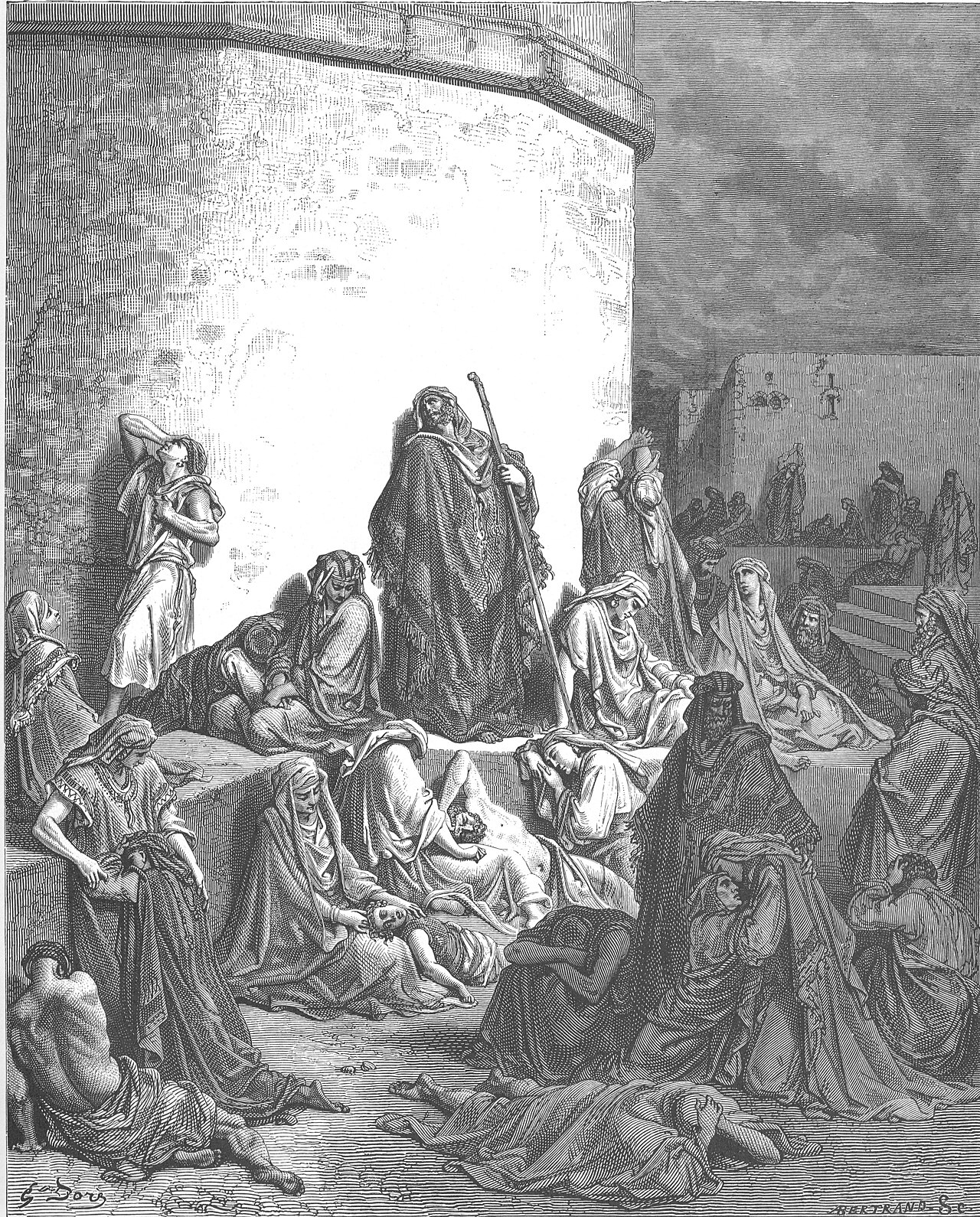
The famine is given in ordinary domestic detail. Nursing infants' tongues stick to the roof of their mouths; children beg for bread and no one gives it; people who once ate delicacies lie on ash heaps; those raised in purple embrace rubbish piles. Skin has shrivelled on their bones, dry as a stick. The chapter says those killed by the sword were better off than those who wasted away for lack of the fruits of the field.
Then the line that survivors of ancient sieges reported and that this book will not leave out: the hands of compassionate women boiled their own children. Siege cannibalism is recorded elsewhere in the ancient world, in Assyrian accounts and later in Josephus's description of Jerusalem's siege in AD 70. The Law had warned centuries earlier that this was where a besieged, covenant-breaking city would end.
Two political lines close it. The LORD's anointed, the breath of our nostrils, was taken in their pits, that is King Zedekiah, run down on the plains of Jericho. And Edom, who had cheered from across the border, is told to rejoice while she can, because the cup will come round to her.
Significance
First hearers had personally seen the things in this chapter. Writing them down was not sensationalism; it was refusing to let a nation tidy up its own memory.
Show the rest of the significance, 1 more paragraph
The verdict inside it is severe and specific: this happened because of the sins of her prophets and the iniquities of her priests, who shed the blood of the righteous in her midst. The leadership is named. And the chapter still ends with a promise that Zion's punishment is accomplished and her exile will not be prolonged.
This chapter in Jewish lifeWhat this chapter is in Jewish life and reading.
What is done
No part of this chapter is read on a weekly Sabbath. The site's own table in src/lib/hebraic/readings.ts printed parashot total 0 and haftarah uses total 0 for this book. It records one public reading, the whole book, on the eve of the fast of Tisha B'Av. The book is read at night in a darkened room in its own mournful melody, and the congregation sits low as mourners sit. It sources the practice to Shulchan Aruch, Orach Chayim 559.
How it is read
Rashi is the one commentator on this chapter whose English the corpus carries, quoted here from The Metsudah Five Megillot, Lakewood, N.J., 2001, which Sefaria reports as CC-BY. The translation is modern, so every quotation is held to fifty words or fewer. The edition sets numbered notes of its own inside Rashi's text, and only Rashi's own words are quoted as his.
Rashi reads this chapter as a lament for a king. "This elegy was pronounced over Yoshiyahu", he says at the first verse, and he cites the Book of Chronicles for it: "Behold it is written in the Book of Lamentations" (Rashi on Lamentations 4:1:1). The edition's note gives the place as 2 Chronicles 35:25. Into that elegy, Rashi adds, the prophet "joined, in the midst of the elegy, the rest of the children of Tzion." At the twentieth verse he names the king again. The Lord's anointed "is Yoshiyahu, as it is stated in Divrei Hayomim" (Rashi on Lamentations 4:20:1). The edition's note sets a second reading beside his, which takes the anointed as Tzidkiyahu, blinded and carried to Babylon.
The children of Zion at the second verse were those "Who were praised and valued like gold" (Rashi on Lamentations 4:2:1). The creature of the third verse, cruel as it is, still feeds its young. "When it sees its offspring coming from afar, hungry, it uncovers its breasts from their sheath" (Rashi on Lamentations 4:3:1). The punishment of the sixth verse, he says, "proves about them that their transgression is greater than that of Sodom" (Rashi on Lamentations 4:6:1).
At the seventh verse Rashi records a reading and sets his own beside it. Some take the Nazirites as princes, from the word for a crown. "But I say [it means] actual Nazirites, who had long hair and were very handsome" (Rashi on Lamentations 4:7:1). The famine of the ninth verse he describes plainly. The enemy roasted meat outside the wall, and the smell killed the starving within. "This is an uglier death than those slain by the sword" (Rashi on Lamentations 4:9:1).
The thirteenth verse he reads of the false prophets, because of whom "this evil has befallen her" (Rashi on Lamentations 4:13:1). The edition's note gives two more readings, one from Eikhah Rabbah 4:16 on the murder of Zecharyah and one from the Targum. The scattering of the sixteenth verse came "because they did not respect the presence of the kohanim when they were in their tranquility" (Rashi on Lamentations 4:16:1). The help watched for at the seventeenth verse was Pharaoh's army, which promised aid and never came. Rashi adds a story he found in a Midrash he calls Midrash Kinos, which begins, "they were coming in ships" (Rashi on Lamentations 4:17:1). In it the Egyptians saw the drowned of the Exodus in the water and turned back.
The twenty-first verse he reads as a prophecy of the later ruin. "Yirmiyahu prophesied about the destruction of the second Beis Hamikdosh which the Romans would destroy" (Rashi on Lamentations 4:21:1). The edition's note gives a second reading, of Edom's joy at the first ruin. The last verse he glosses in one sentence: "You suffered for all your sins" (Rashi on Lamentations 4:22:1).
The corpus carries three further notes on this chapter without an English text, each marked linked because Sefaria holds no English version of the ref. They stand cited and unquoted at Ibn Ezra on Lamentations 4:4:1, 4:12:1 and 4:19:1.
What the rabbis say
The corpus carries forty rabbinic locators on this chapter and the text of none, so each is cited and linked here rather than quoted. Eikhah Rabbah stands under the first verse at 3:1, the second at 4:2, the third at 4:6, and the fourth at 4:7 and Petichta 16. It stands under the seventh through the ninth at 4:10, 4:11 and 4:12, under the tenth at 1:57, and under the twelfth at 4:15 and Petichta 30. It stands under the thirteenth through the sixteenth at 4:16, 4:17, 4:18 and 4:19, and under the seventeenth at 4:20 and 5:6. It stands under the eighteenth at 2:4 and 4:21, and under the nineteenth through the twenty-first at 4:22, 4:23 and 4:24.
Other Midrashim stand beside it. Bereshit Rabbah is set at 68:13 on the first verse, 1:1 on the fifth and 28:5 on the tenth. Bamidbar Rabbah stands at 13:14 on the second verse, 12:14 on the eleventh and 13:20 on the twenty-second. Aggadat Bereshit 68:2 stands on the fifth verse, and Midrash Aggadah, Deuteronomy 1:1:10, on the sixth. Midrash Lekach Tov on Lamentations stands at 4:6:1, 4:7:1, 4:13:1, 4:14:1 and 4:16:1.
The Talmud stands at five places. Chullin 64b:4 is set on the third verse, Ketubot 10b:7 on the eighth, Bava Batra 8b:4 on the ninth, Bava Kamma 60b:14 on the eleventh, and Jerusalem Talmud Eruvin 5:1:15 on the fifteenth. What each of them teaches is a saying of the rabbis, and is reported as theirs wherever this site quotes one. The quotations wait on a fetch that carries the text.
Sources: Rashi, Rashi on Lamentations 4:1:1 to 4:22:1, The Metsudah Five Megillot, Lakewood, N.J., 2001, reported CC-BY; Ibn Ezra, Ibn Ezra on Lamentations 4:4:1, 4:12:1 and 4:19:1, cited by ref because the corpus carries no English text; The Sefaria corpus, scripts/data/sources/sefaria/lamentations/4.json, the 40 Talmud and Midrash locators of this chapter; The site's own files, src/lib/hebraic/readings.ts, probed for this book and printing parashot total 0, haftarah uses total 0, and the festival reading on the eve of the fast of Tisha B'Av, sourced there to Shulchan Aruch, Orach Chayim 559.
The heads below are this chapter's scenes. The numbered points under each are its verses.
The Gold Grown Dim; Precious Sons as Earthen Pitchers
Lamentations 4:1-2
How the gold has become tarnished: Lamentations 4 is an acrostic, twenty-two verses running the Hebrew alphabet from aleph to tav. It opens on a jeweler's grief: “The gems of the temple lie scattered on every street corner”. Then Zion's sons are named as the treasure debased, “once worth their weight in pure gold”.
Lamentations 4:1
“The stones of the sanctuary - Or, the hallowed stones, literally stones of holiness, a metaphor for the people themselves. The actual stones of the temple would not be thus widely thrown about as to be seen everywhere, but the prophet has already affirmed this of the young children dying of hunger (compare Lam 2:19).”
1 more voice on this verseWhat preachers and commentators have said about this verse, in their own words.
Lamentations 4:1
“He begins by expressing his astonishment, How obscured is the gold! and the precious gold! for ktm, catam, is properly the best gold, though the word good,htvv ethub, is added to it. We may hence conclude that it generally denotes gold only. He mentions, then, gold twice, but they are two different words in Hebrew, zhv, zaeb, and ktm catam.”
John Calvin · Commentaries (1554)reformed
precious sons of Zion: The precious sons of Zion are the gold of verse 1, and Albert Barnes reads the Hebrew as sons worth their weight in solid gold. Jars of clay are cheap and break. Jeremiah 19:11 uses the potter's jar for the whole people.
Lamentations 4:2
“The precious sons of Zion - The Jewish priests and Jewish believers. Comparable to fine gold - Who were of the pure standard of holiness; holy, because God who called them is holy; but now esteemed no better than earthen pitchers - vessels of dishonor in comparison of what they once were.”
Adam Clarke · Commentary on the Bible (1810-1826)evangelical
1 more voice on this verse
Lamentations 4:2
“They were comparable to fine gold. Israel was more rich in them than in treasures of gold and silver. But now they are esteemed as earthen pitchers; they are broken as earthen pitchers, thrown by as vessels in which there is no pleasure.”
Matthew Henry · Commentary on the Whole Bible (1707-1721)puritan
Lamentations 4:3-6
Even jackals offer their breasts to nurse their young: Where the King James reads sea monsters, the Berean reads jackals: “Even jackals offer their breasts to nurse their young”. The daughter of my people “has become cruel, like an ostrich in the wilderness”, the bird Job 39:13-16 names for leaving her eggs.
Lamentations 4:3
“Sea monsters - Rather, jackals. Their young ones - “Their” whelps. The term is applied only to the young of dogs, lions, and the like.”
1 more voice on this verse
Lamentations 4:3
“Cruel - The Jewish women are become cruel to their children, or forced to appear so, having through the famine no milk to give them, nor any thing to relieve them.”
John Wesley · Explanatory Notes upon the Old Testament (1765)evangelical
John Wesley reads the cruel mothers of verse 3 as women whose milk had dried up, leaving the nursing infant to thirst. Thirst comes first, then hunger. Lamentations 2:12 shows the same children crying for grain and wine and fainting in the streets.
Lamentations 4:4
“What good will marriage be to me if it is to end in slavery to the haughtiest of kings? What good will little ones be to me if their lot is to be that which the prophet sadly describes: "The tongue of the sucking child cleaves to the roof of his mouth for thirst; the young children ask for bread and no one breaks it unto them"? In those days, as I have said, the virtue of continence was found only in men: Eve still continued to travail with children.”
Jerome · written before 420 · LETTER 22.21patristic
1 more voice on this verse
Lamentations 4:4
“The tongue of the sucking child - See the note on Lam 2:12 (note).”
Adam Clarke · Commentary on the Bible (1810-1826)evangelical
brought up in crimson: Albert Barnes reads crimson as the cloth on which infants of the highest birth were carried. Now they huddle in ash heaps, destitute. Hannah's song in 1 Samuel 2:8 lifts the needy from the ash heap, and here that order is turned over.
Lamentations 4:5
“They that were brought up in scarlet - literally, “those that were carried upon scarlet;” young children in arms and of the highest birth now lie on the dirt-heaps of the city.”
1 more voice on this verse
Lamentations 4:5
“They were brought up upon scarlet (so the word is); their foot-cloths, and the carpets they walked on, were scarlet, yet these, being stripped of all by the war, are desolate in the streets, have not a house to put their head in, nor a bed to lie on, nor clothes to cover them, nor fire to warm them.”
Matthew Henry · Commentary on the Whole Bible (1707-1721)puritan
greater than that of Sodom: The Hebrew words behind punishment can also mean iniquity, and Albert Barnes reads the verse as a comparison of guilt as well as of pain. Sodom fell in an instant. Adam Clarke sets that against Jerusalem's long death, and Matthew Henry adds that Jerusalem had the prophets Sodom lacked.
Lamentations 4:6
“For the punishment - He thinks the punishment of Jerusalem far greater than that of Sodom. That was destroyed in a moment while all her inhabitants were in health and strength; Jerusalem fell by the most lingering calamities; her men partly destroyed by the sword, and partly by the famine.”
Adam Clarke · Commentary on the Bible (1810-1826)evangelical
1 more voice on this verse
Lamentations 4:6
“And, when the iniquity of Jerusalem is more aggravated than that of Sodom, no wonder that the punishment of it is so. Sodom never had the means of grace the Jerusalem had, the oracles of God and his prophets, and therefore the condemnation of Jerusalem will be more intolerable than that of Sodom, Matt. xi.”
Matthew Henry · Commentary on the Whole Bible (1707-1721)puritan
Lamentations 4:7-8
Her dignitaries were brighter than snow: The word the King James renders Nazarites names the consecrated nobles, the Berean's dignitaries, drawn in the richest terms: “brighter than snow, whiter than milk”. Verse 8 turns the portrait inside out, the skin shriveled on the bones, so famine erases every mark of rank.
Lamentations 4:7
“God's blessing formerly caused their body not to be the less fair and ruddy for their abstinence from strong drink. Compare the similar case of Daniel, &c. Type of Messiah (So 5:10). rubies--GESENIUS translates, "corals," from a Hebrew root, "to divide into branches," from the branching form of corals. polishing--They were like exquisitely cut and polished sapphires.”
Jamieson, Fausset & Brown · Commentary Critical and Explanatory on the Whole Bible (1871)reformed
2 more voices on this verse
Lamentations 4:7
“Her Nazarites were purer than snow,.... Such who separated themselves by a vow to the Lord, and abstained from drinking wine and strong drink, and by a moderate diet, and often washing themselves, as well as taking great care of their hair, appeared very neat and comely, like snow, without any spot or blemish.”
Lamentations 4:7
“The Nazarites from their temperance were remarkable for health and personal beauty, besides being held in religious veneration. Rubies - Or, corals. Their polishing was of sapphire - Or, their shape was “a sapphire.” The allusion is no longer to color, but to form. Their shape was exact and faultless as the cutting of a precious stone.”
blacker than soot: Each image of verse 7 is undone here: snow turns to soot, and bodies once ruddy dry out like a stick. Albert Barnes points to Job 30:30, where Job's skin grows black and his bones burn with fever. Famine made the city's nobles strangers in their own streets.
Lamentations 4:9-10
Those slain by the sword are better off than those who die of hunger: Verse 9 weighs two deaths and finds the quicker one lighter. Verse 10 names the famine's last horror plainly: “The hands of compassionate women have cooked their own children”. It is the curse Moses warned would fall on a besieged, covenant-breaking city in Deuteronomy 28:56-57 and Leviticus 26:29.
Lamentations 4:9
“They were stricken through, for want of the fruits of the field; those who were starved were as sure to die as if they had been stabbed and stricken through; only their case was much more miserable. Those who are slain with the sword are soon put out of their pain; in a moment they go down to the grave, Job xxi.”
Matthew Henry · Commentary on the Whole Bible (1707-1721)puritan
1 more voice on this verse
Lamentations 4:9
“They that be slain with the sword are better than they that be slain with hunger,.... Not that they are better with respect to their state after death, but with respect to their manner of dying.”
compassionate women: Adam Clarke stresses the Hebrew: the women who cooked their children were the compassionate ones. Hunger did this, worse than the sword of verse 9. Lamentations 2:20 had already set this horror before the LORD, and John Chrysostom sets it beside the siege of Samaria in 2 Kings 6:28-29.
Lamentations 4:10
“The hands of the pitiful women have sodden their own children - See on Lam 2:20 (note). But here there is a reference to mothers eating their own children; and this was done, not by mothers cruel and brutal, but by נשים רחמניות nashim rachmaniyoth, the compassionate, the tender-hearted mothers. From these horrible scenes it is well to pass with as hasty a step as possible.”
Adam Clarke · Commentary on the Bible (1810-1826)evangelical
Lamentations 4:11-12
The LORD has exhausted His wrath: Verse 11 names the source of the fire: “He has kindled a fire in Zion, and it has consumed her foundations”. So the temple's burning is the LORD's own act. Verse 12 records the disbelief of the nations.
The Sins of Her Prophets; the Breath of Our Nostrils Taken
the gates of Jerusalem: Albert Barnes notes that Uzziah and later kings had made Jerusalem so strong that the enemy took a year and a half (2 Kings 25:1-4). The kings of the earth thought the gates would hold. Jamieson, Fausset and Brown conclude that only the LORD could have opened them.
Lamentations 4:12
“Jerusalem was so fortified that all thought it impregnable. It therefore could only have been the hand of God, not the force of man, which overthrew it.”
Jamieson, Fausset & Brown · Commentary Critical and Explanatory on the Whole Bible (1871)reformed
Lamentations 4:13-15
But this was for the sins of her prophets and the guilt of her priests: Verse 13 lays the disaster at the leaders' door. Verses 14 and 15 follow them out still marked, “defiled by this blood, so that no one dared to touch their garments”. Men cried out at them as at the unclean, and among the nations they found no lasting home.
Lamentations 4:13
“Note, Nothing ripens a people more for ruin, nor fills the measure faster, than the sins of their priests and prophets. The particular sin charged upon them is persecution; the false prophets and corrupt priests joined their power and interest to shed the blood of the just in the midst of her, the blood of God's prophets and of those that adhered to them.”
Matthew Henry · Commentary on the Whole Bible (1707-1721)puritan
1 more voice on this verse
Lamentations 4:13
“The blood of the just - Jer. 26:7-24 exhibits priests and prophets as the prime movers in an attempt to silence the word of God by putting Jeremiah to death. Compare the margin reference to Matthew.”
wandered blind in the streets: These are the priests and prophets of verse 13. Numbers 19:16 made anyone who touched a body slain unclean for seven days, and Jamieson, Fausset and Brown read the blood in that light. Matthew Henry notes that men avoided them as they would a corpse.
Lamentations 4:14
“They have wandered as blind men in the streets - Rather, “They ran frantic through the streets, they were stained with blood.” This was in their pretended zeal for their cause. Bishop Bonner, who was at the head of those sanguinary executions in England, was accustomed to buffet the poor Protestants, when on their examinations they were too powerful for him in argument: - “He proved his doctrine orthodox, By apostolic blows and knocks.” Just as his elder brethren, the false priests and prophets of Jerusalem.”
Adam Clarke · Commentary on the Bible (1810-1826)evangelical
1 more voice on this verse
Lamentations 4:14
“They have so polluted themselves with innocent blood, the blood of the saints, that men could not touch their garments; they made themselves odious to all about them, so that good men were as shy of touching them as of touching a dead body, which contracted a ceremonial pollution, or of touching the bloody clothes of one slain, which tender spirits care not to do.”
Matthew Henry · Commentary on the Whole Bible (1707-1721)puritan
men shouted at them: Leviticus 13:45 made the leper cry out that he was unclean. Here men shouted it at the priests, and Albert Barnes reads their flight as a search for a home, turned away at every city. Adam Clarke notes that even the heathen nations refused them.
Lamentations 4:15
“Men cried to these priests, “Away! Unclean! Away! Away! Touch not.” “Unclean” was the cry of the leper whenever he appeared in public: here it is the warning shout of those who meet the murderers. When they fled away and wandered - These priests fled away from the city, but with uncertain steps, not knowing where to find refuge. They find themselves abhorred abroad as well as at home. It is quite possible that this verse records a real occurrence, if not during the siege, at all events during the last years of Zedekiah’s reign.”
Lamentations 4:16-17
The presence of the LORD has scattered them: Verse 16 traces the scattering to its source: “The presence of the LORD has scattered them; He regards them no more”. Verse 17 confesses a misplaced hope, watching “for a nation that could not save us”, which the older commentators name as Egypt.
Lamentations 4:16
“Literally, The countenance of Yahweh hath scattered them, has driven these outlawed priests here and there, “and He will no more regard them” with favor.”
looked in vain for help: Here ayin follows pe, the order of chapters 2 and 3. Adam Clarke names the nation as Egypt, the help the eyes on the towers watched for in vain. Jeremiah 37:7 had warned that Pharaoh's army would go back and leave Jerusalem to the enemy.
Lamentations 4:17
“A rapid sketch of the last days of the siege and the capture of the king. Lam 4:17 Rather, “Still do our eyes waste away looking for our vain help.” In our watching - Or, “on our watchtower.” Lam 4:18 Or, They hunted “our steps that we could not go out into the streets. To hunt” means here to lie in ambush, and catch by snares; and the streets are literally “the wide places,” especially at the gates. Toward the end of the siege the towers erected by the enemy would command these places.”
Lamentations 4:18-19
They stalked our every step: Verse 18 describes a city with nowhere left to walk: “They stalked our every step, so that we could not walk in our streets”. Verse 19 names pursuers “swifter than the eagles in the sky”, matching the king's flight and capture near Jericho in 2 Kings 25:4-5.
Lamentations 4:18
“We cannot go in our streets - Supposed to refer to the darts and other missiles cast from the mounds which they had raised on the outside of the walls, by which those who walked in the streets were grievously annoyed, and could not shield themselves.”
Adam Clarke · Commentary on the Bible (1810-1826)evangelical
swifter than the eagles in the sky: Jeremiah 4:13 said the enemy's horses were swifter than eagles, and Jamieson, Fausset and Brown take these eagles as the Chaldean horsemen. Thomas Aquinas applies the pursuit to the king himself. Jeremiah 52:8 records that he was captured on the plains of Jericho and his army scattered.
Lamentations 4:19
“The last times just before the taking of the city. There was no place of escape; the foe intercepted those wishing to escape from the famine-stricken city, "on the mountains and in the wilderness." swifter . . . than . . . eagles--the Chaldean cavalry (Jer 4:13). pursued--literally, "to be hot"; then, "to pursue hotly" (Ge 31:36).”
Jamieson, Fausset & Brown · Commentary Critical and Explanatory on the Whole Bible (1871)reformed
2 more voices on this verse
Lamentations 4:19
“Our persecutors are swifter than the eagles of the heavens,.... That fly in the heavens; and which, as they have a quick sight to discern their prey afar off, are very swift to pursue it; they are the swiftest of birds, and are so to a proverb. Apuleius (i) represents the swift pursuit of their prey, and sudden falling upon it, to be like thunder and lightning.”
Lamentations 4:19
“They pursued us upon the mountains - They hunted down the poor Jews like wild beasts in every part of the country by their marauding parties, whilst the great army besieged Jerusalem. But this may apply to the pursuit of Zedekiah. See what follows.”
Adam Clarke · Commentary on the Bible (1810-1826)evangelical
Lamentations 4:20-22
The LORD’s anointed, the breath of our life: Verse 20 names the political center of the loss: “The LORD’s anointed, the breath of our life, was captured in their pits”, King Zedekiah. Verse 21 tells Edom to rejoice, yet “the cup will pass to you as well”, the charge Obadiah takes up at length.
Lamentations 4:20
“The breath of our nostrils, the anointed of the Lord - That is, Zedekiah the king, who was as the life or the city, was taken in his flight by the Chaldeans, and his eyes were put out; so that he was wholly unfit to perform any function of government; though they had fondly hoped that if they surrendered and should be led captives, yet they should be permitted to live under their own laws and king in the land of their bondage.”
Adam Clarke · Commentary on the Bible (1810-1826)evangelical
2 more voices on this verse
Lamentations 4:20
“The anointed - Zedekiah, who though a bad man yet afforded some protection to the Jews. We said - We promised ourselves that though the land of Judah was encompassed with Pagan nations, yet through Zedekiah's valour and good conduct we should live comfortably.”
John Wesley · Explanatory Notes upon the Old Testament (1765)evangelical
Lamentations 4:20
“Thus apt are sinking interests not only to catch at every twig, but to think it will recover them. Jerusalem died of a consumption, a flattering distemper. Even when she was ready to expire she formed some hopeful symptoms to herself, and on them grounded a hope that she should recover; but what came of it?”
Matthew Henry · Commentary on the Whole Bible (1707-1721)puritan
Rejoice, Daughter of Edom: the Cup Shall Pass to Thee
O Daughter of Edom: The call to rejoice is irony, as Adam Clarke and Jamieson, Fausset and Brown both read it. Edom cheered the fall of Jerusalem, as Psalm 137:7 and Obadiah 1:11-14 record. Jeremiah 25:20-21 names the land of Uz and Edom among the nations who must drink the cup.
Lamentations 4:21
“The prophet ends his elegy with the language of Messianic hope. The earthly king had fallen Lam 4:20; but Israel cannot really perish. First then Edom, the representative of the Church’s foes, is ironically told to rejoice. Rejoice she did at the capture of Jerusalem Jer. 49:7-22; but her punishment is quickly to follow. Lam 4:22 The punishment of thine iniquity is accomplished - literally, Thy iniquity is ended. This is the result of Judah having borne her punishment.”
your punishment is complete: The last letter, tav, brings two verdicts. Matthew Henry sets Zion's complete punishment beside Isaiah 40:2, where the warfare of Jerusalem is over. God covers sin when He forgives (Psalm 32:1), so to expose the sins of Edom is to punish them, as Jamieson, Fausset and Brown note.
Lamentations 4:22
“The punishment of thine iniquity is accomplished, O daughter of Zion - On the contrary: Rejoice, O Jerusalem, for thy captivity will soon end; thy sufferings are nearly completed; thou shalt soon return to thy own land: but he will visit thy iniquity, O Edom; he will discover thy sins. When sin is pardoned it is said to be covered: here, God says he will not cover the sins of Edom - he will not pardon them; they shall drink the cup of wrath. The promise in this last verse may refer to Jerusalem under the Gospel.”
Adam Clarke · Commentary on the Bible (1810-1826)evangelical
2 more voices on this verse
Lamentations 4:22
“The punishment of thine iniquity is accomplished, O daughter of Zion,.... In part in the seventy years' captivity in Babylon, and more fully in their present captivity; for, as has been observed, there are some things in the preceding account, which had a further accomplishment in the destruction of Jerusalem, and the distress of the Jews by the Romans.”
Lamentations 4:22
“The Romans carried them away subsequently. The full accomplishment of this prophecy must therefore refer to the Jews' final restoration. discover--By the severity of His punishments on thee, God shall let men see how great was thy sin (Jer 49:10). God "covers" sin when He forgives it (Ps 32:1, 5).”
Jamieson, Fausset & Brown · Commentary Critical and Explanatory on the Whole Bible (1871)reformed
How this psalm is built
The form: An alphabetic acrostic of twenty-two verses, one letter to each verse, with Pe standing before Ayin, as guide classes it.
The patterns in this chapter
| Device | What it does | Where to see it |
|---|---|---|
| The alphabet with Pe before Ayin | Each verse opens with the next letter of the Hebrew alphabet, and counted over the store's own tagged Hebrew all twenty-two stand in place. Verse 16 opens with Pe and verse 17 with Ayin, the order chapters 2 and 3 also keep. This is the last of the book's four alphabet poems.the site's Lamentations guide, src/components/book/guides/lamentations/LamentationsGuide.tsx, the chapter spine, chapter 4. | Lamentations 4:1, Lamentations 4:16, Lamentations 4:17, Lamentations 4:22 |
| Once and now | The first half of the poem sets pairs side by side. Gold has grown tarnished in verse 1, and sons once worth their weight in gold are counted as clay jars in verse 2. In verse 5 people raised in crimson lie on the ash heaps. Verses 7 and 8 do the same with the city's dignitaries, brighter than snow before and blacker than soot now. Each pair measures the fall by what was lost.the site's Lamentations guide, src/components/book/guides/lamentations/LamentationsGuide.tsx, the chapter spine, chapter 4. | Lamentations 4:1, Lamentations 4:2, Lamentations 4:5, Lamentations 4:7, Lamentations 4:8 |
How this chapter is built
2 more paragraphs on the patterns
The poem runs through the Hebrew alphabet one verse to a letter, with Pe at verse 16 before Ayin at verse 17. Verses 1 to 11 set what the city's people once were beside what the famine made them. Verses 12 to 16 name the prophets and priests as the cause, and verses 17 to 20 remember the last days of the siege and the capture of the king. Verses 21 and 22 turn to Edom and close on the end of Zion's punishment.
The letters are counted from the store's tagged Hebrew, and the outline follows the chapter spine of the site's Lamentations guide.
Key words
The words this chapter repeats, each one a lemma of the store’s tagged Hebrew however the chapter inflects it, with the verses it stands in. The grammar words are struck out, and the eight terms the psalm says the word of God by stand in the figure above the patterns rather than here. Every row opens that word’s own page.
| Word | Said | No.Strong’s | Meaning | Where it stands |
|---|---|---|---|---|
| יָנַק | yânaq | H3243 | to suckle | 3, 4 |
| חוּץ | chûwts | H2351 | outside | 1, 5, 8, 14 |
| שָׁפַךְ | shâphak | H8210 | to pour | 1, 11, 13 |
| עָוֺן | ʻâvôn | H5771 | iniquity | 6, 13, 22 |
| בַּת | bath | H1323 | daughter | 3, 6, 10, 21, 22 |
| צִיּוֹן | Tsîyôwn | H6726 | Zion | 2, 11, 22 |
Show the next 12 words
| Word | Said | No.Strong’s | Meaning | Where it stands |
|---|---|---|---|---|
| חָלָל | châlâl | H2491 | slain | 9 |
| יָסַף | yâçaph | H3254 | to add | 15, 16, 22 |
| אֱדֹם | ʼĔdôm | H123 | Edom | 21, 22 |
| חַטָּאָה | chaṭṭâʼâh | H2403 | sin | 6, 13, 22 |
| סוּר | çûwr | H5493 | to turn aside | 15 |
| גָּלָה | gâlâh | H1540 | Heglam | 22 |
| גּוֹי | gôwy | H1471 | nation | 15, 17, 20 |
| דָּם | dâm | H1818 | blood | 13, 14 |
| טוֹב | ṭôwb | H2896 | pleasant | 1, 9 |
| יָד | yâd | H3027 | hand | 2, 6, 10 |
| עַם | ʻam | H5971 | people | 3, 6, 10 |
| יְהֹוָה | Yᵉhôvâh | H3068 | LORD | 11, 16, 20 |
Keep studying
Sources for this chapter
The summary
Jamieson, Fausset & Brown, Commentary Critical and Explanatory; John Calvin, Commentaries; John Wesley, Notes on the Old Testament and Matthew Henry, Complete Commentary.
The form and classifications
the site's Lamentations guide, src/components/book/guides/lamentations/LamentationsGuide.tsx, the chapter spine, chapter 4.
The exposition
Adam Clarke, Commentary on the Bible; Albert Barnes; Carl Friedrich Keil, Lamentations; Jamieson, Fausset & Brown, Commentary Critical and Explanatory on the Whole Bible; John Chrysostom, HOMILIES ON 1 THESSALONIANS 8; John Gill, Exposition of the Old Testament; John Wesley, Explanatory Notes upon the Old Testament; Matthew Henry, Commentary on the Whole Bible and Thomas Aquinas, Commentary on Lamentations.