
Lamentations 4:7
in Lamentations 4Her dignitaries were brighter than snow, whiter than milk; their bodies were more ruddy than rubies, their appearance like sapphires.
BSB
The same verse in ASV and KJV ▾
ASV
Her nobles were purer than snow, they were whiter than milk; They were more ruddy in body than rubies, their polishing was as of sapphire.
KJV
Her Nazarites were purer than snow, they were whiter than milk, they were more ruddy in body than rubies, their polishing was of sapphire:
⋯
This verse in Lamentations 4
Commentary
8 notes on this verseHer Nazarites were purer than snow,.... Such who separated themselves by a vow to the Lord, and abstained from drinking wine and strong drink, and by a moderate diet, and often washing themselves, as well as taking great care of their hair, appeared very neat and comely, like snow, without any spot or blemish.
This site's exposition
Her dignitaries were brighter than snow
on Lamentations 4:7-8
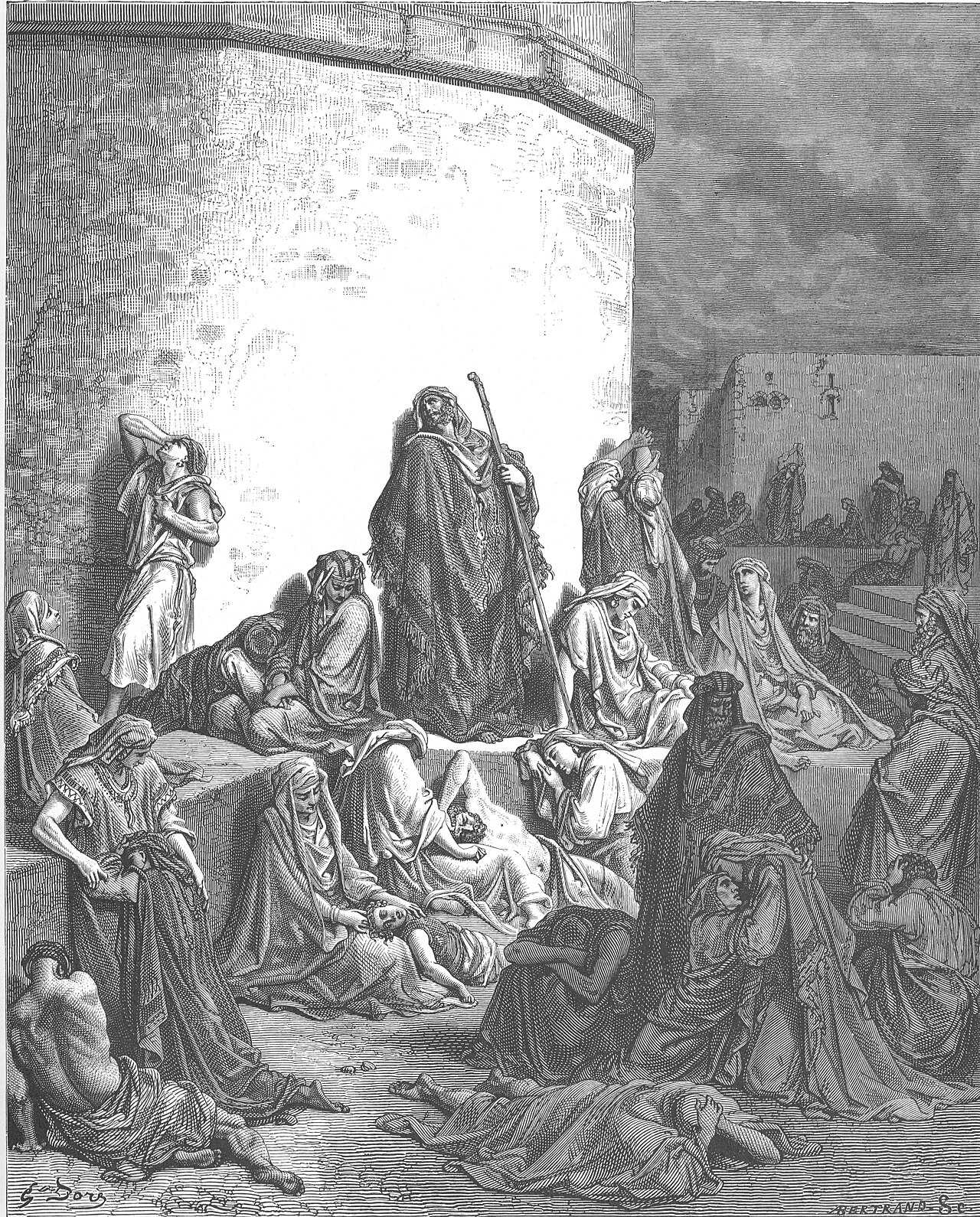
The word the King James renders Nazarites names the consecrated nobles, the Berean's dignitaries, drawn in the richest terms: “brighter than snow, whiter than milk”. Verse 8 turns the portrait inside out, the skin shriveled on the bones, so famine erases every mark of rank.
The record, by era
The Church Fathers1 voice
The Christ of the Creator had to be called a Nazarene according to prophecy; thus the Jews also designate us, on that very account, Nazarenes after him. For we are they of whom it is written, "Its Nazarites were whiter than snow," even they who were once defiled with the stains of sin and darkened with the clouds of ignorance. But to Christ the title Nazarene was destined to become a suitable one, from the hiding place of his infancy, for which he went down and dwelled at Nazareth, to escape from Archelaus the son of Herod.
The Medieval Church1 voice
Here is viewed the knowledge of those consecrated to God, namely, the Nazarites, concerning whose consecration Numbers 6:13, and following, reports. So, first is spoken of their beauty, second, their knowledge and subsequent shame. As said in Verse 8: "Now their visage is blacker than …
The Puritans and the Awakening1 voice
Note, It is a thing to be much lamented that even those who are separated to God are yet, when desolating judgments are abroad, often involved with others in the common calamity. Jerusalem came down slowly, and died a lingering death; for the famine contributed more to her destruction than any other judgment whatsoever.
The Nineteenth Century2 voices
A commentator
Albert Barnes1798–1870
Notes, Explanatory and Practical, on the Old and New Testaments (1832-1869)
The Nazarites from their temperance were remarkable for health and personal beauty, besides being held in religious veneration. Rubies - Or, corals. Their polishing was of sapphire - Or, their shape was “a sapphire.” The allusion is no longer to color, but to form. Their shape was exact and faultless as the cutting of a precious stone.
A commentator
Jamieson, Fausset & Brown1802–1910
Commentary Critical and Explanatory on the Whole Bible (1871)
God's blessing formerly caused their body not to be the less fair and ruddy for their abstinence from strong drink. Compare the similar case of Daniel, &c. Type of Messiah (So 5:10). rubies--GESENIUS translates, "corals," from a Hebrew root, "to divide into branches," from the branching form of corals. polishing--They were like exquisitely cut and polished sapphires.
1 more voice on this verse
The Nineteenth Century1 voice
Her Nazarites were purer than snow - נזיר nazir does not always signify a person separated under a religious vow; it sometimes denotes what is chief or eminent. It is applied to Joseph, Gen 49:26. Blayney therefore translates here, Her Nobles. “Her nobles were purer than snow, they were whiter than milk; They were ruddier on the bone than rubies; their veining was the sapphires.” On which he remarks: - “In the first line the whiteness of their skin is described, and in the second, their flesh;” and as גזר gazar signifies to divide and intersect, as the blue veins do on the surface of the body, these are without doubt intended. Milk will most certainly well apply to the whiteness of the skin; the beautiful ruby to the ruddiness of the flesh; and the sapphire, in its clear transcendent purple, to the veins in a fine complexion. The reverse of this state, as described in the following verse, needs no explanation. The face was a dismal dark brown, the flesh gone, the skin shrivelled, and apparently wrapped round the bones.
The words behind it
10 Hebrew wordsEvery Hebrew word of this verse in the order it stands, with what it means and the door to its own study. The last column counts the times a word stands in the whole Bible: the rarer the word, the more the places it appears belong together.
| Hebrew | Sound | Meaning | Word study | In the Bible |
|---|---|---|---|---|
| זַכּ֤וּ | zaku | they were bright | H2141 → | |
| נְזִירֶ֙יהָ֙ | nezireiha | ones of high rank its | H5139 → | |
| מִשֶּׁ֔לֶג | misheleg | more than snow | H7950 → | |
| צַח֖וּ | tzachu | they were dazzling | H6705 → | |
| מֵחָלָ֑ב | mechalav | more than milk | H2461 → | |
| אָ֤דְמוּ | ʾademu | they were red | H119 → | |
| עֶ֙צֶם֙ | ʾetzem | bone | H6106 → | 126 times |
| מִפְּנִינִ֔ים | mipeninim | more than corals | H6443 → | |
| סַפִּ֖יר | sapir | [was] sapphire | H5601 → | |
| גִּזְרָתָֽם׃ ס | gizratam | polishing their | H1508 → |
זַכּ֤וּthey were bright
zakuH2141 →
נְזִירֶ֙יהָ֙ones of high rank its
nezireihaH5139 →
מִשֶּׁ֔לֶגmore than snow
mishelegH7950 →
צַח֖וּthey were dazzling
tzachuH6705 →
מֵחָלָ֑בmore than milk
mechalavH2461 →
אָ֤דְמוּthey were red
ʾademuH119 →
עֶ֙צֶם֙bone
ʾetzemH6106 →126 times
מִפְּנִינִ֔יםmore than corals
mipeninimH6443 →
סַפִּ֖יר[was] sapphire
sapirH5601 →
גִּזְרָתָֽם׃ סpolishing their
gizratamH1508 →
A shaded row is a word that stands 400 times or fewer in the Bible.
The walk
8 stopsEach card is a verse this one points to, and under it the verses that one points to in turn. Where several paths arrive at the same place, that place is listed first: the text keeps returning to it.
Through
Psalms 51:7Purify me with hyssop, and I will be clean; wash me, and I will be whiter than snow.
it leads to
- 1 John 1:7
But if we walk in the light as He is in the light, we have fellowship with one another, and the blood of Jesus His Son cleanses us from all sin.
- Isaiah 1:18
“Come now, let us reason together,” says the LORD. “Though your sins are like scarlet, they will be as white as snow; though they are as red as crimson, they will become like wool.
- Hebrews 9:13–14
For if the blood of goats and bulls and the ashes of a heifer sprinkled on those who are ceremonially unclean sanctify them so that their bodies are clean,
- Numbers 19:18–20
Then a man who is ceremonially clean is to take some hyssop, dip it in the water, and sprinkle the tent, all the furnishings, and the people who were there. He is also to…
- Hebrews 9:19
For when Moses had proclaimed every commandment of the law to all the people, he took the blood of calves and goats, along with water, scarlet wool, and hyssop, and sprinkled the scroll and…
- 1 John 1:7
Through
Psalms 144:12Then our sons will be like plants nurtured in their youth, our daughters like corner pillars carved to adorn a palace.
it leads to
- Psalms 128:3
Your wife will be like a fruitful vine flourishing within your house, your sons like olive shoots sitting around your table.
- 1 Peter 3:3–6
Your beauty should not come from outward adornment, such as braided hair or gold jewelry or fine clothes,
- Psalms 128:3
Through
Judges 13:5For behold, you will conceive and give birth to a son. And no razor shall come over his head, because the boy will be a Nazirite to God from the womb, and he will…
it leads to
- Numbers 6:5
For the entire period of his vow of separation, no razor shall pass over his head. He must be holy until the time of his separation to the LORD is complete; he must let…
- Numbers 6:5
Where this verse is studied
On this page
About Lamentations
This page draws on Adam Clarke, Commentary on the Bible; Albert Barnes, Notes, Explanatory and Practical, on the Old and New Testaments (1832-1869); Carl Friedrich Keil, Lamentations; Jamieson, Fausset & Brown, Commentary Critical and Explanatory on the Whole Bible; John Gill, Exposition of the Old Testament (1748-1763); Matthew Henry, Commentary on the Whole Bible; Tertullian, AGAINST MARCION 4.8 and Thomas Aquinas, Commentary on Lamentations.