
Lamentations 4:18
in Lamentations 4They stalked our every step, so that we could not walk in our streets. Our end drew near, our time ran out, for our end had come!
BSB
The same verse in ASV and KJV ▾
ASV
They hunt our steps, so that we cannot go in our streets: Our end is near, our days are fulfilled; for our end is come.
KJV
They hunt our steps, that we cannot go in our streets: our end is near, our days are fulfilled; for our end is come.
⋯
This verse in Lamentations 4
Commentary
6 notes on this verseWe cannot go in our streets - Supposed to refer to the darts and other missiles cast from the mounds which they had raised on the outside of the walls, by which those who walked in the streets were grievously annoyed, and could not shield themselves.
This site's exposition
They stalked our every step
on Lamentations 4:18-19
Verse 18 describes a city with nowhere left to walk: “They stalked our every step, so that we could not walk in our streets”. Verse 19 names pursuers “swifter than the eagles in the sky”, matching the king's flight and capture near Jericho in 2 Kings 25:4-5.
The record, by era
The Medieval Church1 voice
Secondly is excluded their own strengths. As said: "Men dogged our steps, so that we could not walk in the streets." That is, as if we were unable to stand upright, due to our weakness, as if the streets were dark and slippery. As Psalm …
The Puritans and the Awakening3 voices
When the Chaldeans besieged the city they raised their batteries so high above the walls that they could command the town, and shoot at people as they went along the streets. They hunted them with their arrows from place to place. When the city was broken up, and all the men of war fled, their persecutors were swifter than the eagles of heaven when they fly upon their prey,
), the end both of our church and of our state; we are just at the brink of the ruin of both; nay, our end has come; we are utterly undone; a fatal final period is put to all our comforts; the days of our prosperity are fulfilled; they are numbered and finished." Thus their fears concurred with the hopes of their enemies that the Lord would no more regard them.
quarantine:debris (2026-07-29) — leading-punctuation+unbalanced-parens+odd-straight-quotes
They hunt our steps, that we cannot go in our streets,....
The words behind it
11 Hebrew wordsEvery Hebrew word of this verse in the order it stands, with what it means and the door to its own study. The last column counts the times a word stands in the whole Bible: the rarer the word, the more the places it appears belong together.
| Hebrew | Sound | Meaning | Word study | In the Bible |
|---|---|---|---|---|
| צָד֣וּ | tzadu | they hunted | H6679 → | 18 times |
| צְעָדֵ֔ינוּ | tzeadeinu | steps our | H6806 → | |
| מִלֶּ֖כֶת | milekhet | from walking | H1980 → | 1546 times |
| בִּרְחֹבֹתֵ֑ינוּ | birchoteinu | in open places our | H7339 → | 43 times |
| קָרַ֥ב | karav | it drew near | H7126 → | |
| קִצֵּ֛ינוּ | kitzeinu | end our | H7093 → | |
| מָלְא֥וּ | malu | they were completed | H4390 → | |
| יָמֵ֖ינוּ | yameinu | days our | H3117 → | 2304 times |
| כִּי־ | ki- | for | H3588 → | 4482 times |
| בָ֥א | va' | it had come | H935 → | 2568 times |
| קִצֵּֽינוּ׃ ס | kitzeinu | end our | H7093 → |
צָד֣וּthey hunted
tzaduH6679 →18 times
צְעָדֵ֔ינוּsteps our
tzeadeinuH6806 →
מִלֶּ֖כֶתfrom walking
milekhetH1980 →1546 times
בִּרְחֹבֹתֵ֑ינוּin open places our
birchoteinuH7339 →43 times
קָרַ֥בit drew near
karavH7126 →
קִצֵּ֛ינוּend our
kitzeinuH7093 →
מָלְא֥וּthey were completed
maluH4390 →
יָמֵ֖ינוּdays our
yameinuH3117 →2304 times
כִּי־for
ki-H3588 →4482 times
בָ֥אit had come
va'H935 →2568 times
קִצֵּֽינוּ׃ סend our
kitzeinuH7093 →
A shaded row is a word that stands 400 times or fewer in the Bible.
The walk
8 stopsEach card is a verse this one points to, and under it the verses that one points to in turn. Where several paths arrive at the same place, that place is listed first: the text keeps returning to it.
Through
Jeremiah 16:16But for now I will send for many fishermen, declares the LORD, and they will catch them. After that I will send for many hunters, and they will hunt them down on every mountain…
it leads to
- Habakkuk 1:14–15
You have made men like the fish of the sea, like creeping things that have no ruler.
- Amos 4:2
The Lord GOD has sworn by His holiness: “Behold, the days are coming when you will be taken away with hooks, and your posterity with fishhooks.
- Micah 7:2
The godly man has perished from the earth; there is no one upright among men. They all lie in wait for blood; they hunt one another with a net.
- Revelation 6:15–17
Then the kings of the earth, the nobles, the commanders, the rich, the mighty, and every slave and free man hid in the caves and among the rocks of the mountains.
- Habakkuk 1:14–15
Through
Amos 8:2“Amos, what do you see?” He asked. “A basket of summer fruit,” I replied. So the LORD said to me, “The end has come for My people Israel; I will no longer spare them.”
it leads to
- Amos 7:8
“Amos, what do you see?” asked the LORD. “A plumb line,” I replied. “Behold,” said the Lord, “I am setting a plumb line among My people Israel; I will no longer spare them:
- Amos 7:8
Through
Psalms 140:11May no slanderer be established in the land; may calamity hunt down the man of violence.
it leads to
- Psalms 34:21
Evil will slay the wicked, and the haters of the righteous will be condemned.
- Proverbs 18:21
Life and death are in the power of the tongue, and those who love it will eat its fruit.
- Psalms 34:21
Through
Lamentations 3:52Without cause my enemies hunted me like a bird.
it leads to
- Psalms 35:19
Let not my enemies gloat over me without cause, nor those who hate me without reason wink in malice.
- Psalms 35:19
Where this verse is studied
On this page
About Lamentations
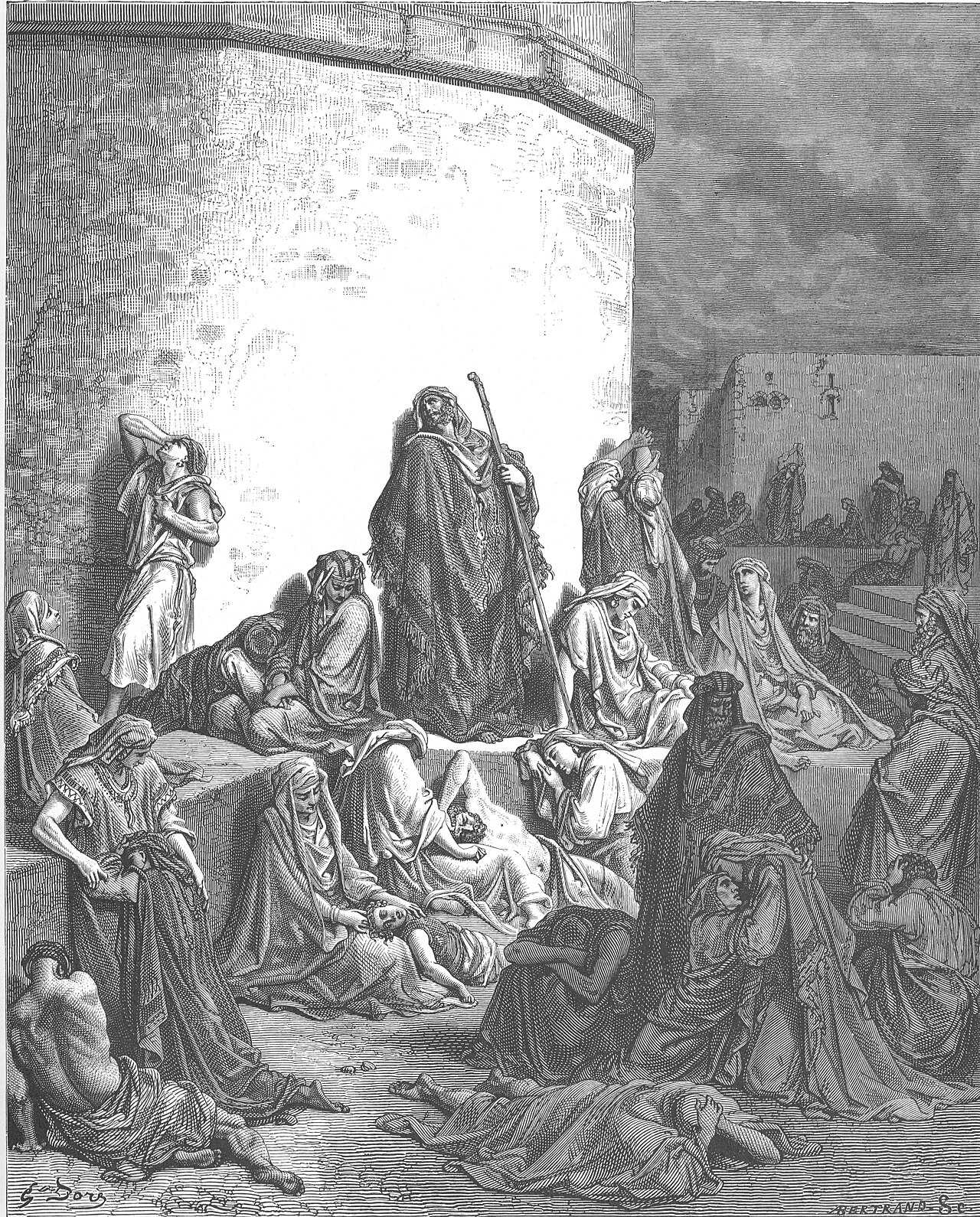
This page draws on Adam Clarke, Commentary on the Bible; Carl Friedrich Keil, Lamentations; John Gill, Exposition of the Old Testament (1748-1763); Matthew Henry, Commentary on the Whole Bible and Thomas Aquinas, Commentary on Lamentations.