
Lamentations 4:5
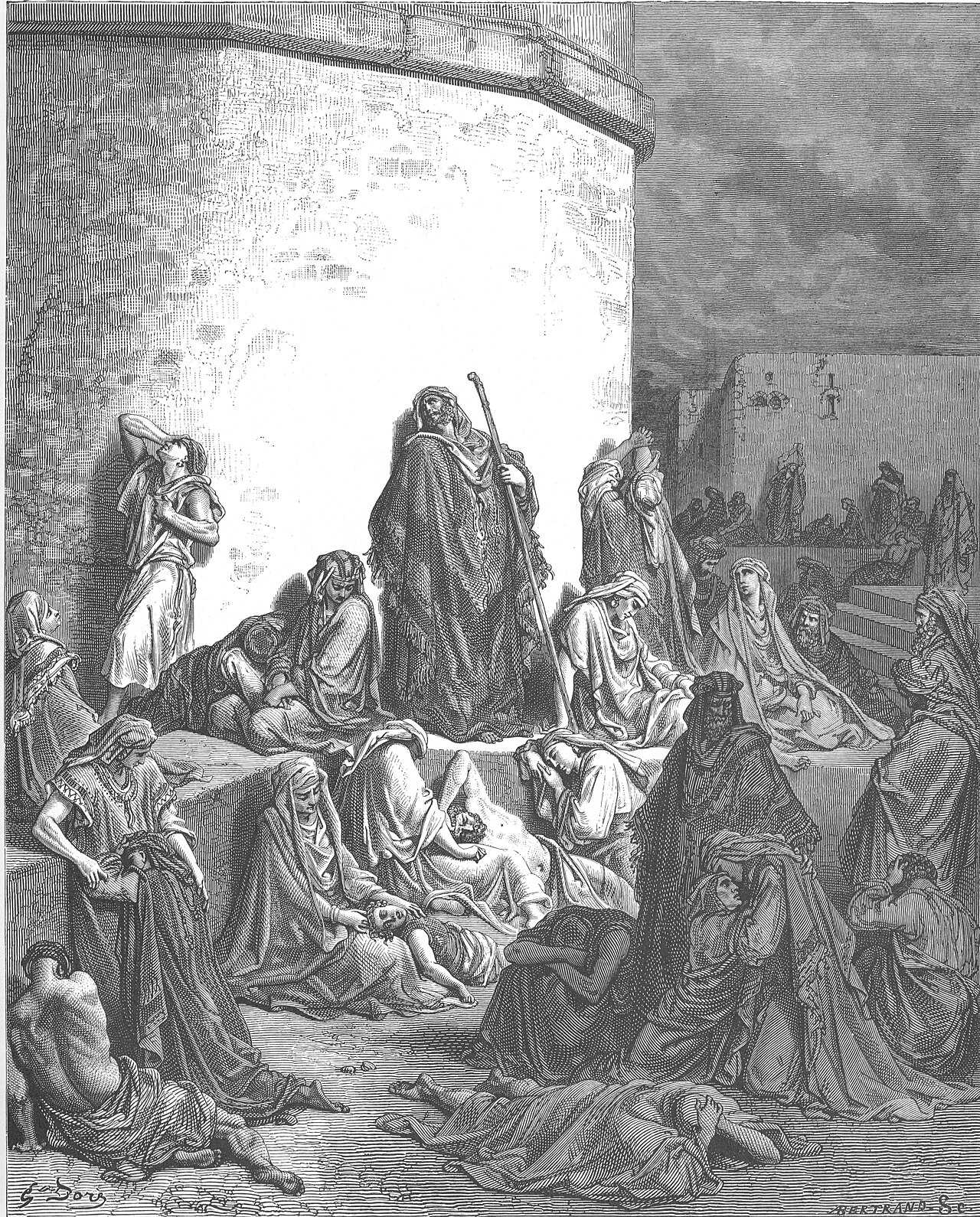
in Lamentations 4Those who once ate delicacies are destitute in the streets; those brought up in crimson huddle in ash heaps.
BSB
The same verse in ASV and KJV ▾
ASV
They that did feed delicately are desolate in the streets: They that were brought up in scarlet embrace dunghills.
KJV
They that did feed delicately are desolate in the streets: they that were brought up in scarlet embrace dunghills.
⋯
This verse in Lamentations 4
Commentary
8 notes on this verseA commentator
Albert Barnes1798–1870
Notes, Explanatory and Practical, on the Old and New Testaments (1832-1869)
They that were brought up in scarlet - literally, “those that were carried upon scarlet;” young children in arms and of the highest birth now lie on the dirt-heaps of the city.
This site's exposition
Even jackals offer their breasts to nurse their young
on Lamentations 4:3-6
Where the King James reads sea monsters, the Berean reads jackals: “Even jackals offer their breasts to nurse their young”. The daughter of my people “has become cruel, like an ostrich in the wilderness”, the bird Job 39:13-16 names for leaving her eggs.
This site's exposition
brought up in crimson
Albert Barnes reads crimson as the cloth on which infants of the highest birth were carried. Now they huddle in ash heaps, destitute. Hannah's song in 1 Samuel 2:8 lifts the needy from the ash heap, and here that order is turned over.
The record, by era
The Medieval Church1 voice
Here is considered famine as to dainties of nutritions. First is noticed the affliction from that famine, second, the comparison. As there in Verse 6: "For the chastisement of the daughter of my people has been greater than the punishment of Sodom, which was overthrown …
The Puritans and the Awakening2 voices
They were brought up upon scarlet (so the word is); their foot-cloths, and the carpets they walked on, were scarlet, yet these, being stripped of all by the war, are desolate in the streets, have not a house to put their head in, nor a bed to lie on, nor clothes to cover them, nor fire to warm them.
They that did feed delicately are desolate in the streets,....
The Nineteenth Century2 voices
A commentator
Jamieson, Fausset & Brown1802–1910
Commentary Critical and Explanatory on the Whole Bible (1871)
proposed
delicately--on dainties. are desolate--or, "perish." in scarlet embrace dunghills--Instead of the scarlet couches on which the grandees were nursed, they must lie on dunghills. embrace--They who once shrank sensitively from any soil, gladly cling close to heaps of filth as their only resting-place.
quarantine:debris (2026-07-29) — starts-lowercase
Embrace dunghills - Lie on straw or rubbish, instead of the costly carpets and sofas on which they formerly stretched themselves.
The words behind it
9 Hebrew wordsEvery Hebrew word of this verse in the order it stands, with what it means and the door to its own study. The last column counts the times a word stands in the whole Bible: the rarer the word, the more the places it appears belong together.
| Hebrew | Sound | Meaning | Word study | In the Bible |
|---|---|---|---|---|
| הָאֹֽכְלִים֙ | haokhelim | the [ones] eating | H398 → | 810 times |
| לְמַ֣עֲדַנִּ֔ים | lemaadanim | <to> delicacies | H4574 → | |
| נָשַׁ֖מּוּ | nashamu | they are desolate | H8074 → | 86 times |
| בַּחוּצ֑וֹת | bachutzot | in the streets | H2351 → | 164 times |
| הָאֱמֻנִים֙ | haemunim | the [ones] brought up | H539 → | |
| עֲלֵ֣י | ʾalei | on | H5921 → | 5755 times |
| תוֹלָ֔ע | tola' | crimson | H8438 → | |
| חִבְּק֖וּ | chibeku | they have embraced | H2263 → | |
| אַשְׁפַּתּֽוֹת׃ ס | ʾashpatot | ash heaps | H830 → |
הָאֹֽכְלִים֙the [ones] eating
haokhelimH398 →810 times
לְמַ֣עֲדַנִּ֔ים<to> delicacies
lemaadanimH4574 →
נָשַׁ֖מּוּthey are desolate
nashamuH8074 →86 times
בַּחוּצ֑וֹתin the streets
bachutzotH2351 →164 times
הָאֱמֻנִים֙the [ones] brought up
haemunimH539 →
עֲלֵ֣יon
ʾaleiH5921 →5755 times
תוֹלָ֔עcrimson
tola'H8438 →
חִבְּק֖וּthey have embraced
chibekuH2263 →
אַשְׁפַּתּֽוֹת׃ סash heaps
ʾashpatotH830 →
A shaded row is a word that stands 400 times or fewer in the Bible.
The walk
8 stopsEach card is a verse this one points to, and under it the verses that one points to in turn. Where several paths arrive at the same place, that place is listed first: the text keeps returning to it.
Through
Luke 16:19Now there was a rich man dressed in purple and fine linen, who lived each day in joyous splendor.
it leads to
- Ezekiel 16:49
Now this was the iniquity of your sister Sodom: She and her daughters were arrogant, overfed, and complacent; they did not help the poor and needy.
- Luke 18:24–25
Seeing the man’s sadness, Jesus said, “How hard it is for the rich to enter the kingdom of God!
- Amos 6:4–6
You lie on beds inlaid with ivory, and lounge upon your couches. You dine on lambs from the flock and calves from the stall.
- Ezekiel 27:7
Of embroidered fine linen from Egypt they made your sail, which served as your banner. Of blue and purple from the coasts of Elishah they made your awning.
- Ezekiel 16:49
Through
Luke 15:16He longed to fill his belly with the pods the pigs were eating, but no one would give him a thing.
it leads to
- Romans 6:19–21
I am speaking in human terms because of the weakness of your flesh. Just as you used to offer the parts of your body in slavery to impurity and to escalating wickedness, so now…
- Hosea 12:1
Ephraim chases the wind and pursues the east wind all day long; he multiplies lies and violence; he makes a covenant with Assyria and sends olive oil to Egypt.
- Romans 6:19–21
Through
Proverbs 31:21When it snows, she has no fear for her household, for they are all clothed in scarlet.
it leads to
- Genesis 45:22
He gave new garments to each of them, but to Benjamin he gave three hundred shekels of silver and five sets of clothes.
- 2 Samuel 1:24
O daughters of Israel, weep for Saul, who clothed you in scarlet and luxury, who decked your garments with ornaments of gold.
- Genesis 45:22
Where this verse is studied
On this page
About Lamentations
This page draws on Adam Clarke, Commentary on the Bible; Albert Barnes, Notes, Explanatory and Practical, on the Old and New Testaments (1832-1869); Jamieson, Fausset & Brown, Commentary Critical and Explanatory on the Whole Bible; John Gill, Exposition of the Old Testament; John Gill, Exposition of the Old Testament (1748-1763); Matthew Henry, Commentary on the Whole Bible and Thomas Aquinas, Commentary on Lamentations.