
Lamentationschapter 1
22 verses · KJVLamentations book hub →
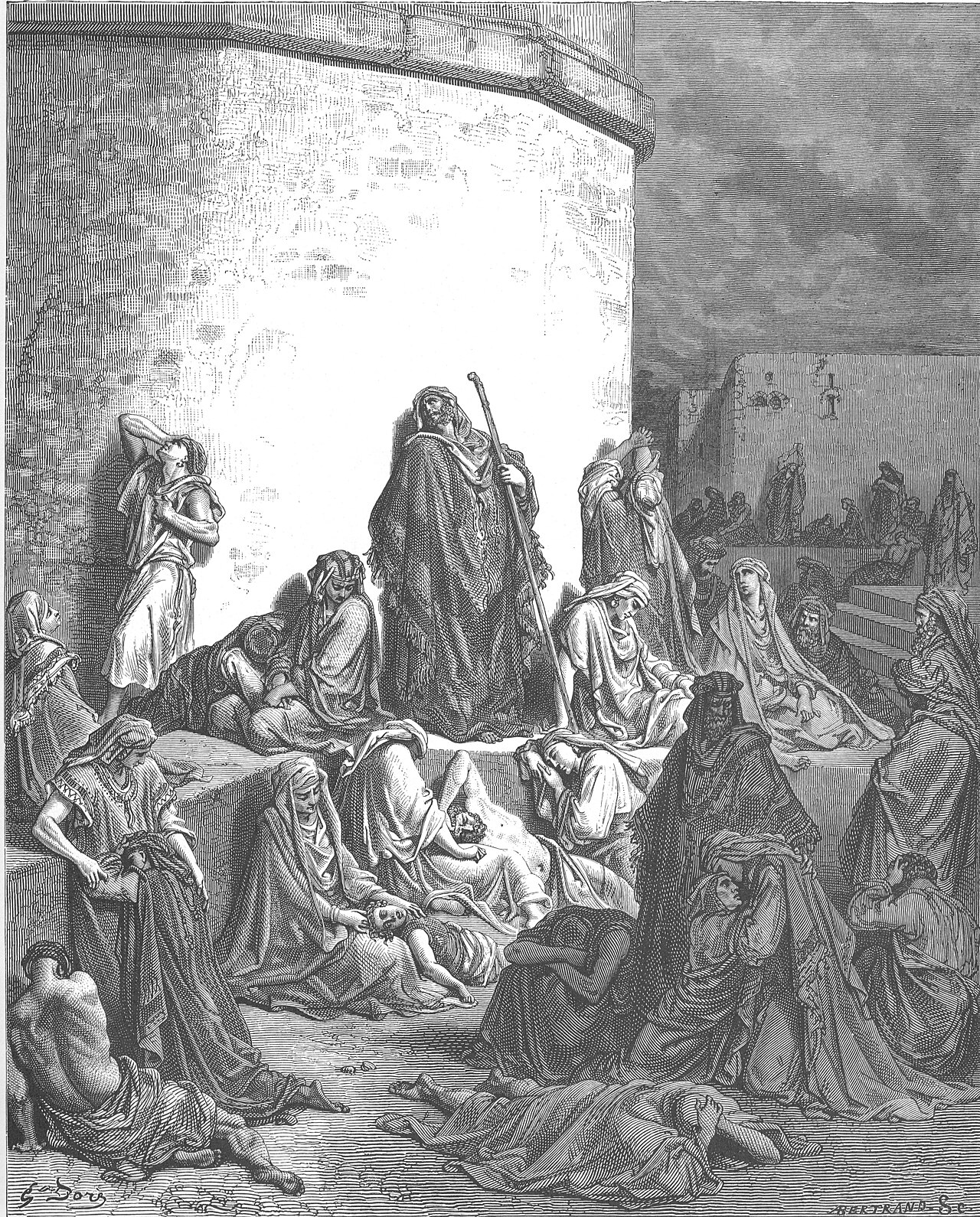
People Mourn over the Destruction of Jerusalem, Gustave Doré, Doré's English Bible (1866), public domain
Key verse
How doth the city sit solitary, that was full of people! how is she become as a widow! she that was great among the nations, and princess among the provinces, how is she become tributary!
It stands in scene A of the chapter, verses 1 to 11.
The chapter
Chapter summary
The first of five poems over the fallen city, and an alphabetic acrostic, twenty-two stanzas, one for each letter of the Hebrew alphabet, grief ordered from aleph to tav. 'How doth the city sit solitary, that was full of people!' She that was great among the nations is become a widow, a forced laborer; she weeps sore in the night and her tears are on her cheeks, with none to comfort her among all her lovers. Judah's roads mourn because none come to the feasts. Halfway through, the city herself speaks and appeals to passers-by: 'Is it nothing to you, all ye that pass by?' (1:12), and then confesses, 'Jehovah is righteous; for I have rebelled against his commandment.'
Context
Poetry · Jeremiah · Lamentations overview
Where the chapter sits
Lamentations 1 falls in Five poems over a fallen city (chapters 1–5). Acrostic laments over Jerusalem's desolation (ch. 1–4); a non-acrostic closing prayer (ch. 5). At the centre: the great affirmation of 3:22–23, ‘his compassions fail not; they are new every morning.’
The city sits solitary. First acrostic; Jerusalem as a widow weeping.
The whole shape of Lamentations→The world behind this chapter
Lamentations 1The history
Each of the first four chapters of this book is an alphabet poem: twenty-two verses, one for each letter of the Hebrew alphabet, in order. That is a deliberate structure for grief that would otherwise have no shape, an A to Z of loss, and a way for people to learn it by heart and say it together.
The rest of the history, and what it meant to them
The city is pictured as a widow sitting on the ground. Sitting in the dust, head covered, was the recognised posture of mourning, held for days while friends came and sat in silence. A widow in that society had no legal standing of her own and depended on the mercy of relatives, which is exactly the point of the image.
The most concrete detail is the roads. The roads to Zion mourn because none come to the appointed feasts. Three times a year the country emptied into Jerusalem for the pilgrim festivals; the highways would have been crowded with families walking up in company. Now they are empty and the gates are desolate.
Poems mourning a destroyed city were a known form in that part of the world, Mesopotamian scribes had composed laments over the fall of Ur and other cities centuries earlier, in which the city's goddess weeps over the ruin. This book uses the familiar form and changes the content: there is no capricious god here, only a city that says the LORD is in the right, for I have rebelled against his word.
What it meant to them
The survivors needed permission to grieve out loud and words that would not lie. This chapter gives both: the horror is fully stated, and so is the reason for it.
The refrain is loneliness rather than pain. She weeps bitterly in the night, and among all her lovers she has none to comfort her, those lovers being the allies Judah had courted for a century, none of whom came.
Sources cited
- James B. Pritchard, ed., Ancient Near Eastern Texts Relating to the Old Testament
- Roland de Vaux, Ancient Israel: Its Life and Institutions
A. How Doth the City Sit Solitary
1. (vv. 1-3)
a.How doth the city sit solitary: The book opens as an alphabet acrostic, one verse to each of the twenty-two Hebrew letters, a form disciplined enough to hold grief without letting it spill past its banks. The city that once sat as a queen among the nations now sits solitary, called a widow though her husband the Lord has not divorced her, and the exile named plainly, Judah is gone into captivity because of affliction and great servitude. The bench reads the language of state and status, princess, tributary, as deliberate: the poem names exactly what has been lost before it names why.
Lamentations 1:1, 2 voicesWhat preachers and commentators have said about these verses, in their own words.
Lamentations 1:1-2
“As for Isaiah, Jeremiah, Ezekiel and Daniel, who can fully understand or adequately explain them? The first of them seems to compose not a prophecy but a gospel. The second speaks of a rod of an almond tree and of a seething pot with its face toward the north, and of a leopard that has changed its spots. He also goes four times through the alphabet in different meters.”
Jerome· written before 420· LETTER 53.8patristic
Lamentations 1:1
“In these two verses is the same sad image as appears in the well-known medal of Titus, struck to celebrate his triumph over Jerusalem. A woman sits weeping beneath a palm-tree, and below is the legend “Judaea capta.” Translate Lam 1:1: How sitteth solitary the city that was full of people: She is become as a widow that was great among the nations: A princess among provinces she is become a vassal. Tributary - In the sense of personal labor Jos 16:10.”
Lamentations 1:2, 1 voice
Lamentations 1:2
“She weepeth sore in the night,.... Or, "weeping weeps" (i); two weepings, one for the first, the other for the second temples (k); and while others are taking their sleep and rest; a season fit for mourners, when they can give their grief the greater vent, without any interruption from others; and it being now a night of affliction with her, which occasioned this sore weeping.”
Lamentations 1:3, 1 voice
Lamentations 1:3
“Because of ... - i. e. the people, not of Jerusalem only, but of the whole land, “is gone into exile to escape from the affliction and laborious servitude,” to which they are subject in their own land. Persecutors ... between the straits - Rather, “pursuers ... in the midst of her straits.” The Jews flee like deer to escape from the invading Chaldaeans, but are driven by them into places from where there is no escape.”
2. (vv. 4-6)
a.The ways of Zion do mourn: The roads to Jerusalem are personified in grief, the ways of Zion mourning because no pilgrims travel them to the solemn feasts, the pilgrim festivals of the Law now attended by no one at all. Priests sigh and virgins are afflicted, the temple's own personnel and its youngest witnesses named together, the roads standing as silent evidence of a calendar broken. Her princes, once the strength of the nation, are now like harts that find no pasture, fugitives too weak to outrun the pursuer, a figure the commentators take from the hunted deer of the wilderness rather than the palace.
Lamentations 1:4, 1 voice
Lamentations 1:4
“The ways of Zion do mourn - A fine prosopopoeia. The ways in which the people trod coming to the sacred solemnities, being now no longer frequented, are represented as shedding tears; and the gates themselves partake of the general distress. All poets of eminence among the Greeks and Romans have recourse to this image.”
Adam Clarke· Commentary on the Bible (1810-1826)evangelical
Lamentations 1:5, 1 voice
Lamentations 1:5
“Are the chief ... prosper - Or, “are become the head”... are at rest. Judaea is so entirely crushed that her enemies did not need to take precautions against resistance on her part. Children - i. e. “young children,” who are driven before the enemy (literally the adversary), not as a flock of lambs which follow the shepherd, but for sale as slaves.”
Lamentations 1:6, 2 voices
Lamentations 1:6
“Her princes ... - Jeremiah had before his mind the sad flight of Zedekiah and his men of war, and their capture within a few miles of Jerusalem Jer 39:4-5.”
Lamentations 1:6
“The beauty of holiness was the beauty of the daughter of Zion; when the temple, that holy and beautiful house, was destroyed, her beauty was gone; that was the breaking of the staff of beauty, the taking away of the pledges and seals of the covenant, Zech. xi.”
Matthew Henry· Commentary on the Whole Bible (1707-1721)puritan
3. (vv. 7-9)
a.Jerusalem remembered in the days of her affliction: Memory becomes its own affliction, Jerusalem remembering in her misery all the pleasant things she once had, while the adversaries mock at her sabbaths, worship itself become a subject for scorn. The poet names the cause without softening it, Jerusalem hath grievously sinned, therefore she is removed, judgment stated as consequence rather than accident. Her filthiness is in her skirts because she remembereth not her last end, a figure the bench reads as the moral history of a nation that never reckoned with where its course was leading, and the unit closes in the line that turns the whole poem to prayer, O Lord, behold my affliction.
Lamentations 1:7, 2 voices
Lamentations 1:7
“Jerusalem remembers in the days of her affliction, And of her homelessness, All her pleasant things which have been from the days of old: Now that her people fall by the hand of the adversary, And she hath no helper; Her adversaries have seen her, They have mocked at her sabbath-keepings. The word rendered “homelessless” means wanderings, and describes the state of the Jews, cast forth from their homes and about to be dragged into exile. Sabbaths - Or, sabbath-keepings, and the cessation from labor every seventh day struck foreigners as something strange, and provoked their ridicule.”
Lamentations 1:7
“MAURER translates it "ruin." But English Version better expresses the point of their "mocking," namely, their involuntary "Sabbaths," that is, the cessation of all national movements. A fourth line is added in this stanza, whereas in all the others there are but three.”
Jamieson, Fausset & Brown· Commentary Critical and Explanatory on the Whole Bible (1871)reformed
Lamentations 1:8, 1 voice
Lamentations 1:8
“Grievously sinned - literally, “Jerusalem hath sinned a sin,” giving the idea of a persistent continuance in wickedness. Removed - Or, become an abomination. Sin has made Jerusalem an object of horror, and therefore she is cast away. Yea, she sigheth ... - Jerusalem groans over the infamy of her deeds thus brought to open shame, and turns her back upon the spectators in order to hide herself.”
Lamentations 1:9, 3 voices
Lamentations 1:9
“Her filthiness is in her skirts,.... Her sin is manifest to all, being to be seen in her punishment. The allusion is to a menstruous woman, to whom she is compared, both before and after; whose blood flows down to the skirts of her garments, and there seen; by which it is known that she is in her separation.”
Lamentations 1:9
“Her filthiness is in her skirts - Her personal defilement is no longer concealed beneath the raiment Jer 13:22. She came down wonderfully - Jerusalem once enthroned as a princess must sit on the ground as a slave.”
Lamentations 1:9
“She forgot how fatal must be the end of her iniquity. Or, as the words following imply: She, in despair, cannot lift herself up to lay hold of God's promises as to her "latter end" [CALVIN]. wonderfully--Hebrew, "wonders," that is, with amazing dejection.”
Jamieson, Fausset & Brown· Commentary Critical and Explanatory on the Whole Bible (1871)reformed
4. (vv. 10-11)
a.The adversary hath spread out his hand: upon all her pleasant things, the temple treasures plundered by hands the Law had forbidden even to enter the congregation, heathen feet crossing a threshold Moses had marked closed to them. The famine behind the siege appears in one plain trade, the people giving their pleasant things for meat to relieve the soul, valuables bartered for bread while the city starved. The bench reads verse 10 against the exclusion laws directly, the violation of the sanctuary counted alongside the hunger as one grief.
Lamentations 1:10, 2 voices
Lamentations 1:10
“Her pleasant things - Chiefly, the sacred vessels of the temple 2Ch 36:10. Sanctuary ... congregation - Even a Jew might not enter the innermost sanctuary, which was for the priests only; but now the tramp of pagan soldiery has been heard within its sacred precincts.”
Lamentations 1:10
“What these pleasant things are we may learn from Isa. lxiv. 11 , where, to the complaint of the burning of the temple, it is added, All our pleasant things are laid waste; the ark and the altar, and all the other tokens of God's presence with them, these were their pleasant things above any other things, and these were now broken to pieces and carried away.”
Matthew Henry· Commentary on the Whole Bible (1707-1721)puritan
Lamentations 1:11, 2 voices
Lamentations 1:11
“All her people sigh,.... Not her priests only, Lam 1:4; but all the common people, because of their affliction, particularly for want of bread.”
Lamentations 1:11
“Sigh ... seek - Are sighing ... are seeking. The words are present participles, describing the condition of the people. After a siege lasting a year and a half the whole country, far and near, would be exhausted. To relieve the soul - See the margin, i. e. to bring back life to them. They bring out their jewels and precious articles to obtain with them at least a meal.”
B. Is It Nothing to You, All Ye That Pass By?
1. (vv. 12-16)
a.Is it nothing to you, all ye that pass by?: The chapter's most quoted line addresses every passerby directly, is it nothing to you, all ye that pass by, behold and see if there be any sorrow like unto my sorrow, wherewith the Lord hath afflicted me in the day of his fierce anger. In the poem's own setting the cry is Jerusalem's over her own ruin, fire sent into the bones, a net for the feet, the Lord treading the virgin daughter of Judah as in a winepress. A long line of Christian reading, carried into Good Friday's own liturgy, has heard the verse again on the lips of Christ; the bench names the reading as devotional application rather than the text's original address, both stated without erasing either.
Lamentations 1:12, 3 voices
Lamentations 1:12
“Is it nothing to you, all ye that pass by? - The desolations and distress brought upon this city and its inhabitants had scarcely any parallel. Excessive abuse of God’s accumulated mercies calls for singular and exemplary punishment.”
Adam Clarke· Commentary on the Bible (1810-1826)evangelical
Lamentations 1:12
“The pathetic appeal of Jerusalem, not only to her neighbors, but even to the strangers "passing by," as her sorrow is such as should excite the compassion even of those unconnected with her. She here prefigures Christ, whom the language is prophetically made to suit, more than Jerusalem. Compare Israel, that is, Messiah, Isa 49:3.”
Jamieson, Fausset & Brown· Commentary Critical and Explanatory on the Whole Bible (1871)reformed
Lamentations 1:12
She here looks beyond the instruments to the author of her troubles, and owns them all to be directed, determined, and disposed of by him: "It is the Lord that has afflicted me, and he has afflicted me because he is angry with me; the greatness of his displeasure may be measured by the greatness of my distress; it is in the day of his fierce anger, "
Matthew Henry· Commentary on the Whole Bible (1707-1721)puritan
Lamentations 1:14, 2 voices
Lamentations 1:14
“The yoke of my transgressions - I am now tied and bound by the chain of my sins; and it is so wreathed, so doubled and twisted round me, that I cannot free myself. A fine representation of the miseries of a penitent soul, which feels that nothing but the pitifulness of God’s mercy can loose it.”
Adam Clarke· Commentary on the Bible (1810-1826)evangelical
Lamentations 1:14
“Thus the translation will be, "in His hand." Or else, "the yoke of my transgressions" (that is, of punishment for my transgressions) is held so fast fixed on me "by" God, that there is no loosening of it; thus English Version, "by His hand." wreathed--My sins are like the withes entwined about the neck to fasten the yoke to. into their hands, from whom--into the hands of those, from whom, &c.”
Jamieson, Fausset & Brown· Commentary Critical and Explanatory on the Whole Bible (1871)reformed
Lamentations 1:15, 1 voice
Lamentations 1:15
“The Hebrew means, literally, such a solemn "assembly" or feast (compare La 2:22). trodden . . . virgin . . . in a wine-press--hath forced her blood to burst forth, as the red wine from the grapes trodden in the press (Isa 63:3;”
Jamieson, Fausset & Brown· Commentary Critical and Explanatory on the Whole Bible (1871)reformed
Lamentations 1:16, 1 voice
Lamentations 1:16
“For these things I weep,.... The congregation of Judah, the godly among them, particularly Jeremiah, who represented them, wept for the sins the people had been guilty of, and for the punishment inflicted on them, or the sore calamities that were brought upon them.”
2. (vv. 17-19)
a.Zion spreadeth forth her hands: , and there is none to comfort her, the third statement of the chapter's want-of-comfort thread, the Lord himself named as having commanded the adversaries round about Jacob. The figure of a menstruous woman among them draws on the Law's own language for ritual uncleanness, Jerusalem cast out from the community of nations the way the Law once set such a woman outside the camp, an image the older commentators do not soften. The confession that follows, I have grievously rebelled, and the naming of allies who deceived her, ties the political betrayal to the moral cause in one breath.
Lamentations 1:17, 2 voices
Lamentations 1:17
“Zion spreadeth forth her hands,.... Either as submitting to the conqueror, and imploring mercy; or rather as calling to her friends to help and relieve her. The Targum is, "Zion spreadeth out her hands through distress, as a woman spreads out her hands upon the seat to bring forth;'' see Jer 4:”
Lamentations 1:17
“Spreadeth forth her hands - In prayer Exo 9:29, Exo 9:33, but Zion entreats in vain. There is no one to comfort her - not God, for He is chastising her, nor man, for all the neighboring nations have become her enemies. See Lam 1:2. That his adversaries ... - Rather, that those round about him should be his adversaries; all the neighboring states should regard him with aversion. Jerusalem is ... - i. e. is become an abomination. The words are virtually the same as in Lam 1:8.”
Lamentations 1:18, 1 voice
Lamentations 1:18
“The sure sign of repentance; justifying God, condemning herself (Ne 9:33; Da 9:7-14). his commandment--literally, "mouth"; His word in the mouth of the prophets.”
Jamieson, Fausset & Brown· Commentary Critical and Explanatory on the Whole Bible (1871)reformed
Lamentations 1:19, 1 voice
Lamentations 1:19
“Those that made court to her in her prosperity were shy of her, and strange to her, in her adversity. Happy are those that have made God their friend and keep themselves in his love, for he will not deceive them! Those whose office it was to guide her were disabled from doing her any service.”
Matthew Henry· Commentary on the Whole Bible (1707-1721)puritan
3. (vv. 20-22)
a.Behold, O Lord; for I am in distress: The chapter closes as it began, addressed to the Lord directly, behold, O Lord, for I am in distress, my bowels are troubled, the sword bereaving abroad and death waiting at home. The prayer turns imprecatory in its last lines, asking the Lord to bring upon her enemies the day he has already brought upon her, do unto them as thou hast done unto me, a pattern the bench reads as the honest cry of a sufferer laid before the Judge rather than executed by the sufferer's own hand. The last word is the poem's own, my heart is faint, closing the acrostic on the note it opened, affliction still spoken directly to the God who sent it.
Lamentations 1:20, 2 voices
Lamentations 1:20
“Abroad the sword bereaveth - War is through the country; and at home death; the pestilence and famine rage in the city; calamity in every shape is fallen upon me. Virgil represents the calamities of Troy under the same image: - - Nec soli poenas dant sanguine Teucri: Quondam etiam victis redit in praecordia virtus; Victoresque cadunt Danai. Crudelis ubique Luctus, ubique Pavor, et plurima mortis imago. Aeneid. lib. 2:366. “Not only Trojans fall; but, in their turn, The vanquished triumph, and the victors mourn. Ours take new courage from despair and night; Confused the fortune is, confused the fight.”
Adam Clarke· Commentary on the Bible (1810-1826)evangelical
Lamentations 1:20
“Abroad the sword bereaves and slays all that comes in its way, and at home all provisions are cut off by the besiegers, so that there is as death, that is, famine, which is as bad as the pestilence, or worse-- the sword without and terror within, Deut. xxxii.”
Matthew Henry· Commentary on the Whole Bible (1707-1721)puritan
Lamentations 1:21, 2 voices
Lamentations 1:21
“They have heard ... - Or, “They heard that I sigh,” that I have “no comforter.” Thou wilt bring the day ... - literally, thou hast brought “the day thou hast proclaimed, and they shall be like unto me.” The day of Judah’s punishment was the proof that the nations now triumphing over Jerusalem’s fall would certainly be visited.”
Lamentations 1:21-22
“Note, Our prayers may and must agree with God's word; and what day God has here called we are to call for, and no other. And though we are bound in charity to forgive our enemies, and to pray for them, yet we may in faith pray for the accomplishment of that which God has spoken against his and his church's enemies, that will not repent to give him glory.”
Matthew Henry· Commentary on the Whole Bible (1707-1721)puritan
Lamentations 1:22, 2 voices
Lamentations 1:22
“Let all their wickedness come before thee - That is, Thou wilt call their crimes also into remembrance; and thou wilt do unto them by siege, sword, famine, and captivity, what thou hast done to me. Though thy judgments, because of thy long-suffering, are slow; yet, because of thy righteousness, they are sure. For my sighs are many - My desolations continue; and my heart is faint - my political and physical strength almost totally destroyed. Imprecations in the sacred writings are generally to be understood as declarative of the evils they indicate; or, that such evils will take place.”
Adam Clarke· Commentary on the Bible (1810-1826)evangelical
Lamentations 1:22
“Such prayers against foes are lawful, if the foe be an enemy of God, and if our concern be not for our own personal feeling, but for the glory of God and the welfare of His people. come before thee--so Re 16:19, "Babylon came in remembrance before God" (compare Ps 109:15).”
Jamieson, Fausset & Brown· Commentary Critical and Explanatory on the Whole Bible (1871)reformed
The text of this chapter
This page carries no textual note on Lamentations 1. Where this site has examined a place the manuscripts differ, the examination is in the manuscripts room. Every place this site examines →
This page draws on 9 works. Open for the list.
This page draws on Adam Clarke; Albert Barnes; Carl Friedrich Keil, Lamentations; Jamieson, Fausset & Brown, Commentary Critical and Explanatory on the Whole Bible (1871); Jamieson, Fausset and Brown, Commentary Critical and Explanatory on the Whole Bible; Jerome, LETTER 53.8; John Calvin, Commentary on Jeremiah and Lamentations; John Gill and Matthew Henry.
Keep studying
On this page
Studies3
On this chapter
On this book