
Jobchapter 1
22 verses · KJVJob book hub →
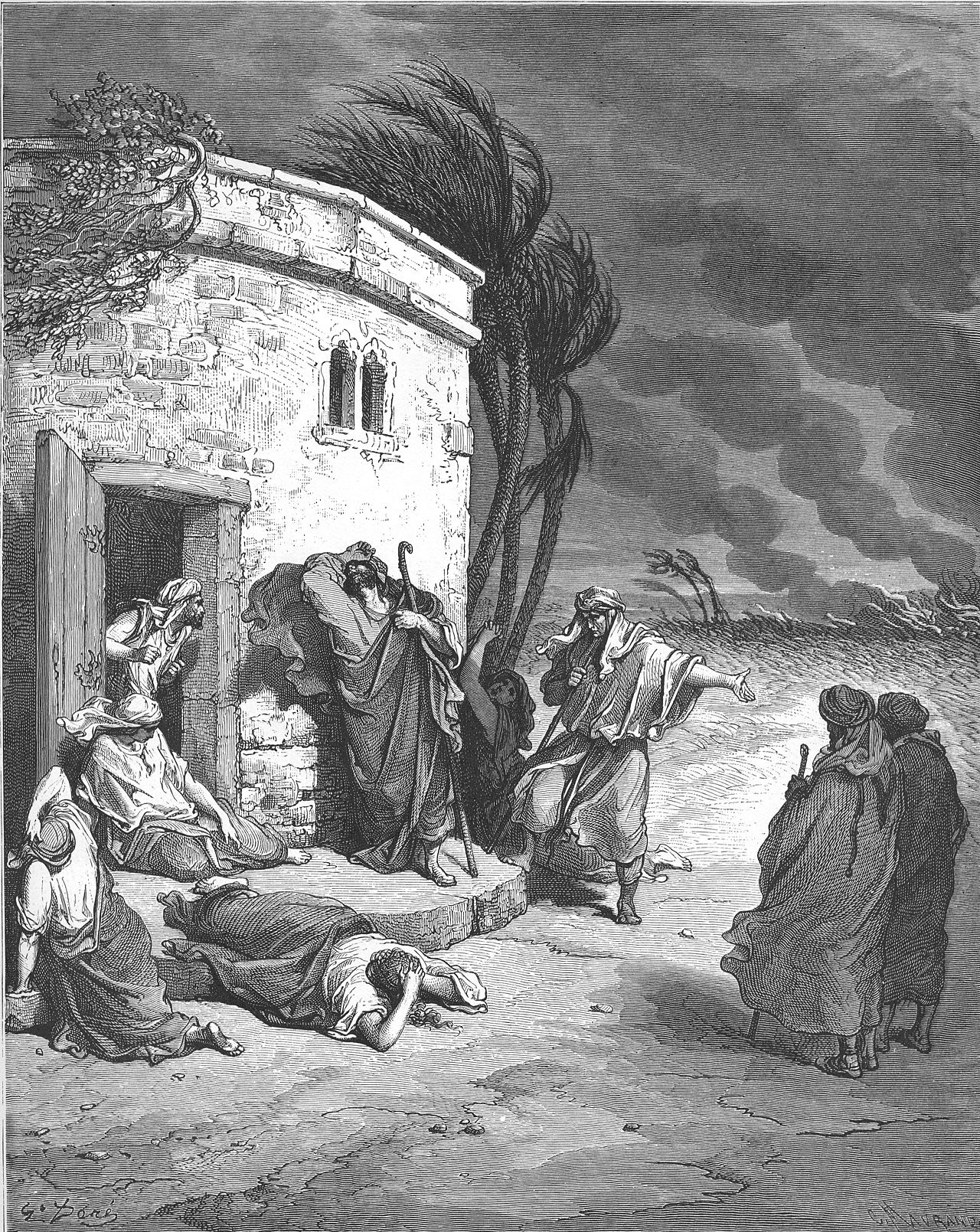
Job Hears of His Misfortunes, Gustave Doré, Doré's English Bible (1866), public domain
Key verse
Now there was a day when the sons of God came to present themselves before the Lord, and Satan came also among them.
It stands in scene B of the chapter, verses 6 to 12.
The chapter
Chapter summary
Job of Uz ('perfect and upright, one that feared God, and turned away from evil') is greatest of all the children of the east: seven sons, three daughters, herds in thousands, and burnt-offerings offered early in case his children sinned in their hearts. Then the scene lifts to the throne, where the sons of God present themselves before Jehovah and Satan comes among them: 'Doth Job fear God for nought?' Four messengers arrive in one day: Sabeans, the fire of God, Chaldeans, a great wind from the wilderness. Job rends his robe and worships: 'Jehovah gave, and Jehovah hath taken away; blessed be the name of Jehovah' (1:21).
Context
Poetry · Unknown · Job overview
Where the chapter sits
Job 1 falls in Prose prologue: heavenly court (chapters 1–2). The accuser (*ha-satan*) in the divine council; YHWH's permission of Job's suffering; two tests (possessions + body); Job's integrity under both: ''shall we receive good at the hand of God, and shall we not receive evil?''
The heavenly court. The accuser in council; the first test; ''the LORD gave, and the LORD hath taken away.''
After it: Dialogue: three cycles, chapters 3–27.
The whole shape of Job→The world behind this chapter
Job 1The history
Everything about Job's world is pre-Israelite, and the details are consistent. His wealth is counted in livestock and servants, not silver. He offers sacrifices himself, as head of his household, with no priest and no tabernacle anywhere in view, the way Abraham and Jacob worshipped. His lifespan runs past a century. No Law of Moses is mentioned, no covenant, no Israel. That is why the traditional reading places the events in the age of the patriarchs, even though the book never dates itself.
The rest of the history, and what it meant to them
Uz lay east or southeast of Canaan, in the direction of Edom and north Arabia; Lamentations connects Uz with Edom, and Job's friends come from places on that map. Out there a wealthy man ran a walled compound with tents and outbuildings, and his herds grazed at a distance under hired hands, which is exactly what makes them easy to raid.
The two raids in the chapter are ordinary crimes of that region. The Sabeans came up the caravan routes from southern Arabia; the Chaldeans were bands out of lower Mesopotamia who formed into three companies for a coordinated sweep, the standard way to hit spread-out herds before the alarm could travel. Neither raid needs a miracle. Fire from heaven and a desert windstorm collapsing a house are likewise things that happened.
The heaven scene is the strange part, and it should be. The 'sons of God' presenting themselves before the LORD is the divine council, the assembly of created spiritual beings through whom God administers his rule, a picture found again in 1 Kings 22 and the Psalms. The accuser is called 'the satan', a title with the definite article that means the adversary or prosecutor, an office in a royal court. Readers divide over whether the chapter is using a job description or a name; the plain sense is that the office and the person who fills it are the same one Scripture later calls Satan, and the scene shows him operating only within limits God sets and enforces.
What it meant to them
The first hearers were let in on a secret Job never learns. The disasters have a cause that has nothing to do with Job's sin, and the question on the table is not whether Job is good but whether anyone loves God for nothing, whether faith survives when the payoff is removed.
That reframes everything that follows. Every speech in the next thirty chapters is delivered by men who do not know what the audience knows, arguing about a case whose file they have never seen.
Sources cited
- John H. Walton, Victor H. Matthews & Mark W. Chavalas, The IVP Bible Background Commentary: Old Testament
- Michael S. Heiser, The Unseen Realm
- Franz Delitzsch, Biblical Commentary on the Book of Job
A. Job the Blameless Man of Uz
1. (vv. 1-3)
a.There was a man in the land of Uz: Uz sits in the Edomite orbit, the same territory Lamentations names the land of the daughter of Edom, and Job is patriarchal rather than Israelite from the first line. Perfect and upright, one that feared God and eschewed evil describes moral completeness and integrity, not sinlessness, as Gill and Henry both note against the popular flattening of the word. The wealth counted in sheep, camels, oxen and servants marks Job as the greatest of all the men of the east, a patriarchal measure the book keeps to its final chapter.
Job 1:1, 3 voicesWhat preachers and commentators have said about this verse, in their own words.
Job 1:1
“There was a man - This has all the appearance of being a true history. Many have regarded the whole book as a fiction, and have supposed that no such person as Job ever lived. But the book opens with the appearance of reality; and the express declaration that there was such a man, the mention of his name and of the place where he lived, show that the writer meant to affirm that there was in fact such a man. On this question see the Introduction, Section”
Job 1:1
“Arabia-Deserta was on the east, Arabia-Petræa on the west, and Arabia-Felix on the south. Job--The name comes from an Arabic word meaning "to return," namely, to God, "to repent," referring to his end [EICHORN]; or rather from a Hebrew word signifying one to whom enmity was shown, "greatly tried" [GESENIUS].”
Jamieson, Fausset & Brown· Commentary Critical and Explanatory on the Whole Bible (1871)reformed
Job 1:1
“Perfect - Not legally or exactly, but as to his sincere intentions, hearty affections, and diligent endeavours to perform all his duties to God and men. Upright - Hebrew. right, exact and regular in all his dealings, with men; one of an unblameable conversation.”
John Wesley· Explanatory Notes upon the Old Testament (1765)evangelical
Job 1:2, 1 voice
Job 1:2
“And there were born unto him seven sons and three daughters - The same number was given to him again after these were lost, and his severe trials had been endured; see Job 42:13. Of his second family the names of the daughters are mentioned, Job 42:14. Of his first, it is remarkable that neither the names of his wife, his sons nor his daughters are recorded. The Chaldee, however, on what authority is unknown, says that the name of his wife was דינה dı̂ynâh, Job 2:9.”
Job 1:3, 2 voices
Job 1:3
“His substance - Margin, or “cattle.” The word used here מקנה mı̂qneh is derived from קנה qânâh, to gain or acquire, to buy or purchase, and properly means anything acquired or purchased - property, possessions, riches. The wealth of nomadic tribes, however, consisted mostly in flocks and herds, and hence the word in the Scripture signifies, almost exclusively, property in cattle.”
Job 1:3
“Camels - Camels in these parts were very numerous, and very useful, both for carrying burdens in these hot and dry countries, as being able to endure thirst much better than other creatures, and for service in war. Asses - He-asses also may be included in this expression, because the greatest part of them (from which the denomination is usually taken) were she asses.”
John Wesley· Explanatory Notes upon the Old Testament (1765)evangelical
2. (vv. 4-5)
a.went and feasted in their houses: The sons' feasting rotates house to house, and Job rises early to offer burnt offerings for all of them on the mere chance that they cursed God in their hearts, a fear he acts on without any accusation before him. Thus did Job continually makes the sacrifice a standing habit rather than a single scare, and Henry reads it as the family priesthood of the patriarchal age exercised in earnest, a father guarding sons he cannot watch every hour. Clarke notes the same care will return inverted in chapter 42, when the friends need a sacrifice offered on their behalf and Job is the one who prays for them.
Job 1:4, 1 voice
Job 1:4
“Feasted in their houses, every one his day - It is likely that a birthday festival is here intended. When the birthday of one arrived, he invited his brothers and sisters to feast with him; and each observed the same custom.”
Adam Clarke· Commentary on the Bible (1810-1826)evangelical
Job 1:5, 4 voices
Job 1:5
“And it was so, when the days of their feasting were gone about - Dr. Good renders this, “as the days of such banquets returned.” But this is not the idea intended. It is, when the banquets had gone round as in a circle through all the families, “then” Job sent and sanctified them. It was not from an anticipation that they “would” do wrong, but it was from the apprehension that they “might” have sinned.”
Job 1:5
“GESENIUS says, the original sense is to "kneel," and thus it came to mean bending the knee in order to invoke either a blessing or a curse. Cursing is a perversion of blessing, as all sin is of goodness. Sin is a degeneracy, not a generation.”
Jamieson, Fausset & Brown· Commentary Critical and Explanatory on the Whole Bible (1871)reformed
Job 1:5
“May be - His zeal for God's glory, and his true love to his children, made him jealous. Cursed - Not in a gross manner, which it is not probable either that they should do, or that Job should suspect it concerning them, but despised or dishonoured God; for both Hebrew and Greek words signifies cursing, are sometimes used to note only, reviling or setting light by a person.”
John Wesley· Explanatory Notes upon the Old Testament (1765)evangelical
Job 1:5
“Still he was the priest of the family, and at his altar they all attended, valuing their share in his prayers more than their share in his estate. Parents cannot give grace to their children (it is God that sanctifies), but they ought by seasonable admonitions and counsels to further their sanctification.”
Matthew Henry· Commentary on the Whole Bible (1707-1721)puritan
B. The Adversary Comes Before the Throne
1. (vv. 6-7)
a.the sons of God came to present themselves: The phrase sons of God falls in the Old Testament at exactly five places, Genesis 6:2 and 6:4, and here at Job 1:6, 2:1 and 38:7, the same divine council standing behind both books. Satan comes also among them, and his answer to the Lord's question, from going to and fro in the earth, and from walking up and down in it, is the roving of an accuser rather than an equal, as Gill and Barnes both read the exchange. The scene is staged entirely for the reader; nothing in the chapters that follow ever tells Job that it happened.
Job 1:6, 3 voices
Job 1:6
“There was a day when the sons of God - All the versions, and indeed all the critics, are puzzled with the phrase sons of God; בני האלהים beney haelohim, literally, sons of the God, or sons of the gods. The Vulgate has simply filii dei, sons of God. The Septuagint, οἱ αγγελοι του θεου, the angels of God. The Chaldee, כתי מלאכיא kittey malachaiya, troops of angels. The Syriac retains the Hebrew words and letters, only leaving out the demonstrative ה he in the word האלהים haelohim, thus, (Syriac) baney Elohim.”
Adam Clarke· Commentary on the Bible (1810-1826)evangelical
Job 1:6
“He has the law of God on his side by man's sin, and against man. But Jesus Christ has fulfilled the law for us; justice is once more on man's side against Satan (Isa 42:21); and so Jesus Christ can plead as our Advocate against the adversary. "Devil" is the Greek name--the "slanderer," or "accuser." He is subject to God, who uses his ministry for chastising man.”
Jamieson, Fausset & Brown· Commentary Critical and Explanatory on the Whole Bible (1871)reformed
Job 1:6
“And it is likewise intimated, that the affairs of earth are much the subject of the counsels of the unseen world. That world is dark to us: but we lie open to it.”
John Wesley· Explanatory Notes upon the Old Testament (1765)evangelical
Job 1:7, 2 voices
Job 1:7
“HISTORICAL INTERPRETATION How is it that it is never said to the elect Angels, when they come, 'Whence come ye?' while Satan is questioned whence he comes? For assuredly we never ask, but what we do not know; but God's not knowing is His condemning. Whence at the last He will say to some, I know you not whence ye are; depart from me, ye that work iniquity.”
Gregory the Dialogist· written before 604· Morals on the Book of Job, Book IIpatristic
Job 1:7
“And the Lord said unto Satan, Whence comest thou? - This inquiry does not appear to have been made as if it was improper that Satan should have appeared there, for no blame seems to have been attached to him for this. He came as a spirit that was subject to the control of yahweh; he came with others, not to mingle in their society, and partake of their happiness, but to give an account of what he had done, and of what he had observed.”
2. (vv. 8-9)
a.Hast thou considered my servant Job: God himself opens the case, repeating the perfect and upright formula of verse 1 and adding none like him in the earth, so the test that follows is not prompted by any fault the Lord has found. Satan's reply is the book's engine question, Doth Job fear God for nought, the charge that every act of piety is a transaction paid for in blessing. Henry notes that the question is aimed past Job at the nature of true religion itself, whether love for God can stand without profit attached to it.
Job 1:8, 2 voices
Job 1:8
“ALLEGORICAL INTERPRETATION That Job means by interpretation, 'Grieving,' we have already said a little above. And He is truly called 'Grieving' in figure, Who is declared by the testimony of the Prophet 'to bear our griefs.' Who has not His like on the earth; for every man is only man, but He is both God and Man. He has not His like on earth, because though every son by adoption attains to the receiving of the Divine nature, yet none ever receives so much, as to be, by nature, God.”
Gregory the Dialogist· written before 604· Morals on the Book of Job, Book IIpatristic
Job 1:8
“Hast thou considered my servant Job - Literally, Hast thou placed thy heart on my servant Job? Hast thou viewed his conduct with attention, whilst thou wert roaming about, seeking whom thou mightest devour? viz., the careless, prayerless, and profligate in general.”
Adam Clarke· Commentary on the Bible (1810-1826)evangelical
Job 1:9, 2 voices
Job 1:9
“Doth Job fear God for nought? - “Is his religion disinterested? Would not anyone be willing to worship God in such circumstances?” The idea is that there was nothing genuine about his piety; that religion could not be tried in prosperity; that Job had an abundant compensation for serving God, and that if the favors conferred on him were taken away, he would be like the rest of mankind.”
Job 1:9
“For nought - Out of pure love and respect to thee? It is policy, not piety, that makes him good; he doth not serve thee, but serveth himself of thee, serving thee for his own ends.”
John Wesley· Explanatory Notes upon the Old Testament (1765)evangelical
3. (vv. 10-12)
a.made an hedge about him: Hast not thou made an hedge about him is Satan's own word for the protection he wants removed, and Job will use the same image of his prison at 3:23, whom God hath hedged in, one word carrying two opposite readings of a single providence he never hears named. The Lord grants power over all that Job has while drawing one line, only upon himself put not forth thine hand, a bounded permission rather than an open field. Barnes reads the boundary as the chapter's real theology: the accuser has no authority except what is given him, and the giving is itself an act of the Lord's rule.
Job 1:10, 2 voices
Job 1:10
“Hast not thou made a hedge about him - Thou hast fortified him with spikes and spears. Thou hast defended him as by an unapproachable hedge. He is an object of thy peculiar care; and is not exposed to the common trials of life.”
Adam Clarke· Commentary on the Bible (1810-1826)evangelical
Job 1:10
"I see thou hast made a hedge about him, round about; " as if he had walked it round, to see if he could spy a single gap in it, for him to enter in at, to do him a mischief; but he was disappointed: it was a complete hedge. The wicked one saw it and was grieved, and argued against Job that the only reason why he served God was because God prospered him.
Matthew Henry· Commentary on the Whole Bible (1707-1721)puritan
Job 1:11, 3 voices
Job 1:11
“HISTORICAL INTERPRETATION When Satan has a desire to tempt the holy man, and yet tells the Lord that He must put forth His hand against him, it is very deserving of notice that even he, who is so especially lifted up against the Maker of all things, never claims to himself the power to strike; for the devil knows well that he is unable to do any thing of himself, for neither in that he is a spirit does he subsist by himself.”
Gregory the Dialogist· written before 604· Morals on the Book of Job, Book IIpatristic
Job 1:11
“But put forth thine hand now - That is, for the purpose of injuring him, and taking away his property. And touch all that he hath - Dr. Good renders this, “and smite.” The Vulgate and the Septuagint, “touch.” The Hebrew word used here נגע nâga‛ means properly to “touch;” then to touch anyone with violence Gen 26:11; Jos 9:19, and then to smite, to injure, to strike; see Gen 32:26, 33; 1Sa 6:9; Job 19:21; compare the notes at Isa 53:”
Job 1:11
“God declared Job the best man then living: now, if Satan can prove him a hypocrite, it will follow that God had not one faithful servant among men and that there was no such thing as true and sincere piety in the world, but religion was all a sham, and Satan was king de facto--in fact, over all mankind.”
Matthew Henry· Commentary on the Whole Bible (1707-1721)puritan
Job 1:12, 3 voices
Job 1:12
“MORAL INTERPRETATION As if He said in plain words; 'I give thee so to try the good that is in each one of Mine Elect by temptation from without, that thou mayest acquaint thine own self that I keep him holding on to Me by the inward root of the mind; and hence it is rightly added, So Satan went out from the presence of the Lord. For in that he is not suffered to prevail so far as to withdraw the heart, being thus shut out from the interior, he roams without.”
Gregory the Dialogist· written before 604· Morals on the Book of Job, Book IIpatristic
Job 1:12
“All that he hath is in thy power - Satan cannot deprive a man even of an ass, a sheep, or a pig, but by especial permission of God. His power and malice are ever bounded, and under control. So Satan went forth - The Targum adds, with authority from the presence of the Lord.”
Adam Clarke· Commentary on the Bible (1810-1826)evangelical
Job 1:12
“He suffered Job to be tried, as he suffered Peter to be sifted, but took care that his faith should not fail ( Luke xxii. 32 ) and then the trial of it was found unto praise, and honour, and glory, 1 Pet. i. It is a matter of comfort that God has the devil in a chain, in a great chain, Rev. xx.”
Matthew Henry· Commentary on the Whole Bible (1707-1721)puritan
C. Four Messengers, and a Man Who Worships
1. (vv. 13-19)
a.there was a day when his sons: Four messengers arrive in succession, each announcing a new loss before the last has finished speaking, and Gill notes the strict alternation of the blows: raiders take the oxen and camels, fire from heaven takes the sheep, raiders again take the servants, and a great wind takes the children, human violence and divine-seeming disaster trading places twice over. Each messenger closes with the same refrain, I only am escaped alone to tell thee, so that Job hears every loss compounded by the survivor's report of it. Delitzsch reads the pattern as deliberately built to remove any single cause Job could blame or appeal against.
Job 1:13, 2 voices
Job 1:13
“HISTORICAL INTERPRETATION We ought to observe what times are suited for temptations; for the devil chose that as the time for tempting, when he found the sons of the blessed Job engaged in feasting; for the adversary does not only cast about what to do, but also when to do it. Then though he had gotten the power, yet he sought a fitting season to work his overthrow, to this end, that by God's disposal it might be recorded for our benefit, that the delight of full enjoyment is the forerunner of woe.”
Gregory the Dialogist· written before 604· Morals on the Book of Job, Book IIpatristic
Job 1:13
“And there was a day - That is, on the day on which the regular turn came for the banquet to be held in the house of the older brother; compare the notes at Job 1:4. And drinking wine - This circumstance is omitted in Job 1:4. It shows that wine was regarded as an essential part of the banquet, and it was from its use that Job apprehended the unhappy results referred to in Job 1:5.”
Job 1:14, 1 voice
Job 1:14
“The asses feeding beside them - אתנות athonoth, the she-asses, which appear to have been more domesticated, as of more worth and use than the others, both for their milk and their work.”
Adam Clarke· Commentary on the Bible (1810-1826)evangelical
Job 1:15, 2 voices
Job 1:15
“And the Sabeans - Hebrew שׁבא shebâ', Vulgate, “Suboei.” The Septuagint gives a paraphrase, καὶ ἐλθόντες οἱ αἰχμαλωτεύοντες ἠχμαλώτευσαν kai elthonia hoi aichmalōteuontes ēchmalōteusan, “And the plunderers coming, plundered them,” or made them captive. On the situation of Sheba and Seba, see Isa 43:3, note; Isa 45:14, note; Isa 9:6, note. The people here referred to were, undoubtedly, inhabitants of some part of Arabia Felix. There are three persons of the name of Sheba mentioned in the Scriptures. (1) A grandson of Cush; Gen 10:7. (2) A son of Joktan; Gen 10:”
Job 1:15
I alone am escaped--cunningly contrived by Satan. One in each case escapes (Job 1:16, 17, 19), and brings the same kind of message. This was to overwhelm Job, and leave him no time to recover from the rapid succession of calamities--"misfortunes seldom come single."
Jamieson, Fausset & Brown· Commentary Critical and Explanatory on the Whole Bible (1871)reformed
Job 1:16, 2 voices
Job 1:16
“The fire of God is fallen - Though the fire of God may mean a great, a tremendous fire, yet it is most natural to suppose lightning is meant; for as thunder was considered to be the voice of God, so lightning was the fire of God. And as the prince of the power of the air was permitted now to arm himself with this dreadful artillery of heaven, he might easily direct the zigzag lightning to every part of the fields where the sheep were feeding, and so destroy the whole in a moment.”
Adam Clarke· Commentary on the Bible (1810-1826)evangelical
Job 1:16
“The fire of God - As thunder is the voice of God, so lightning is his fire. How terrible then were the tidings of this destruction, which came immediately from the hand of God! And seemed to shew, that God was angry at his very offerings, and would receive no more from his hands.”
John Wesley· Explanatory Notes upon the Old Testament (1765)evangelical
Job 1:17, 1 voice
Job 1:17
“Chaldeans--not merely robbers as the Sabeans; but experienced in war, as is implied by "they set in array three bands" (Hab 1:6-8). RAWLINSON distinguishes three periods: 1. When their seat of empire was in the south, towards the confluence of the Tigris and Euphrates.”
Jamieson, Fausset & Brown· Commentary Critical and Explanatory on the Whole Bible (1871)reformed
Job 1:18, 2 voices
Job 1:18
“HISTORICAL INTERPRETATION He who is not laid low by one wound is in consequence stricken twice and thrice, that at one time or another he may be struck to the very core. Thus the blow from the Sabeans had been reported, the Divine visitation by fire from heaven had been reported, tidings are brought of the plundering of the camels, by man again, and of the slaughter of his servants, and the fury of God's displeasure is repeated, in that a fierce wind is shewn to have smitten the comers of the house, and to have overwhelmed his children.”
Gregory the Dialogist· written before 604· Morals on the Book of Job, Book IIpatristic
Job 1:18
“This was the greatest of Job's losses, and which could not but go nearest him; and therefore the devil reserved it for the last, that, if the other provocations failed, this might make him curse God. Our children are pieces of ourselves; it is very hard to part with them, and touches a good man in as tender a part as any.”
Matthew Henry· Commentary on the Whole Bible (1707-1721)puritan
Job 1:19, 1 voice
Job 1:19
“There came a great wind - Such tornadoes are not less common in Oriental countries than in the United States. Indeed they abound more in regions near the equator than they do in those which are more remote; in hot countries than in those of higher latitude. From the wilderness - Margin, “From aside.” That is, from aside the wilderness. The word here rendered “from aside” in the margin (מדבר mı̂dbâr ) means properly “from across,” and is so rendered by Dr. Good.”
2. (vv. 20-22)
a.rent his mantle, and shaved his head: Job's mourning is full and physical, the rent mantle and the shaved head, and then he worships, the grief and the act of faith standing in the same verse rather than one following the other at a distance. Naked came I out of my mother's womb, and naked shall I return thither traces his life to its bare beginning and end, and the Lord gave, and the Lord hath taken away names God as the direct actor in the loss without naming Satan at all. Henry marks the closing line, blessed be the name of the Lord, as the wager's first answer: in all this Job sinned not, nor charged God foolishly, the very charge Satan predicted at verse 11 has not come to pass.
Job 1:20, 4 voices
Job 1:20
“Be perfectly assured of this, that though the reasons for what is ordained by God are beyond us, yet always what is arranged for us by him who is wise and who loves us is to be accepted, be it ever so grievous to endure. He himself knows how he is appointing what is best for each and why the terms of life that he fixes for us are unequal.”
Basil of Caesarea· written before 379· LETTER 5.2patristic
Job 1:20
“Rent his mantle - Tearing the garments, shaving or pulling off the hair of the head, throwing dust or ashes on the head, and fitting on the ground, were acts by which immoderate grief was expressed. Job must have felt the bitterness of anguish when he was told that, in addition to the loss of all his property, he was deprived of his ten children by a violent death. Had he not felt this most poignantly, he would have been unworthy of the name of man.”
Adam Clarke· Commentary on the Bible (1810-1826)evangelical
Job 1:20
“Inward excitement is implied, and the beginning to do anything. He had heard the other messages calmly, but on hearing of the death of his children, then he arose; or, as EICHORN translates, he started up (2Sa 13:31). The rending of the mantle was the conventional mark of deep grief (Ge 37:34).”
Jamieson, Fausset & Brown· Commentary Critical and Explanatory on the Whole Bible (1871)reformed
Job 1:20
“Shaved - Caused his hair to be shaved or cut off, which was then an usual ceremony in mourning. Worshipped - Instead of cursing God, which Satan said he would do, he adored him, and gave him the glory of his sovereignty, of his justice, and of his goodness also, in this most severe dispensation.”
John Wesley· Explanatory Notes upon the Old Testament (1765)evangelical
Job 1:21, 2 voices
Job 1:21
“And said, Naked came I out - That is, destitute of property, for so the connection demands; compare 1Ti 6:7; “For we brought nothing into this world, and it is certain we can carry nothing out.” A similar expression also occurs in Pliny, “Hominem natura tanturn nudism.” Nat. Hist. proem. L. vii. Job felt that he was stripped of all, and that he must leave the world as destitute as he entered it. My mother’s womb - The earth - the universal mother. That he refers to the earth is apparent, because he speaks of returning there again.”
Job 1:21
“Return thither - I shall be as rich when I die as I was when I was born, and therefore have reason to be contented with my condition, which also is the common lot of all men. Into the lap of our common mother, the earth, as the weary child lays its head in its mother's bosom. We go out of the world naked; the body doth, tho' the sanctified soul goes clothed.”
John Wesley· Explanatory Notes upon the Old Testament (1765)evangelical
Job 1:22, 3 voices
Job 1:22
“HISTORICAL INTERPRETATION Since, when we are laid hold of by distressing trials, we may even in the silent working of our thoughts, without word of mouth, be guilty of sin; the testimony both of the lips and of the heart is given to blessed Job. For it is first said, he sinned not, and then it is afterwards added, nor charged God foolishly: for he, who uttered nothing foolishly, kept offence from his tongue, and whereas the words, he sinned not, come before, it appears that he excluded the sin of murmuring even from his thought, so that he neither sinned nor spake foolishly, since he neither swelled with indignation in his silent consciousness, nor gave a loose to his tongue in reviling.”
Gregory the Dialogist· written before 604· Morals on the Book of Job, Book IIpatristic
Job 1:22
“In all this Job sinned not - He did not give way to any action, passion, or expression, offensive to his Maker. He did not charge God with acting unkindly towards him, but felt as perfectly satisfied with the privation which the hand of God had occasioned, as he was with the affluence and health which that hand had bestowed. This is the transaction that gave the strong and vivid colouring to the character of Job; in this, and in this alone, he was a pattern of patience and resignation.”
Adam Clarke· Commentary on the Bible (1810-1826)evangelical
Job 1:22
“Charged - Hebrew. not imputed folly to God; so far was he from blaspheming God, that he did not entertain any dishonourable thought of God, as if he had done anything unworthy of his infinite wisdom, or justice, or goodness, but heartily acquiesced in his good pleasure, and in his righteous though sharp proceedings against him.”
John Wesley· Explanatory Notes upon the Old Testament (1765)evangelical
The text of this chapter
This page carries no textual note on Job 1. Where this site has examined a place the manuscripts differ, the examination is in the manuscripts room. Every place this site examines →
This page draws on 9 works. Open for the list.
This page draws on Adam Clarke; Albert Barnes; Basil of Caesarea, LETTER 5.2; Franz Delitzsch, Biblical Commentary on the Book of Job; Gregory the Dialogist, Morals on the Book of Job, Book II; Jamieson, Fausset & Brown, Commentary Critical and Explanatory on the Whole Bible (1871); John Gill, Exposition of the Old Testament; John Wesley, Explanatory Notes upon the Old Testament (1765) and Matthew Henry.
Keep studying
On this page