
Job 1:8
in Job 1Then the LORD said to Satan, “Have you considered My servant Job? For there is no one on earth like him, a man who is blameless and upright, who fears God and shuns evil.”
BSB
The same verse in ASV and KJV ▾
ASV
And Jehovah said unto Satan, Hast thou considered my servant Job? for there is none like him in the earth, a perfect and an upright man, one that feareth God, and turneth away from evil.
KJV
And the Lord said unto Satan, Hast thou considered my servant Job, that there is none like him in the earth, a perfect and an upright man, one that feareth God, and escheweth evil?
⋯
This verse in Job 1
Commentary
11 notes on this verseALLEGORICAL INTERPRETATION That Job means by interpretation, 'Grieving,' we have already said a little above. And He is truly called 'Grieving' in figure, Who is declared by the testimony of the Prophet 'to bear our griefs.' Who has not His like on the earth; for every man is only man, but He is both God and Man. He has not His like on earth, because though every son by adoption attains to the receiving of the Divine nature, yet none ever receives so much, as to be, by nature, God.
This site's exposition
Have you considered My servant Job
on Job 1:8-9
God himself opens the case, adding "there is no one on earth like him". The test that follows rises from the LORD's praise of Job and from no fault found in him. Satan's reply is the charge that every act of piety is a transaction paid for in blessing.
The record, by era
The Medieval Church3 voices
MORAL INTERPRETATION To him, whom Divine Inspiration makes strong to meet the enemy, God gives praise as it were in the ears of Satan; for His giving him praise is the first vouchsafing virtues, and afterwards preserving them when vouchsafed. But the old enemy is the more enraged against the righteous, the more he perceives that they are hedged around by the favour of God's protection.
The fact that worldly men are designated by "earth" is shown clearly enough by the fact that the Lord seems to separate Job from the earth, although he is living on earth. For when Satan had said, "I have prowled about the earth and I …
HISTORICAL INTERPRETATION This point, viz, that blessed Job is by the voice of God called a perfect and an upright man, one that feareth God, and escheweth evil, having explained above minutely and particularly, we forbear to rehearse what we have said, lest while we go over points that have been already examined, we should be slow in coming to those which have not. This then requires our discreet consideration, how it is either that the Lord is said to speak to Satan, or that Satan is said to answer the Lord, for we must make out what this speaking means. For neither by the Lord Who is the supreme and unbounded Spirit, nor by Satan, who is invested with no fleshly nature, is the breath of air inhaled by the bellows of the lungs, after the manner of human beings, so that by the organ of the throat it should be given back in the articulation of the voice; but when the Incomprehensible Nature speaks to an invisible nature, it behoves that our imagination rising above the properties of our corporeal speech should be lifted to the sublime and unknown methods of interior speech. For we, that we may express outwardly the things which we are inwardly sensible of, deliver these through the organ of the throat, by the sounds of the voice, since to the eyes of others we stand as it were behind the partition of the body, within the secret dwelling place of the mind; but when we desire to make ourselves manifest, we go forth as though through the door of the tongue, that we may shew what kind of persons we are within. But it is not so with a spiritual nature, which is not a twofold compound of mind and body. But again we must understand that even when incorporeal nature itself is said to speak, its speech is by no means characterized by one and the same form. […]
The Puritans and the Awakening2 voices
And the Lord said unto Satan, hast thou considered my servant Job,....
The saints glory in God-- Who is like thee among the gods? and he is pleased to glory in them-- Who is like Israel among the people? So here, none like Job, none in earth, that state of imperfection. Those in heaven do indeed far outshine him; those who are least in that kingdom are greater than he; but on earth there is not his like.
4 more voices on this verse
The Nineteenth Century4 voices
Hast thou considered my servant Job - Literally, Hast thou placed thy heart on my servant Job? Hast thou viewed his conduct with attention, whilst thou wert roaming about, seeking whom thou mightest devour? viz., the careless, prayerless, and profligate in general.
HOW VERY UNCERTAIN are all terrestrial things! How foolish would that believer be who should lay up his treasure anywhere, except in heaven! Job’s prosperity promised as much stability as anything can do beneath the moon. The man had round about him a large household of, doubtless, devoted and attached servants. He had accumulated wealth of a kind which does not suddenly depreciate in value. He had oxen, and asses, and cattle.
HOW VERY UNCERTAIN are all terrestrial things! How foolish would that believer be who should lay up his treasure anywhere, except in heaven! Job’s prosperity promised as much stability as anything can do beneath the moon. The man had round about him a large household of, doubtless, devoted and attached servants. He had accumulated wealth of a kind which does not suddenly depreciate in value. He had oxen, and asses, and cattle. He had not to go to markets, and fairs, and trade with his goods to procure food and clothing, for he carried on the processes of agriculture on a very large scale round about his own homestead, and probably grew within his own territory everything that his establishment required. His children were numerous enough to promise a long line of descendants. His prosperity wanted nothing for its consolidation. It had come to its flood-tide: where was the cause which could make it ebb? Up there, beyond the clouds, where no human eye could see, there was a scene enacted which augured no good to Job’s prosperity. The spirit of evil stood face to face with the infinite Spirit of all good. An extraordinary conversation took place between these two beings. When called to account for his doings, the evil one boasted that he had gone to and fro throughout the earth, insinuating that he had met with no hindrance to his will, and found no one to oppose his freely moving and acting at his own pleasure. He had marched everywhere like a king in his own dominions, unhindered and unchallenged.
A commentator
Albert Barnes1798–1870
Notes, Explanatory and Practical, on the Old and New Testaments (1832-1869)
proposed
Hast thou considered my servant Job? - Margin, “Set thine heart on.” The margin is a literal translation of the Hebrew. Schultens remarks on this, that it means more than merely to observe or to look at - since it is abundantly manifest from the following verses that Satan “had” attentively considered Job, and had been desirous of injuring him. It means, according to him, to set himself against Job, to fix the heart on him with an intention to injure him, and yahweh means to ask whether Satan had done this. But it seems more probable that the phrase means to consider “attentively,” and that God means to ask him whether he had carefully observed him. Satan is represented as having no confidence in human virtue, and as maintaining that there was none which would resist temptation, if presented in a form sufficiently alluring. God here appeals to the case of Job as a full refutation of this opinion. The trial which follows is designed to test the question whether the piety of Job was of this order. That there is none like him in the earth - That he is the very highest example of virtue and piety on earth. Or might not the word כי kı̂y here be rendered “for?” “For there is none like him in the earth.” Then the idea would be, not that he had considered “that” there was none like him, but God directs his attention to him “because” he was the most eminent among mortals. A perfect and an upright man - See the Notes at Job 1:1. The Septuagint translates this verse as they do Job 1:1.
The words behind it
20 Hebrew wordsEvery Hebrew word of this verse in the order it stands, with what it means and the door to its own study. The last column counts the times a word stands in the whole Bible: the rarer the word, the more the places it appears belong together.
| Hebrew | Sound | Meaning | Word study | In the Bible |
|---|---|---|---|---|
| וַיֹּ֤אמֶר | vaiyomer | and he said | H559 → | 5305 times |
| יְהוָה֙ | yahweh | Yahweh | H3068 → | 6520 times |
| אֶל־ | ʾel- | to | H413 → | 5510 times |
| הַשָּׂטָ֔ן | hasatan | the adversary | H7854 → | 27 times |
| הֲשַׂ֥מְתָּ | hasamta | ¿ have you set | H7760 → | 584 times |
| לִבְּךָ֖ | libekha | heart your | H3820 → | 595 times |
| עַל־ | ʾal- | on | H5921 → | 5755 times |
| עַבְדִּ֣י | ʾavdi | servant my | H5650 → | 799 times |
| אִיּ֑וֹב | ʾiyov | Job | H347 → | 58 times |
| כִּ֣י | ki | for | H3588 → | 4482 times |
| אֵ֤ין | ʾein | there not | H369 → | 789 times |
| כָּמֹ֙הוּ֙ | kamohu | [is] like him | H3644 → | 143 times |
| בָּאָ֔רֶץ | baaretz | on the earth | H776 → | 2504 times |
| אִ֣ישׁ | ʾish | a man | H376 → | 1663 times |
| תָּ֧ם | tam | blameless | H8535 → | 16 times |
| וְיָשָׁ֛ר | veyashar | and upright | H3477 → | 119 times |
| יְרֵ֥א | yere' | fearing | H3373 → | 64 times |
| אֱלֹהִ֖ים | ʾelohim | <of> God | H430 → | 2601 times |
| וְסָ֥ר | vesar | and [who] turns aside | H5493 → | 299 times |
| מֵרָֽע׃ | mera' | from evil | H7451 → | 662 times |
וַיֹּ֤אמֶרand he said
vaiyomerH559 →5305 times
יְהוָה֙Yahweh
yahwehH3068 →6520 times
אֶל־to
ʾel-H413 →5510 times
הַשָּׂטָ֔ןthe adversary
hasatanH7854 →27 times
הֲשַׂ֥מְתָּ¿ have you set
hasamtaH7760 →584 times
לִבְּךָ֖heart your
libekhaH3820 →595 times
עַל־on
ʾal-H5921 →5755 times
עַבְדִּ֣יservant my
ʾavdiH5650 →799 times
אִיּ֑וֹבJob
ʾiyovH347 →58 times
כִּ֣יfor
kiH3588 →4482 times
אֵ֤יןthere not
ʾeinH369 →789 times
כָּמֹ֙הוּ֙[is] like him
kamohuH3644 →143 times
בָּאָ֔רֶץon the earth
baaretzH776 →2504 times
אִ֣ישׁa man
ʾishH376 →1663 times
תָּ֧םblameless
tamH8535 →16 times
וְיָשָׁ֛רand upright
veyasharH3477 →119 times
יְרֵ֥אfearing
yere'H3373 →64 times
אֱלֹהִ֖ים<of> God
ʾelohimH430 →2601 times
וְסָ֥רand [who] turns aside
vesarH5493 →299 times
מֵרָֽע׃from evil
mera'H7451 →662 times
A shaded row is a word that stands 400 times or fewer in the Bible.
The walk
8 stopsEach card is a verse this one points to, and under it the verses that one points to in turn. Where several paths arrive at the same place, that place is listed first: the text keeps returning to it.
Through
Job 1:1There was a man in the land of Uz whose name was Job. And this man was blameless and upright, fearing God and shunning evil.
it leads to
- James 5:11
See how blessed we consider those who have persevered. You have heard of Job’s perseverance and have seen the outcome from the Lord. The Lord is full of compassion and mercy.
- Ezekiel 14:14
then even if these three men—Noah, Daniel, and Job—were in it, their righteousness could deliver only themselves, declares the Lord GOD.
- Ezekiel 14:20
then as surely as I live, declares the Lord GOD, even if Noah, Daniel, and Job were in it, they could not deliver their own sons or daughters. Their righteousness could deliver only themselves.
- Job 28:28
And He said to man, ‘Behold, the fear of the Lord, that is wisdom, and to turn away from evil is understanding.’”
- Job 2:3
Then the LORD said to Satan, “Have you considered My servant Job? For there is no one on earth like him, a man who is blameless and upright, who fears God and shuns evil.…
- James 5:11
Through
Proverbs 8:13To fear the LORD is to hate evil; I hate arrogant pride, evil conduct, and perverse speech.
it leads to
- Psalms 97:10
Hate evil, O you who love the LORD! He preserves the souls of His saints; He delivers them from the hand of the wicked.
- Proverbs 16:6
By loving devotion and faithfulness iniquity is atoned for, and by the fear of the LORD one turns aside from evil.
- 1 Samuel 2:3
Do not boast so proudly, or let arrogance come from your mouth, for the LORD is a God who knows, and by Him actions are weighed.
- Psalms 97:10
Where this verse is studied
On this page
Studies13
About Job
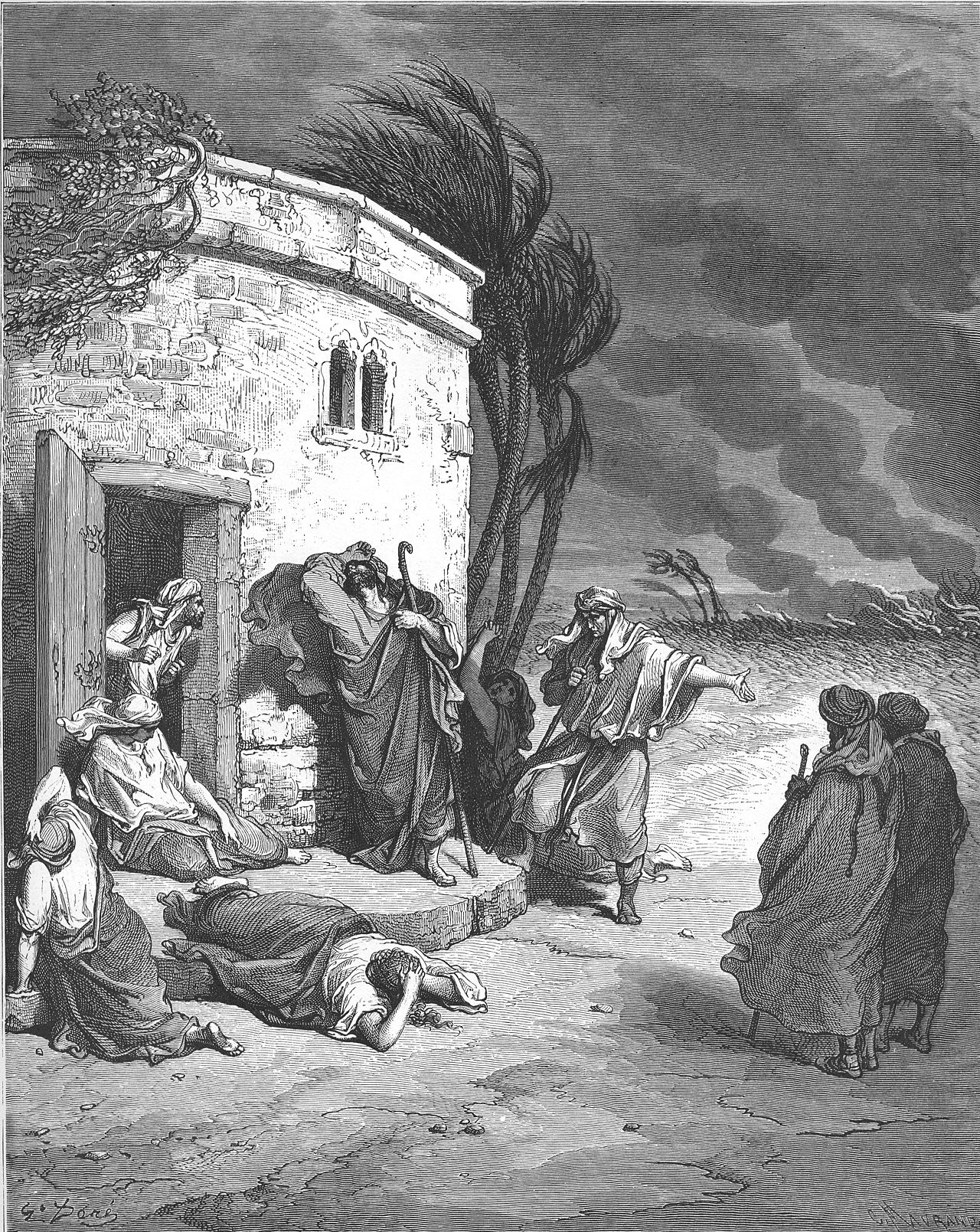
Who and where
1 name in this verse with a page on the site.
This page draws on Adam Clarke, Commentary on the Bible; Albert Barnes, Notes on the Book of Job; Albert Barnes, Notes, Explanatory and Practical, on the Old and New Testaments (1832-1869); Charles Spurgeon, The Metropolitan Tabernacle Pulpit, Sermon No. 623: “Satan Considering the Saints” (lightly modernized text, CCEL edition); Gregory the Dialogist, Morals on the Book of Job, Book II; John Gill, Exposition of the Old Testament (1748-1763); Matthew Henry, Commentary on the Whole Bible and Thomas Aquinas, Commentary on Job.