
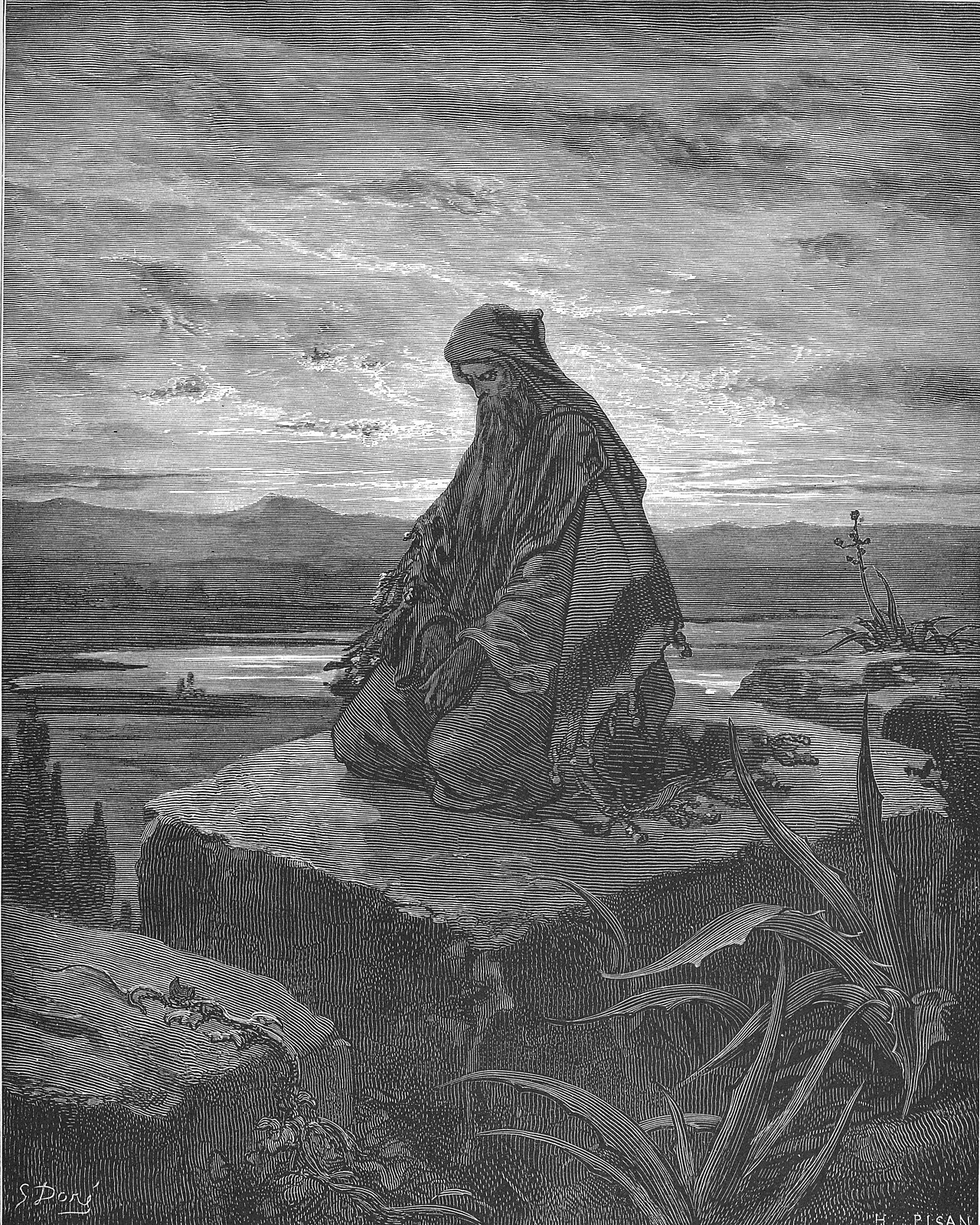
Isaiahchapter 49
26 verses · Isaiah · 8th century BC · The Prophets
He made My mouth like a sharp sword; He hid Me in the shadow of His hand. He made Me like a polished arrow; He hid Me in His quiver.
Introduction
Isaiah, The Prophets, Isaiah Overview.
Isaiah wrote this chapter for a people convinced that God had forgotten them. It opens the second part of the book of comfort with the second song of the Servant, spoken this time in the Servant's own voice. His task is first to restore Israel and then to reach far beyond it. The rest of the chapter answers Zion's complaint that she has been abandoned. Listen for the pictures of weapons held back, a mother with her child, and a crowded house. The New Testament takes up this song in the preaching of Paul and Barnabas.
Context
- Who
- A people convinced God had forgotten them
- What
- The second Servant Song, followed by God's answer to Zion's complaint that she has been forsaken.
- Where
- Spoken to the coastlands and distant peoples, and to Zion in ruins.
- When
- Spoken about 700 to 690 BC by the book's own reading.
- Why
- To show that the Servant will bring salvation to the ends of the earth, and that God has not forgotten Zion.
Historical context
The weapons in the opening lines are described as being kept back. God made his mouth like a sharp sword and hid him in the shadow of his hand; made him a polished arrow and hid him in his quiver. Both images are about restraint, a blade sheathed and an arrow that has been worked smooth so it will fly true, held until the shot is taken.
Show the rest of the historical context, 4 more paragraphs
The mission gets enlarged mid-song, and the enlargement is the point. It is too small a thing that you should be my servant to raise up the tribes of Jacob and restore the preserved of Israel; I will also give you as a light to the Gentiles, that you may be my salvation to the end of the earth. Restoring one nation is described as a job too small.
The court scene that follows is drawn from life at an imperial palace. Kings will see and stand up, and princes will worship; kings will be your foster fathers and their queens your nursing mothers; they will bow to you with their faces to the earth and lick up the dust of your feet. Assyrian and Persian reliefs show exactly that prostration before a throne, and licking the dust was a formula in their own royal letters.
The road home is a shepherd's road: they will feed along the ways, and their pastures will be on all the bare heights; they will not hunger or thirst, and the heat and sun will not strike them, for the one who has mercy on them will lead them by springs of water. And God says he will make all his mountains a road, and his highways will be raised up.
The last image answers the complaint head on. Zion says the LORD has forsaken me, my Lord has forgotten me. The reply is a question about mothers, can a woman forget her nursing child?, followed by an admission that some do, and then the guarantee: I have engraved you on the palms of my hands; your walls are continually before me. Marking a hand as a permanent reminder was a real practice, and a wall drawing on the palm is the kind of thing a builder does.
Significance
The servant's own discouragement is inside the song: I have labored in vain, I have spent my strength for nothing. Even here, the answer is not a denial. It is that his reward is with the LORD, and the assignment gets bigger.
Show the rest of the significance, 1 more paragraph
For exiles doing the mathematics of a ruined nation, the closing promise was almost too large to take in: children born during the bereavement, crowding in until the place is too narrow, and the mother asking who bore these for me.
This chapter in Jewish lifeWhat this chapter is in Jewish life and reading.
What is done
The site's own table in src/lib/hebraic/readings.ts sets this chapter in one prophetic reading of the annual cycle. It is read as the Haftarah of Eikev, Isaiah 49:14 to 51:3, in both rites, on the Sabbath of the portion Deuteronomy 7:12 to 11:25. A congregation keeping that cycle hears the verses of each reference read aloud after the Torah portion of its Sabbath.
The corpus joins the chapter to the weeks of the Torah portions through the works arranged by portion. Under the fifth verse it carries Midrash Tanchuma Buber, Ha'Azinu 2:2. Under the twenty-first verse it carries Bereshit Rabbati, Parashat Bereshit 17.
How it is read
Two commentators on this chapter carry English in the corpus. Rashi is quoted from The Judaica Press complete Tanach with Rashi, translated by A. J. Rosenberg, which Sefaria reports as CC-BY, and every quotation of it is held to fifty words or fewer because the translation is modern. Ibn Ezra is quoted from the version Sefaria titles Commentary of Ibn Ezra on Isaiah - trans. by M. Friedlander, 1873, which it reports as Public Domain.
Rashi reads the servant who speaks in the opening verses as the prophet himself. The name was given in the womb: "the thought came before Him that my name should be Isaiah", to prophesy salvations and consolations. The sword of the mouth is for rebuking the wicked (Rashi on Isaiah 49:1:1 and 49:2:1). The labour in vain is the prophet's complaint "when I saw that I admonish them and they do not obey" (Rashi on Isaiah 49:4:1). Ibn Ezra's note on the third verse, where the servant is called Israel, is a gloss naming God as the speaker (Ibn Ezra on Isaiah 49:3:1).
Rashi reads the light to the nations as a gift added to the charge: "to prophesy concerning the downfall of Babylon, which will be a joy for the whole world" (Rashi on Isaiah 49:6:1). A Christian reader who takes the servant of this song as Christ meets here a classical reading that takes him as Isaiah. The two readings part on who the servant is, and the card sets Rashi's down as his.
The second half of the chapter is Zion's complaint and the answer. Zion thought she was forgotten, and the answer is the hands: "I see you as though you are engraved on My hands, to see you and always to remember you". He gives a second reading beside it, the clouds of glory, from a verse of Job (Rashi on Isaiah 49:14:1 and 49:16:1). The crowding of the land he reads literally, a place too narrow for the returning to build their houses (Rashi on Isaiah 49:19:1). At the last verse the mighty one from whom the captives are taken is Esau (Rashi on Isaiah 49:24:1).
What the rabbis say
The corpus carries forty rabbinic locators on this chapter and the text of none, so each is cited and linked here rather than quoted. On the first verse it holds Ein Yaakov (Glick Edition), Taanit 1:48 and Midrash Tehillim 139:5. On the second verse it holds Midrash Tehillim 17:9. On the third verse it holds Bamidbar Rabbah 20:19 and Bereshit Rabbah 68:12. On the fourth verse it holds Bereshit Rabbah 62:1 and Jerusalem Talmud Avodah Zarah 3:1:9. On the fifth verse it holds Midrash Lekach Tov, Deuteronomy 3:24:1 and Midrash Tanchuma Buber, Ha'Azinu 2:2. On the sixth verse it holds Jerusalem Talmud Sheviit 4:8:5.
On the seventh verse it holds Ein Yaakov (Glick Edition), Sanhedrin 11:46 and Ein Yaakov, Taanit 1:53. On the eighth verse it holds Aggadat Bereshit 77:2 and Berakhot 8a:2. On the ninth verse it holds Aggadat Bereshit 7:3 and Eikhah Rabbah 2:9. On the tenth verse it holds Bava Kamma 92b:2 and Bava Metzia 107b:10. On the twelfth verse it holds Bamidbar Rabbah 16:25 and Bereshit Rabbah 52:4. On the thirteenth verse it holds Mekhilta DeRabbi Yishmael, Tractate Shirah 6:22 and Midrash Sekhel Tov, Bereshit 25:16:2. On the fourteenth verse it holds Aggadat Bereshit 71:1 and Aggadat Bereshit 71:3.
On the fifteenth verse it holds Aggadat Bereshit 71:2 and Aggadat Bereshit 71:5. On the sixteenth verse it holds Ein Yaakov (Glick Edition), Taanit 1:7 and Ein Yaakov, Taanit 1:10. On the eighteenth verse it holds Bamidbar Rabbah 11:2 and Bamidbar Rabbah 13:2. On the twentieth verse it holds Midrash Aggadah, Leviticus 8:3:2 and Midrash Lekach Tov, Exodus 11:2:1. On the twenty-first verse it holds Bereshit Rabbah 79:7 and Bereshit Rabbati, Parashat Bereshit 17. On the twenty-second verse it holds Bamidbar Rabbah 12:17 and Midrash Sekhel Tov, Shemot 17:15:1. On the twenty-third verse it holds Aggadat Bereshit 19:3 and Aggadat Bereshit 68:2.
On the twenty-fifth verse it holds Aggadat Bereshit 6:1. On the twenty-sixth verse it holds Yalkut Shimoni on Nach 443:2. What each of them teaches is a saying of the rabbis, and is reported as theirs wherever this site quotes one. The quotations wait on a fetch that carries the text.
Sources: Rashi, Rashi on Isaiah 49:1:1 to 49:24:1, The Judaica Press complete Tanach with Rashi, translated by A. J. Rosenberg, reported CC-BY; Ibn Ezra, Ibn Ezra on Isaiah 49:3:1 to 49:23:1, Commentary of Ibn Ezra on Isaiah - trans. by M. Friedlander, 1873, reported Public Domain; The Sefaria corpus, scripts/data/sources/sefaria/isaiah/49.json, the 40 Talmud and Midrash locators of this chapter; The site's own files, src/lib/hebraic/readings.ts, the Haftarah entries for Eikev (Isaiah 49:14 to 51:3).
The heads below are this chapter's scenes. The numbered points under each are its verses.
A Light to the Gentiles: My Mouth Like a Sharp Sword
Isaiah 49:1-2
The LORD called Me from the womb: The second Servant Song opens to the “islands”. “The LORD called Me from the womb”, a calling like the one at Jeremiah 1:5, “Before I formed you in the womb I knew you”. The LORD made his mouth “like a sharp sword”, then “hid Me in His quiver”.
Isaiah 49:1
“Listen - This is the exordium, or introduction. According to the interpretation which refers it to the Messiah, it is to be regarded as the voice of the Redeemer calling the distant parts of the earth to give a respectful attention to the statement of his qualifications for his work, and to the assurances that his salvation would be extended to them (compare Isa 41:1).”
1 more voice on this verseWhat preachers and commentators have said about this verse, in their own words.
Isaiah 49:1
“But this is directed to the isles (that is, the Gentiles, for they are called the isles of the Gentiles, Gen. x. 5 ) and to the people from far, that were strangers to the commonwealth of Israel, and afar off.”
Matthew Henry · Commentary on the Whole Bible (1707-1721)puritan
He made Me like a polished arrow: Wesley reads the sharp sword as the Servant's word, and the polished arrow as a bright point that pierces deeper. He reads the shadow of His hand as protection. Clarke holds that the Servant here must be the Messiah, in a fuller sense than any prophet.
Isaiah 49:2
“A sword - As he made me the great teacher of his church, so he made my word, quick and powerful, and sharper than any two- edged sword. Hath he hid - He will protect me from all mine enemies. Made me - Like an arrow, whose point is bright and polished; which therefore pierceth deeper.”
John Wesley · Explanatory Notes upon the Old Testament (1765)evangelical
1 more voice on this verse
Isaiah 49:2
“And he hath made my mouth like a sharp sword “And he hath made my mouth a sharp sword” - The servant of God, who speaks in the former part of this chapter, must be the Messiah. If any part of this character can in any sense belong to the prophet, yet in some parts it must belong exclusively to Christ; and in all parts to him in a much fuller and more proper sense.”
Adam Clarke · Commentary on the Bible (1810-1826)evangelical
The LORD names the servant outright, “You are My Servant, Israel, in whom I will display My glory”. The name ties the servant to the nation. Verses 5 and 6 then send the same servant “to raise up the tribes of Jacob”, a mission to Israel itself.
Isaiah 49:3
“And said unto me - That is, as I suppose, to the Messiah. God said to him that he was his servant; he by whom he would be particularly glorified and honored. Thou art my servant, O Israel - There has been great variety, as was intimated in the analysis of the chapter, in the interpretation of this verse. The question of difficulty is, to whom does the word ‘Israel’ refer? And if it refer to the Messiah, why is this name given to him? There is no variety in the ancient versions, or in the MSS.”
1 more voice on this verse
Isaiah 49:3
“O Israel - As the name of David is sometimes given to his successors, so here the name of Israel may not unfitly be given to Christ, not only because he descended from his loins; but also because he was the true and the great Israel, who, in a more eminent manner, prevailed with God, as that name signifies, of whom Jacob, who was first called Israel, was but a type.”
John Wesley · Explanatory Notes upon the Old Testament (1765)evangelical
The servant answers with a confession of apparent failure, “I have labored in vain, I have spent My strength in futility and vanity”. He turns the verdict over to the LORD, “yet My vindication is with the LORD, and My reward is with My God”. The complaint ends in trust.
Isaiah 49:4
“For it was a labor for the Word to come among us and to surrender himself to human fragility. But "my judgment" is the punishment of the Father that I [the Savior] have turned into a feast for their salvation. For that reason the judgment was taken away from him [the servant].”
Cyril of Alexandria · written before 444 · Commentary on Isaiah 4:4.49:4patristic
2 more voices on this verse
Isaiah 49:4
“Then I said - I the Messiah. In the previous verses he speaks of his appointment to the office of Messiah, and of his dignity. The design here is to prepare the way for the announcement of the fact that he would make known his gospel to the pagan, and would be for a light to the Gentiles.”
Isaiah 49:4
“His comfort is, and it may be the comfort of all faithful ministers, when they see little success of their labours, (1.) That, however it be, it is a righteous cause that they are pleading.”
Matthew Henry · Commentary on the Whole Bible (1707-1721)puritan
Isaiah 49:5-6
from the womb to be His Servant: The LORD “formed Me from the womb to be His Servant, to bring Jacob back to Him”, a first mission. Verse 6 calls that “not enough” and adds a wider one. Paul and Barnabas quote these words at Acts 13:47, “I have made you a light for the Gentiles”.
Isaiah 49:5
“Therefore, says he, we turn to the Gentiles, to preach the gospel to them, because so has the Lord commanded us, saying, I have set thee to be a light to the Gentiles. In this the Redeemer was truly glorious, though Israel was not gathered; the setting up of his kingdom in the Gentile world was more his honour than if he had raised up all the tribes of Jacob.”
Matthew Henry · Commentary on the Whole Bible (1707-1721)puritan
2 more voices on this verse
Isaiah 49:5
“And now, saith the Lord that formed me - This verse contains the reason why he cherished the hope that his work would not be unaccepted. The reason is, that Yahweh had said to him that he should be glorious in his eyes, and that he would be his strength. He stood so high in his favor, and he had such assurances of that favor, that he could confidently commit himself to his care.”
Isaiah 49:5
“In respect of nature, [Christ] differs in nothing from us, though he precedes us in time, so long as we all consist and are created by the same hand.”
Athanasius of Alexandria · written before 373 · Defense of the Nicencene Definition 3:9patristic
restore the protected ones of Israel: Clarke calls the Hebrew behind the protected ones of Israel a matter of doubt, and the Syriac reads it as branch, as in Isaiah 11:1. Wesley takes the tribes of Jacob as the remnant that survives. He takes the Servant himself as the author of that salvation.
Isaiah 49:6
“And to restore the preserved of Irsrae “And to restore the branches of Israel” - נצירי netsirey, or נצורי netsurey, as the Masoretes correct it in the marginal reading. This word has been matter of great doubt with interpreters: the Syriac renders it the branch, taking it for the same with נצר netser, Isa 11:1. See Michaelis Epim. in Praelect. xix.”
Adam Clarke · Commentary on the Bible (1810-1826)evangelical
1 more voice on this verse
Isaiah 49:6
“It is - This is but a small favour. The tribes - That remnant of them which shall survive all their calamities. My salvation - The great instrument and author of that eternal salvation which I will give to the Gentiles.”
John Wesley · Explanatory Notes upon the Old Testament (1765)evangelical
Cross references
Isaiah 49:6
- Quoted inActs 13:47For this is what the Lord has commanded us: ‘I have made you a light for the Gentiles, to bring salvation to the ends of the earth.’”
'I have set thee to be a light of the Gentiles' ('so hath the Lord commanded us')
The LORD speaks “to Him who was despised and abhorred by the nation, to the Servant of rulers”. The ground is the LORD’s own faithfulness. One sentence joins the deepest humiliation and the highest exaltation, the pattern the fourth Servant Song carries to full length in chapter 53.
Isaiah 49:7
“Thus saith the Lord - This verse contains a promise of the future honor that should await the Redeemer, and of the success which should crown his work. The sense is, that Yahweh had promised to him who was despised and rejected, that kings and princes should yet rise up and honor him. The Redeemer of Israel - (See the note at Isa 43:1). To him whom man despiseth - On the construction of the Hebrew here, see Gesenius, Vitringa, and Hengstenberg.”
1 more voice on this verse
Isaiah 49:7
“This shall be the accomplishment of God's promise, and he will give him the heathen for his inheritance, and therefore it shall be done, because of the Lord who is faithful and true to his promise; and this shall be an evidence that Christ had a commission for what he did, and that God had chosen him, and would own the choice he had made.”
Matthew Henry · Commentary on the Whole Bible (1707-1721)puritan
Say to the Prisoners, Go Forth; Sing, O Heavens
Isaiah 49:8-9
“In the time of favor I will answer You” is the LORD’s reply to his servant. Paul quotes this verse at 2 Corinthians 6:2, where “now is the day of salvation”. The servant’s work begins as release, telling the prisoners to come out and those in darkness to show themselves.
Isaiah 49:8
“Thus saith the Lord - Still an address to the Messiah, and designed to give the assurance that he should extend the true religion, and repair the evils of sin on the earth. The Messiah is represented as having asked for the divine favor to attend his efforts, and this is the answer, and the assurance that his petition had not been offered in vain. In an acceptable time - Hebrew, ‘In a time of delight or will,’ that is, a time when Yahweh was willing, or pleased to hear him.”
2 more voices on this verse
Isaiah 49:8
“Heard thee - Though not so as to deliver thee from death; yet so as to crown thee with glory and honour. For a covenant - To be the Mediator and surety of that covenant, which is made between me and them. To establish - To establish truth and righteousness upon earth, and subdue those lusts and passions, which are the great disturbers of human society.”
John Wesley · Explanatory Notes upon the Old Testament (1765)evangelical
Isaiah 49:8
“Messiah is represented as having asked for the grace of God in behalf of sinners; this verse contains God the Father's favorable answer. an acceptable time--"In a time of grace" [HENGSTENBERG].”
Jamieson, Fausset & Brown · Commentary Critical and Explanatory on the Whole Bible (1871)reformed
Cross references
Isaiah 49:8
- Quoted in2 Corinthians 6:2“For He says: “In the time of favor I heard you, and in the day of salvation I helped you.” Behold, now is the time of favor; now is the day of salvation!”
'In an acceptable time have I heard thee' ('he saith')
find pasture on every barren hill: Rosenmuller reads the pasture along the pathways as food found on the road home, so Israel need never turn aside to seek it. Henry adds the barren hill. When God pleases, dry and high ground feeds the sheep of His pasture.
Isaiah 49:9
“When God pleases even highway ground shall be good ground for the sheep of his pasture to feed in. Their pastures shall be not only in the valleys, but in all high places, which are commonly dry and barren. Wherever God brings his people he will take care they shall want nothing that is good for them, Ps. xxxiv.”
Matthew Henry · Commentary on the Whole Bible (1707-1721)puritan
2 more voices on this verse
Isaiah 49:9
“Another sense probably is the right one. Israel, on its way back to the Holy Land, shall not have to turn aside to devious paths in search of necessaries, but shall find them in all places wherever their route lies; so ROSENMULLER.”
Jamieson, Fausset & Brown · Commentary Critical and Explanatory on the Whole Bible (1871)reformed
Isaiah 49:9
“Prisoners - To the Gentiles who are fast bound by the cords of their sins, and taken captive by the devil at his will. Go forth - Come forth to the light, receive divine illumination. In high places - They shall have abundant provision in all places, yea even in those which commonly are unfruitful, such are both common roads and high grounds.”
John Wesley · Explanatory Notes upon the Old Testament (1765)evangelical
Isaiah 49:10-13
They will not hunger or thirst: The regathering is a flock led by the LORD, who “will guide them and lead them beside springs of water”, an image John’s Gospel echoes. The exiles come “from the north and from the west”, and from Sinim, which the Berean reads as “the land of Aswan”.
Isaiah 49:10
“But since they have been called to the light of truth, they have become pastures for them, and feeding-grounds that nourish them toward spiritual manliness, and to the desire for every good thing. And God promises them the abundance of His grace, and help, and spiritual consolation. For they shall not hunger, nor shall they thirst, he says. For long ago they were in want of spiritual consolation, for there was among them no divine law, no prophet, no guide, no instructor, no teacher, no spring of spiritual waters.”
Cyril of Alexandria · written before 444 · Commentary on Isaiahpatristic
1 more voice on this verse
Isaiah 49:10
“They shall not hunger nor thirst - All their needs shall be abundantly provided for, as a shepherd will provide for his flock. In the book of Revelation, this entire passage is applied Isa 7:16-17 to the happiness of the redeemed in heaven, and the use which is made of it there is not foreign to the sense in Isaiah.”
My highways will be raised up: Barnes reads the raised highways as the LORD clearing every obstruction from the road home from Babylon, the promise first given at Isaiah 40:4. Henry carries it to the way to heaven. Grace levels mountains that the traveler's own strength cannot climb.
Isaiah 49:11
“And I will make all my mountains a way - I will make all the mountains for a highway; or an even, level way. That is, he would remove all obstructions from their path. The image is taken from the return from Babylon to the land of Palestine, in which God so often promises to make the hills a plain, and the crooked places straight (see the notes at Isa 40:4).”
2 more voices on this verse
Isaiah 49:11
“The levelling of the roads from Babylon, as it was foretold ( ch. xl. 2, 3 ), was applied to gospel work, and so may this be. Though there be difficulties in the way to heaven, which we cannot by our own strength get over, yet the grace of God shall be sufficient to help us over them and to make even the mountains a way, ch. xxxv.”
Matthew Henry · Commentary on the Whole Bible (1707-1721)puritan
Isaiah 49:11
“If some come "from the north" and some "from the sea," that is, from the western parts, and others come "from the land of the Persians" (meaning the highlands), then those in the first clause who are from the land far away are called "of the midday," since the uncircumscribable southern country lies among the midday people. These people are the ones who "shall come from a distance." But the word prophesies that they will come from all over, from the four latitudes to God and will receive the promises spoken to them.”
Eusebius of Caesarea · written before 339 · Commentary on Isaiah 2:35patristic
The land of Aswan renders the Hebrew Sinim, which Clarke records Michaelis took for Syene at the south of Egypt. Gesenius took it for China, far away in the east. With the north and the west, it makes the four quarters from which Eusebius sees them come.
Isaiah 49:12
“And he sets out the return of the captives: behold these shall come from afar, from the east, and from the sea, the west: I will bring them from the north (Jer 31:8).”
Thomas Aquinas · written before 1274 · Commentary on Isaiahpatristic
3 more voices on this verse
Isaiah 49:12
“Behold, these shall come from far - “Babylon was far and east, ממזרח mimmizrach, (non sic Vett.), Sinim, Pelusians, to the south.” - Secker. The land of Sinim - Prof. Doederlein thought of Syene, the southern limit of Egypt, but does not abide by it. Michaelis thinks it is right, and promises to give his reasons for so thinking in the second part of his Spicilegium Geographiae Hebraeorum Exterae. See Biblioth. Oriental.”
Adam Clarke · Commentary on the Bible (1810-1826)evangelical
Isaiah 49:12
“Sinim - Either of the Sinites as they are called, Gen. x, 17, who dwelt about the wilderness. Or of Sin, a famous city of Egypt, which may be put for all Egypt, and that for all southern parts.”
John Wesley · Explanatory Notes upon the Old Testament (1765)evangelical
Isaiah 49:12
“Sinim--The Arabians and other Asiatics called China Sin, or Tchin; the Chinese had no special name for themselves, but either adopted that of the reigning dynasty or some high-sounding titles. This view of "Sinim" suits the context which requires a people to be meant "from far," and distinct from those "from the north and from the west" [GESENIUS].”
Jamieson, Fausset & Brown · Commentary Critical and Explanatory on the Whole Bible (1871)reformed
Shout for joy, O heavens: Jamieson, Fausset and Brown weigh the word His. God has compassion on the afflicted as afflicted, and on His afflicted ones because of the covenant. Barnes sets the song against the light promised to the nations in verse 6.
Isaiah 49:13
“Sing, O heavens - In view of the glorious truths stated in the previous verses, that kings should rise up, and princes worship; that the Messiah would be for a light to the Gentiles, and that the true religion would be extended to each of the four quarters of the globe. The idea in this verse is, that it was an occasion on which the heavens and the earth would have cause to exult together.”
2 more voices on this verse
Isaiah 49:13
“We say that those humble ones who submit their necks to Christ and who do not despise the yoke of a kingdom under him, in that they welcome faith, will be fit to worship him in spirit and in truth. [They will] fulfill the worship of those who did not receive faith, those who were not humble but raised their proud horns in the air and spoke unrighteousness against him and his holy prophecies and who exulted in stretching out the neck of their understanding. These were not worthy of spiritual consolation, for they were not deserving.”
Cyril of Alexandria · written before 444 · Commentary on Isaiah 4:4.49:13patristic
Isaiah 49:13
“God will have mercy on the afflicted, because of His compassion; on His afflicted, because of His covenant.”
Jamieson, Fausset & Brown · Commentary Critical and Explanatory on the Whole Bible (1871)reformed
Graven Upon the Palms of My Hands
Zion answers everything just promised with a complaint, “The LORD has forsaken me; the Lord has forgotten me”. The people the promises were for speak it, and the comfort chapters have been building toward this objection. The verses that follow answer it directly and with tenderness.
Isaiah 49:14
“The Lord (יהוה Yehovah) hath forsaken me, and my Lord (אדני Adonai) hath forgotten me - But a multitude of MSS. and several ancient editions read יהוה Yehovah in both places.”
Adam Clarke · Commentary on the Bible (1810-1826)evangelical
Isaiah 49:15-16
The LORD answers Zion with the strongest human bond, “Can a woman forget her nursing child”, and then surpasses it. Verse 16 gives the proof, “I have inscribed you on the palms of My hands”, a mark carried on the body itself. Zion’s walls stand “ever before Me.”
Isaiah 49:15
This providence and love of God therefore, which the Lord in His unwearied goodness vouchsafes to show us, He compares to the tenderest heart of a kind mother, as He wishes to express it by a figure of human affection, and finds in His creatures no such feeling of love, to which he could better compare it. And He uses this example, because nothing dearer can be found in human nature, saying: "Can a mother forget her child, that she should not have compassion on the son of her womb?"
John Cassian · written before 435 · The Third Conference of Abbot Chaeremon, Chapter 17patristic
1 more voice on this verse
Isaiah 49:15
“Can a woman forget her sucking child? - The design of this verse is apparent. It is to show that the love which God has for his people is stronger than that which is produced by the most tender ties created by any natural relation. The love of a mother for her infant child is the strongest attachment in nature. The question here implies that it was unusual for a mother to be unmindful of that tie, and to forsake the child that she should nourish and love.”
on the palms of My hands: Clarke sees an allusion to a custom of the time, the city inscribed on the palms by puncture and made lasting with fire or stain. The LORD bears such a mark for Zion. Ambrose's text has the walls of Jerusalem painted.
Isaiah 49:16
“Behold, I have graven thee upon the palms of my hands “Behold, on the palms of my hands have I delineated thee” - This is certainly an allusion to some practice, common among the Jews at that time, of making marks on their hands or arms by punctures on the skin, with some sort of sign or representation of the city or temple, to show their affection and zeal for it. They had a method of making such punctures indelible by fire, or by staining. See note on Isa 44:6 (note).”
Adam Clarke · Commentary on the Bible (1810-1826)evangelical
2 more voices on this verse
Isaiah 49:16
“Let us flee these evils and elevate our soul to the image and likeness of God. The flight from evils is the likeness of God, and the image of God is gained through the virtues. And so, like a painter, he has painted us with the colors of the virtues. "See, I have painted your walls, Jerusalem." Let us not wipe away with the brush of neglect the props of the painted walls of our soul.”
Ambrose of Milan · written before 397 · Death as a Good 5:17patristic
Isaiah 49:16
“Two things are here promised, which were to be in part accomplished in the reviving of the Jewish church after its return out of captivity, but more fully in the planting of the Christian church by the preaching of the gospel of Christ; and we may take the comfort of these promises.”
Matthew Henry · Commentary on the Whole Bible (1707-1721)puritan
Isaiah 49:17-21
Your builders hasten back: “Your builders hasten back” while “your destroyers and wreckers depart from you”, and the ruined land “will now indeed be too small for your people”. Zion is astonished at the increase. The numbers outrun anything she counted on when she said the LORD had forsaken her.
Isaiah 49:17
“And the manner of its fulfillment: your builders are come, that is, the rebuilders, namely, Zorobabel and Jesus and others already before my eyes; they that destroy you, the Chaldeans: the hands of Zorobabel have laid the foundations of this house (Zech 4:9).”
Thomas Aquinas · written before 1274 · Commentary on Isaiahpatristic
3 more voices on this verse
Isaiah 49:17
“Thy children - The children of Zion - the true people of God. But there is here considerable variety in the interpretation. The Hebrew of the present text is בניך bânâyı̂k (“thy sons”). But Jerome reads it, Structores tui - ‘Thy builders;’ as if it were בונין.”
Isaiah 49:17
“By Christ the prince of this world, the great destroyer, is cast out, is dispossessed, has his power broken and his attempts quite baffled. (2.) Now by this it will appear that Zion's suggestions were altogether groundless, that God has not forsaken her, nor forgotten her, nor ever will.”
Matthew Henry · Commentary on the Whole Bible (1707-1721)puritan
Isaiah 49:17
“Thy children shall make haste,.... Regenerate persons, young converts, such as are born again of incorruptible seed by the word; these shall flock to the church, as doves to the windows; join themselves to her, and submit to Gospel ordinances, and make haste, and delay not, to keep the Lord's commandments; which is no small pleasure, joy, and comfort to the church of God.”
put them on like a bride: Clarke finds the Hebrew incomplete, a bride who wears her children, and follows the Septuagint in supplying her ornaments. The Berean jewelry gives that sense. Henry reads the children who gather to Zion as those who come to the church through faith.
Isaiah 49:18
“And he added: And in the blood of the grape, his garment: that is, in the suffering of his body, he washed the nations with his blood. For indeed, the nations are the garment of the Word, as it is written: As I live, says the Lord, unless I clothe them all as a garment. And elsewhere: You will change them as a garment, and they will be changed. Therefore, he has cleansed not with his own blood, their sins which they did not have, but with our sins which we have committed.”
Ambrose of Milan · written before 397 · On the Blessings of the Patriarchs, 4.24patristic
2 more voices on this verse
Isaiah 49:18
“Bind them on thee, as a bride doeth “Bind them about thee, as a bride her jewels” - The end of the sentence is manifestly imperfect. Does a bride bind her children, or her new subjects, about her? Sion clothes herself with her children, as a bride clothes herself, - with what? some other thing certainly. The Septuagint help us out in this difficulty, and supply the lost word: ὡς κοσμον νυμφη· as a bride her ornaments. ככליה כלה kichleyha callah, or ככלה כליה kecallah keleyha.”
Adam Clarke · Commentary on the Bible (1810-1826)evangelical
Isaiah 49:18
“They come to Jerusalem from all the adjacent countries, for that was then the centre of their unity; but, under the gospel, it is by a spiritual accession to the mystical body of Christ in faith and love. Those that come to Jesus as the Mediator of the new covenant do thereby come to the Mount Zion, the church of the first-born, Heb. xii.”
Matthew Henry · Commentary on the Whole Bible (1707-1721)puritan
too small for your people: Barnes notes your ravaged land is in Hebrew the land of your destruction, a noun doing the work of an adjective, as in Psalm 2:6. The land lay desolate. Cyril pictures those who devoured it as wild beasts, who depart far away and leave the desolate places to her children.
Isaiah 49:19
“For thy waste and thy desolate places - Thy land over which ruin has been spread, and ever which the exile nation mourns. And the land of thy destruction - That is, thy land laid in ruins. The construction is not uncommon where a noun is used to express the sense of an adjective. Thus in Psa 2:6, the Hebrew phrase (margin) is correctly rendered ‘my holy hill.’ Here the sense is, that their entire country had been so laid waste as to be a land of desolation.”
1 more voice on this verse
Isaiah 49:19
This means that he is teaching here about the ones who were swarming and absorbing it, those who had taken it over. For almost like wild beasts they had reduced and absorbed it. He shows here that the number of those called are so many that they are without number. For his children, it says, that you have lost have pleaded in your ear, "Make room for me."
Cyril of Alexandria · written before 444 · Commentary on Isaiah 4:4.49:19-21patristic
the children of your bereavement: Barnes gives the Hebrew as the children of your widowhood, sons born to Zion after those lost in war and in exile. Aquinas ties their cry that the land is too small to Isaiah 54:2. Her bereavement becomes a crowded home.
Isaiah 49:20
“Third, he foretells the multitude of its inhabitants: the children of your barrenness, that is, those who were born when they believed you were barren, emptied of inhabitants, below: enlarge the place of your tent (Isa 54:2).”
Thomas Aquinas · written before 1274 · Commentary on Isaiahpatristic
3 more voices on this verse
Isaiah 49:20
“The children which thou shalt have, after thou hast lost the other,.... Which "other lost" are not the Jews, the broken branches, rejected and cut off for unbelief; and the "children after" them not the Gentiles converted, which took their place; but "the other" are such who have been destroyed by the Heathen persecutions, and especially by the antichristian cruelties; and the "children after", the great numbers of converts upon the fall of antichrist.”
Isaiah 49:20
“The children which thou shalt have - The increase of the population shall be so great. After thou hast lost the other - Hebrew, ‘The sons of thy widowhood.’ That is, after thou hast lost those that have been killed in the wars, and those that have died in captivity in a distant land, there shall be again a great increase as if they were given to a widowed mother.”
Isaiah 49:20
“God will repair his church's losses and secure to himself a seed to serve him in it. It is promised to the Jews, after their return, that Jerusalem shall be full of boys and girls playing in the streets, Zech. viii.”
Matthew Henry · Commentary on the Whole Bible (1707-1721)puritan
I was bereaved and barren: Wesley takes Zion as a wife left alone, bereaved and barren, forsaken by God who had owned Himself her husband. Jamieson, Fausset and Brown hear the same surprise at Acts 10:45. Gentiles joining the mother church of Jerusalem raised the same question of where they came from.
Isaiah 49:21
“Secondarily, the accession of spiritual Israelites to the mother church of Jerusalem from the Gentiles is meant. This created surprise at first (Ac 10:45; 15:3, 4). lost . . . am desolate, a captive, and removing to and fro--rather, "bereaved of . . . have been barren, an exile and outcast" [HORSLEY].”
Jamieson, Fausset & Brown · Commentary Critical and Explanatory on the Whole Bible (1871)reformed
2 more voices on this verse
Isaiah 49:21
“She was left alone in obscurity ( this is Zion whom no man seeks after ), left in all the solitude and sorrow of a widowed state. How then came she to be thus replenished?”
Matthew Henry · Commentary on the Whole Bible (1707-1721)puritan
Isaiah 49:21
“Who - Whence have I this numberless issue? Seeing - Seeing I was in a manner left childless. Desolate - Without an husband, being forsaken by God, who formerly owned himself for my husband.”
John Wesley · Explanatory Notes upon the Old Testament (1765)evangelical
Kings Shall Be Thy Nursing Fathers
Isaiah 49:22-23
lift up My hand to the nations: The nations that held Zion’s children carry them home; kings become “your foster fathers” and queens “your nursing mothers”, bowing “facedown”. The verse ends on recognition, “Then you will know that I am the LORD; those who hope in Me will never be put to shame.”
Isaiah 49:22
“Thus saith the Lord God,.... In answer to the questions, where had these children been? and from whence did they come? who begot them, and brought them up? and by what means was all this done, or would be done? I will lift up mine hand to the Gentiles; beckoning them to come unto him, directing and ordering them what to do; or rather exerting the power of his grace in the conversion of them.”
2 more voices on this verse
Isaiah 49:22
“Thus saith the Lord God - אדני יהוה Adonai Yehovah. Adonai is wanting in one MS., in the Alexandrine copy of the Septuagint, and in the Arabic.”
Adam Clarke · Commentary on the Bible (1810-1826)evangelical
Isaiah 49:22
“The Christian church, after a long captivity, was happy in some such kings and queens as Constantine and his mother Helena, and afterwards Theodosius, and others, who nursed the church with all possible care and tenderness. Whenever the sceptre of government is put into the hands of religious princes, then this promise is fulfilled.”
Matthew Henry · Commentary on the Whole Bible (1707-1721)puritan
lick the dust at your feet: Barnes reads the kings as guardians who protect and provide for the people of God as a parent does a child. Henry names Constantine, his mother Helena and Theodosius as rulers who nursed the church. Wesley calls the bow an eastern custom.
Isaiah 49:23
“And kings shall be thy nursing fathers - Margin, ‘Nourishers.’ That is, they would patronize the church of God; they would protect it by their laws, and foster it by their influence and become the personal advocates of the cause of Zion. The idea is properly that of guarding, educating, and proriding for children; and the sense is that kings and princes would evince the same tender care for the interests of the people of God which a parent or a nurse does for a child.”
1 more voice on this verse
Isaiah 49:23
“Lick the dust - They shall highly reverence and honour thee. These expressions are borrowed from the practice of the eastern people, who bowed so low as to touch the ground.”
John Wesley · Explanatory Notes upon the Old Testament (1765)evangelical
Isaiah 49:24-26
Can the plunder be snatched from the mighty: The LORD answers in his own name, “Even the captives of the mighty will be taken away”. The oppressors “eat their own flesh”. The chapter closes, “all mankind will know” the LORD as “the Mighty One of Jacob”, the title Jacob uses in blessing Joseph at Genesis 49:24.
Isaiah 49:24
“Shall the prey be taken from the mighty “Shall the prey seized by the terrible be rescued” - For צדיק tsaddik, read עריץ arits. A palpable mistake, like that in Isa 42:19. The correction is self-evident from the very terms of the sentence; from the necessity of the strict correspondence in the expressions between the question and the answer made to it, - and it is apparent to the blindest and most prejudiced eye.”
Adam Clarke · Commentary on the Bible (1810-1826)evangelical
2 more voices on this verse
Isaiah 49:24
“Shall the prey - Here is a double impediment to their deliverance, the power of the enemy who kept them in bondage, and the justice of God which pleads against their deliverance.”
John Wesley · Explanatory Notes upon the Old Testament (1765)evangelical
Isaiah 49:24
“IN the days when this prophecy was written, there were certain great nations of the earth that sought and obtained their wealth, not by commerce, but by force—not by fair trading, but by fiercely invading their richer neighbors. The Babylonians and the Chaldeans gathered together great armies and then pounced upon small territories, such as those at Israel and Judea, and carried off all the substance of the inhabitants as a prey. When the marauding host, flushed with victory, was returning home with its booty, it would have been a very dangerous thing to attempt to rescue the spoil.”
Charles Spurgeon · written before 1892 · The Metropolitan Tabernacle Pulpit, Sermon No. 3462: “To the Rescue” (lightly modernized text, CCEL edition)Particular Baptist
the plunder of the tyrant: Barnes gives the Hebrew as the captivity of the mighty and applies it to the captives held in Babylon. Their release lay beyond any ordinary means. The LORD will contend with the tyrant himself to save her children.
Isaiah 49:25
“But thus saith the Lord - The meaning of this verse is, that however difficult or impracticable this might seem to be, yet it should be done. The captives taken by the terrible and the mighty should be rescued, and should be restored to their own land. Even the captives of the mighty shall be taken away - Margin, as Hebrew, ‘The captivity of the mighty.’ That which could not have been rescued by any ordinary means. The language here refers undoubtedly to Babylon, and to the captivity of the Jews there.”
they will be drunk on their own blood: Barnes reads the figure as civil strife, the oppressors turning on each other until they are drunk with blood, as in Isaiah 9:20. Jerome has them sated with their own death and flesh. All mankind then learns that the Mighty One of Jacob is Savior.
Isaiah 49:26
“And I will feed them that oppress thee with their own flesh - The language used here is that which appropriately describes the distresses resuiting from discord and internal strifes. Similar language occurs in Isa 9:20 (see the note on that verse). Their rage shall be excited against each other; and there shall be anarchy, internal discord, and the desire of mutual revenge. They shall destroy themselves by mutual conflicts, until they are gorged with slaughter, and drunk with blood.”
1 more voice on this verse
Isaiah 49:26
“Whoever suffers anything on account of me obtains help from me, the One who gives strength to you, Jacob, that is, all of you from the seed of Jacob. I have said how he sends them prophetic words in the mouth of the holy apostles and evangelists that they are from Jacob, which clearly relates to the flesh. And it is small wonder that Jacob was called the supplanter, that is, the supplanter of Satan and of those who casually and with youthful neglect rush into the noose of sins.”
Cyril of Alexandria · written before 444 · Commentary on Isaiah 4:4.49:25-26patristic
Keep studying
Studies8
People and groups1
Places1
Sources for this chapter
The summary
Jamieson, Fausset & Brown, Commentary Critical and Explanatory; John Calvin, Commentaries; John Wesley, Notes on the Old Testament and Matthew Henry, Complete Commentary.
The exposition
Adam Clarke, Commentary on the Bible; Albert Barnes; Ambrose of Milan, DEATH AS A GOOD 5:17; Cyril of Alexandria, COMMENTARY ON ISAIAH 4:4.49:19-21; Eusebius of Caesarea, COMMENTARY ON ISAIAH 2:35; Franz Delitzsch, Biblical Commentary on the Prophecies of Isaiah; Jamieson, Fausset & Brown, Commentary Critical and Explanatory on the Whole Bible; Jerome, Commentary on Isaiah; John Calvin, Commentary on the Book of the Prophet Isaiah; John Gill, Exposition of the Old Testament; John Wesley, Explanatory Notes upon the Old Testament; Matthew Henry, Commentary on the Whole Bible and Thomas Aquinas, Commentary on Isaiah.