
Isaiah 49:14
in Isaiah 49But Zion said, “The LORD has forsaken me; the Lord has forgotten me!”
BSB
The same verse in ASV and KJV ▾
ASV
But Zion said, Jehovah hath forsaken me, and the Lord hath forgotten me.
KJV
But Zion said, The Lord hath forsaken me, and my Lord hath forgotten me.
⋯
This verse in Isaiah 49
Commentary
10 notes on this verseBut Zion said,.... By way of objection, as some think, to the above prophecies of glorious and comfortable times; she being now in a very disconsolate condition, and could not tell how to take it in, how it should thus be, when the case was with her as it was; though I rather think the words should be rendered, "for Zion had said"; and which is mentioned to show the uncomfortable condition she had been in, and to observe the method the Lord took to comfort her, as he before promises.
This site's exposition
The LORD has forsaken me
Zion answers everything just promised with a complaint, “The LORD has forsaken me; the Lord has forgotten me”. The people the promises were for speak it, and the comfort chapters have been building toward this objection. The verses that follow answer it directly and with tenderness, beginning with the mother and her nursing child in verse 15.
The record, by era
The Church Fathers2 voices
Jerusalem and Zion are understood in four ways in the holy Scriptures, as we have often mentioned. One, according to the Jews, which the Lord laments in the Gospel, "Jerusalem, Jerusalem, who kills the Prophets, and stones those who are sent to you."… Secondly, the congregation of the Saints, who are established in the peace of the Lord and in the towers of virtues, are rightly called Zion, of whom it is said: "Its foundations are on the holy mountains: the Lord loves the gates of Zion more than all the dwellings of Jacob." For the foundations of the Jewish Zion, which we see to be destroyed, were not loved by the Lord, nor could that which was loved by the Lord be destroyed. Thirdly, Jerusalem is called the multitude of Angels, Dominions, and Powers, and everything that is established in the ministry of God.… Fourthly, Jerusalem is called the one which the Jews and our Judaizers, according to the Apocalypse of John, think should be placed in the celestial realm as a golden and bejeweled one, which they do not understand, whose boundaries and infinite breadth are also described in the final part of Ezekiel. Therefore, since these things are so, let us now examine more closely what Zion has said: The Lord has forsaken me, and the Lord has forgotten me. There is no doubt that the congregation of the saints, which was once among the Jews and was abandoned by the Lord, laments this and bitterly mourns that it has been deserted and deprived of the Lord's help.
(Verse 14 and following) And Zion said: The Lord has abandoned me, and the Lord has forgotten me. Can a woman forget her nursing child, so as not to have compassion on the son of her womb? Even if she forgets, I will not forget you. Behold, I have inscribed you on the palms of my hands; your walls are always before my eyes. Your builders have come, and those who destroyed and devastated you will depart from you. Lift up your eyes all around and see; all these have gathered together, they have come to you.
The Medieval Church2 voices
A commentator
Gregory the DialogistMorals on the Book of Job, Book 32, Section 7 · Written before 604.
proposed
And again speaking by the comparison of a wife, He says: "Even if she shall have forgotten, yet will I not forget thee." For who can be ignorant, that the memory of God is neither broken off by oblivion, nor yet repaired by recollection? But when He neglects and passes over some things, He is said, after the manner of minds, to forget, and when, after a long time, He visits the things He wills, He is said, after the fashion of our changeableness, to have remembered. For how does oblivion weaken the strength of that Godhead, with Which even praiseworthy memory itself has no essential agreement. For men remember no things, except those which are either past or absent. How then does God remember past things, when the very things which in themselves pass away, stand ever present at His beck? Or how does He call to mind things absent, when every thing that is, is present to Him, from the fact that it exists in Him? For if it were not present to Him, it would not exist at all; for things nonexistent He creates, by looking on them, things existent He keeps together, by looking on them.
904. And Zion said. Here he excludes their doubt. And first, that which arose from divine indignation; second, that which arose from their dejection: and you shall say in your heart (Isa 49:21); third, that which arose from the power of their enemies, where it …
The Puritans and the Awakening1 voice
12 ), and has forgotten their sins, Ps. x. Weak believers, in their despondency, are ready to say, "God has forsaken his church and forgotten the sorrows of his people." But we have no more reason to question his promise and grace than we have to question his providence and justice. He is as sure a rewarder as he is a revenger.
quarantine:debris (2026-07-29) — leading-citation-number+unbalanced-parens
3 more voices on this verse
The Nineteenth Century3 voices
The Lord (יהוה Yehovah) hath forsaken me, and my Lord (אדני Adonai) hath forgotten me - But a multitude of MSS. and several ancient editions read יהוה Yehovah in both places.
A commentator
Jamieson, Fausset & Brown1802–1910
Commentary Critical and Explanatory on the Whole Bible (1871)
proposed
Zion--the literal Israel's complaint, as if God had forsaken her in the Babylonian captivity; also in their dispersion previous to their future restoration; thereby God's mercy shall be called forth (Isa 63:15-19;
quarantine:debris (2026-07-29) — unbalanced-parens
A commentator
Albert Barnes1798–1870
Notes, Explanatory and Practical, on the Old and New Testaments (1832-1869)
proposed
But Zion said - On the word ‘Zion,’ see the note at Isa 1:8. The language here is that of complaint, and expresses the deep feeling of the people of God amidst many calamities, afflictions, and trials. It may be applicable to the exile Jews in Babylon during their long captivity, as if God had forsaken them; or to those who were waiting for the coming of the Messiah, and who were sighing for the divine interposition under him to restore the beauty of Zion, and to extend his kingdom; or in general, to the church when wickedness triumphs in a community, and when God seems to have forsaken Zion, and to have forgotten its interests. The language here was suggested, doubtless, by a view of the desolations of Jerusalem and Judea, and of the long and painful captivity in Babylon; but it is general, and is applicable to the people of God, in all times of similar oppression and distress. The object of the prophet is to furnish the assurance that, whatever might be the trials and the sufferings of his people, God had not forgotten them, and he neither could nor would forsake them. For this purpose, he makes use of two most striking and forcible arguments Isa 49:15-16, to show in the strongest possible manner that the interests of his people were safe.
The words behind it
6 Hebrew wordsEvery Hebrew word of this verse in the order it stands, with what it means and the door to its own study. The last column counts the times a word stands in the whole Bible: the rarer the word, the more the places it appears belong together.
| Hebrew | Sound | Meaning | Word study | In the Bible |
|---|---|---|---|---|
| וַתֹּ֥אמֶר | vatomer | and it said | H559 → | 5305 times |
| צִיּ֖וֹן | tziyon | Zion | H6726 → | 154 times |
| עֲזָבַ֣נִי | ʾazavani | he has forsaken me | H5800 → | 215 times |
| יְהוָ֑ה | yahweh | Yahweh | H3068 → | 6520 times |
| וַאדֹנָ֖י | vadonai | and [the] Lord | H136 → | 440 times |
| שְׁכֵחָֽנִי׃ | shekhechani | he has forgotten me | H7911 → | 102 times |
וַתֹּ֥אמֶרand it said
vatomerH559 →5305 times
צִיּ֖וֹןZion
tziyonH6726 →154 times
עֲזָבַ֣נִיhe has forsaken me
ʾazavaniH5800 →215 times
יְהוָ֑הYahweh
yahwehH3068 →6520 times
וַאדֹנָ֖יand [the] Lord
vadonaiH136 →440 times
שְׁכֵחָֽנִי׃he has forgotten me
shekhechaniH7911 →102 times
A shaded row is a word that stands 400 times or fewer in the Bible.
The walk
8 stopsEach card is a verse this one points to, and under it the verses that one points to in turn. Where several paths arrive at the same place, that place is listed first: the text keeps returning to it.
Through
Psalms 31:22In my alarm I said, “I am cut off from Your sight!” But You heard my plea for mercy when I called to You for help.
it leads to
- Psalms 116:11
In my alarm I said, “All men are liars!”
- Hebrews 5:7
During the days of Jesus’ earthly life, He offered up prayers and petitions with loud cries and tears to the One who could save Him from death, and He was heard because of His…
- Psalms 6:9
The LORD has heard my cry for mercy; the LORD accepts my prayer.
- Job 35:14
How much less, then, when you say that you do not see Him, that your case is before Him and you must wait for Him,
- Psalms 116:11
Through
Lamentations 5:20Why have You forgotten us forever? Why have You forsaken us for so long?
it leads to
- Psalms 13:1
How long, O LORD? Will You forget me forever? How long will You hide Your face from me?
- Psalms 44:24
Why do You hide Your face and forget our affliction and oppression?
- Psalms 13:1
Through
Isaiah 40:27Why do you say, O Jacob, and why do you assert, O Israel, “My way is hidden from the LORD, and my claim is ignored by my God”?
it leads to
- Isaiah 49:4
But I said, “I have labored in vain, I have spent My strength in futility and vanity; yet My vindication is with the LORD, and My reward is with My God.”
- Luke 18:7–8
Will not God bring about justice for His elect who cry out to Him day and night? Will He continue to defer their help?
- Isaiah 49:4
Where this verse is studied
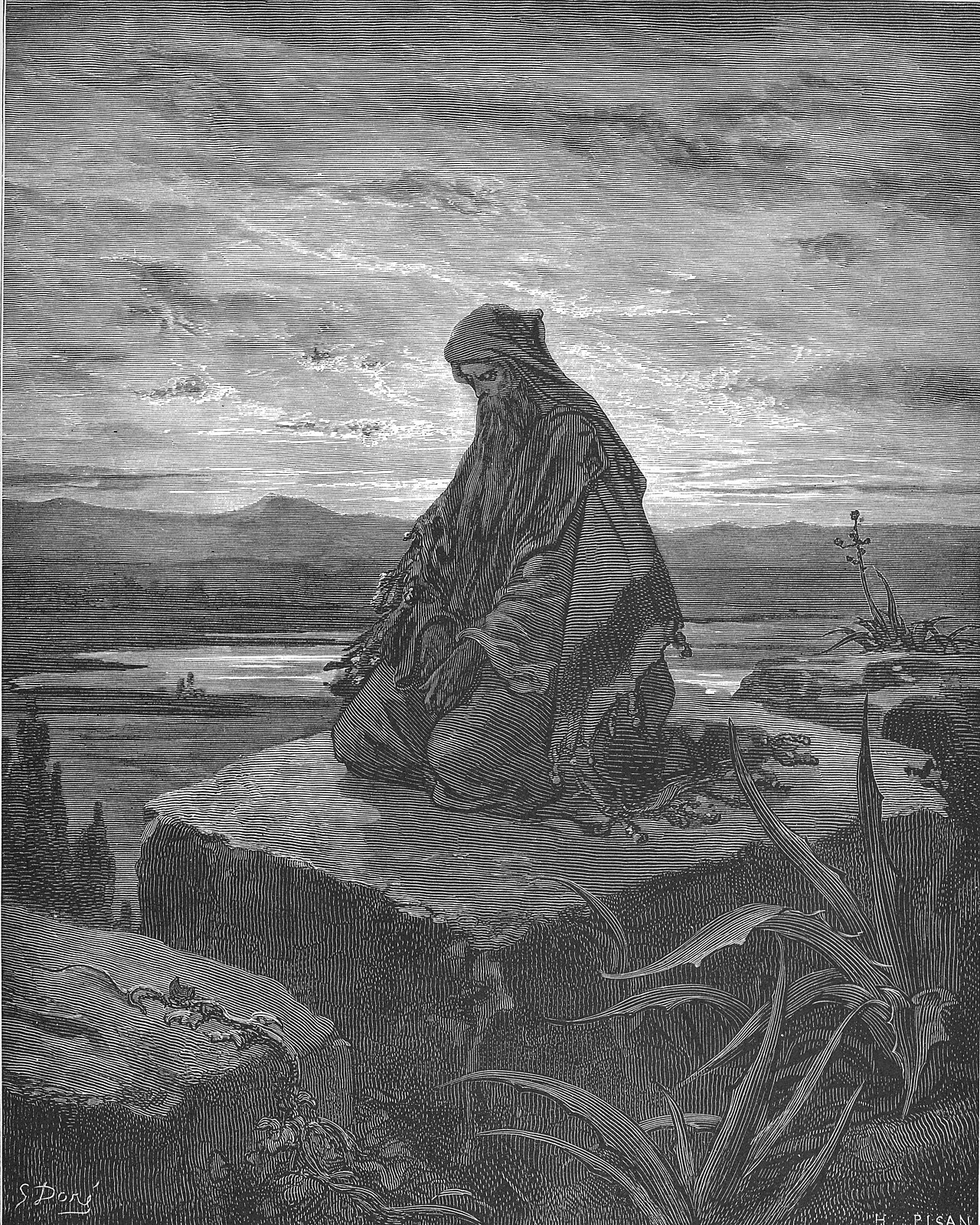
About Isaiah
Who and where
1 name in this verse with a page on the site.
This page draws on 9 works. Open the list of works
This page draws on Adam Clarke, Commentary on the Bible; Albert Barnes, Notes, Explanatory and Practical, on the Old and New Testaments (1832-1869); Gregory the Dialogist, Morals on the Book of Job, Book 32, Section 7; Jamieson, Fausset & Brown, Commentary Critical and Explanatory on the Whole Bible; Jerome, Commentary on Isaiah; John Gill, Exposition of the Old Testament (1748-1763); John Gill, Exposition of the Old Testament; Matthew Henry, Commentary on the Whole Bible and Thomas Aquinas, Commentary on Isaiah.