
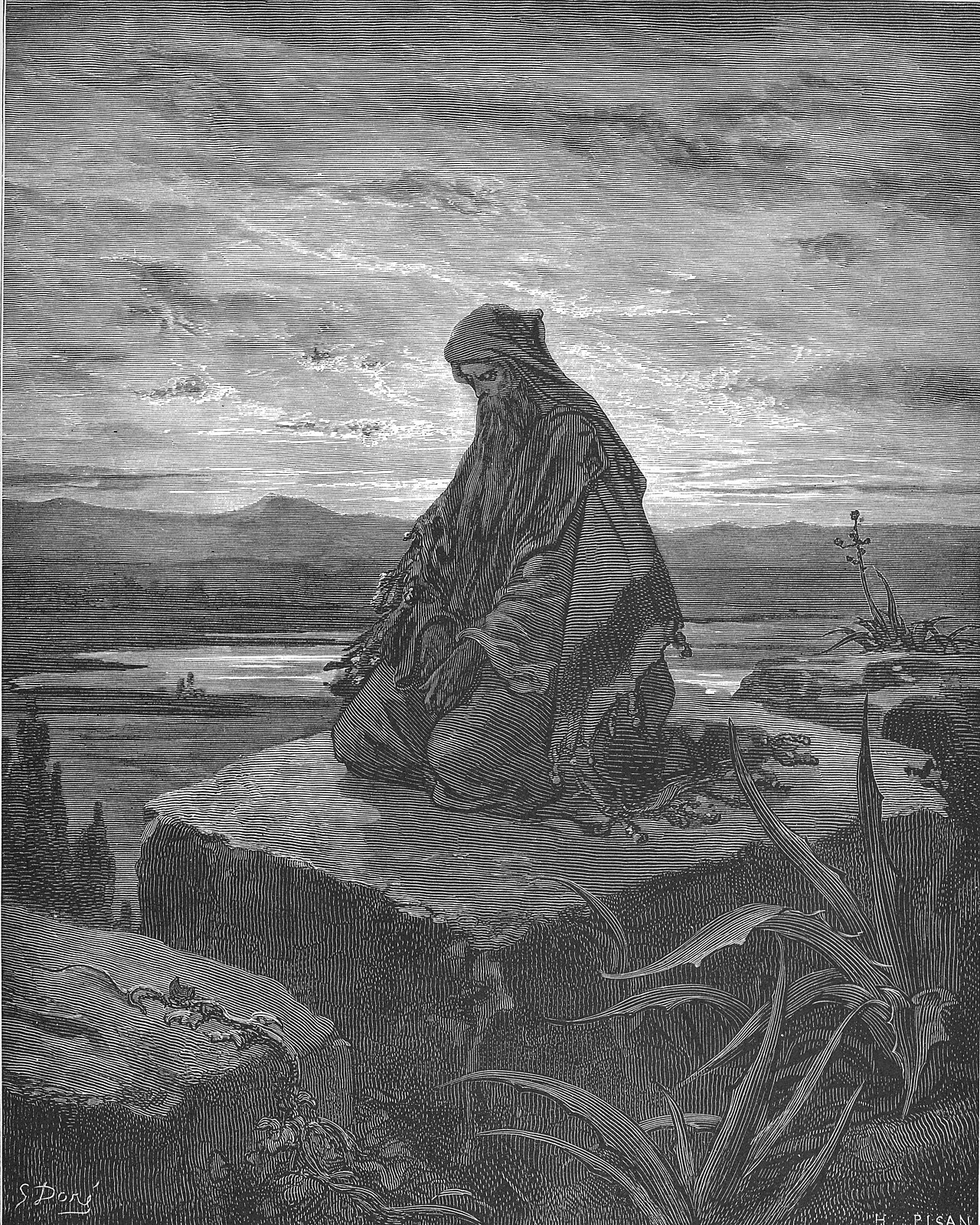
Isaiahchapter 45
25 verses · Isaiah · 8th century BC · The Prophets
This is what the LORD says to Cyrus His anointed, whose right hand I have grasped to subdue nations before him, to disarm kings, to open the doors before him, so that the gates will not be shut:
Introduction
Isaiah, The Prophets, Isaiah Overview.
Isaiah wrote this chapter for exiles who would be set free by a foreign king who had never heard of their God. It is addressed first to that king, Cyrus of Persia, who is given a title that belonged to Israel's own anointed rulers. The chapter then turns to answer those who might object to God working through an outsider. Listen for the repeated claim that there is no other God, and for the invitation that widens to the whole earth. Paul later took the chapter's closing oath and applied it to Jesus.
Context
- Who
- Exiles about to be freed by a king who had never heard of their God
- What
- The LORD's commission of Cyrus as His anointed, and His call to all the earth to turn to Him and be saved.
- Where
- Babylon's gates and treasuries, a potter's yard, and the ends of the earth.
- When
- Spoken about 700 to 690 BC by the book's own reading; the decree of Cyrus freeing captive peoples came in 539 or 538 BC.
- Why
- To show that the LORD rules history, even through a ruler who does not know Him, and that salvation is offered to every nation.
Historical context
The word used of Cyrus is the word for anointed, the term used of Israel's kings and, later, of the Messiah. It is applied here to a Persian who did not know the LORD, and the text says so twice: though you have not known me. God commissions a man outside the covenant to do covenant work.
Show the rest of the historical context, 4 more paragraphs
The details of the taking of Babylon are specific. God says he will open the two-leaved gates before him and the gates will not be shut, and will break the bronze gates and cut the iron bars. Babylon's walls had massive gates, and Herodotus describes the river gates being left open on the night the Persians waded in along the drained channel.
The treasures of darkness and the hidden riches of secret places are the vaults. Cyrus took the accumulated wealth of the Babylonian empire, and before that the treasury of Lydia; the Persian empire was funded by what it inherited rather than what it looted by force.
What Cyrus actually did is recorded in his own words. A clay barrel now in the British Museum, the Cyrus Cylinder, sets out his policy of sending captive peoples home to their own cities and restoring their sanctuaries, the exact policy that let the Jews go back and rebuild. The cylinder credits the Babylonian god Marduk for calling him. Isaiah, a century and a half earlier, says who was really doing it: I girded you, though you have not known me.
The potter's yard supplies the answer to the objection. Woe to the one who argues with his Maker, a potsherd among the potsherds of the earth. Does the clay say to the potter, what are you making? Does the pot ask, he has no hands? A broken piece of pottery arguing with the man at the wheel is as ridiculous a picture as the ancient world could produce, and the yards were full of the shards.
Significance
Some exiles would have been offended that God would use a Gentile emperor. The chapter answers before the complaint is made: I am the LORD, and there is none else; I form the light and create darkness, I make peace and create calamity.
Show the rest of the significance, 1 more paragraph
And the scope widens past the homecoming. Look to me and be saved, all the ends of the earth, with an oath that every knee will bow and every tongue swear. Paul would later quote that line about Jesus.
This chapter in Jewish lifeWhat this chapter is in Jewish life and reading.
What is done
The site's own table in src/lib/hebraic/readings.ts, probed for this lane, printed no weekly portion and no Haftarah from this chapter, and no festival reading for the book. That table carries the Haftarah of each of the fifty-four weekly portions and the books read whole at the feasts, and it carries nothing for the special Sabbaths or the fast days. This card therefore names no public reading of the chapter and leaves that question to a source that holds those readings.
The corpus joins the chapter to the weeks of the Torah portions through the works arranged by portion. Under the eleventh verse it carries Bereshit Rabbati, Parashat Bereshit 19. Under the seventeenth verse it carries Bereshit Rabbati, Parashat Vayechi 23.
How it is read
Two commentators on this chapter carry English in the corpus. Rashi is quoted from The Judaica Press complete Tanach with Rashi, translated by A. J. Rosenberg, which Sefaria reports as CC-BY, and every quotation of it is held to fifty words or fewer because the translation is modern. Ibn Ezra is quoted from the version Sefaria titles Commentary of Ibn Ezra on Isaiah - trans. by M. Friedlander, 1873, which it reports as Public Domain.
Rashi reads the anointing of Cyrus in the first verse as a title and says so in one line: "Every title of greatness is called anointing". He then reports the Sages in Megillah 12a, where God speaks to the King Messiah and complains to him about Cyrus (Rashi on Isaiah 45:1:1). Two readings of the one word stand in the same note, and he leaves both. At the third verse he marks that the naming comes before the birth, "You are not yet born, and I call you by the name Cyrus". The purpose follows at the fourth verse, for Jacob's sake, "that you take him out of Babylonian exile" (Rashi on Isaiah 45:3:1 and 45:4:1).
Ibn Ezra reads the same run as an argument from prediction. "I alone know what will happen in future; as the victory of Cyrus shows". The strength given to Cyrus has one end in his reading, that the name of the Lord be known everywhere as the one God (Ibn Ezra on Isaiah 45:5:1 and 45:6:1).
The seventh verse, on the forming of light and the creating of darkness, Rashi glosses in a few words as light for the righteous (Rashi on Isaiah 45:7:1). At the ninth verse he reads the woe on the one who contends with his Maker as a prophecy about Habakkuk, who would complain of the length of Nebuchadnezzar's success (Rashi on Isaiah 45:9:1).
The close of the chapter turns to the nations. Rashi reads the call to the ends of the earth as a call to "abandon your graven images". The oath of the twenty-third verse is a word "to accept all those who return to Me", and he sets it beside Zephaniah 3:9. At the next verse he keeps Israel's own promise apart. He calls the verse inverted and reads it as righteousness and strength promised to the congregation of Israel alone (Rashi on Isaiah 45:22:1, 45:23:1 and 45:24:1).
What the rabbis say
The corpus carries forty rabbinic locators on this chapter and the text of none, so each is cited and linked here rather than quoted. On the first verse it holds Ein Yaakov, Megillah 1:23, Esther Rabbah 2:1 and Megillah 12a:5. On the second verse it holds Sifrei Aggadah on Esther, Midrash Panim Acherim, Version II 2:18, Tractate Kallah Rabbati 2:15 and Tractate Soferim 7:4. On the third verse it holds Midrash Lekach Tov on Esther 1:4:1 and Otzar Midrashim, Midrashim of Rabbi Shimon bar Yochai, Prayer of Rabbi Shimon Bar Yochai 6. It holds Sifrei Aggadah on Esther, Midrash Abba Guryon 1:5 there as well.
On the fifth verse it holds Shabbat 103b:6. On the seventh verse it holds Berakhot 11b:1, Berakhot 11b:3 and Berakhot 11b:4. On the eighth verse it holds Bereshit Rabbah 13:13 and Ein Yaakov (Glick Edition), Taanit 1:22. On the ninth verse it holds Jerusalem Talmud Megillah 4:5:4 and Midrash Tehillim 7:19. On the eleventh verse it holds Bamidbar Rabbah 21:2 and Bereshit Rabbati, Parashat Bereshit 19. On the twelfth verse it holds Bereshit Rabbah 12:5 and Bereshit Rabbah 5:5. On the thirteenth verse it holds Midrash Tehillim 118:10.
On the fourteenth verse it holds Mekhilta DeRabbi Shimon Ben Yochai 14:4 and Mekhilta DeRabbi Yishmael, Tractate Vayehi Beshalach 2:9. On the fifteenth verse it holds Bava Batra 13a:4 and Otzar Midrashim, Chuppah of Eliyahu, Chuppat Eliyahu Rabbah 163. On the seventeenth verse it holds Bereshit Rabbati, Parashat Vayechi 23 and Ein Yaakov (Glick Edition), Makkot 3:6. On the eighteenth verse it holds Arakhin 2b:15 and Bamidbar Rabbah 12:4. On the nineteenth verse it holds Mekhilta DeRabbi Shimon Ben Yochai 19:1 and Mekhilta DeRabbi Shimon Ben Yochai 20:2. On the twentieth verse it holds Midrash Tehillim 9:5.
On the twenty-first verse it holds Megillah 27a:3 and Midrash Tehillim 20:1. On the twenty-second verse it holds Jerusalem Talmud Yevamot 8:3:4 and Midrash Tehillim 9:11. On the twenty-third verse it holds Ein Yaakov, Niddah 3:6 and Jerusalem Talmud Berakhot 1:5:14. On the twenty-fourth verse it holds Midrash Tehillim 19:14. What each of them teaches is a saying of the rabbis, and is reported as theirs wherever this site quotes one. The quotations wait on a fetch that carries the text.
Sources: Rashi, Rashi on Isaiah 45:1:1 to 45:24:1, The Judaica Press complete Tanach with Rashi, translated by A. J. Rosenberg, reported CC-BY; Ibn Ezra, Ibn Ezra on Isaiah 45:5:1 to 45:17:1, Commentary of Ibn Ezra on Isaiah - trans. by M. Friedlander, 1873, reported Public Domain; The Sefaria corpus, scripts/data/sources/sefaria/isaiah/45.json, the 40 Talmud and Midrash locators of this chapter; The site's own files, src/lib/hebraic/readings.ts, printing no portion and no Haftarah for this chapter and no festival reading for this book.
The heads below are this chapter's scenes. The numbered points under each are its verses.
I Will Loose the Loins of Kings Before Cyrus
Isaiah 45:1-2
to open the doors before him: The LORD calls Cyrus, a Persian king named long before his birth, “His anointed”, the Hebrew word behind Messiah. The phrase “to disarm kings” pictures royal power unbuckled. Verse 2 promises, “I will go before you and level the mountains; I will break down the gates of bronze.”
Isaiah 45:1
“Thus saith the Lord to his anointed - This is a direct apostrophe to Cyrus, though it was uttered not less than one hundred and fifty years before Babylon was taken by him. The word ‘anointed’ is that which is usually rendered “Messiah” (משׁיח mâshı̂yach), and here is rendered by the Septuagint, Τῷ χριστῷ μου Κύρῳ Tō christō mou Kurō - ‘To Cyrus, my Christ,’ i. e, my anointed.”
level the mountains: Clarke defends the mountains of the Berean text. The Hebrew word here is hard to account for, and the Septuagint read it as mountains, a form two manuscripts nearly share. Clarke hears the ease God gave Cyrus against the nations, and he sets beside it a like image from Ovid.
Isaiah 45:2
“The crooked places “The mountains” - For הדורים hodurim, crooked places, a word not easily accounted for in this place, the Septuagint read הררים hararim, τα ορη, the mountains. Two MSS. have הדרים hadarim, without the ו vau, which is hardly distinguishable from the reading of the Septuagint. The Divine protection that attended Cyrus, and rendered his expedition against Babylon easy and prosperous is finely expressed by God’s going before him, and making the mountains level. The image is highly poetical: - At vos, qua veniet, tumidi subsidite montes, Et faciles curvis vallibus este viae. Ovid, Amor.”
Adam Clarke · Commentary on the Bible (1810-1826)evangelical
Isaiah 45:3-4
the treasures of darkness: Verse 3 promises “the treasures of darkness and the riches hidden in secret places”. It is given “so that you may know that I am the LORD, the God of Israel”, and the conquest becomes evidence. Verse 4 states the purpose, “For the sake of Jacob My servant”.
Isaiah 45:3
“And I will give thee the treasures of darkness - The treasures which kings have amassed, and which they have laid up in dark and secure places. The word ‘darkness,’ here, means that which was hidden, unknown, secret (compare Job 12:22). The treasures of the kings of the East were usually hidden in some obscure and strong place, and were not to be touched except in cases of pressing necessity.”
1 more voice on this verse
Isaiah 45:3
“PLINY (Natural History,, 33:3) says that Cyrus obtained from the conquest of Asia thirty-four thousand pounds weight of gold, besides golden vases, and five hundred thousand talents of silver, and the goblet of Semiramis, weighing fifteen talents. that thou mayest know--namely, not merely that He was "the God of Israel," but that He was Jehovah, the true God.”
Jamieson, Fausset & Brown · Commentary Critical and Explanatory on the Whole Bible (1871)reformed
a title of honor: Jamieson, Fausset and Brown add that Cyrus came to know the LORD in some degree, as his decree in Ezra 1:1 to 3 shows. Jerome and Matthew Henry read Cyrus as a type of Christ. He is raised to power so that the LORD's chosen people may go free.
Isaiah 45:4
“Cyrus is preferred that Israel may be released. He shall have a kingdom, only that God's people may have their liberty; for their kingdom is not of this world, it is yet to come. In all this Cyrus was a type of Christ, who was made victorious over principalities and powers, and entrusted with unsearchable riches, for the use and benefit of God's servants, his elect.”
Matthew Henry · Commentary on the Whole Bible (1707-1721)puritan
Isaiah 45:5-6
I will equip you for battle: Verse 5 restates the trial’s verdict, “I am the LORD, and there is no other”. It repeats the point of verse 4, that Cyrus serves a God he does not know. Verse 6 names the inhabited world as the audience, “from where the sun rises to where it sets”.
Isaiah 45:5
“I am the Lord ... - (see the notes at Isa 42:8; Isa 43:2; Isa 44:8; Isa 45:14, Isa 45:18, Isa 45:22). I girded thee ... - (see the note at Isa 45:1). The sense is, I girded thee with the girdle - the military belt; I prepared thee, and strengthened thee for war and conquest. Even people who are strangers to the true God are sustained by him, and are unable to accomplish anything without his providential aid.”
2 more voices on this verse
Isaiah 45:5
“No, it was I that girded thee, I whom thou didst not know, nor seek to." By this it appears that the God of Israel is the only true God, that he manages and makes what use he pleases even of those that are strangers to him and pay their homage to other gods.”
Matthew Henry · Commentary on the Whole Bible (1707-1721)puritan
Isaiah 45:5
“I girded you, with strength: I called, and you refused (Prov 1:24).”
Thomas Aquinas · written before 1274 · Commentary on Isaiahpatristic
from where the sun rises: Barnes reports how Kimchi explains the east and west. The earth was thought habitable along the course of the sun and less so from north to south. Barnes finds the LORD made known in Ezra 1, where Cyrus proclaimed the LORD had given him all the kingdoms of the earth.
Isaiah 45:6
“That they may know from the rising of the sun, and from the west - This phrase is evidently used here to designate the whole world. Kimchi says, that the reason why the north and the south are not mentioned here is, that the earth from the east to the west is perfectly inhabitable, but not so from the north to the south. That this was accomplished, see Ezr 1:1 ff Cyrus made public proclamation that Yahweh had given him all the kingdoms of the earth, and had commanded him to rebuild the temple in Jerusalem.”
I form the light and create the darkness: “I form the light and create the darkness” states the LORD’s rule over the created order in its starkest terms. The Hebrew word behind “create calamity” is the common word for evil. Cyrus’s religion taught light and darkness as two eternal powers, and this verse claims both for one God.
Isaiah 45:7
“I form the light, and create darkness - Light, in the Bible, is the emblem of knowledge, innocence, pure religion, and of prosperity in general; and darkness is the emblem of the opposite. Light here seems to be the emblem of peace and prosperity, and darkness the emblem of adversity; and the sentiment of the verse is, that all things prosperous and adverse are under the providential control and direction of God. Of light, it is literally true that God made it; and emblematically true that he is the source of knowledge, prosperity, happiness, and pure religion.”
let the skies pour down righteousness: “Drip down, O heavens, from above” calls for a rain of righteousness, the sky commanded to bring down what only God can create. The verse closes with “I, the LORD, have created it”, naming salvation a creation beside the light, darkness, prosperity and calamity of verse 7.
Isaiah 45:8
“Drop down, ye heavens - The eighty-fifth psalm is a very elegant ode on the same subject with this part of Isaiah’s prophecies, the restoration of Judah from captivity; and is, in the most beautiful part of it, a manifest imitation of this passage of the prophet: - “Verily his salvation is nigh unto them that fear him, That glory may dwell in our land. Mercy and truth have met together; Righteousness and peace have kissed each other. Truth shall spring from the earth, And righteousness shall look down from heaven.”
Adam Clarke · Commentary on the Bible (1810-1826)evangelical
2 more voices on this verse
Isaiah 45:8
“It is good news to God's Israel that their God is the creator and governor of the world. They are particularly told what God would do for them, that they might know what to depend upon; and this shall lead them to expect a more glorious Redeemer and redemption, of whom, and of which, Cyrus and their deliverance by him were types and figures.”
Matthew Henry · Commentary on the Whole Bible (1707-1721)puritan
Isaiah 45:8
“MAURER translates, "Let all kinds of salvation (prosperity) be fruitful" (Ps 72:3, 6, 7). The revival of religion after the return from Babylon suggests to the prophet the diffusion of Messiah's Gospel, especially in days still future; hence the elevation of the language to a pitch above what is applicable to the state of religion after the return.”
Jamieson, Fausset & Brown · Commentary Critical and Explanatory on the Whole Bible (1871)reformed
Woe to the Clay That Strives with the Potter
Isaiah 45:9-10
“Woe to him who quarrels with his Maker” warns against questioning the LORD’s use of Cyrus. Paul takes up the figure at Romans 9:20, “Shall what is formed say to Him who formed it”. Verse 10 applies the same point to birth, a child questioning the father and mother.
Isaiah 45:9
“Wo unto him that striveth with his Maker! - This verse commences a new subject. Its connection with the preceeding is not very obvious. It may be designed to prevent the objections and cavils of the unbelieving Jews who were disposed to complain against God, and to arraign the wisdom of his dispensations in regard to them, in permitting them to be oppressed by their enemies, and in promising them deliver ance instead of preventing their captivity. So Lowth understands it.”
who says to his father: Aquinas reads the father and mother as figures for the LORD, who begets Cyrus in purpose and conceives him in intention. Jamieson, Fausset and Brown hear a warning to Israel. In their reading the Jews counted themselves God's only children and grew angry when he adopted the Gentiles as well.
Isaiah 45:10
“If it be wrong for a child, born in less favorable circumstances, to upbraid his parents with having given him birth, a fortiori, it is, to upbraid God for His dealings with us. Rather translate, "a father . . . a woman." The Jews considered themselves exclusively God's children and were angry that God should adopt the Gentiles besides.”
Jamieson, Fausset & Brown · Commentary Critical and Explanatory on the Whole Bible (1871)reformed
Isaiah 45:11-13
question Me about My sons: In verse 11 the LORD asks who would “question Me about My sons, or instruct Me in the work of My hands”. Verse 12 restates the creation claim. Verse 13 returns to Cyrus, who “will rebuild My city and set My exiles free, but not for payment or reward.”
It is I who made the earth: Jamieson, Fausset and Brown compare Isaiah 40:26 to 31, where the Maker of the starry host also gives strength to the weary. The power that ordained the host of heaven can grant any request made of it. The Hebrew sets the speaker beside his own hands.
Isaiah 45:12
“The same argument for prayer, drawn from God's omnipotence and consequent power, to grant any request, occurs in Isa 40:26-31. I, even my hands--so Hebrew (Ps 41:2), "Thou . . . thy hand" (both nominatives, in apposition).”
Jamieson, Fausset & Brown · Commentary Critical and Explanatory on the Whole Bible (1871)reformed
I will raise up Cyrus in righteousness: Barnes links this verse to Isaiah 41:2, where the same conqueror is stirred up, and he hears in make straight the word of Isaiah 40:4. The righteousness belongs to the LORD's plan. Barnes holds that it says nothing of the character of Cyrus.
Isaiah 45:13
“I have raised him up - That is. Cyrus (see the notes at Isa 41:2). In righteousness - In Isa 41:2, he is called ‘the righteous man.’ He had raised him up to accomplish his own righteous plans. It does not necessarily mean that Cyrus was a righteous man (see the notes at Isa 41:2). And I will direct all his ways - Margin, ‘Make straight.’ This is the meaning of the Hebrew word (see the notes at Isa 40:4).”
Verily Thou Art a God That Hidest Thyself
Isaiah 45:14-15
Verse 14 pictures “products of Egypt” coming to Israel, a scene taken up at Isaiah 60:5, where “the wealth of the nations” comes to Zion. The nations then confess the trial’s verdict, “there is no other God”. Verse 15 answers, “Truly You are a God who hides Himself”.
a God who hides Himself: Barnes takes the hiding to be God's plans, dark for a long season and plain only when the event comes. Gill reads it two ways. God hid himself from the Gentiles for centuries before the gospel, and at times he withdraws his felt presence from his own people.
Isaiah 45:15
“Verily thou art a God that hideth thyself,.... Who hid himself from the Gentile world for some hundreds of years, who had no knowledge of the true God, lived without him in the world, and whose times of ignorance God overlooked, and suffered them to walk in their own ways; though now he would make himself known by his Gospel sent among them, and blessed for the conversion of them. He is also a God that hides himself from his own people at times, withdraws his gracious presence, and withholds the communication of his love and grace.”
2 more voices on this verse
Isaiah 45:15
“Hidden, not visible like our gods; the savior, not weak: he made darkness his covert (Ps 18:11).”
Thomas Aquinas · written before 1274 · Commentary on Isaiahpatristic
Isaiah 45:15
“Verily thou art a God that hidest thyself - That is, that hidest thy counsels and plans. The idea is, that the ways of God seems to be dark until the distant event discloses his purpose; that a long series of mysterious events seem to succeed each other, trying to the faith of his people, and where the reason of his doings cannot be seen.”
Isaiah 45:16-17
the makers of idols: Verse 16 closes the idol theme once more, with “the makers of idols” departing “together in disgrace”. Verse 17 sets Israel against them, “But Israel will be saved by the LORD with an everlasting salvation”. The shame the idol makers carry is the shame Israel is promised never to bear.
Isaiah 45:16
“Second, he shows their exaltation as to the confusion of their enemies: they are all confounded: the nations shall see, and shall be confounded at all their strength (Mic 7:16).”
Thomas Aquinas · written before 1274 · Commentary on Isaiahpatristic
1 more voice on this verse
Isaiah 45:16
“They shall be ashamed “They are ashamed” - The reader cannot but observe the sudden transition from the solemn adoration of the secret and mysterious nature of God’s counsels in regard to his people, to the spirited denunciation of the confusion of idolaters, and the final destruction of idolatry; contrasted with the salvation of Israel, not from temporal captivity, but the eternal salvation by the Messiah, strongly marked by the repetition and augmentation of the phrase, to the ages of eternity.”
Adam Clarke · Commentary on the Bible (1810-1826)evangelical
an everlasting salvation: Barnes reads Israel first of the exiles and then of the true Israel Paul describes in Romans 2:28, the people of God in every age. Matthew Henry looks past the return to the salvation of the soul through the Messiah. Aquinas links the promise to Zephaniah 3:15.
Isaiah 45:17
“Third, as to the perpetual salvation of the Jews: Israel is saved for ever, unless he should sin, or of the spiritual Israel: the king of Israel, the Lord, is in the midst of you, you shall fear evil no more (Zeph 3:15).”
Thomas Aquinas · written before 1274 · Commentary on Isaiahpatristic
2 more voices on this verse
Isaiah 45:17
“But Israel shall be saved - Referring primarily to the Jews in Babylon, but affirming the universal truth that the true Israel (compare Rom 2:28-29), that is, the people of God, shall be saved from all their trials, and shall be brought to his everlasting kingdom. In the Lord - By Jehovah - ביהוה bayohvâh; Septuagint, Ἀπὸ κυρίου Apo kuriou. It shall be done by the power of Yahweh, and shall be traced to him alone. No more human power could have saved them from their captivity in Babylon; no human power can save the soul from hell.”
Isaiah 45:17
“To look beyond this temporal deliverance to that which is spiritual and has reference to another world, to think of that salvation by the Messiah which is an everlasting salvation, the salvation of the soul, a rescue from everlasting misery and a restoration to everlasting bliss.”
Matthew Henry · Commentary on the Whole Bible (1707-1721)puritan
Isaiah 45:18-19
He did not create it to be empty: “He did not create it to be empty, but formed it to be inhabited” gives creation a stated purpose. The refrain returns, “I am the LORD, and there is no other”. Verse 19 adds that the claim was never hidden, “I have not spoken in secret”.
Isaiah 45:18
“For thus saith the Lord - This verse is designed to induce them to put uuwavering confidence in the true God. For this purpose, the prophet enumerates the great things which God had done in proof that he alone was A mighty, and was worthy of trust. He hath established it - That is, the earth. The language here is derived from the supposition that the earth is laid upon a foundation, and is made firm.”
4 more voices on this verse
Isaiah 45:18
“For it says, "thus says the Lord" and not simply an earthly "lord," for there are many in heaven and earth that ruin this name [the Lord] by overusing it. But he is the one who by nature and in truth is just—he is what he is said to be and derives no false glory from what he has ordained.… For if he who made heaven and earth did not make it in vain but to be inhabited, … then who else other than him can be considered God?”
Cyril of Alexandria · written before 444 · Commentary on Isaiah 4:3.45:18-19patristic
Isaiah 45:18
“He here mentions the creation of the heavens, but enlarges more upon that of the earth, because that is the part of the creation which we have the nearest view of and are most conversant with. It is here observed, (1.) That he formed it.”
Matthew Henry · Commentary on the Whole Bible (1707-1721)puritan
Isaiah 45:18
“For in reality God did not establish the universe in vain or to no purpose but destruction, as those weak-minded people say, but to exist and be inhabited and continue. Therefore the earth and the heaven must exist again after the conflagration and shaking of all things.”
Methodius of Olympus · written before 311 · On the Resurrection 1:8patristic
Isaiah 45:18
“He formed it to be inhabited “For he formed it to be inhabited” - An ancient MS. has כי ki before לשבת lashebeth; and so the ancient Versions.”
Adam Clarke · Commentary on the Bible (1810-1826)evangelical
I have not spoken in secret: Barnes sets this against the pagan oracles, which spoke from caves and dark recesses wrapped in deliberate mystery. The LORD gave his word in the open. Matthew Henry adds a moral contrast, the gods commanding what degraded their worshipers and the LORD speaking what is right and makes people righteous.
Isaiah 45:19
“I have not spoken in secret - The word rendered ‘secret’ (סתר sı̂ther) denotes a hiding, or covering; and the phrase here means secretly, privately. He did not imitate the pagan oracles by uttering his predictions from dark and deep caverns, and encompassed with the circumstances of awful mystery, and with designed obscurity. In a dark place of the earth - From a cave, or dark recess, in the manner of the pagan oracles.”
1 more voice on this verse
Isaiah 45:19
“The heathen deities dictated those things to their worshippers which were the reproach of human nature and tended to the extirpation of virtue; but God speaks righteousness, dictates that which is right in itself and tends to make men righteous; and therefore he is God, and there is none else.”
Matthew Henry · Commentary on the Whole Bible (1707-1721)puritan
Look Unto Me and Be Saved, All the Ends of the Earth
Isaiah 45:20-21
you fugitives from the nations: Verse 20 summons “you fugitives from the nations” into the trial. Verse 21 asks the trial’s question, “Who foretold this long ago”, and answers with a title new to the chapter, “a righteous God and Savior”. Justice and salvation stand joined in one claim.
Isaiah 45:20
“Assemble yourselves, and come - This, like the passage in Isa 41:1 ff, is a solemn appeal to the worshippers of idols, to come and produce the evidences of their being endowed with omniscience, and with almighty power, and of their having claims to the homage of their worshippers. Ye that are escaped of the nations - This phrase has been very variously interpreted.”
Who foretold this long ago?: Barnes names what was foretold. It was the rise of Cyrus, the fall of Babylon, announced long before, and the argument of the chapter rests on that fact. Barnes traces the same appeal back to Isaiah 41:22 and 23, where the idols were dared to predict anything at all.
Isaiah 45:21
“Tell ye, and bring them near - That is, announce, and bring forward your strongest arguments (see the notes at Isa 41:1). Who hath declared this from ancient time? - Who has clearly announced the events respecting Cyrus, and the conquest of Babylon, and the deliverance from the captivity? The argument is an appeal to the fact that God had clearly foretold these events long before, and that therefore he was the true God. To this argument he often appeals in proof that he alone is God (see the note at Isa 41:22-23).”
Isaiah 45:22-23
Turn to Me and be saved: “Turn to Me and be saved, all the ends of the earth” opens the verdict into an invitation wider than Israel. Verse 23 makes it an oath. Paul quotes “every knee will bow before Me” at Romans 14:11, and Philippians 2:10 applies it to Jesus, “every knee should bow”.
Isaiah 45:22
“They shall all be invited to look unto him, as the stung Israelites did to the brazen serpent; and so strong is the eye of faith that by divine grace it will reach the Saviour and fetch in salvation by him even from the ends of the earth; for he is God, and the is none else.”
Matthew Henry · Commentary on the Whole Bible (1707-1721)puritan
2 more voices on this verse
Isaiah 45:22
“Look unto me, and be ye saved, etc. - This verse and the following contain a plain prediction of the universal spread of the knowledge of God through Christ; and so the Targum appears to have understood it; see Rom 14:11; Php 2:10. The reading of the Targum is remarkable, viz., אתפנו למימרי ithpeno lemeymri, look to my Word, ὁ Λογος, the Lord Jesus.”
Adam Clarke · Commentary on the Bible (1810-1826)evangelical
Isaiah 45:22
“Not do something, but look to the Saviour (Ac 16:30, 31). Believers look by faith, the eye of the soul. The look is that of one turning (see Margin) to God, as at once "Just and the Saviour" (Isa 45:21), that is, the look of conversion (Ps 22:27).”
Jamieson, Fausset & Brown · Commentary Critical and Explanatory on the Whole Bible (1871)reformed
By Myself I have sworn: Barnes reads the oath as the fullest statement of the call in verse 22, God's settled purpose that every nation will acknowledge him. He calls it a purpose ratified in the most sacred form. Jerome notes that the Septuagint has every tongue confess to God, the wording Paul follows.
Isaiah 45:23
“I have sworn by myself - This verse contains a fuller statement of the truth intimated in the previous verse, that the benefits of salvation should yet be extended to all the world. It is the expression of God’s solemn purpose that all nations should yet be brought to acknowledge him, and partake of the benefits of the true religion. The expression, ‘I have sworn by myself,’ denotes a purpose formed in the most solemn manner, and ratified in the most sacred form.”
1 more voice on this verse
Isaiah 45:23
“Observe, First, All believers are the seed of Israel, an upright praying seed. Secondly, The great privilege they enjoy by Jesus Christ is that in him, and for his sake, they are justified before God, Christ being made of God to them righteousness.”
Matthew Henry · Commentary on the Whole Bible (1707-1721)puritan
Cross references
Isaiah 45:23
- Quoted inPhilippians 2:10“that at the name of Jesus every knee should bow, in heaven and on earth and under the earth,”
'Every knee shall bow... every tongue confess' (the exalted Name)
- Quoted inRomans 14:11It is written: “As surely as I live, says the Lord, every knee will bow before Me; every tongue will confess to God.”
'Every knee shall bow to me' ('it is written, As I live, saith the Lord')
Isaiah 45:24-25
Verse 24 gives the confession every bowing knee will make, “In the LORD alone are righteousness and strength”. The opposition meets its end in the same verse. Verse 25 gives the last word to Israel by name, “In the LORD all descendants of Israel will be justified and will exult.”
Isaiah 45:24
“In the Lord - By or from God alone, or the Messiah, who is the true Jehovah as well as man. Righteousness - To justify me from all things which I could not be justified by the law of Moses.”
John Wesley · Explanatory Notes upon the Old Testament (1765)evangelical
all descendants of Israel will be justified: Matthew Henry counts every believer among the descendants of Israel, and he finds their justification in Christ, made righteousness for them. Barnes reads the verse toward the Redeemer. Justification comes by the mercy of God, and Barnes calls that truth the sum of the New Testament.
Isaiah 45:25
“In the Lord - It shall be only in Yahweh that they shall find justification, and this must mean, that it is by his mercy and grace. The entire passage here, I suppose, has reference to the times of the Redeemer (see the notes at Isa 45:21-24). If so, it means that justification can be obtained only by the mercy of God through a Redeemer. The great truth is, therefore, here brought into view, which constitutes the sum of the New Testament, that people are not justified by their own works, but by the mercy and grace of God.”
Keep studying
Studies9
People and groups1
Places1
Words12
Sources for this chapter
The summary
Jamieson, Fausset & Brown, Commentary Critical and Explanatory; John Calvin, Commentaries; John Wesley, Notes on the Old Testament and Matthew Henry, Complete Commentary.
The exposition
Adam Clarke, Commentary on the Bible; Albert Barnes; Franz Delitzsch, Biblical Commentary on the Prophecies of Isaiah; Jamieson, Fausset & Brown, Commentary Critical and Explanatory on the Whole Bible; Jerome, Commentary on Isaiah; John Calvin, Commentary on the Book of the Prophet Isaiah; John Gill; Matthew Henry, Commentary on the Whole Bible and Thomas Aquinas, Commentary on Isaiah.