
Genesischapter 9
29 verses · Moses, by tradition · 15th to 13th century BC · The Law
In Jewish life
The reading
Weekly portion 2 of 54
נֹחַ Noach, Genesis 6:9 to 11:32
Read with it: Isaiah 54:1 to 55:5 in Ashkenazi use, and Isaiah 54:1 to 54:10 in Sephardi use.
The verse numbers here are the ones a Hebrew Bible carries, which differ from an English Bible by a verse or two in several places. The Sephardi reading is named only where this site records a difference; communities vary beyond what is listed. What these books are, and how a Christian reader meets them →
What is done
This chapter is heard inside the second portion of the annual cycle, in the same sitting as the flood and the table of the nations (src/lib/hebraic/readings.ts). The blessing on Noah, the covenant of the bow and the drunkenness in the tent are read together with what comes before them. The card above carries the portion and the prophetic reading set beside it.
How it is read
The corpus holds the English text of two comments on this chapter and the reference alone for twenty two more. Radak is quoted from the CC-BY translation of Eliyahu Munk, HaChut Hameshulash.
Radak reads the blessing of the first verse as a renewal rather than a new gift. The household had stood under the blessing given at creation, and the blessing was said again to reassure them after the flood. He holds that the blessing was chiefly "the promise that they would once again be fruitful and multiply" (Radak on Genesis 9:1:1). On the nineteenth verse he reads the word for the spreading of the sons as a scattering. He points to the same word used of the people leaving Saul at 1 Samuel 13:11 (Radak on Genesis 9:19:1). He notes that the word is used again of the dispersion at Babel.
Rashi comments on eighteen verses of this chapter, and the corpus holds the text of none of them, because the licence Sefaria reports for that English version keeps it out. They run from Rashi on Genesis 9:2:1 on the fear of man to Rashi on Genesis 9:24:1 on Noah waking. Those comments cover the blood of the fourth verse, the reckoning for blood in the fifth and the image of God in the sixth. They cover the covenant in the ninth to the eleventh, the bow in the twelfth to the seventeenth, and the tent in the twentieth to the twenty fourth. Ibn Ezra stands on three verses, at Ibn Ezra on Genesis 9:8:1, 9:13:1 and 9:15:1.
What the rabbis say
The corpus records forty places where the Midrash and the Talmud cite this chapter, thirty three under Midrash and seven under Talmud, with the locator for each one and no text. The chapter carries no quoted saying in this corpus, so the references stand here and the sayings are read at the source.
Bereshit Rabbah reads the second verse at 29:4, the third at 34:13, the seventh at 34:15 and the eighth and ninth together at 35:1. It reads the twelfth verse at 35:2, the thirteenth at 13:12, the twenty fourth at 36:6 to 36:7 and the twenty fifth at 59:9. It reads the twenty sixth verse at 26:3 and the twenty eighth at 32:6.
Bereshit Rabbati reads five verses of the chapter in Parashat Noah, at 24 on the third verse, 37 on the fifth, 20 on the eleventh, 21 on the fifteenth and 5 on the sixteenth. Bamidbar Rabbah reads the first verse at 11:2, the second at 12:4, the fourth at 14:12 and the twentieth at 10:4. Aggadat Bereshit reads the first verse at 4:2, the twelfth at 1:1, the eighteenth at 10:1, the nineteenth at 10:3 and the twenty second at 37:2. Midrash Tehillim reads the tenth verse at 93:3, Devarim Rabbah reads the twenty seventh at 1:1, and Otzar Midrashim reads the ninth at Sefer Tagin 25:16.
The Talmud is cited at Bava Kamma 91b:8 on the reckoning for blood and at Avodah Zarah 5a:7 on the seventh verse. It is cited at Berakhot 40a:14 and 25b:11 on the drunkenness and the covering of the father. The Jerusalem Talmud reads the blood of the fourth verse at Nazir 6:1:6, and Avot DeRabbi Natan reads the image of God at 16:2 and 39:1.
The text, verse by verse
Each word shows the Hebrew, the English under it, how it sounds and its Strong’s number. A rule between verses marks where the Hebrew manuscripts end a paragraph.
Be Fruitful; Lifeblood Is Sacred
The Bow Set in the Cloud
Ramban on Genesis 9:12
It would appear from this sign that the rainbow in the cloud was not part of creation and that now G-d created a new thing by making a rainbow in the heavens on a cloudy day. Now commentators have said. I have found this opinion in Chizkuni.
Read it in full at Sefaria · Commentary on the Torah by Ramban (Nachmanides). Translated and annotated by Charles B. Chavel. New York, Shilo Pub. House, 1971-1976
Ibn Ezra on Genesis 9:13
MY BOW. Behold, I now set a bow in the clouds. Saadiah Gaon’s interpretation that the rainbow was previously in existence is incorrect.
Read it in full at Sefaria · Ibn Ezra's commentary on the Pentateuch, tran. and annot. by H. Norman Strickman and Arthur M. Silver. Menorah Pub., 1988-2004
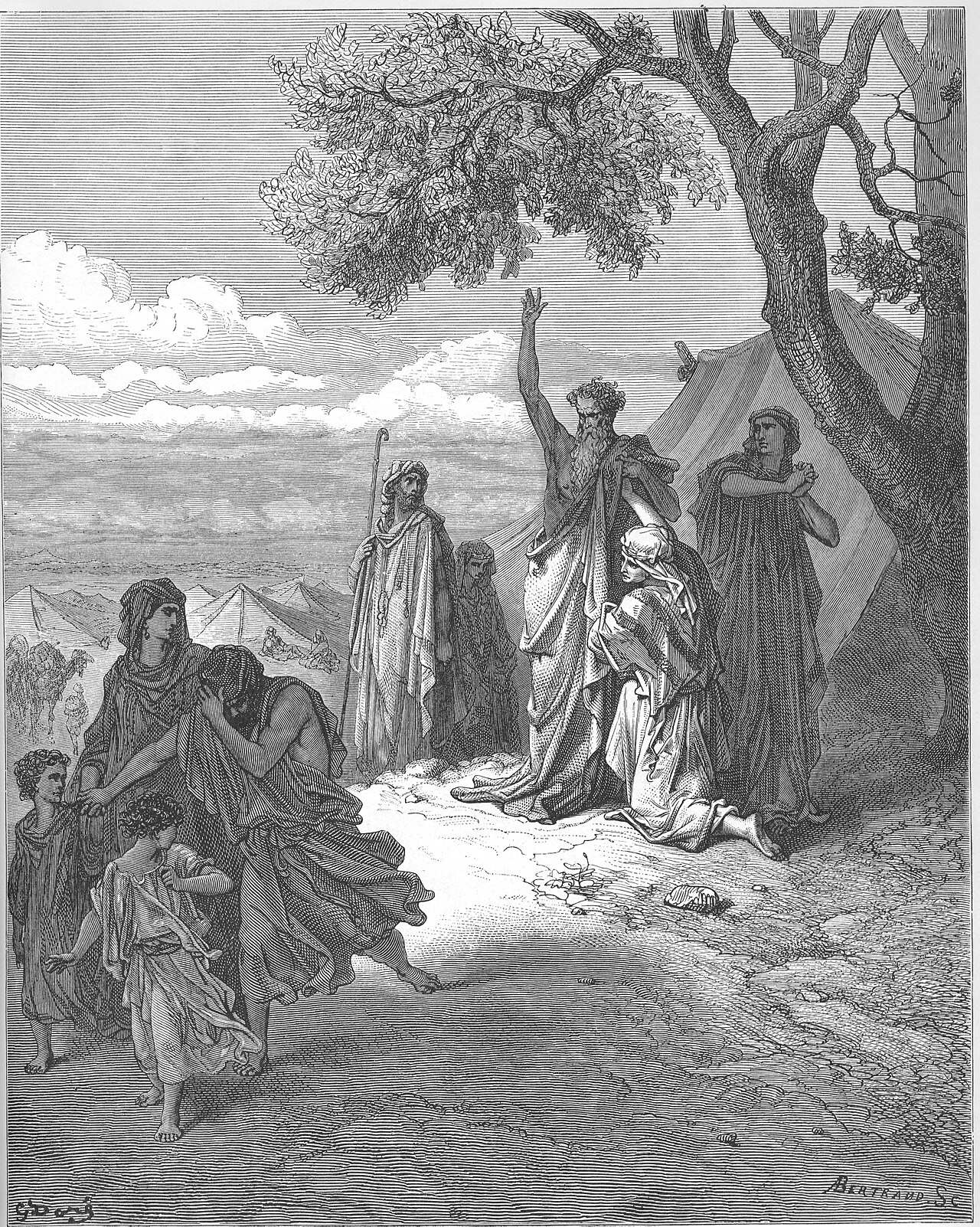
Noah's Vineyard and Shame
Hebrew words in this chapter
The 40 most used Hebrew words of the chapter, counted by lemma. The article, the object marker, the negatives and the common prepositions are left out.
| Word | Sense here | Uses | Strong’s |
|---|---|---|---|
| אֶרֶץʼerets | the earth | 11 | H776 |
| נֹחַNôach | Noah | 9 | H5146 |
| חַיchay | alive | 9 | H2416 |
| אֱלֹהִיםʼĕlôhîym | God | 8 | H430 |
| אָמַרʼâmar | to say | 7 | H559 |
| נֶפֶשׁnephesh | with life its | 7 | H5315 |
| בְּרִיתbᵉrîyth | covenant | 7 | H1285 |
| בָּשָׂרbâsâr | flesh | 6 | H1320 |
| בֵּןbên | son | 5 | H1121 |
| אָדָםʼâdâm | humankind | 5 | H120 |
| אָבʼâb | father | 5 | H1 |
| כְּנַעַןKᵉnaʻan | Canaan | 5 | H3667 |
| יָדyâd | hand | 4 | H3027 |
| נָתַןnâthan | to give | 4 | H5414 |
| דָּםdâm | blood | 4 | H1818 |
| מַבּוּלmabbûwl | flood | 4 | H3999 |
| עָנָןʻânân | cloud | 4 | H6051 |
| רָאָהrâʼâh | to see | 4 | H7200 |
| שֵׁםShêm | Shem | 4 | H8035 |
| עֶבֶדʻebed | a slave of | 4 | H5650 |
| Word | Sense here | Uses | Strong’s |
|---|---|---|---|
| שָׁנֶהshâneh | year | 4 | H8141 |
| רָבָהrâbâh | to multiply | 3 | H7235 |
| דָּרַשׁdârash | to seek | 3 | H1875 |
| אָחʼâch | brother | 3 | H251 |
| קוּםqûwm | about to establish | 3 | H6965 |
| עוֹדʻôwd | again | 3 | H5750 |
| אוֹתʼôwth | sign | 3 | H226 |
| קֶשֶׁתqesheth | bow | 3 | H7198 |
| חָםChâm | Ham | 3 | H2526 |
| יֶפֶתYepheth | Japheth | 3 | H3315 |
| עֶרְוָהʻervâh | nakedness | 3 | H6172 |
| בָרַךְbârak | and he blessed | 2 | H1288 |
| פָּרָהpârâh | be fruitful | 2 | H6509 |
| עוֹףʻôwph | bird | 2 | H5775 |
| אֲדָמָהʼădâmâh | the ground | 2 | H127 |
| אִישׁʼîysh | man | 2 | H376 |
| שָׁפַךְshâphak | sheds | 2 | H8210 |
| עָשָׂהʻâsâh | he made | 2 | H6213 |
| יָצָאyâtsâʼ | to come out | 2 | H3318 |
| תֵּבָהtêbâh | ark | 2 | H8392 |
Keep studying
Studies7
Words12
Subjects1
Sources for this chapter
The Hebrew text
STEP Bible, the tagged Hebrew text and its English glosses and James Strong, Strong's Exhaustive Concordance.
In Jewish life
Radak, Radak on Genesis 9:1:1 and 9:19:1, in HaChut Hameshulash, translated by Eliyahu Munk, CC-BY; Rashi and Ibn Ezra, their twenty two comments on Genesis 9, cited by reference; the licence Sefaria reports for the English versions keeps the text out of the corpus; The Midrash and the Talmud, the forty locators on Genesis 9 in scripts/data/sources/sefaria/genesis/9.json and MannaFest, the annual cycle table at src/lib/hebraic/readings.ts.
The rabbinic texts
Ramban, Commentary on the Torah by Ramban (Nachmanides). Translated and annotated by Charles B. Chavel. New York, Shilo Pub. House, 1971-1976; Ibn Ezra, Ibn Ezra's commentary on the Pentateuch, tran. and annot. by H. Norman Strickman and Arthur M. Silver. Menorah Pub., 1988-2004 and Sefaria, texts and citation data.