
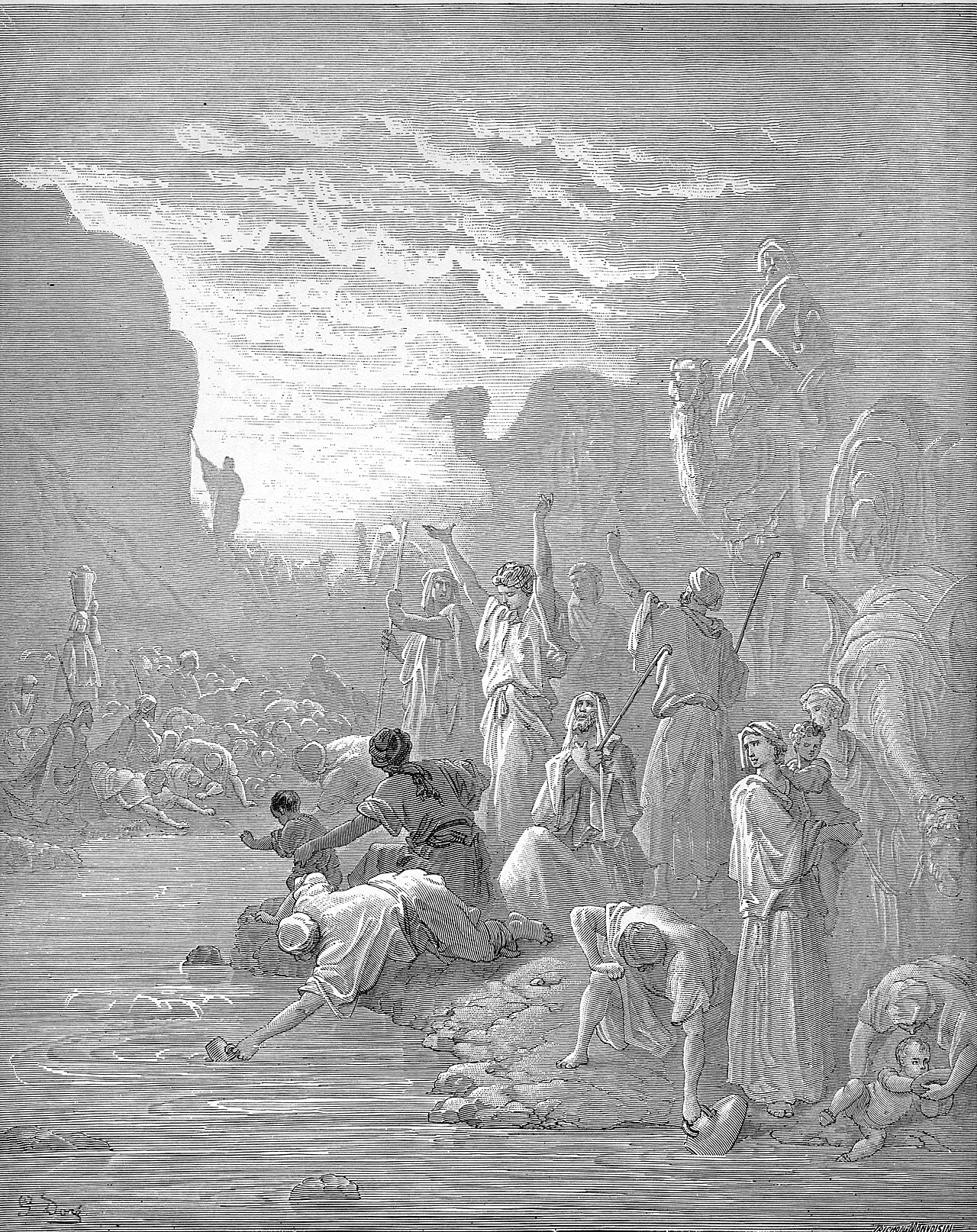
Exoduschapter 17
16 verses · Moses, by tradition · 15th or 13th century BC · The Law
In Jewish life
The reading
Weekly portion 16 of 54
בְּשַׁלַּח Beshalach, Exodus 13:17 to 17:16
Read with it: Judges 4:4 to 5:31 in Ashkenazi use, and Judges 5:1 to 5:31 in Sephardi use.
The verse numbers here are the ones a Hebrew Bible carries, which differ from an English Bible by a verse or two in several places. The Sephardi reading is named only where this site records a difference; communities vary beyond what is listed. What these books are, and how a Christian reader meets them →
What is done
One rule of the synagogue is drawn from this chapter. Rashi reads the three men named at verse 10, Moses and Aaron and Hur, as the pattern for a public fast day, on which three men stand before the ark to lead the prayer. He infers it from the fasting Israel was engaged in during the battle, and cites the Mekhilta (Rashi on Exodus 17:10:1).
How it is read
Rashi guards the miracle at the rock against a later doubt. The elders were taken along as witnesses, he says, so that nobody could claim "that there had been springs there from time immemorial" (Rashi on Exodus 17:5:2). At verse 6 he reads the wording closely, holding that Moses was told to strike into the rock rather than on its face (Rashi on Exodus 17:6:1). At verse 8 he explains why Amalek follows the question whether the LORD is among us. He gives the parable of a son carried on his father's shoulder who asks a passer-by where his father is (Rashi on Exodus 17:8:1). At verse 9 he reads the words choose out men for us as Moses setting Joshua beside himself, and the Rabbis drew a rule of honour from it (Rashi on Exodus 17:9:1). At verse 12 he explains the heavy hands as a consequence, since Moses had sent another man to the fighting (Rashi on Exodus 17:12:1). The text is the Rosenbaum and Silbermann Rashi of 1929 to 1934, in the public domain. Ramban reads the complaint of verse 3 as a practical one. The people named their cattle in it, so the whole matter needed counsel (Ramban on Exodus 17:3:1, the Chavel translation, Shilo, 1971 to 1976).
What the rabbis say
The rabbis take up the quarrel over water at Arakhin 15a:20 and Bekhorot 5b:4. On Moses fearing to be stoned they taught in the Mekhilta at Tractate Vayassa 7:8. On the rock at Horeb they taught at Bava Metzia 86b:13 and Bamidbar Rabbah 14:2. On the coming of Amalek they taught at Jerusalem Talmud Megillah 3:7:1 and Jerusalem Talmud Taanit 4:3:2. On the lifted hands they taught in Ein Yaakov (Glick Edition), Rosh Hashanah 3:1.
The text, verse by verse
Each word shows the Hebrew, the English under it, how it sounds and its Strong’s number. A rule between verses marks where the Hebrew manuscripts end a paragraph.
Water from the Rock at Horeb
Onkelos Exodus 17:1
The entire community of B’nei Yisrael journeyed from the wilderness of Sin, traveling according to the word of Adonoy.
Read it in full at Sefaria · Metsudah Chumash, Metsudah Publications, 2009 [with Onkelos translation]
Hands Held Up Against Amalek
Onkelos Exodus 17:10
Yehoshua did as Moshe told him—to battle [ fight a war with ] Amaleik.
Read it in full at Sefaria · Metsudah Chumash, Metsudah Publications, 2009 [with Onkelos translation]
Ramban on Exodus 17:11
By way of the plain meaning of Scripture, when Moses was compelled to lower his hands because of weariness, he saw that Amalek prevailed. He then commanded Aaron and Hur to support them, and thus he would not lower them again.
Read it in full at Sefaria · Commentary on the Torah by Ramban (Nachmanides). Translated and annotated by Charles B. Chavel. New York, Shilo Pub. House, 1971-1976
Ramban on Exodus 17:12
AND HIS HANDS WERE ‘EMUNAH’. This means that they remained steadily uplifted. The usage of the word is similar to the expressions: ‘va’amanah’ (And a sure) ordinance concerning the singers, as every day required; 465 Nehemiah:23. And yet for all this we make ‘amanah’ (a sure) covenant, 466 Ibid.,:1.
Read it in full at Sefaria · Commentary on the Torah by Ramban (Nachmanides). Translated and annotated by Charles B. Chavel. New York, Shilo Pub. House, 1971-1976
Ibn Ezra on Exodus 17:13
There is no difference between va-yachalosh. Which is an efol. (discomfited or weakened) and va-yechelash. Which is an efal.
Read it in full at Sefaria · Ibn Ezra's commentary on the Pentateuch, tran. and annot. by H. Norman Strickman and Arthur M. Silver. Menorah Pub., 1988-2004
Ramban on Exodus 17:14
Rabbi Abraham ibn Ezra commented. This quote from Ibn Ezra is found in his commentary to Numbers:14. Part of it is also found here. that “this was a known book, namely, the book of the wars of the Eternal, 472 Numbers:14.
Read it in full at Sefaria · Commentary on the Torah by Ramban (Nachmanides). Translated and annotated by Charles B. Chavel. New York, Shilo Pub. House, 1971-1976
Hebrew words in this chapter
The 40 most used Hebrew words of the chapter, counted by lemma. The article, the object marker, the negatives and the common prepositions are left out.
| Word | Sense here | Uses | Strong’s |
|---|---|---|---|
| מֹשֶׁהMôsheh | Moses | 13 | H4872 |
| אָמַרʼâmar | to say | 10 | H559 |
| יְהֹוָהYᵉhôvâh | yahweh | 9 | H3068 |
| עַםʻam | people | 8 | H5971 |
| יָדyâd | hand | 8 | H3027 |
| עֲמָלֵקʻĂmâlêq | Amalek | 7 | H6002 |
| יִשְׂרָאֵלYisrâʼêl | Israel | 6 | H3478 |
| מַיִםmayim | water | 4 | H4325 |
| יְהוֹשׁוּעַYᵉhôwshûwaʻ | Joshua | 4 | H3091 |
| בֵּןbên | people of | 3 | H1121 |
| שָׁתָהshâthâh | to drink | 3 | H8354 |
| עָשָׂהʻâsâh | will I do | 3 | H6213 |
| לָקַחlâqach | to take | 3 | H3947 |
| לָחַםlâcham | to fight | 3 | H3898 |
| פֶּהpeh | mouth of | 2 | H6310 |
| רְפִידִיםRᵉphîydîym | Rephidim | 2 | H7508 |
| אַיִןʼayin | and there not | 2 | H369 |
| רִיבrîyb | and it quarreled | 2 | H7378 |
| נָסָהnâçâh | to test | 2 | H5254 |
| שָׁםshâm | there | 2 | H8033 |
| Word | Sense here | Uses | Strong’s |
|---|---|---|---|
| עָלָהʻâlâh | did you bring up us | 2 | H5927 |
| זָקֵןzâqên | elder | 2 | H2205 |
| מַטֶּהmaṭṭeh | and staff your | 2 | H4294 |
| נָכָהnâkâh | you struck | 2 | H5221 |
| צוּרtsûwr | Rocks | 2 | H6697 |
| יָצָאyâtsâʼ | to come out | 2 | H3318 |
| קָרָאqârâʼ | to call | 2 | H7121 |
| שֵׁםshêm | name | 2 | H8034 |
| בּוֹאbôwʼ | and it came | 2 | H935 |
| רֹאשׁrôʼsh | top of | 2 | H7218 |
| גִּבְעָהgibʻâh | the hill | 2 | H1389 |
| אַהֲרוֹןʼAhărôwn | Aaron | 2 | H175 |
| חוּרChûwr | Hur | 2 | H2354 |
| גָּבַרgâbar | to prevail | 2 | H1396 |
| שׂוּםsûwm | and they put | 2 | H7760 |
| אֶחָדʼechâd | one | 2 | H259 |
| מָחָהmâchâh | to wipe | 2 | H4229 |
| דּוֹרdôwr | generation | 2 | H1755 |
| נָסַעnâçaʻ | to set out | 1 | H5265 |
| עֵדָהʻêdâh | congregation | 1 | H5712 |
Keep studying
Studies6
Sources for this chapter
The Hebrew text
STEP Bible, the tagged Hebrew text and its English glosses and James Strong, Strong's Exhaustive Concordance.
In Jewish life
Rashi, Rashi on Exodus 17:5:2, 17:6:1, 17:8:1, 17:9:1, 17:10:1 and 17:12:1, Pentateuch with Rashi's commentary by M. Rosenbaum and A. M. Silbermann, 1929 to 1934 (public domain); Ramban, Ramban on Exodus 17:3:1, Commentary on the Torah translated by Charles B. Chavel, Shilo, 1971 to 1976 (CC-BY); Ibn Ezra, Ibn Ezra on Exodus 17:7:1 and 17:8:1, cited by ref alone under the corpus licence rule; The Babylonian Talmud, Arakhin 15a:20, Bekhorot 5b:4 and Bava Metzia 86b:13, cited by ref; The Jerusalem Talmud, Jerusalem Talmud Megillah 3:7:1 and Taanit 4:3:2, cited by ref and The Midrash, Mekhilta DeRabbi Yishmael, Tractate Vayassa 7:8, Bamidbar Rabbah 14:2, and Ein Yaakov (Glick Edition), Rosh Hashanah 3:1, cited by ref.
The rabbinic texts
Ramban, Commentary on the Torah by Ramban (Nachmanides). Translated and annotated by Charles B. Chavel. New York, Shilo Pub. House, 1971-1976; Ibn Ezra, Ibn Ezra's commentary on the Pentateuch, tran. and annot. by H. Norman Strickman and Arthur M. Silver. Menorah Pub., 1988-2004; Targum, Metsudah Chumash, Metsudah Publications, 2009 [with Onkelos translation] and Sefaria, texts and citation data.