
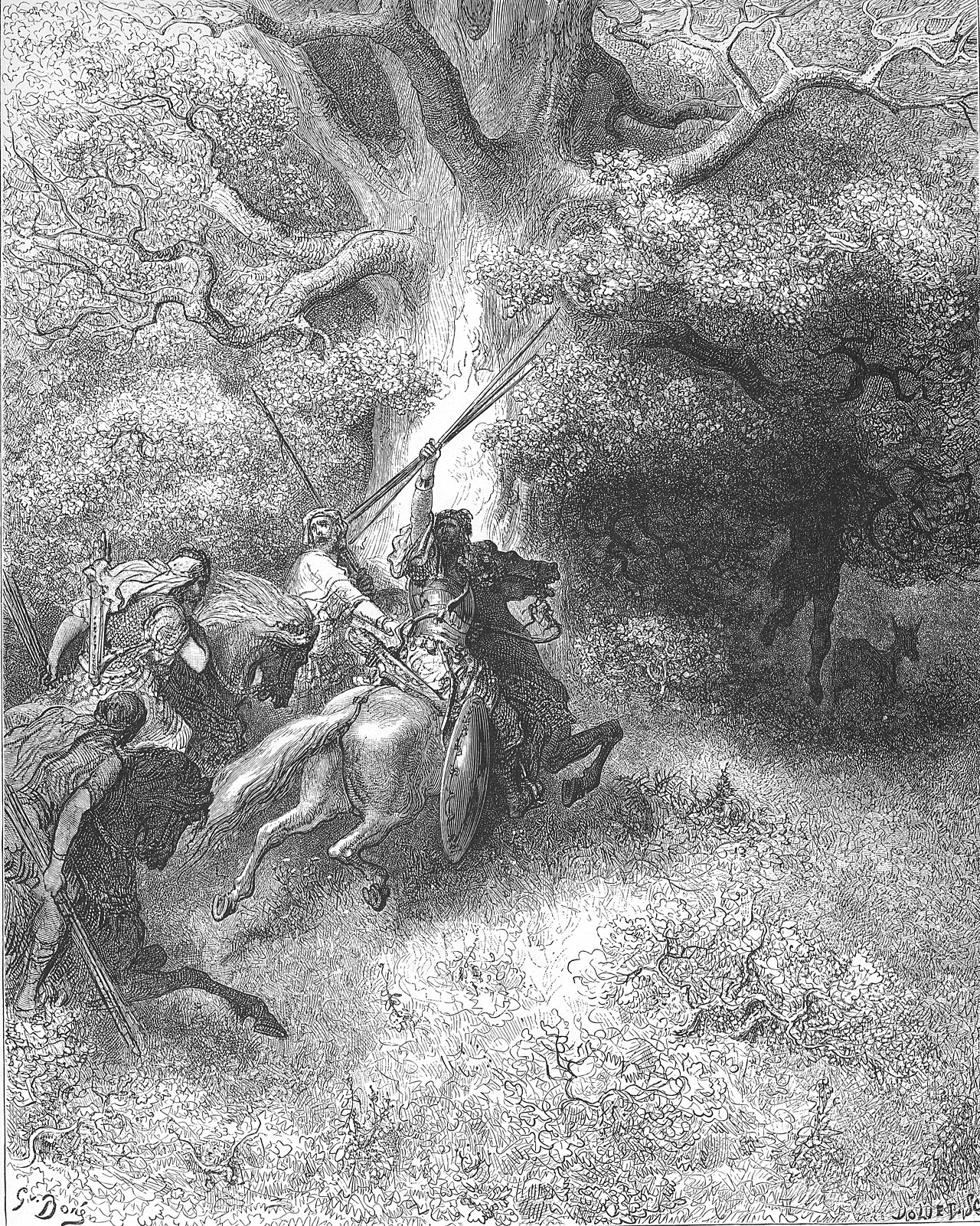
2 Samuelchapter 18
33 verses · Samuel, Nathan and Gad, by tradition · 10th century BC · History
And David sat between the two gates: and the watchman went up to the roof over the gate unto the wall, and lifted up his eyes, and looked, and behold a man running alone.
Introduction
Samuel, Nathan and Gad, by tradition, History, 2 Samuel Overview.
This chapter records the one battle of Absalom's revolt and the news of it reaching the king. The writer of 2 Samuel tells it for a people who had lost thousands of their own sons in a single day of civil war. The fighting takes place in broken, wooded country east of the Jordan, where a large army easily loses its shape. Much of the chapter is spent at a town gate, waiting for runners. Listen for the one order the king gives before the battle and who obeys it. Listen also for the question he asks each messenger. The chapter measures victory by what it costs the king.
Context
- Who
- Israelites who had lost twenty thousand men in a single day of civil war
- What
- An account of the battle in the forest of Ephraim, the death of Absalom at Joab's hand, and the news brought to David.
- Where
- The forest of Ephraim in Gilead, and the gate of Mahanaim east of the Jordan.
- When
- About 979 BC, soon after the flight across the Jordan.
- Why
- To show the sword promised against David's house taking his son, and a victory the king cannot receive.
Historical context
The terrain is the weapon. Gilead east of the Jordan is broken country, steep wadis, thick oak and terebinth scrub, hidden ravines. A large conscript army loses cohesion in ground like that, while a smaller professional force that knows the land can cut it apart in pieces, which is why the text says the forest devoured more men than the sword.
Show the rest of the historical context, 3 more paragraphs
David's men insist he stay behind at the gate, and their reasoning is practical: you are worth ten thousand of us, so be ready to send help from the town. Sitting between the two gates, in the chamber over the entry with a watchman on the roof above, was the standard command post, you could see the road, and news reached you first.
The mule was the royal mount before horses became common in Israel. When it carried Absalom under a low oak and left him hanging, the mule going on without him is a picture of the throne walking out from under him.
Joab's response is a deliberate breach of a direct royal order, and he knows it, hence the soldier's refusal to touch the prince for any amount of silver. Burying the body under a great heap of stones in the forest was the treatment given to a criminal, the opposite of the monument Absalom had built for himself in the King's Valley. And the running of the news is a scene in itself: two runners on different routes, the watchman calling their gait, and a king who only wants to know about one man.
Significance
The first hearers would have felt the whole chapter collapse into one cry at the gate. The victory report arrives and the king cannot hear it.
Show the rest of the significance, 1 more paragraph
It is also the moment the sword promised to David's house finishes its work. Four sons are dead across the book, the infant, Amnon, Absalom, and later Adonijah, and the man who has to be told he is ruining his own army's homecoming is the man who wrote the letter to Joab.
This chapter in Jewish lifeWhat this chapter is in Jewish life and reading.
How it is read
The longest of Rashi's notes here is about a place name, and it shows how closely the classical reading holds the map. The battle is fought in the forest of Ephraim, and the forest lies east of the Jordan, where Ephraim had no portion. Rashi answers that Joshua divided the land on a condition, that any tribe might graze its cattle in any forest. The wood lay near the portion of Ephraim with the river between, and the men of Ephraim grazed there. The name followed the use (Rashi on II Samuel 18:6:1, the Metsudah Tanach series, Lakewood, N.J., CC-BY).
Two more notes turn on single words. At the eighth verse he takes the devouring of the forest from the Targum as the wild beasts in it (Rashi on II Samuel 18:8:1). At the ninth he reads the verb used of Absalom meeting David's men as chance, "Denoting something that just happened, a chance meeting" (Rashi on II Samuel 18:9:1). At the eighteenth he explains the pillar Absalom raised in his lifetime. Absalom had children, and the note is that he had no son who could replace him and stand as high as he stood, with Sotah 11a named for it (Rashi on II Samuel 18:18:1).
The orders about Absalom and the race of the runners draw shorter glosses. At the third verse he gives the men's reason for keeping the king out of the field, that the enemy would think a victory without him worth little (Rashi on II Samuel 18:3:1). At the fifth and twelfth he reads the king's charge as a plain order to spare him if he comes to hand (Rashi on II Samuel 18:5:1 and 18:12:1). At the twentieth and twenty-second verses he follows the argument between Joab and Ahimaaz over carrying the news (Rashi on II Samuel 18:20:1 and 18:22:1). At the twenty-third he reads the young man's answer as a willingness to run without reward (Rashi on II Samuel 18:23:1).
Malbim, Radak and Metzudat David carry the rest. The corpus holds thirteen of their refs with the reason that Sefaria holds no English version of them, so they stand cited and unquoted. They are Malbim on II Samuel 18:1:1 and 18:2:1, Radak on II Samuel 18:4:1, 18:7:1, 18:11:1, 18:13:1, 18:15:1, 18:16:1, 18:17:1, 18:21:1 and 18:24:1, and Metzudat David on II Samuel 18:19:1 and 18:25:1.
What the rabbis say
The corpus carries thirty-eight rabbinic locators for this chapter and the text of none, so each is cited and linked here rather than quoted. Nine of them stand on the fourteenth verse, where Joab takes three darts and thrusts them through Absalom. They are Sotah 9b:7 and Jerusalem Talmud Sotah 1:8:1, Bamidbar Rabbah 9:24, Mekhilta DeRabbi Shimon Ben Yochai 15:8, and Mekhilta DeRabbi Yishmael, Tractate Shirah 6:21. Beside them stand Midrash Sekhel Tov, Shemot 15:8:3 and 15:21:24, Midrash Tanchuma, Beshalach 17:1 and Yalkut Shimoni on Torah 248:3. Two more follow at the fifteenth verse, Sanhedrin 103b:5 and Ein Yaakov (Glick Edition), Sanhedrin 11:81.
The hair caught in the oak draws five. They are Sotah 10b:14, Ein Yaakov (Glick Edition), Sotah 1:27, Mekhilta DeRabbi Yishmael, Tractate Shirah 2:14, Midrash Tanchuma, Beshalach 12:10, and Otzar Midrashim, Chuppah of Eliyahu, Chuppat Eliyahu Rabbah 197. The pillar of the eighteenth verse draws four, Sotah 10b:16 and 11a:2, with Ein Yaakov (Glick Edition), Sotah 1:31 and Ein Yaakov, Sotah 1:37.
The running of the news draws seven at the twenty-third verse alone. They are Megillah 21b:4, Niddah 63a:8, Pesachim 7b:10 and 119b:2, Sukkah 39a:3, Ein Yaakov, Sukkah 3:9, and Midrash Sekhel Tov, Bereshit 37:28:1. Two more stand at the twenty-second verse, Midrash Sekhel Tov, Bereshit 37:13:3 and Shir HaShirim Rabbah 8:10:2. The Pirkei DeRabbi Eliezer reads the chapter at four places, 53:7, 53:8, 53:9 and 53:10. The last five are Midrash Tehillim 7:19, Midrash Sekhel Tov, Bereshit 30:34:2, Yalkut Shimoni on Torah 950:4, Otzar Midrashim, Keri & K'tiv, Midrash Keri V'lo Ketiv 6 and Tractate Kallah Rabbati 5:1. What each of them teaches is a saying of the rabbis, and is reported as theirs wherever this site quotes one. The quotations wait on a fetch that carries the text.
Sources: Rashi, Rashi on II Samuel 18:3:1 to 18:23:1, the Metsudah Tanach series, Lakewood, N.J., CC-BY; Malbim, Malbim on II Samuel 18:1:1 and 18:2:1, cited by ref because the corpus carries no English text; Radak, Radak on II Samuel 18:4:1, 18:7:1, 18:11:1, 18:13:1, 18:15:1, 18:16:1, 18:17:1, 18:21:1 and 18:24:1, cited by ref because the corpus carries no English text; Metzudat David, Metzudat David on II Samuel 18:19:1 and 18:25:1, cited by ref because the corpus carries no English text; The Babylonian Talmud, Sotah 9b:7, 10b:14, 10b:16 and 11a:2, Sanhedrin 103b:5, Megillah 21b:4, Niddah 63a:8, Pesachim 7b:10 and 119b:2, and Sukkah 39a:3, cited by locator from the Sefaria corpus for 2 Samuel 18; The Midrash, Bamidbar Rabbah 9:24, Pirkei DeRabbi Eliezer 53:7, 53:8, 53:9 and 53:10, Shir HaShirim Rabbah 8:10:2, Midrash Tehillim 7:19 and Midrash Tanchuma, Beshalach 12:10 and 17:1, cited by locator from the Sefaria corpus for 2 Samuel 18.
The heads below are this chapter's scenes. The numbered points under each are its verses.
Deal gently for my sake with the young man
2 Samuel 18:1-3
captains of thousands and captains of hundreds: David numbers the men who have stayed loyal to him and divides them into three companies under Joab, Abishai and Ittai the Gittite, then tells them he means to go out with them himself. The people refuse him outright: if the army breaks and flees no one will care, and if half of them fall no one will care, but the king is worth ten thousand of them and safer inside the city walls. Josephus counted this loyal army at only about four thousand men, a small remnant beside the host that followed Absalom out of Hebron in chapter fifteen.
2 Samuel 18:1
“And set captains of thousands - By this time David’s small company was greatly recruited; but what its number was we cannot tell. Josephus says it amounted to four thousand men. Others have supposed that they amounted to ten thousand; for thus they understand a clause in 2Sa 18:3, which they think should be read, We are now ten thousand strong.”
Adam Clarke · Commentary on the Bible (1810-1826)evangelical
David sent out the troops in three parts, a third under Joab, a third under Abishai, and a third under Ittai the Gittite. Albert Barnes notes this threefold order among Hebrew commanders, as with Gideon at Judges 7:16 and Saul at 1 Samuel 11:11. Ittai's oath at 15:21 earns him equal rank with Joab.
2 Samuel 18:2
“A third part - This seems to have been a favorite division with the Hebrew commanders (see Jdg 7:16; Jdg 9:43; 1Sa 11:11; 2Ki 11:5-6) and with the Philistines also 1Sa 13:17.”
worth ten thousand of us: The people tell the king he is worth ten thousand. Adam Clarke takes the Hebrew word now as a copying slip for the similar word meaning you, as the Septuagint, Vulgate and Chaldee read it. Albert Barnes explains the plan that David support the troops from the city, ready to send help or to take in a beaten army.
2 Samuel 18:3
“But now thou art worth ten thousand of us - The particle יתה attah, now, is doubtless a mistake for the pronoun אתה attah, thou; and so it appears to have been read by the Septuagint, the Vulgate, and the Chaldee, and by two of Kennicott’s and De Rossi’s MSS.”
Adam Clarke · Commentary on the Bible (1810-1826)evangelical
2 Samuel 18:4-5
What seemeth you best I will do: David leaves the shape of the battle to his three commanders and stands at the gate as the army files out by hundreds and by thousands. Before they go he gives one order that reaches every ear in the camp: deal gently for my sake with the young man, even with Absalom. Matthew Henry reads the plea as a father's tenderness for the son who caused the war, and even sets it, carefully, beside the mercy of the true King who prayed for those who rose against him.
David had commanded Joab, Abishai, and Ittai to treat the young man Absalom gently for his sake. Matthew Henry calls this an injurious tenderness that makes the cause of the war a reason for mercy, and Adam Clarke answers that any father would have felt the same. All the people heard the order.
2 Samuel 18:5
“Must the cause of the quarrel be the motive of mercy? Even in the holiest parents, nature may be guilty of an injurious tenderness, of a bloody indulgence. But was not this done in type of that immeasurable mercy of the true King and Redeemer of Israel, who prayed for his persecutors, for his murderers, Father, forgive them?”
Matthew Henry · Commentary on the Whole Bible (1707-1721)puritan
2 Samuel 18:6-8
the battle was in the wood of Ephraim: The two armies meet in the wood of Ephraim, and the fighting scatters across broken ground rather than holding one line. Twenty thousand of Absalom's men fall that day, and the wood devoured more people that day than the sword devoured, a line the narrator states as plain fact rather than as ornament. Clarke notes that the Targum and other ancient versions read part of the loss as wild beasts in the forest rather than only pits and thickets, though the picture of a battlefield turned death trap by its own terrain stands either way.
2 Samuel 18:6
“Against Israel - Implying that the revolt was in a great measure that of the ten tribes, Saul’s party, against the kingdom. The wood of Ephraim - This would naturally be sought in the west of Jordan (marginal reference). But on the other hand it seems certain that the scene of this battle was on the east of Jordan.”
John Gill counts the twenty thousand as Absalom's men only, fallen both in battle and in the pursuit. Adam Clarke leaves open whether the figure includes those lost in the forest of verse 8. Matthew Henry asks where their promised rewards had gone.
2 Samuel 18:7
“Now where are the rewards, the preferments, the golden days, they promised themselves from him? Now they see what it is to take counsel against the Lord and his anointed, and to think of breaking his bands asunder.”
Matthew Henry · Commentary on the Whole Bible (1707-1721)puritan
Fighting spread across the whole countryside, and the forest took more lives than the sword. Albert Barnes thinks Absalom's army far outnumbered David's troops, and credits Joab with choosing ground where numbers counted for little. Absalom's body lies in a pit of that forest.
2 Samuel 18:8
“The wood devoured more people - It is generally supposed that, when the army was broken, they betook themselves to the wood, fell into pits, swamps, etc., and, being entangled, were hewn down by David’s men; but the Chaldee, Syriac, and Arabic, state that they were devoured by wild beasts in the wood.”
Adam Clarke · Commentary on the Bible (1810-1826)evangelical
Caught in an oak, and three darts through the heart
taken up between the heaven and the earth: Absalom rides his mule under a great oak and his head catches in the boughs, so that he hangs suspended between heaven and earth while the mule runs on without him. Older writers, reading against 14:26, where his hair was cut once a year and weighed two hundred shekels, take the boughs as catching that same hair rather than his head plainly; Wesley calls it the very pride that made him admired turned into the instrument of his ruin. The verse itself says only that his head caught hold and he was left hanging alive, and the hair reading, old and widely held as it is, goes beyond what the text states outright.
2 Samuel 18:9
"It is necessary to be continually on one's guard against the branches of trees; and when the hair is worn in large locks floating down the back, as was the case with a young man of the party to which I belonged, any thick boughs interposing in the path might easily dislodge a rider from his seat, and catch hold of his flowing hair" [HARTLEY].
Jamieson, Fausset & Brown · Commentary Critical and Explanatory on the Whole Bible (1871)reformed
1 more voice on this verse
2 Samuel 18:9
“Thus he that fleeth from the fear shall fall into the pit, and he that getteth up out of the pit shall be taken in the snare, Jer. xlviii. David is inclined to spare him, but divine justice passes sentence upon him as a traitor, and sees it executed--that he hang by the neck, be caught alive, be embowelled, and his body dispose of disgracefully. He is hanged by the neck.”
Matthew Henry · Commentary on the Whole Bible (1707-1721)puritan
2 Samuel 18:10-13
I saw Absalom hanged in an oak: A soldier sees Absalom hanging and reports it to Joab, who asks why he did not strike him down on the spot for a reward of ten shekels of silver and a girdle. The man refuses outright: not for a thousand shekels would he raise his hand against the king's son, because he heard David's charge with his own ears and knows nothing stays hidden from the king. His answer holds the very order Joab is about to break, and the narrator lets an ordinary soldier state a loyalty the commander himself will not keep.
2 Samuel 18:10
“Thus was he set up for a spectacle, as well as a mark, that the righteous might see him and laugh at him ( Ps. lii. 6 ), while he had this further vexation in his breast, that of all the friends he had courted and confided in, and thought he had sure in his interest, though he hung long enough to have been relieved, yet he had none at hand to disentangle him.”
Matthew Henry · Commentary on the Whole Bible (1707-1721)puritan
Joab tells the man he would have given a warrior's belt and ten shekels of silver. Matthew Henry reads the belt as a captain's commission, and Adam Clarke adds that the military belt was a soldier's chief honor, the gift Jonathan gave David at 1 Samuel 18:4. Joab offers a reward for disobedience to the king.
2 Samuel 18:11
“Ten shekels - (About 25 shillings.) The word “shekel” is understood, as in Gen 20:16; Gen 37:28. See the Exo 38:24 note. A girdle - Girdles were costly articles of Hebrew dress used to put money in Mat 10:9, and given as presents 1Sa 18:4.”
a thousand shekels of silver: The soldier multiplies Joab's offer a hundred times and still refuses. Silver was weighed on scales in that age, so he pictures the full weight laid in his palms. His quotation of the king's order at verse 5 shows the whole army took it as binding.
Albert Barnes hears in this aside a witness to David's sharp discernment, the same the wise woman of Tekoa met at 14:19. The soldier also knows Joab well enough to expect no protection from him. Adam Clarke notes that the appeal left Joab unmoved.
2 Samuel 18:13
“The man gives a remarkable incidental testimony to David’s sagacity and penetration (compare 2Sa 14:19), and to Joab’s known unscrupulousness.”
2 Samuel 18:14-15
three darts in his hand: Joab will not tarry any longer over the man's excuse; he takes three darts and thrusts them through Absalom's heart while he still hangs alive in the oak, then ten of his own armorbearers close in and finish the killing. Henry will not excuse the plain disobedience to the king's own charge at verse five, while Jamieson Fausset and Brown read Joab as acting from a hard loyalty to David's throne rather than against David the father, a memory 1 Kings 2:5 shows David never let go of. Three darts against one charge is the chapter's plainest collision between mercy commanded and war's own logic.
2 Samuel 18:14
“I may not tarry thus with thee - He had nothing to say in vindication of the purpose he had formed. Thrust them through the heart of Absalom - He was determined to make sure work, and therefore he pierced his heart. Joab should have obeyed the king’s commandment: and yet the safety of the state required the sacrifice of Absalom. But independently of this, his life was quadruply forfeited to the law: - 1. In having murdered his brother Amnon. 2. In having excited an insurrection in the state.”
Adam Clarke · Commentary on the Bible (1810-1826)evangelical
2 more voices on this verse
2 Samuel 18:14
“I know not whether Joab can be justified in this direct disobedience to the command of his sovereign; was this to deal gently with the young man? Would David have suffered him to do it if he had been upon the spot?”
Matthew Henry · Commentary on the Whole Bible (1707-1721)puritan
2 Samuel 18:14
“Being a violation of the expressed wish, as well as of all the fond paternal feelings of David, it must have been deeply offensive to the king, nor was it ever forgotten (1Ki 2:5); and yet there is the strongest reason for believing that Joab, in doing it, was actuated by a sincere regard to the interests of David, both as a man and a monarch.”
Jamieson, Fausset & Brown · Commentary Critical and Explanatory on the Whole Bible (1871)reformed
John Gill has the armor bearers acting on Joab's orders, closing a ring so that no one could rescue Absalom. Adam Clarke doubts any life remained after three darts through the heart. The ten blows spread the deed across Joab's own men.
2 Samuel 18:16-17
Joab held back the people: Joab sounds the trumpet and the pursuit stops; the head of the revolt is dead, and further slaughter serves nothing more. Absalom's body is thrown into a pit in the wood and covered with a great heap of stones, the burial the ancient world gave a rebel rather than a prince, while the rest of Israel scatters to their own tents. Clarke notes the heap of stones was the standing way to mark a memory for good or ill, the same rite by which a hero and a traitor were both remembered on the ground where they fell.
2 Samuel 18:16
“The danger is over, now that Absalom is slain; the people will soon return to their allegiance to David, and therefore no more blood shall be spilt; no prisoners are taken, to be tried as traitors and made examples; let every man return to his tent; they are all the king's subjects, all his good subjects again.”
Matthew Henry · Commentary on the Whole Bible (1707-1721)puritan
Jamieson, Fausset and Brown note the Eastern custom of throwing stones on the grave of an infamous man, so the heap grows with every passerby. Ambrose of Milan sets this pit beside the pillar Absalom raised for himself in the King's Valley at verse 18. The monument he built stood empty.
2 Samuel 18:17
“And laid a very great heap of stones - This was the method of burying heroes, and even traitors, the heap of stones being designed to perpetuate the memory of the event, whether good or bad. The ancient cairns or heaps of stones, in different parts of the world, are of this kind. The various tumuli or barrows in England are the same as the cairns in different parts of Ireland and Scotland. In the former, stones were not plenty; hence they heaped up great mounds of earth.”
Adam Clarke · Commentary on the Bible (1810-1826)evangelical
I have no son to keep my name in remembrance: Absalom had already built himself a pillar in the king's dale and named it after himself, for he said, I have no son to keep my name in remembrance. It stands against 14:27, which names three sons born to him and one daughter, Tamar; most of the bench reads the pillar's claim as evidence the sons died young, since Scripture never gives their names and Absalom himself, in his own words here, counts himself without an heir. The stone pillar outlives him in Jerusalem, and the narrator leaves the two verses standing together rather than closing the gap between them.
2 Samuel 18:18
“Now Absalom in his lifetime had taken,.... Had taken it into his head, had of himself devised it, as Kimchi explains it; he contrived the following scheme to perpetuate his memory: and reared up for himself a pillar, which is in the king's dale: or valley, the valley of Jehoshaphat; this pillar was of marble, as Josephus (o) says, and stood about two furlongs or a quater mile from Jerusalem.”
2 more voices on this verse
2 Samuel 18:18
“Reared up for himself a pillar - There was a marble pillar in the time of Josephus called Absalom’s pillar: and there is one shown to the present day under this name; but it is comparatively a modern structure. Absalom’s place - Literally Absalom’s Hand. See the note on 1Sa 15:12.”
Adam Clarke · Commentary on the Bible (1810-1826)evangelical
2 Samuel 18:18
“Absalom in his lifetime had reared up for himself a pillar--literally, "hand." In the valley of Jehoshaphat, on the east of Jerusalem, is a tomb or cenotaph, said to be this "pillar" or monument: it is twenty-four feet square, dome-topped, and reaches forty feet in height.”
Jamieson, Fausset & Brown · Commentary Critical and Explanatory on the Whole Bible (1871)reformed
Two runners and a watchman on the wall
2 Samuel 18:19-23
the Lord hath avenged him of his enemies: Ahimaaz asks to be the one who carries word that the Lord hath avenged him of his enemies, and Joab refuses him because the king's son is dead, sending Cushi instead to tell the king what he has seen. Ahimaaz asks a second time to run after Cushi and Joab lets him go, though he warns him he has no news ready to tell; Ahimaaz takes the way of the plain and outruns Cushi, who has kept to the harder road through the hills. Barnes reads Cushi as a foreign slave, a man Joab did not scruple to send first into whatever anger the news might draw down on the one who carries it.
2 Samuel 18:19
Ahimaaz was a well-known runner 2Sa 18:27. Speed was a heroic virtue in those simple times (compare 2Sa 2:18). In Hezekiah’s reign 2Ch 30:6, 2Ch 30:10 we find an establishment of running post-men; and the same name (“runners”) is given Est 3:13 to the Persian posts, though at that time they rode on mules and camels. Bear tidings - The original word is used almost exclusively of bearing good tidings, and hence, is rendered in the Septuagint (though not always) εὐαγγίζεσθαι euangelizesthai 2Sa 4:10; 1Sa 31:9. In 2Sa 18:21, it is not “carry the good tidings,” but “tell,” simply “announce.”
because the king’s son is dead: Joab knows how David treats bearers of such news, having seen him execute the Amalekite who reported Saul's death at 1:15. Matthew Henry judges tidings of this kind fitter for a footman than a priest. Joab protects Zadok's son.
Matthew Henry reports that some took the Cushite for an Ethiopian by birth, who may have been one of the ten who struck Absalom. John Gill allows that he may instead have been a dark-skinned Israelite. Adam Clarke says Joab told him of the death.
2 Samuel 18:21
“Cushi - “The Cushite,” a foreign slave, perhaps of Joab’s, whom he did not scruple to expose to David’s anger. If, however, it is a name, it must be rendered “Haccushi.” In the title to Ps. 7, “Cush, the Benjamite,” cannot mean this Cushi, since the contents of the Psalm are not suitable to this occasion.”
Matthew Henry weighs two motives for Ahimaaz's persistence. He may have been proud of his speed, or he may have meant to prepare David gently before the Cushite's plain report arrived. Joab addresses him as a son, which softens the refusal.
2 Samuel 18:22
“No great praise for a priest to be swift of foot, yet perhaps Ahimaaz was proud of it. (2.) Perhaps it was in prudence and tenderness to the king that he desired it. He knew he could get before Cushi, and therefore was willing to prepare the king, by a vague and general report, for the plain truth which Cushi was ordered to tell him.”
Matthew Henry · Commentary on the Whole Bible (1707-1721)puritan
Ahimaaz outran the Cushite by way of the plain. The Hebrew word for plain is ciccar, meaning circle, which Jamieson, Fausset and Brown say is used elsewhere only of the Jordan valley. Albert Barnes and John Gill both think the valley way was longer but easier, so Ahimaaz won the run by his choice of road.
2 Samuel 18:23
“But howsoever (said he) let me run,.... Be it as it may, I beg I may have leave; and being so very importunate, it was granted: and he said unto him, run; since he would take no denial: then Ahimaaz ran by the way of the plain, and overran Cushi; who ran by the way of the mountains; which though the shorter way, that through the plain was easiest, and soonest run, though the longest.”
1 more voice on this verse
2 Samuel 18:23
“The plain - The floor of the valley through which the Jordan runs. The Cushite did not run by that road, but took the road over the hills, which may well have been the shorter but also the more difficult road. The two roads would probably meet a short distance from Mahanaim.”
2 Samuel 18:24-27
David sat between the two gates: David sits between the two gates of Mahanaim while a watchman keeps the wall above him, and the first runner is seen alone, which the king reads rightly as a sign of good news, since a rout would send men running in every direction rather than one man running straight. A second runner appears, and then the watchman recognizes the gait of the first as Ahimaaz's own running, specific enough that David calls him a good man who comes with good tidings before a word has reached him. The whole scene is told through a watchman's eyes and a father's guesses, the reader kept exactly as far from the truth as the man waiting at the gate.
2 Samuel 18:24
“David sat between the two gates - He was probably in the seat of justice. Before the gate of the city it is supposed there was an enclosure, which had its gate also; David sat in the space between these two doors. Over the larger gate there appears to have been a turret, on which a sentinel or watchman stood continually, and gave information of what he saw in the country.”
Adam Clarke · Commentary on the Bible (1810-1826)evangelical
1 more voice on this verse
2 Samuel 18:24
“David sat between the two gates--that is, in the tower-house on the wall that overhung the gate of Mahanaim. Near it was a watchtower, on which a sentinel was posted, as in times of war, to notify every occurrence.”
Jamieson, Fausset & Brown · Commentary Critical and Explanatory on the Whole Bible (1871)reformed
Jamieson, Fausset and Brown place David in the tower house over the gate of Mahanaim, with a sentinel posted on the watchtower beside it. The watchman calls down each sighting. The king's hopeful reading of each one prepares for the blow that falls at verse 33.
2 Samuel 18:25
“If he be alone, there is tidings - That is, good tidings. For if the battle had been lost men would have been running in different directions through the country.”
Adam Clarke · Commentary on the Bible (1810-1826)evangelical
The watchman calls to the gatekeeper below, who keeps the gate under the watchtower. John Gill notes that armies commonly sent one messenger after another as fresh news came in. David takes a second runner as more good news.
2 Samuel 18:26
“And the watchman saw another man running,.... At a further distance: and the watchman called unto the porter; that kept the gate, under which the watchtower was: and said, behold, another man runneth alone; as the other, and has the same appearance of a messenger: and the king said, he also bringeth tidings; it being usual then, as now, to dispatch one messenger after another, as fresh accounts coming in made it necessary.”
David trusts Ahimaaz son of Zadok, who had already risked his life carrying Hushai's warning at 17:21. Matthew Henry draws the wider rule that good tidings ought to come by good men. The news is good for the king, grievous for the father.
O Absalom, my son, my son
2 Samuel 18:28-29
Blessed be the Lord thy God: Ahimaaz arrives first, falls on his face and blesses the Lord for delivering up the men who rose against the king, but when David asks the one question that matters, is the young man Absalom safe, Ahimaaz answers with a report of a great tumult he says he did not understand. Clarke and Gill both weigh whether Ahimaaz already knew Absalom was dead and simply could not bring himself to say it to the king he loved; either way, the young priest who ran to be first with good news arrives carrying none of the news the king is actually asking for. Every word he brings is true, and none of it answers the only thing David wants to hear.
2 Samuel 18:28
"They are all cut off that lifted up their hands against the king; " and, as became a priest, while he gives the king the joy of it, he gives God the glory of it, the God of peace and war, the God of salvation and victory: " Blessed be the Lord thy God, that has done this for thee, as thy God, pursuant to the promises made to uphold thy throne," ch. vii.
Matthew Henry · Commentary on the Whole Bible (1707-1721)puritan
1 more voice on this verse
2 Samuel 18:28
“Ahimaaz called - This marks the eager haste with which, before he had quite reached the king, he shouted out the pithy decisive word of good tidings, “Shalom!” Peace! Hath delivered - See the margin. The figure seems to be that of confining a person within the power of his enemy, in opposition to “giving him his liberty” “in a large room,” to work what mischief he pleases.”
I saw a great tumult: The king's question turns on the word shalom. John Gill hears the contrast: the army has peace, and David asks whether Absalom has it too. Charles Spurgeon preached the question as a father's anxious enquiry for a son both wicked and still loved, asked over a field of twenty thousand dead.
2 Samuel 18:29
“I saw a great tumult - It was very probable that Ahimaaz did not know of the death of Absalom; he had seen the rout of his army, but did not know of his death. Others think he knew all, and told this untruth that he might not be the messenger of bad news to David.”
Adam Clarke · Commentary on the Bible (1810-1826)evangelical
1 more voice on this verse
2 Samuel 18:29
THIS WAS SAID by David after a great battle in which many had been slain, and the hosts led by Absalom had fallen to the number of twenty thousand; perishing not only by the sword, but among the thick oaks and tangled briers of the wood, which concealed fearful precipices and great caverns, into which the rebels plunged in their wild fright when the rout set in. His father's anxious question concerned his wicked but still well-beloved son, "Is the young man Absalom safe?" He does not appear to have asked, "How have we won the victory?"
2 Samuel 18:30-32
Turn aside, and stand here: David sets Ahimaaz aside and waits for Cushi, who is met with the same question: is the young man Absalom safe? Cushi answers as carefully as a man can who must tell his king the truth, the enemies of my lord the king be as that young man is, letting David hear his son's death without the word itself ever being spoken. Gill reads the answer as shaped so David could not turn his anger on the messenger, even though the message itself was the heaviest one Cushi had to bring.
2 Samuel 18:30
“And the king said unto him, turn aside, and stand here,.... On the side of him, not far from him, until the other messenger came, that he might learn from them both the true state of the case: and he turned aside, and stood still; saying nothing more to the king, nor he to him.”
1 more voice on this verse
2 Samuel 18:30
“Stand here - He intended to confront two messengers, and compare their accounts.”
Adam Clarke · Commentary on the Bible (1810-1826)evangelical
The Cushite frames the victory as the LORD's judgment, the same wording Ahimaaz had asked to carry at verse 19. Salvian reads the deliverance as fuller than David himself wished, since it cost him his son. Albert Barnes renders the opening as a formal greeting.
2 Samuel 18:31
“And, behold, Cushi came,.... A little after: and Cushi said, tidings, my lord the king; news is sent and brought by me, and good news it is: for the Lord hath avenged thee this day of all them that rose up against thee; they are either killed or dispersed; there is an entire victory over them, and deliverance from them.”
Matthew Henry notes what the Cushite leaves out: the hanging, the darts and the heap of stones. Adam Clarke thinks David's question, asked twice with no word about the victory, earned the reproof Joab gives at 19:5. The same question had failed with Ahimaaz.
2 Samuel 18:32
“And the king said unto Cushi, is the young man Absalom safe?.... The same question that was put to Ahimaaz, 2Sa 18:29; which shows what lay nearest his heart, and was uppermost in his mind: and Cushi answered, the enemies of my lord the king, and all that rise against thee to do thee hurt, be as that young man is, which was tacitly saying he was dead, and so David understood it; and he expressed it in such a manner, that David could not be displeased with the messenger; though the message was grievous to him.”
1 more voice on this verse
2 Samuel 18:32
“Is the young man Absalom safe? - This was the utmost of his solicitude, and it well merited the reproof which Joab gave him, 2Sa 19:5.”
Adam Clarke · Commentary on the Bible (1810-1826)evangelical
would God I had died for thee: David goes up to the chamber over the gate and weeps, and his words break the ordinary shape of a father's grief: O my son Absalom, my son, my son Absalom, would God I had died for thee. Barnes calls it the deepest pathos in the whole Old Testament and sets it beside Luke 19:41, a king in tears over a son whose ruin he could not turn back. Wesley reads the grief as David's own sense of Absalom's state at death, dying as he did in his sins, and the verse is left to stand as it is, with no word added to soften it.
2 Samuel 18:33
But that same David, that the difference of his actions may not perhaps disturb those who cling to the words of Scripture; that same David, I say, who had not wept for the innocent infant, wept for the parricide when dead. For at the last, when he was wailing and mourning, he said, "O my son Absalom, my son Absalom! Who will grant me to die for thee!"
Ambrose of Milan · written before 397 · On the Decease of His Brother Satyrus, Book 2.28patristic
2 more voices on this verse
2 Samuel 18:33
“Over the gate - Retiring himself from all men and business, that he might wholly give up himself to lamentation. My son - This he might speak from a deep sense of his eternal state, because he died in his sins, and because David himself had by his own sins been the occasion of his death.”
John Wesley · Explanatory Notes upon the Old Testament (1765)evangelical
2 Samuel 18:33
“There is not in the whole of the Old Testament a passage of deeper pathos than this. Compare Luk 19:41. In the Hebrew Bible this verse commences the nineteenth chapter. The King James Version follows the Greek and Latin versions.”
How this psalm is built
The form: Narrative, a battle told in three scenes: the muster at the gate, the fighting in the wood, and the news carried back to the same gate, as Samuel classes it.
The patterns in this chapter
| Device | What it does | Where to see it |
|---|---|---|
| The one question asked of both runners | David asks the same thing twice, and the chapter is built so that a reader waits through both answers. At verse 29 he asks Ahimaaz whether the young man Absalom is safe. At verse 32 he asks Cushi the same words. Ahimaaz answers with a report of a tumult he says he did not understand. Cushi answers by wishing the king's enemies the fate of that young man. The death is never stated in the plain word, and the repetition is what makes the second answer land.John Gill, Exposition of the Old Testament, on 2 Samuel 18:30 to 32, as the published exposition of this chapter reports him. | 2 Samuel 18:29, 2 Samuel 18:32 |
| The pillar he built and the heap thrown over him | Two stone monuments stand within two verses of each other and they answer one another. At verse 17 Absalom's body goes into a pit in the wood under a great heap of stones, which was the treatment the ancient world gave a rebel. At verse 18 the narrator turns back to the pillar Absalom had raised for himself in the king's dale, because he said he had no son to keep his name in remembrance. Adam Clarke notes that a heap of stones was the standing way to mark a memory for good or for ill.Adam Clarke, Commentary on the Bible, on 2 Samuel 18:16 to 18, as the published exposition of this chapter reports him. | 2 Samuel 18:17, 2 Samuel 18:18 |
| The army divided and named by its three commanders | Verses 1 and 2 number the loyal men and put them under three named commanders, Joab, Abishai and Ittai the Gittite. The third of those is a foreigner from Gath who had joined David two chapters earlier. The published exposition records that Josephus counted this loyal army at about four thousand men, a small force beside the host that followed Absalom out of Hebron in chapter 15.Matthew Henry, Commentary on the Whole Bible, on 2 Samuel 18:1 to 3, as the published exposition of this chapter reports him. | 2 Samuel 18:1, 2 Samuel 18:2 |
| The order given in the hearing of the whole army | Verse 5 is spoken aloud to three commanders while the men file past, so that every ear in the camp hears it. David asks them to deal gently for his sake with the young man, with Absalom. The chapter then turns on who keeps that order. A common soldier refuses a reward of ten shekels rather than break it at verse 12. Joab breaks it himself at verse 14 with three darts.Matthew Henry, Commentary on the Whole Bible, on 2 Samuel 18:4 to 5, as the published exposition of this chapter reports him. | 2 Samuel 18:5, 2 Samuel 18:12, 2 Samuel 18:14 |
The debated readings
8 more paragraphs on the patterns
Three questions in this chapter have been argued for a long time, and the published exposition of the chapter states where the evidence stops.
The first is what caught Absalom at verse 9. The verse says that his head caught hold in the boughs of a great oak and that he was left hanging alive. Older writers read the boughs as catching his hair, arguing from 14:26, where his hair was cut once a year and weighed two hundred shekels. John Wesley holds that reading and calls it the very pride that made him admired turned into the instrument of his ruin. The published exposition of this chapter marks the limit of the evidence plainly. The hair reading is old and widely held, and it goes beyond what the text states outright. This row keeps it at that level.
The second is Joab's act at verses 14 and 15. Matthew Henry will not excuse the plain disobedience to the king's charge at verse 5. Jamieson, Fausset and Brown read Joab as acting from a hard loyalty to the throne rather than against David the father. They point to 1 Kings 2:5 as evidence that David never let the memory go. Both positions are named here and neither is decided.
The third is verse 18, where Absalom says he has no son to keep his name in remembrance. It stands against 14:27, which names three sons born to him and one daughter. The published exposition records that most of the bench reads the pillar's claim as evidence that the sons died young. Scripture never gives their names, and Absalom counts himself without an heir in his own words. The narrator leaves the two verses standing together rather than closing the gap between them.
How the chapter has been read of Christ
Two commentators set scenes of this chapter beside the gospels, and the status of both readings needs stating. Neither is a citation the New Testament itself makes.
Matthew Henry reads David's plea at verse 5 as a father's tenderness for the son who caused the war. He sets it, carefully, beside the mercy of the true King who prayed for those who rose against him. Albert Barnes sets the lament of verse 33 beside Luke 19:41, a king in tears over a ruin he could not turn back. The published exposition of this chapter reports both as likenesses the commentators draw, and this row keeps them there.
John Wesley reads the grief of verse 33 differently, as David's own sense of Absalom's state at death, dying as he did in his sins. The published exposition leaves the verse to stand as it is with no word added to soften it, and this row does the same.
Keep studying
Studies2
People1
Places1
Sources for this chapter
The summary
Jamieson, Fausset & Brown, Commentary Critical and Explanatory; John Wesley, Notes on the Old Testament and Matthew Henry, Complete Commentary.
The form and classifications
Albert Barnes, Notes on the Old Testament, on 2 Samuel 18:33, as the published exposition of this chapter reports him; This site's published guide to 2 Samuel, src/components/book/guides/2-samuel/Book2SamuelGuide.tsx, act II, "The Troubles: Sin's Fruit, Fourfold" at 9:1 to 20:26 and This site's published historical context for 2 Samuel 18, scripts/data/historical-context/ch3-2sa-kings.mjs, the row for 2 Samuel 18.
The exposition
Adam Clarke, Commentary on the Bible; Albert Barnes; Ambrose of Milan, Letter 28.2; Charles Spurgeon, The Metropolitan Tabernacle Pulpit, Sermon No. 1433: “An Anxious Enquiry for a Beloved Son” (lightly modernized text, CCEL edition); Jamieson Fausset and Brown, Commentary Critical and Explanatory on the Whole Bible; Jamieson, Fausset & Brown, Commentary Critical and Explanatory on the Whole Bible; John Gill; John Wesley, Explanatory Notes upon the Old Testament; Matthew Henry, Commentary on the Whole Bible and Salvian the Presbyter, THE GOVERNANCE OF GOD 2.3-4.