
2 Samuelchapter 10
19 verses · BSB2 Samuel book hub →
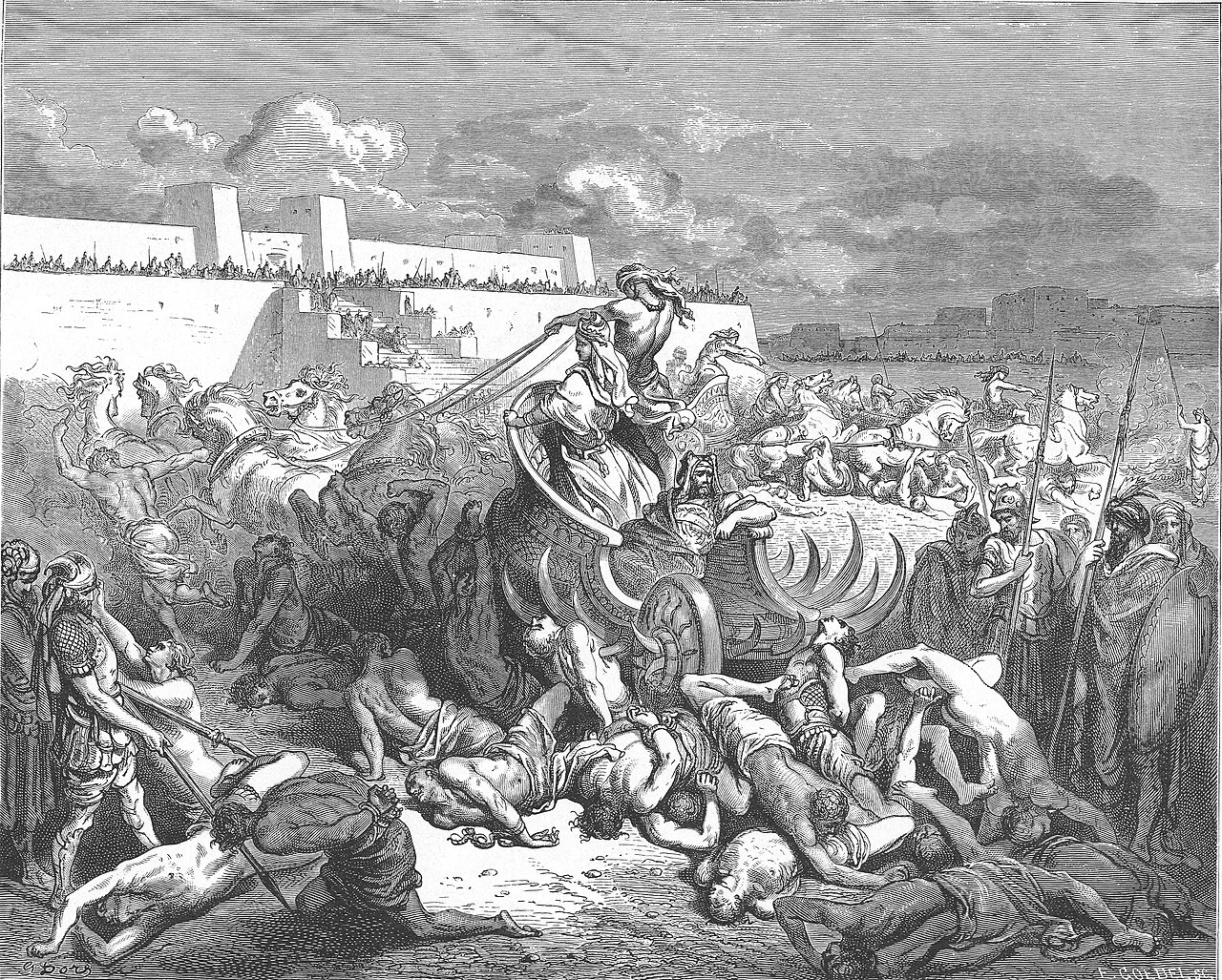
David Attacks the Ammonites, Gustave Doré, Doré's English Bible (1866), public domain
Key verse
So Hanun took David’s servants, shaved off half of each man’s beard, cut off their garments at the hips, and sent them away.
It stands in scene A of the chapter, verses 1 to 5.
The chapter
Chapter summary
The same kindness offered abroad is answered with insult. David sends comforters to Hanun on the death of his father Nahash; the princes of Ammon persuade the young king they are spies, so he shaves off half their beards, cuts their garments off at the buttocks, and sends them away, and David meets them at Jericho with orders to stay until the beards are grown. Ammon hires Syrians by the tens of thousands, and Joab, caught between two fronts, splits the army with Abishai and speaks the soldier's creed of the book: 'Be of good courage, and let us play the man for our people, and for the cities of our God: and Jehovah do that which seemeth him good' (10:12).
Context
History · Nathan, Gad · 2 Samuel overview
Where the chapter sits
2 Samuel 10 falls in Rise: David over all Israel (chapters 1–10). Lament for Saul; anointing at Hebron; capture of Jerusalem; ark brought up; the Davidic covenant (ch. 7); Nathan's oracle; the Ammonite wars.
After it: The Fall: Bathsheba and Uriah, chapters 11–12.
The whole shape of 2 Samuel→The world behind this chapter
2 Samuel 10The history
Sending a delegation to a new king on his father's death was ordinary diplomacy, you renewed the arrangement your fathers had made. Envoys were protected persons everywhere in the ancient Near East; harming them was a declaration of war, and every court knew it.
The rest of the history, and what it meant to them
The insult was carefully designed. Half of each man's beard was shaved off and their robes were cut away at the hips. A full beard was a grown man's dignity, and the clothing left them exposed like prisoners of war. Half-shaved, they could not simply grow it back quietly, so David tells them to wait at Jericho until it was even. Sitting out weeks in a border town rather than walking through Jerusalem was the merciful order.
Ammon's response to a fight it could not win alone was to buy an army. Twenty thousand Aramean footmen and a thousand men from Maacah were hired for a thousand talents of silver, according to the parallel account in Chronicles. Mercenary contracting between small kingdoms was routine business in the region.
The battle problem Joab faced is worth picturing. He had the city's troops in the gate in front of him and the hired coalition in the open field behind him, an army caught between two fronts. He splits the force, takes the best men against the Arameans himself, gives his brother the rest, and they agree to reinforce whichever side breaks first.
What it meant to them
The first hearers heard a lesson about counsel. Hanun listened to advisers who told him the funeral delegation was a spy mission, and the suspicion cost his kingdom its independence.
They also heard Joab's line before the charge, which is the theological center of the chapter: be strong, and may the LORD do what seems good to him. Do your duty and leave the outcome where it belongs.
Sources cited
- John H. Walton, Victor H. Matthews & Mark W. Chavalas, The IVP Bible Background Commentary: Old Testament
- Roland de Vaux, Ancient Israel: Its Life and Institutions
A. Half a beard and half a garment: kindness answered with insult
1. (vv. 1-2)
a.Hanun succeeds his father Nahash, and David sends comfort for the kindness the two kings once shared, using the same word he used two chapters earlier when he sought out Mephibosheth to shew him kindness for Jonathan's sake. Wesley notes the earlier friendship recorded at 8:12 stands behind this embassy. One king's kindness is received as covenant loyalty in chapter 9; here it meets suspicion instead.
2 Samuel 10:1, 1 voiceWhat preachers and commentators have said about these verses, in their own words.
2 Samuel 10:1
“The king - In marginal reference. Nahash, king, etc. The interval between the two events, not less than 50 years, and possibly more, is against his being the same as the Nahash of 1Sa 11:1-15. The Ammonites are almost always spoken of as the children of Ammon, from the name of their first ancestor Ben-ammi Gen 19:38. Hanun - The equivalent of the Carthaginian Hanno, from the same root as the Hebrew, Hananiah, Johanan, Hannah, etc. The same name appears in composition with Baal in Baal-Hanan, an Aramean king Gen 36:38-39.”
2 Samuel 10:2, 2 voices
2 Samuel 10:2
“I will show kindness unto Hanun the son of Nahash - We do not know exactly the nature or extent of the obligation which David was under to the king of the Ammonites; but it is likely that the Nahash here mentioned was the same who had attacked Jabesh-gilead, and whom Saul defeated: as David had taken refuge with the Moabites, (1Sa 22:3), and this was contiguous to the king of the Ammonites, his hatred to Saul might induce him to show particular kindness to David.”
Adam Clarke· Commentary on the Bible (1810-1826)evangelical
2 Samuel 10:2
“David sent - There had hitherto been friendship between David and him: and therefore the spoils of the children of Ammon are mentioned, chap. viii, 12, by way of anticipation, and with respect to the story here following.”
John Wesley· Explanatory Notes upon the Old Testament (1765)evangelical
2. (vv. 3-4)
a.The princes read an act of respect as espionage, a charge David never gives them ground for, and Hanun trusts the accusation over years of peace. He shaves half of each ambassador's beard and cuts their garments away at the hip, an insult measured in a culture where the beard was a man's honor and exposure a mark of slavery. Clarke and Jamieson, Fausset and Brown both read the outrage as the whole nation's grievance and not the ambassadors' alone, which is why all Israel takes up the cause that follows.
2 Samuel 10:3, 1 voice
2 Samuel 10:3
“The princes ... - Compare Rehoboam’s advisers 1Ki 12:10-11. It is not improbable that David’s severe treatment of Moab 2Sa 8:2 was in part the cause of the fear of the Ammonites that a similar treatment was in store for themselves.”
2 Samuel 10:4, 3 voices
2 Samuel 10:4
“Shaved off the one half of their beards - The beard is held in high respect in the East: the possessor considers it his greatest ornament; often swears by it; and, in matters of great importance, pledges it. Nothing can be more secure than a pledge of this kind; its owner will redeem it at the hazard of his life. The beard was never cut off but in mourning, or as a sign of slavery.”
Adam Clarke· Commentary on the Bible (1810-1826)evangelical
2 Samuel 10:4
“Besides, a knowledge of the extraordinary respect and value which has always been attached, and the gross insult that is implied in any indignity offered, to the beard in the East, will account for the shame which the deputies felt, and the determined spirit of revenge which burst out in all Israel on learning the outrage.”
Jamieson, Fausset & Brown· Commentary Critical and Explanatory on the Whole Bible (1871)reformed
2 Samuel 10:4
“Shaved - To fasten this is a reproach upon them, and to make them ridiculous and contemptible. Cut off, &c. - This was worse than the former, because the Israelites wore no breeches, and so their nakedness was hereby uncovered.”
John Wesley· Explanatory Notes upon the Old Testament (1765)evangelical
3. (v. 5)
2 Samuel 10:5-6
a.David meets the men before they reach Jerusalem and sends them to wait at Jericho until their beards grow back, sparing them the shame of appearing at court disfigured. Henry reads the courtesy as proof a king's own grace can shield his servants from public ridicule. The Ammonites, knowing they have made themselves odious, do not wait for David's answer but hire four Syrian forces at once, thirty three thousand men bought rather than raised, turning an insult into a coalition war.
2 Samuel 10:5, 2 voices
2 Samuel 10:5
“Tarry at Jericho - This city had not been rebuilt since the time of Joshua; but there were, no doubt, many cottages still remaining, and larger dwellings also, but the walls had not been repaired. As it must have been comparatively a private place, it was proper for these men to tarry in, as they would not be exposed to public notice.”
Adam Clarke· Commentary on the Bible (1810-1826)evangelical
2 Samuel 10:5
“The Jews wore their beards long, reckoning it an honour to appear aged and grave; and therefore it was not fit that persons of their rank and figure should appear at court unlike their neighbours.”
Matthew Henry· Commentary on the Whole Bible (1707-1721)puritan
B. Joab and Abishai back to back against two armies
1. (v. 6)
2 Samuel 10:6, 1 voice
2 Samuel 10:6
“The children of Ammon saw that they stank - That is, that their conduct rendered them abominable. This is the Hebrew mode of expressing such a feeling. See Gen 34:30. The Syrians of Bethrehob - This place was situated at the extremity of the valley between Libanus and Anti-libanus. The Syrians of Zoba were subject to Hadadezer. Maacah was in the vicinity of Mount Hermon, beyond Jordan, in the Trachonitis. Ish-tob - This was probably the same with Tob, to which Jephthah fled from the cruelty of his brethren. It was situated in the land of Gilead.”
Adam Clarke· Commentary on the Bible (1810-1826)evangelical
2. (vv. 7-8)
a.David answers with the whole standing army rather than more diplomacy, sending Joab and all the host of the mighty men south toward Rabbah. Ammon draws up at the entrance of the city while the hired Syrians take the open field apart from them, and Joab arrives to find one army in front of him and another beside it. Barnes locates the Syrian camp near Medeba, some twenty miles off, which shows how far the war had already spread before a blow fell.
2 Samuel 10:7, 2 voices
2 Samuel 10:7
“And when David heard of it,.... Of the preparation made by the Ammonites to fight with him: he sent Joab and all the host of the mighty men: he sent out Joab his general, and an army under his command, consisting of men of strength, valour, and courage; or all the host and the mighty men, as Kimchi and Ben Melech, the famous mighty men mentioned in 2Sa 23:8; he did not think it advisable to wait for the Ammonites, but carried the war into their own country, and, instead of suffering them to invade his dominions, he invaded theirs.”
2 Samuel 10:7
“Those that are at war with the Son of David not only give the provocation, but begin the war; for he waits to be gracious, but they strengthen themselves against him, and therefore, if they turn not, he will whet his sword, Ps. vii.”
Matthew Henry· Commentary on the Whole Bible (1707-1721)puritan
2 Samuel 10:8, 2 voices
2 Samuel 10:8
“Came out - From their city, Rabbah Deu 3:11, Deu 3:15 or 20 miles from Medeba, where 1Ch 19:7 the Syrian army was encamped. Medeba (modern Madeba) was taken from Sihon Num 21:30, and fell to Reuben Jos 13:9, Jos 13:16; in the reign of Ahaz it seems to have returned to Moab Isa 15:2, and in the time of the Maccabees to the Amorites (1 Macc. 9:36, 37). In church history it was a bishop’s see. In the field - i. e. in the plain below the round rocky hill on which the city stood.”
2 Samuel 10:8
“Joab, like a wise general, was soon aware of the design, and accordingly divided his forces: the choicest men he took under his own command, to fight the Syrians, whom probably he knew to be the better soldiers, and, being hired men, better versed in the arts of war,”
Matthew Henry· Commentary on the Whole Bible (1707-1721)puritan
3. (vv. 9-11)
a.Caught between two fronts, Joab divides the army rather than choosing one enemy: he takes the chosen men against the Syrians himself and gives the rest to his brother Abishai against Ammon. His instruction binds the two forces into one plan, whichever side breaks first, the other comes to help, so neither brother fights alone. Henry draws the line forward into the church: the soldiers of Christ owe each other the same standing pact, to strengthen one another's hands when the pressure falls harder on one than the other.
2 Samuel 10:9, 1 voice
2 Samuel 10:9
“The two armies of the Ammonites and the Syrians were drawn up facing one another; the Ammonites supported by the city Rabbah behind them; the Syrians in great force, with numerous chariots able to manoeuvre in the plain in front of Medeba. If Joab advanced against either, he would have the other in his rear.”
4. (v. 12)
a.Joab's charge holds courage and surrender in one breath, be of good courage, and let us play the men for our people, and the LORD do that which seemeth him good. He commands the fight and hands the outcome to God in the same sentence, owing nothing to fatalism, since he has just finished arraying his troops with care. The same surrender in nearly the same words is spoken by Eli at the ark's loss in 1 Samuel 3:18, it is the LORD, let him do what seemeth him good, and later by David fleeing his own son in 2 Samuel 15:26, let him do to me as seemeth good unto him.
2 Samuel 10:12, 1 voice
2 Samuel 10:12
“Be of good courage - This is a very fine military address, and is equal to any thing in ancient or modern times. Ye fight pro aris et focis; for every good, sacred and civil; for God, for your families, and for your country.”
Adam Clarke· Commentary on the Bible (1810-1826)evangelical
5. (vv. 13-14)
a.Joab routs the Syrians outright, and the moment Ammon sees their hired strength break, they retreat into the city without a fight of their own. Gill notes Joab does not press a siege of Rabbah because winter is drawing near, so he brings the army home rather than camp before its walls. That same seasonal marker opens the next chapter, at the return of the year, when kings go forth to battle, and Joab returns to besiege the very city while David stays behind in Jerusalem, where the matter of chapter eleven begins.
2 Samuel 10:14, 3 voices
2 Samuel 10:14
“And when the children of Ammon saw that the Syrians were fled,.... In whom they put great confidence: then they fled also before Abishai; without engaging at all with him, as it seems: and entered into the city; out of which they came, either Rabbah or Medeba, for their safety: so Joab returned from the children of Ammon; did not stay to lay siege to their city, the season of the year not being proper for it, winter drawing near; see 2Sa 11:1, and came to Jerusalem; in triumph, to report to David the victory he had obtained.”
2 Samuel 10:14
“Joab returned - The great strength of Rabbah made it hopeless to take it by assault, and the Syrians were not sufficiently broken 2Sa 10:15 to make it safe to undertake a regular siege.”
2 Samuel 10:14
“The Syrians were first routed by Joab, and then the Ammonites by Abishai; the Ammonites seem not to have fought at all, but, upon the retreat of the Syrians, to have fled into the city. It is a temptation to soldiers to fly when they have a city at their backs to fly to. It is one thing when men may either fight or fly and another thing when they must either fight or die.”
Matthew Henry· Commentary on the Whole Bible (1707-1721)puritan
C. Hadadezer sues for peace; Syria helps Ammon no more
1. (vv. 15-16)
a.One defeat does not end the war. The Syrians, smitten before Israel, gather themselves again, and Hadarezer draws in reinforcements from beyond the Euphrates, forces he had not needed against Israel before this campaign widened. Gill and Clarke both note this is the same Hadarezer David had already struck at 2 Samuel 8:3, so the second muster is a defeated king trying to reverse an old defeat rather than a new enemy rising.
2 Samuel 10:15, 1 voice
2 Samuel 10:15
“And when the Syrians saw that they were smitten before Israel,.... Considered it in their minds, and conversed with one another about it, and fearing what would be the consequence of it: they gathered themselves together; not only the forces got together again, that fled before Joab, but all the kings of Syria united their forces together, as appears from 2Sa 10:19; supposing that David would avenge himself on them for assisting the Ammonites against him; and therefore judged it advisable to raise a large army, that they might be in a condition to receive him.”
2 Samuel 10:16, 3 voices
2 Samuel 10:16
“And Hadarezer sent,.... The same with Hadadezer, 2Sa 8:3, who was at the head of this confederacy, and to whom the rest of the kings of Syria were servants, 2Sa 10:19, and brought out the Syrians that were beyond the river; the river Phrat or Euphrates, as the Targum; so the Arabic version and Josephus (y), who says, that he hired them: and they came to Helam; which, according to the same writer, was king of the Syrians beyond Euphrates; but it seems to be the name of a place, where was the general rendezvous of the Syrian army.”
2 Samuel 10:16
“The Syrians that were beyond the river - That is, the Euphrates. Hadarezer - This is the same that was overthrown by David, 2Sa 8:3 and there called Hadadezer; which is the reading here of about thirty of Kennicott’s and De Rossi’s MSS. But the ר resh and ד daleth are easily interchanged.”
Adam Clarke· Commentary on the Bible (1810-1826)evangelical
2 Samuel 10:16
“Hadarezer sent and brought out the Syrians that were beyond the river--This prince had enjoyed a breathing time after his defeat (2Sa 8:3). But alarmed at the increasing power and greatness of David, as well as being an ally of the Ammonites, he levied a vast army not only in Syria, but in Mesopotamia, to invade the Hebrew kingdom.”
Jamieson, Fausset & Brown· Commentary Critical and Explanatory on the Whole Bible (1871)reformed
2. (vv. 17-19)
a.This time David takes the field himself, gathers all Israel, crosses the Jordan, and meets the Syrians at Helam, where they break before Israel a second time and their commander Shobach dies in the rout. Every king who had served Hadarezer now makes peace with Israel and serves David instead, and the coalition that hired itself out to Ammon at the chapter's opening will not help them again. Wesley reads the outcome as the promise of the Euphrates border made to Abraham and repeated to Joshua reaching further than it had before, so a war that began over a shaved beard ends with Israel's border pressed toward where the covenant had said it would stand.
2 Samuel 10:17, 1 voice
2 Samuel 10:17
“And when it was told David,.... What preparations the Syrians were making to fight him, and where they were: he gathered all Israel together; all the fighting men in the country: and passed over Jordan, and came to Helam: which, according to Bunting (b), was twenty miles from Jerusalem.”
2 Samuel 10:18, 1 voice
2 Samuel 10:18
“Seven Hundred chariots - and forty thousand Horsemen - In the parallel place, 1Ch 19:18, it is said, David slew of the Syrians Seven Thousand men, which fought in chariots. It is difficult to ascertain the right number in this and similar places.”
Adam Clarke· Commentary on the Bible (1810-1826)evangelical
2 Samuel 10:19, 2 voices
2 Samuel 10:19
“Servants to Hadarezer - This gives us an idea of the great power of Hadarezer, and consequently of the strength of Israel in David’s victorious reign.”
2 Samuel 10:19
“And served them - And thus at length was fulfilled the promise made to Abraham, and repeated to Joshua, that the borders of Israel should extend as far as the river Euphrates.”
John Wesley· Explanatory Notes upon the Old Testament (1765)evangelical
The text of this chapter
This page carries no textual note on 2 Samuel 10. Where this site has examined a place the manuscripts differ, the examination is in the manuscripts room. Every place this site examines →
This page draws on Adam Clarke; Albert Barnes; Jamieson, Fausset & Brown; John Gill; John Wesley and Matthew Henry.
Keep studying
On this page
Studies1