
2 Samuel 10:18
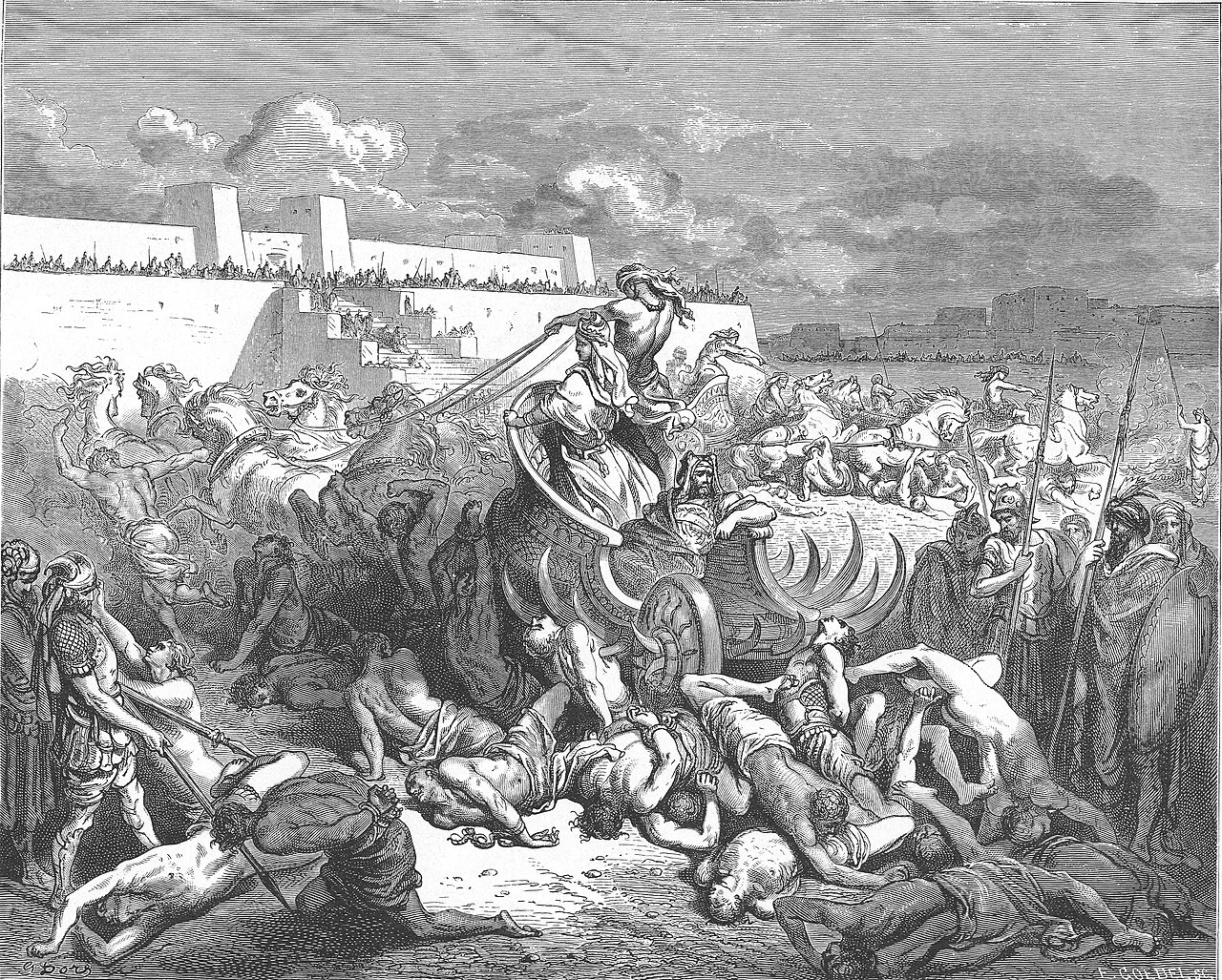
in 2 Samuel 10But the Arameans fled before Israel, and David killed seven hundred charioteers and forty thousand foot soldiers. He also struck down Shobach the commander of their army, who died there.
BSB
The same verse in ASV and KJV ▾
ASV
And the Syrians fled before Israel; and David slew of the Syrians the men of seven hundred chariots, and forty thousand horsemen, and smote Shobach the captain of their host, so that he died there.
KJV
And the Syrians fled before Israel; and David slew the men of seven hundred chariots of the Syrians, and forty thousand horsemen, and smote Shobach the captain of their host, who died there.
⋯
This verse in 2 Samuel 10
Commentary
6 notes on this verseSeven Hundred chariots - and forty thousand Horsemen - In the parallel place, 1Ch 19:18, it is said, David slew of the Syrians Seven Thousand men, which fought in chariots. It is difficult to ascertain the right number in this and similar places.
This site's exposition
passed over Jordan, and came to Helam
on 2 Samuel 10:17-19
This time David takes the field himself, gathers all Israel, crosses the Jordan, and meets the Syrians at Helam, where they break before Israel a second time and their commander Shobach dies in the rout. Every king who had served Hadarezer now makes peace with Israel and serves David instead, and the coalition that hired itself out to Ammon at the chapter's opening will not help them again. Wesley reads the outcome as the promise of the Euphrates border made to Abraham and repeated to Joshua reaching further than it had before, so a war that began over a shaved beard ends with Israel's border pressed toward where the covenant had said it would stand.
This site's exposition
seven hundred charioteers
1 Chronicles 19:18 gives seven thousand charioteers where this verse gives seven hundred. Barnes prefers seven hundred and traces the difference to numbers written as letters. Henry joins the two, seven thousand men for seven hundred chariots.
The record, by era
The Puritans and the Awakening2 voices
), slew 7000 men, who belonged to 700 chariots, and 40,000 other soldiers, horse and foot, as appears by comparing 1 Chron. xix. Their general was killed in the battle, and David came home in triumph, no doubt.
quarantine:debris (2026-07-29) — leading-punctuation+unbalanced-parens
And the Syrians fled before Israel,....
The Nineteenth Century1 voice
A commentator
Albert Barnes1798–1870
Notes, Explanatory and Practical, on the Old and New Testaments (1832-1869)
proposed
Seven hundred chariots - More probable than the “seven thousand” of 1Ch 19:18. The frequent errors in numbers arise from the practice of expressing numerals by letters, with one or more dots or dashes to indicate hundreds, thousands, etc.
The words behind it
20 Hebrew wordsEvery Hebrew word of this verse in the order it stands, with what it means and the door to its own study. The last column counts the times a word stands in the whole Bible: the rarer the word, the more the places it appears belong together.
| Hebrew | Sound | Meaning | Word study | In the Bible |
|---|---|---|---|---|
| וַיָּ֣נָס | vaiyanos | and it fled | H5127 → | 159 times |
| אֲרָם֮ | ʾaram | Aram | H758 → | 143 times |
| מִפְּנֵ֣י | mipenei | from before | H6440 → | 2123 times |
| יִשְׂרָאֵל֒ | yisrael | Israel | H3478 → | 2507 times |
| וַיַּהֲרֹ֨ג | vaiyaharog | and he killed | H2026 → | 167 times |
| דָּוִ֜ד | david | David | H1732 → | 999 times |
| מֵאֲרָ֗ם | mearam | of Aram | H758 → | 143 times |
| שְׁבַ֤ע | sheva' | seven | H7651 → | 394 times |
| מֵאוֹת֙ | meot | hundred<s> | H3967 → | 581 times |
| רֶ֔כֶב | rekhev | charioteer[s] | H7393 → | 119 times |
| וְאַרְבָּעִ֥ים | vearbaim | and forty | H705 → | 136 times |
| אֶ֖לֶף | ʾelef | thousand | H505 → | 505 times |
| פָּרָשִׁ֑ים | parashim | horsemen | H6571 → | 57 times |
| וְאֵ֨ת | veet | and <obj.> | H853 → | 10935 times |
| שׁוֹבַ֧ךְ | shovakh | Shobach | H7731 → | |
| שַׂר־ | sar- | [the] commander of | H8269 → | 421 times |
| צְבָא֛וֹ | tzevao | army its | H6635 → | 485 times |
| הִכָּ֖ה | hikah | he struck down | H5221 → | 499 times |
| וַיָּ֥מָת | vaiyamot | and he died | H4191 → | 839 times |
| שָֽׁם׃ | sham | there | H8033 → | 834 times |
וַיָּ֣נָסand it fled
vaiyanosH5127 →159 times
אֲרָם֮Aram
ʾaramH758 →143 times
מִפְּנֵ֣יfrom before
mipeneiH6440 →2123 times
יִשְׂרָאֵל֒Israel
yisraelH3478 →2507 times
וַיַּהֲרֹ֨גand he killed
vaiyaharogH2026 →167 times
דָּוִ֜דDavid
davidH1732 →999 times
מֵאֲרָ֗םof Aram
mearamH758 →143 times
שְׁבַ֤עseven
sheva'H7651 →394 times
מֵאוֹת֙hundred<s>
meotH3967 →581 times
רֶ֔כֶבcharioteer[s]
rekhevH7393 →119 times
וְאַרְבָּעִ֥יםand forty
vearbaimH705 →136 times
אֶ֖לֶףthousand
ʾelefH505 →505 times
פָּרָשִׁ֑יםhorsemen
parashimH6571 →57 times
וְאֵ֨תand <obj.>
veetH853 →10935 times
שׁוֹבַ֧ךְShobach
shovakhH7731 →
שַׂר־[the] commander of
sar-H8269 →421 times
צְבָא֛וֹarmy its
tzevaoH6635 →485 times
הִכָּ֖הhe struck down
hikahH5221 →499 times
וַיָּ֥מָתand he died
vaiyamotH4191 →839 times
שָֽׁם׃there
shamH8033 →834 times
A shaded row is a word that stands 400 times or fewer in the Bible.
The walk
8 stopsEach card is a verse this one points to, and under it the verses that one points to in turn. Where several paths arrive at the same place, that place is listed first: the text keeps returning to it.
Through
Psalms 46:11The LORD of Hosts is with us; the God of Jacob is our fortress. Selah
it leads to
- Deuteronomy 33:27
The eternal God is your dwelling place, and underneath are the everlasting arms. He drives out the enemy before you, giving the command, ‘Destroy him!’
- Jeremiah 16:19
O LORD, my strength and my fortress, my refuge in the day of distress, the nations will come to You from the ends of the earth, and they will say, “Our fathers inherited nothing…
- Psalms 46:7
The LORD of Hosts is with us; the God of Jacob is our fortress. Selah
- Psalms 46:1
God is our refuge and strength, an ever-present help in times of trouble.
- Psalms 48:3
God is in her citadels; He has shown Himself to be a fortress.
- Deuteronomy 33:27
Through
Judges 4:2So the LORD sold them into the hand of Jabin king of Canaan, who reigned in Hazor. The commander of his forces was Sisera, who lived in Harosheth-hagoyim.
it leads to
- Joshua 11:1
Now when Jabin king of Hazor heard about these things, he sent word to Jobab king of Madon; to the kings of Shimron and Achshaph;
- Judges 4:16
Then Barak pursued the chariots and army as far as Harosheth-hagoyim, and the whole army of Sisera fell by the sword; not a single man was left.
- Judges 4:13
he summoned all nine hundred of his iron chariots and all the men with him, from Harosheth-hagoyim to the River Kishon.
- Joshua 11:1
Where this verse is studied
On this page
About 2 Samuel
Who and where
1 name in this verse with a page on the site.
This page draws on Adam Clarke, Commentary on the Bible; Albert Barnes, Notes, Explanatory and Practical, on the Old and New Testaments; Albert Barnes, Notes, Explanatory and Practical, on the Old and New Testaments (1832-1869); Jamieson, Fausset & Brown, Commentary Critical and Explanatory on the Whole Bible; John Gill, Exposition of the Old Testament (1748-1763); John Wesley, Explanatory Notes upon the Old Testament and Matthew Henry, Commentary on the Whole Bible.