
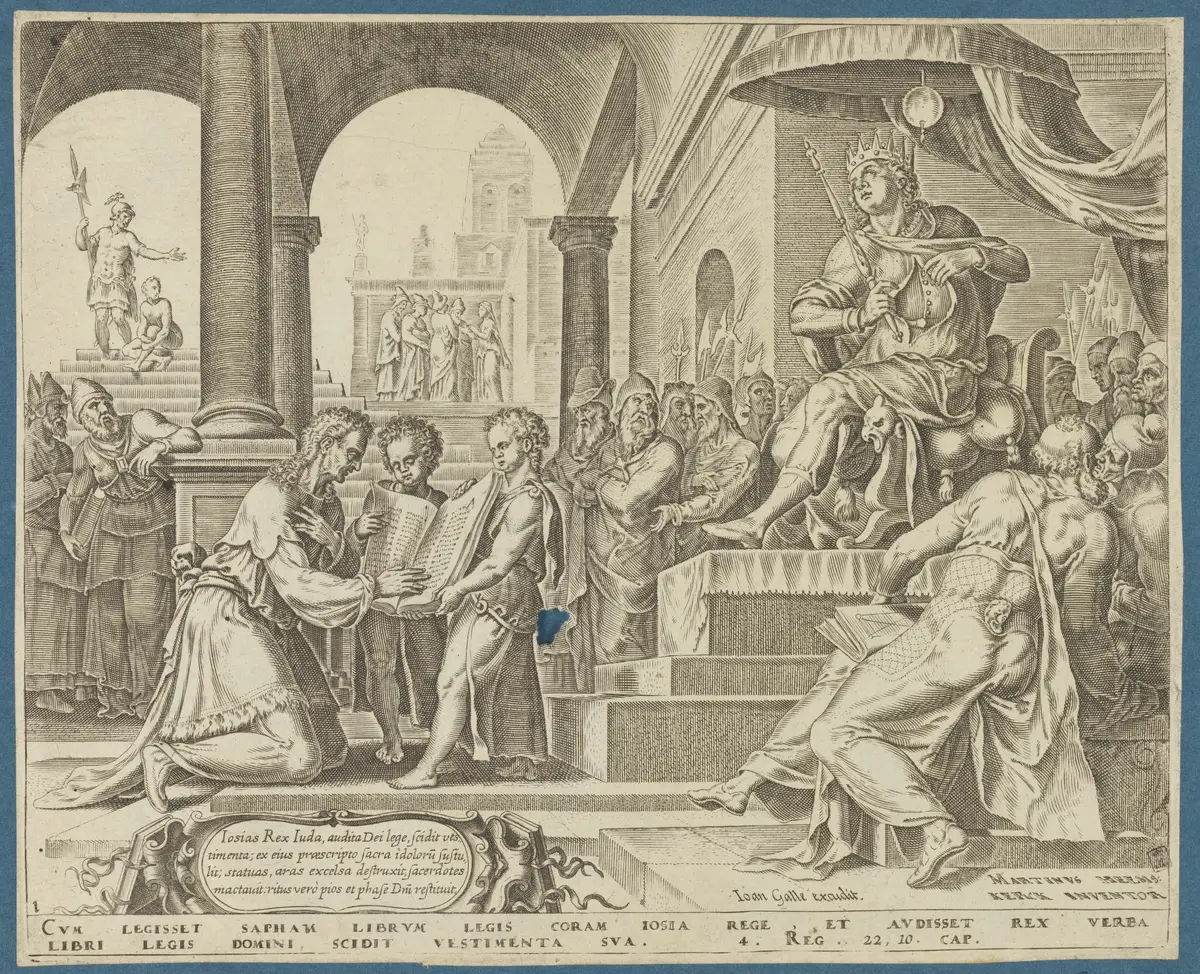
2 Chronicleschapter 24
27 verses · Ezra, by tradition · 450 to 400 BC · History
And a proclamation was issued in Judah and Jerusalem that they were to bring to the LORD the tax imposed by Moses the servant of God on Israel in the wilderness.
Introduction
Ezra, by tradition, History, 2 Chronicles Overview.
This chapter was written for people who were paying for their own temple's upkeep out of their own pockets. It follows a king who owed his life and his throne to a faithful priest. His reign is told in two halves, and the break between them falls at a death. Listen for how the repair money is gathered and handled, because the first hearers were doing the same. Then listen for what changes when the king's guardian is gone. The chapter sets a rebuilt house and a crime in its courtyard side by side.
Context
- Who
- People funding repairs on a temple out of their own pockets
- What
- The reign of Joash: the temple repaired while Jehoiada lived, then idolatry, the stoning of the prophet Zechariah, and the king's defeat and murder.
- Where
- Jerusalem, at the gate of the temple where the chest stood and in the temple court.
- When
- About 835 to 796 BC, the forty years of Joash's reign.
- Why
- To show that faithfulness propped up by another person's example does not last, and that forsaking the LORD brings judgment.
Historical context
The chapter belongs to Joash, crowned at seven and reigning forty years, and to Jehoiada the priest who raised him. Thiele's reconstruction places the reign at about 835 to 796 BC.
Show the rest of the historical context, 5 more paragraphs
The places are the gate of the house of the LORD where the collection chest stood, and the court where Zechariah was stoned.
The occasion is a funding problem. The tax of Moses, the half shekel each man paid for the service of the tent, had lapsed, and the building had been damaged and stripped by Athaliah's household.
A first hearer knew how the answer worked. A chest was set at the gate with a proclamation through Judah, the king's scribe and the high priest's officer emptied it together, and the money paid the masons and carpenters directly.
A first hearer knew who Zechariah was. He was Jehoiada's own son, so the man stoned in the court at the king's order was the child of the priest who had saved the king's life.
A reader today meets the same name in the Gospels, where Jesus speaks of a Zechariah killed between the sanctuary and the altar.
Significance
The chest at the gate was a model for a poor community. Repairs funded by ordinary people a coin at a time, with honest accounting and named officials, is how the second temple was maintained too.
Show the rest of the significance, 1 more paragraph
The writer will not let the good half stand alone. The same reign that rebuilt the house murdered a prophet in its courtyard, and he places both in one chapter so that the building and the behaviour are read together.
This chapter in Jewish lifeWhat this chapter is in Jewish life and reading.
What is done
Chronicles stands among the Writings in the Hebrew canon, and the annual cycle of Torah portions and their Haftarot draws on other books. A Jewish reader meets this chapter in study rather than in a reading appointed for a Sabbath or a feast, and the site's own reading data records the same for every chapter.
The money this chapter gathers is the money of a standing obligation. Rashi calls it the tax of Moses, the shekels mandated in the wilderness (Rashi on II Chronicles 24:6:1). He sets out three kinds of Temple money (Rashi on II Chronicles 24:5:1). They are the yearly shekel of everyone counted, the personal donation a man vows at his own valuation, and the freewill gift for the repair of the house. The chest itself was made with a bored lid rather than a door, so that the gifts could go in and a thief could not reach them (Rashi on II Chronicles 24:8:1).
The death of Zechariah has a place in the Jewish ordering of the canon. In the order the Talmud records at Bava Batra 14b, Chronicles stands last among the Writings, so this killing is the last martyrdom in the Hebrew Bible as the Talmud orders it. That ordering is carried in this repository at src/components/book/dossier-content/2-chronicles.ts.
How it is read
The turn in Joash is read as a turn that came with flattery. Rashi says that after Jehoiada died the officers came to prostrate themselves before the king and to make a god of him (Rashi on II Chronicles 24:2:1). He gives the midrashic ground for it from Exodus Rabbah 8:2 and Midrash Tanchuma Buber on Va'era. Because Joash had hidden in the Holy of Holies and had not been harmed, they said, "You are fit to be a god" (Rashi on II Chronicles 24:2:1).
The killing of Zechariah is read as a compounded offence. Rashi reports the reading of Lamentations Rabbah (Rashi on II Chronicles 24:20:1). Zechariah was a prince above all the people, a prophet and a priest, and the king's son-in-law, and the day was the Day of Atonement. He takes the prophet's dying words as a plea that the blood be required, "since I have been slain for His sake" (Rashi on II Chronicles 24:22:1). The requital follows in the text at the turn of the year.
The king's own death is then read measure for measure. Zechariah was killed while he was secure and had nothing to fear, so Joash was killed in his bed while he was secure (Rashi on II Chronicles 24:25:1). Rashi also uses the chapter to date the fabric of the house. He counts a hundred and twenty-five years from the finishing of the Temple to Joash, and about two hundred from Joash to Josiah. He argues that the house would have stood unrepaired had it not been breached in the previous reign (Rashi on II Chronicles 24:7:1).
Metzudat David comments at 24:4:1, 24:9:1, 24:10:1, 24:12:1, 24:16:1, 24:18:1, 24:19:1, 24:21:1 and 24:24:1, and Radak at 24:17:1. A further comment of Rashi at 24:1:1 is held by Sefaria in Hebrew alone. The corpus holds no English text for any of these, so they stand cited and unquoted.
What the rabbis say
The corpus carries thirty-six locators on this chapter and holds the locator alone for each. The Babylonian Talmud carries it at Ketubot 106b:2, 106b:6 and 106b:7, Gittin 57b:3 and Sanhedrin 96b:5. The Jerusalem Talmud carries it at Shekalim 1:1:3 and 6:4:7, Taanit 4:5:17, Eruvin 5:1:15, Megillah 3:2:6 and Kiddushin 1:7:3. The Rabbah collections carry it at Shemot Rabbah 8:2, Eikhah Rabbah 2:4 and Petichta 23, Bereshit Rabbah 22:9 and 62:3, Bamidbar Rabbah 23:13 and Kohelet Rabbah 10:4:1. The Tanchuma carries it at Masei 12:1, Va'era 9:4 and Yitro 2:1, and Midrash Tanchuma Buber at Masei 9:1, Va'era 8:1 and 16:3 and Vayetzei 14:1. The Tanchuma also carries it at Beshalach 25:2. The rest are Mekhilta DeRabbi Yishmael Tractate Amalek 1:6 and 1:7, Midrash Shmuel 25:3, Aggadat Bereshit 49:4, and Seder Olam Rabbah 18:2, 20:2 and 24:2. Last are Yalkut Shimoni on Torah 87:4, 180:2 and 261:22.
Sources: Rashi, Rashi on II Chronicles, the Judaica Press complete Tanach with Rashi, translated by A. J. Rosenberg (Sefaria, CC-BY); Metzudat David, Metzudat David on II Chronicles 24, cited by ref from the Sefaria corpus, which holds no English version of it; Radak, Radak on II Chronicles 24, cited by ref from the Sefaria corpus, which holds no English version of it; The Sefaria corpus on disk, scripts/data/sources/sefaria/2-chronicles/24.json, fetched 2026-09-19; The reading data of this site, src/lib/hebraic/readings.ts, probed in this lane: 2-chronicles parashot 0, haftarah uses 0, hasSynagogueReading true for 0 of 36 chapters; The 2 Chronicles dossier of this site, src/components/book/dossier-content/2-chronicles.ts, which records the Talmud's canon order at Bava Batra 14b.
The heads below are this chapter's scenes. The numbered points under each are its verses.
A chest set at the gate, and the house of God repaired
2 Chronicles 24:1-3
seven years old when: Joash reigns forty years, the same span Chronicles gives David and Solomon. The formula for his goodness names its limit at once: he did right “all the days of Jehoiada the priest”. Chronicles alone records that “Jehoiada took for him two wives”, a detail Kings does not carry.
2 Chronicles 24:1
“Joash was seven years old when he began to reign,.... This, and the following verse, are the same with 2Ki 11:21. See Gill on 2Ki 12:1. See Gill on 2Ki 12:2.”
3 more voices on this verseWhat preachers and commentators have said about this verse, in their own words.
2 Chronicles 24:1
“Joash was seven years old - As he was hidden six years in the temple, and was but seven when he came to the throne, he could have been but one year old when he was secreted by his aunt; see on 2Ch 22:10 (note).”
Adam Clarke · Commentary on the Bible (1810-1826)evangelical
2 Chronicles 24:1
“If in a small parish one advanced in years is not to be found, let some younger person who has a good report among his neighbors and is esteemed by them worthy of the office of a bishop—who has carried himself from his youth with meekness and regularity, like a much elder person—after examination and a general good report, be ordained in peace.… Joash governed the people at seven years of age. Wherefore, although the person is young, let him be meek, gentle and quiet.”
Apostolic Constitutions · written before 380 · Constitutions of the Holy Apostles 2.1patristic
2 Chronicles 24:1
“This chapter is parallel with 2 Kings 12, but treats the matters common to both narratives in a different and, apparently, supplemental way.”
all the days of Jehoiada the priest: Barnes calculates from 2 Kings 12:6-7, where the repairs stand unfinished in Joash's twenty-third year, that the priest lived at least that long. The fall of verses 17-18 belongs to the last ten or fifteen of the forty years. Spurgeon preached on this verse as Goodness, as a Morning Cloud.
2 Chronicles 24:2
“Jehoiada lived after the accession of Joash at least 23 years 2Ki 12:6. Thus the idolatries of Joash 2Ch 24:18 were confined to his last 10 or 15 years.”
Jehoiada took for him two wives: Jamieson, Fausset and Brown note that interpreters generally read the wives as taken for the young king, since Jehoiada was too old for new marriages. Barnes explains the marriages as a matter of state, because Athaliah's slaughter of the royal seed had left Joash with no heir.
2 Chronicles 24:3
“Athaliah’s destruction of the seed royal had left Joash without a natural successor, and his marriage at the earliest suitable age, was, therefore, a matter of state policy. One of his wives in question was probably “Jehoaddan of Jerusalem,” the mother of Amaziah 2Ch 25:1, who must have been taken to wife by Joash as early as his 21st year.”
2 Chronicles 24:4-7
Joash set his heart on repairing: Chronicles alone explains why the house needed repair: “the sons of that wicked woman Athaliah had broken into the house of God”. Joash orders the Levites to collect the yearly money, and they do not hurry. Second Kings 12 records the same slow start without naming a cause.
2 Chronicles 24:4
“And it came to pass after this,.... After his marriage, when he was about twenty or twenty one years of age, perhaps: that Joash was minded to repair the house of the Lord; which in some places might be fallen to decay, having been built one hundred and fifty years or more, and in others defaced by Athaliah, and needed ornamenting, see 2Ki 12:4.”
1 more voice on this verse
2 Chronicles 24:4
“To repair the house of the Lord - During the reigns of Joram and Athaliah, the temple of God had been pillaged to enrich that of Baal, and the whole structure permitted to fall into decay; see 2Ch 24:7.”
Adam Clarke · Commentary on the Bible (1810-1826)evangelical
The Levites, however, did not make haste: Joash sends the priests and Levites for a collection from all Israel. Clarke observes that the temple belonged to the whole nation and served all its people, so each household was fairly asked to share the cost. He calls this the first general collection for repairing a house of God.
2 Chronicles 24:5
“Gather of all Israel money - As the temple was the property of the whole nation, and the services performed in it were for the salvation of the people at large, it was right that each should come forward on an occasion of this kind, and lend a helping hand. This is the first instance of such a general collection for building or repairing a house of God. From year to year - It must have been in a state of great dilapidation, when it required such annual exertions to bring it into a thorough state of repair.”
Adam Clarke · Commentary on the Bible (1810-1826)evangelical
The king grounds the levy in the tax Moses laid on Israel. Barnes adds that Joash had assigned two further kinds of money to the repair fund. Matthew Henry remarks that building temples is easier than being temples to God, a word that fits the king's later fall.
2 Chronicles 24:6
“The chief - It is observable, that he is not called the chief priest, or high-priest, but only the chief, or the head, which he might be in many other respects, either by reason of his near relation to the royal family: or because he was the chief of one of the twenty- four families.”
John Wesley · Explanatory Notes upon the Old Testament (1765)evangelical
1 more voice on this verse
2 Chronicles 24:6
“The collection - of Moses - This was the poll-tax, fixed by Moses, of half a shekel, which was levied on every man from twenty years old and upward; and which was considered as a ransom for their souls, that there might be no plague among them. See Exo 30:12-14.”
Adam Clarke · Commentary on the Bible (1810-1826)evangelical
the sons of that wicked woman Athaliah: Wesley identifies the sons as Ahaziah and his brothers, acting at their mother's urging before the Arabians carried the brothers off at 21:17. The verse ties the repair to Baal worship at the heart of the royal family, the same worship the people tore down at 23:17.
2 Chronicles 24:7
“The sons - Ahaziah, and his brethren before they were carried away captive, chap. xxi, 17, who did this by her instigation, as this phrase implies. Broke up - Both broke up the treasuries, and defaced the house itself.”
John Wesley · Explanatory Notes upon the Old Testament (1765)evangelical
2 Chronicles 24:8-11
a chest was made and placed: Second Kings 12:9 credits Jehoiada with boring a hole in a chest's lid. Chronicles credits the king's command and places the chest “outside, at the gate of the house of the LORD”. It adds a detail Kings omits: “All the officers and all the people rejoiced” and filled the chest.
2 Chronicles 24:8
“They made a chest - See the notes on the parallel places, 2Ki 12:4 (note), etc.”
Adam Clarke · Commentary on the Bible (1810-1826)evangelical
1 more voice on this verse
2 Chronicles 24:8
“And at the king's commandment they made a chest,.... See Gill on 2Ki 12:9.”
the tax imposed by Moses the servant of God on Israel in the wilderness: Heralds carry the call across Judah and Jerusalem. Gill compares the gift to the offering Moses asked of Israel for building the tabernacle, which the people brought willingly in Exodus 35:4-29. He notes that the Targum reads the verse as a call to bring in the tabernacle of Moses itself.
2 Chronicles 24:9
“And they made a proclamation through Judah and Jerusalem,.... By heralds appointed for the purpose: to bring in to the Lord; into the house of the Lord, and for the reparation of it; and so for his service, honour, and glory: the collection that Moses the servant of the Lord laid upon Israel in the wilderness; not to bring in the tabernacle of Moses, as the Targum here and in 2Ch 24:6, but such a voluntary gift as Moses moved the children of Israel to bring, when in the wilderness, for the service of the tabernacle.”
they dropped them in the chest until it was full: Officials and people alike give gladly, a contrast with the slow collection of verse 5. Gill notes the money went in through the opening cut in the chest's lid, and that each person gave as much as he chose. They kept giving “until it was full”.
2 Chronicles 24:10
“And all the princes and all the people rejoiced,.... When they heard the proclamation, and understood for what use the money was to be given, and in what manner; all was agreeable and pleasing to them: and brought in, and cast into the chest; through the hole that was in the lid of it, 2Ki 12:9, until they had made an end: everyone had given as much as he could, or thought fit to give.”
They did this daily and gathered the money in abundance: The chest is emptied under witnesses, “the royal scribe and the officer of the high priest”, so neither palace nor priesthood handles the money alone. Barnes reads the Hebrew so that the Levites empty the chest in the scribe's presence. The daily emptying shows how much the people brought.
2 Chronicles 24:11
“The king’s scribe ... came and emptied ... - Rather, “the king’s scribe came ... and they emptied” etc. i. e. the Levites who brought the chest from the temple emptied it in the presence of the scribe.”
1 more voice on this verse
2 Chronicles 24:11
“Now it came to pass, that at what time the chest was brought unto the king's office by the hand of the Levites,....”
2 Chronicles 24:12-14
the king and Jehoiada would give: Kings states that no bowls, snuffers or gold and silver utensils were made from the repair fund. Chronicles records that the money left once the house was finished furnished “utensils for the service and for the burnt offerings”. The two accounts read as two stages, repair first and utensils after.
2 Chronicles 24:12
“And the king and Jehoiada gave it to such as did the work of the service of the house of the Lord,.... That is, they gave it to those who were overseers of them, to pay them with it, 2Ki 12:11. and hired masons and carpenters to repair the house of the Lord see 2Ki 12:12. and also such as wrought iron and brass to mend the house of the Lord; where it required any work of that kind.”
They restored the house of God according to its specifications: Barnes gives the sense of the phrase as its old measure or proportions. Gill takes it to mean the house stood as it had at first, as firm as when it was built. The craftsmen of verse 12 finish what the Levites had been slow to begin.
2 Chronicles 24:13
They set the house of God in his state - Some prefer, “they set up the house of God in its (old) measure” or “proportions.”
burnt offerings were presented regularly in the house of the LORD: Gill marks the point at which the work was finished and the surplus went to the king and Jehoiada. The verse closes with a time limit: the burnt offerings the law set at Numbers 28:3-8 went on throughout the days of Jehoiada. The phrase repeats the limit of verse 2.
Jehoiada dies, and the princes flatter the king away
2 Chronicles 24:15-16
When Jehoiada was old and full: Jehoiada dies at the age of 130. He “was buried with the kings in the City of David, because he had done what was good in Israel for God and His temple”. Keil and Bennett call it an honor without parallel for a priest, a king's grave.
2 Chronicles 24:15
“But Jehoiada waxed old, and was full of days when he died,.... A very old man; few at this time arrived to such an age; he was a rare instance: One hundred and thirty years old was he when he died; the oldest man we read of from the times of Moses, and older than he by ten years.”
2 more voices on this verse
2 Chronicles 24:15
“An hundred and thirty years old - Most critics suppose the number in the text to be corrupt, and suggest 103 or 83 in its stead.”
2 Chronicles 24:15
“Well, Jehoiada finished his course with honour; but the little religion that Joash had was all buried in his grave, and, after his death, both king and kingdom miserably degenerated. See how much one head may sustain, and what a great judgment to any prince or people the death of godly, zealous, useful men is.”
Matthew Henry · Commentary on the Whole Bible (1707-1721)puritan
because he had done what was good in Israel: Barnes gives two reasons: Jehoiada's wife Jehoshabeath was a daughter of Jehoram, and he had governed in practice through the king's minority. Gill adds that he was uncle to Joash by that marriage. Wesley reads Israel here as Judah, the part of the nation that still kept the LORD's worship.
2 Chronicles 24:16
“Among the Hebrews, intramural interment was prohibited in every city but Jerusalem, and there the exception was made only to the royal family and persons of eminent merit, on whom the distinction was conferred of being buried in the city of David, among the kings, as in the case of Jehoiada.”
Jamieson, Fausset & Brown · Commentary Critical and Explanatory on the Whole Bible (1871)reformed
2 more voices on this verse
2 Chronicles 24:16
“Israel - In Judah, which was an eminent part of Israel, and the only part of it which owned God, or was owned by God as his Israel, to whom therefore he often appropriates this name.”
John Wesley · Explanatory Notes upon the Old Testament (1765)evangelical
2 Chronicles 24:16
“They buried him - among the kings - He had, in fact, been king in Judah; for Joash, who appears to have been a weak man, was always under his tutelage. Jehoiada governed the state in the name of the king; and his being buried among the kings is a proof of the high estimation in which he was held among the people.”
Adam Clarke · Commentary on the Bible (1810-1826)evangelical
2 Chronicles 24:17-19
the officials of Judah came: After Jehoiada dies, “the officials of Judah came and paid homage to the king, and he listened to them”. Second Kings 12 does not carry this scene, and Chronicles alone records the fall. Judah abandons the temple for Asherah poles and idols, bringing wrath on Judah and Jerusalem.
2 Chronicles 24:17
“Some such thing we read of in the book of Chronicles. For Joash the king of Judah at the age of seven was summoned by Jehoiada the priest to the kingdom and by the witness of Scripture is commended for all his actions as long as the aforesaid priest lived. But hear what Scripture relates of him after Jehoiada's death and how he was puffed up with pride and given over to a most disgraceful state.”
John Cassian · written before 435 · INSTITUTES 12.21patristic
served the Asherah poles and idols: Jamieson, Fausset and Brown suggest the princes asked to worship on the high places at home. Wesley notes that the king and princes who had repaired the temple now leave it. Gill connects the wrath of this verse to the Aramean army of verse 23, which destroys these same princes.
2 Chronicles 24:18
“It has been suggested that what he had witnessed of the conduct of many of the priests in the careless performance of the worship, and especially their unwillingness to collect the money, as well as apply a portion of their revenues for the repairs of the temple, had alienated and disgusted him [LE CLERC].”
Jamieson, Fausset & Brown · Commentary Critical and Explanatory on the Whole Bible (1871)reformed
the LORD sent prophets to bring the people back to Him: Before judgment falls, the LORD sends prophets with a call to return, the pattern Chronicles follows with Shemaiah at 12:5 and Azariah at 15:1-2. Matthew Henry notes that in the worst times God kept witnesses among His people, and that the warning left those who refused it without excuse.
2 Chronicles 24:19
“In the most degenerate times God left not himself without witness; though they had dealt very disingenuously with God, yet he sent prophets to them to convince and instruct them, and to assure them that they should find favour with him if yet they would return; for he would rather sinners should turn and live than go on and die, and those that perish shall be left inexcusable.”
Matthew Henry · Commentary on the Whole Bible (1707-1721)puritan
Zechariah stoned in the court: the LORD look upon it
Spirit of God came upon: The Spirit of God comes upon Zechariah. He stands up before the people with God's own question, “Why do you transgress the commandments of the LORD so that you cannot prosper”. He is Jehoiada's own son, the child of the priest who once hid the infant Joash and crowned him.
2 Chronicles 24:20
“And the Spirit of God came upon Zechariah - “When he saw the transgression of the king and of the people, burning incense to an idol in the house of the sanctuary of the Lord, on the day of expiation; and preventing the priests of the Lord from offering the burnt-offerings, sacrifices, daily oblations, and services, as written in the book of the law of Moses; he stood above the people, and said.” - Targum.”
Adam Clarke · Commentary on the Bible (1810-1826)evangelical
2 Chronicles 24:21-22
they conspired against Zechariah: By order of the king, they stone Zechariah “in the courtyard of the house of the LORD”. Matthew 23:35 names a Zechariah son of Berechiah killed. Readers take him as this Zechariah, with a second name for Jehoiada, or as the prophet of Zechariah 1:1.
2 Chronicles 24:21
“And they conspired against him,.... Consulted together to take away his life, and got the order of the king to do it: and stoned him with stones at the commandment of the king in the court of the house of the Lord; where he had stood and reproved them; this they did before he went out, while in the temple; and if he is the same Zechariah, as some think, our Lord speaks of, he was slain between the temple porch and the altar, Mat 23:35; see Gill on Mat 23:35.”
3 more voices on this verse
2 Chronicles 24:21
“In the court of the house of the Lord - “Between the altar and the Temple,” or directly in front of the temple porch, if it be this Zechariah of whom our Lord speaks Mat 23:35. A horror of the impious deed long possessed the Jews, who believed that the b ood could not be effaced, but continued to bubble on the stones of the court, like blood newly shed, until the temple was entered, just prior to its destruction, by Nebuzaradan.”
2 Chronicles 24:21
“This deed of violence involved complicated criminality on the part of the king. It was a horrid outrage on a prophet of the Lord--base ingratitude to a family who had preserved his life--atrocious treatment of a true Hebrew patriot--an illegal and unrighteous exercise of his power and authority as a king.”
Jamieson, Fausset & Brown · Commentary Critical and Explanatory on the Whole Bible (1871)reformed
2 Chronicles 24:21
“The Jews say, there were seven transgressions in one: They killed a priest, a prophet, a judge; they shed innocent blood; polluted the court of the temple, the Sabbath, and the day of expiation: for on that day, their tradition says, this happened.”
John Wesley · Explanatory Notes upon the Old Testament (1765)evangelical
Jamieson, Fausset and Brown set Zechariah's dying words beside Stephen's prayer for his killers, and suggest they may be a prophet's announcement of doom. Bede takes Zechariah as the martyr Jesus names at Matthew 23:35. John Cassian uses Joash as a warning of a good beginning undone by pride.
2 Chronicles 24:22
“The Lord look upon it, and require it - And so he did; for, at the end of that year, the Syrians came against Judah, destroyed all the princes of the people, sent their spoils to Damascus; and Joash, the murderer of the prophet, the son of his benefactor, was himself murdered by his own servants. Here was a most signal display of the Divine retribution. On the subject of the death of this prophet the reader is requested to refer to the note on Mat 23:34, Mat 23:35.”
Adam Clarke · Commentary on the Bible (1810-1826)evangelical
1 more voice on this verse
2 Chronicles 24:22
“Require it - Make inquisition for innocent blood. But the words may be rendered, The Lord will look upon it, and require it, will require satisfaction from you for it.”
John Wesley · Explanatory Notes upon the Old Testament (1765)evangelical
A small Syrian company, and servants who kill a king in his bed
2 Chronicles 24:23-24
the army of Aram went: In the spring the army of Aram destroys “all the leaders of the people”. The Arameans “had come with only a few men”, yet “the LORD delivered into their hand a very great army”. The reason follows: “Because Judah had forsaken the LORD, the God of their fathers”.
2 Chronicles 24:23
“The year - So soon did God hear the cry of his holy prophet's blood, and revenge it. The princes - That it might appear they were sent and directed by God to single out to destruction the first beginners of this general apostacy.”
John Wesley · Explanatory Notes upon the Old Testament (1765)evangelical
2 more voices on this verse
2 Chronicles 24:23
“Most probably, also, he promised the payment of an annual tribute, on the neglect or refusal of which the Syrians returned the following year, and with a mere handful of men inflicted a total and humiliating defeat on the collected force of the Hebrews.”
Jamieson, Fausset & Brown · Commentary Critical and Explanatory on the Whole Bible (1871)reformed
2 Chronicles 24:23
“On the unusual character of this expedition, see the marginal reference note.”
the LORD delivered into their hand a very great army: Barnes reads the judgment on Joash as the defeat of his army, the killing of his nobles and the advance on Jerusalem. The reversal of numbers turns Asa's victory at 14:9-12 against Judah. Matthew Henry traces the judgment on to the king's wounds and death in the verses that follow.
2 Chronicles 24:24
“For the army of the Syrians came with a small company of men,.... It consisted but of few: and the Lord delivered a very great host into their hand; which the king of Judah and his princes had got together to oppose them: because they had forsaken the Lord God of their fathers; therefore the Lord forsook them, and gave them up into the hand of their enemies: so they executed judgment against Joash; were the instruments God made use of to execute his vengeance on him for his idolatry and murder.”
1 more voice on this verse
2 Chronicles 24:24
“They executed judgment against Joash - By defeating his army, slaying his nobles, and pressing on against Jerusalem, etc. (2Ki 12:18 note).”
2 Chronicles 24:25-26
His own servants conspired against him: Joash's own servants conspire against him “for shedding the blood of the son of Jehoiada the priest”, a motive Kings leaves unstated, and kill him. He is buried in the City of David, “but not in the tombs of the kings”, the honor Jehoiada received withheld from the king.
2 Chronicles 24:25
“Son - By which it seems, he slew not only Zechariah, but his brothers also. Perhaps they that slew him intended to take vengeance for that innocent blood. However that was it, which God intended, in permitting them to do it.”
John Wesley · Explanatory Notes upon the Old Testament (1765)evangelical
Zabad son of Shimeath the Ammonitess: Gill matches the names with 2 Kings 12:21, where Zabad appears as Jozachar son of Shimeath and Jehozabad as Shomer's son. Clarke suggests the two may have served in the royal bedchamber, which would explain their access to him in his bed. The mothers came from Ammon and Moab.
2 Chronicles 24:26
“And these are they that conspired against him, Zabad the son of Shimeah an Ammonitess,.... Called Jozachar, the son of Shimeah, 2Ki 12:21, and Jehozabad the son of Shimrith a Moabitess; called in the same place the son of Shomer.”
the many pronouncements about him: The closing formula names a source, “the Treatise of the Book of the Kings”, one of several documents Chronicles cites without preserving. It names “the many pronouncements about him”, and the throne passes to his son Amaziah. The dynasty promised to David survives a king's murder for the second time.
2 Chronicles 24:27
“The greatness of the burdens laid upon him - Or, “And the multitude of burdens uttered against him.” “Burdens” (2Ki 9:25 note) are prophetical denunciations of coming evil. The repairing - See the marginal rendering. Joash’s repairs extended to the very base of the temple building. The story of the book of the kings - See the introduction to Chronicles, the second note.”
How this psalm is built
The form: Historical narrative of a reign in two halves, hinged on the death of the priest who raised the king, as Keil and Delitzsch classes it.
The patterns in this chapter
| Device | What it does | Where to see it |
|---|---|---|
| All the days of Jehoiada | The qualifier stands at verse 2 and again at verse 14, and it names the limit of the king's goodness both times. Matthew Henry reads it as a warning set down before the reader reaches the fall. Keil and Delitzsch read the righteousness as borrowed, resting on a tutor rather than on a settled heart.Matthew Henry, Commentary on the Whole Bible, 1710, on 2 Chronicles 24:2. | 2 Chronicles 24:2, 2 Chronicles 24:14 |
| The trades the repair money paid | Verse 12 names stonecutters, carpenters, and workers in iron and bronze, and verse 14 names the utensils made from what was left. Adam Clarke reads the chest at the gate and the daily emptying as an accounting method rather than a collection alone. The chapter records the audit in its own words, that the workmen laboured and the repair progressed.Adam Clarke, Commentary on the Bible, 1832, on 2 Chronicles 24:8. | 2 Chronicles 24:8, 2 Chronicles 24:12, 2 Chronicles 24:14 |
| Forsaken, and forsaken | The book's negative verb turns back on the people at verse 20, where they have forsaken the LORD and He has forsaken them. It returns at verse 24, where Judah had forsaken the LORD and judgment was carried out. Albert Barnes reads the charge as the book's own test of a reign spoken to the king's face.Albert Barnes, Notes, Explanatory and Practical, on the Old and New Testaments, 1832 to 1869, on 2 Chronicles 24:20. | 2 Chronicles 24:18, 2 Chronicles 24:20, 2 Chronicles 24:24 |
| Two burials | Verse 16 buries Jehoiada with the kings in the City of David because he had done good in Israel. Verse 25 buries Joash in the City of David but away from the tombs of the kings. John Gill reads the second as the first withheld, and W. H. Bennett calls the priest's honour one without parallel.John Gill, Exposition of the Old Testament, 1748 to 1763, on 2 Chronicles 24:25. | 2 Chronicles 24:16, 2 Chronicles 24:25 |
| May the LORD see this and call you to account | Zechariah speaks to the people in God's own words at verse 20 and to the king in his own at verse 22, and the dying sentence becomes the chapter's hinge. Jamieson, Fausset and Brown read the murder as done at the king's own command in the temple court. Verses 23 to 25 report the answer to it within the year.Jamieson, Fausset and Brown, Commentary Critical and Explanatory on the Whole Bible, 1871, on 2 Chronicles 24:21. | 2 Chronicles 24:20, 2 Chronicles 24:22 |
The debated concept
8 more paragraphs on the patterns
The first question is whether Matthew 23:35 names this Zechariah. Three readings stand. One holds that Matthew names the same man under a second name carried by Jehoiada. One holds that Matthew means the writing prophet Zechariah son of Berechiah of Zechariah 1:1. One reads the reference as marking this murder as the last in the Hebrew canon's own order, since Chronicles closes the Tanakh where Genesis opens it. The three stand named and none of them settles the question the texts leave open.
The second is what the two accounts of the repair fund add up to. Albert Barnes notes that 2 Kings 12:13 says no vessels of gold and silver were made from the fund, while verse 14 here says the leftover money did furnish them. The commentators read the two as two stages of one project, repair first and vessels after.
The third is who acts in the collection. 2 Kings 12:9 credits Jehoiada with boring the hole in the chest lid and setting it beside the altar. This chapter credits the king's own command and places the chest outside at the gate. Adam Clarke reads a small shift in who acts and where the box stands, with the same result.
Where the chapter reaches
The murder of verse 21 is taken up in the New Testament. Luke 11:51 draws a line from the blood of Abel to the blood of Zechariah, who was killed between the altar and the sanctuary. Matthew 23:35 gives the same saying with the patronymic son of Berechiah.
The dossier's Christ section reads the line as running from the first murder in the first book to the last martyr in the last. The Hebrew ordering recorded in the Talmud at Bava Batra 14b puts Chronicles last among the Writings. The site states the three readings of the patronymic and no verdict.
The verbs of the whole book meet in this chapter. Verse 18 has Judah abandon the house of the LORD, verse 20 has the LORD forsake those who forsook Him, and verse 24 gives the defeat as judgment for the same fault.
The repair itself returns later in the book. Josiah repairs the same house at 34:8 to 13 by the same method, with the money gathered and handed to the workmen.
Keep studying
Sources for this chapter
The summary
Jamieson, Fausset & Brown, Commentary Critical and Explanatory; John Wesley, Notes on the Old Testament and Matthew Henry, Complete Commentary.
The form and classifications
Keil and Delitzsch, Biblical Commentary on the Old Testament: The Books of the Chronicles, on 2 Chronicles 24:15; the dossier's theology section for this book, `src/components/book/dossier-content/2-chronicles.ts`, the theology section on the account closed in each reign and the guide's ledger for this book, `src/components/book/guides/2-chronicles/Book2ChroniclesGuide.tsx`, the kings ledger, Joash at 23:1 to 24:27.
The exposition
Adam Clarke, Commentary on the Bible; Albert Barnes; Bede, Homilies on the Gospels 1.3; Charles Spurgeon, The Metropolitan Tabernacle Pulpit, Sermon No. 2365: “"Goodness, as a Morning Cloud"” (lightly modernized text, CCEL edition); Jamieson Fausset and Brown, Commentary Critical and Explanatory on the Whole Bible; Jamieson, Fausset & Brown, Commentary Critical and Explanatory on the Whole Bible; John Cassian, INSTITUTES 12.21; John Gill; John Wesley, Explanatory Notes upon the Old Testament; Keil, The Books of the Chronicles; Matthew Henry, Commentary on the Whole Bible and W. H. Bennett, The Books of Chronicles (Expositor's Bible).