
1 Samuelchapter 19
24 verses · Samuel, Nathan and Gad, by tradition · 10th century BC · History
And Jonathan spake good of David unto Saul his father, and said unto him, Let not the king sin against his servant, against David; because he hath not sinned against thee, and because his works have been to thee-ward very good:
Introduction
Samuel, Nathan and Gad, by tradition, History, 1 Samuel Overview.
This chapter records the night David left the king's court for good. It was written for a people whose songs remembered these years of danger for centuries. Every person close to Saul is drawn into the conflict, his son, his daughter and finally his prophet. Listen for the ways each one protects David and how long each protection lasts. Listen also for what happens to the men Saul sends after him, and at last to Saul himself. The chapter shows God guarding His anointed when every human help has run out.
Context
- Who
- Israelites who knew that a household kept its own images and what a night escape cost
- What
- An account of Saul's attempts on David's life, Jonathan's plea, Michal's ruse, and David's escape to Samuel at Ramah.
- Where
- Saul's palace at Gibeah, David and Michal's house on the town wall, and Naioth at Ramah.
- When
- About 1019 BC, some years before Saul's death, on the traditional reckoning.
- Why
- To show the LORD protecting David when the king's oath, the prince's plea and the wife's trick each run out.
Historical context
The chapter belongs to Saul's house again. Jonathan is the heir speaking for the accused man, and Michal is David's wife and Saul's daughter. Samuel is the prophet who anointed David in secret and who now presides over a company of prophets at Ramah.
Show the rest of the historical context, 4 more paragraphs
The place moves three times: the palace at Gibeah, David's own house with a window on the town wall, and Naioth at Ramah. The occasion is an order to kill, given openly to Jonathan and to every servant in the house after two private attempts with a javelin.
A first hearer knew what Jonathan's speech was doing, since it argues innocence and service and points at the blood guilt of killing a man without cause. Saul answers with an oath sworn on the life of the LORD, and breaks it inside the same chapter.
He knew how a man leaves a watched house with a guarded gate, since houses were often built against the town wall with an outer window, the method Rahab used for the spies at Jericho.
He knew what a teraphim was, since household images were ordinary enough in Israelite homes to turn up in excavations, and the goats' hair at the head passes for a sick man in dim light. He also knew what a company of prophets was, since these communities lived together under a leader and prophesied, often with music, and in this chapter the phenomenon takes hold of everyone sent near it.
Significance
The first hearers watched every human protection fail in order. The king's oath, the prince's advocacy and the wife's trick each buy time and each run out, and then God stops an arrest party without a weapon in sight.
Show the rest of the significance, 1 more paragraph
The chapter also marks the break. David never lives at court again, and the years that begin at this window are the years his people would sing about for centuries.
This chapter in Jewish lifeWhat this chapter is in Jewish life and reading.
How it is read
Rashi reads this chapter through the two houses David is hidden in, his wife's and the prophets'. On Jonathan's plan to stand beside his father in the field he glosses the phrase as near my father (Rashi on I Samuel 19:3:1, the Metsudah Tanach series, Lakewood, N.J., CC-BY). On the figure Michal laid in the bed he gives her purpose in one line, "So that they would not realize that he fled, and pursue him" (Rashi on I Samuel 19:13:1, same edition). On her answer to Saul he reads her as putting the blame on the king himself. She says that David threatened her, and Rashi gives her sense as a complaint that Saul had delivered her into a bandit's hands (Rashi on I Samuel 19:17:1, same edition). On the place David fled to with Samuel he reads the name as the house of study (Rashi on I Samuel 19:19:1, same edition). He reports Radak's derivation of the name from the word for beauty, which names the Temple, the beauty of the world. On that reading the company at Ramah was seeking the place where the Temple would stand (same ref). On the company of prophets he reads the noun as a transposition of the word for an assembly (Rashi on I Samuel 19:20:1, same edition). He cites Malbim there on the difference between a whole company and a part of one (same ref). On Saul stripping before Samuel he reads the garments removed as the royal ones, put off to wear the garments of the students (Rashi on I Samuel 19:24:1, same edition). Radak stands as a citation at I Samuel 19:5:1, 19:10:1, 19:11:1, 19:12:1, 19:16:1, 19:18:1, 19:22:1 and 19:23:1. Malbim stands at 19:1:1, 19:2:1, 19:6:1, 19:8:1 and 19:9:1, and Metzudat David at 19:1:1, 19:2:1, 19:4:1, 19:14:1 and 19:15:1. The corpus holds no English version of any of them.
What the rabbis say
The corpus records eighteen rabbinic locators on this chapter, sixteen of them Midrash and two Talmud, each a locator without text. Jonathan speaking for David to his father draws Bereshit Rabbah 27:4. The spear thrown at David in the house draws Midrash Sekhel Tov, Shemot 13:1:2, Midrash Sekhel Tov, Shemot 13:12:2 and Midrash Tanchuma, Masei 1:1. The watch set on David's house draws Midrash Shmuel 22:3 and Pirkei DeRabbi Eliezer 29:17, and the figure in the bed draws Midrash Shmuel 22:4. Michal's answer to her father draws Midrash Tehillim 59:3. David's flight to Samuel at Ramah draws the largest cluster of the chapter. It draws Bamidbar Rabbah 23:1, Zevachim 54b:3, Ein Yaakov, Zevakhim 5:2, Midrash Tanchuma Buber, Masei 1:1, Midrash Tehillim 7:17 and Yalkut Shimoni on Torah 957:2. The house of study at Nayos draws Ein Yaakov (Glick Edition), Zevachim 5:2. The company of prophets draws Midrash Lekach Tov, Genesis 49:10:6 and Midrash Sekhel Tov, Bereshit 49:27:35. Saul's messengers draw Introductions to Tanaitic Literature, Introductions to Tractates of the Mishnah, Eruvin 307. The rabbis teach in these places, and this site reports them as their teaching rather than as a rule of the text.
Sources: Rashi, Rashi on I Samuel 19:3:1, 19:13:1, 19:17:1, 19:19:1, 19:20:1 and 19:24:1, the Metsudah Tanach series, Lakewood, N.J., CC-BY; Radak, Radak on I Samuel 19:5:1, 19:10:1, 19:11:1, 19:12:1, 19:16:1, 19:18:1, 19:22:1 and 19:23:1, cited only, no English version in the corpus; and Radak on the name Nayos as Rashi carries it; Malbim, Malbim on I Samuel 19:1:1, 19:2:1, 19:6:1, 19:8:1 and 19:9:1, cited only; and Malbim on the word for a company as Rashi carries it; Metzudat David, Metzudat David on I Samuel 19:1:1, 19:2:1, 19:4:1, 19:14:1 and 19:15:1, cited only.
The heads below are this chapter's scenes. The numbered points under each are its verses.
Jonathan pleads and wins a reprieve
1 Samuel 19:1-2
Saul had tried the spear twice in private, and here the order goes out openly, to his son and every servant. Jonathan "delighted greatly in David," and his warning to hide until morning is the first time son and father openly divide over David. His plan to speak for David in the field where Saul can be watched opens a reconciliation that will not hold for long.
1 Samuel 19:1
“That they should kill David - Nothing less than the especial interposition of God could have saved David’s life, when every officer about the king’s person, and every soldier, had got positive orders to despatch him.”
Adam Clarke · Commentary on the Bible (1810-1826)evangelical
Adam Clarke takes the warning about the morning to mean the killing was set for the next day. Jonathan passes his father's order straight to its target. Clarke adds that every officer near the king now held that order.
1 Samuel 19:2
“Take heed to thyself until the morning - Perhaps the order was given to slay him the next day; and therefore Jonathan charges him to be particularly on his guard at that time, and to hide himself.”
Adam Clarke · Commentary on the Bible (1810-1826)evangelical
1 Samuel 19:3-5
Jonathan's plea rests on two arguments, David's innocence and his service to the throne, and Saul can still be reached by reason at this stage. Verse 5 recalls Goliath without naming him, "the LORD worked a great salvation for all Israel," turning Saul's own memory against the order. The plea works for the moment, though Saul's record with vows gives little reason to expect it to hold.
Jonathan calls his father's plan a sin in plain words. The verse uses the word twice, once for what Saul intends and once for the sin David is cleared of. Jamieson, Fausset and Brown note that the appeal won an oath from Saul and a return to service for David.
1 Samuel 19:4
“As he was still susceptible of good and honest impressions, he bound himself by an oath to relinquish his hostile purpose; and thus, through the intervention of the noble-minded prince, a temporary reconciliation was effected, in consequence of which David was again employed in the public service.”
Jamieson, Fausset & Brown · Commentary Critical and Explanatory on the Whole Bible (1871)reformed
Jonathan reminds his father that he watched the fight and rejoiced at it. Saul's own memory becomes the witness for David. Bede reads David here as a figure of Christ, the one man among mortals who lived without fault.
1 Samuel 19:5
“Why then do you sin against innocent blood? etc. Why do you sin, trying to extinguish his faith, striving to remove his love from the Church, who alone among mortals could live without fault?”
Bede · written before 735 · Commentary on Samuelpatristic
1 Samuel 19:6-7
Saul swears, "As surely as the LORD lives, David will not be put to death," and David returns to serve him "as he had before" at court. The oath is sworn on God’s life, and the narrator does not soften what happens to it within this chapter. Wesley, following Henry, reads the moment as God turning Saul’s heart through Jonathan for this hour, a mercy as short as Saul’s memory.
Jonathan acts as go-between for both men, carrying Saul's oath to David and bringing David back into Saul's presence. Jamieson, Fausset and Brown call the result a temporary reconciliation. It lasts only until the next Philistine war.
1 Samuel 19:7
“He was in his presence, as in times past - By Jonathan’s advice he had secreted himself on that day on which he was to have been assassinated: the king having sworn that he should not be slain, David resumes his place in the palace of Saul.”
Adam Clarke · Commentary on the Bible (1810-1826)evangelical
1 more voice on this verse
1 Samuel 19:7
“Though Saul had requited him evil for good, and even his usefulness was the very thing for which Saul envied him, yet he did not therefore retire in sullenness and decline public service. Those that are ill paid for doing good, yet must not be weary of well doing, remembering what a bountiful benefactor our heavenly Father is, even to the froward and unthankful.”
Matthew Henry · Commentary on the Whole Bible (1707-1721)puritan
An image in the bed, and escape through a window
1 Samuel 19:8-10
David’s victory renews Saul’s jealousy as at 18:6 to 9, and "a spirit of distress from the LORD" comes upon him, the phrasing of 16:14 and 18:10. The older commentators differ on whether it names a judicial abandonment or a permitted affliction. The spear flies at David a third time and strikes only the wall, so the next move turns from the king’s own arm to messengers.
Adam Clarke traces the distress to Saul's envy returning after David's new victory, with the devil's influence adding to it. Matthew Henry sets the attack beside the oath of verse 6. The man who swore by the LORD's life now takes up the spear himself.
1 Samuel 19:9
“And the evil spirit from the Lord - His envy and jealousy again returned, producing distraction of mind, which was exacerbated by diabolic influence. See on 1Sa 16:14 (note).”
Adam Clarke · Commentary on the Bible (1810-1826)evangelical
1 more voice on this verse
1 Samuel 19:9
“Saul continues his malice against David. He that but the other day had sworn by his Maker that David should not be slain now endeavors to slay him himself. So implacable, so incurable, is the enmity of the serpent against that of the woman, so deceitful and desperately wicked is the heart of man without the grace of God, Jer. xvii.”
Matthew Henry · Commentary on the Whole Bible (1707-1721)puritan
David escapes the spear that night and goes home, where Saul's men will surround the house before morning. Matthew Henry records that Josephus tells of a plan to try David for treason. Verse 11 records a plainer order to kill him.
1 Samuel 19:10
“But he slipped away - He found he could not trust Saul; and therefore was continually on his watch. His agility of body was the means of his preservation at this time.”
Adam Clarke · Commentary on the Bible (1810-1826)evangelical
2 more voices on this verse
1 Samuel 19:10
“14 And when Saul sent messengers to take David, she said, He is sick. 15 And Saul sent the messengers again to see David, saying, Bring him up to me in the bed, that I may slay him. 16 And when the messengers were come in, behold, there was an image in the bed, with a pillow of goats' hair for his bolster.”
Matthew Henry · Commentary on the Whole Bible (1707-1721)puritan
1 Samuel 19:10
“David fled - This was the beginning of David’s life as a fugitive and outcast, though for no “offence or fauIt” of his (Psa 59:3, Prayer Book Version).”
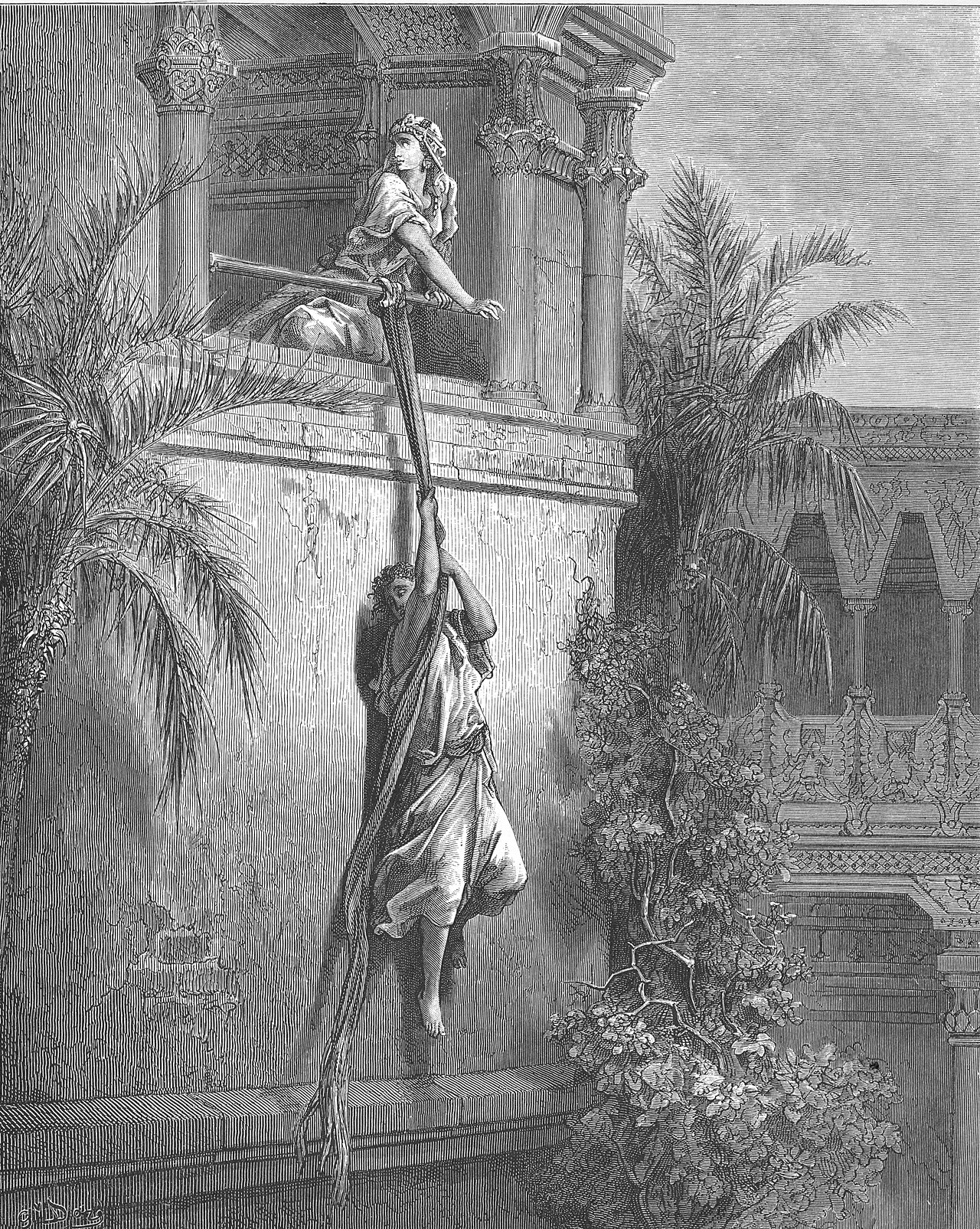
1 Samuel 19:11-13
Saul sets messengers "to watch him and kill him in the morning," and Michal lowers David from the window, a rescue the older commentators compare to Rahab lowering the spies. She lays "a household idol" in the bed with goat hair on its head. The text never says why such an image was in the house, and Gill notes that David would not have allowed it had he known.
1 Samuel 19:11
“Often is the devil out-shot with his own bow. How Michal came to know the danger her husband was in does not appear; perhaps she had notice sent her from court, or rather was herself aware of the soldiers about the house, when they were going to bed, though they kept so still and silent that they said, Who dost hear? which David takes notice of, Ps. lix.”
Matthew Henry · Commentary on the Whole Bible (1707-1721)puritan
John Gill sets this escape beside Paul's, lowered from the wall of Damascus at Acts 9:25. Matthew Henry ties the night to Psalm 59, whose heading names the men Saul sent to watch David's house and kill him. David prayed that psalm in this house.
1 Samuel 19:12
“So Michal let David down through a window,.... In like manner as Rahab let down the spies from her house in Jericho, when the king's messengers were in quest of them, Jos 2:15; and as the disciples let down the Apostle Paul at Damascus, to preserve him from the designs of the Jews upon him: and he went, and fled, and escaped; he departed from his house, and ran with all the haste he could, and escaped the messengers that had beset the house, and were waiting for him.”
Albert Barnes describes the household idol as a figure in human form, as large as life, laid in the bed to pass for David. John Gill connects it with the idol Rachel took from her father at Genesis 31:19 and 34. A daughter deceives her father with such an idol both times.
1 Samuel 19:13
“And Michal took an image, and laid it in the bed--"an image," literally, "the teraphim," and laid, not in the bed, but literally on the "divan"; and "the pillows," that is, the cushion, which usually lay at the back of the divan and was stuffed with "goat's hair," she took from its bolster or heading at the upper part of the divan.”
Jamieson, Fausset & Brown · Commentary Critical and Explanatory on the Whole Bible (1871)reformed
3 more voices on this verse
1 Samuel 19:13
Now Michal's name means "reign," because sin reigned over our nature up to that time. And at the very time he himself was born, he [the Lord in the figure of David] went out through a window. And the window indicates the return to the light again of the one who made himself known to those sitting in darkness and the shadow of death.And his image is seen on the bed. For the angel says to those seeking the Lord in the tomb, "Why do you seek the living with the dead? He is not here; he is risen."
Gregory of Nyssa · written before 395 · ON THE INSCRIPTIONS OF THE PSALMS 2.16.272-73patristic
1 Samuel 19:13
“And Michal took an image,.... Or "teraphim", as the word is; which, if the same with those that Rachel stole from her father, they seem to be of the same sort with the penates or household gods of the Heathens, which were privately kept by Michal; for, had David known of them, he would not have suffered them to have been in his house. Aben Ezra supposes they were images made in the form of men under such a constellation, a sort of talismans, to receive the heavenly influences, and which being consulted, foretold things to come; and R.”
1 Samuel 19:13
“An image - “Teraphim” (see the margin), an image, or bust in human form, and as large as life, of a kind of household god, to the worship of which the Israelites, and especially women, were much addicted. A pillow - It was probably a quilt or blanket of goats’ hair and of common use as a bed-covering. Whether Michal drew it over the head of the teraphim, as if for warmth, and so covered it, or whether she disposed it about the head so as to look like hair, is not clear.”
1 Samuel 19:14-15
Michal’s lie, "He is ill," buys another day, and Saul’s order to bring David "up to me in his bed so I can kill him" shows how far the pursuit has run. The command exposes the order for what it always was, a private hatred that will not wait for due process. Henry calls it base to hunt a man believed dying, and worse to demand him in his bed.
At 18:17 Saul planned to keep his own hand off David and let the Philistines do the killing. Here he wants to strike the blow himself. Matthew Henry marks the change from that earlier resolve, a king who can no longer wait for any other hand.
1 Samuel 19:15
“It was base and barbarous thus to triumph over a sick man; and to vow the death of one who for aught that he knew was dying by the hand of nature. So earnestly did he thirst after his blood, and so greedy was his revenge, that he could not be pleased to see him dead, unless he himself was the death of him; though awhile ago he had said, Let not my hand be upon him.”
Matthew Henry · Commentary on the Whole Bible (1707-1721)puritan
1 Samuel 19:16-17
The messengers find "the idol in the bed with the quilt of goats’ hair on its head," and Michal's device serves its purpose before Saul's own men. Saul turns on his daughter for deceiving him, and she answers with a second lie, that David threatened her life. Barnes reads her line as self-protection, a wife turning her father's anger onto an absent man.
1 Samuel 19:16
“And when the messengers were come in,.... To David's house, and into the room where he was supposed to lie: behold, there was an image in the bed to their great surprise; they expected to see David, but instead of him the teraphim, as in 1Sa 19:13; if they had been in the room before, and thought they had seen David in the bed, they might be the more surprised to find that it was only an image they saw: with a pillow of goats' hair for his bolster; See Gill on 1Sa 19:13.”
Matthew Henry turns the charge back on Saul. A wife is bound to cleave to her husband, and Henry holds that Saul had no right to ask his daughter to betray hers to his spear. Saul calls David his enemy in the same breath.
1 Samuel 19:17
“Why should I kill thee? - To avert Saul’s anger from herself, she pretended that David had threatened her life unless she facilitated his escape.”
1 more voice on this verse
1 Samuel 19:17
“What a base spirit was Saul of, to expect that, because Michal was his daughter, she must therefore betray her own husband to him unjustly. Ought she not to forsake and forget her father and her father's house, to cleave to her husband? Those that themselves will be held by no bonds of reason or religion are ready to think that others should as easily break those bonds.”
Matthew Henry · Commentary on the Whole Bible (1707-1721)puritan
Prophesying at Naioth; Saul lies down stripped all day
1 Samuel 19:18-19
David runs to Samuel, the prophet who anointed him in chapter 16, and the two settle at Naioth, a name meaning dwellings, among the prophets Samuel leads. The prophets first appeared at 10:5 and 10:10, when the Spirit came on Saul at the start of his reign, so the fugitive comes where the first king’s story with prophecy began. Word of it reaches Saul.
1 Samuel 19:18
“David fled, and escaped - to Samuel - He, no doubt, came to this holy man to ask advice; and Samuel thought it best to retain him for the present, with himself at Naioth, where it is supposed he had a school of prophets.”
Adam Clarke · Commentary on the Bible (1810-1826)evangelical
1 more voice on this verse
1 Samuel 19:18
“It was a retreat congenial to the mind of David; but Saul, having found out his asylum, sent three successive bodies of men to apprehend him. The character of the place and the influence of the sacred exercises produced such an effect on them that they were incapable of discharging their commission, and were led, by a resistless impulse, to join in singing the praises of God.”
Jamieson, Fausset & Brown · Commentary Critical and Explanatory on the Whole Bible (1871)reformed
Ramah was Samuel's home town, where he judged Israel and built an altar at 7:17. Word of David's hiding place reaches Saul quickly. Jamieson, Fausset and Brown note that he answered it with three companies of men sent one after another.
1 Samuel 19:19
“And it was told Saul,.... By some officious persons who saw David at Ramah, and observed that he and Samuel went together to Naioth: saying, behold, David is at Naioth, in Ramah; or near it; according to R.”
1 Samuel 19:20-21
Three companies of messengers come to seize David, and each is overtaken by "the Spirit of God" and prophesies instead of making an arrest. The text repeats it three times without explanation, since the repetition is the argument: God stops Saul through the office he wanted turned against David. Clarke reads the outcome as the point, the men kept from seizing David by a power stronger than their orders.
1 Samuel 19:20
“The company of the prophets prophesying - Employed in religious exercises. Samuel - appointed over them - Being head or president of the school at this place. The Spirit of God was upon the messengers - They partook of the same influence, and joined in the same exercise; and thus were prevented from seizing David.”
Adam Clarke · Commentary on the Bible (1810-1826)evangelical
2 more voices on this verse
1 Samuel 19:20
“Now, it seems to me that fortuitous circumstance also is sometimes the cause of prophesying, as is true in the present case of Caiaphas. He was high priest of that year [in which] Jesus was to die for the people that the whole nation might not perish. For although others were high priests … no one prophesies except the high priest of the year in which Jesus was to suffer.And it was fortuitous circumstance that caused the messengers of Saul to prophesy when they were sent to David, along with Saul himself.”
Origen of Alexandria · written before 253 · COMMENTARY ON THE GOSPEL OF JOHN 28.175-76patristic
1 Samuel 19:20
“And whereas some might falsely pretend to those raptures; or the devil might transform himself into an angel of light, Samuel's presence and judgment was necessary to prevent and to detect such impostures.”
John Wesley · Explanatory Notes upon the Old Testament (1765)evangelical
Origen compares these messengers to Caiaphas at John 11:51, who prophesied as high priest without intending to. Saul's men came to seize David and found themselves speaking as prophets. Three times the order fails the same way.
1 Samuel 19:21
“And when it was told Saul,.... That the messengers he had sent, instead of seizing on David, were prophesying of him, or however were attending to services of a different nature than what they were sent upon: he sent other messengers, and they prophesied likewise; when they came to the same place: and Saul sent messengers again a third time, and they prophesied also; joined the rest in singing praises, or foretelling future events.”
1 Samuel 19:22-24
Saul goes himself, and the Spirit of God comes upon him before he reaches Naioth, so he prophesies from the cistern at Secu onward and lies before Samuel all day and night. The saying about Saul among the prophets returns from 10:11 to 12, now over a man the Spirit only stops. Wesley reads the collapse as God’s ordering of the hour, giving David room to slip away.
1 Samuel 19:22
“To a great well - Some large well-known cistern at Sechu, the site of which is uncertain, which Saul passed on his way from Gibeah to Ramah.”
Matthew Henry sets this coming of the Spirit of God apart from saving grace. Saul prophesies and still seeks David's life. Henry points to Matthew 7:22, where men who prophesied in Christ's name are still disowned.
1 Samuel 19:23
“And he went thither to Naioth in Ramah,.... He went on from the well towards the place: and the Spirit of God was upon him also; as well as upon his messengers; even the spirit of prophecy, as the Targum: and he went on and prophesied until he came to Naioth in Ramah: in this he differed from his messengers; they did not prophesy till they came to that place, but Saul began to prophesy before he came thither, as he was in his way from the well to it.”
1 more voice on this verse
1 Samuel 19:23
“This was only amazing, but that sanctifying--this for a day, that for ever. Note, Many have great gifts and yet no grace, prophesy in Christ's name and yet are disowned by him, Matt. vii. Now the proverb recurs, Is Saul among the prophets?”
Matthew Henry · Commentary on the Whole Bible (1707-1721)puritan
Is Saul also among the prophets?: John Gill and John Wesley read naked as stripped to the undergarment, the royal robe laid aside. The king lies before the prophet who anointed him. Gregory of Nyssa turned the proverb on Eunomius, whose arguments against the truth kept ending in support for it.
1 Samuel 19:24
“He stripped off his clothes - Threw off his royal robes or military dress, retaining only his tunic; and continued so all that day and all that night, uniting with the sons of the prophets in prayers, singing praises, and other religious exercises, which were unusual to kings and warriors; and this gave rise to the saying, Is Saul also among the prophets? By bringing both him and his men thus under a Divine influence, God prevented them from injuring the person of David.”
Adam Clarke · Commentary on the Bible (1810-1826)evangelical
3 more voices on this verse
1 Samuel 19:24
For, by the arguments wherewith he [Eunomius] endeavours to destroy the truth, he is often himself unwittingly drawn into an advocacy of the very doctrines against which he is contending: Some such thing the history tells us concerning Saul, that once, when moved with wrath against the prophets, he was overcome by grace, and was found as one of the inspired, (the Spirit of prophecy willing, as I suppose, to instruct the apostate by means of himself,) whence the surprising nature of the event became a proverb in his after life, as the history records such an expression by way…
Gregory of Nyssa · written before 395 · AGAINST EUNOMIUS 3.4patristic
1 Samuel 19:24
“And he stripped off his clothes also,.... Not all his clothes, but his upper garments, as men in such circumstances used to do, as the prophets sometimes did, and as it seems his messengers had done; according to Jarchi, R.”
1 Samuel 19:24
“Lay down - Hebrew. fell, down upon the earth; for his mind being in an extasy, he had not the use of his senses. God so ordering it, that David might have an opportunity to escape. Naked - That is, stript of his upper garments, as the word naked is often used; and it is here repeated to signify how long he lay in that posture.”
John Wesley · Explanatory Notes upon the Old Testament (1765)evangelical
How this psalm is built
The form: A narrative of four rescues in prose, running from an open kill order to the king lying prophesying before Samuel, as 19 classes it.
The patterns in this chapter
| Device | What it does | Where to see it |
|---|---|---|
| The javelin in Saul's hand | The spear is thrown at David for the third time at verse 10, after the two throws of 18:10 and 18:11, and it is thrown once more at Jonathan at 20:33. Every javelin in these books stays in Saul's hand, and it is always aimed at the man playing music to calm him. The king's own arm has now failed twice against David in two chapters.The site's drafted exposition notes on 1 Samuel 19:8 to 10 and 18:10 to 11, data/commentary/1-samuel-19-exposition.json, catchword "slew them with a great slaughter", and data/commentary/1-samuel-18-exposition.json, catchword "the evil spirit from God came upon Saul", citing Adam Clarke, Commentary on the Bible, and Matthew Henry, Commentary on the Whole Bible. | 1 Samuel 19:9, 1 Samuel 19:10, 1 Samuel 18:11, 1 Samuel 20:33 |
| Three companies, and then the king | Three separate companies of messengers are sent to seize David at verses 20 and 21, and each in turn is overtaken by the Spirit of God and prophesies instead. Saul then goes himself and is taken the same way before he reaches the place. The text repeats the outcome without explanation, because the repetition itself is the argument.The site's drafted exposition note on 1 Samuel 19:20 to 21, data/commentary/1-samuel-19-exposition.json, catchword "the Spirit of God was upon the messengers", citing Adam Clarke, Commentary on the Bible, and John Gill, Exposition of the Old Testament. | 1 Samuel 19:20, 1 Samuel 19:21, 1 Samuel 19:22, 1 Samuel 19:23 |
| Is Saul also among the prophets | The saying is asked for the second time in this book at verse 24. It was first asked at 10:11 and 10:12, when the Spirit came on Saul at the start of his reign and made him a new man fit to be king. The same question now closes over a man the Spirit only stops, and the bracket runs from his rise to his ruin.The site's drafted exposition note on 1 Samuel 19:22 to 24, data/commentary/1-samuel-19-exposition.json, catchword "a great well that is in Sechu", citing Adam Clarke, Commentary on the Bible, and John Wesley, Explanatory Notes upon the Old Testament. | 1 Samuel 19:24, 1 Samuel 10:11, 1 Samuel 10:12 |
| Naioth, the dwellings | David runs to Samuel at Ramah and the two settle at Naioth, a name meaning dwellings, among the company of prophets Samuel oversees. It is the same school first named at 10:5 and 10:10, where the Spirit fell on Saul at the very start of his reign. The hunted man is sent to the place where the first king's own story with prophecy began.The site's drafted exposition note on 1 Samuel 19:18 to 19, data/commentary/1-samuel-19-exposition.json, catchword "came to Samuel to Ramah", citing John Wesley, Explanatory Notes upon the Old Testament, and Adam Clarke, Commentary on the Bible. | 1 Samuel 19:18, 1 Samuel 19:19, 1 Samuel 10:5, 1 Samuel 10:10 |
The structure of the chapter in the book's argument
10 more paragraphs on the patterns
The guide draws this book as one crossing, with Saul's standing and David's plotted against each other from chapter 8 to chapter 31. This chapter is where David leaves the court for good. Chapter 18 handed it a king whose fear had hardened into settled enmity, and this chapter turns that enmity into a spoken order, first to the household and then to arrest parties sent after him.
What it hands to chapter 20 is a broken oath. Saul swears at verse 6 that David will not be put to death, and by verse 11 the house is surrounded. That is why Jonathan and David need the field and the arrows of the next chapter to test the king's mind again.
The chapter also closes a bracket the book opened at its middle. The dossier's theology section reports the Spirit's work in this book five times with the same verb. The places are Saul at 10:6 and 10:10, Jabesh-gilead at 11:6, David at 16:13, and the arrest parties and the king at 19:20 to 24. Prophecy in this book is something that happens to people, including people who did not come looking for it.
The historical value
The site's published historical layer for this chapter carries the three customs it turns on, drawn from Keil and Delitzsch, Biblical Commentary on the Old Testament: The Books of Samuel, and from John H. Walton, Victor H. Matthews and Mark W. Chavalas, The IVP Bible Background Commentary: Old Testament. Houses built against the town wall carried an outer window, which is how a watched man leaves a watched house. Household images were common enough to turn up in excavations across the region. Companies of prophets lived together under a leader and prophesied with music.
The oath at verse 6 belongs to the same record. A king swearing by the life of the LORD bound himself in the strongest terms his world had, and the narrator reports the breaking of it without comment.
Where the chapter reaches
The flight that begins at the window runs to the end of the book. The site's published historical layer for this chapter states that David never lives at court again, and the door at /featured/davids-life-in-the-psalms carries the songs the estate connects with the years that follow.
Michal's two rescues reach forward to the marriage's later history, since Saul gives her to another man at 25:44 and David asks for her back at 2 Samuel 3:14. The drafted exposition treats the window and the answer to her father as one continuous act of protecting her husband.
Jonathan's plea reaches forward to the covenant he asks David to keep at 20:14 and 20:15. The dossier's word ladder carries the word behind that request, chesed at Strong's h2617, the loyalty a covenant binds a man to keep.
Keep studying
Places1
Sources for this chapter
The summary
Jamieson, Fausset & Brown, Commentary Critical and Explanatory; John Wesley, Notes on the Old Testament and Matthew Henry, Complete Commentary.
The form and classifications
The site's drafted exposition for 1 Samuel 19, data/commentary/1-samuel-19-exposition.json, the file's own header note, which sets the javelin's third throw against the two throws of 18:10 and 18:11 and closes the bracket opened at 10:11 and 10:12; The site's published dossier for 1 Samuel, src/components/book/dossier-content/1-samuel.ts, the theology entry titled The Spirit comes mightily, anchored on 1 Samuel 19:20 to 24 and The site's published guide for the book of 1 Samuel, src/components/book/guides/1-samuel/Book1SamuelGuide.tsx, the act entry keyed david.
The exposition
Adam Clarke, Commentary on the Bible; Albert Barnes; Bede, Commentary on Samuel; Gregory of Nyssa, AGAINST EUNOMIUS 3.4; Jamieson Fausset and Brown, Commentary Critical and Explanatory on the Whole Bible; Jamieson, Fausset & Brown, Commentary Critical and Explanatory on the Whole Bible; John Gill; John Wesley, Explanatory Notes upon the Old Testament; Matthew Henry, Commentary on the Whole Bible and Origen of Alexandria, COMMENTARY ON THE GOSPEL OF JOHN 28.175-76.