
1 Samuelchapter 10
27 verses · BSB1 Samuel book hub →
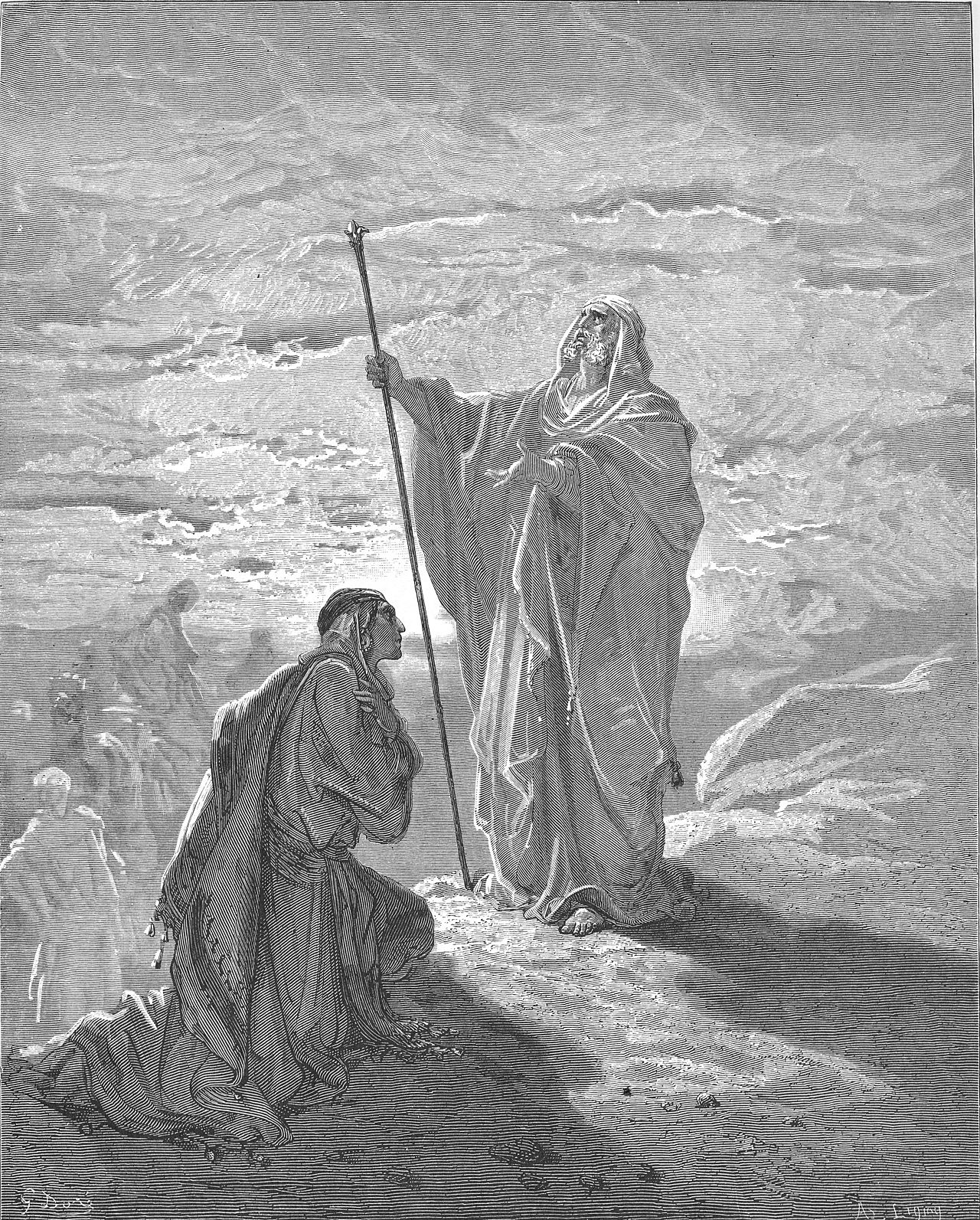
Samuel Blesses Saul, Gustave Doré, Doré's English Bible (1866), public domain
Key verse
So again they inquired of the LORD, “Has the man come here yet?” And the LORD replied, “Behold, he has hidden himself among the baggage.”
It stands in scene C of the chapter, verses 17 to 27.
The chapter
Chapter summary
Samuel pours the vial of oil on Saul's head, kisses him, and gives three signs: men at Rachel's tomb with news of the asses, three men at the oak of Tabor with bread, and a band of prophets coming down with psaltery, timbrel, pipe, and harp. The Spirit of Jehovah comes mightily upon Saul, he prophesies among them, God gives him another heart, and a proverb is born: 'Is Saul also among the prophets?' At Mizpah the lot narrows from tribe to family to man, and the man is hiding among the baggage. Most shout, long live the king; certain sons of Belial despise him, and Saul holds his peace.
Context
History · Samuel, Nathan, Gad · 1 Samuel overview
Where the chapter sits
1 Samuel 10 falls in Saul's reign: promise and rejection (chapters 9–15). Saul anointed in secret, chosen by lot, confirmed by the Ammonite deliverance. Then the presumptuous sacrifice at Gilgal (13) and the failure to destroy Amalek (15): ‘the LORD hath rejected thee from being king.’
Before it: The demand for a king, chapters 8. After it: David's rise in Saul's shadow, chapters 16–31.
The whole shape of 1 Samuel→The world behind this chapter
1 Samuel 10The history
Anointing was how an office was conferred. Olive oil, usually perfumed, was poured on the head to set a man apart for priesthood or kingship, and the term the anointed one, messiah in Hebrew, comes from this act. Samuel uses a small flask rather than a horn, and does it privately on an empty road, which is a quieter installation than a coronation.
The rest of the history, and what it meant to them
The three signs walk Saul home through loaded geography. At Rachel's tomb he learns the donkeys are found. At the oak of Tabor three men going up to Bethel with kids, loaves, and a skin of wine, a standard set of pilgrim offerings, give him two loaves, which is an offering portion handed to a king-to-be. And at Gibeah he meets a band of prophets coming down from the high place with harp, tambourine, flute, and lyre. Prophetic activity in that period was often communal and musical, whole companies moving together under the Spirit.
The detail nobody in Israel could ignore is placed in that same verse: there is a Philistine garrison at Gibeah. Israel's new king is anointed within sight of an enemy post inside his own tribal territory. That is the situation he inherits.
The public selection at Mizpah is done by lot, narrowing tribe to clan to family to man. Casting lots was the accepted way of putting a decision beyond human manipulation, and it produces a candidate nobody can accuse Samuel of choosing. Saul is found hiding among the baggage, the piled gear and supplies at the edge of camp.
Samuel then writes the rights and duties of the kingship in a book and lays it up before the LORD. Israel's monarchy begins with a written constitution deposited at the sanctuary, which is a striking thing in a region where a king's word normally was the law.
What it meant to them
God gives another heart to the man he did not want them to have, and the Spirit rushes on him. First hearers were being told that the concession was not a sulk. God equipped the king they should not have asked for.
The chapter also sorts the people immediately. Some shout long live the king; some worthless men ask how can this man save us and bring no gift. Saul held his peace, and the text will remember that he did not always.
Sources cited
- Roland de Vaux, Ancient Israel: Its Life and Institutions
- John H. Walton, Victor H. Matthews, and Mark W. Chavalas, The IVP Bible Background Commentary: Old Testament
A. A vial of oil and three signs on the road home
1. (v. 1)
a.Samuel's oil names Saul captain over God's inheritance, a private word to one man, not yet a public coronation before Israel. The same two stage shape marks David: a hidden anointing at 16:13, then a public installation at 2 Samuel 2:4 over Judah and 5:3 over all Israel. The kiss that follows is an act of homage, the first allegiance paid to the man just set apart, and it matches the ordinary greeting of a subject before his lord.
1 Samuel 10:1, 2 voicesWhat preachers and commentators have said about these verses, in their own words.
1 Samuel 10:1
“These sacred unctions then used, pointed at the great Messiah, or anointed One, the King of the church, and High-priest of our profession, who was anointed with the oil of the spirit without measure, above all the priests and princes of the Jewish church. Kissed - As a testimony of his sincere friendship and affection to him.”
John Wesley· Explanatory Notes upon the Old Testament (1765)evangelical
1 Samuel 10:1
“But it was only a vial of oil that he anointed him with, the vessel brittle, because his kingdom would soon be cracked and broken, and the quantity small, because he had but little of the Spirit conferred upon him to what David had, who was therefore anointed with a horn of oil, as were Solomon and Jehu with a box of oil.”
Matthew Henry· Commentary on the Whole Bible (1707-1721)puritan
2. (vv. 2-4)
a.Three signs confirm the private word before Saul reaches home: two men at Rachel's tomb in Benjamin's own border tell him the asses are found, three men going up to Bethel share their bread, and a third sign at the hill of God completes the set. Each sign moves Saul through ground his own tribe knows, so the confirmation is local and checkable rather than distant and unfalsifiable. Samuel had told him in the previous chapter that God would show him what to do, and these three signs are that showing worked out point by point.
1 Samuel 10:2, 2 voices
1 Samuel 10:2
“Rachel’s sepulcher - This was nigh to Bethlehem. See Gen 35:19. At Zelzah - If this be the name of a place, nothing is known of it. The Hebrew בצלצח betseltsach is translated by the Septuagint ἁλλομενους μεγαλα, dancing greatly: now this may refer to the joy they felt and expressed on finding the asses, or it may refer to those religious exultations, or playing on instruments of music, mentioned in the succeeding verses.”
Adam Clarke· Commentary on the Bible (1810-1826)evangelical
1 Samuel 10:2
“When thou art departed from me to-day--The design of these specific predictions of what should be met with on the way, and the number and minuteness of which would arrest attention, was to confirm Saul's reliance on the prophetic character of Samuel, and lead him to give full credence to what had been revealed to him as the word of God.”
Jamieson, Fausset & Brown· Commentary Critical and Explanatory on the Whole Bible (1871)reformed
1 Samuel 10:3, 1 voice
1 Samuel 10:3
“The plain of Tabor - It should be “the oak or terebinth”” of Tabor” (Jdg 4:11 note). It has been ingeniously conjectured that “Tabor” is either a different form of “Deborah,” or a corruption of it, and that the “oak,” or “terebinth of Tabor,” is the same as “Allon-bachuth,” the oak under which Deborah was buried, and which lay “beneath Bethel” Gen 35:”
1 Samuel 10:4, 1 voice
1 Samuel 10:4
“And they will salute thee - ושאלו לך לשלום veshaalu lecha leshalom, “And they will inquire of thee concerning peace,” i.e., welfare. In the East, if this salutation be given, then the person or persons giving it may be reckoned friends; if the others return it, then there is friendship on both sides. Salaam alicum, Peace to you! is the mode of compellation: Alicum essalaam, To you be peace! is the return. If you give the former and receive not the latter, you may expect hostility.”
Adam Clarke· Commentary on the Bible (1810-1826)evangelical
3. (vv. 5-7)
a.The hill of God stands within sight of a Philistine garrison, so the third sign meets Saul at the very edge of the enemy's hold on his own land. The company of prophets descending with psaltery, tabret, pipe and harp is this company's first appearance in the text, the seedbed of the sons of the prophets who reappear under Samuel at 19:20 and later under Elijah and Elisha. The Spirit of the LORD coming upon Saul and turning him into another man is one of only four times these two books name the Spirit of the LORD by that exact title, and here it marks the moment God fits a man for a work he did not choose for himself.
1 Samuel 10:5, 2 voices
1 Samuel 10:5
“The company of prophets were, doubtless, the pupils at this seminary, which had probably been instituted by Samuel, and in which the chief branches of education taught were a knowledge of the law, and of psalmody with instrumental music, which is called "prophesying" (here and in 1Ch 25:1, 7).”
Jamieson, Fausset & Brown· Commentary Critical and Explanatory on the Whole Bible (1871)reformed
1 Samuel 10:5
“Prophets - By prophets he understands persons that wholly devoted themselves to religious studies and exercises. For the term of prophesying is not only given to the most eminent act of it, foretelling things to come; but also to preaching, and to the making or singing of psalms, or songs of praise to God.”
John Wesley· Explanatory Notes upon the Old Testament (1765)evangelical
1 Samuel 10:6, 2 voices
1 Samuel 10:6
“Will come upon thee - The word rendered “come,” means to “come” or “pass upon,” as fire does when it breaks out and spreads Amo 5:6; hence, it is frequently used of the Spirit of God passing upon anyone. (See Jdg 14:19; Jdg 15:14; below 1Sa 10:10; 1Sa 11:6; 1Sa 16:13.) Shalt be turned into another man - This is a remarkable expression, and occurs nowhere else. It describes the change in point of mental power and energy which would result from the influx of the Spirit of the Lord 1Sa 10:”
1 Samuel 10:6
“Will come - Hebrew. will leap, or rush upon thee. Another man - That is, thou shalt be suddenly endowed with another spirit, filled with skill of divine things, with courage, and wisdom, and magnanimity; and other qualifications befitting thy dignity.”
John Wesley· Explanatory Notes upon the Old Testament (1765)evangelical
1 Samuel 10:7, 2 voices
1 Samuel 10:7
“Thou do as occasion serve thee - After God has shown thee all these signs that thou art under his especial guidance, fear not to undertake any thing that belongs to thy office, for God is with thee. What a number of circumstances thus precisely foretold! Does not this prove that Samuel was under the continual inspiration of the Almighty?”
Adam Clarke· Commentary on the Bible (1810-1826)evangelical
1 Samuel 10:7
“Thou do - Hebrew. do what they hand findeth to do; that is, as thou shalt have a call and opportunity. He doth not intend that he should take the kingly government upon him, before his call to it was owned by the people, but that he should dispose his mind to a readiness of undertaking any public service when he should be called to his office.”
John Wesley· Explanatory Notes upon the Old Testament (1765)evangelical
4. (v. 8)
a.Samuel's instruction to wait seven days at Gilgal for his return is a plain command with a plain deadline, and the book keeps it in reserve for chapter 13, where Saul breaks it and offers the burnt offering himself rather than wait out the count. Nothing in this verse explains why the wait matters; the weight falls on it only in hindsight, once Saul has failed to keep it. The command is given here, at the very outset of his reign, before Saul has done anything wrong.
1 Samuel 10:8, 1 voice
1 Samuel 10:8
“Seven days shalt thou tarry - I will come to thee within seven days, offer sacrifices, receive directions from the Lord, and deliver them to thee. It is likely that these seven days referred to the time in which Samuel came to Saul to Gilgal, offered sacrifices, and confirmed the kingdom to him, after he had defeated the Ammonites. See 1Sa 11:14, 1Sa 11:15.”
Adam Clarke· Commentary on the Bible (1810-1826)evangelical
B. Another heart: is Saul also among the prophets?
1. (v. 9)
a.The changed heart of this verse belongs to Saul alone; it describes a fitness for the office, not the settled character that later chapters will test and find wanting. Wesley and other older writers read it as a gift of extraordinary qualification for government rather than a permanent change in the man's disposition, since Saul's later course shows the gift was for the hour and not a lasting one. The phrase stands in the same book that will later have Samuel look for a man after God's own heart at 13:14, and the contrast between a given heart here and a heart proved wanting there is the book's own argument.
1 Samuel 10:9, 2 voices
1 Samuel 10:9
“23. For the heart is changed to another when it is directed toward desiring better things; the heart is also changed when it is abandoned to evil. But in the case of Saul, who was first good and afterward evil, how this ought rather to be understood literally is not very clear. But if it is said with reference to his advancement, he had a changed heart, because he who had been searching for donkeys was now thinking about the governance of a kingdom.”
Gregory the Dialogist· written before 604· Commentary on 1 Kings, Book 4, Chapter 5patristic
1 Samuel 10:9
“A new fire was kindled in his breast, such as he had never before been acquainted with: seeking the asses is quite out of his mind, and he thinks of nothing but fighting the Philistines, redressing the grievances of Israel, making laws, administering justice, and providing for the public safety; these are the things that now fill his head.”
Matthew Henry· Commentary on the Whole Bible (1707-1721)puritan
2. (vv. 10-13)
a.Saul meets the same kind of company the third sign promised, and prophesies among them exactly as told, so the sign is fulfilled to the letter. Onlookers who knew him turn the surprise into a question, Is Saul also among the prophets, and a local man's sharp answer about the prophets' father turns it into a standing proverb. The same question returns word for word at 19:24, near the end of Saul's story, when the Spirit that once turned him into another man drives him instead to strip his robes and lie prophesying all that day and night before David, so the proverb brackets his whole reign between one meaning and its bitter reversal.
1 Samuel 10:10, 1 voice
1 Samuel 10:10
“When they came thither to the hill,.... Or, to Gibeah, as the Targum, and so Josephus (e): behold, a company of prophets met him; as foretold, 1Sa 10:5, and the Spirit of the Lord came upon him, and he prophesied among them; the spirit of prophecy, as the Targum, and he sung praises among them; he joined with them in their psalmody, and performed it as regularly as if he had been brought up with them.”
1 Samuel 10:11, 2 voices
1 Samuel 10:11
“It is possible for an evil spirit to influence a person. The spirit of God later turned Saul into another man, that is, into a prophet, when people said, "What is this that has happened to the son of Kish? Is Saul also among the prophets?" But the evil spirit also turned him into another man, in other words, into a renegade. For some time Judas was numbered among the chosen [apostles], even becoming the keeper of the purse. He was then not yet a traitor, but he was dishonest.”
Tertullian· written before 220· ON THE SOUL 11.5-6patristic
1 Samuel 10:11-12
“Though this school of the prophets was near his father's house, yet he had never associated with them, nor shown them any respect, perhaps had sometimes spoken slightly of them; and now to see him prophesying among them was a surprise to them, as it was long after when his namesake, in the New Testament, preached that gospel which he had before persecuted, Acts ix.”
Matthew Henry· Commentary on the Whole Bible (1707-1721)puritan
1 Samuel 10:12, 1 voice
1 Samuel 10:12
“But who is their father? - The Septuagint, in its principal editions, adds ου Κεις; is it not Kish? This makes the sense more complete.”
Adam Clarke· Commentary on the Bible (1810-1826)evangelical
1 Samuel 10:13, 1 voice
1 Samuel 10:13
“He came to the high place - I suppose this to mean the place where Saul’s father lived; as it is evident the next verse shows him to be at home.”
Adam Clarke· Commentary on the Bible (1810-1826)evangelical
3. (vv. 14-16)
a.Saul's uncle asks only after the asses, and Saul answers only about the asses, keeping back the larger matter of the kingdom that Samuel had spoken. The silence is Saul's own choice, not an omission of the narrator, since the text says plainly that of the kingdom he told him not. Gill and others read the reticence as modesty proper to a man not yet installed before the people, a restraint that stands in sharp contrast to the later Saul who cannot keep his throne out of his mouth.
1 Samuel 10:14, 2 voices
1 Samuel 10:14
“And Saul's uncle said unto him, and to his servant, whither went ye?.... Since they had been absent so long a time. This was his father's brother, as the Targum, and so Aquila; whose name was Ner, the father of Abner, 1Sa 14:50 who met with him at the high place, or found him in the city, in his father's house it may be.”
1 Samuel 10:14
“Saul’s uncle - The word דוד dod signifies a beloved one, love, a lover, friend, etc.; and is the same as David. It is supposed to mean uncle here; but I think it means some familiar friend.”
Adam Clarke· Commentary on the Bible (1810-1826)evangelical
C. Chosen by lot, and found hiding among the baggage
1. (vv. 17-19)
a.Samuel gathers all Israel to Mizpeh and rehearses the exodus deliverance before he says one word about a king, God's acts named first and the people's demand named second. Verse 19 restates in Samuel's own mouth what God had already told him privately at 8:7, that the request for a king is a rejection of the LORD who saved them out of their adversities. The public rehearsal at Mizpeh puts before all Israel what God had already judged in private, so that no one at the casting of lots that follows can say the choice was sprung on them without warning.
1 Samuel 10:17, 1 voice
1 Samuel 10:17
“31. Mizpah, as I said, is interpreted as "watchtower." In the ordination of the king, the people are called to Mizpah, because those who come together to ordain a pastor of holy Church are taught to attend to his spiritual qualities, not his carnal ones. To watch, indeed, is to recognize the preacher to be ordained through the standard of sacred Scripture. For sacred Scripture is the mirror of the elect. A pastor is known as if through a mirror, when he is shown by his conduct to be such as is proclaimed in sacred eloquence.”
Gregory the Dialogist· written before 604· Commentary on 1 Kings, Book 4, Chapter 5patristic
1 Samuel 10:19, 2 voices
1 Samuel 10:19
“For the use of “thousand” as equivalent to “family,” see 1Sa 23:23; Jdg 6:15 margin. In Num 1:16 it may mean whole tribes.”
1 Samuel 10:19
“He tells them in plain terms, " You have this day rejected your God; you have in effect done it: so he construes it, and he might justly, for your so doing, reject you." Those that can live better by sense than by faith, that stay themselves upon an arm of flesh rather than upon the almighty arm, forsake a fountain of living waters for broken cisterns.”
Matthew Henry· Commentary on the Whole Bible (1707-1721)puritan
2. (vv. 20-22)
a.The lot narrows in three steps, tribe, then family, then man, and lands on Saul though God had already named him to Samuel privately at 9:15-17. The public casting of lots does not choose Saul; it discloses a choice already made, so that Israel receives by a method it trusts a king it did not otherwise select. When Saul cannot be found, the LORD is enquired of further and answers that he has hid himself among the stuff, the first time in these two books that anyone enquires of the LORD and receives a direct answer, a pattern that runs through both books until Saul's own last enquiry at 28:6 gets silence instead.
1 Samuel 10:20, 2 voices
1 Samuel 10:20
Caused ... to come near ... was taken - The Hebrew phrases are exactly the same as in Jos 7:16-17, where the King James Version renders the first has “brought.”
1 Samuel 10:20
“Benjamin - Which tribe was now preferred before Judah, because the kingdom was freely promised by God to Judah, and was to be given to him in love; but now the kingdom was in a manner forced from God, and given them in anger and therefore conferred upon an obscure tribe.”
John Wesley· Explanatory Notes upon the Old Testament (1765)evangelical
1 Samuel 10:21, 2 voices
1 Samuel 10:21
“The family of Matri - This name occurs nowhere else among the families of Benjamin, or in the genealogy of Saul. (See 1Sa 9:1 note.)”
1 Samuel 10:21
“When the tribe of Benjamin was taken, they might easily foresee that they were setting up a family that would soon be put down again; for dying Jacob had, by the spirit of prophecy, entailed the dominion upon Judah. Judah is the tribe that must rule as a lion;”
Matthew Henry· Commentary on the Whole Bible (1707-1721)puritan
1 Samuel 10:22, 3 voices
1 Samuel 10:22
“Commonly in the school of adversity the heart is subdued under discipline, while, on sudden attainment of supreme rule, it is forthwith changed and becomes elated through familiarity with glory. Thus Saul, who had before fled in consideration of his unworthiness, no sooner had assumed the government of the kingdom than he was puffed up; for, desirous of being honoured before the people while unwilling to be publicly blamed, he cut off from himself even him who had anointed him to the kingdom.”
Gregory the Dialogist· written before 604· The Book of Pastoral Rule, Part 1, Chapter 3patristic
1 Samuel 10:22
“The Lord answered - What a continual access to God! and what condescension in his attention to all their requests! The stuff among which he had secreted himself may mean the carts, baggage, etc., brought by the people to Mizpeh.”
Adam Clarke· Commentary on the Bible (1810-1826)evangelical
1 Samuel 10:22-23
“SAUL seems to have known that he was the elect person, having already been secretly anointed by Samuel and, therefore, while the voting was going on and while the lots were being cast, he hid himself. The Lord answered, "Behold, he has hid himself among the stuff. And they ran and fetched him from there." We hardly know why Saul did this.”
Charles Spurgeon· written before 1892· The Metropolitan Tabernacle Pulpit, Sermon No. 3322: “Hiding Among the Stuff” (lightly modernized text, CCEL edition)Particular (Reformed) Baptist / Five-point Calvinist / 1689 LBCF / 19th-c. evangelical
3. (vv. 23-24)
a.Saul stands before Israel exactly as chapter 9 already described him, head and shoulders above the people, and Samuel points to the very trait Israel prized in a king like the nations. The shout that follows, God save the king, is the first time this exact acclamation appears in Scripture; the words return only once more, at 2 Samuel 16:16, spoken by Hushai as he deceives Absalom with a lie. The book sets the first cry of the crowd's approval beside its one echo, an honest shout at Saul's coronation matched later by a flattering one in another man's mouth.
1 Samuel 10:23, 1 voice
1 Samuel 10:23
“And they ran and fetched him thence,.... Being in haste to see their king elect, and proclaim him: and when he stood among the people; being brought among them, and presented to them: he was higher than any of the people, from the shoulders, and upwards; which made him look very graceful and majestic; height of stature, and a comely form, as Kimchi observes, recommend to royal dignity; and make the people stand more in awe of a prince, and have always been reckoned among all other nations to make a prince venerable; see Gill on 1Sa 9:2.”
1 Samuel 10:24, 1 voice
1 Samuel 10:24
“God save the king - There is no such word here; no, nor in the whole Bible; nor is it countenanced by any of the versions. The words which we thus translate here and elsewhere are simply יחי המלך yechi hammelech, “May the king live;” and so all the versions, the Targum excepted, which says, May the king prosper! The French Vive le roi! is a proper version of the Hebrew.”
Adam Clarke· Commentary on the Bible (1810-1826)evangelical
4. (v. 25)
a.Samuel tells the people the manner of the kingdom and sets it down in writing before the LORD, a second document alongside his earlier catalogue of what a king like the nations will take at 8:11-18. Deuteronomy 17:14-20 had already forbidden a king to multiply horses, wives and silver and gold for himself, and Samuel's written manner functions as Israel's copy of that older law now that the king is named. The book is never quoted again in Samuel, but its existence is itself a witness that the monarchy was never meant to be a blank grant of power.
1 Samuel 10:25, 2 voices
1 Samuel 10:25
The manner of the kingdom - i. e., the just prerogative of the kingdom, the law, or bill of rights, by which the king’s power was limited as well as secured. It is not improbable that what Samuel wrote was simply a transcript of Deu 17:14-20, which he “laid up before the Lord,” i. e., placed by the side of the ark of the covenant with the copy of the Law (see Deu 31:26). It would be ready for reference if either king or people violated the “law of the kingdom.”
1 Samuel 10:25
“He had before told them the manner of the king ( ch. viii. 11 ), how he would abuse his power; now he tells them the manner of the kingdom, or rather the law, or judgment, or constitution, of it, what power the prince might challenge and the utmost of the property the subject might claim.”
Matthew Henry· Commentary on the Whole Bible (1707-1721)puritan
5. (vv. 26-27)
a.whose hearts God had touched: Saul goes home to Gibeah with a band of men whose hearts God had touched, ordinary loyalty stirred up rather than commanded, while the children of Belial ask how this man can save them and withhold the customary gift a new king would expect. Saul's response to the contempt, he held his peace, is restraint from the very start of his reign, the same kind of restraint David will later show toward Saul himself at 24:6 and 26:9 when he calls him the LORD's anointed and will not lift a hand. The chapter that opened with a private anointing closes on a king who has support from some, scorn from others, and the self control to answer neither.
1 Samuel 10:26, 3 voices
1 Samuel 10:26
“39. If a plain historical narrative is sought, what could ever have been stated more clearly? But if we attend to the force of each individual word, great things are enclosed within this simplicity of words. For the people are said to have been dismissed to their home, but the king is reported not to have been dismissed to his home, but to have gone away.”
Gregory the Dialogist· written before 604· Commentary on 1 Kings, Book 4, Chapter 5patristic
1 Samuel 10:26
“A band of men - Not a military band, as I imagine, but some secret friends, or companions, who were personally attached to him. Others think that all the men fit to bear arms are intended; but this seems inconsistent with the life that Saul led for some time afterwards; for he appears to have gone into his agricultural concerns, and waited for a call from the Divine providence. See 1Sa 11:5.”
Adam Clarke· Commentary on the Bible (1810-1826)evangelical
1 Samuel 10:26
And Saul also went home to Gibeah--near Geba. This was his place of residence (see Jud 20:20), about five miles north of Jerusalem. there went . . . a band of men, whose hearts God had touched--who feared God and regarded allegiance to their king as a conscientious duty. They are opposed to "the children of Belial."
Jamieson, Fausset & Brown· Commentary Critical and Explanatory on the Whole Bible (1871)reformed
1 Samuel 10:27, 3 voices
1 Samuel 10:27
“Presents - The מנחה mı̂nchāh was the token of homage and acknowledgment from the subject to the sovereign, and from the tributary nation to their suzerain. (See 2Sa 8:2, 2Sa 8:6; Jdg 3:17-18; 1Ki 4:21; 2Ki 17:4, etc.; Psa 72:10; Isa 16:1.) Saul dissembled his resentment, and waited for the favorable tide which soon came with the invasion of Nahash.”
1 Samuel 10:27
“And they despised him, and brought him no presents--In Eastern countries, the honor of the sovereign and the splendor of the royal household are upheld, not by a fixed rate of taxation, but by presents brought at certain seasons by officials, and men of wealth, from all parts of the kingdom, according to the means of the individual, and of a customary registered value.”
Jamieson, Fausset & Brown· Commentary Critical and Explanatory on the Whole Bible (1871)reformed
1 Samuel 10:27
“This was an evidence both of his humility, and the mercifulness of his disposition. So Christ held his peace, in the day of his patience. But there is a day of recompense coming.”
John Wesley· Explanatory Notes upon the Old Testament (1765)evangelical
The text of this chapter
This page carries no textual note on 1 Samuel 10. Where this site has examined a place the manuscripts differ, the examination is in the manuscripts room. Every place this site examines →
This page draws on 12 works. Open for the list.
This page draws on Adam Clarke; Albert Barnes; Charles Spurgeon, The Metropolitan Tabernacle Pulpit, Sermon No. 3322: “Hiding Among the Stuff” (lightly modernized text, CCEL edition); Gregory the Dialogist; Jamieson Fausset and Brown, Commentary Critical and Explanatory on the Whole Bible; Jamieson, Fausset & Brown, Commentary Critical and Explanatory on the Whole Bible (1871); John Gill; John Wesley; Keil and Delitzsch, Biblical Commentary on the Books of Samuel; Matthew Henry; Tertullian, ON THE SOUL 11.5-6 and W. G. Blaikie, The First Book of Samuel (Expositor's Bible).
Keep studying
On this page
Studies1