
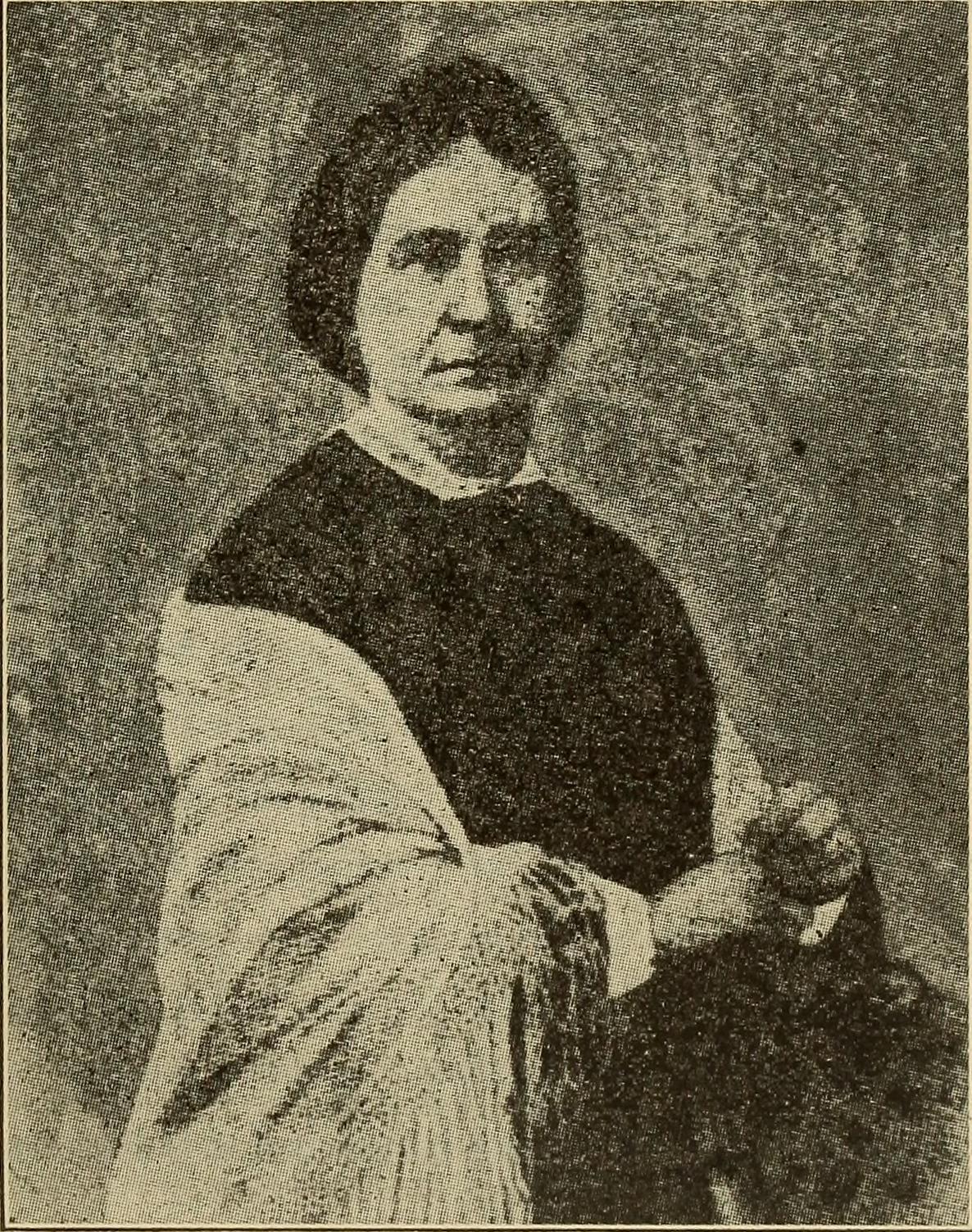
Photographer not named, Mrs. Phoebe Palmer, 1920. CC0.
New York, 1807 to 1874 · Person · Featured Study
Phoebe Palmer
She was a New York Methodist who taught entire sanctification at a weekly meeting in her home and in her books.
She resolved to be a Bible Christian, and for the rest of her life she called a summer day of 1837 her day of days.
Therefore I urge you, brothers, on account of God’s mercy, to offer your bodies as living sacrifices, holy and pleasing to God, which is your spiritual service of worship.
- Born
- 18 December 1807
- Died
- 2 November 1874
- Family
- husband: Walter C. Palmer; sister: Sarah Lankford; daughter: Phoebe Knapp
- Places
- New York, Vineland, Liverpool, Belfast
Summary
Phoebe Palmer was born in New York in 1807 and married Walter C. Palmer, a physician, in 1827. A women's prayer meeting at their house became the Tuesday Meeting for the Promotion of Holiness. Her book The Way of Holiness taught that a believer may lay all upon the altar and be made holy now.
- She and her husband held meetings in the British Isles from 1859 to 1863.
- A professor named Mattison charged her teaching with error, and she declined to answer him in print.
- Catherine Booth named her among the women whose labours spread revival.
The Texts She Read
She built her teaching on the altar of Exodus 29 and the living sacrifice of Romans 12.
The question of this life is what she meant by holiness now and how far her way was John Wesley's. Her own book of 1843, her life and letters as Richard Wheatley edited them in 1881, and the record of the camp meeting at Vineland in 1867 are the witnesses.
For seven days you shall make atonement for the altar and consecrate it. Then the altar will become most holy; whatever touches the altar will be holy.She read the altar that makes holy whatever touches it as a pattern for the believer's gift of all to God.
You blind men! Which is greater: the gift, or the altar that makes it sacred?She quoted the words on the altar that makes the gift sacred as the Lord's own word on that rule.
The Life in Order
Each date stands in Wheatley's edition of her diaries and letters or in a book of her own day.
Her public work began after her children's deaths and her day of days.
- 18 December 1807She was born in New York, the fourth child of Henry Worrall and Dorothea WadeWheatley (1881), page 10
- 28 September 1827She married Walter C. Palmer, a physician, at her father's houseWheatley, page 23
- About 1835Two women's prayer meetings joined at the Palmers' house on Tuesday afternoonsWheatley, page 238
- 1829 to 1836Three of her children died in infancyWheatley, pages 26, 30 to 31 and 622
- 26 July 1837She entered what she called her day of daysWheatley, page 36
- 1839Men first came to the Tuesday Meeting, Professor Upham among themWheatley, pages 238 to 239
- 1843The Way of Holiness was printed in New YorkPiercy and Reed's imprint
- June 1859She and her husband sailed for England and landed at LiverpoolWheatley, page 349
- 17 to 26 July 1867They led the Bower of Prayer at the first National Camp-Meeting, at VinelandPenuel (1869), pages 15 and 155
- 2 November 1874She died at sixty-sixWheatley, page 625
Each step of the life stands with its witness.
1843, June 1859, 17 to 26 July 1867, 2 November 1874
From the Parlour to the Camp Meeting
Her life ran from her own parlour to meetings in Canada, the British Isles and New Jersey.
Her father, Henry Worrall, came from Yorkshire, near Sheffield. Her mother was a member of the Methodist Episcopal Church.
Her first son died at nine months, and a second lived seven weeks. In 1836 the gauze curtains around her daughter Eliza's cradle caught fire through a nurse's carelessness. She wrote that God takes our treasure to heaven so that our hearts may be there also.
Her sister Sarah Lankford proposed that the women's prayer meetings of the Allen Street and Mulberry Street churches meet together in Dr. Palmer's house. They met on Tuesday afternoons, first in his back office and then in the parlours upstairs.
In 1839 Mrs. Upham asked to bring her husband, and from then on men came too. Professor Upham questioned Phoebe Palmer for about three hours, and the next morning he entered the rest of faith.
She travelled to camp meetings and churches in the northern states and in Canada. By February 1853 the Ladies' Home Missionary Society, of which she was an officer, had a mission at Five Points in New York.
In June 1859 they sailed for England. They spent four years in Ireland, England, Scotland and Wales. They came home in 1863, and in 1867 they led the prayer meetings in the Bower of Prayer at Vineland, New Jersey.
In 1873 she wrote that the editing of the Guide to Holiness took much of her time. She died in her husband's arms on 2 November 1874.
The Altar Teaching
The Way of Holiness taught that the gift laid on the altar is holy because the altar is holy.
Its title calls the book a narrative of experience, and it tells of a sister in the way of holiness in the third person. A brother asks whether there is a shorter way into holiness, and she answers, "Yes, brother, there is a shorter way!"
The book sets out the way in steps. The believer lays all upon the altar in an everlasting covenant. Then she believes, on the word of Scripture, that the gift is holy and accepted because the altar is holy. Then she praises God for it.
For the altar she cited Exodus 29, the words of Jesus in Matthew 23 and Hebrews 13:10, and she named the altar as Christ. Romans 12:1 gave her the living sacrifice.
In Their Own Words
Three passages from The Way of Holiness and one letter from the eve of her voyage to England.
Phoebe Palmer (1807 to 1874)
The Way of Holiness, page 8
The motto of the book
“I will let every high state of grace in name alone, and seek only to be fully conformed to the will of God, as recorded in his written word. My chief endeavors shall be centered in the aim to be an humble Bible Christian.”
Methodist (Holiness)
About this saying1 paragraph
These words stand on the title page of the 1843 printing, which gives page 8 as their place in the book.
Phoebe Palmer
The Way of Holiness, page 7
God requires present holiness
“Whatever my former deficiences may have been, God requires that I should now be holy. Whether convicted, or otherwise, duty is plain. God requires present holiness.”
Methodist (Holiness)
About this saying1 paragraph
Page 7 of the 1843 printing gives the thought with which the sister of the story began.
Phoebe Palmer
The Way of Holiness, with Notes by the Way, page 59
The altar is Christ
“The altar, thus provided by the conjoint testimony of the Father, Son, and Holy Spirit, is Christ. His sacrificial death and sufferings are the sinner's plea; the immutable promises of the Lord Jehovah the ground of claim.”
Methodist (Holiness)
About this saying1 paragraph
She wrote this on page 59 of the 1843 printing, in the chapter headed There Is But One Way.
Phoebe Palmer
Letter of 4 June 1859, in Richard Wheatley, The Life and Letters of Mrs. Phoebe Palmer, page 349
On the eve of sailing
“We want to see thousands sanctified wholly, and thousands won over to our Saviour.”
Methodist (Holiness)
About this saying1 paragraph
She wrote this to a friend on 4 June 1859, before the voyage to England, and Wheatley prints it on page 349.
The People Around Her
Her family held the meeting, and ministers and writers came to it.
The meeting began with her sister and grew through the people who came.
| Person | Tie to Phoebe Palmer | The witness |
|---|---|---|
| Walter C. Palmer | Her husband, a physician, who travelled and preached with her | Wheatley, pages 23 and 349 |
| Sarah Lankford | Her sister, who proposed joining the prayer meetings in the Palmers' house | Wheatley, the chapter on the meeting |
| Professor Upham | A professor who wrote on the higher life after his evening at the meeting | Wheatley, page 239 |
| L. L. Hamline | A bishop and close friend, who drafted an answer to her critic | Wheatley, pages 94 to 96 |
| Phoebe Knapp | Her daughter, whose musical compositions Wheatley praised | Wheatley, pages 146 to 147 and 150 |
| Catherine Booth | She named Palmer among the women whose labours spread revival | Booth, Female Ministry (1891 printing) |
The case for a woman's right to preach is told on its own page.
The Places of Her Life
Her home was in New York, and her meetings reached Canada, the British Isles and New Jersey.
Most of her work went out from one house.
| Place | What the witnesses say | The witness |
|---|---|---|
| New York | She was born there, and the Tuesday Meeting met in her husband's house | Wheatley, pages 10 and 238 |
| Five Points, New York | A mission of the women's society she served as an officer | Wheatley, page 224 |
| Canada | She held meetings in Upper Canada in the 1850s | Wheatley, the contents of chapter 7 |
| Liverpool | They landed there in June 1859 | Wheatley, page 349 |
| Belfast and Newcastle | Their first year abroad took them to both cities | Wheatley, the contents of chapter 8 |
| Vineland, New Jersey | They led the Bower of Prayer at the National Camp-Meeting of 1867 | McLean and Eaton's record |
What Her Way Asked
She asked for full consecration, faith in God's word, and open testimony.
She held that many believers wait for feelings or deeper conviction before they ask to be made holy. The book answers that God already commands holiness, so the command is reason enough to ask.
The book still names one way only. When the sister says there is a shorter way, she adds at once, "But, brother, there is but one way."
How the Key Verse Was Taught
Matthew Henry, John Wesley and Jamieson, Fausset and Brown read the living sacrifice.
Matthew Henry (1662 to 1714)
Commentary on the Whole Bible
Matthew Henry read the verse as the offering of the whole person.
“A body sincerely devoted to God is a living sacrifice. A living sacrifice, by way of allusion--that which was dead of itself might not be eaten, much less sacrificed, Deut. xiv. 21 ; and by ways of opposition--‘The sacrifice was to be slain, but you may be sacrificed, and yet live on’--an unbloody sacrifice.”
on Romans 12:1Puritan
John Wesley (1703 to 1791)
Explanatory Notes upon the New Testament
John Wesley tied the mercies of the verse to the whole gospel.
“It has a reference here to the entire gospel, to the whole economy of grace or mercy, delivering us from ‘the wrath of God,’ and exciting us to all duty. To present - So chap. vi, 13; xvi, 19; now actually to exhibit before God. Your bodies - That is, yourselves; a part is put for the whole; the rather, as in the ancient sacrifices of beasts, the body was the whole.”
on Romans 12:1Evangelical
Jamieson, Fausset & Brown (1802 to 1910)
Commentary Critical and Explanatory on the Whole Bible
Jamieson, Fausset and Brown called the offering a rational service.
“In this view the presentation of ourselves, as living monuments of redeeming mercy, is here called ‘our rational service’; and surely it is the most rational and exalted occupation of God's reasonable creatures. So”
on Romans 12:1Reformed
The rest2 more paragraphs
2Pe 1:5,
"to offer up spiritual sacrifices, acceptable to God through Jesus Christ."
What Her Critics Said
Readers asked whether her way was Wesley's and what she taught about testimony.
Her way and Wesley'sPhoebe Palmer; John Wesley; Professor Mattison
Wesley wrote that Christian perfection is received by faith and given in a moment. He also wrote that the work may be called gradual or instantaneous "without any manner of contradiction". Palmer pressed the moment and the act of faith.
Wheatley records that Professor Mattison attacked her teaching on entire sanctification in print, "attributing defectiveness, if not heresy" to it. She wrote that she would not stoop to answer him.
What she taught about testimonyProfessor Mattison; L. L. Hamline
Mattison said she taught that the sanctified should profess holiness before mixed crowds and the ungodly. Bishop Hamline drafted a reply in her name, which she never adopted, and it answers, "I simply deny it." The draft grants that she taught holiness be professed in the words of Scripture. Hamline wrote that the page Mattison cited held "not even the shadow" of the charge.
Books to Read Next
The Way of Holiness, with Notes by the Way
Phoebe Palmer · 1843
This is her own account of the shorter way and the altar.
Read the 1843 printing free at the Internet ArchiveThe Life and Letters of Mrs. Phoebe Palmer
Richard Wheatley · 1881
It prints her diaries and letters in order, from her birth to her death.
Read Wheatley free at the Internet ArchivePenuel; or, Face to Face with God
Alexander McLean and Joel W. Eaton, editors · 1869
This is the record of the first National Camp-Meeting, at Vineland.
Read Penuel free at the Internet ArchiveWhat Phoebe Palmer Left
She left her books, the Tuesday Meeting and a teaching that the Holiness churches carried on. Wheatley wrote that Mrs. Upham began a weekly meeting like it at her home in the East, an example copied "in many places and in many lands".
Sources
Scripture is the Berean Standard Bible.
- The Holy Bible, Berean Standard Bible (read 2026)
- Phoebe Palmer, The Way of Holiness, with Notes by the Way (New York: Piercy and Reed, 1843)
- Richard Wheatley, The Life and Letters of Mrs. Phoebe Palmer (New York: W. C. Palmer, 1881)
- Alexander McLean and Joel W. Eaton, editors, Penuel; or, Face to Face with God (New York: W. C. Palmer, Jr., 1869), pages 15 to 16 and 155.
- Catherine Booth, Female Ministry; or, Woman's Right to Preach the Gospel, in Papers on Practical Religion (London: Salvation Army, 1891)
- John Wesley, A Plain Account of Christian Perfection, the Jackson edition of 1872.
- Matthew Henry, Commentary on the Whole Bible (1710), on Romans 12:1.
- John Wesley, Explanatory Notes upon the New Testament (1755), on Romans 12:1.
- Jamieson, Fausset and Brown, Commentary Critical and Explanatory on the Whole Bible (1871), on Romans 12:1.
Keep Studying
Studies1
People and groups7
Doctrines1