
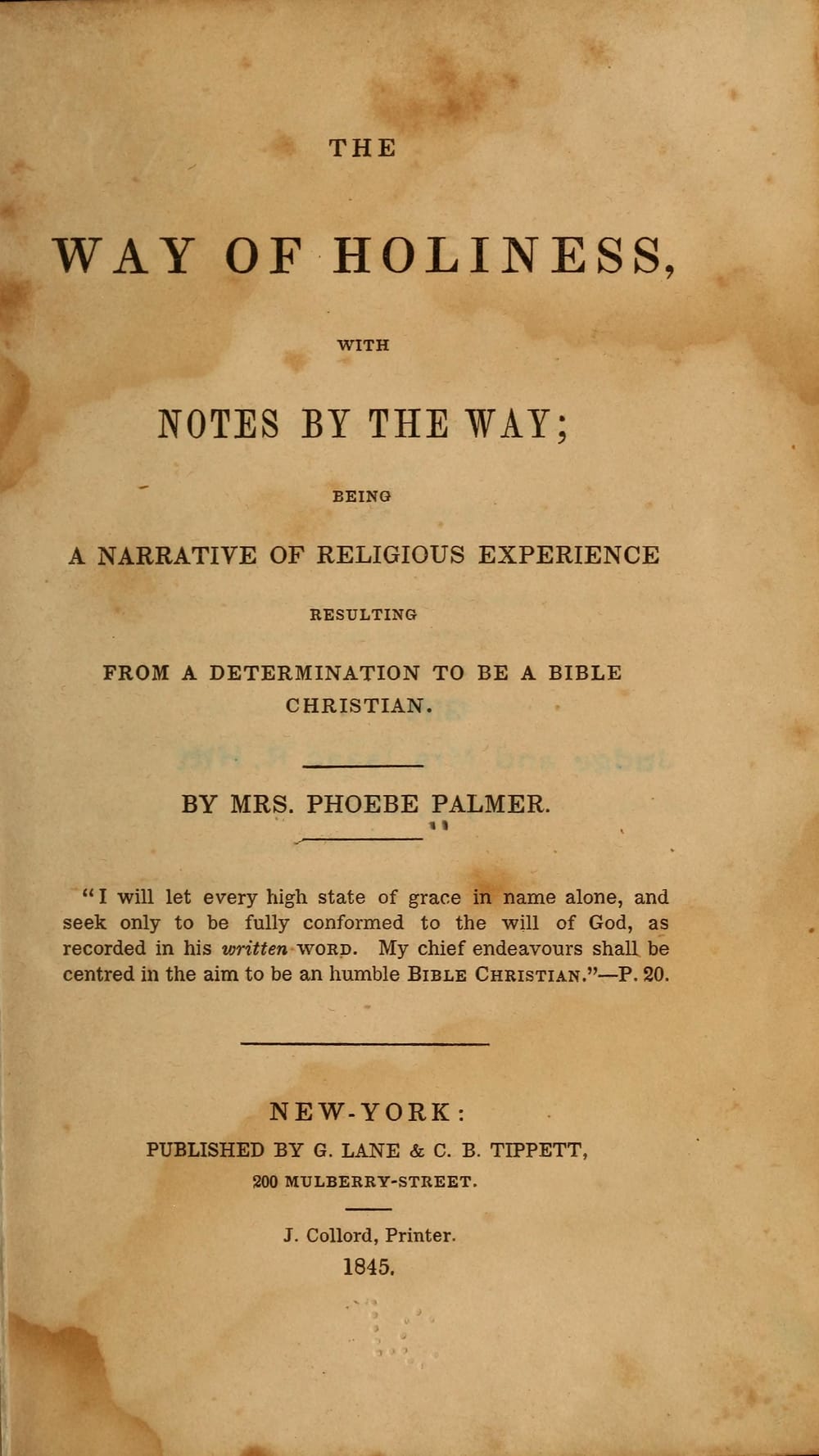
Phoebe Palmer, The Way of Holiness, 1845. Public domain.
1738 to 1906 · Subject · Featured Study
From Wesley to Azusa
The dated steps from John Wesley in London to William Seymour in California, through Phoebe Palmer, the Vineland camp meeting and Topeka.
The first holiness camp meeting at Vineland opened with "There is a fountain filled with blood," a hymn adopted as the battle hymn of the movement.
Now may the God of peace Himself sanctify you completely, and may your entire spirit, soul, and body be kept blameless at the coming of our Lord Jesus Christ.
Now may the God of peace Himself sanctify you completely, and may your entire spirit, soul, and body be kept blameless at the coming of our Lord Jesus Christ.
- Books
- 1 Thessalonians, Matthew, 1 John, Acts
- Hold in memory
- 1 Thessalonians 5:23, Acts 2:4
Summary
The Pentecostal movement grew out of the Holiness movement. The Holiness movement grew out of John Wesley's teaching that a believer may be made perfect in love in this life. Each step on that line stands below with the record that dates it.
- Wesley taught that perfect love is received by faith in one moment.
- Phoebe Palmer taught a shorter way into the same blessing in her book of 1843.
- Methodist ministers called the first national holiness camp meeting at Vineland in 1867.
- Seymour heard Parham in Houston. He then led the meetings in Los Angeles where the revival began.
The Verses of Perfect Love, From Wesley to Topeka
Wesley set a prayer, a command and the love texts under his teaching; Palmer added the altar, and Topeka turned to Acts 2.
Wesley answered the question of what Scripture promises with a prayer of Paul and two commands of Christ. Palmer added the altar of Matthew 23, and the students at Topeka read Acts 2:4.
Wesley's Plain Account
Be perfect, therefore, as your heavenly Father is perfect.
Wesley sets this command first when he asks what command Scripture gives to the same effect.
Matthew 5:48BSB
Jesus declared, “‘Love the Lord your God with all your heart and with all your soul and with all your mind.’
Wesley cites the great command in the same answer, though the 1872 printing gives the reference as Matthew 12:37.
There is no fear in love, but perfect love drives out fear, because fear involves punishment. The one who fears has not been perfected in love.
Wesley names perfect love as the essence of Christian perfection and cites this verse for it.
1 John 4:18BSB
Palmer and Topeka
You blind men! Which is greater: the gift, or the altar that makes it sacred?
Palmer taught believers to lay themselves on the altar that sanctifies the gift, in the words of this verse.
And they were all filled with the Holy Spirit and began to speak in other tongues as the Spirit enabled them.
The Topeka students settled on this verse for the sign of the Spirit's baptism, and Seymour preached from it on 9 April.
Acts 2:4BSB
Matthew 23:19, Acts 2:4
The Line, Step by Step
Six dated records from London, New York, New Jersey, Kansas and California.
The teaching ran from Aldersgate in 1738 to Bonnie Brae Street, a span of 168 years.
- Wesley's heart is strangely warmed in Aldersgate Street24 May 1738Wesley's Journal, Curnock's edition of 1909, volume 1, page 475
- Wesley's last revision of the Plain Account1777The editor's note in Jackson's edition of 1872
- Palmer publishes The Way of Holiness1843The title page, New York, Piercy and Reed
- The first National Camp-meeting opens at Vineland17 July 1867McDonald and Searles, Life of Inskip, 1885, page 191
- Parham's students search Acts for the signLate December 1900Shumway's thesis, 1919, page 112
- The Spirit falls at Bonnie Brae Street9 April 1906Shumway, page 115, and Bartleman, 1925, page 44
A timeline of the dated steps, each row naming the record that fixes its date.
The era of the Revival Streams holds the wider story of the years from Topeka to the healing tents.
Wesley's Perfect Love and Palmer's Shorter Way
Wesley taught a blessing received by faith in a moment, and Palmer taught believers to claim it at once.
On the evening of 24 May 1738 Wesley went unwillingly to a society in Aldersgate Street, London, where a man was reading Luther's preface to Romans. About a quarter before nine, he wrote, he felt his heart strangely warmed.
In his Plain Account of Christian Perfection Wesley says that he and his brother Charles held four things. Perfection is the love of God and neighbour that delivers from all sin, and it is received by faith alone. It is given in one moment, and it is to be expected now.
About 1835 the women's prayer meetings of the Allen Street and Mulberry Street Methodist churches joined at the house of Dr. Palmer, on the proposal of Sarah Lankford with the agreement of his wife, Phoebe. This Tuesday Meeting admitted men from 1839.
Phoebe Palmer dated her own entry into the blessing to 26 July 1837. Her book The Way of Holiness opens with a believer asking whether there is a shorter way into holiness than long waiting and struggle.
Her answer was the altar. A believer who lays the whole self on Christ, the altar that sanctifies the gift, may believe the offering accepted and the heart cleansed by His blood, she wrote, though the believer must act.
From the Vineland Camp Meeting to Bonnie Brae Street
Methodist ministers carried the teaching into national camp meetings, and the Holiness missions still preached it.
On 13 June 1867 a group of Methodist ministers met at 1018 Arch Street, Philadelphia, and resolved to hold a camp meeting for the special work of promoting Christian holiness. They chose Vineland, New Jersey, and named the movement the National Camp-meeting for the Promotion of Christian Holiness.
The meeting opened on 17 July, with John S. Inskip leading. His biographers of 1885 write that the National Camp-meeting Association came out of it.
In the last two weeks of 1900 Charles Parham told the students of his Bible school at Topeka to search the Scriptures for the sign that goes with the baptism of the Holy Spirit. Charles Shumway, a critic who wrote his thesis on tongues in 1919, records that they agreed on speaking in tongues.
Shumway writes that William J. Seymour heard Parham for several evenings in a mission hall in Houston. When a mission in Los Angeles needed a leader, a woman there named him.
Frank Bartleman first met Seymour on 26 March 1906 at a cottage meeting on Bonnie Brae Street. He wrote that Seymour had just come from Texas.
On 9 April Seymour prayed with a sick man named Lee, who spoke in tongues. That evening Seymour preached from Acts 2:4 in the Asberry home on Bonnie Brae Street, and most of the people in the room spoke in tongues. The meetings soon moved to a building on Azusa Street.
The Azusa mission's paper printed its creed in its first issue. It called sanctification the second work of grace and the baptism with the Holy Ghost a gift of power upon the sanctified life.
In Their Own Words
Phoebe Palmer (1807 to 1874)
The Way of Holiness, with Notes by the Way, Section I, page 5
Palmer opened her book with a conversation.
“Yes, brother, there is a shorter way! O! I am sure this long waiting and struggling with the powers of darkness is not necessary. There is a shorter way.”
Methodist (Holiness)
About this saying1 paragraph
Palmer opened her book of 1843 with this exchange between two believers on the way of holiness.
William J. Seymour (1870 to 1922)
"Bro. Seymour's Call", The Apostolic Faith 1:1, page 1, in the Apostolic Faith Church's transcription
Seymour told how he came to Los Angeles.
“The Lord sent the means, and I came to take charge of a mission on Santa Fe Street, and one night they locked the door against me, and afterwards got Bro. Roberts, the president of the Holiness Association, to come down and settle the doctrine of the Baptism with the Holy Ghost, that it was simply sanctification. He came down and a good many holiness preachers with him, and they stated that sanctification was the baptism with the Holy Ghost. But yet they did not have the evidence of the second chapter of Acts, for when the disciples were all filled with the Holy Ghost, they spoke in tongues as the Spirit gave utterance. After the president heard me speak of what the true baptism of the Holy Ghost was, he said he wanted it too, and told me that when I had received it to let him know. So I received it and let him know. The beginning of the Pentecost started in a cottage prayer meeting at 214 Bonnie Brae.”
Pentecostal
About this saying1 paragraph
The Apostolic Faith printed this account of his call on its front page in 1906.
Frank Bartleman (1871 to 1935)
How Pentecost Came to Los Angeles (Los Angeles: F. Bartleman, 1925), on the Azusa Street meetings, p. 58
Bartleman described the building on Azusa Street.
“In that old building, with its low rafters and bare floors, God took strong men and women to pieces, and put them together again, for His glory.”
Pentecostal
About this saying1 paragraph
Bartleman looked back on the mission's old building in his book of 1925.
How the Line Is Read
Wesley named a moment and a process, and the Azusa creed set the Spirit's baptism after both works.
Wesley taught a perfection given in a moment and also a gradual work before and after it, as his Plain Account says. Palmer's book stresses the moment, and the ministers at Vineland called their camp meeting for that blessing.
The Azusa creed kept both of Wesley's works and set the baptism with the Holy Ghost upon them.
Books to Read Next
A Plain Account of Christian Perfection
John Wesley · 1777
Wesley sets out the doctrine in his own words, in questions and answers.
Free at the Christian Classics Ethereal LibraryThe Way of Holiness
Phoebe Palmer · 1843
Palmer tells her own search for the blessing as a conversation between believers.
Free scan of the 1843 editionThe Life of Rev. John S. Inskip
William McDonald and John E. Searles · 1885
The biographers tell the calling of the Vineland camp meeting from the minutes and Inskip's diary.
Free at the Internet ArchiveHow Pentecost Came to Los Angeles
Frank Bartleman · 1925
Bartleman tells the meetings as one who was there.
Free at the Christian Classics Ethereal LibraryWhat the Line Handed On
The Holiness movement handed the Pentecostal churches a hunger for a definite blessing received by faith. The Azusa mission kept Wesley's two works and preached the baptism of the Spirit as the gift that followed them.
Sources
Scripture is the Berean Standard Bible.
- The Holy Bible, Berean Standard Bible (read 2026)
- John Wesley, A Plain Account of Christian Perfection (last revised 1777), in The Works of John Wesley, edited by Thomas Jackson (London, 1872), volume 11, pages 366 to 446, section 18 and the questions after it.
- The Journal of the Rev. John Wesley, Standard Edition, edited by Nehemiah Curnock (London: Charles H. Kelly, 1909), volume 1, pages 475 to 476.
- Phoebe Palmer, The Way of Holiness, with Notes by the Way (New York: Piercy and Reed, 1843), Section I, page 5, and pages 66 to 67.
- Richard Wheatley, The Life and Letters of Mrs. Phoebe Palmer (New York: W. C. Palmer, 1876), page 65 and chapter VI, pages 238 to 239.
- William McDonald and John E. Searles, The Life of Rev. John S. Inskip (Boston: McDonald and Gill, 1885), chapter XIV, pages 188 to 195.
- Charles W. Shumway, A Critical History of Glossolalia (thesis, Boston University, 1919), pages 112 to 116.
- Frank Bartleman, How Pentecost Came to Los Angeles: As It Was in the Beginning (Los Angeles: F. Bartleman, 1925), pages 43 and 44.