
Galatians 6:14
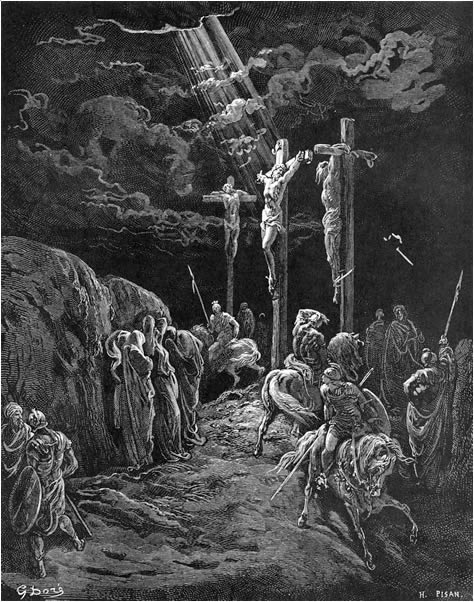
in Galatians 6But as for me, may I never boast, except in the cross of our Lord Jesus Christ, through which the world has been crucified to me, and I to the world.
BSB
The same verse in ASV and KJV ▾
ASV
But far be it from me to glory, save in the cross of our Lord Jesus Christ, through which the world hath been crucified unto me, and I unto the world.
KJV
But God forbid that I should glory, save in the cross of our Lord Jesus Christ, by whom the world is crucified unto me, and I unto the world.
⋯
This verse in Galatians 6
Commentary
31 notes on this verseMoreover, they affirm that the Apostle Paul himself made mention of this cross in the following words: "The doctrine of the cross is to them that perish foolishness, but to us who are saved it is the power of God." And again: "God forbid that I should glory in anything save in the cross of Christ, by whom the world is crucified to me, and I unto the world."
This site's exposition
save in the cross
on Galatians 6:14-15
Against their glorying Paul sets his only boast, the cross of our Lord Jesus Christ, and the crucifixion chain of the letter reaches its last beat: the world crucified unto me, and I unto the world, a double death that ends the world's claim on him and his on it. Verse 15 draws the standard beneath the whole dispute: neither circumcision nor uncircumcision counts for anything, but a new creature. The new creation, not the old badge, is what God is making.
The record, by era
The Church Fathers5 voices
How sad a thing it has become! But what is the boast? That he accepted to be crucified for us the unworthy. For this is the occasion of our boasting. May it be my boast, then, to boast in the cross of Christ, which seems …
A commentator
Philoxenus of Mabbug13 Ascetic Discourses, Discourse 9 -- Second Discourse on Poverty · Written before 523.
proposed
For when thou hast gone forth from the world, inasmuch as it is its custom to pursue after those who forsake it and depart from it, turn thee to fight against it, and be thou crucified to it, remembering that which Paul spake, "I am …
A commentator
Philoxenus of Mabbug13 Ascetic Discourses, Discourse 9 -- Second Discourse on Poverty · Written before 523.
proposed
And the participation in the sufferings of Christ consisteth not in a man giving alms, and in shewing his lovingkindness unto those who are needy, but in his dying wholly and entirely to the world, and to the body, and to the lusts, and to …
Moreover, "the world is crucified unto me," who am a servant of the Creator-"the world," (I say, ) but not the God who made the world-"and I unto the world," not unto the God who made the world.
When Paul writes that the cross is glory, he means obviously "the cross of our Lord Jesus Christ." When in that mystery his body hung from the cross and in it crushed the power of this world, the whole world was crucified through him. In …
24 more voices on this verse
The Church Fathers9 voices
(Verse 14.) But far be it from me to boast except in the cross of our Lord Jesus Christ, by which the world has been crucified to me, and I to the world. For neither circumcision counts for anything, nor uncircumcision, but a new creation. And as for all who walk by this rule, peace and mercy be upon them, and upon the Israel of God. But that world is crucified to the just one, of whom the Savior says: I have conquered the world (John 16:33). And: Do not love the world. And: You have not received the spirit of the world. To whom the world is crucified, to him the world is also dead: and now the end of the world has come to him, and he is worthy of the new heaven and the new earth, and the new Testament, he sings a new song, and receives a new name written in a book, which no one knows except the one who receives it. It is asked how now Paul says: But God forbid that I should glory, save in the cross of our Lord Jesus Christ, by whom the world is crucified unto me, and I unto the world. (Galatians 6:14). And in another place concerning others: That in this boasting I may not be put to shame. (2 Corinthians 9:4). And again: But he said to me: My grace is sufficient for thee; for power is made perfect in weakness. (2 Corinthians 12:9). And in another place: But though I should have a mind to glory, I shall not be foolish; for I will say the truth. But I forbear, lest any man should think of me above that which he seeth in me or any thing he heareth from me. (2 Corinthians 12:6). And so on, such as are written in this manner. But it must be known that all that boasting related to the cross, let the glory be to the cross: and whatever worthy is accomplished in virtues, let it be done because of the Lord's passion.
A commentator
Lucius Caecilius Firmianus LactantiusThe Divine Institutes, Book 4, Chapter XXVII · Written before 325.
proposed
But they say that the gods do this, not through fear, but through hatred; as though it were possible for any one to hate another, unless it be him who injures, or has the power of injuring. Yea, truly, it would be consistent with their majesty to visit those whom they hated with immediate punishment, rather than to flee from them. But since they can neither approach those in whom they shall see the heavenly mark, nor injure those whom the immortal sign as an impregnable wall protects, they harass them by men, and persecute them by the hands of others: and if they acknowledge the existence of these demons, we have overcome; for this must necessarily be the true religion, which both understands the nature of demons, and understands their subtlety, and compels them, vanquished and subdued, to yield to itself.
Paul proclaims in a loud and lofty voice, "But God forbid that I should glory, save in the cross of our Lord Jesus Christ, by whom the world is crucified unto me, and I unto the world." And yet a virgin in the Church glories concerning her fleshly appearance and the beauty of her body! Paul adds, and says, "For they that are Christ's have crucified their flesh, with its faults and lusts." And she who professes to have renounced the lusts and vices of the flesh, is found in the midst of those very things which she has renounced! Virgin, thou art taken, thou art exposed, thou boastest one thing and affectest another. You sprinkle yourself with the stains of carnal concupiscence, although you are a candidate of purity and modesty. "Cry," says the Lord to Isaiah, "All flesh is grass, and all the glory of it as the flower of the grass: the grass withereth, and the flower fadeth; but the word of the Lord endureth for ever." It is becoming for no Christian, and especially it is not becoming for a virgin, to regard any glory and honour of the flesh, but only to desire the word of God, to embrace benefits which shall endure for ever. Or, if she must glory in the flesh, then assuredly let her glory when she is tortured in confession of the name; when a woman is found to be stronger than the tortures; when she suffers fire, or the cross, or the sword, or the wild beasts, that she may be crowned. These are the precious jewels of the flesh, these are the better ornaments of the body.
A commentator
CyprianTreatise XII. Three Books of Testimonies Against the Jews. · Written before 258.
proposed
That he who has attained to trust, having put off the former man, ought to regard only celestial and spiritual things, and to give no heed to the world which he has already renounced. In Isaiah: "Seek ye the Lord; and when ye have found Him, call upon Him. But when He hath come near unto you, let the wicked forsake his ways, and the unrighteous man his thoughts: and let him be turned unto the Lord, and he shall obtain mercy, because He will plentifully pardon your sins." Of this same thing in Solomon: "I have seen all the works which are done under the sun; and, lo, all are vanity." Of this same thing in Exodus: "But thus shall ye eat it; your loins girt, and your shoes on your feet, and your staves in your hands: and ye shall eat it in haste, for it is the Lord's passover." Of this same thing in the Gospel according to Matthew: "Take no thought, saying, What shall we eat? or, What shall we drink? or, Wherewith shall we be clothed? for these things the nations seek after. But your Father knoweth that ye have need of all these things. Seek first the kingdom of God, and His righteousness; and all these things shall be added unto you." Likewise in the same place: "Think not for the morrow, for the morrow shall take thought for itself. Sufficient unto the day is its own evil." Likewise in the same place: "No one looking back, and putting his hands to the plough, is fit for the kingdom of God." Also in the same place: "Behold the fowls of the heaven: for they sow not, nor reap, nor gather into barns; and your heavenly Father feedeth them. Are not ye of more value than they? " Concerning this same thing, according to Luke: "Let your loins be girded, and your lamps burning; and ye like unto men that wait for their lord, when he cometh from the wedding; that, when he cometh and knocketh, they may open to him. […]
And to return to the praise of martyrdom, there is a word of the blessed Paul, who says; "Know ye not that they who run in a race strive many, but one receiveth the prize? But do ye so run, that all of you may obtain." Moreover also elsewhere, that be may exhort us to martyrdom, he has called us fellow-heirs with Christ; nay, that he might omit nothing, he says, "If ye are dead with Christ, why, as if living in the world, do ye make distinctions? " Because, dearest brethren, we who bear the rewards of resurrection, who seek for the day of judgment, who, in fine, are trusting that we shall reign with Christ, ought to be dead to the world. For you can neither desire martyrdom till you have first hated the world, nor attain to God's reward unless you have loved Christ. And he who loves Christ does not love the world. For Christ was given up by the world, even as the world also was given up by Christ; as it is written, "The world is crucified unto me, and I unto the world." The world has been an object of affection to none whom the Lord has not previously condemned; nor could he enjoy eternal salvation who has gloried in the life of the world. That is the very voice of Christ, who says: "He that loveth his life in this world, shall lose it in the world to come; but he that hateth his life in this world, shall find it in the world to come." Moreover, also, the Apostle Paul says: "Be ye imitators of me, as I also am of Christ." And the same elsewhere says: "I wish that all of you, if it were possible, should be imitators of me."
Such is a soul winged with heavenly love. For if those who cherish the foul earthly passion which men call love, think nothing either glorious or precious, but those things alone which tend to gratify their lust, they think both glorious and honorable, and their mistress is everything to them; much more do those, who have been taken captive by this heavenly love, think nothing of the cost. Would that I could bring forward examples of all this from among ourselves: but since we are at a loss for such, we must needs betake ourselves to this same Paul. Observe him then, how he felt towards the whole world. "The world is crucified unto me," he says, "and I unto the world": I am dead to the world, and the world is dead to me.
"But far be it from me to glory, save in the cross of our Lord Jesus Christ." Truly this symbol is thought despicable; but it is so in the world's reckoning, and among men; in Heaven and among the faithful it is the highest glory. Poverty too is despicable, but it is our boast; and to be cheaply thought of by the public is a matter of laughter to them, but we are elated by it. So too is the Cross our boast. He does not say, "I boast not," nor, "I will not boast," but, "Far be it from me that I should," as if he abominated it as absurd, and invoked the aid of God in order to his success therein. And what is the boast of the Cross? That Christ for my sake took on Him the form of a slave, and bore His sufferings for me the slave, the enemy, the unfeeling one; yea He so loved me as to give Himself up to a curse for me. What can be comparable to this! If servants who only receive praise from their masters, to whom they are akin by nature, are elated thereby, how must we not boast when the Master who is very God is not ashamed of the Cross which was endured for us. Let us then not be ashamed of His unspeakable tenderness; He was not ashamed of being crucified for thy sake, and wilt thou be ashamed to confess His infinite solicitude? It is as if a prisoner who had not been ashamed of his King, should, after that King had come to the prison and himself loosed the chains, become ashamed of him on that account. Yet this would be the height of madness, for this very fact would be an especial ground for boasting. "Through which the world hath been crucified unto me, and I unto the world." What he here calls the world is not the heaven nor the earth, but the affairs of life, the praise of men, retinues, glory, wealth, and all such things as have a show of splendor. To me these things are dead. Such an one it behooves a Christian to be, and always to use this language. […]
A commentator
Ignatius of AntiochEpistle of Pseudo-Ignatius to the Tarsians · Written before 108.
proposed
Mindful of him, do ye by all means know that Jesus the Lord was truly born of Mary, being made of a woman; and was as truly crucified. For, says he, "God forbid that I should glory, save in the cross of the Lord Jesus." And He really suffered, and died, and rose again. For says [Paul], "If Christ should become passible, and should be the first to rise again from the dead." And again, "In that He died, He died unto sin once: but in that He liveth, He liveth unto God." Otherwise, what advantage would there be in [becoming subject to] bonds, if Christ has not died? what advantage in patience? what advantage in [enduring] stripes? And why such facts as the following: Peter was crucified; Paul and James were slain with the sword; John was banished to Patmos; Stephen was stoned to death by the Jews who killed the Lord? But, [in truth, ] none of these sufferings were in vain; for the Lord was really crucified by the ungodly.
The assertion, then, may be hazarded, that it has been shown that death is the fellowship of the soul in a state of sin with the body; and life the separation from sin. And many are the stakes and ditches of lust which impede us, and the pits of wrath and anger which must be overleaped, and all the machinations we must avoid of those who plot against us,-who would no longer see the knowledge of God "through a glass." "The half of virtue the far-seeing Zeus takes from man, when he reduces him to a state of slavery." As slaves the Scripture views those "under sin" and "sold to sin," the lovers of pleasure and of the body; and beasts rather than men, "those who have become like to cattle, horses, neighing after their neighbours' wives." The licentious is "the lustful ass," the covetous is the "savage wolf," and the deceiver is "a serpent." The severance, therefore, of the soul from the body, made a life-long study, produces in the philosopher gnostic alacrity, so that he is easily able to bear natural death, which is the dissolution of the chains which bind the soul to the body. "For the world is crucified to me, and I to the world," the [apostle] says; "and now I live, though in the flesh, as having my conversation in heaven."
The Medieval Church2 voices
After unmasking the sinister intention of the seducers, the Apostle here insinuates his own intention. First, he states his intention; Secondly, he gives a sign of this intention (v. 14); Thirdly, the reason for this intention (v. 15). He says therefore: The intention of the …
Let them, he says, boast in circumcision, a thing abolished, but for me let there be no other boast "except in the cross of our Lord Jesus Christ" (that is, faith in the Crucified), which (cross) abolished the law. He turned away from this as …
The Puritans and the Awakening4 voices
But God forbid that I should glory - Should boast of anything I have, am, or do; or rely on anything for my acceptance with God, but what Christ hath done and suffered for me. By means of which the world is crucified to me - All the things and persons in it are to me as nothing.
1 Brethren, if a man be overtaken in a fault, ye which are spiritual, restore such an one in the spirit of meekness; considering thyself, lest thou also be tempted. 2 Bear ye one another's burdens, and so fulfil the law of Christ. 3 For if a man think himself to be something, when he is nothing, he deceiveth himself.
quarantine:scripture (2026-07-29) — verbatim-scripture
But God forbid that I should glory,....
Note, The cross of Christ is a good Christian's chief glory, and there is the greatest reason why we should glory in it, for to it we owe all our joys and hopes. That he was dead to the world.
The Nineteenth Century9 voices
But God forbid that I should glory - Whatever others may do, or whatever they may exult or glory in, God forbid that I should exult, except in the cross of our Lord Jesus Christ; in the grand doctrine, that justification and salvation are only through Christ crucified, he having made an atonement for the sin of the world by his passion and death. And I glory, also, in the disgrace and persecution which I experience through my attachment to this crucified Christ.
WHENEVER we rebuke other people we should be prepared to clear ourselves of their offense. The Apostle had been rebuking those who wished to glory in the flesh. In denouncing false teachers and upbraiding their weak-minded followers, he used sharp language while he appealed to plain facts and maintained his ground with strong arguments. And this he did without fear of being met by a flank movement and being charged with doing the same things himself. Very fitly, therefore, does he contrast his own determined purpose with their plausible falseness.
A commentator
Charles Spurgeon1834–1892
The Metropolitan Tabernacle Pulpit, Sermon No. 3451: “Grand Glorying” (lightly modernized text, CCEL edition) · Written before 1892.
WITH that, "God forbid," Paul makes a clean sweep of every other ground of boasting and casts himself upon the one only chosen object of his soul's glorying. And yet, if you will think of it, Paul had, after the fashion of other men, many things in which he might have gloried. If it had so pleased him, he might have boasted of his pedigree, for he was "a Hebrew of the Hebrews." He could trace his genealogy, as the pure Hebrews could, up to that great fountain of nobility—Abraham himself!
A commentator
Jamieson, Fausset & Brown1802–1910
Commentary Critical and Explanatory on the Whole Bible (1871)
We are to testify the power of Christ's death working in us, after the manner of crucifixion (Ga 5:24; Ro 6:5, 6). our--He reminds the Galatians by this pronoun, that they had a share in the "Lord Jesus Christ" (the full name is used for greater solemnity), and therefore ought to glory in Christ's cross, as he did. the world--inseparably allied to the "flesh" (Ga 6:13).
WHENEVER we rebuke other people we should be prepared to clear ourselves of their offense. The Apostle had been rebuking those who wished to glory in the flesh. In denouncing false teachers and upbraiding their weak-minded followers, he used sharp language while he appealed to plain facts and maintained his ground with strong arguments. And this he did without fear of being met by a flank movement and being charged with doing the same things himself. Very fitly, therefore, does he contrast his own determined purpose with their plausible falseness. They were for making a fair show in the flesh, but he shrunk not from the deepest shame of the Christian profession. So far from shrinking, he even counted it honor to be scorned for Christ's sake, exclaiming, "God forbid that I should glory, save in the Cross of our Lord Jesus Christ." The Galatians and all others to whom his name was familiar, well knew how truly he spoke, for the manner of his life as well as the matter of his teaching had supplied evidence of this assertion, which none of his enemies could deny. There had not been in all his ministry any doctrine that he extolled more highly than that of "Christ crucified." Nor any experience that he touched on more tenderly than this "fellowship with Christ in His sufferings." Nor any rule of conduct that he counted more safe than following in the footsteps of Him who "endured the Cross, despising the shame, and is set down at the right hand of the Throne of God." His example accorded with his precept. God grant, of His Grace, that there may always be with us the same transparent consistency. Sometimes when we notice an evil and protest as boldly and conscientiously as we can against it, we feel that our protest is too obscure to have much influence.
ALMOST all men have something in which to glory. Every bird has its own note of song. It is a poor heart that never rejoices. It is a dull packhorse that is altogether without bells. Men usually rejoice in something or other and many men so rejoice in that which they choose that they become boastful and full of vainglory. It is very sad that men should be ruined by their glory and yet, many are. Many glory in their shame and more glory in that which is mere emptiness.
ALMOST all men have something in which to glory. Every bird has its own note of song. It is a poor heart that never rejoices. It is a dull packhorse that is altogether without bells. Men usually rejoice in something or other and many men so rejoice in that which they choose that they become boastful and full of vainglory. It is very sad that men should be ruined by their glory and yet, many are. Many glory in their shame and more glory in that which is mere emptiness. Some glory in their physical strength, in which an ox excels them, or in their gold, which is but thick clay, or in their gifts, which are but talents with which they are entrusted. The pounds entrusted to their stewardship are thought, by men, to belong to themselves and, therefore, they rob God of the glory of them. O my Hearers, hear the voice of Wisdom, which cries, "He that glories, let him glory only in the Lord." To live for personal glory is to be dead while we live! Be not so foolish as to perish for a bubble! Many a man has thrown his soul away for a little honor, or for the transient satisfaction of success in trifles. O men, your tendency is to glory in something—your wisdom will be to find a glory worthy of an immortal mind! The Apostle Paul had a rich choice of things in which he could have gloried. If it had been his mind to have remained among his own people, he might have been one of their most honored rabbis.
A commentator
Charles Spurgeon1834–1892
The Metropolitan Tabernacle Pulpit, Sermon No. 3451: “Grand Glorying” (lightly modernized text, CCEL edition) · Written before 1892.
proposed
WITH that, "God forbid," Paul makes a clean sweep of every other ground of boasting and casts himself upon the one only chosen object of his soul's glorying. And yet, if you will think of it, Paul had, after the fashion of other men, many things in which he might have gloried. If it had so pleased him, he might have boasted of his pedigree, for he was "a Hebrew of the Hebrews." He could trace his genealogy, as the pure Hebrews could, up to that great fountain of nobility—Abraham himself! If he had pleased, he might have boasted in the precision of the former ritual which he had practiced, for he could say that as touching the Law of God, he had been a Pharisee—a man observant of the minutest points of the very letter of the Law, careful for its doctrinal tittles, not allowing even the gnat to escape him, but straining after it with care. And yet the Apostle did not care to boast, either of his pedigree or of his ritualism. He casts them both aside and though he had once gloried in them, he now counted them but dross, that he might win Christ and be found in Him! Surely, if the Apostle had wished it, he might have gloried in his martyr life. He did once give a list of what he had suffered, and he added, "I have become a fool in glorying; you have compelled me." Had he not been beaten with rods, shipwrecked, subject to perils from robbers, perils from false brethren, imprisonment and stones? And yet you never hear him glory in that wonderful martyr life of his! Among the Apostles, he was no less than the chief in that which he suffered, and yet he says, "God forbid that I should glory in it." He might have gloried in the Revelation which he received.
A commentator
Albert Barnes1798–1870
Notes, Explanatory and Practical, on the Old and New Testaments (1832-1869)
proposed
But God forbid - See the note at Rom 3:4. “For me it is not to glory except in the cross of Christ.” The object of Paul here is evidently to place himself in contrast with the judaizing teachers, and to show his determined purpose to glory in nothing else but the cross of Christ. Well they knew that he had as much occasion for glorying in the things pertaining to the flesh, or in the observance of external rites and customs, as any of them. He had been circumcised. He had had all the advantages of accurate training in the knowledge of the Jewish law. He had entered on life with uncommon advantages. He had evinced a zeal that was not surpassed by any of them; and his life, so far as conformity to the religion in which he had been trained was concerned, was blameless; Php 3:4-8. This must have been to a great extent known to the Galatians; and by placing his own conduct in strong contrast with that of the Judaizing teachers, and showing that he had no ground of confidence in himself, he designed to bring back the minds of the Galatians to simple dependence on the cross. That I should glory - That I should boast; or that I should rely on any thing else. Others glory in their conformity to the laws of Moses; others in their zeal, or their talents, or their learning, or their orthodoxy; others in their wealth, or their accomplishments; others in their family alliances, and their birth; but the supreme boast and glorying of a Christian is in the cross of Christ. In the cross of our Lord Jesus Christ - In Jesus the crucified Messiah. It is a subject of rejoicing and glorying that we have such a Saviour. The world looked upon him with contempt; and the cross was a stumbling-block to the Jew, and folly to the Greek. Notes, 1Co 1:23. But to the Christian, that cross is the subject of glorying. […]
The words behind it
22 Greek wordsEvery Greek word of this verse in the order it stands, with what it means and the door to its own study. The last column counts the times a word stands in the whole Bible: the rarer the word, the more the places it appears belong together.
| Greek | Sound | Meaning | Word study | In the Bible |
|---|---|---|---|---|
| ἐμοὶ | emoi | For me myself | G1473 → | 839 times |
| δὲ | de | however | G1161 → | 2765 times |
| μὴ | me | never | G3361 → | 1066 times |
| γένοιτο | genoito | would it be | G1096 → | 667 times |
| καυχᾶσθαι | kauchasthai | to boast | G2744 → | |
| εἰ | ei | only | G1487 → | 508 times |
| μὴ | me | except | G3361 → | 1066 times |
| ἐν | en | in | G1722 → | 2738 times |
| τῷ | to | the | G3588 → | 19766 times |
| σταυρῷ | stauro | cross | G4716 → | 27 times |
| τοῦ | tou | of the | G3588 → | 19766 times |
| κυρίου | kuriou | Lord | G2962 → | 711 times |
| ἡμῶν | hemon | of us | G3165 → | 1936 times |
| Ἰησοῦ | iesou | Jesus | G2424 → | 908 times |
| Χριστοῦ, | christou | Christ, | G5547 → | 523 times |
| δι᾽ | di᾽ | through | G1223 → | 664 times |
| οὗ | hou | which | G3739 → | 1405 times |
| ἐμοὶ | emoi | to me myself | G1473 → | 839 times |
| κόσμος | kosmos | [the] world | G2889 → | 185 times |
| ἐσταύρωται | estaurotai | has been crucified | G4717 → | 46 times |
| κἀγὼ | kago | and I myself | G1473 →G2532 → | 839 times |
| κόσμῳ. | kosmo | to [the] world. | G2889 → | 185 times |
ἐμοὶFor me myself
emoiG1473 →839 times
δὲhowever
deG1161 →2765 times
μὴnever
meG3361 →1066 times
γένοιτοwould it be
genoitoG1096 →667 times
καυχᾶσθαιto boast
kauchasthaiG2744 →
εἰonly
eiG1487 →508 times
μὴexcept
meG3361 →1066 times
ἐνin
enG1722 →2738 times
τῷthe
toG3588 →19766 times
σταυρῷcross
stauroG4716 →27 times
τοῦof the
touG3588 →19766 times
κυρίουLord
kuriouG2962 →711 times
ἡμῶνof us
hemonG3165 →1936 times
ἸησοῦJesus
iesouG2424 →908 times
Χριστοῦ,Christ,
christouG5547 →523 times
δι᾽through
di᾽G1223 →664 times
οὗwhich
houG3739 →1405 times
ἐμοὶto me myself
emoiG1473 →839 times
κόσμος[the] world
kosmosG2889 →185 times
ἐσταύρωταιhas been crucified
estaurotaiG4717 →46 times
κἀγὼand I myself
κόσμῳ.to [the] world.
kosmoG2889 →185 times
A shaded row is a word that stands 400 times or fewer in the Bible.
The walk
8 stopsEach card is a verse this one points to, and under it the verses that one points to in turn. Where several paths arrive at the same place, that place is listed first: the text keeps returning to it.
Through
Galatians 2:20I have been crucified with Christ, and I no longer live, but Christ lives in me. The life I live in the body, I live by faith in the Son of God, who loved…
it leads to
- Galatians 5:24
Those who belong to Christ Jesus have crucified the flesh with its passions and desires.
Reached by 2 separate paths from here.
- 2 Corinthians 5:15
And He died for all, that those who live should no longer live for themselves, but for Him who died for them and was raised again.
- Romans 6:4–6
We were therefore buried with Him through baptism into death, in order that, just as Christ was raised from the dead through the glory of the Father, we too may walk in newness of…
- Colossians 3:3–4
For you died, and your life is now hidden with Christ in God.
- 2 Corinthians 4:10–11
We always carry around in our body the death of Jesus, so that the life of Jesus may also be revealed in our body.
- Galatians 5:24
Through
Romans 6:6We know that our old self was crucified with Him so that the body of sin might be rendered powerless, that we should no longer be slaves to sin.
it leads to
- Galatians 2:20
I have been crucified with Christ, and I no longer live, but Christ lives in me. The life I live in the body, I live by faith in the Son of God, who loved…
- Ephesians 4:22
to put off your former way of life, your old self, which is being corrupted by its deceitful desires;
- John 8:34–36
Jesus replied, “Truly, truly, I tell you, everyone who sins is a slave to sin.
- Galatians 2:20
Where this verse is studied
On this page
Studies1
About Galatians
This page draws on 26 works. Open the list of works
This page draws on Adam Clarke, Commentary on the Bible; Albert Barnes, Notes, Explanatory and Practical, on the Old and New Testaments (1832-1869); Charles Spurgeon, The Metropolitan Tabernacle Pulpit, Sermon No. 1447: “Three Crosses” (lightly modernized text, CCEL edition); Charles Spurgeon, The Metropolitan Tabernacle Pulpit, Sermon No. 3451: “Grand Glorying” (lightly modernized text, CCEL edition); Charles Spurgeon, The Metropolitan Tabernacle Pulpit, Sermon No. 1859: “The Cross Our Glory” (lightly modernized text, CCEL edition); Clement of Alexandria, The Stromata Book 4; Cyprian, Treatise II On the Dress of Virgins; Cyprian, Treatise XII. Three Books of Testimonies Against the Jews.; Cyprian, Pseudo-Cyprian On the Glory of Martyrdom; Gaius Marius Victorinus, EPISTLE TO THE GALATIANS 2.6.14; Ignatius of Antioch, Epistle of Pseudo-Ignatius to the Tarsians; Irenaeus, Irenaeus Against Heresies Book 1; Jamieson, Fausset & Brown, Commentary Critical and Explanatory on the Whole Bible; Jerome, Commentary on Galatians; John Calvin, Commentary on Galatians; John Chrysostom, Homily on Acts 52; John Chrysostom, Homily on Galatians 6; John Gill, Exposition of the New Testament (1746-1748); John Wesley, Explanatory Notes upon the New Testament; Lucius Caecilius Firmianus Lactantius, The Divine Institutes, Book 4, Chapter XXVII; Matthew Henry, Commentary on the Whole Bible; Oecumenius, Commentary on Galatians; Philoxenus of Mabbug, 13 Ascetic Discourses, Discourse 9 -- Second Discourse on Poverty; Tertullian, Against Marcion Book V; Theophylact of Ohrid, Commentary on Galatians and Thomas Aquinas, Commentary on Galatians.