
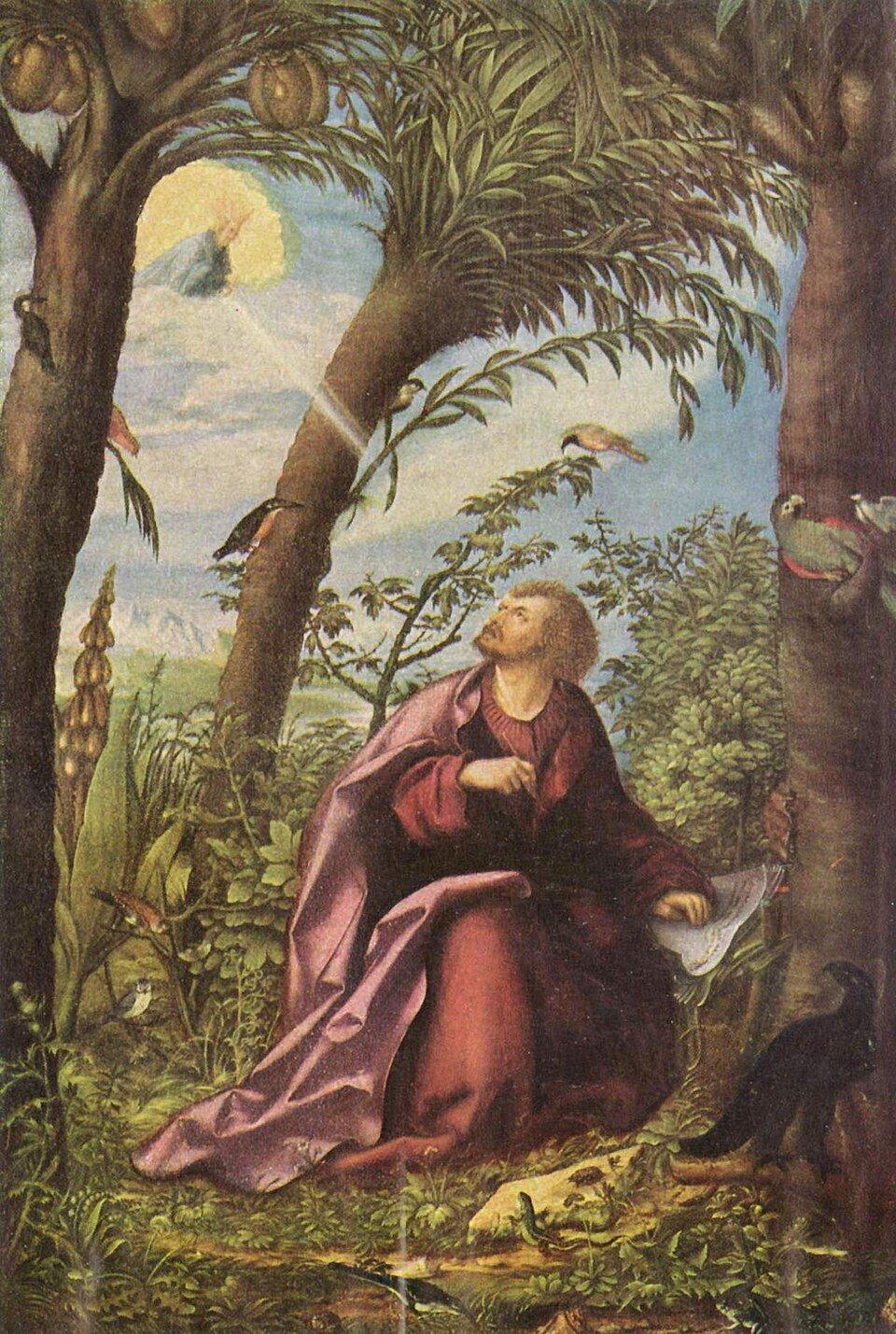
Hans Burgkmair the Elder, John the Evangelist on Patmos, 1518. Public domain.
2 Thessalonians 2:2 and Daniel 7 · Subject · Featured Study
What the Early Church Taught About the End
Teachers of the church wrote on Christ's coming, the Antichrist, the thousand years and the time of the end from the second century to the fifth.
Irenaeus expected the Antichrist to reign three years and six months before the Lord came from heaven in the clouds.
not to be easily disconcerted or alarmed by any spirit or message or letter seeming to be from us, alleging that the Day of the Lord has already come.
not to be easily disconcerted or alarmed by any spirit or message or letter seeming to be from us, alleging that the Day of the Lord has already come.
- Books
- Daniel, Acts, Revelation
- Hold in memory
- Acts 1:7
Summary
The early church left no single book on the end. Its teachers wrote of it inside other work: a dialogue, a book against false teaching, a commentary, a book on the city of God. They agree that Christ will come again, and they differ on how the end will unfold.
- Their readings of Daniel and Revelation were bound up with the empire they lived under.
- More than one of them warned against fixing the date of the end.
- A sermon from a later century is still argued over.
The Coming They Confessed
Daniel's vision and Augustine's creed frame what the early church confessed.
In my vision in the night I continued to watch, and I saw One like the Son of Man coming with the clouds of heaven. He approached the Ancient of Days and was led into His presence. And He was given dominion, glory, and kingship, that the people of every nation and language should serve Him. His dominion is an everlasting dominion that will not pass away, and His kingdom is one that will never be destroyed.Justin quoted this vision in his Dialogue with Trypho.
In the thirty-first chapter Justin set Christ's suffering beside His glorious advent. Christ will come on the clouds as the Son of man, he wrote, with His angels.
Hippolytus of Rome wrote a Commentary on Daniel. He took the time, times and half a time of Daniel 7:25 as three and a half years before the judgment.
Augustine opens the twentieth book of The City of God with what the whole Church of the true God holds and professes as its creed. It holds “that Christ shall come from heaven to judge quick and dead.”
Four Beasts, Four Kingdoms
Hippolytus gave each beast of Daniel 7 the name of an empire.
The four beasts of Daniel 7 as Hippolytus named them in his Commentary on Daniel, book 4.
| The beast | Its place in the vision | The kingdom Hippolytus named |
|---|---|---|
| The lion | The first | The kingdom of the Babylonians |
| The bear | The second | The kingdom of the Persians |
| The leopard | The third | The kingdom of the Greeks |
| The fourth beast | The last | The kingdom of the Romans |
This is what he said: ‘The fourth beast is a fourth kingdom that will appear on the earth, different from all the other kingdoms, and it will devour the whole earth, trample it down, and crush it.Hippolytus and Irenaeus read this kingdom as Rome.
Hippolytus described the fourth beast as a people of many tongues, gathered from many races, all called Romans though not all from one country.
The Number of the Beast
Irenaeus weighed three names for the number and chose none.
Irenaeus explained the number by what the Antichrist would be.
“And there is therefore in this beast, when he comes, a recapitulation made of all sorts of iniquity and of every deceit, in order that all apostate power, flowing into and being shut up in him, may be sent into the furnace of fire. Fittingly, therefore, shall his name possess the number six hundred and sixty-six, since he sums up in his own person all the commixture of wickedness which took place previous to the deluge, due to the apostasy of the angels.”
Irenaeus · Against Heresies 5.29.2 · on Revelation 13:18Patristic
Here is a call for wisdom: Let the one who has insight calculate the number of the beast, for it is the number of a man, and that number is 666.Irenaeus wrote on this verse in the thirtieth chapter of his fifth book.
There he tested Evanthas, Lateinos and Teitan, and each adds up to that number. He called Lateinos the name of the last of Daniel's four kingdoms, because the Latins then ruled.
He still would not pronounce on the name. It was “more certain, and less hazardous, to await the fulfilment of the prophecy,” he wrote, than to guess.
Watch, and Do Not Reckon the Day
Hippolytus recorded two false alarms, and Augustine answered those who counted the years.
So when they came together, they asked Him, “Lord, will You at this time restore the kingdom to Israel?” Jesus replied, “It is not for you to know times or seasons that the Father has fixed by His own authority.Hippolytus quotes this answer in his Commentary on Daniel, and Augustine in The City of God.
Hippolytus told of a church leader in Syria who led believers, with their wives and children, into the desert to meet Christ. They wandered in the mountains, and the local commander would have put them to death as robbers. His wife was a believer, and at her plea he settled the matter.
Hippolytus told of another leader in Pontus who trusted his dreams and said the judgment would come within a year. His people let their fields lie waste, and when the year passed, some who had sold their goods were begging.
Hippolytus asked why anyone should labour over the times and seek the day of the Lord, when the Savior had hidden it.
Augustine wrote in The City of God, book 18, of those who counted the years from the ascension to the final coming. Some said four hundred, some five hundred and others a thousand.
He answered from Acts 1:7 that it is in vain “to compute definitely the years that may remain to this world”.
Three Disputed Questions
The fathers differed on a reign on the earth and on the age of the world, and a later sermon is still argued over.
A thousand years on the earthPapias, as Eusebius reports him in his Church History
Eusebius reports that Papias taught a period of some thousand years after the resurrection of the dead, with the kingdom of Christ “set up in material form on this very earth.”
Eusebius wrote that many fathers after Papias took up the same view because of his age, Irenaeus among them.
The objection: Eusebius held that Papias misread the apostles, who spoke of these things mystically in figures.
Six thousand years for the worldHippolytus of Rome, Commentary on Daniel, book 4
Hippolytus counted a thousand years for each day of creation, so that six thousand years come before the sabbath rest of the saints.
He placed the birth of Christ in the year five thousand five hundred from Adam. So he taught that the end was not near in his own day.
The objection: Augustine set aside the counts of years made in his own day as human conjectures, with nothing certain from the canonical Scriptures.
A sermon once credited to EphremPseudo-Ephraem, On the End of the World
The sermon De fine mundi, On the End of the World, has come down under the name of Ephrem the Syrian.
One sentence in it has all the saints and elect of God gathered before the coming tribulation and taken to the Lord.
Roger Pearse judges that its author wrote in Latin. The copy at St Gall ascribes it to Isidore of Seville.
Its date is disputed. Pearse reports that Bousset placed it in the fourth century and Caspari before 628, and he suggests about 450 himself. The page on the sermon at bible.ca dates it after 700, because it borrows from the Pseudo-Methodius apocalypse.
Albrecht Diem lists four copies, the oldest from the eighth century. Pearse, following Verhelst's edition, lists five, and notes that the words to the Lord stand only in the Vatican copy.
Grant Jeffrey brought the sermon to English readers when he asked Cameron Rhoades to translate it.
Thomas Ice and Timothy Demy wrote that the sermon “clearly emphasizes imminence, two comings separated by the tribulation, and the promise of deliverance of believers from the tribulation.”
David Gunn, in the Baptist Bulletin, grants that the sermon gives the tribulation three and a half years, where modern pretribulational teaching gives seven. He writes that pretribulationists cite it only to answer the charge that their view is a recent invention.
The bible.ca study reads the sermon the other way. In its reading Christians pass through the tribulation, and they escape it by death rather than by a catching away.
The Wikipedia article on the sermon adds that other passages in the Latin text imply Christians will not escape the tribulation.
Pearse grants that the evidence fits Jeffrey's claim. He still warns that one should be “very wary of asserting it based on a single ambiguous sentence in an obscure work.”
Come, Lord Jesus
The last prayer of the Bible asks for the Lord to come.
He who testifies to these things says, “Yes, I am coming soon.” Amen. Come, Lord Jesus!Justin, Irenaeus, Hippolytus and Augustine each wrote of the coming this verse promises.
Sources
Scripture is the Berean Standard Bible.
- Justin Martyr, Dialogue with Trypho, chapter 31, in the Ante-Nicene Fathers, volume 1.
- Irenaeus, Against Heresies, book 5, chapters 29 and 30, in the Ante-Nicene Fathers, volume 1.
- Hippolytus of Rome, Commentary on Daniel, book 4, chapters 2 to 24.
- Augustine, The City of God, book 18, chapter 53, and book 20, chapter 1, translated by Marcus Dods.
- Eusebius of Caesarea, Church History, book 3, chapter 39, in the Nicene and Post-Nicene Fathers, second series, volume 1.
- Roger Pearse, Did pseudo-Ephraim believe in the Rapture? Some notes on the manuscripts, the passage, and its Greek origins (2018)
- Albrecht Diem, Pseudo-Ephraem, De fine mundi, the list of manuscripts.
- David Gunn, Is the Pre-Trib Rapture a Recent Invention?, The Baptist Bulletin, quoting Thomas Ice and Timothy Demy, The Rapture and an Early Medieval Citation.
- Pseudo-Ephraem: the Latin and Syriac texts, bible.ca.
- Apocalypse of Pseudo-Ephraem, Wikipedia, its account of the Latin text.
Keep Studying
Read it4
Studies3
People and groups3
Doctrines7
Go further3