
1 Thessalonians 4:18
in 1 Thessalonians 4Therefore encourage one another with these words.
BSB
The same verse in ASV and KJV ▾
ASV
Wherefore comfort one another with these words.
KJV
Wherefore comfort one another with these words.
⋯
This verse in 1 Thessalonians 4
Commentary
9 notes on this verseComfort one another with these words - Strange saying! comfort a man with the information that he is going to appear before the judgment-seat of God! Who can feel comfort from these words? That man alone with whose spirit the Spirit of God bears witness that his sins are blotted out, and the thoughts of whose heart are purified by the inspiration of Gods Holy Spirit, so that he can perfectly love him, and worthily magnify his name. Reader, thou art not in a safe state unless it be thus with thee, or thou art hungering and thirsting after righteousness.
This site's exposition
comfort one another with these words
The passage's own application is comfort, spoken church member to church member, and any use of the catching up that produces panic or speculation instead has left the text's purpose. Where this event falls relative to the tribulation is the church's long Tier A question: pre-tribulational, mid-tribulational, and post-tribulational readings each argue from Scripture and each has its teachers, and this site's tradition holds the pre-tribulational hope while presenting the others fairly. What no reading touches is the comfort itself: the dead in Christ rise, the living are caught up, and all are with the Lord forever.
The record, by era
The Church Fathers1 voice
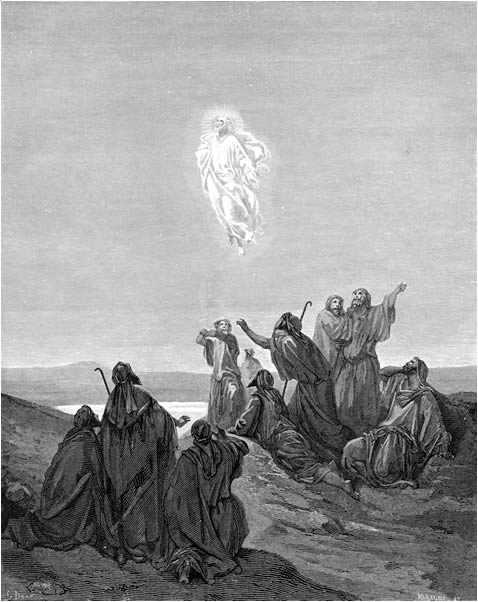
"Wherefore comfort one another with these words." If He is about to descend, on what account shall we be caught up? For the sake of honor. For when a king drives into a city, those who are in honor go out to meet him; but the condemned await the judge within. And upon the coming of an affectionate father, his children indeed, and those who are worthy to be his children, are taken out in a chariot, that they may see and kiss him; but those of the domestics who have offended remain within. We are carried upon the chariot of our Father. For He received Him up in the clouds, and "we shall be caught up in the clouds." (Acts i. 9) Seest thou how great is the honor? and as He descends, we go forth to meet Him, and, what is more blessed than all, so we shall be with Him. "Who shall speak of the mightinesses of the Lord, and make all His praises to be heard?" (Ps. cvi. 2, Sept) How many blessings has He vouchsafed to the human race! Those who are dead are raised first, and thus the meeting takes place together. Abel who died before all shall then meet Him together with those who are alive. So that they in this respect will have no advantage, but he who is corrupted, and has been so many years in the earth, shall meet Him with them, and so all the others. For if they awaited us, that we might be crowned, as elsewhere he says in an Epistle, "God having provided some better thing concerning us, that apart from us they should not be made perfect" (Heb. xi. 40), much more shall we also await them; or rather, they indeed awaited, but we not at all. For the Resurrection takes place "in a moment, in the twinkling of an eye."
The Medieval Church2 voices
So as not to grieve like the rest, who have no hope of the resurrection.
Then when he says, therefore comfort one another with these words, Paul concludes that they should comfort one another about the dead. He feels that since the saints will rise without suffering any loss, the Thessalonians should comfort one another about the dead. "Comfort, comfort …
The Puritans and the Awakening2 voices
We should endeavour to support one another in times of sorrow, not deaden one another's spirits, nor weaken one another's hands, but should comfort one another; and this may be done by serious consideration and discourse on the many good lessons to be learned from the doctrine of the resurrection of the dead, the second coming of Christ, and the glory of the saints in that day.
2 For ye know what commandments we gave you by the Lord Jesus. 3 For this is the will of God, even your sanctification, that ye should abstain from fornication: 4 That every one of you should know how to possess his vessel in sanctification and honour;
quarantine:scripture (2026-07-29) — verbatim-scripture
2 more voices on this verse
The Puritans and the Awakening1 voice
Wherefore comfort one another with these words.
The Nineteenth Century1 voice
A commentator
Albert Barnes1798–1870
Notes, Explanatory and Practical, on the Old and New Testaments (1832-1869)
proposed
Wherefore comfort one another - Margin, “exhort.” The word comfort probably best expresses the meaning. They were to bring these glorious truths and these bright prospects be fore their minds, in order to alleviate, the sorrows of bereavement. The topics of consolation are these: first, that those who had died in the faith would not always lie in the grave; second, that when they rose they would not occupy an inferior condition because they were cut off before the coming of the Lord; and third, that all Christians, living and dead, would be received to heaven and dwell forever with the Lord. With these words - That is, with these truths. Remarks On 1 Thessalonians 4 1. This passage 1Th 4:13-18 contains a truth which is to be found in no pagan classic writer, and nowhere else. except in the teachings of the New Testament. For the elevated and glorious view which it gives of future scenes pertaining to our world, and for all its inestimable consolations, we are wholly indebted to the Christian religion. Reason, unassisted by revelation, never dared to conjecture that such scenes would occur; if it had, it would have had no arguments on which the conjecture could be supported. 2. The death of the Christian is a calm and gentle slumber; 1Th 4:13. It is not annihilation; it is not the extinction of hope. It is like gentle repose when we lie down at night, and when we hope to awake again in the morning; it is like the quiet, sweet slumber of the infant. Why, then, should the Christian be afraid to die? Is he afraid to close his eyes in slumber? Why dread the night - the stillness of death? Is he afraid of the darkness, the silence, the chilliness of the midnight hour, when his senses are locked in repose? Why should death to him appear so terrible? “Is the slumbering of an infant an object of terror?” 3. There are magnificent scenes before us. […]
The words behind it
7 Greek wordsEvery Greek word of this verse in the order it stands, with what it means and the door to its own study. The last column counts the times a word stands in the whole Bible: the rarer the word, the more the places it appears belong together.
| Greek | Sound | Meaning | Word study | In the Bible |
|---|---|---|---|---|
| Ὥστε | hoste | Therefore | G5620 → | 83 times |
| παρακαλεῖτε | parakaleite | do encourage | G3870 → | 108 times |
| ἀλλήλους | allelous | one another | G240 → | 100 times |
| ἐν | en | with | G1722 → | 2738 times |
| τοῖς | tois | <the> | G3588 → | 19766 times |
| λόγοις | logois | words | G3056 → | 329 times |
| τούτοις.¶ | toutois | these. | G3778 → | 1381 times |
ὭστεTherefore
hosteG5620 →83 times
παρακαλεῖτεdo encourage
parakaleiteG3870 →108 times
ἀλλήλουςone another
allelousG240 →100 times
ἐνwith
enG1722 →2738 times
τοῖς<the>
toisG3588 →19766 times
λόγοιςwords
logoisG3056 →329 times
τούτοις.¶these.
toutoisG3778 →1381 times
A shaded row is a word that stands 400 times or fewer in the Bible.
The walk
8 stopsEach card is a verse this one points to, and under it the verses that one points to in turn. Where several paths arrive at the same place, that place is listed first: the text keeps returning to it.
Through
1 Thessalonians 5:11Therefore encourage and build one another up, just as you are already doing.
it leads to
- Ephesians 4:29
Let no unwholesome talk come out of your mouths, but only what is helpful for building up the one in need and bringing grace to those who listen.
- Romans 15:2
Each of us should please his neighbor for his good, to build him up.
- Hebrews 10:25
Let us not neglect meeting together, as some have made a habit, but let us encourage one another, and all the more as you see the Day approaching.
- Hebrews 3:13
But exhort one another daily, as long as it is called today, so that none of you may be hardened by sin’s deceitfulness.
- Romans 14:19
So then, let us pursue what leads to peace and to mutual edification.
- Ephesians 4:29
Through
1 Thessalonians 5:14And we urge you, brothers, to admonish the unruly, encourage the fainthearted, help the weak, and be patient with everyone.
it leads to
- 2 Timothy 4:2
Preach the word; be prepared in season and out of season; reprove, rebuke, and encourage with every form of patient instruction.
- Romans 14:1
Accept him whose faith is weak, without passing judgment on his opinions.
- Acts 20:35
In everything, I showed you that by this kind of hard work we must help the weak, remembering the words of the Lord Jesus Himself: ‘It is more blessed to give than to receive.’”
- 2 Timothy 4:2
Where this verse is studied
About 1 Thessalonians
This page draws on Adam Clarke, Commentary on the Bible; Albert Barnes, Notes, Explanatory and Practical, on the Old and New Testaments (1832-1869); John Chrysostom, Homily on 1 Thessalonians 8; John Gill, Exposition of the New Testament (1746-1748); John Wesley, Explanatory Notes upon the New Testament; Matthew Henry, Commentary on the Whole Bible; Theophylact of Ohrid, Commentary on 1 Thessalonians and Thomas Aquinas, Commentary on 1 Thessalonians.