
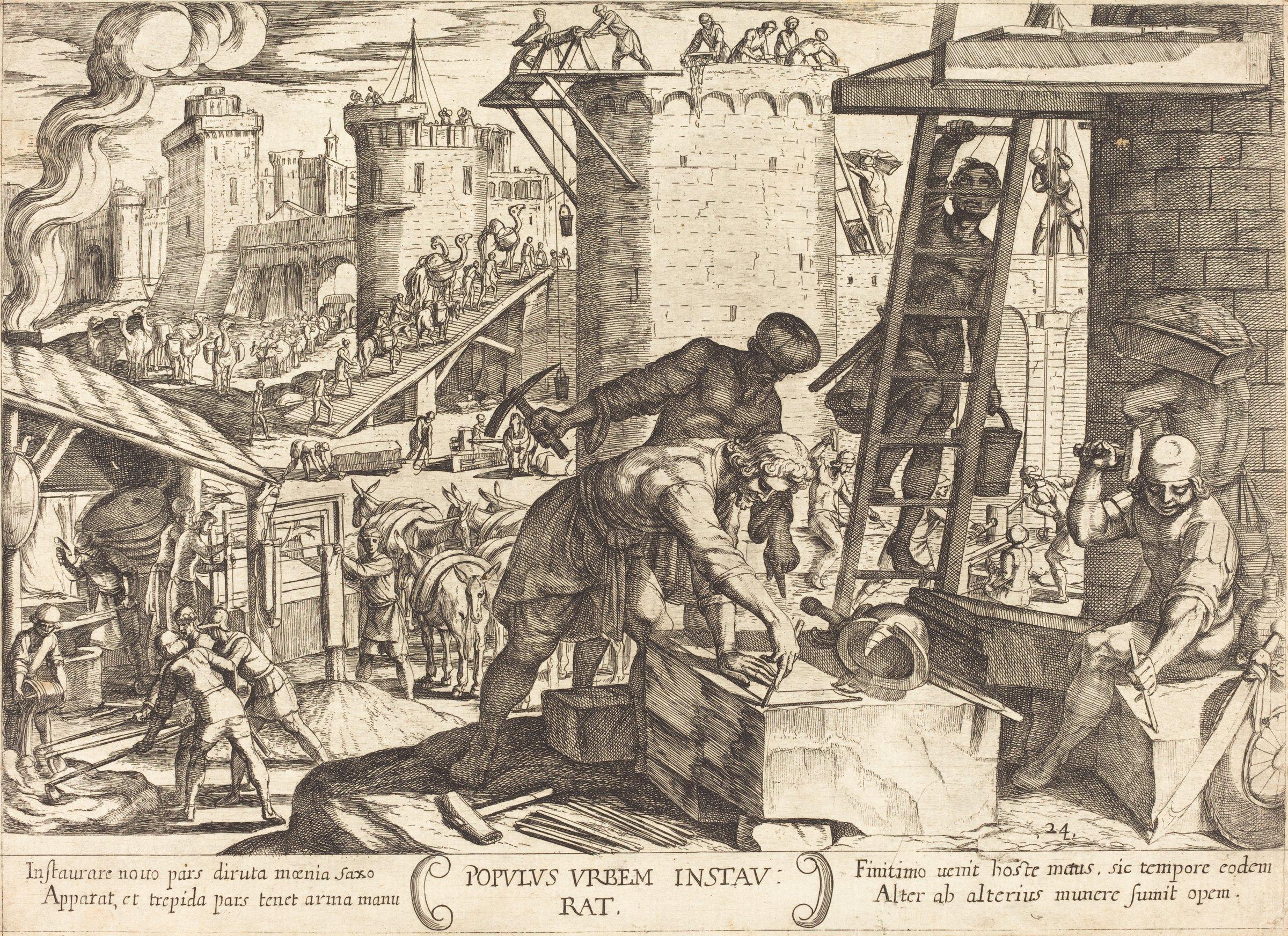
Antonio Tempesta, The Israelites Rebuilding the Walls of Jerusalem, 1613. CC0.
Nehemiah 2 to 13 · Group · Featured Study
Sanballat, Tobiah and Geshem
Three neighbouring leaders opposed Nehemiah's rebuilding of Jerusalem's wall, one from Samaria, one from Ammon and one of the Arabs.
But when Sanballat the Horonite, Tobiah the Ammonite official, and Geshem the Arab heard about this, they mocked us and ridiculed us, saying, “What is this you are doing? Are you rebelling against the king?”
Tobiah said that a fox climbing on the new wall would break it down.
Summary
Sanballat, Tobiah and Geshem mocked the builders and then plotted against Nehemiah. Two of them kept ties in the city after the wall was built.
- A Jewish letter from Egypt, dated 408 BC, names Sanballat as governor of Samaria.
- Tobiah was tied by marriage to two leading houses of Judah.
- Geshem is named only while the wall was rising.
- Readers differ on which town the title Horonite points to.
Three Men Named Together
The book names the three men together twice, at the first mockery and when the wall stood whole.
This study asks who the three men were and how they fought the work. It maps their allies, follows them through the book and sets out what sources outside the Bible add.
When Sanballat, Tobiah, Geshem the Arab, and the rest of our enemies heard that I had rebuilt the wall and not a gap was left—though to that time I had not yet installed the doors in the gates—The second naming of all three comes as the danger turns from an attack on the city to plots against Nehemiah himself.
The building itself, scene by scene, stands in the study of the wall.
Sanballat (Hebrew, H5571)
10 uses in the canon
Strong's dictionary calls him a Persian satrap of Samaria. The International Standard Bible Encyclopedia of 1915 reads the name as the Babylonian Sin-uballit.
Tobiah (Hebrew, H2900)
18 uses in the canon
Strong's dictionary gives the name to three Israelites and to one Samaritan.
Geshem (Hebrew, H1654)
4 uses in the canon
Strong's dictionary gives the name in two forms, Geshem and Gashmu, and calls him an Arabian.
Where the Allies Stood
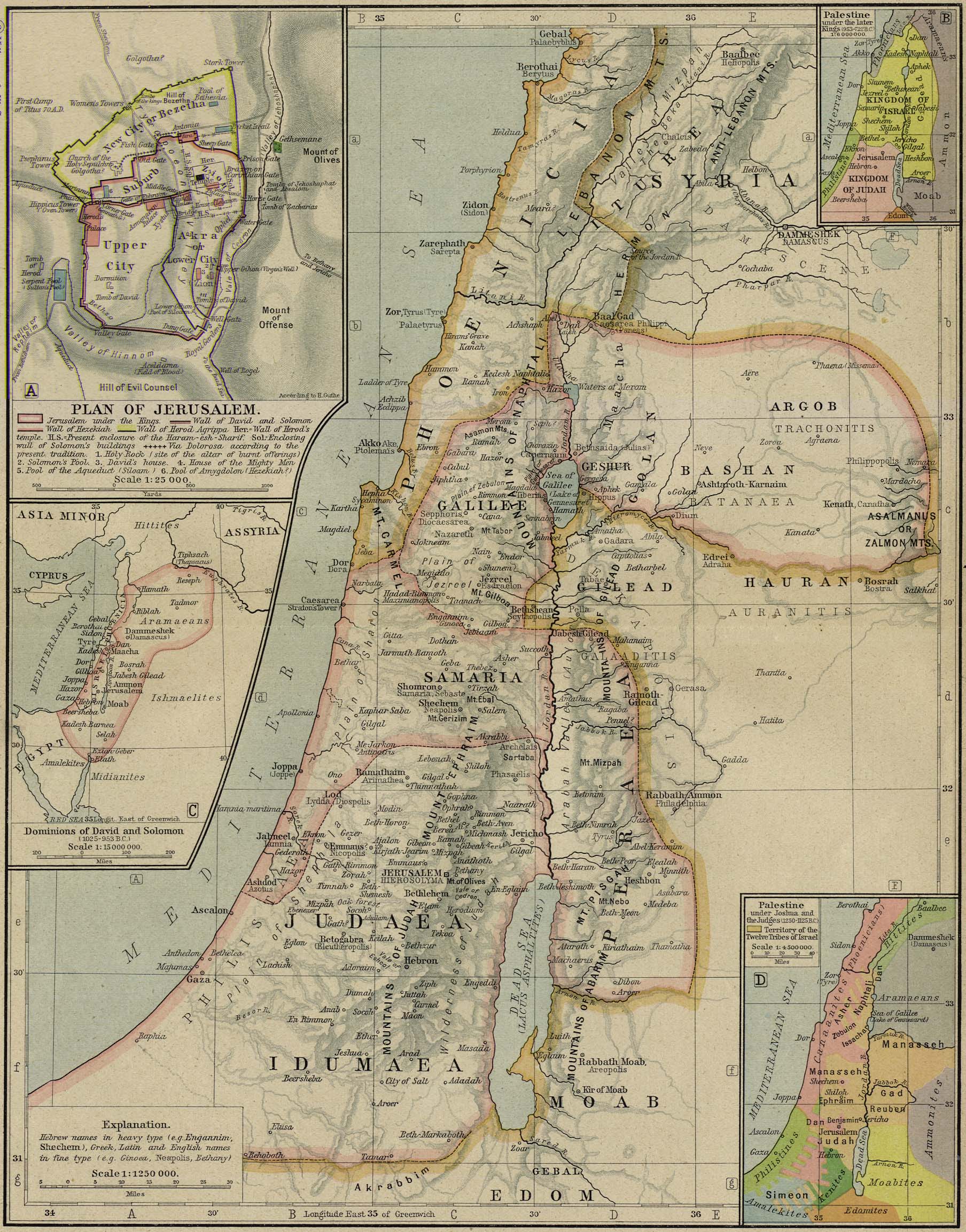
The map marks the places tied to the three men and the two towns proposed as the Horonite's home.
Samaria lay north of Jerusalem, Ammon east and Ashdod west, and Ono stood on the coastal plain.
- Located: the site is known
- Identified: the point stands for an area, or is rounded
- Proposed: one candidate among several
- 1Jerusalem, The city whose wall the three men opposed Nehemiah 2:17
- 2Samaria, Sanballat mocked the builders before the army of Samaria Nehemiah 4:2
- 3Rabbah of Ammon, Tobiah is called the Ammonite official Nehemiah 2:10
- 4Ashdod, The men of Ashdod joined the plot against Jerusalem Nehemiah 4:7
- 5Ono, Sanballat and Geshem asked Nehemiah to meet them on the plain of Ono Nehemiah 6:2
- 6Upper Beth-horon, One reading of the Horonite: a man of Beth-horon, on Ephraim's border Joshua 16:5
- 7?Horonaim, The other reading: a man of Horonaim in Moab Isaiah 15:5
Base map: Reference map of ancient Palestine, Rand McNally reference map (1926), public domain. Places with a place page stand at its coordinates and the others at the point cited for each, set on the plate by Jerusalem and Damascus, as the plate prints them.
Seven places, each with its verse. OpenBible scores Kafr Ana 758 of 1,000 for Ono and El Iraq 273 of 1,000 for Horonaim.
The Three Men in Nehemiah's Record
Ten moments in the order of the book show which of the three acted at each stage.
Sanballat stands in eight of the ten moments, Tobiah in seven and Geshem in three.
- Nehemiah's arrivalSanballat and Tobiah hear that Nehemiah has comeNehemiah 2:10
- The start of the workAll three mock the builders and ask whether they are rebelling against the kingNehemiah 2:19
- The wall risingSanballat scorns the builders, and Tobiah mocks the strength of the new wallNehemiah 4:3
- The gaps closingSanballat and Tobiah plot an attack with the Arabs, the Ammonites and the men of AshdodNehemiah 4:8
- The wall wholeSanballat and Geshem send the same invitation four timesNehemiah 6:4
- The fifth messageSanballat's open letter cites Geshem for the report that Nehemiah would be kingNehemiah 6:6 to 7
- Before the finishTobiah and Sanballat hire Shemaiah to frighten NehemiahNehemiah 6:12
- The same daysThe nobles of Judah trade letters with TobiahNehemiah 6:17
- Nehemiah at courtEliashib prepares a large storeroom of the temple for TobiahNehemiah 13:5
- Nehemiah's returnA son of Jehoiada son of Eliashib is found to be Sanballat's son-in-lawNehemiah 13:28
Each row names the men who act, with its verse.
Before the finish, The same days, Nehemiah at court, Nehemiah's return
The Three Outside the Bible
Letters from Egypt, a silver bowl and Josephus name men of these houses.
The Jews of Elephantine, on the Nile, wrote to Bigvai, governor of Judaea, for leave to rebuild their temple. Their petition says they had also written to Delaiah and Shelemiah, the sons of Sanballat.
A. E. Cowley, who edited the papyri, judged Bigvai to be a successor of Nehemiah. A memorandum in the same find is headed with the names of Bigvai and Delaiah.
Josephus, in Antiquities 11.7.2, tells of a Sanballat sent into Samaria by the last Darius, who gave his daughter Nicaso to Manasseh, the high priest's brother. In 11.8.4 Sanballat builds a temple on Mount Gerizim and makes Manasseh its priest. Cowley held that Josephus had confused Darius II with Darius III.
A silver bowl from Tell el-Maskhuta in Egypt, dated about 410 BC and now in the Brooklyn Museum, was offered by Kainu son of Geshem, and its inscription calls Kainu king of Kedar. An inscription from Dedan in Arabia names a Gashm son of Shahr.
What the Text Leaves Unsaid
Two gaps stand in the book's record of the three men.
Nehemiah names Geshem last in the open letter of Nehemiah 6:5 to 7 and records nothing more of him.
The only motive the book gives for the anger is the one it states at Nehemiah's arrival, that a man had come to seek the good of Israel.
Ties Inside the City
Nehemiah 6 and 13 show where Tobiah's allies stood inside the city.
For many in Judah were bound by oath to him, since he was a son-in-law of Shecaniah son of Arah, and his son Jehohanan had married the daughter of Meshullam son of Berechiah.The verse names the two houses that explain the nobles' letters to Tobiah.
Now before this, Eliashib the priest, a relative of Tobiah, had been put in charge of the storerooms of the house of our GodThis kinship explains the room Tobiah was later given in the temple courts.
Tobiah's allies inside the city kept his influence alive while Nehemiah was away.
And I was greatly displeased and threw all of Tobiah’s household goods out of the room.It stands here as Nehemiah's answer to the ties within the city.
The study of the covenant of Nehemiah 10 sets the marriages of Nehemiah 13 against the covenant's vow.
Voices on the Three
Two passages of Matthew Henry's commentary speak to the opposition at its start and at its end.
Matthew Henry (1662 to 1714)
Matthew Henry, on Nehemiah 4:1, says the enemies' scorn worked in the builders' favour.
“The strength and safety of the church are the grief and vexation of its enemies. They despised it, and made it the subject of their ridicule. In this they sufficiently displayed their malice; but good was brought out of it; for, looking upon it as a foolish undertaking that would sink under its own weight, they did not go about to obstruct it till it was too late.”
Matthew Henry · Commentary on the Whole Bible · on Nehemiah 4:1Puritan
On Nehemiah 13:28 Henry weighs the high priest's pride in his family's tie to Tobiah.
“Probably some other of his family had married Tobiah's, and (would you think it?) the high priest thought the alliance an honour to his family, and was very proud of it, though really it was his greatest disgrace, and what he had reason to be ashamed of.”
Matthew Henry · Commentary on the Whole Bible · on Nehemiah 13:28Puritan
Where Readers Differ on the Horonite
Readers give two readings of Sanballat's title, each with its holders and an objection.
A man of Beth-horonL. W. Batten (1913); the ISBE article Horonite (1915)
Batten, in the International Critical Commentary, says the word would naturally mean a man of Beth-horon, a town of Ephraim. He adds that the Elephantine papyri place Sanballat's rule at Samaria, so the town of Ephraim is meant.
The objection, which Batten reports from Winckler, is that Tobiah is named by his people, so that Sanballat's title should point to Horon in Moab.
A man of Horonaim in MoabJohn Gill; R. Dick Wilson in the ISBE (1915); Strong's dictionary
John Gill says Sanballat either ruled at Horonaim or came from there. R. Dick Wilson, writing on Sanballat in the ISBE, makes him a Moabite of Horonaim, and Strong's dictionary reads Horonite the same way.
The objection is the one Batten draws from the Elephantine letters in the first reading.
Books to Read Next
Four works on the three men and their world, each free to read.
Aramaic Papyri of the Fifth Century B.C.
A. E. Cowley · 1923
The Elephantine petition that names the sons of Sanballat, with Cowley's notes on its date.
Read it at the Internet ArchiveA Critical and Exegetical Commentary on the Books of Ezra and Nehemiah
L. W. Batten · 1913
Batten weighs the titles of the three men against the Elephantine letters.
Read it at the Internet ArchiveThe Books of Ezra, Nehemiah, and Esther
C. F. Keil · 1873
Keil's commentary, in Sophia Taylor's translation, reads the book of Nehemiah verse by verse.
Read it at the Internet ArchiveAntiquities of the Jews
Flavius Josephus, translated by William Whiston · 1737
Josephus gives his account of Sanballat in book 11 and of a later family of Tobias in book 12.
Read it at Project GutenbergNehemiah's First Answer
The study closes where the opposition began, with Nehemiah's first answer.
So I answered them and said, “The God of heaven is the One who will grant us success. We, His servants, will start rebuilding, but you have no portion, right, or claim in Jerusalem.”The builders rest their work on the God of heaven and deny their opponents any share in the city.
Sources
Scripture is the Berean Standard Bible.
- James Strong, Exhaustive Concordance of the Bible (1890), Hebrew dictionary, entries 5571, 2900, 1654 and 2772.
- A. E. Cowley, Aramaic Papyri of the Fifth Century B.C., Oxford, Clarendon Press, 1923, nos. 30 to 32.
- Flavius Josephus, Antiquities of the Jews 11.7.2 and 11.8.4, translated by William Whiston (1737)
- L. W. Batten, A Critical and Exegetical Commentary on the Books of Ezra and Nehemiah, International Critical Commentary, 1913.
- C. F. Keil, The Books of Ezra, Nehemiah, and Esther, translated by Sophia Taylor, Edinburgh, T. and T. Clark, 1873.
- R. Dick Wilson, Sanballat, International Standard Bible Encyclopedia, 1915.
- Horonite, International Standard Bible Encyclopedia, 1915.
- The Center for Online Judaic Studies, Tel el-Maskhuta Libation Bowl, late 5th century BCE.
- Encyclopedia of the Bible (Zondervan), Geshem.
- OpenBible.info, Bible Geocoding Data, ancient.jsonl.
- John Gill, Exposition of the Old Testament (1748 to 1763), on Nehemiah 2:10.
- Matthew Henry, Commentary on the Whole Bible (1710), on Nehemiah 4:1.
- Matthew Henry, Commentary on the Whole Bible (1710), on Nehemiah 13:28.
Keep Studying
Read it4
Studies2
Go further2
People and groups3
Subjects1