
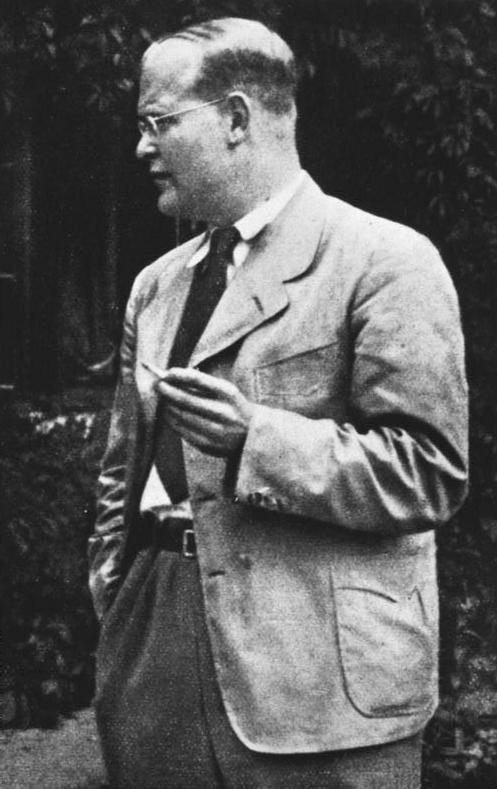
Dietrich Bonhoeffer, 1939. CC BY-SA 3.0.
Breslau to Flossenbürg, 1906 to 1945 · Person · Featured Study
Dietrich Bonhoeffer
A Lutheran pastor and teacher in Berlin, he trained ministers in secret and was hanged by the SS in April 1945.
A pastor invited to lecture in New York in 1939 cut his stay short and went home to Hitler's Germany.
Then Jesus told His disciples, “If anyone wants to come after Me, he must deny himself and take up his cross and follow Me.
Then Jesus told His disciples, “If anyone wants to come after Me, he must deny himself and take up his cross and follow Me.
- Born
- 4 February 1906 at Breslau
- Died
- 9 April 1945 at Flossenbürg
- Family
- father: Karl Bonhoeffer; mother: Paula Bonhoeffer; twin sister: Sabine; fiancée: Maria von Wedemeyer
- Places
- Breslau, Berlin, Barcelona, New York, London, Finkenwalde, Flossenbürg
Summary
Dietrich Bonhoeffer was born at Breslau in 1906 and took his doctorate in Berlin at twenty-one. He served congregations in Barcelona and London and studied a year in New York. From 1935 he trained young pastors for the Confessing Church. He was arrested in 1943 and hanged at Flossenbürg.
- In New York he worshipped in Harlem at Abyssinian Baptist Church.
- His essay of April 1933 called the church to resist an unjust state. It also repeated old anti-Jewish teaching.
- Historians differ on how large a part he took in the plot against Hitler.
Come and Die
Jesus' call to take up the cross lies behind his book's line on the cost of following.
His book of 1937 on following Christ came into English in 1948 as The Cost of Discipleship. One line of it says that when Christ calls a man, he bids him come and die.
The question of this life is how a pastor who wrote that line came to die in a camp yard. It is also how far he went in the plot against Hitler.
But He was pierced for our transgressions, He was crushed for our iniquities; the punishment that brought us peace was upon Him, and by His stripes we are healed.On 8 April 1945 he expounded this verse, the text of the day, to his fellow prisoners.
The Life in Order
The dates come from Bethge's life, the museum's encyclopedia and the camp memorial.
Two years in prison ended on a gallows at thirty-nine.
- 4 February 1906He and his twin sister Sabine were born at BreslauBethge; the museum
- 1 August 1927The faculty in Berlin accepted his doctoral thesisBethge
- 1928 to 1930He went to Barcelona as a pastorThe museum
- 1930 to 1931He studied at Union Theological Seminary in New YorkThe museum
- 1 February 1933His radio address was cut off the airThe memorial
- April 1933He finished his essay on the church and the Jewish questionThe museum; WiBiLex
- September 1933 to April 1935He served German congregations in LondonThe museum
- September 1937The police shut the house at FinkenwaldeThe museum
- July 1939He cut short a stay in America and came homeThe memorial; the era brief
- October 1940Dohnanyi found him a post in military intelligenceThe museum
- 17 January 1943He became engaged to Maria von WedemeyerBethge
- 5 April 1943The Gestapo arrested himThe memorial
- February 1945He was taken to BuchenwaldThe memorial; the museum
- 9 April 1945The SS hanged him at FlossenbürgThe memorial
- 1996The Nazi verdicts against him were overturnedThe memorial
Each step of the life stands with its witness.
September 1933 to April 1935, September 1937, July 1939, October 1940, 17 January 1943, 5 April 1943, February 1945, 9 April 1945 and 1 more
From Breslau to Flossenbürg
A scholar's career became a pastor's work under a hostile state, and then a prisoner's.
Dietrich Bonhoeffer was a German Lutheran pastor, theologian, ecumenist, and resistance member, executed by the SS at the Flossenbürg concentration camp on 9 April 1945. Born in Breslau, the sixth of eight children of the psychiatrist Karl Bonhoeffer and his wife Paula, he completed his doctoral dissertation, Sanctorum Communio, at age 21 under Reinhold Seeberg in Berlin.
He pastored German-speaking congregations in Barcelona and London, lectured at the university in Berlin, and directed the underground Confessing Church seminary at Finkenwalde. In Berlin he also took a confirmation class in the working district of Wedding.
On 1 February 1933, days after Hitler took power, he spoke on the radio about leaders who make idols of themselves, and the broadcast was cut off. That autumn he went to London, and he led his congregations there to join the church that opposed the Nazi takeover of German Protestantism.
He came home in 1935 to train pastors at Zingst and then Finkenwalde, until the Gestapo closed the seminary in September 1937. He spent the next two years travelling in secret to his students in their small parishes. The Gestapo banned him from Berlin in January 1938.
From 1940 he served in German military intelligence, the Abwehr, where the military resistance had its center. In October 1941 he and the lawyer Friedrich Perels wrote a report on the first deportations of Berlin's Jews for trusted officers.
Arrested April 1943, he wrote his final theological letters from Tegel prison. The first charges were helping Jews escape, using his journeys for other ends, and keeping pastors out of the army. After the failed plot of 20 July 1944, his ties to the wider resistance came to light.
The next February he was moved to Buchenwald, and in April to Flossenbürg. A summary court of the SS condemned him with six others, and he was hanged in the courtyard of the cell block. His family learned of his death four months later.
He left his Ethics unfinished, and Bethge gathered it and the prison letters for print after his death.
A Year in New York
A fellow student took him to a Black church in Harlem nearly every Sunday.
He studied at Union Theological Seminary in 1930 and 1931. A fellow student, Albert F. Fisher, known as Frank, took him into Harlem, near the seminary.
Bethge writes that nearly every Sunday he went with Fisher to Abyssinian Baptist Church. The museum's encyclopedia says he became deeply interested there in the question of racial injustice.
The year also gave him friends in the churches abroad. After Hitler took power, those ties served the church struggle at home and, later, the resistance.
In Their Own Words
Four short sayings from his books and letters, each in the English of its source.
Dietrich Bonhoeffer (1906 to 1945)
The Cost of Discipleship
Come and die
“When Christ calls a man, He bids him come and die.”
Confessing Church
About this saying1 paragraph
The line stands in The Cost of Discipleship, in R. H. Fuller's English of 1948.
Dietrich Bonhoeffer
Letter to Niebuhr, in Christian History (1991)
A mistake to come
“I have come to the conclusion that I have made a mistake in coming to America. I must live through this difficult period of our national history with the Christian people of Germany.”
Confessing Church
About this saying1 paragraph
He wrote this to Reinhold Niebuhr in the summer of 1939, as Christian History printed it in 1991.
Dietrich Bonhoeffer
Life Together (1939), translated by John W. Doberstein
A real blessing
“the daily Bible passages published by the Moravian Brethren, for example, are a real blessing to all who have ever used them”
Confessing Church
About this saying1 paragraph
In Life Together, published in 1939, he commended the daily texts of the Moravian Brethren.
Dietrich Bonhoeffer
Letter from Tegel, 21 July 1944, in Eberhard Bethge, Dietrich Bonhoeffer: Theologian, Christian, Contemporary
The day's Losungen
“At those times I simply take pleasure in the day's Losungen”
Confessing Church
About this saying1 paragraph
He wrote this from Tegel on 21 July 1944, the day after the plot against Hitler failed.
The People Around Him
His family, his teachers, his friends and the men who shared his end.
His brother and two brothers-in-law died for the same resistance.
| Person | Tie to Bonhoeffer | The witness |
|---|---|---|
| Karl Bonhoeffer | His father was a prominent psychiatrist. | The memorial |
| Paula Bonhoeffer | His mother had spent months at Herrnhut as a young woman. | Bethge |
| Sabine | The seventh child, she shared his birthday. | Bethge |
| Reinhold Seeberg | He supervised the doctoral thesis. | Bethge |
| Frank Fisher | An African American at Union, he was one of his three friends there. | Bethge |
| Hans von Dohnanyi | His brother-in-law told him of the resistance plans, found him a post in intelligence, and was executed. | The museum |
| Eberhard Bethge | His friend became the editor of his works and his biographer. | Widerstand und Ergebung; Bethge |
| Maria von Wedemeyer | His fiancée received his last letter of December 1944. | Bethge; the memorial |
| Klaus Bonhoeffer | His brother was also executed for the resistance. | The museum |
| Payne Best | A British officer held with him, he wrote down his last message. | Bethge |
Eberhard Bethge, Maria von Wedemeyer, Klaus Bonhoeffer, Payne Best
The Places of His Life
He worked in Germany, Spain, the United States and Britain.
He was jailed in Berlin for two years before the camps.
| Place | What the witnesses say | The witness |
|---|---|---|
| Breslau | The museum and Bethge give it as his birthplace. | Bethge; the museum |
| Berlin | He studied, lectured and took a confirmation class in Wedding. | Bethge; the memorial |
| Barcelona | He served a German-speaking congregation from 1928. | The museum |
| New York | He studied at Union and worshipped in Harlem. | The museum; Bethge |
| London | He served German congregations from 1933 to 1935. | The museum |
| Finkenwalde | His seminary for young pastors met there. | The museum |
| Tegel | Its jail held him from April 1943 until after the plot of 1944. | The memorial; the museum |
| Flossenbürg | The SS camp in Bavaria where he died. | The memorial |
Tegel, Flossenbürg
A Spoke in the Wheel
His essay set out what the church owes when the state does wrong.
He finished the essay by 15 April. The museum's encyclopedia gives its three stages. The church must first question the state's injustice, and then help every victim of it, Christian or not.
Last, the church might be called to put a spoke in the wheel itself, to halt the machine. Wolfgang Huber shows that the image was a common idiom of the time.
The same essay repeats the old Christian teaching against the Jews. It looks for the Jewish question to end in their conversion, and the museum notes that he never plainly gave up that view.
How the Key Verse Was Taught
Jerome, John Wesley and J. C. Ryle read the call to take up the cross.
Jerome (died 420)
Letter 121, Chapter 3
Jerome asked in a letter what it means to deny oneself.
“Whose sense what is written in the Gospel of Matthew: If anyone wants to come after me, let him deny himself (Matth. 16. 24). What is self-denial? or how does one who follows the Savior deny himself? On this matter I have spoken briefly in the third book of his commentary on Matthew: He who lays down the old man with his works denies himself, saying: And yet I live, but not me, but Christ lives in me (Galatians 2:20) and takes up his cross and is crucified to the world.”
on Matthew 16:24Patristic
John Wesley (1703 to 1791)
Explanatory Notes upon the New Testament
John Wesley read every cross as a way of taking God's will.
“Should we not consider all crosses, all things grievous to flesh and blood, as what they really are, as opportunities of embracing God's will at the expense of our own? And consequently as so many steps by which we may advance toward perfection? We should make a swift progress in the spiritual life, if we were faithful in this practice.”
on Matthew 16:24Evangelical
J.C. Ryle (1816 to 1900)
Expository Thoughts on the Gospels: Matthew
J. C. Ryle set the verse against the disciples' hope of an earthly kingdom.
“In order to see the connection of these verses we must remember the mistaken impressions of our Lord’s disciples as to the purpose of his coming into the world. Like Peter they could not bear the idea of the crucifixion. They thought that Jesus had come to set up an earthly kingdom; they did not see that he must needs suffer and die. They dreamed of worldly honors and temporal rewards in their Master’s service; they did not understand that true Christians, like Christ, must be made ‘perfect through suffering.’”
on Matthew 16:24 to 28Reformed Evangelical
What the Witnesses Leave Open
Readers differ on his part in the conspiracy and on the account of his death.
How far he went in the conspiracyEberhard Bethge; Sabine Dramm; Victoria Barnett; Charles Marsh
Bethge reports him saying he was ready to kill Hitler if the deed fell to him, and Bethge calls it a theoretical statement. Sabine Dramm finds a modest record of actual missions and results.
Victoria Barnett reports Dramm's view that Bethge himself shaped the place Bonhoeffer holds in the story of the resistance. Charles Marsh holds that by 1940 he had joined the conspiracy, moved by Dohnanyi's record of Nazi crimes.
The doctor's account of his deathH. Fischer-Hüllstrung; Vito Mancuso
In 1955 the camp doctor, H. Fischer-Hüllstrung, described him praying before the execution and dying within seconds. Vito Mancuso calls the account a lie, citing a survivor's testimony.
Books to Read Next
Dietrich Bonhoeffer: A Biography
Eberhard Bethge · 2000
His friend's life of him, revised in 2000, gives most of the dates of his life.
In print: find it wherever books are sold.
The Cost of Discipleship
Dietrich Bonhoeffer · 1948
This is his book on the call of Christ, in R. H. Fuller's English.
In print: find it wherever books are sold.
Life Together
Dietrich Bonhoeffer · 1954
This is his book on Christian community, written after the Finkenwalde house closed, in John Doberstein's English.
In print: find it wherever books are sold.
What Bonhoeffer Left
The Flossenbürg memorial calls him a symbol of Christian resistance since the 1960s, and congregations, schools and streets bear his name.
Sources
Scripture is the Berean Standard Bible.
- The Holy Bible, Berean Standard Bible (read 2026)
- United States Holocaust Memorial Museum, Holocaust Encyclopedia, "Dietrich Bonhoeffer".
- KZ-Gedenkstätte Flossenbürg, "Dietrich Bonhoeffer", the memorial's page on the prisoner.
- Eberhard Bethge, Dietrich Bonhoeffer: A Biography, revised edition (Minneapolis: Fortress, 2000)
- Dietrich Bonhoeffer, Widerstand und Ergebung, edited by Eberhard Bethge, twelfth edition (Gütersloh: Gerd Mohn, 1983)
- Dietrich Bonhoeffer, The Cost of Discipleship, translated by R. H. Fuller (London: SCM, 1948)
- Jerome, Letter 121, chapter 3.
- John Wesley, Explanatory Notes upon the New Testament (1755), on Matthew 16:24.
- J. C. Ryle, Expository Thoughts on the Gospels: Matthew (1856), on Matthew 16:24.
Keep Studying
People and groups7