
Skip to content
mannafest.faith

What we believe · 10 of 10

Angels & the Unseen Realm

What else is out there?

The Bible assumes, everywhere and without embarrassment, that the world you can see is not the whole world. There is a court in heaven, messengers who carry decisions out of it, an accuser, and an enemy who is real and defeated at the same time.

Two errors sit on either side of this subject, and C. S. Lewis named them better than anyone: we can disbelieve in the unseen entirely, or we can develop an unhealthy fascination with it. Both suit the enemy fine.

So the aim of this page is sobriety. Scripture tells us enough to stand, to pray, and to refuse fear. It does not tell us enough to build a system, and where it stops, we stop.

Theologians have a name for this subject: angelology. You don’t need the word — but now you’ll know it when you see it.

The shape of it

The court of Psalm 82

The Bible's picture of the unseen is not a mist. It is a court: God presiding, creatures serving, nations allotted, and rebels who are on trial and already sentenced.

THE NATIONS, ALLOTTED — DEUT 32:8THE SONS OF GOD — JOB 1:6THE LORDPSALM 82:1THOSE WHO REBELLED — SENTENCED, PSALM 82:6-7
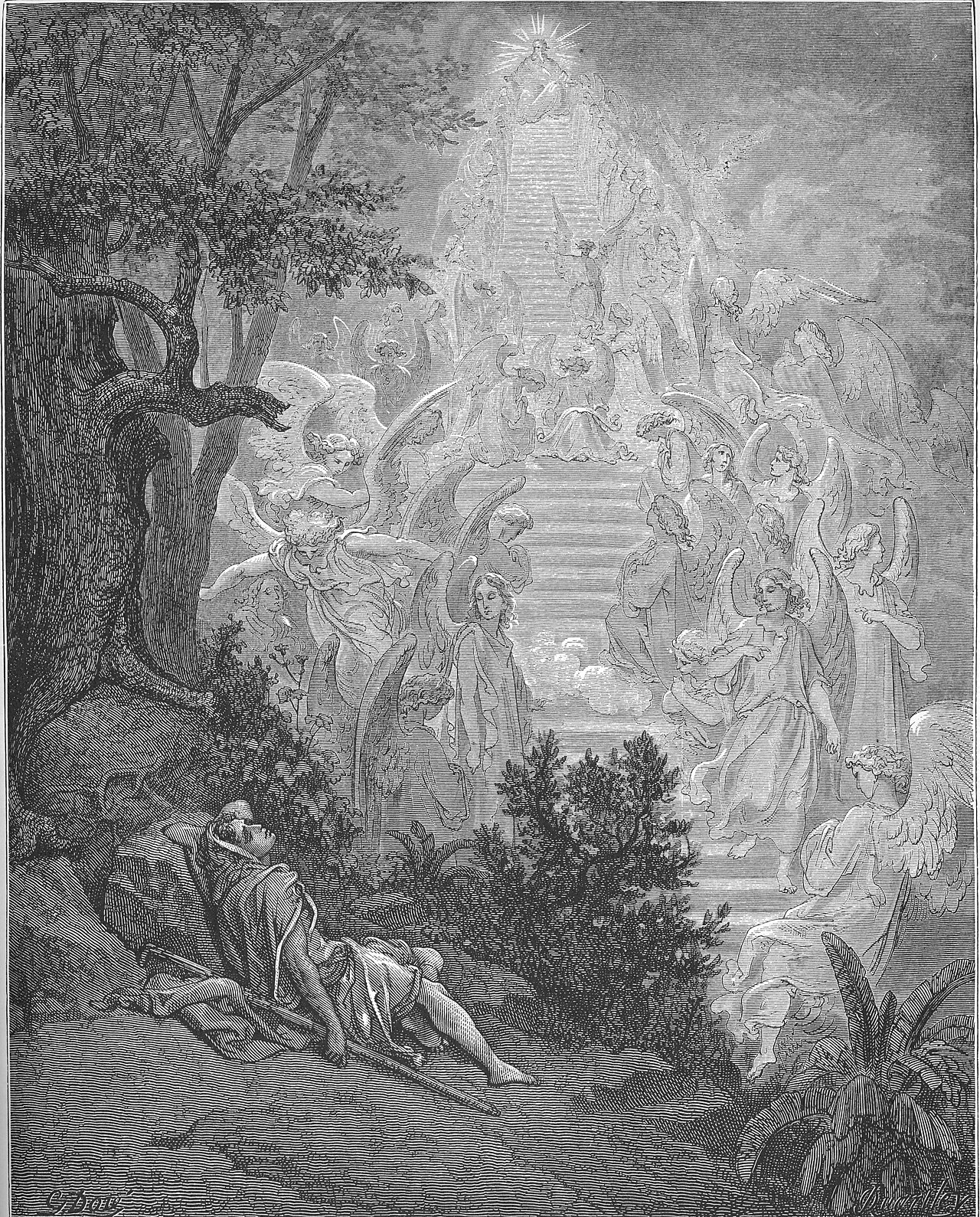
Jacob asleep at the foot of a stair of light filled with ascending and descending angels, engraving by Gustave Doré.

Notable art

Jacob's Dream

Genesis 28:12 · a ladder set up on the earth, and the angels of God ascending and descending.

Gustave Doré, 1866. Public domain.

7 statements, each with its passages

What we hold

  1. 01What we hold

    God created a realm of spirits, and it is not eternal beside him

    Angels are creatures. They had a beginning, they serve at God's pleasure, and they are not divine. That single fact rules out most of what popular imagination does with them.

    Their ordinary work in Scripture is not decorative. They carry messages, execute judgments, strengthen the exhausted, and, the line the New Testament actually uses, are sent to serve those who will inherit salvation.

  2. 02What we hold

    Scripture names ranks and kinds, and does not systematize them

    Cherubim guard: they are stationed at Eden's gate and worked in gold over the mercy seat. Seraphim (the word means 'burning ones') appear by name in one scene, Isaiah's temple vision, crying holy, holy, holy. An archangel is named. So is a prince who withstands another prince.

    Both of those plural words are Hebrew plurals your Bible left untranslated: the -im ending is Hebrew's -s. Note also what Scripture does NOT give: no ninefold hierarchy, no chain of command. That framework comes from a sixth-century writer, not from the text.

  3. 03What we hold

    There is a divine council, and God presides over it alone

    Psalm 82 opens with God standing in the divine assembly and judging among the 'gods', and ends with them sentenced to die like men. Deuteronomy 32:8-9 describes the nations divided according to a number, and the reading of that verse is itself a manuscript question: the Dead Sea Scrolls and the Greek Old Testament read 'sons of God' where the later Hebrew reads 'sons of Israel'.

    None of this makes MannaFest polytheist, and the psalm itself is the reason: whatever these beings are, they are creatures on trial before the God who made them.

  4. 04What we hold

    The Nephilim are in the text, and the text does not explain them away

    Genesis calls them Nephilim, and their offspring gibborim: 'mighty men, which were of old, men of renown'. The same word surfaces again in the spies' report from Canaan, where the sons of Anak are described as coming of the Nephilim, and again in the giant clans Israel meets: the Rephaim, the Anakim, Og of Bashan with his enormous bedstead.

    None of that is a fringe reading. It is the plain surface of the passages, and it is why Genesis 6 has never been treated as an ordinary genealogy note. What the passages do not give is a biology lesson, so this site reports what is written and stops where the text stops.

  5. 05What we hold

    Demons are real, and Scripture says less about where they came from than we would like

    The Gospels treat them as a matter of fact. They speak, they know who Jesus is, they beg, they are named (Legion, for we are many), and they are put out with a word. Whatever else is unclear, the New Testament does not present them as a way of talking about mental illness; it distinguishes the two in the same sentence.

    Where they came from, the Bible never states outright. Two readings have run side by side since the second century. The older Jewish and early-Christian one takes them for the disembodied spirits of the Nephilim dead, which is why the New Testament pictures an unclean spirit as restless without a body and looking for one. The commoner modern one takes them for angels who fell with Satan. MannaFest reports both and builds nothing on either, because the text does not.

    What the text does give is the part that matters at the door: they are creatures, they are outranked, and they came out at a word from Jesus and at a word from men he had sent.

  6. 06What we hold

    Satan is real, created, defeated: and not God's opposite

    The most persistent popular error here is symmetry: a good God and an evil equal, locked in a contest whose outcome is open. Scripture never presents that. The accuser is a creature, his access is bounded, and the cross has already disarmed him.

    He is called the accuser, the tempter, a liar from the beginning, and one who disguises himself as an angel of light, which is the warning worth keeping: the danger is rarely obvious.

  7. 07What we hold

    The believer is armed, and the armor is not a technique

    Ephesians 6 is the New Testament's fullest treatment, and what is striking is how ordinary the equipment is: truth, righteousness, the gospel, faith, salvation, the word, prayer. There is no formula, no secret name, no method.

    The instruction given three times in the passage is simply to stand. The victory is already won; the believer's task is to hold ground in it.

Quoted, with the work named

How the church has said it

The second-century church stating the Watchers reading as the plain sense of Genesis 6.

The angels transgressed this appointment, and were captivated by love of women, and begat children who are those that are called demons.

Justin Martyr· Second Apology 5 (Ante-Nicene Fathers, vol. 1)Patristic

Read the work →

A first-century Jewish historian reporting the reading as simply what everyone understood.

For many angels of God accompanied with women, and begat sons that proved unjust, and despisers of all that was good, on account of the confidence they had in their own strength.

Flavius Josephus· Antiquities of the Jews I.73 (Whiston translation)Jewish

Read the work →

The Sethite reading at its source: the case MannaFest disagrees with, in its strongest voice.

By these two names — the sons of God and the daughters of men — the two cities are sufficiently distinguished. For though the former were by nature children of men, they had come into possession of another name by grace.

Augustine of Hippo· The City of God XV.23 (Dods translation)Patristic

Read the work →

Calvin carrying Augustine's reading into the Reformed tradition, where it stayed.

It was, therefore, base ingratitude in the posterity of Seth to mingle themselves with the children of Cain… they voluntarily deprived themselves of the inestimable grace of God.

John Calvin· Commentaries on the First Book of Moses, on Genesis 6:2Reformed

Read the work →

The house answer in gold, every alternative at full strength

Where Christians divide

  • The claimthis site's tradition
  • The objectionanother reading, at full strength
  • The answerwhat that reading costs
  • Scripturequoted plain, never slanted toward any side

Who are the 'sons of God' in Genesis 6?

The claim · this site's tradition

This site's tradition holds the Watchers reading: the sons of God in Genesis 6 are angelic beings, and the transgression described there is exactly as strange as it sounds.

The phrase itself points that way. 'Sons of God' (bene ha-elohim) elsewhere in the Hebrew Bible denotes heavenly beings (in Job it is the company that presents itself before the LORD), and Genesis 6 sets them in deliberate contrast with 'the daughters of men'.

The New Testament reads it this way twice. Both 2 Peter and Jude speak of angels who sinned and did not keep their proper domain, and Jude places that failure in the same breath as Sodom's sexual transgression, which is an odd association unless the Genesis 6 sin was of that kind.

The Second Temple world read it this way as a matter of course. 1 Enoch tells the story at length, the Greek Old Testament rendered the phrase 'angels' in some manuscripts, and Josephus reports it as the common understanding. That is not proof, but it tells you what the first readers of Jude and 2 Peter had in their ears.

MannaFest carries 1 Enoch as a labeled study resource on its own shelf, never among the 66: a witness to how the passage was read, not Scripture.

Where others land: 2 positions, each with what it costs

  1. THE OBJECTION01The Sethite viewThe 'sons of God' are the godly line of Seth, and the 'daughters of men' the ungodly line of Cain. The sin is intermarriage across the covenant line, and the judgment falls because the distinction that carried the promise was erased.Its case, in fullThe immediate context supports it. Genesis 4 and 5 have just traced exactly two lines (Cain's and Seth's), and Genesis 4:26 marks the moment men began to call on the name of the LORD. Chapter 6 reads naturally as those two lines merging.Jesus says that in the resurrection people neither marry nor are given in marriage but are like the angels in heaven, which many take to rule out angelic marriage altogether.It requires no appeal to non-canonical literature, and it keeps the flood's cause squarely on human sin, which is what Genesis 6:5 goes on to describe.It has a long and serious pedigree. This is not a modern rationalization; it is the reading of Augustine and Calvin.Augustine, City of God XV; John Calvin; Matthew Henry; and much of the Reformed tradition since: for centuries the majority Christian reading

    THE ANSWER

    The honest difficulty. 'Sons of God' is not used of the Sethite line anywhere else, and the contrast in the text is with 'daughters of MEN', not 'daughters of Cain'. And the Matthew 22 saying is about angels in heaven, which is precisely not the case of angels who left their proper domain.

  2. THE OBJECTION02The dynastic-rulers viewThe 'sons of God' are human rulers and despots who claimed divine descent, and the sin is tyrannical polygamy: powerful men taking whatever women they wanted, which is why the judgment follows.Its case, in fullIt fits the ancient Near Eastern setting, where royal titles of divine sonship are well attested.It reads 'took wives of all whom they chose' as the language of tyranny, which the Hebrew will bear.It explains the Nephilim as a dynasty of warrior-kings (the 'mighty men of renown') without appeal to hybrid offspring.Meredith Kline and others; drawing on ancient Near Eastern royal ideology, where kings were styled sons of the gods

    THE ANSWER

    The honest difficulty. It has little support in how the phrase is used elsewhere in Scripture, and it does not obviously account for the way 2 Peter and Jude speak of angels who sinned.

How far does spiritual warfare actually go?

The claim · this site's tradition

MannaFest takes the unseen seriously and takes the text's limits just as seriously. There is real conflict, and there is real warrant for prayer against it, and much popular warfare teaching runs far past anything Scripture says.

The warrant is genuine. Daniel is told that a messenger was withstood twenty-one days by 'the prince of the kingdom of Persia', and that another prince would come: language that implies a structured opposition tied to nations.

Paul names the conflict as being against principalities and powers rather than flesh and blood, and gives an armor for it.

But notice what neither passage supplies: no method, no naming ritual, no map of territories. Daniel's part in that episode was prayer and fasting; he was not given a technique, and he did not command anything.

So the house line is this. Pray boldly, resist the devil, and refuse fear, and be suspicious of any teaching that makes your safety depend on knowing a name, a rank, or a procedure. That is the shape of superstition, not of faith.

Where others land: 2 positions, each with what it costs

  1. THE OBJECTION01Strategic-level warfareTerritorial spirits hold cities and regions, and they can be identified by research and displaced by targeted corporate prayer, opening the way for evangelism.Its case, in fullIt takes Daniel 10 seriously as describing something structural rather than merely personal.It reads the Deuteronomy 32 division of the nations as an ongoing arrangement, not merely an ancient one.Its practitioners point to real accounts of breakthrough following concerted prayer.C. Peter Wagner and the spiritual-mapping movement of the 1990s; widely taught in charismatic mission circles

    THE ANSWER

    The honest difficulty. The New Testament never instructs the church to identify or address territorial spirits: the apostles preached and prayed and cast out demons from people, not from cities. The claimed results are hard to assess, and the practice has produced fear and spectacle where it has been pressed hardest.

  2. THE OBJECTION02The cautious-Reformed readingThe decisive battle was fought and won at the cross; the believer's warfare is the ordinary means of grace (Word, prayer, sacrament, obedience), and preoccupation with the demonic is itself a spiritual danger.Its case, in fullColossians 2:15 says the powers were disarmed and made a public spectacle. That is stated as accomplished, not pending.Ephesians 6 arms the believer with truth, righteousness, faith and the word (the ordinary things) and tells him to stand rather than to advance.Historically, intense demonological focus has repeatedly produced abuse, fear, and the blaming of the devil for what Scripture calls the flesh.Much of the Reformed tradition; and, on the demonological side, writers who emphasize the sufficiency of Christ's victory over any ongoing engagement

    THE ANSWER

    The honest difficulty. It can flatten passages that plainly describe ongoing conflict, and a church that never expects opposition is poorly prepared when it meets it.

Can a Christian be demonized?

The claim · this site's tradition

This site's tradition holds that a believer cannot be owned or indwelt by a demon (the Spirit indwells him) but that a believer can be genuinely oppressed, harassed, and given ground through unrepented sin. This is a disagreement among people who agree on everything else here, and it is treated as one.

The Greek word usually behind 'possessed' is daimonizomai, which means simply 'to be demonized': it does not carry the ownership implication the English word acquired. Much of the heat in this debate comes from a translation choice.

The pastoral instinct that matters more than the taxonomy: deal with sin, forgive, renounce what needs renouncing, and pray. That counsel is the same whichever label is used.

Where others land: 2 positions, each with what it costs

  1. THE OBJECTION01A believer cannot be demonized in any senseThe indwelling Spirit and an indwelling demon cannot occupy the same person, and treating a Christian's struggle as demonic misdirects the cure away from repentance and renewal of the mind.Its case, in full1 John 5:18 says the wicked one does not touch the one born of God.The New Testament letters address sin in believers with instruction and repentance, never with deliverance.The practical danger is real: a person taught to see a demon behind every struggle stops taking responsibility for the flesh.Many Reformed pastors and counselors

    THE ANSWER

    The honest difficulty. It has to account for the plain experience of pastors across traditions and centuries, and for the fact that Scripture nowhere says a believer is immune to demonic harassment.

  2. THE OBJECTION02A believer can be demonized in the full sense of the wordA Christian is sealed and owned by the Spirit and cannot be lost, and can still carry a demonic presence in the unredeemed parts of his life, given ground by trauma, occult involvement, or unrepented sin. The remedy is repentance, renunciation, and command, and it is ordinary pastoral work rather than spectacle.Its case, in fullThe New Testament never says a believer cannot be demonized. The claim is an inference from indwelling, and the same letters say a believer can give the devil a foothold and can be taken captive at his will.Paul warns the Corinthians (believers, gifted ones) that they can partake of the table of demons, which is not the language of immunity.The word itself carries no ownership. Daimonizomai describes affliction, and the Gospels use it of degrees, from a boy thrown into fire to a woman bent for eighteen years whom Jesus calls a daughter of Abraham bound by Satan.The experience is not confined to one tradition. Missionaries, counselors, and pastors across the theological map report the same thing and, having reported it, are usually asked to stop.Merrill Unger, Demons in the World Today (who changed his mind on this in print); Neil T. Anderson, The Bondage Breaker; Charles Kraft, Defeating Dark Angels; and much of the deliverance ministry of the last fifty years

    THE ANSWER

    The honest difficulty. It can put the emphasis on diagnosis rather than repentance, and it has produced real harm where believers were told their besetting sin was a demon to be expelled rather than a habit to be put to death. The line between ground given and person owned is easy to state and hard to police.

Does each person have a guardian angel?

The claim · this site's tradition

This site's tradition holds this loosely. There are two suggestive verses and no doctrine built on them, and that is exactly how the site treats it.

Jesus says of little ones that 'their angels' always behold the face of his Father. In Acts, when Peter is at the door, the praying believers say 'it is his angel'.

Those are the texts. They suggest something; they do not establish a one-to-one assignment, and building a doctrine on two passages that were not making that point is how speculation starts.

What is certain is the promise underneath the question: God's care is personal, and it does not depend on our knowing its mechanism.

Where others land: 2 positions, each with what it costs

  1. THE OBJECTION01One angel assigned to each personEvery human being is given a particular angel at the beginning of life, charged with guarding and interceding for that person: the plain sense of 'their angels' in Matthew 18 and of the believers' words in Acts 12.Its case, in fullMatthew 18:10 attaches angels to particular people ('THEIR angels') and says those angels behold the Father's face, which is the language of standing in a court to represent someone.In Acts 12 the church at prayer does not say 'an angel'; they say 'it is HIS angel', as though a personal angel were an assumption everyone in the room already shared.Psalm 91:11 says he shall give his angels charge over thee, and the Old Testament repeatedly shows angels attached to individuals: to Hagar, to Elijah, to Daniel.It is the reading of the early church across both East and West, held long before any medieval system was built on it.Basil the Great, Homily on Psalm 33; Jerome, Commentary on Matthew 18; the Catechism of the Catholic Church §336; widely held in Catholic and Orthodox teaching

    THE ANSWER

    The honest difficulty. Neither passage is teaching about angelic assignment; both mention it in passing while making another point. And a doctrine of personal angels can quietly slide toward addressing them, which Scripture never does.

  2. THE OBJECTION02Ministering spirits sent as neededAngels serve God's people really and personally, but as a company dispatched by God for each occasion rather than as a permanent one-to-one assignment. Calvin's own comment is that whether each believer has his own angel we cannot decide, and that God's whole host is engaged for our safety.Its case, in fullHebrews 1:14 describes angels collectively ('ministering spirits, sent forth to minister for them who shall be heirs of salvation') with no hint of a fixed pairing.In 2 Kings 6 the mountain around Elisha is full of horses and chariots of fire; the help is an army, not an escort of one.It keeps the comfort where Scripture puts it (on God's care, not on a mechanism) and gives speculation nothing to feed on.John Calvin, Institutes I.xiv.7; most of the Reformed tradition; many evangelical commentators since

    THE ANSWER

    The honest difficulty. It has to read 'their angels' and 'it is his angel' as loose speech, when both phrases most naturally suggest something more particular.

Named, and linked where the text is free

The works this page stands on

Public domain: read the whole thing

Out of copyright. This site quotes them in full, and so may you.

In copyright: named, not reproduced

We cite these at fifty words or fewer and send you to the book itself.

  • Michael S. Heiser on the divine council and the Deuteronomy 32 reading
  • Merrill F. Unger, Demons in the World Todayfor the case that a believer can be demonized, from a scholar who changed his mind
  • Neil T. Anderson, The Bondage Breakerfor the deliverance-counseling position at full strength
  • Chuck Missler on the Genesis 6 transgression
  • Meredith G. Kline, 'Divine Kingship and Genesis 6:1-4'the dynastic-rulers case
  • C. S. Lewis, The Screwtape Letters, prefacethe two-errors warning