
MANNAFEST

What we believe · 6 of 10

Sin

What is wrong with us?

Everyone knows something is wrong. That is not a religious claim; it is the one doctrine you can verify by reading the news or by being honest for ten seconds about your own week. The disagreement is never about whether. It is about what, and how deep.

The world's usual answers keep the damage on the surface. It is ignorance — educate people. It is scarcity — fix the economy. It is trauma — heal the wound. It is bad structures — build better ones. Each of these is partly true and worth doing, and none of them explains why every fix so far has been staffed by the same species that needed fixing.

Scripture's answer goes lower. The problem is not merely what people do. It is what people are apart from grace. That sounds harsh until you notice the alternative: if sin were only behavior, the remedy would be effort, and every one of us already knows how that goes.

This locus is honest about the diagnosis because the diagnosis is what makes the cure make sense. It ends with the question people actually lie awake over — whether they have committed the unforgivable sin — and it answers that one plainly.

Theologians call this subject hamartiology — a word you never need, and will now recognize when you meet it.

What we hold

Sin is a condition, not just a list of acts.

Jesus made the move himself: out of the heart proceed evil thoughts, murders, adulteries. The acts come out of something. Deal only with the acts and you are pruning a tree while the root keeps sending up new shoots.

That is why the Bible can say a person is dead in trespasses and sins rather than merely guilty of them. Guilt describes a legal status. Death describes a condition. Both are true, and the second is why the first cannot be fixed by trying harder.

Jeremiah puts it as plainly as it can be put: "The heart is deceitful above all things, and desperately wicked: who can know it?" Note the second clause. Part of the condition is that you cannot fully see the condition. Self-examination is necessary and it is not sufficient.

The Bible's words for sin describe four different failures.

The vocabulary is worth knowing, because each word catches something the others miss, and English flattens them all into one.

**Missing the mark.** Hebrew *chata'*, Greek *hamartia* — the ordinary words, used of an archer whose arrow falls short or a traveler who misses the road. This is failure to hit what God aimed us at. It covers sin that is not defiance at all: the good you meant to do and did not.

**Crossing a line.** Hebrew *pesha'*, often translated transgression, and Greek *parabasis*, literally a stepping-over. This is not missing; this is knowing where the boundary is and putting your foot across it on purpose.

**Being bent.** Hebrew *avon*, usually translated iniquity, from a root meaning twisted or crooked. This is the warped inner condition rather than any single act — the shape a person has taken.

**Rebellion.** *Pesha'* also carries this sense in political contexts, where it means a province revolting against its king. Sin at its root is not a rule broken but a ruler refused.

Psalm 51 uses three of these in two verses, and David's ordering is instructive: he asks for transgressions blotted out, iniquity washed, sin cleansed — the act, the bent, and the failure, all needing different verbs.

The fall was a real event.

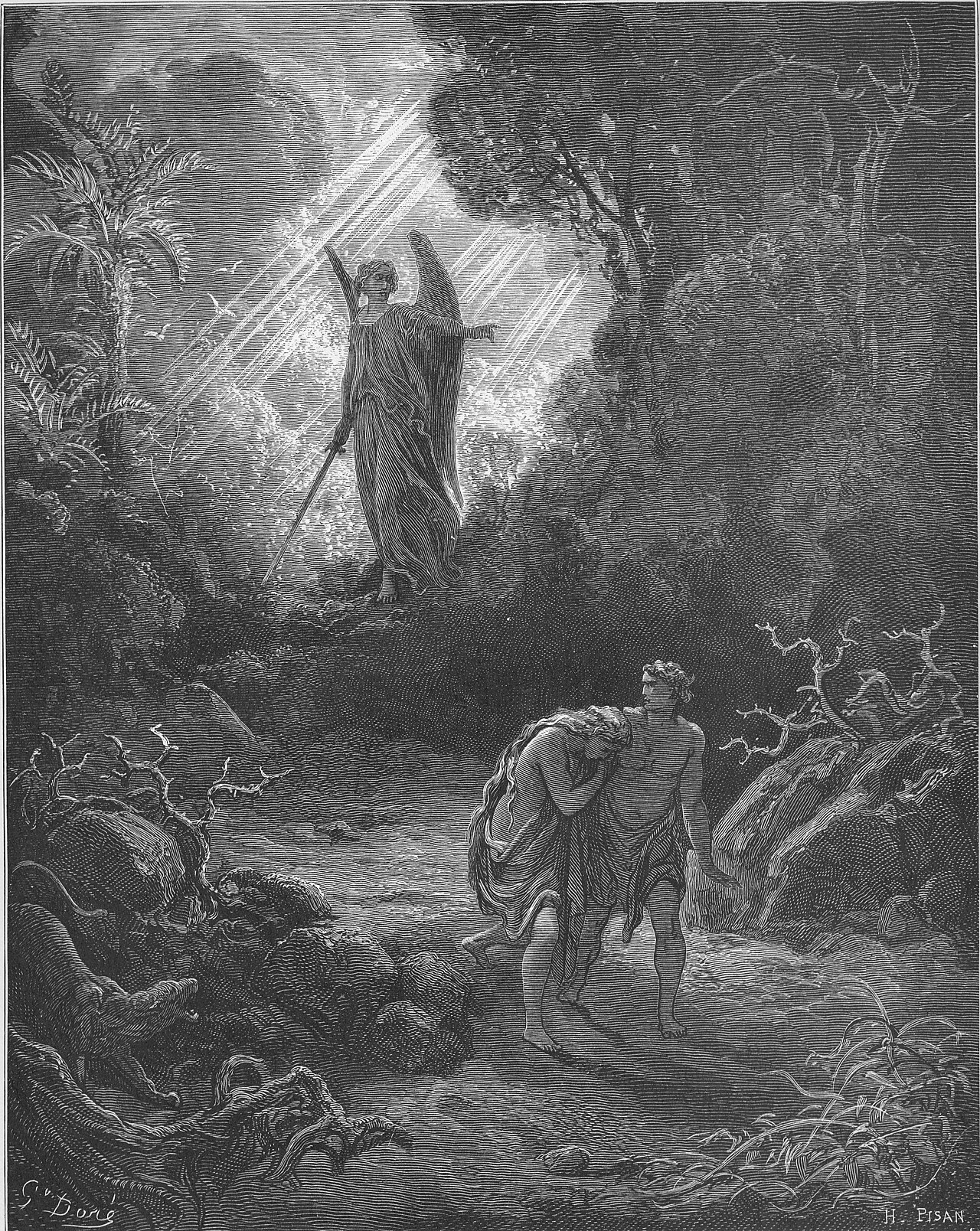
Genesis 3 is not a parable about growing up. A real command was given, a real serpent spoke, a real choice was made, and everything changed.

The temptation's shape is worth studying because it has never been improved on. First the question — "Yea, hath God said?" — which does not deny God's word, only loosens it. Then the flat contradiction: "Ye shall not surely die." Then the motive supplied: God is holding out on you, and you can be as gods, knowing good and evil. Doubt, denial, and then the accusation that God cannot be trusted with your happiness.

And the sin itself is small. A piece of fruit. That is exactly the point — the issue was never the nutritional content of a tree. It was whether the creature would take from the Creator the right to define good and evil.

What follows immediately is a map of everything that has gone wrong since: shame, hiding, blame passed to the wife and then to God who gave her, a broken relationship with the ground, pain, and exile from God's presence. Nothing in that list has changed.

The damage reached the whole race — and the whole creation.

Paul: "by one man sin entered into the world, and death by sin; and so death passed upon all men." Not a bad example that people imitated. Something transmitted.

And it did not stop at people. Romans 8 says the creation itself was subjected to vanity, groaning together in pain until now, waiting for the revealing of the sons of God. The stewards fell, and the estate fell with them. Every earthquake, every predator, every wasted field is part of a world that is not the way it was made.

That has a hopeful edge people miss. The creation is groaning because it is not dead — the groaning is the sound of something waiting to be delivered. Paul explicitly calls it the pain of childbirth, not of dying.

Everyone sins. There are no exceptions and no gradations that matter at this level.

"For all have sinned, and come short of the glory of God." Paul has spent nearly three chapters arriving at that sentence, working through the openly pagan, the morally respectable, and the religious, and closing every exit in turn.

The standard is what makes this universal. Not the average person's behavior — the glory of God. Measured against each other, people spread out over a wide range. Measured against that, the range collapses to nothing, which is why the passage says there is no difference.

John says it too, and takes away the last exit: "If we say that we have no sin, we deceive ourselves, and the truth is not in us." Claiming to be the exception is itself listed as one of the symptoms.

Sin pays wages, and the wage is death.

Paul chose the word carefully. Wages are earned. They are not a disproportionate punishment imposed by an angry God; they are what the work pays out.

Death in Scripture is more than the heart stopping. It is physical — the body returns to dust. It is spiritual — separation from God, which is what Adam experienced the same day, though he lived on for centuries. And Scripture speaks of a second death beyond it.

The verse does not end there, and it must never be quoted as though it does: "For the wages of sin is death; but the gift of God is eternal life through Jesus Christ our Lord." One side is wages, earned. The other is a gift, free. That contrast is the hinge of the entire Bible.

Where Christians divide

On each of these, MannaFest’s own answer comes first and is not hedged. Then every serious alternative is set out the way the people who hold it would set it out. If you hold one of these and think it is put unfairly here, that is a failure on our part — tell us.

Are we born sinners, or do we become them?

What MannaFest holds

MannaFest holds the Wesleyan answer: we are born with a real inherited corruption. Every part of a person is affected by it and nobody can climb out unaided. But God does not leave anyone there — prevenient grace, grace that goes ahead of us, is already at work in every person, restoring enough freedom to respond to the gospel. So the diagnosis is as severe as the Reformed one, and the door is genuinely open.

The corruption is inherited and real. David says he was shapen in iniquity and conceived in sin — not that his mother sinned in conceiving him, but that he was of this stock from the start. Paul says we were by nature children of wrath. Wesley preached original sin as bluntly as any Calvinist: in his sermon on the subject he insisted the natural man is "altogether corrupt" and that anyone who denies it is still a heathen at heart. Wesleyans are not soft on this.

It is total in extent. Mind, will, affections, conscience, body — nothing is untouched. The corruption is not confined to appetite or to the flesh in the physical sense; it reaches the highest faculties, which is why religion itself can be an instrument of sin.

But God has moved first, in everyone. This is the doctrine that makes the Wesleyan position what it is. Prevenient grace — grace that goes before — is given to all through Christ, and it awakens conscience, gives some light, and restores enough freedom that a person can say yes or no to the gospel. Nobody is saved by it; everybody is enabled by it. John 1:9 speaks of the true Light which lights every man that comes into the world. Titus 2:11 says the grace of God that brings salvation has appeared to all men.

So natural free will, in Wesley's own careful phrase, does not exist. Every ability to respond is itself grace. Wesley wrote that he did not carve out any natural freedom, but only "what grace has restored." That single sentence is the whole difference between Arminianism as Wesley taught it and the do-it-yourself religion it is often mistaken for.

On guilt: MannaFest holds that we inherit a corrupt nature, and that inherited guilt for Adam's personal act is answered at the cross for all — Romans 5 says the free gift came upon all men to justification of life. What each person will answer for is their own sin, committed with the light they were given.

The Augustinian / Reformed view — inherited guilt as well as corruption

Augustine, *On the Merits and Forgiveness of Sins*; the Council of Orange (529); Calvin, *Institutes* II.i; the Westminster Confession ch. 6; the Canons of Dort; Jonathan Edwards, *Original Sin*; R. C. Sproul.

Adam was the covenant head of the human race. When he sinned, he sinned as our representative, and so his guilt is reckoned to us as well as his corruption inherited by us. Every person enters the world both guilty in Adam and morally unable to turn to God. Only sovereign, effectual grace changes that — and God gives it to those he has chosen.

  • Romans 5 is a parallel of two representatives, and it will not stay one-directional. If Christ's righteousness is credited to those who did not earn it, then the parallel Paul is drawing means Adam's sin is credited to those who did not personally commit it. The Reformed reading takes the symmetry seriously; softer readings tend to keep the half they like.
  • Verse 12's final clause — "for that all have sinned," in the aorist — most naturally points to a completed past act rather than to each person's ongoing sinning, which fits corporate solidarity in Adam.
  • It explains infant death. Infants die, and death is the wage of sin. If they have committed no personal sin, something must account for their standing under death.
  • Ephesians 2:3, "by nature the children of wrath," puts wrath and nature in the same clause — not wrath incurred by later choices.
  • It gives the most God-exalting account of grace: if we were dead, then salvation is resurrection, and no one contributes to their own resurrection.

The honest difficulty: It must explain how a person can be justly guilty for an act committed before they existed, and Ezekiel 18 states flatly that the son shall not bear the iniquity of the father. Federal-headship answers exist and are serious, but the objection is not frivolous. It also carries the weight of the whole election question, taken up in the next locus.

The Eastern Orthodox view — inherited mortality, not inherited guilt

The Greek fathers broadly; John Chrysostom; Athanasius, *On the Incarnation*; Timothy Ware, *The Orthodox Church*.

What Adam passed on is death and the corruption that flows from it, not guilt. Humans are born mortal and weakened, and mortality drives us to sin — but no one is born guilty of another's transgression. Salvation is being healed and made partakers of the divine nature, not primarily a courtroom acquittal.

  • Romans 5:12's crucial phrase, *eph' ho*, was rendered in Latin as "in whom all sinned," which is how Augustine read it — but the Greek most likely means "because" or "inasmuch as." Death spread to all *because* all sinned. That is a translation-history fact, not a modern dodge, and it undercuts the strongest Western proof text.
  • Ezekiel 18 and Deuteronomy 24:16 both deny inherited guilt in explicit terms.
  • It takes seriously that Scripture's dominant image for sin is sickness, slavery, and death — conditions to be healed and broken — not only a debt to be paid.
  • It gives a straightforward account of infants without requiring either inherited guilt or a special exemption.

The honest difficulty: It can under-read how deep the biblical language of corruption goes — 'dead in sins' is stronger than 'weakened' — and the Western tradition asks fairly whether mortality alone explains the universality and stubbornness of sin.

Pelagianism — declined, but stated as it was actually taught

Pelagius, a fifth-century British ascetic, and his follower Julian of Eclanum; condemned at Carthage (418) and Ephesus (431).

Every person is born in the same condition Adam was created in: morally neutral, fully able to choose good or evil. Adam's sin harmed us by bad example, not by transmission. Sin is always an act of the will, never a nature, and God would not command what a person cannot do.

  • Its motive was moral seriousness, not laxity. Pelagius was reacting against Christians who used their supposed inability as an excuse to stay as they were, and he had watched it corrupt the church in Rome.
  • Its argument has force: God's commands imply the ability to obey them, or the commands are unjust. This is a genuine philosophical point that every other view has to answer.
  • It insists that sin is chosen, which protects both individual responsibility and God from being the author of a nature that cannot help sinning.

The honest difficulty: Scripture does not describe humanity as neutral. It says the heart is deceitful, that none seeks God, that we are dead in sins and by nature children of wrath. And the empirical record is against it: if every person begins neutral and able, the universal outcome is inexplicable. Most decisively, it makes grace an aid to the willing rather than a rescue of the dead — and the church rejected it, at Carthage and again at Orange, on exactly that ground. MannaFest declines it with the whole church.

What does 'total depravity' actually mean?

What MannaFest holds

It does not mean people are as bad as they could possibly be. It means sin has reached every part of a person — mind, will, feelings, conscience — so that no faculty is left clean enough to reach God on its own. And here is the part most readers do not expect: MannaFest, from a Wesleyan-Arminian position, agrees with Calvinists about this almost entirely. The disagreement in the next locus is about what God does next, not about how bad the problem is.

"Total" describes extent, not intensity. Every part is affected; no part is as affected as it could be. A drop of ink in a glass of water reaches all of it without making it ink.

This is why people are frequently decent. Unbelievers love their children, keep their promises, run into burning buildings, and give away money. Christians who talk as though the unsaved are monsters are contradicting the doctrine as well as the evidence. Theologians have long called this common grace — God restrains evil and pours out real gifts on everyone.

What total depravity denies is not human decency but human self-rescue. Not one of those good acts amounts to seeking God, and none of them removes guilt. Isaiah's line about righteousnesses as filthy rags is about our best offerings, not our worst.

And here is the ecumenical fact worth stating loudly, because it saves a great deal of pointless argument: the Arminian Articles of Remonstrance in 1610 conceded this. Arminius himself wrote that the free will of man is "imprisoned, destroyed, and lost" toward any true good without grace. Wesley said the same. When a Calvinist and a Wesleyan argue about the letter T in TULIP, they are usually agreeing and not noticing. The live disagreement is over what grace does about it — whether it enables everyone to respond, or effectually saves the chosen.

Total depravity with irresistible grace as its remedy

The Canons of Dort (1618-19); the Westminster Confession ch. 9; the Reformed tradition generally.

Depravity is total and its consequence is total inability. Since a dead man cannot cooperate in his own resurrection, the grace that saves must be effectual — it regenerates first, and the person then believes as a result.

  • It follows the logic of 'dead' consistently. Corpses do not meet God halfway, and Ephesians 2:1 chose that word.
  • John 6:44 — no man can come unless the Father draw him — and the observation that in John 6:37 all whom the Father gives do in fact come.
  • It leaves no room for boasting whatsoever, which Ephesians 2:9 says is the point.

The honest difficulty: The step from 'no one can come unaided' to 'the aid is given only to some and cannot be refused' is a further move, and it must reckon with Acts 7:51, where Stephen tells his hearers they always resist the Holy Ghost.

Total depravity with prevenient grace as its remedy — the Wesleyan-Arminian view

Jacobus Arminius, *Works*; the Articles of Remonstrance (1610); John Wesley, Sermon 85, 'On Working Out Our Own Salvation'; Thomas Oden, *John Wesley's Scriptural Christianity*.

Depravity is total, and so is natural inability. But God gives prevenient grace to all, which restores the capacity to respond without compelling the response. What a person does with that grace is genuinely theirs.

  • It agrees with the Reformed on the diagnosis and differs only on the distribution of the cure, which is a smaller gap than most people assume.
  • It accounts for the universal offer of the gospel and for the commands to repent addressed to everyone.
  • It makes resistance intelligible: Stephen's charge in Acts 7:51 assumes the Spirit can be resisted by those he is working on.

The honest difficulty: Critics ask what prevenient grace is, exactly, and where Scripture teaches it as a distinct category rather than as an inference. The texts cited — John 1:9, Titus 2:11, John 12:32 — are suggestive rather than explicit, and Wesleyans should say so.

Are some sins worse than others?

What MannaFest holds

Yes — in consequence, in guilt, and in the judgment they receive. And no — in the one respect that matters for salvation: any sin is enough to separate a person from God, and no sin is too great for the cross. Both halves are biblical, and dropping either one does real damage.

Scripture plainly grades sins. Jesus told Pilate that the one who delivered him had the greater sin. He said it would be more tolerable for Sodom in the day of judgment than for Capernaum. He warned that the servant who knew his master's will and did not do it would be beaten with many stripes, and the one who did not know with few. The Old Testament distinguished unintentional sin, which had a sacrifice, from sin committed with a high hand, which did not.

Guilt tracks light received. This is why the same act is not equally culpable in every person, and why teachers receive the greater condemnation.

The equalizing half is about sufficiency, not equivalence. James says that whoever keeps the whole law and offends in one point is guilty of all — one break puts you on the wrong side of the line, however small the break. That is why a decent person needs a savior as truly as a monstrous one does.

Why both halves matter: drop the grading and you get a flattened moral world in which impatience and genocide are the same, which is obviously false and makes the church sound absurd on public questions. Drop the equalizing and you get a scoreboard, and everyone finds someone below them to feel safe next to. The gospel takes away the scoreboard without taking away moral seriousness.

One note on 1 John 5:16, which is genuinely difficult: John distinguishes a sin "not unto death," for which a believer should pray, from a "sin unto death," about which he does not say to pray. Interpretations vary — physical death as divine discipline, as with the Corinthians who misused the Lord's table; or a decisive apostasy. John's restraint is notable: he does not forbid prayer, he simply declines to command it. MannaFest declines to be more precise than the apostle was.

Mortal and venial sins

Roman Catholic moral theology; the Catechism of the Catholic Church §§1854-1864, drawing on 1 John 5:16-17.

Mortal sin — grave matter, committed with full knowledge and deliberate consent — destroys charity in the heart and cuts a person off from sanctifying grace. Venial sin wounds but does not sever. The distinction determines the pastoral remedy.

  • It is drawn directly from 1 John 5:16-17, which does distinguish a sin unto death from one that is not.
  • It preserves the biblical grading with real pastoral machinery attached, and it takes seriously that some sins are catastrophic in a way others are not.

The honest difficulty: Protestants argue the categories became more precise than the text warrants, and that in practice the system can produce either scrupulosity or a checklist conscience. But the underlying observation — that not all sins are equal — is one MannaFest shares.

All sins are equal before God

A common view in popular Protestant preaching, usually built on James 2:10 and Matthew 5:21-28.

Any sin makes a person a lawbreaker and separates them from God, so before God there is no meaningful difference between them.

  • James 2:10 really does say that one offense makes a person guilty of the whole law.
  • Jesus levels anger with murder and lust with adultery, which forecloses the self-congratulation of the outwardly respectable — the very move he was attacking.
  • It protects the truth that no one may look down on anyone else, which is the pastoral instinct behind the position.

The honest difficulty: It over-reads texts about sufficiency into claims about equivalence, and it collides with Jesus' own explicit gradings — greater sin, more tolerable, many stripes and few. It also leaves a church unable to say that abuse is worse than gossip, which it must be able to say.

What is the unforgivable sin — and have I committed it?

What MannaFest holds

The short answer first, because this question keeps people awake: if you are afraid you have committed it, you almost certainly have not. That fear is itself evidence against it. The person who blasphemes the Spirit in the sense Jesus meant is not tormented about it — they have settled into calling God's work evil and have stopped caring. Anguish over sin is the Spirit at work in a person, and the Spirit does not work in someone he has abandoned.

Look at what was actually happening. Jesus had just cast out a demon. The scribes, watching an obvious work of God's mercy, said he did it by Beelzebub. Mark tells us exactly why Jesus said what he said next: "because they said, He hath an unclean spirit." They looked straight at the Holy Spirit delivering a suffering man and called it satanic — not from confusion, but to protect their position.

So the sin is not a word said in anger, a blasphemous thought that intrudes during prayer, a season of doubt, a period of rebellion, or a sin repeated after promising not to. It is a settled, knowing, final attribution of the Spirit's work to the devil — a hardening so complete that repentance is no longer wanted.

Why it cannot be forgiven is worth understanding, because it makes God's character clear rather than obscure. It is not that God's mercy runs out. It is that the Spirit is the one who brings a person to repentance, and a person who has decisively rejected him has refused the only door in. The lock is on the inside.

The pastoral rule, stated as plainly as MannaFest knows how: nobody who wants to be forgiven has committed it. Wanting forgiveness is something the Spirit produces. If you are reading this with a knot in your stomach, that knot is the evidence you need. Come to Christ; the invitation is still open, and he said he would in no wise cast out anyone who comes.

Spurgeon, who pastored many people through this exact terror, gave the same counsel: the very fear of having committed the unpardonable sin is proof that one has not, since those who commit it have no such fear. Take that from a man who was no stranger to darkness himself.

It was a sin possible only in Jesus' earthly ministry

A number of dispensational interpreters; some conservative commentators noting the specificity of the setting.

The sin required seeing Christ's miracles in person and attributing them to Satan. Since no one today witnesses his works in the flesh, the sin in its precise form cannot now be committed.

  • The context is extremely specific — a particular miracle, a particular accusation, particular accusers standing in front of the incarnate Son.
  • It offers the most direct pastoral comfort to the terrified, and the terrified are most of the people who ask.

The honest difficulty: It may be too neat. Hebrews 6 and 10 describe a hardening with no way back for people who were not eyewitnesses of the Galilean ministry, which suggests a continuing category of some kind.

It is final, settled unbelief — the state, not a single act

Augustine; Calvin, *Institutes* III.iii.21-22; Matthew Henry; the majority view across the tradition.

The unforgivable sin is persistent, knowing, willful rejection of the Spirit's testimony to Christ, carried to death. It is unforgivable because it refuses the only means by which forgiveness is received.

  • It accounts for why Jesus attaches finality to it while elsewhere forgiving every kind of sinner, including those who mocked and killed him.
  • It matches Hebrews 6:4-6 and 10:26-29, where the impossibility is of *renewing them again unto repentance* — the problem is located in the hardened will.
  • It explains without contradiction why anyone still capable of repenting is by definition not in this state.

The honest difficulty: It can be misapplied by anxious people who mistake struggle for settledness, which is precisely why it must always be taught with the pastoral answer attached and never as a bare warning.

Go further

Sources: Augustine, *On the Merits and Forgiveness of Sins and on Infant Baptism* (public domain) · Augustine, *Confessions* II, on the stolen pears — sin desired for its own sake (public domain) · The Council of Orange (529), canons against Pelagianism (public domain) · John Calvin, *Institutes of the Christian Religion* II.i–iii, on original sin and bondage of the will (public domain) · Jacobus Arminius, *The Works of James Arminius*, Public Disputation XI, on the free will of man (public domain) · The Articles of Remonstrance (1610), Articles III–IV (public domain) · John Wesley, Sermon 44, 'Original Sin' (public domain) · John Wesley, Sermon 85, 'On Working Out Our Own Salvation' — prevenient grace (public domain) · Jonathan Edwards, *The Great Christian Doctrine of Original Sin Defended* (1758) (public domain) · Matthew Henry, *Commentary on the Whole Bible*, on Genesis 3 and Romans 5 (public domain) · Charles Spurgeon, sermon 'The Unpardonable Sin' (No. 167, 1857) (public domain) · John Chrysostom, *Homilies on Romans*, Homily X on Romans 5 (public domain) · Leonard Ravenhill, *Why Revival Tarries* — cite only, ≤50 words · R. C. Sproul, *Chosen by God* — cited as the Reformed case, cite only, ≤50 words · Thomas Oden, *John Wesley's Scriptural Christianity* — cite only, ≤50 words · Timothy Ware, *The Orthodox Church* — cited as the Eastern view, cite only, ≤50 words Every cited work — the sources registry →